
It works really well, until it suddenly doesn’t.
By Wolf Richter for WOLF STREET.
The size of the repo market has ballooned to over $13.5 trillion in outstanding agreements daily, according to the government’s Office of Financial Research (OFR). Via the repo market, financial institutions borrow from, and lend to, each other mostly overnight, but also for longer periods, such as for one week, secured by high-quality liquid collateral with a “haircut.”
About 70% of repos are secured by Treasury securities. The rest are secured by agency securities, such as MBS issued by government-sponsored enterprises (GSEs Fannie Mae and Freddie Mac), and also high-grade corporate bonds and Asset-Backed Securities (with a bigger haircut, the bigger the risk, the bigger the haircut).
Some institutions lend cash to the repo market for the yield and liquidity, such as money market funds. Others lend cash to the repo market to borrow Treasury securities they need for margin requirements on other trades, such as hedge funds. Others borrow cash from the repo market to lever up financial positions or trades or for other reasons. Dealers act as intermediaries between lenders and borrowers.
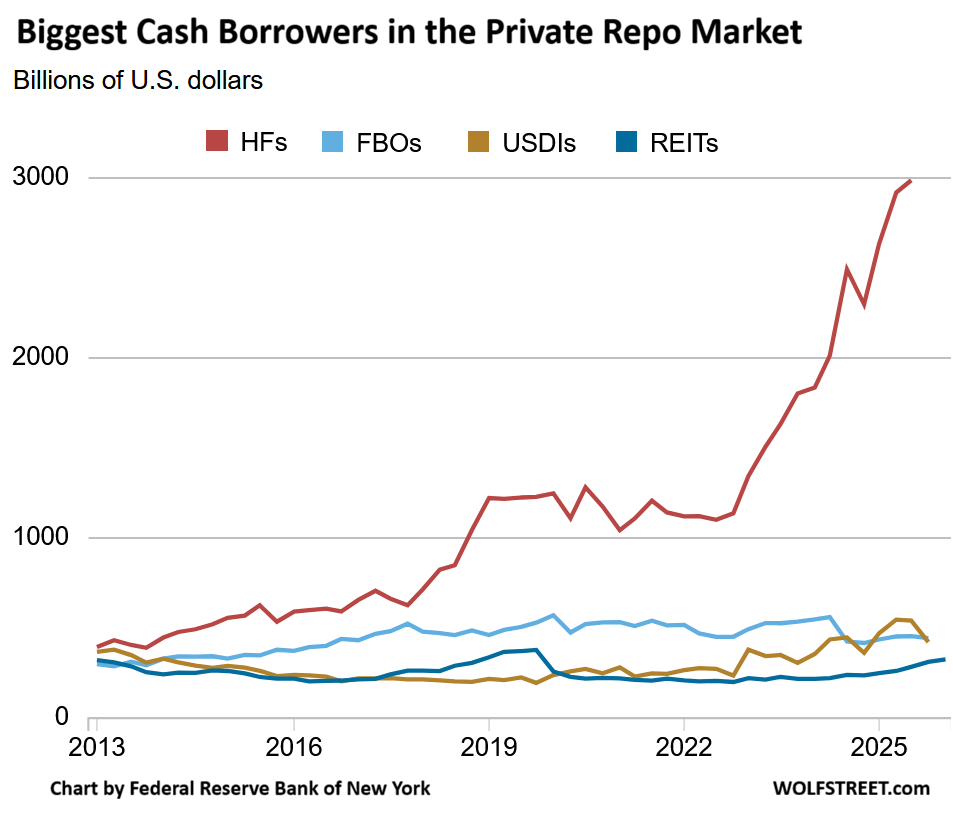
An analysis by the New York Fed today outlines who the biggest borrowers and lenders in the repo market are.
Biggest cash borrowers in the repo market: Hedge Funds.
Far ahead: Hedge funds (HFs) engaged in the “basis trade” borrowed $3.0 trillion in the repo market as of July 2025, up from $2.5 trillion in July 2024, $1.1 trillion in July 2022, and $664 billion in July 2017, according to the New York Fed’s analysis today (top red line in the chart below).
With the “Treasury cash-futures basis trade,” hedge funds purchase Treasury securities and sell Treasury futures contracts, thereby profiting from the spread between them. But the spread is small, so they lever up their strategy by borrowing cash in the repo market, and putting up the Treasury securities as collateral, thereby multiplying their returns through vast amounts of leverage.
Hedge funds in the basis trade provide liquidity in the Treasury market, as they’re big leveraged buyers of Treasury securities.
But when the basis trade encountered a rough spot in March 2020, and hedge funds had to unwind some of their positions, the Treasury market locked up. The effort to untangle this issue was one of the reasons the Fed cited for its massive Treasury purchases in March 2020.
The Fed has cited hedge funds, with their vast leverage and dense opacity, as a primary risk to financial stability, and they didn’t disappoint in March 2020, and again came to the Fed’s attention for their part in the repo market blowout in the fall of 2019.
Far behind, the next 3 largest borrowers: US branches and agencies of “Foreign Banking Organizations” (FBOs) at $445 billion; US banks (US Depository Institutions or USDIs) at $422 billion; and Real Estate Investment Trusts (REITs), especially mortgage REITs, at $313 billion, as of October 2025, for a combined $1.2 trillion.
Chart via the New York Fed, sources: OFR, Federal Financial Institutions Examination Council (FFIEC), and the St. Louis Fed’s FRED database.
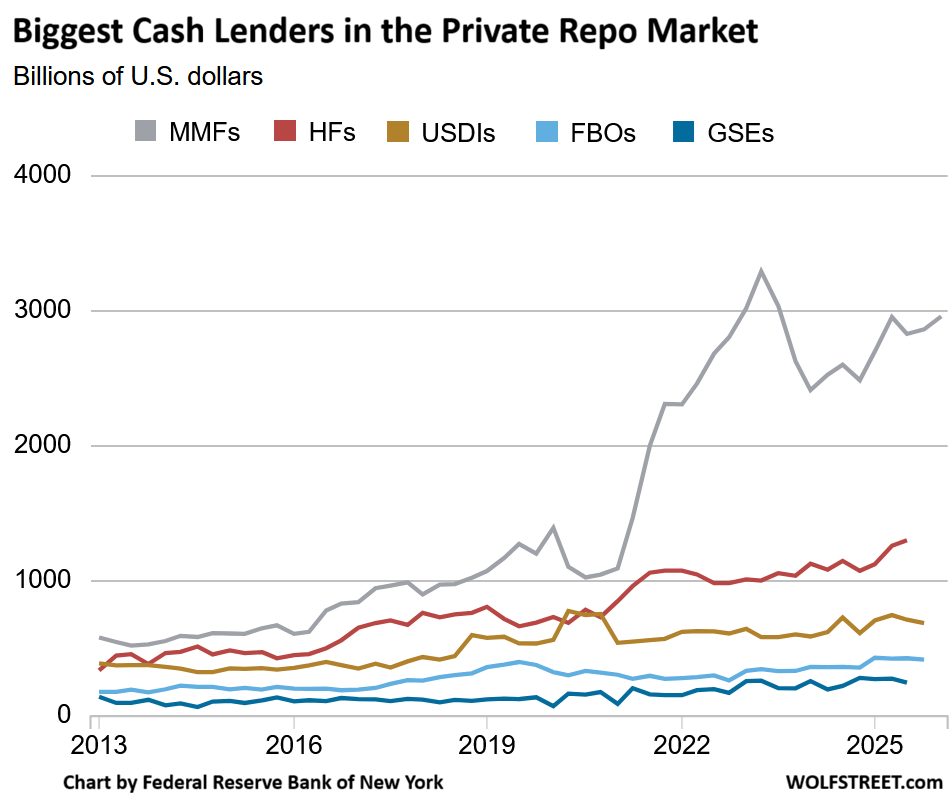
Biggest cash lenders in the repo market: money market funds.
Far ahead: Money market funds (MMFs) lent $3.0 trillion to the repo market as of January 2026, having tripled from July 2020. The high occurred in April 2023 at $3.3 trillion (top gray line in the chart below).
Lending to the repo market provides MMFs with short-term investments, including overnight with next-day liquidity, in high-grade securities, backed mostly by Treasuries. Overnight repos allow MMFs to manage their redemptions while keeping their cash invested.
Total MMF balances rose by nearly $1 trillion over the past 12 months, to $8.4 trillion in Q2 2026, including a record $5.1 trillion held by households, and a substantial portion of that was invested in the repo market.

Far behind: Hedge funds (HFs) lent $1.3 trillion to the repo market as of July 2025 (red in the chart below), in part to invest short-term their otherwise uninvested cash; and in part for “collateral transformation” purposes through a dealer where they in effect borrow Treasury securities from the repo market that they then post as collateral, such as to meet strict margin requirements for derivative trades. Hedge fund leverage is multi-layered and complex.
On net, hedge funds are far bigger borrowers from the repo market ($3.0 trillion), than lenders to the repo market ($1.3 trillion), with net borrowing amounting to about $1.7 trillion at that time.
Further behind: US banks (USDIs: $689 billion, brown line, as of October 2025); US branches of foreign banks (FBOs: $419 billion, light blue line, as of October 2025), and the GSEs ($249 billion, dark blue line, as of July 2025):
Chart via the New York Fed, sources: OFR, Federal Financial Institutions Examination Council (FFIEC), and the St. Louis Fed’s FRED database.
The $13.5 trillion repo market interconnects a large spectrum of financial institutions, including dealers, banks, hedge funds, money market funds, and the GSEs, through short-term cash and collateral exchanges.
Due to the repo-market interconnectedness and vastness, liquidity problems in one corner of the repo market – visible when repo rates, such as SOFR, soar – can spiral out into the rest of the financial system in no time.
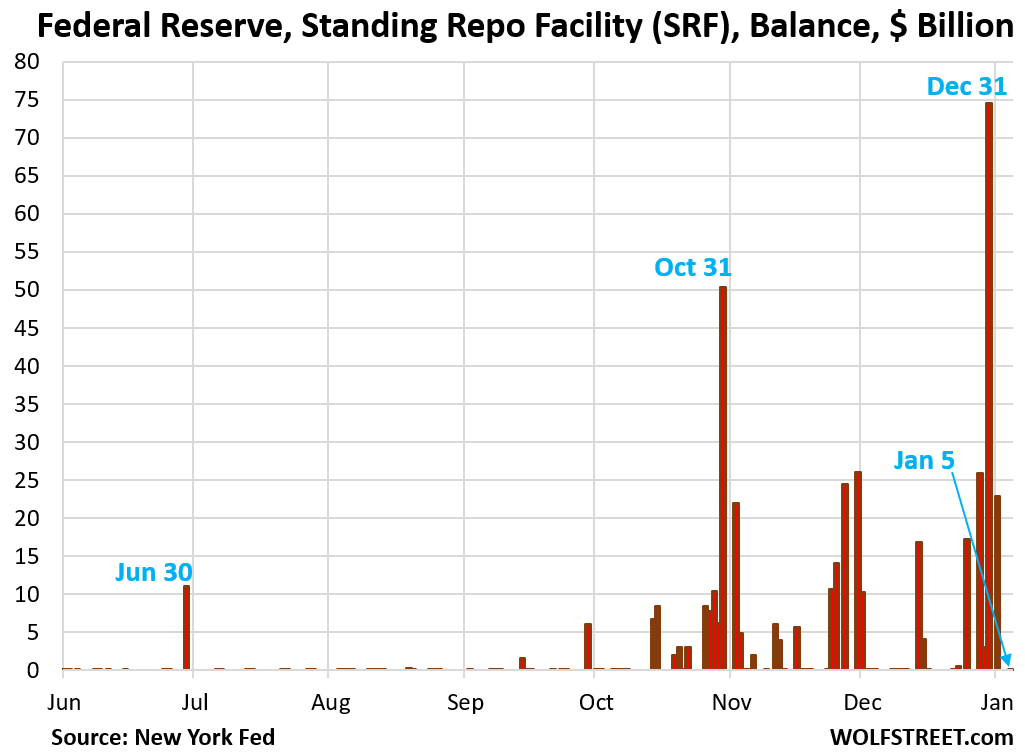
To tamp down on liquidity issues before they spiral out into the financial system, the Fed set up its Standing Repo Facility (SRF) in July 2021, where approved banks can borrow from the Fed at its SRF rate (4.0% since the rate hike on Sep. 16) and a haircut to lend to the repo market to profit from the spread and bring down repo rates again in the process, which is what they did during the repo market squiggles in September through December 2025, that might have spiraled out into the financial system otherwise:
Enjoy reading WOLF STREET and want to support it? You can donate. I appreciate it immensely. Click on the mug to find out how:


Looks a little ominous. Are HFs creating liquidity in their own strategies anticipating a flight from risk shortly or is a leveraged carry trade becoming more attractive with the Treasury curve steepening? A couple rate hikes in the near future would pose more of a bullish flattening on the long end, no?
Good stuff, it’s all coming together for the plunge, even though with the repo market being available to provide liquidity. Last week we had Jamie D start the Monday rally with confirmation about upcoming 1 T is AI spending. Today Jeffries said 9k SP 500 target(bad call at the top or just calling in the last of the retail mania to unload to) and NVDA 150B buyback biggest buyback ever, Nvda will be unable to close at a new high, it’s a long way down from the top. Junk bonds confirmed the equity crash, just a little delay to allow smart money to unload to retail traders from around the world here in our markets.
Part of the boost to stocks recently is that earnings have skyrocketed. They’re up 50% in 2 years, and up 25% in the first 6 months of 2026 alone. That dropped the P/E ratio to just 25
Of course, something similar did happen in 1999, so there’s that.
Yeah the problem with that is that their earnings are so dependent on the economy as a whole. BigTech is making money from everyone, so if we enter even a mild recession, their profits will plunge, in my opinion, as their customers will drastically reduce spending.
Stock market is bloated by the richer, all forms of PE are even bloateder by the even richer-richer.
Still…..all is excessive creative finance/accounting……by “smart” MBAs….usually with Law degree kicker….and lotsa money votes.
Greedy moron prez really helps them, too.
Yes, I am acute TDS sufferer since watching the “Escalator descending from someplace on high to our level” show…and then the speech finished me off.
Good article…..stock market is just a smaller casino in this burg.
Repo never dies. The Fed is always there. Have been a former Repo broker I would not fret one second over it.
Bernanke went to work at Citadel after his Fed Chairmanship. The revolving door appears to spin like a turbine. Wall Street has shaped monetary policy to be quite lucrative to itself.
I suspect the lack of “forward guidance” is largely for retail. I suspect Jamie and Ken have suffered no interruption of the information flow.
When institutions purposely keep the population ignorant it is to protect their interests and not the publics…inflate, deflate and consolidate rhymes so nicely…if people actually understood where to look, ouch wouldn’t that be a thing to behold… Institutional control reinforces the narrative over, over, over again like it’s all a competitive game…that’s funny. Nobody elected the Federal Reserve and they can also be removed by a strong executive…it’s been done before…maybe they have an event and it happens again…
And here I am working for a living.
Mandatory participation or you starve in a free society… 😅😂…but they give us fake and phoney scripts across all extracting institutions by their actors…it’s on TV it must be real…it’s real because we tell you to believe it’s real….funny, if it’s so real why the constant reinforcement ad nauseum of fake and phoney…a little insecure my institutional over lords…
Just what is the purpose of any of this nonsensical borrowing?
I always understood it to be to cover very short-term liquidity requirements for banks to settle outstanding cash deficiencies at the end of the day. Obviously I was confused or maybe I’m a simpleton.
A lot of it is pure greed. Like every cycle where greed dominates reason, there will be players who execute and those that don’t. I think there will be at least 1 big hedge fund go under between now and year-end.
the bailout of LTCM set a terrible precedent.
The Fed continues to enable very bad behavior.
“round and round it goes; where it will stop nobody knows”.
Dow, S&P 500 and Nasdaq drop as 10-year Treasury yield climbs above 5.2%
re markets:
Today, I listened to a CNBC host say Oracle was at junk bond.
AI says “No, Oracle’s bonds are not officially junk yet, but they are trading at high-yield (junk) prices and sit just one notch above junk status”
And the rate of needed money continues to rise.
Robin Williams is back. Nano Nano bank closed. Probably a one off though.
Minuscule bank. There are several each year that get shut down.
That Hedge Fund line in the chart makes me think a lot of that money is being used for “extend and preted”, given the key dates of the slope changes in the chart. And that is almost all leveraged money, so when it blows up as interest rates rise another 1% to 2%, it will be spectacular.
This one has nothing to do with extend and pretend. It’s the image of the ballooning highly leveraged basis trade that the Fed is worried about.
Wolf says:
“The Fed has cited hedge funds, with their vast leverage and dense opacity, as a primary risk to financial stability, and they didn’t disappoint in March 2020, and again came to the Fed’s attention for their part in the repo market blowout in the fall of 2019.”……….
“Hedge funds (HFs) engaged in the “basis trade” borrowed $3.0 trillion in the repo market as of July 2025, up from $2.5 trillion in July 2024, $1.1 trillion in July 2022, and $664 billion in July 2017”
Make your own conclusion what is ahead to our financial stability given this exponential increase in borrowing with high leverage and opacity.
As a professor/researcher in system theory, all I can say is that these models are highly unstable meaning they can blow up at any time.
We have seen this in 1987, 1999, 2019, 2020 etc. and we are seeing this in Gen. AI training (which again based on training techniques which are inherently unstable). It is not that AI is escaping etc. They are just stochostic adaptive algorithms written by human beings and adaptability simply means it can converge (stable) or diverge (unstable).
Is a big part of the “basis trade” the Yen-Dollar carry trade? What else does this term refer to?
Wolf,
Thanks for the great explanation of this process. Since the largest contributor of cash to the repo market is MM funds, what would occur if that revenue were to significantly decline?
Repo market rates would surge to maybe 4.2% or 4.5% from below 4% now (given current short-term rate environment), and banks would borrow heavily at the SRF at 4% and lend to the repo market at 4.2% or 4.5%, and pocket the differences… that’s a lot of spread for a quick, near risk-free trade. Which would bring the repo rates back down toward 4%. That’s what the SRF is for.
Reminds me of just before the GFC crash:
As David A. Stockman, in his book, pg. 23: “The Great Deformation” put it: the Fed’s monetary transmission mechanism, interest rate manipulation, “fueled massively leveraged carry trades”. “Using CDS to avoid capital requirements”, transformed CDOs into “AAA rated blue-chip credits”. “The giant ultra-leveraged hedge funds” (investment banks) held assets “which were illiquid, longer-term, and subject to credit and market value risk”
“Due to this *credit* and *duration* mismatch, the profit spread per-dollar of assets was considerable, and when harvested a trillion times over, total profits were enormous”.
E.g., “ultra-cheap CP (commercial paper) funding also bore short maturities, meaning that GE Capital had to rollover billions of commercial paper debts day-in and day-out.”
…”these firms had become voracious consumers of “wholesale” money market funds, mainly short-term repo loans and unsecured commercial papers. From these sources, they had erected trillion-dollar financial towers of hot-money speculation.”
“on the eve of the financial crisis, Goldman had asset footings of $1.1 trillion and Morgan Stanley had also passed the trillion-dollar mark. Much of their massive wholesale funding, however, had maturities of less than thirty days, and some of that was as short as a week and even overnight.
When Bear Sterns hit the wall in March 2008, for example, it was actually rolling over $60 billion of funding every morning – until, suddenly, it couldn’t”
Wait a minute. You’re lumping unsecured lending (such as GE’s commercial paper and Bear Sterns’ interbank funding and some of the instruments Stockman mentioned) together with secured lending (repos).
Unsecured interbank lending was huge before the Financial Crisis and was one of the mechanisms by which contagion spread from bank to bank during the Financial Crisis because banks stopped lending to each other, such as to Bear Stearns, when they had even slight doubts because their loans were unsecured. This caused funding to suddenly dry up for banks, and they began to collapse.
Today, there is nearly no unsecured interbank lending anymore outside of the FHLBs and some foreign entities. The banking system has switched to repos which are secured by good collateral, and to borrowing from the Fed if they need to, which is also secured. This shift to secured borrowing has removed one source of contagion from the banking system and has made it substantially less fragile.
Question is what FED is doing about Hedge Funds % in Repo Markets have gone exponential in last decade. If they alone go alone Bankrupt no one will care. But that never happens. They sure are increasing the risk and ultimately cause Financial instability.
Or FED is just waiting for bad stuff to happen so they can do QE again.
Not sure about the Fed but the US treasury loves it, they sell T bills and bonds to hedge funds and than it gets deposited at the repo window by hedge funds for cash and the hedge fund takes the cash and buys more t bills and bonds and than takes them to the repo window for cash ; rinse wash and repeat until the hedge funds have giant leverage positions. Basis trade can have leverage of 30X or even 50 x. It’s financial engineering to sell US debt. Plus you got the growing stable coins industry of 300b that buys T bills to back their stable coins industry with 85% backed by T bills and this is also growing buyers of US debt maybe not in size yet but it’s velocity of change(growth) as real potential to sell more debt. The house that Besset runs the US treasure is in cahoots with casinos(hedge funds) to sell debt and place the risk at the Fed window. The Fed takes a haircut on the cash they lend out to protect against risk, but not enough for big tail risk events. It’s Crazy and encourage because the bonds salesman(the US treasury) gets the job done.
It’s (The basis trade) almost can be described as monetizing the debt with a little help from our willing friends the hedge funds. Until the size of the trade goes into reverse and leverage ratio drop and hedge funds pull their collateral out of repo window and return cash. That’s why the repo window is so important to watch. It’s a leverage machine
The Fed’s SRF (if that’s what you refer to “repo window”) was briefly used last fall, as show in the last chart in the article. The last time there was any meaningful borrowing at all was a one-day shot on Tax Day April 15 ($10 billion). Before then, there was one day on March 2 with a balance. It has had a $0 or near $0 balance between those two days, and since April 15. It has not been used since then.
I made mistake in words used or incorrect financial Nomenclature; “There’s a mechanical difference: a discount window operation is borrowing, while a repurchase agreement is matched pair of buy/sell orders.”
My point was hedge funds buy bonds sell option contract on those bonds separately and than leverage with repo market to keep the party going.
The Fed’s report says: “hedge fund borrowing in repo markets tripled over 2013-23, from $400 billion to $1.5 trillion; and then it doubled again in the following two years, reaching $3 trillion in late 2025.”
But their report proffers no reasons for why HF borrowings increased.
My guess is it’s mostly due to improved plumbing, which has reduced margins. When the CME bought BrokerTec in 2017 that enabled CME to lower margins because it could now see its customers’ offsetting cash positions.
Gemini tells me the CME and FICC/DTCC made more cross-margining changes in Jan. 2024 and in April 2026, good news for the casino operators at Citadel, Virtu, Jump, Hudson River Trading, and Jane Street.
Also, many bond ETFs have been born since Covid, creating another possible source for HF’s increased basis risk exposure.
$1.5 trillion of that $3.0 trillion in borrowing is for leverage for the “basis trade.”
I think some of those posters above who are concerned about repo balances need to re-read the part about collateral. This isn’t unsecured borrowing (though there is plenty of that elsewhere!).
Mr. Wolf writes: “…financial institutions borrow from, and lend to, each other mostly overnight…”
Analysis: This makes all of them super rich overnight for whatever financial shenanigans they are up to. Even better than the Cinderella story because they get way past midnight into the morning until their financial institutions turn into Pumpkins.
Repos are an exchange of cash for collateral with interest and a haircut. A repo per se doesn’t make anyone “rich.” But it serves a purpose and for the lender provides about 3.88% in yield.
Ridiculous. paper games. You read stuff like this and wonder why physical capital isn’t priced 10,000x higher and why anyone would trust anyone else. Every single dollar is a claim on someone’s labor and or capital…
It’s almost as if the destruction was planned to enrich a relative few…
“Full faith and credit”
Hedge accordingly.
Can these hedge funds continue doing this indefinitely? SOMEONE must be losing for them to continue winning. When and how can it stop?
Let me know if I get this wrong, this is a levered circle jerk trade with the understanding the Fed will always have to step in if it goes the wrong way.
Has the debt market become so large that the Fed is but a mosquito on the elephant’s rear end?
Basis trade as of August 2026 has shrunk to about $900 billion. Expect it to continue to shrink as interest rates rise.
The key compliance date for mandatory central clearing of repos by the FICC is June 30, 2027.
This will increase operating margins.