
Warsh moved the needle on Friday, while Bessent’s Hocus-Pocus Shows 1-3 fizzled.
By Wolf Richter for WOLF STREET.
The US government sold $797 billion of Treasury securities this week, spread over 10 auctions. That’s a lot of paper. Of them, $562 billion were Treasury bills with maturities from 4 weeks to 26 weeks, spread over six auctions. Most of these sales replaced maturing T-bills. And $235 billion were Treasury notes across four auctions.
No auctions are scheduled on Fridays, and all these auctions took place on Monday through Thursday. But it was on Friday that the wild drama happened – the wild drama of Fed Chair Warsh refusing to spoon-feed markets some soothing pap. This caused yields across the Treasury yield curve to rise on Friday; in the maturities of 1 year to 5 years, yields rose the most, spiking by 11 to 14 basis points.
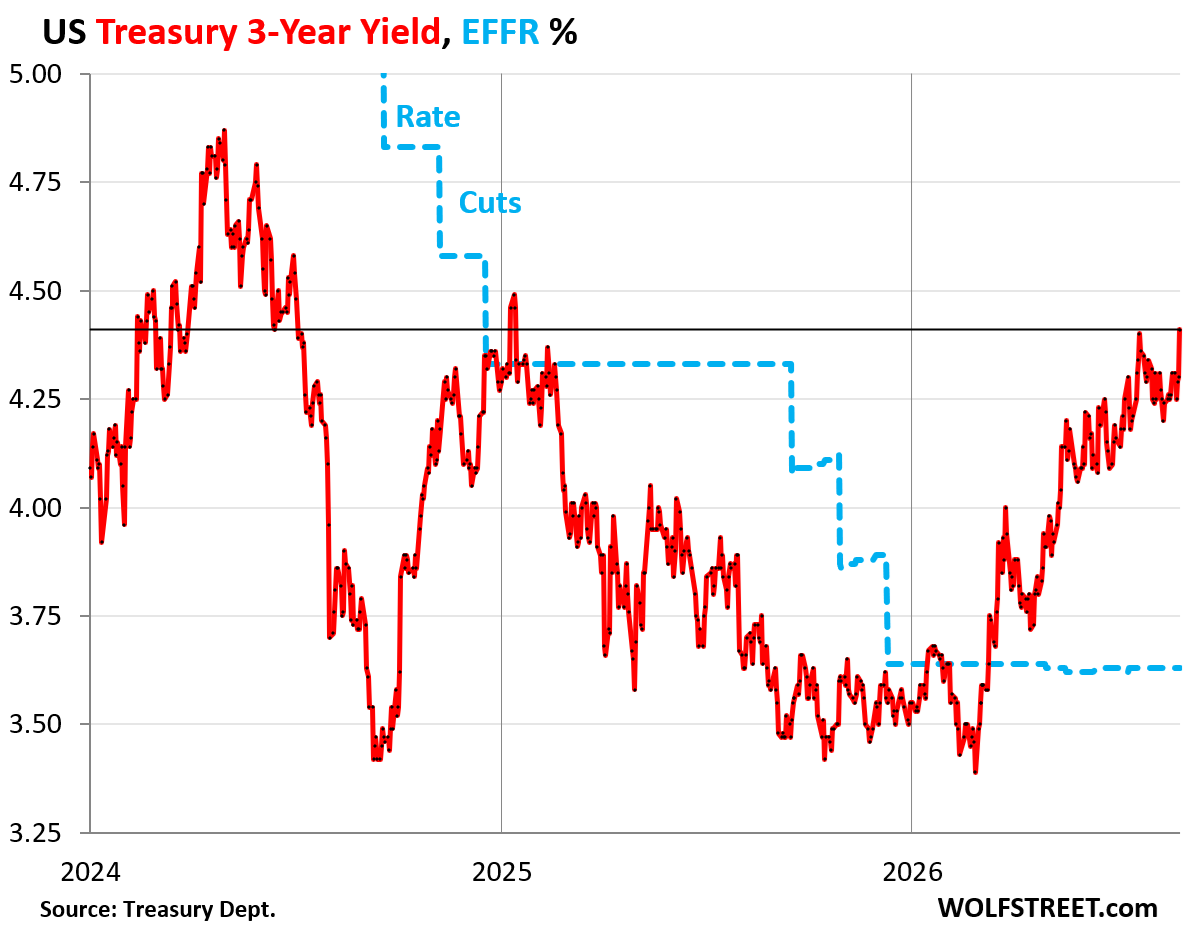
The 3-year Treasury yield spiked by 11 basis points on Friday to 4.41%, the highest since a few days in January 2025, and before then, the highest since 2024. Buyers and sellers in that segment of the bond market are seeing a scenario of multiple rate hikes. The 3-year yield is now 78 basis points above the Effective Federal Funds Rate (EFFR, blue), which the Fed targets with its policy rates.
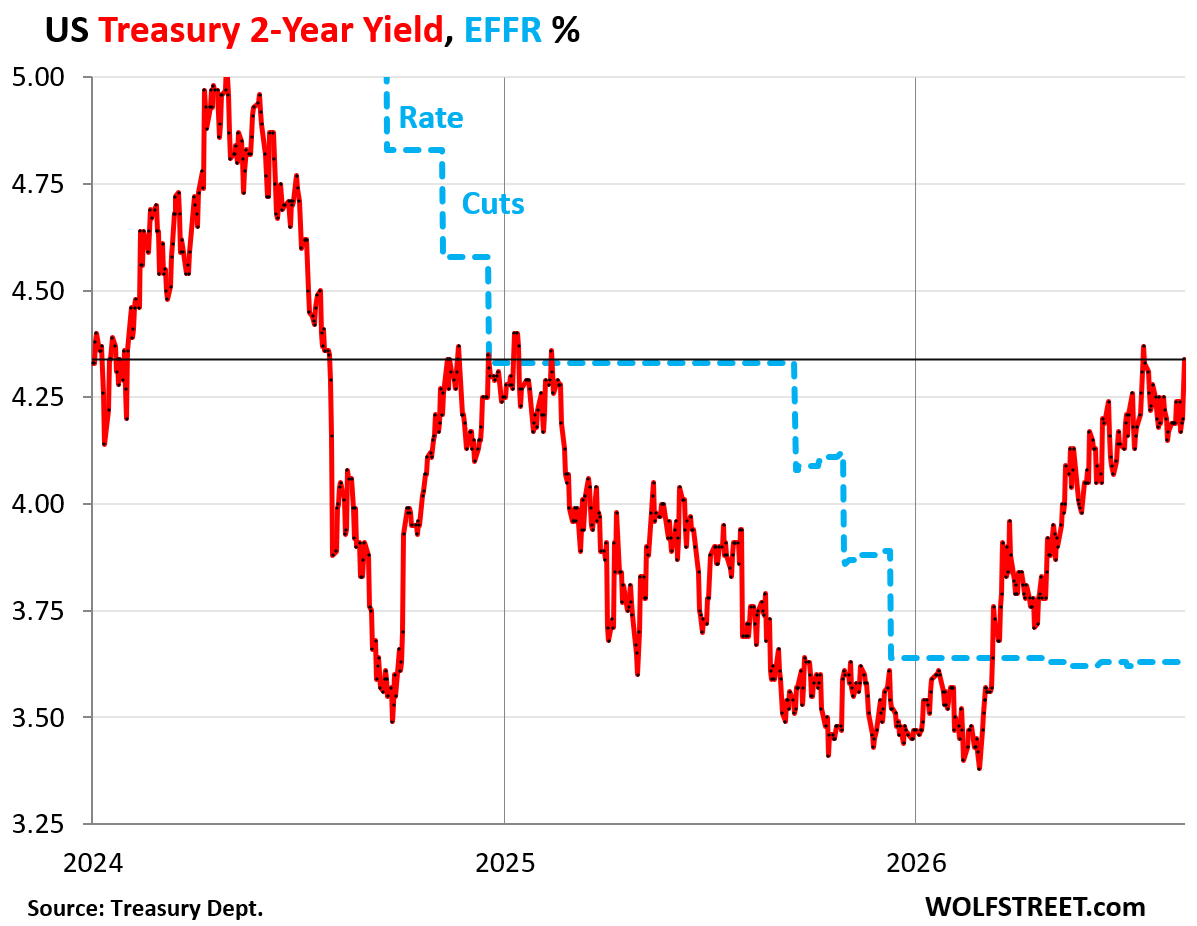
The 2-year Treasury yield spiked by 14 basis points to 4.34%, according to Treasury Department calculations, the highest since July 23, and beyond that one day, the highest since February 2025.
But at the Treasury auction on Tuesday, the government had sold $78 billion of 2-year notes at a yield of 4.20%, 14 basis points below Friday’s closing yield.
The government sold $235 billion of Treasury notes this week, including a regular 2-year note with a fixed coupon payment, and a 2-year Floating Rate Note (FRN).
The 2-year FRNs were sold at a “spread” of 0.055%. Holders get an interest rate that resets every week, based on the yield at which the most recent 13-week T-bills were sold at auction, plus the spread of 0.055% (discount margin).
| Notes & Bonds | Auction date | Billion $ | Auction yield | Spread |
| Notes FRN 2-year | Aug-26 | 28 | 0.055% | |
| Notes 2-year | Aug-25 | 78 | 4.204% | |
| Notes 5-year | Aug-26 | 79 | 4.393% | |
| Notes 7-year | Aug-27 | 50 | 4.512% | |
| Notes & bonds | 235 |
In the secondary market, the 5-year Treasury yield closed at 4.48% on Friday, about 9 basis points higher than the yield at which $79 billion of 5-year notes has been sold at auction on Wednesday.
And the 7-year Treasury yield closed on Friday at 4.59% in the secondary market, about 8 basis points higher than the yield at which the $50 billion of 7-year Treasury notes had been sold on Thursday.
Bessent’s three hocus-pocus shows fizzled.
Bessent’s job is to fund the huge deficits by selling Treasury securities at a pace of $1 trillion every three to five months, come hell or high water. And he has to sell them at the lowest possible yield. It’s a dirty job, but somebody’s gotta do it.
The 30-year Treasury yield was surging in July. So he came up with Hocus-Pocus #1: the joint US-Japan yen intervention at the end of July and confirmed on August 3. That pushed yields down for a couple of days before they rose again.
Then on August 13, 30-year Treasury bonds sold at the auction at a yield of 5.216%, the highest auction yield since 2001, and in the secondary market, the 30-year yield continued to rise. That gave Bessent the willies. So on August 19, the announcement of Hocus-Pocus #2: doubling the buybacks of 10-year to 30-year Treasuries. Yields dropped for just one day, then rose again.
So then Hocus-Pocus #3, on August 24, the leaked story on CNBC that he’d “tap” the Treasury General Account to fund the buybacks. Alas that’s the checking account of the US, the only checking account of the US that pays for everything, including paying off maturing Treasuries, so what else is he going to tap? But the media ran with it. And that worked for a day.
Bessent has been accused of politicizing the bond market with these shows, trying to get yields and mortgage rates down before the midterm elections, including by his former boss, Druckenmiller, in an editorial in the WSJ:
“Debt management that even appears to follow the political calendar spends the one asset that took two centuries to accumulate: the credibility of the Treasury market. That asset doesn’t regain its value so easily.”

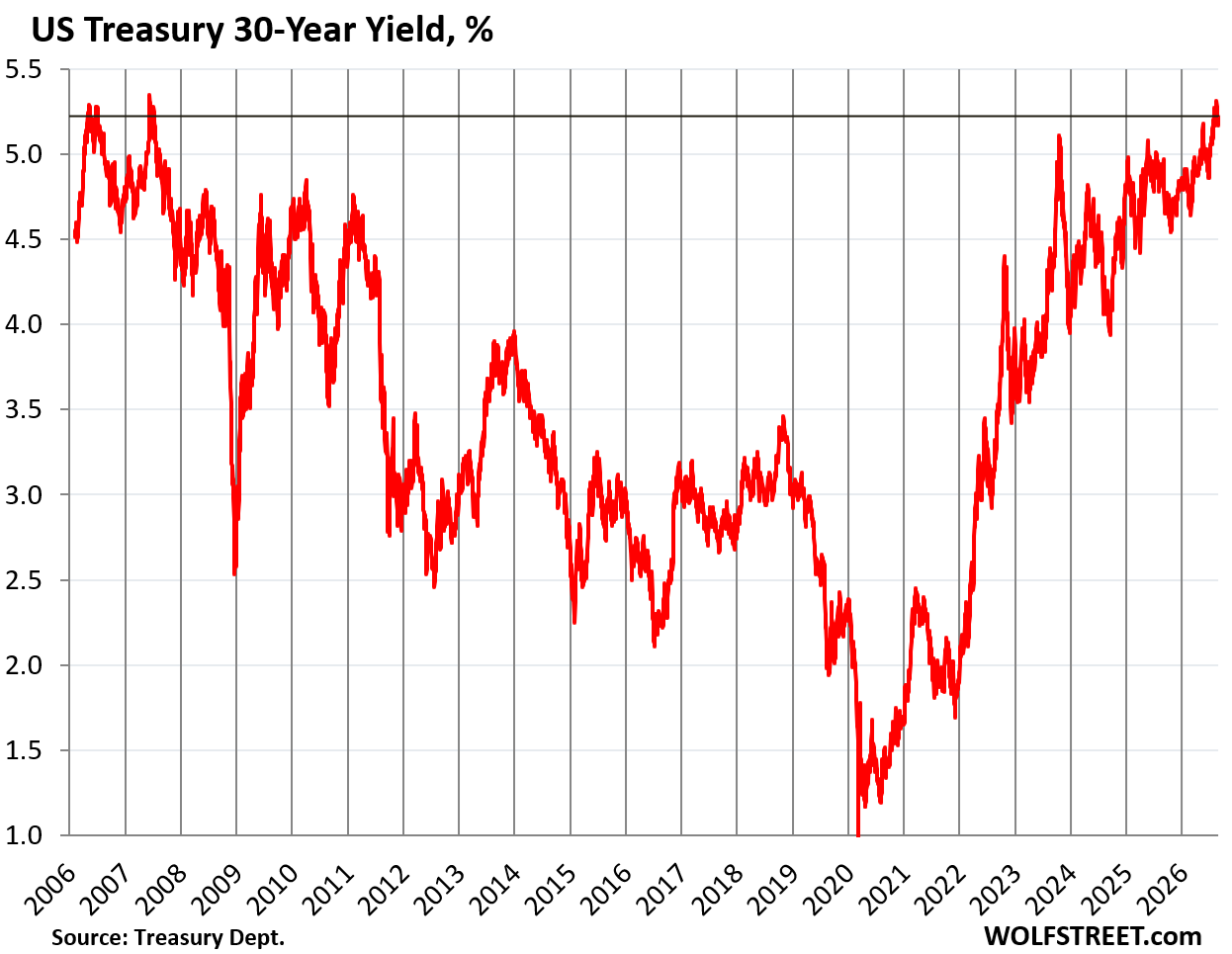
Unimpressed with the shows, the 30-year Treasury yield rose on Friday to 5.22%, right back in the 5.20%-plus range, reflecting the highest secondary-market yields since 2007.
When yields rise, bond prices fall, and these past six years of bond bear market have been a bloodbath for holders of 30-year bonds, especially those issued in 2020, at around the final paroxysm of the 40-year bond bull market that ended in August 2020. Those 30-year bonds have lost over half their value in the secondary market. The bond bear market just passed it sixth anniversary.
A lot of things can go wrong over the next 30 years. Inflation can go haywire. The fiscal situation of the federal government can deteriorate further, leaving behind a rapidly growing mountain of debt that could reach crisis levels. With Congress unwilling to raise taxes and cut spending, eventually the debt will remain manageable only through the combination of higher inflation – such as in the 3-5% range, forget 2% – and higher nominal economic growth. In this scenario, the Fed would let the economy “run hot,” cutting rates early, and hiking rates late. Which is what the Fed has been doing already.
Bond buyers, wanting to be compensated for those risks, have been demanding a higher yield.
But these bond buyers currently are still expecting the Fed to reduce average inflation over the next 30 years to about 2.25%, according to the difference between the 30-year Treasury bond yield of 5.22% and the 30-year Treasury Inflation Protected Securities (TIPS) yield of 2.97% (TIPS holders get inflation protection added to the principal, based on CPI). That difference of 2.25 percentage points reflects the average inflation over the term of the bonds that the bond market expects.
Many observers and potential bond buyers, including this one here, see a very low chance of inflation averaging 2.25% over the next 30 years. And they’re not buying 30-year Treasury bonds until 30-year yields move significantly higher to compensate them for this expected inflation. Some sellers are in the same camp, and they’re selling. But others disagree, and they’re buying, which is what makes a market.
But increased issuance will require that these fence-sitters get pulled off the fence to buy the new securities, and pulling them off the fence in large enough numbers would mean higher yields. That is a result of ballooning supply. New buyers that didn’t want to buy have to be persuaded to come in and buy, and higher yields accomplish that.
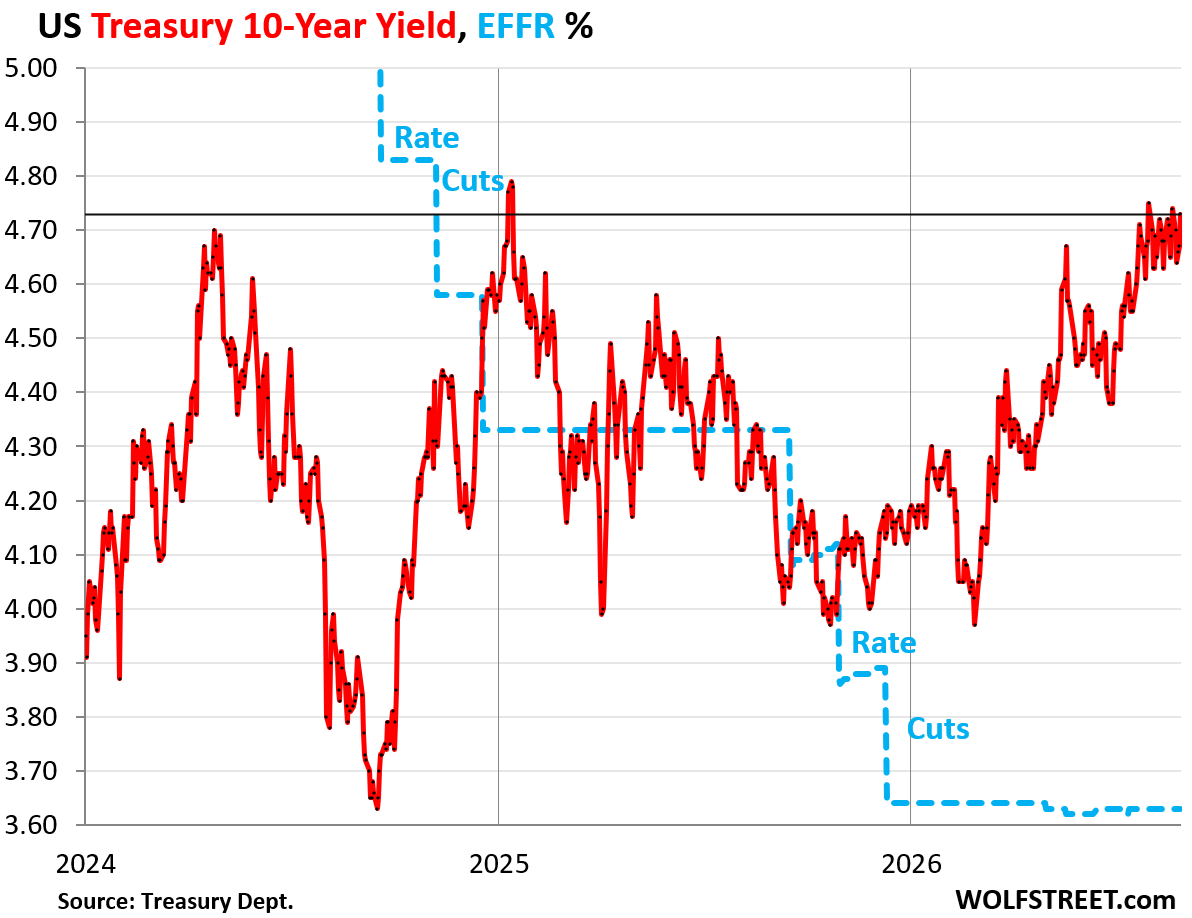
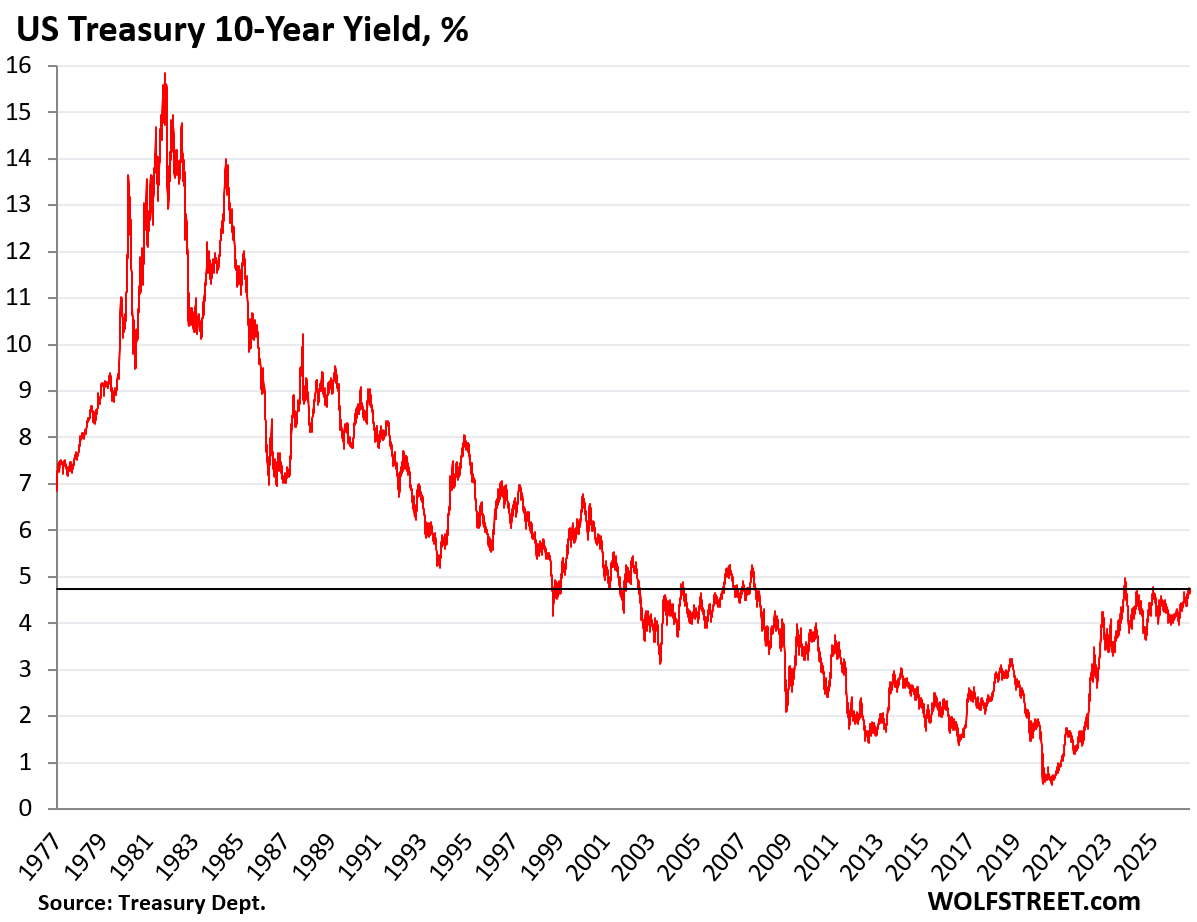
The 10-year Treasury yield jumped by 6 basis points on Friday to 4.73%, at the high end of its range in August.
At the auction on August 12, the government had sold 10-year Treasury notes at a yield of 4.68%, the highest auction yield since the auction in August 2007, which had spooked Bessent, and had been another reason to pull off Hocus-Pocus #2. And yields then bounced right back.
But yields are not high compared to the pre-QE decades of bond history. This chart shows the last years of the brutal bond bear market through late 1981, then the glorious 40-year bond bull market through August 2020, followed by the six years of the current bond bear market.
The government sold $562 billion of T-bills this week on Monday through Thursday, before the Warsh-inspired move on Friday.
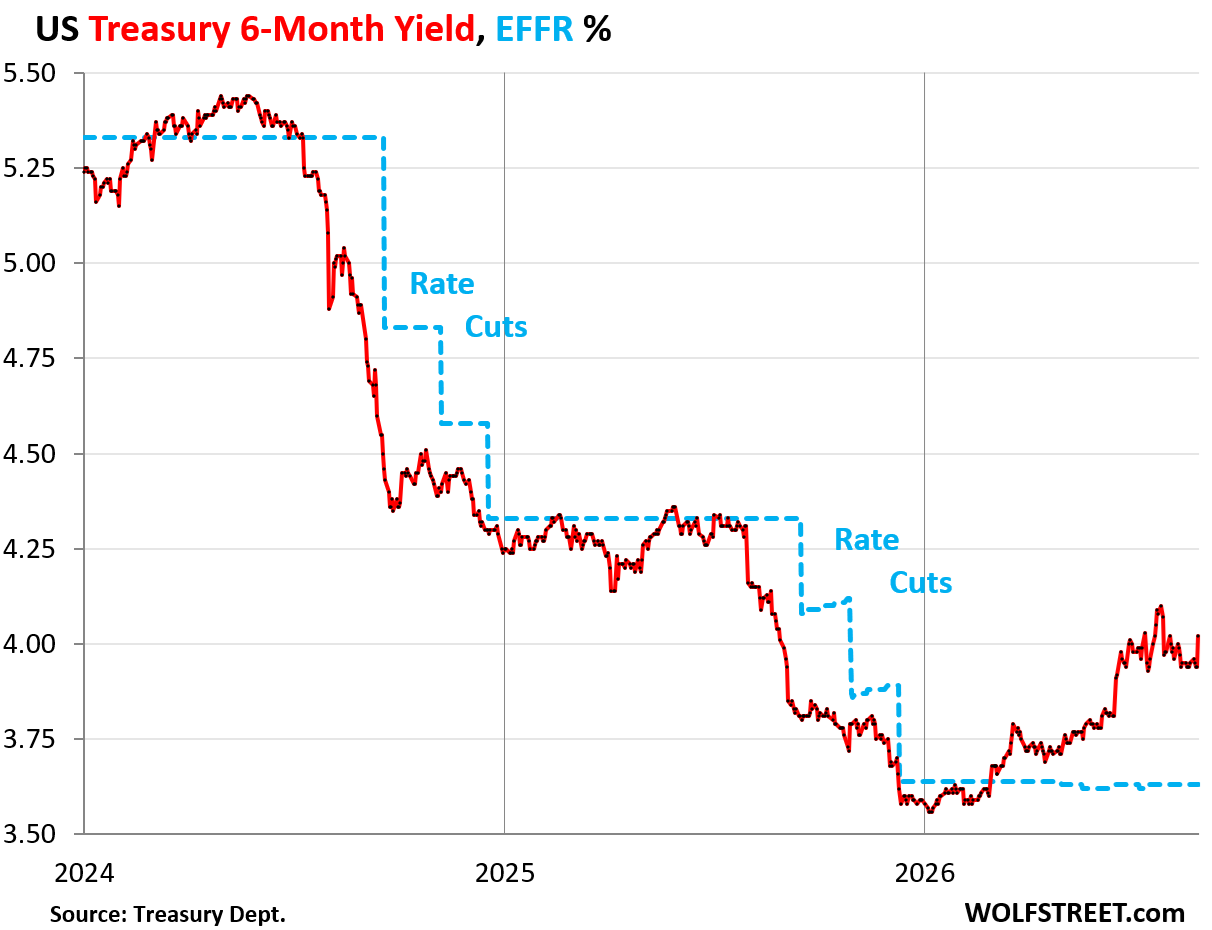
Yields of T-bills are less influenced by inflation and supply fears – unlike long-term Treasury securities. Instead, they react to the Fed’s policy rates and to expectations of the Fed’s policy rates in the near future. And Warsh jolted them on Friday, when the 3-month yield jumped by 6 basis points, the 6-month yield by 8 basis points, and the 1-year yield by 11 basis points.
But these auction yields predated Friday.
| Type | Auction date | Billion $ | High Rate | Investment Rate |
| Bills 4-week | Aug-27 | 109 | 3.650% | 3.711% |
| Bills 6-week | Aug-25 | 99 | 3.650% | 3.717% |
| Bills 8-week | Aug-27 | 98 | 3.670% | 3.742% |
| Bills 13-week | Aug-24 | 96 | 3.715% | 3.803% |
| Bills 17-week | Aug-26 | 78 | 3.750% | 3.850% |
| Bills 26-week | Aug-24 | 83 | 3.790% | 3.918% |
| Bills | 562 |
The $83 billion of 26-week T-bills were sold at the auction on Monday at a “high yield” of 3.79% or at an “investment rate” of 3.918%.
Then Friday happened. In the secondary market, the yield jumped by 8 basis points, to 4.02%, according to Treasury Department calculation.
The bond market is now largely left up to its own devices as the Fed stopped spoon-feeding it forward guidance about its future policy rates. So in early July, the bond market started pricing in a rate hike at the July FOMC meeting, and the six-month yield spiked to reflect that. But there was no majority for a rate hike (only three of the 12 FOMC members strongly wanted a hike and dissented). So that spike got worked off after the no-rate-hike meeting. On Friday, there was another spike, based on Warsh’s no-spoon-feeding Jackson Hole speech, that the market interpreted as “hawkish” in general terms, despite the lack of specific forward guidance.
The 6-month yield is 39 basis points above the EFFR (blue, 3.63%), indicating that the market sees a very high chance of at least one rate hike in its window.
In case you missed it: Quarterly Update on the Ugly Fiscal Condition of the US in Q2 2026
Enjoy reading WOLF STREET and want to support it? You can donate. I appreciate it immensely. Click on the mug to find out how:


Why buy bonds when you can just buy some crypto and get a 30% return in a week?
Every week, right?
Sure. Why buy Bessent’s dirty toilet paper when there are such lucrative alternatives these days? They printed too much.
Just how do you expect the US government to finance itself when it has a $ 40+trillion accumulated debt that is increasing by $2+ trillion a year? Cut spending? Raise taxes? Any other ideas?
Luckily, cryptocoins cannot be printed. They can only be Ctrl-C’d!
Is that all crypto earns these days, just 30% in a week? Has it fallen this low? 💔
I just checked, and Helium crypto is up 378% this week. So no, it hasn’t fallen this low.
Until this speculative mania is cut off at the knees, inflation will continue to skyrocket, and Bessent’s dirty toilet paper will need to provide higher and higher returns.
It seems like 5% has been the ceiling for the 10Y over the past few years. Looking forward to that being a floor which would be a good start at cutting off at the speculative mania at the knees.
With increasingly negative sentiment towards AI due to potential job loses, data centers and a looming rogue or intentional AI cyber-attack that causes Congress’ sphincter to pucker up, I’d say 2027 is looking to be a pivotal year. And more than anything, it will be interesting if AGI gives rise by the end of 2027 or early 2028.
IMHO, the only thing that’s going to solve the speculative mania in crypto & financial markets is a good old nasty recession. Lots of stocks, crypto & gold will be sold to pay margin debt, adding fuel to the fire of the sell off.
BenW, the biggest issue I have with AI is that nearly all of the spending is coming from the Mag7. Normally, I wouldn’t care. I’d say that people can spend their money however they want, even if I think it’s silly. The reason I have an issue is that the Mag7 are not like McDonald’s and Disney, where you are choosing to consume their goods and services. The Mag7 have set up a “moat” around society such that ordinary people are funding them on a massive scale, and the lack of antitrust enforcement has led to a point where they can earn gobs of money by raising prices every year, and consumers don’t even know it’s happening. And if they do, they don’t have much of a choice. If Microsoft raises your Office 365 subscription from $15 a month per use to $20, what are you going to do? Grumble about it and pay it.
So the Mag7 are legally extorting the rest of society, and using that money to fund unpopular data centers.
Helium crypto is old news. Hydrogen is the lightest element so Hydrogencoin is the thing that’s going to float all the way to the moon.
Buy it and loan it to my sketchy website and I’ll pay you 20% interest on top of the 20,000% appreciation you’ll probably earn next month. Promise!
Lol. Right after it collapsed by the same amount. At the beginning of June, it dropped from 70 cents to 25 cents. After falling a little further, it went from 14 cents to 60 cents in the last week.
If you can time it right with the right tiny crypto, sure. But the total crypto value is the same as it was in March 2024. And Bitcoin is up ~50% over the last 5 years, about the same as the stock market.
I’m investing in helium, not crypto, because it always goes up….
“ US Government Sold $797 Billion of Treasury Securities this Week.” Eight tenths of a trillion dollars in one week? And we aren’t supposed to think that some shenanigans might be going on?
Oh, malarkey.
NYT: Warsh, After Talking Tough on Inflation, Faces a ‘No-Win Situation’ on Rates
Kevin M. Warsh, the chairman of the Federal Reserve, must soon decide whether to raise interest rates if inflation does not ease, even if it draws President Trump’s ire.
That’s a win-win. It’s only a no-win in the New York Times screwed-up book.
Their idea of a “win” is being able to finance government deficits and stock buybacks with cheap money in perpetuity.
The WSJ is the same, except that they want the government deficits to be spent on the military and corporate welfare instead of social programs and refugees.
Id prefer just to give the government less of my hard earned money over them redistributing to anyone else.
I think you are missing the point. It isn’t a win-win to draw Trump’s ire. If Warsh raises rates and Trump tweets about it, Warsh is going to recieve death threats. There are going to be crazies speculating in the nuttersphere if he hung around Epstien.
There is no winning to drawing Trump’s ire. There are too many craziest out there who will make your life hell even if younare doing the right thing.
I sadly have to agree with you. -sigh-
The last few Fed rate cuts have driven up long term interest rates, including mortgages.
If Warsh shows the Fed is serious about inflation, and raises short term rates, that will likely lower long term rates and mortgage rates. At least for a while. It’d be the opposite of 2024 when the Fed lowered short rates but long rates and mortgages actually got more expensive.
So raising the Fed’s overnight rate might actually help with the politically sensitive issue of lowering mortgage rates.
Or, maybe the rise in long-term rates has more to do with the US having a budget deficit >6% of GDP, and the movement of overnight rates has very little impact on people’s willingness to lend to a government in that much financial trouble.
Keep in mind that as short-term rates rise, short-term debt becomes more attractive as an investment alternative to long-term debt.
Germany…”Early 1923: A loaf of bread cost 250 marks.Late 1923: Prices jumped to billions and even trillions of marks.” Let’s hope it never get’s to that. There would be a run on wheelbarrows full of cash just to buy a single loaf of bread.
“Before the [Civil] war, I went to market with the money in my pocket, and brought back my purchases in a basket; now I bring the money in the basket, and bring the things home in my pocket.”
—George Cary Eggleston, recollecting the post-war inflation
“Let’s hope it never get’s to that.”
Plenty of people have been warning about abuse of the USD for *decades*.
But for a lot of reckless individuals, unless the inevitable is immediately disemboweling them *this minute*, then “everything’s fine” (see 20 years of ZIRP manipulations).
And the kind of people who end up in Congress are on the far end of that sociopathy scale.
Ryan- And keep your eye on that wheelbarrow….
People will dump the colored pieces of paper on the ground, and steal the wheelbarrow because it has value ……
We can not have a wheelbarrow gap.
When do these drops in Treasury prices start becoming visible on bank balance sheets? Who’s the next Silicon Valley Bank poking a finger at an event horizon? Somebody with a big chunk of uninsured deposits surely must be starting to math this out.
Lather, rinse, repeat.
The drops have been there for three years. And most, not all, banks survived.
True, but private credit cracks are showing. Private equity environment has changed this summer as well. Maybe I am too negative but Sept and Oct are not good months historically.
Banks are not taking the fist losses on private credit and private equity, investors are. Banks are involved and they eat some losses, and they have already been eating some losses, but the lion’s share of the losses before they get to the banks are eaten by investors. And if there is no fraud involved, those losses are not big. Some of the cases we’ve seen involved loan fraud (same collateral pledged to multiple lenders, etc.), and those losses were bigger. But still, banks got the tail end, after investors were wiped out.
“The drops have been there for three years. And most, not all, banks survived.”
An interesting question is the detailed mechanism of *how*, considering the banks’ massive 2022 holdings of ZIRP-era-infected fixed income securities and loans.
unZIRP had to have had an inevitable mathematical impact upon those ZIRP’ed holdings’ market value. And none of it good.
And even just white knuckling it to maturity (and ignoring mark-to-mkt) likely had to have had some significant impact upon bank loan operations (compared to ZIRP fantasy land era) but how much discussion of *this* have we heard?
Not much.
I kinda got a rough answer to my own question via a Marketwatch article I stumbled into on Morningstar:
“How a plan to fix a $326 billion hole on bank balance sheets could underpin a Warsh and Bessent Treasury twist
Provided by Dow Jones Aug 28, 2026, 12:44:00 PM”
“The data came from the Federal Deposit Insurance Corp.’s quarterly banking profile, and the statistic in question is unrealized losses on bank securities. The number remains substantial – $326.7 billion as of the second quarter – albeit down from the 2023 peak of $688 billion.
The issue of unrealized losses at banks came to a head after the run on Silicon Valley Bank in 2023. The bank’s collapse stemmed from a few issues, the central one being that the boring old bonds it bought as it expanded in size deteriorated in value as the Federal Reserve had to jack up interest rates due to the surge in inflation. ”
So at $326B now vs. $688B then I guess we can hit the snooze button because it’s less than half the problem it used to be. Article leaves out a lot of detail, like what securities are included in that comparison, how that hole got smaller (securities sales, white knuckle to maturity), etc.
Ignore my last comment. It should probably be deleted. Most of that article is speculation. I was curious enough about the FDIC data cited that I got motivated to search for the source and think I found it on the FDIC’s own website.
“FDIC Quarterly Banking Profile Second Quarter 2026
Federal Deposit Insurance Corporation
Statement
August 25, 2026”
“Chart 7 shows the level of unrealized losses on held-to-maturity and available-for-sale securities portfolios as a percentage of amortized cost. Total unrealized losses reached $326.7 billion, rising slightly from $325.1 billion the prior quarter. Total unrealized losses relative to amortized cost increased slightly to 5.5 percent, but were lower than the 6.8 percent in the year-ago quarter.”
https://www.fdic.gov/news/speeches/2026/fdic-quarterly-banking-profile-second-quarter-2026
A broad range of banking system reforms came out of the 2008 crisis to make banks stronger and less vulnerable to losses from . Basel 1 and 2 made it through, even if Basel 3 appears to have been aborted by the politicians and lobbyists.
2023 was a test case we can use to assess how vulnerable the banking system would be to yet another massive increase in treasury yields. Banks did very well IMO, with a couple of high-profile exceptions like SVB. The FDIC quickly cleaned up these messes, and the Federal Reserve opened a window to ensure adequate liquidity to all banks.
Based on the 2023 experience, I’m not as worried about banks. The regulations worked, and a 2nd GFC was averted.
The fair question, IMO, is how much of the pre-2022 stuff is still on the banks’ books not marked to market. That could be a hangover if bond yields keep rising.
If the banks rate them and hold them as “held to maturity” they stay at par value. If they start to sell even a bit of it, then they have to mark the whole thing as mark to market.
So (and it’s true) if they hold them for 27 more years, they will in fact get back their money in nominal terms. It’s only if they are forced to sell that they would then have to mark the entire batch to market (50% cut currently).
So basically it’s dead money, but as long as they don’t need that capital (a bank run), it functions just fine as reserves.
As part of my periodic review of Bank finances, I do a quick review of a Bank’s “cost of funds” and weigh that against their average yield on their Held-to-Maturity portfolio. I then apply the difference (the percentage) against the Bank’s Held-to-Maturity portfolio balance and come up with an “annual cost” of sitting on those underwater securities.
For example: As of the end of second quarter 2026, Wells Fargo had a Held-to-Maturity portfolio of 198 Billion, with an average yield of 2.24%, versus an average Cost of Funds of 2.7% and with a Fair Value of 166B.
So Wells Fargo’s Held-to-Maturity portfolio is costing them, as of end of second quarter 2026, 910 Million annually +/- to “sit” on that portfolio.
Thanks for sharing. That’s really interesting.
It’s reasonable to think that these Treasury bond buybacks are targeting what’s let over of those ultra low-yield bonds from COVID.
Now THAT would be an epic taxpayer-funded bailout for the banks.
Bessent says hocus-Pocus is only stabilizing the market to “fair value”
But central bankers at the camp-out had concerns: From Reuters,
1. The U.S. is becoming less predictable
2. The Treasury is intervening directly in currency markets
3. They are worried about Treasury intervention in the bond market
4. They fear political pressure could eventually influence the Federal Reserve
5. They are worried about the dollar’s role in the global financial system
6. They are concerned about dollar swap lines
7. They fear the old rules of international central-bank cooperation are weakening
8. They are worried that U.S. actions could destabilize global markets
Golly, accumulating national debts in excess of 100% GDP has serious consequences.
If only someone had warned of this for decades…
President Nixon was a financial genius and knew how to fix the money, 1) taking the US off the gold standard (can only do it once); 2) Devalue the dollar (1971 & 1973); wage & price controls (USA 1971), (ancient Rome 301AD).
Very informative. Thanks for this continual effort to help regular people understand how the levers are pulled.
The why of these lever pullers seems to be one of the three definitions of the word “political”.
Involving Power: Describing actions or systems where individuals or groups compete for authority and influence.
Then we have to look at the character of the lever pullers and their underlying motivations. Warsh seems to be the ultimate professional. I will assume he is trying to do right for the economy. I think Powell also did this with said motivation. Bessant? God help and protect us from avaricious fools.
To what extent does the market take the POTUS seriously, versus his being a propagandist? The latest was what would seem to be a trade war with Canada, and then an official renaming of one of the bordering lakes (somehow related to the trade war, but who knows)? And previously declaring the Strait of Hormuz as a U.S. territory, after a shooting war with Iran to accomplish what economically? We have militarily forced regime change in Venezuela, and are acquiring their oil? Floating a 50% increase in the defense (“war”) budget? And on and on and on. So is this bizarre populist trolling and seemingly total lack of adult policies economically substantive? Or is he ignored, even though he is the POTUS and supposed to be an adult? It would sure seem to be a lot of unconventional loose cannon uncertainty coming out of the White House for the market to sift through–is it having an economic impact? Loaning money to a country that is all over the place in its policies would seem to be very risky, but maybe there is no better option globally?
I think it was Carney who put it in a nutshell last year: “The world cannot be at the mercy of a handful of swing voters in Wisconsin every four years.” From more recent analyst interviews on Bloomberg and such, that still seems to be the feeling; that the wise thing to do is diversify away from the US as much as possible. The problem is that it takes time and money, and in the meantime there aren’t really any alternative hegemons to align yourself with. Even if China isn’t actively trying to destroy itself the way the US is, the country is just too opaque to rely on. At least with the US, while the president may be going mad, you at least know what he’s thinking since he posts every single thought that enters his head onto his social media page. There’s also the hope that the Democrats may be able to clean up the mess a bit after the midterms, and the hope that Trump actually leaves office in two years, so I think everyone’s just trying to white-knuckle it through to then.
Apparently the final hope here is that there’s no way we’re going to end up with someone else like Trump, even if we get another Republican. I wonder though, that given the primaries are won on name recognition…we have Vance, the empty vessel; Rubio, who has apparently been castrated; and Hegseth, who could actually benefit from being castrated. At least these guys don’t operate entirely on grievance, but are any of them capable of being a world leader? For instance, would any of them rejoin the Paris agreement or the WHO after standing by as we withdrew? It’s hard to see how they can turn the country around if they refuse to take the long view on anything, and it’s hard to see why any other country would cooperate with someone whose world consists of election cycles and alternative facts.
Hegseth for President? And the High-T Department of War. And you think Trump is crazy?
Testosterone affects the brain in several well-documented ways, though individual responses vary a lot:
Mood and emotion
• Often increases confidence, assertiveness, and motivation
• Can reduce anxiety and depressive symptoms in men with clinically low testosterone
• May increase irritability or aggression in some people, especially at supraphysiological (bodybuilding-level) doses
• Effects on emotional reactivity — some studies show blunted empathy or altered processing of others’ emotional expressions
Cognition
• Some evidence for improved spatial reasoning
• Effects on verbal memory and general cognition are mixed and generally small
• Better studied as protective against cognitive decline in older men with deficiency than as an “enhancer” in normal-range men
Libido and drive
• Reliably increases sex drive when correcting a deficiency
• Increases general motivation/reward-seeking behavior
Risk-taking and social behavior
• Associated with increased status-seeking and competitiveness
• Some studies link it to reduced fear response and more risk-tolerant decisions
• Social effects (dominance behavior, threat sensitivity) show up more clearly in experimental studies than everyday self-report
A few caveats worth keeping in mind:
1. Dose matters enormously. Restoring normal levels in someone deficient (low-T therapy) behaves very differently than pushing levels well above normal range, which carries more risk of mood instability, aggression, and irritability.
2. Baseline personality interacts with the hormone. People with pre-existing anger-management issues or impulsivity tend to see those traits amplified more than someone without them.
3. A lot of the “personality change” evidence is correlational — testosterone and behavior influence each other bidirectionally (status and competition raise testosterone too), so causality isn’t always clean.
Rico,
The Free AI Detector says that 79% of your comment is AI generated. My personal AI detector says that everything except the first line is AI generated.
I warned you not to post AI content into the comments — especially not without disclosing it. Now you’re back on the blacklist.
The bankers and hedgies hoped to make so
easy gains from this hocus pocus with short term trading . When it did not materialize the release bogus info about using the TGA . These guys are diabolical.
As Wolf says, in short, we will sell huge amounts of bonds. Next week, next month, and next year. Now, when the interest eats all the national revenue, we will have a problem. And our political class has been kicking cans for 25 years. Sux to be the next guy. Meanwhile, I can make big bux, and be far ahead of inflation eating the little people.
Apres moi, les deluge says the 86 year old paternal unit, and Good Luck to you!
It’s only a crisis when the wheel stops, and it is a huuuuge problem. Interest rates are simply a signal. So get your popcorn, prop up your feet, and watch the freak show. You have ringside tickets to a very slow glacier disaster. Can this be fixed? Sure. Huge tax increases, and some spending cuts to the big defense budget. But hey, that might just require us to understand basic math. Which this is a math problem. You can grow your way out of this, with ENOUGH REVENUE. But cut social security and kill domestic economic demand, yeah, that’s not going to work. But whatever, we will only solve this when we have to. And it obviously isn’t going to happen now.
So enjoy the gradual crisis. That trend in bonds is going to last a long long long time. With sharp problems from outside the economic area.
Nota bene, I was expecting this in the middle 2030s before choices were made that have brought this up much quicker. Eh, sometime we are stupid. And it is amazing how many smart people are willing to sign up for stupid if it sold to them as a way to get richer and more powerful.
Starting in 2032 there is no choice but to cut Social Security benefits for many people until the Social Security Trust Fund is somehow refunded. It the old never-changing principle of ‘no money, no checkie.’
The choice is for Congress to fix the system. They fixed it before about 40 years ago (including by bumping up my full retirement age), and it worked well for 30+ years and built a $2.8 trillion surplus during those 30 years, before shifts in demographics caused the old assumptions to stop working, and that surplus is now getting eaten up.
Congress has been talking about fixing it for years. But it never does anything major until its back is against the wall.
It will be interesting to see how the mid-terms flesh out. If TACO is able to survive, I wonder if he’ll change course & agree to push Congress to come up with the necessary SS adjustments during his final two years. He’s big into legacy actions, and this would certainly be one of those.
Vote for me!
My plan to distribute free cigarettes to seniors will drop life expectancy to 70, and save SS without any tax hikes.
@SoCalBeachDude,
I would say you are correct. My plan is to collect at 70, which would be 2033. Murphy’s Law
There are many ways to fix SS funding without cutting benefits.
Fraught times for a retiree looking for stable income and low risk.
TIPS appeared attractive until listening to a commentator argue that the administration was attempting to pervert the data collection and reporting of the inflation rate.
Thankfully I still have that old mattress. No income, but easier to quantify the risks involved.
Well, at least you don’t have to worry about social security payments not being stable. I guess once Congress finally gets backed into a corner and run out of hocus pocus (shifting funds around), they will legislate some fundamental changes. At least we don’t have a demographic issue on top of that.
The hocus-pocus may have just been initial baby steps by the current administration to effect yield curve control. Beyond trying to fire and replace members of the Federal Reserve Bank Board with obedient subjects, I wonder what more forceful and potentially illegal actions they will try.
Lots of manipulative BS from the internet in there. People need to wrap their brains around these issues:
1. YCC can ONLY be done with money printing, and the US government cannot engage in money printing. Only the Fed can. So the government CANNOT engage in YCC. And saying so is ignorant or manipulative BS.
2. The Bank of Japan did YCC until inflation broke out and the yen collapsed, which FORCED the BOJ to stop YCC and shift to the opposite: QT, and the BOJ has been doing QT ever since, and long-term yields have soared.
3. The US government cannot print money and cannot do yield curve control. All it can do is shift SOME issuance to short-term T-bills, and it has already been doing that since Yellen was Secretary of the Treasury, and that did not do anything for long-term yields and may not do anything for long-term yields in the future. Shifting issuance around is not “control.” It does NOT control long-term yields. It’s an effort to talk yields down a little.
4. YCC in an inflationary environment will cause massive inflation and crush the currency, and even Japan was forced to give up. But the government and the Fed may want to “let it run hot,” that means 3-5% inflation and hot nominal economic growth, and higher long-term interest rates. But that’s not 20% or 50% inflation, which would destroy the economy.
I get really tired of people dragging this constant internet garbage into here.
What is it going to take to get Americans to focus on and comprehend the massive federal debt and deficit issues? Would $500 per months cuts in Social Security benefits starting in 2032 start to get their attention?
Yes, but Congress will act in time. It might be early 2032 until a bill is passed, but it’s going to happen.
The only question is what changes are made to save the trust fund? The longer they wait, the more likely the SS tax is increased vs more palatable options like raising the maximum income cap & the FRA. Adjusting the bend curve in some manner is also a possibility.
I’ve always said that one good change would be to allow tax filers to take a deduction for their SS payment, if they choose not to receive it. There are all sorts of things that can be done.
And the longer they wait, the more likely it is that we start to run into AI job disruptions that will affect the overall calculus of what can & should be done.
Why would someone willingly forgo their SS benefit in exchange for a deduction? The money isn’t going to charity.
It’s a nonstarter IMO.
Hey, Google:
“How close did the social security trust fund come to insolvency in 1983?”
Answer:
In 1983, the Social Security Trust Funds were months away from insolvency — specifically, just weeks or months before they would have been unable to pay full scheduled benefits on time.
So, it’s going to be a nail bitter for sure.
Social Security checks provide benefit payments for 63 million Americans, including retirees, spouses and dependents, but the trust fund that bankrolls the funds will be depleted by late 2032, setting up a massive headache for the next presidential administration.
‘This train wreck is going to happen,’ Representative Steve Womack told Politico.
Last year, Social Security’s retirement fund earned $1.2 trillion in payroll taxes, but the program paid out $1.4 trillion.
The Social Security trust fund supplements the rest, but at the current rate, reserves will be depleted by late 2032, meaning beneficiaries will take the hit.
Congress can fix the system. They fixed it before about 40 years ago (including by bumping up my full retirement age), and it worked well for 30+ years and built a $2.8 trillion surplus during those 30 years, before shifts in demographics caused the old assumptions to stop working, and that surplus is now getting eaten up.
Congress has been talking about fixing it for years. But it never does anything major until its back is against the wall.
Congress could fix the social security system but given today’s partisan divide that seems unlikely doesn’t it?
The way I read the room is that today’s partisan divide doesn’t really matter because their back isn’t against the wall yet. I bet that the future’s partisan divide gets bridged pretty quickly a on the day the monthly check arrives 25% lighter than the previous monthly check and the phones light up. That’s just how things get done now. Sigh.
Supporting evidence: the nearly annual farce of the debt ceiling debates. It’s never really a debate. It’s backs-against-the-wall theater.
The partisan divide has been just as bad before.
Social Security transcends partisan divide. This isn’t some sort of budget showdown, where Schumer will let it default. That’s not going to happen. It will be an ugly debate, when it starts. In 1983, the SSTF was months away from not being able to pay full benefits, so this time will be no different. Rest assured though, something will pass to save it. But my guess is there could be enough AI job disruptions that it then is no longer just about SS as we know it today. It then becomes a much larger, harder problem to solve that surrounds UBI.
The problem is that their back is more than against the wall. They are more against the wall than it has ever been. There have been plenty of times where SS has been in bad shape, but never this bad of shape.
Yes, the longer you wait, the worser it gets, as one of my mentors used to say.
Passive investing keeps blowing the bubble bigger — 17 years now. White collar layoffs could put a damper on it….
The government is on the hook on more things than just SSN. Medicaid and Medicare is going to jostling for Tax Revenue dollars too.
I believe Medicare is what retirees receive. Some retirees need help beyond Medicare and do receive Medicaid. Medicaid is for people how cannot afford health care.
The following is from AI and this is for Medicaid
Based on the breakdown from the American Hospital Association (March 2026):
~10% of Medicaid beneficiaries are age 65 or older
The remaining ~90% are under 65
With total Medicaid enrollment at approximately 66.7 million (April 2026), that puts the number of Medicaid enrollees under age 65 at roughly 60 million.
The under-65 group includes:
Children (~36% of all enrollees)
Non-elderly adults (~42%, including the ACA expansion population)
People with disabilities (~10%, some of whom may overlap with the other categories)
—————————
Then add in CHIPS, SNAPs, Rent Assistance and some other state entitlements. we are getting close to 1/3 of the US needs assistance from the Government.
When you have one of the wealthiest city’s (New York) in the country that has 48% of the people on Medicaid… things don’t add up. The city metro I live in ranges from 12% to 18% depending on the city / suburb.
And it’s reasonable to thing that 2032 becomes 2031. Heck, it might even jump to 2030, before it’s all said & done.
The basis trade is primarily playing in 10year to 30y duration, without it buyers would be fewer and yield would be higher, Right? Stable coin is at the other end buying TBills. It appears we have found financial engineered solution to help sell out debt. What could go wrong?
Stable coins are minuscule compared to Treasury securities. And there is essentially no use for them outside the crypto ecosystem.
Stable coin perpetually owns 300b plus of t bills to back value of coin, right now, that number is expected to grow to 4 trillion globally quickly. That’s is a chunk of perpetual debt debt the USA will be happy to owe in 90 day T bills obligations.
“expected to grow” by crypto promoters. Not happening.
The law changing the full retirement age from 65 to 67 was signed by President Reagan in 1983. That was 43 years ago; my home time flies — it seems like just yesterday.
Full Faith and Credit of what?? Control the narrative, define the hierarchy, institutional inertia and mind control the masses with Programming and stories about men behind curtains…it’s all a construct of men, men who took power…
The design is to extract up to the point of structural collapse…manage the decline, pivot to new reality for the masses..maybe Soylent 🍏 green…empires always fail…so why sweat it with made up reserves, fake news, poor schools, leverage and inflation…but sure, watch a grown man kick or play with a ball…fake, fake and phoney only lasts for so long…
Breaking News!
The dropping oil prices were….drum roll….Transitory!
Trump out pocussed Bessent.
Hocus Pocus….Iran back in focus!
Lets see what the odds are for a hike in September now…..
“Deficits don’t matter”
True words of wisdom. /S
Meanwhile, the biggest pension fund in the world, the Dutch ABP (civil servants pension fund) is selling US treasuries. Allegedly, because of the “risk of no return of the principal” and the currency exchange risk. Ironically it is buying French and German ones. While the French are openly suggesting to “burn the paper held by foreigners”, without defining what they mean by foreigners. Probably everyone outside the Euro-realm. But you never know for sure with the chauvinistic French.
Rumour goes that ABP does so because the Dutch Government wants it to.
Which is no surprise because for who’s pensions they are responsible.
And what of the Corporate debt?
There is much discussion about massive “off the balance sheet” debt creation by AI concerns.
How does one calculate debt to equity ratios when debt is off the balance sheet of the company?
How and why would a company hide their debt obligations?
Arent there some GAAP being ignored here?
GAAP allows off-balance sheet obligations if structured correctly, and these companies know how GAAP works and how to use it, no problem. Some of that has to be disclosed in the footnotes though.
Sounds kind of like 2/28 loans back in circa 2005.
It’s an accounting gimmick.
If the AI revenue doesn’t materialize like all of these companies are predicting, then there’s going to be a very big problem with all of these private companies paying back this private credit.
It’s very reasonable to think consumer backlash against data centers & AI for that matter will continue to explode over the next 2-3 years.
Looming AI job loses
Data center build out pushing up CPI
Data center gobbling up energy
Data center climate change via natural gas, especially all of these attempts at un-permitted power plants
And then you’ve got the mother of all concerns, AI cyber attacks
It’s not going to take too much more bad news to really start to put the brakes on AI. The slowdown is almost certainly going to arrive by the end of 2027, especially after Warsh has to raise rates three times in the next six months.
GAAP or not, there’s a very big collision headed our way, and accounting gimmicks aren’t going to save MSFT, Google, Oracle, Meta & Anthropic / OpenAI, once they go public.
The 2008 collapse was all about 2/28 loans. This time it’s all about private credit and the gargantuan public debt that Congress is incapable of addressing.
But, these are all known knowns. None of this is going to sneak up anyone.
“How and why would a company hide their debt obligations?”
When you’re making trillions of dollars in loans on really HUGE, future revenue assumptions, then you probably want all that debt off books, if Uncle Sam lets you do so. This way, when the music stops playing, it’s the shell company that goes down, not the mothership. Well, at least not quite as fast.
The only pertinent question is: how long can this Bessent-Warsh dog-and-pony show go on before yields rise enough to make the “imminent rate rise” dogs stop yapping?
Wolf: I now that you don’t like links to other articles posted on your site, but I think you and your readers will find this interesting. Washington Post is reporting “US Treasury blocks certain journalists from G20 meeting in North Carolina”
“Individual reporters from The New York Times, The Wall Street Journal and Bloomberg News were not granted credentials to the Group of 20 finance ministers’ meeting in Asheville, North Carolina, the Times reported.”
“Treasury Secretary Scott Bessent told The Associated Press in an interview Sunday that “it has nothing to do with point of view.” – Right
LOL! Your move Mr. Warsh.
I do se a lot of undervalued companies in the commodity and energy space…
Full “faith” and credit…
Hedge accordingly.
I was watching Bessent on CNBC this am saying (paraphrased): the world is awash in debt post GFC and post Covid and the only way out of this is to grow our way out of this.
I’m assuming that means let the economy run hot but this does nothing to solve inflation or the government spending problem.
Before that statement he stated the bottom 25% is doing better than the top 25% due to the AI build out. Which I call shenanigans on due to the anecdotes from Target, Walmart, Costco, and Amazon. Also, don’t these jobs dry up when this build out slows?
“Before that statement he stated the bottom 25% is doing better than the top 25% due to the AI build out.”
This is pure, unadulterated gaslighting. Only a narcissist with zero shame could say this with a straight face.
That’s not what he said. What he said and has been saying is that the wage growth (% change) at the bottom 25% has been higher than at the top 25%.
In terms of the bottom 25%: That’s not what he said. What he said and has been saying for weeks is that the wage growth (% change) at the bottom 25% has been higher than at the top 25%.
Now what if we remove that and only include the top 5-10% who is benefitting from all this AI spend? None of what he said changes how any of us feel about the debt/inflation situation.
This stuff gets really tiring. Lots of people benefit from the AI spending mania: construction workers, truck drivers, electricians; the various professions that are involved in siting, designing, and building data centers, power plants, and the infrastructure needed for all of it; the hardware and software engineers that design the various pieces of electronic, optical, and electrical equipment; the factory workers that build that equipment; the port workers and transportation workers and warehouse workers that help move equipment through the supply chain; the people who sell lunches and dinners to all them and drive them around and fly them around, and do their taxes, and sell them appliances and cellphones, etc. etc. There has rarely been a spending boom that was so broad-based in the economy… maybe the railroad boom back in the day.