
Buybacks have to be funded with new issuance. All Bessent can do is delay it. That’ll increase the risks of the coming Debt Ceiling.
By Wolf Richter for WOLF STREET.
So that didn’t take long. Bessent’s Hocus-Pocus 3 came this morning, put into the world by CNBC, citing as sources two unnamed “senior Treasury officials,” with this headline today: “Bessent could tap near $1 trillion Treasury General Account to fund bond buybacks, sources said.”
And the news spread from there with various headlines. But let me ask you this: Where else is the money for the buybacks supposed to come from?
The Treasury General Account (TGA) is the only checking account that the US government has. Every single dollar that the government spends on anything comes out of the TGA, and so the government “taps” the TGA to send you your tax refund, pay for military salaries and hardware, pay off maturing bonds, etc. And every single dollar that the government takes in from taxes and Treasury auctions goes into the TGA. Treasury must “tap” the TGA for every dollar it spends. Where else is the money for the buybacks supposed to come out of? A cookie jar?
The implication is that Treasury doesn’t have to sell T-bills (Treasuries maturing in 1-12 months) to fund these buybacks, but that it can just draw down the balance in the checking account.
Huge amounts of funds run through it every day. For example, the week Treasury sold $742 billion in securities at auctions generated $742 billion in inflows as those transactions settled. And as hundreds of billions of securities mature every week and have to be paid off, it generates huge outflows, which is why the balance has to be large enough to provide enough of a buffer to handle these massive and seasonal flows.
In its Quarterly Refunding Statement on August 5, Treasury said this about the TGA balance:
“Treasury is assuming a $950 billion cash balance at the end of September. However, based on current projections for the upcoming refunding quarter, Treasury estimates that the size of the Treasury General Account (TGA) could peak at $1.05 trillion (plus or minus $50 billion) in late October. This figure is consistent with Treasury’s long-standing cash balance policy and is driven by the large outflows expected to occur at that time.”
Sure, the government can draw down the TGA, as it does periodically, but eventually it has to refill the TGA through rapidly increased debt issuance.
And the debt ceiling is coming. The government will hit the debt ceiling of $41.1 trillion late this year or early next year, and unless Congress immediately raises it, the government will have to draw down the TGA to fund the deficits that come at it at a pace of $1 trillion every 3-5 months. And if Congress fails to raise the debt ceiling for long enough, Treasury will then draw down the TGA all the way to the last moment before it runs out of money.
There are currently $936 billion in the TGA. Note the periods of the debt ceiling when the TGA gets drawn down to precarious levels – and occasionally, such as in 2023 and 2021, to nerve-wracking levels, with the government essentially out of money before the debt ceiling gets resolved, followed by massive issuance of Treasury securities to refill the TGA.
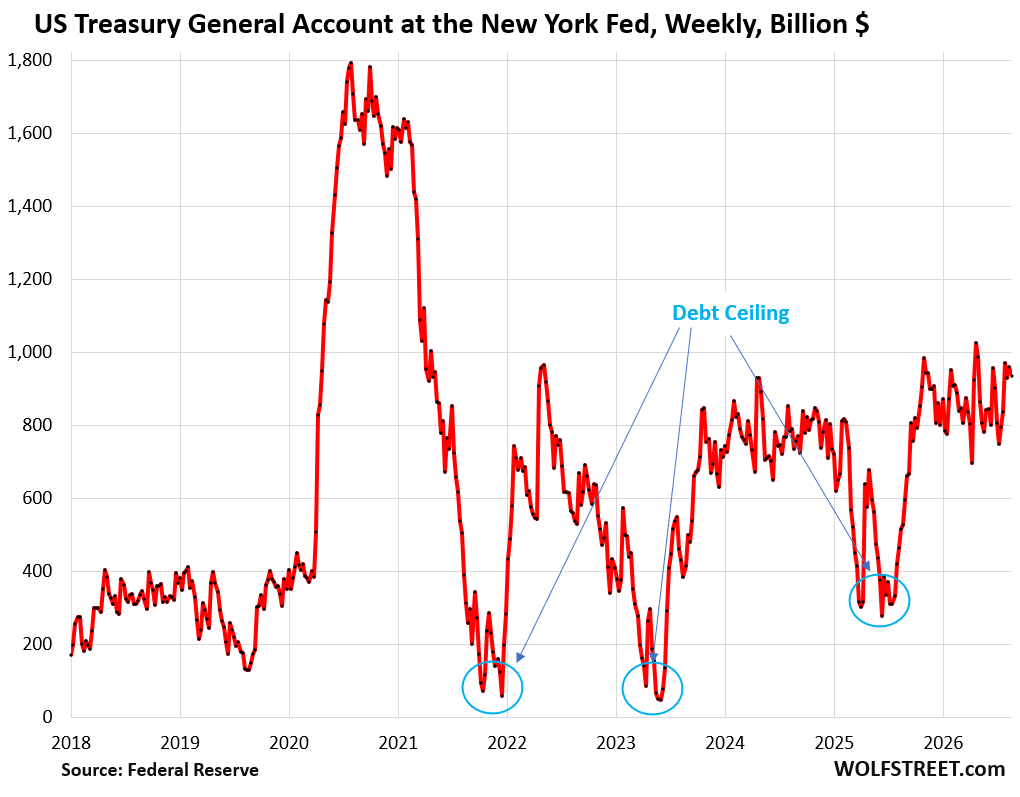
And if it draws down the TGA in September and October to fund the Treasury buybacks, just before hitting the debt ceiling, it will have less cash left to bridge the debt ceiling debate, and less time left before it runs out of cash during the debt ceiling. And then when it’s resolved, Treasury has to issue $2 trillion in new debt in all haste within a few months to refill the TGA and fund the deficits.
We just went through this in 2025. In the six months after the debt ceiling was resolved at the beginning of July 2025, Treasury added $1.8 trillion to the publicly traded Treasury securities. Have these people at CNBC already forgotten?
There is simply no escape: Buybacks have to be funded with new issuance. All Bessent can do is shift the timing around a little, but that would increase the debt ceiling risks.

CNBC, always eager to carry manipulative stuff from sources, is just regurgitating Bessent’s effort to push down long-term Treasury yields by hook or crook. We have started to call them Bessent’s Hocus-Pocus shows, and we are now numbering them to keep track of them. This is #3.
The prior two Hocus-Pocus shows so far in August:
- Hocus-Pocus 1: joint US-Japan yen intervention, confirmed on August 3.
- Hocus-Pocus 2: announcement of doubling of the Treasury buybacks on August 19.
None of these hocus-pocus shows address the actual issues that the bond market faces: A flood of new debt coming at it at a pace of $1 trillion every 3-5 months that it must absorb come hell or high water; inflation; and rising uncertainty. Bessent’s hocus-pocus shows, instead of addressing the issues, just contribute to that uncertainty.
Enjoy reading WOLF STREET and want to support it? You can donate. I appreciate it immensely. Click on the mug to find out how:


Meanwhile, in the August 22, 2026, edition of the New York Times, an opinion piece floats the idea of canceling the U.S. federal debt.
“ An Ancient Sumerian Solution to Our $40 Trillion Deficit.”
God help us.
The word for that would be DEFAULT.
So I lose a bunch of money because what, you want a financial reset?
People here don’t think so.. but this will hurt you too
I’m fine with a big financial reset. It’s one of the few benefits of being a conservative investor.
And the fact remains is the ONLY way inflation comes under control is if we have deflation via a significant recession which may or may not coincide with a “financial reset”.
Does that make the value of the remaining circulating currency go up or down? The Milkshake theory implies it would make the value go up.
Weekly auctions are already 725 billion per week. Most of this is rollover. I keep funds through Treasury Direct in 8 week TBills and set the option to reinvest automatically. So the funds needed to buy up the new issuance are probably available without much strain as long as current holders are in the “roll it over” frame of mind.
I wonder what it would take to change that mind set ? And, over the years, that 725 billion per week will become a Trillion and then 1.5 Trillion as more and more issuance moves to the front end.
I wonder what it would take for an adversary to disrupt these auctions. There are only 25 primary dealers. 25 primary targets.
If I were an enemy of the US with limited means, I would focus on the mechanics of this process and on the institutions, their information systems, physical locations where operations occur and the names and identities of key personalities.
It’s surprising to me that nobody does this (except the US).
I’m currently liquitading my Treasury Direct holdings. I don’t want to switch to the id.me authentication, which is run by a private company, and requires intrusive information gathering that I’m not comfortable with. I’m currently looking into purchasing my parents beautiful house with a portion of the money because they want to move, so maybe it will work out for the best.
All credit card debt will be dissolved under one condition: Central Bank Digital Currency. This is my prediction.
The first rule of Fight Club is, you do not talk about Fight Club.
Why are people getting paid (and handsomely enough, if writing for the NY Times, I imagine) to write such total nonsense?
It sounds exactly like the nonsense spouted by people in countries before they went into selective default (major haircuts/debt restructuring and subsequent servitude to creditors) in the past.
And the author is supposed to be an expert in money.
In the meantime, short term trading opportunities (eg using TLT) abound!😊
noticed that tlt is scraping the bottom, low going back to 2002…somethings broken and its crazy
TLT is up quite a bit since 2002. As with any bond fund, you have to include the dividends to see the total return on investment.
And maybe look at writing some long dated ITM covered calls to make sure you have your TLT exit strategy in place. Just in case
Careful, we are one bad unemployment report from having the 10y yield drop 50bp. Too risky for my blood.
We can all sweep dust off of the servers at the local data center.
Chris B.
If your forecasting rates dropping why not buy the 30yr at 5.2% & sell for a profit when rates drop?
I’m forecasting hyperinflation.
Dr. Lacy Hunt is forecasting secular inflation.
For the record, I don’t use cookie jars to stash my cash. I use old peanut butter jars. It’s a family tradition. The Fed would be wise to emulate.
End the Fed.
Sure, end the Fed and go back to periodic bank panics and bankruptcies. Is that what you prefer??
Check out the zig zags in rates over the past 5 years. It’s an exercise in humility for me. There is no one theme that explains it, and any trading bias would have resulted in an eventual wipeout.
E.g. if we cannot have forecasted and cannot explain with the benefit of hindsight why the 10 year rate dropped 30 basis points last February, then maybe we should be less confident in our predictions in general.
I’m not predicting rates dropping; I’m saying these things jump around for unforeseeable reasons. Very slight increases in market pessimism can send piles of money into bonds.
Chris B. don’t be so reasonable–wrong venue.
Personally I can’t understand how folks can’t be experiencing AI capabilities exploding, the demographic collapse, and the lowest consumer sentiment on record and not think there is at least a chance of rapid rate declines. We all live in our own bubble I guess.
If the debt ceiling is reached after January, it may be a perfect setup for the next scapegoat.
Spend it while you got it. Planes, pools, ballrooms, golf, bond buybacks……
Thanks again for bringing this information to the masses. I primarily read you instead of watching Netflix dramas. It is far more interesting.
Bessent is getting less lift which each “show of force”.
I suggest he take a few weeks off and watch some World Poker Tour. He needs to learn how to bluff.
Bessent is Mr. Bluster today and is practicing his new approach on Iran:
Trump launches ferocious ‘economic onslaught’ on Iran to cripple its economy after bombing campaign and peace deal stalls… with chilling warning to China
The Trump administration unveiled its ‘economic D-Day’ plan intended to decimate Iran’s already teetering monetary environment with what has been dubbed the ‘toughest sanctions in history.’
Waiono,
Very true & insightful comment.
I do enjoy Bessetts 1920 etiquette.
It’s quaint & old fashion.
I suffer from a 1980s skullduggery etiquette when they stopped teaching a classical education.
Woe is me.
You mean the etiquette of the guy regularly starting fistfights in the workplace and at restaurants? The Bessent widely known for foul-mouthed tirades? Look past the bryllcreme.
So if the treasury buys, say, $50 billion in T-Bills to pay off $50 billion they earlier ‘borrowed’ in the past, why isn’t that earlier $50 billion subtracted from the country’s debt total?
Every buyback is subtracted and every new issuance is added. In your example, the effect is nil. This goes by actual securities outstanding. When securities are bought back, they’re no longer outstanding, and they get removed at face value from the debt.
Thank you, Wolf!
Wolf,
Are there transaction costs for these buybacks? If so, who stands to profit from them?
In terms of transaction costs that someone could benefit from? The Treasury Department holds the buyback auctions (lowest offered price wins) via its fiscal agent, the NY Fed, and the NY Fed’s primary dealers (broker-dealers, banks, etc.) offer to sell specified securities. There are no transaction costs at these auctions. But the broker-dealers will charge their clients some fees for any kind of transaction.
The way I would look at is the net debt is total debt of $40 trillion less $950 billion in cash in the TGA, or $39.05 trillion. So in your example both the debt and the TGA go down by $50 billion and the net debt stays the same.
As others pointed out, the debt bought back does come off the books. What they were too polite to point out though is the interest rates. The debt they are buying back is at low interest rates of 3% or likely even lower. The new debt they would have to issue would be at higher rates. So even though the new debt issued equals the old debt bought to cancel each other out, there is an interest cost in that the U.S. is now paying a higher net interest rate overall.
So the first time that an interest payment is made on the new debt, the U.S. goes deeper into debt than it otherwise would have if Bessent did nothing.
So he is spending money the U.S. does not have just to make it look like he is doing something about long term rates when he really isn’t. It is wasteful spending. The worst part about it is that he knows it is wasteful spending because he complained about it when it was done once before.
It’s taking a personal loan to pay off a credit card. Net debt is the same. Unfortunately in this case the overall financial position is probably worse in the long run.
One thing for sure though, seeing them tripping over their own dxxk over and over again has been quite amusing…I guess gaslighting the public with hocus pocus is much easier on the public than the bond market. Who would’ve thought especially since the bond market has been wrong so many times before and was a asleep for quite a while too…
The weird thing is the true public doesn’t care about any of this and is only mad about gas prices.
MarketWatch ‘thinks’ that single US government checking account at the Federal Reserve is some kind of a ‘rainy day fund’ and laughably went on to say ‘Bessent tapping Treasury’s rainy-day fund for buybacks isn’t a ‘bazooka’ to get markets to move his way.’
It’s the treasury trying to control the long end. The Fed can bearly control the long end. The treasury can only send rates at the long end higher. And that’s where the ship is headed.
MW: Dow rises but S&P 500, Nasdaq decline; oil prices dip after ‘Operation Outcast’ announced against Iran
Away all morning but just checked in with CNBC to see if Bessie had released info about the war sanctions and tariff wars. Then immediately left for Wolfstreet to see what is really going on.
Thanks for this. What jumped out to me is the eventual reliance on the debt ceiling chickenout race. Diversionary drama and then someone else’s fault.
I would hope someone in the loon bin reads this site and passes on the info. Then maybe they’ll stop talking. That would be nice, but then what would they trade on?
It’s beginning to look intentional. Juice btc for his boss? Force a crisis?
I guess I sort of thought, even though he’s a conspiracy theorist and a fantasist, that he was actually sort of smart in other ways. Guess we’ll find out in the tell all book in 2.5 years
E –
Before picking everyone’s pocket, one must first create chaos and lots of it! That is my best guess.
Amen. Hocus Pocus economics is right.
The Antideficiency Act and 1st Amendment petition fir redress of grievances.
“The secretary of the treasury is a Level I position in the Executive Schedule,[3] thus earning the salary prescribed for that level ($250,600 as of January 2024).[9]” Reference: Wikipedia.
“The Antideficiency Act prohibits federal employees from[:]
making or authorizing an expenditure from, or creating or authorizing an obligation under, any appropriation or fund in excess of the amount available in the appropriation or fund unless authorized by law. 31 U.S.C. § 1341(a)(1)(A).
involving the government in any obligation to pay money before funds have been appropriated for that purpose, unless otherwise allowed by law. 31 U.S.C. § 1341(a)(1)(B).” Reference: US Government Accountability (GAO) website (gao.gov).
While a citizen may not have court standing; The First Amendment of The Constitution provides that the citizens have a right to petition Congress for “a redress of grievances.”
That Congressional redress of grievances is the answer right there.
Howdy Youngins. Houston we have a problem. Come in Houston, Come in Please, Houston come in, Houston we have a problem, come in please.
Mean while at squirrels anonymous , laughter and party times are continuing as sober and drunken sailors continue telling about their resent purchases… Party on folks… Life is so good…..
Don t worry, Your Govern ment loves you. HEE HEE. Sorry Lone Wolf. Gonna have the time of my life this time around…..Bring back the 70s and 80s every which way. Some of US are ready and waiting……
DFB
Bessent getting ready for Hocus Pocus 4 to decommission Iran and dozens of its trading partner form the Dollar system. So the $300B theft of Russian assets was just for starters. If Bessant isn’t trying to destroy the Bond market, he is certainly doing a very good imitation of doing so.
I’m starting to think the drunken sailors may have it right… if the US $ becomes worthless at least they have things. The money in my retirement accounts will be useless.
That’s what I’m worried about….
I’m a math teacher in GA, and I looked up our retirement system as it relates to private credit. Apparently, the fund is managed very conservatively and has little to no exposure to private credit. Thank God!
Private credit is the new 2/28 home loans from 2005.
Consumer pushback over power / water is likely to put a damper on the AI bubble sometime in the next 12-18 months, and a nasty rogue or intentional cyber-attack would go a long way towards popping or deflating the bubble.
“And if it draws down the TGA in September and October to fund the Treasury buybacks, just before hitting the debt ceiling, it will have less cash left to bridge the debt ceiling debate, and less time left before it runs out of cash during the debt ceiling. ”
I’m guessing that’s the point. Thanks to any buyback by Bessent, the debt ceiling debate would have to happen right around the November midterm elections, instead of possibly occurring afterward. Now, let’s think of some reasons why Republicans would want to pick that timing?
That’s because any “deal” would be made within a Republican majority instead of a possible Democrat majority that might be in place by early January. They are spending that money just to obtain political advantage.
Agreed! Timing is everything. Imagine why the Ds would ask for to pass a debt ceiling extension….
Government spending money it borrowed in order to loan it back to itself?
Like a dog chasing its tail.
Or a hocus pocus shell game.
Paying off one credit card with another.
You’ve got to believe it will work to make it work.
And congress like they always will will vote to increase the debt ceiling and the circus will go on. This is getting entertaining.
President Trump addressed the imminent threat if Iran attained a nuclear bomb. No one seems prepared to address the imminent threat the national debt and government spending poses to national security. That time bomb could be much more dangerous than Iran and could in the not too distant future cause economic collapse. We need a balanced budget amendment to solve the problem before it is too late. We need to take a scalpel to government spending. Interest rates must go higher to help curb government spending. No one wants to hear that. Trump must act on reducing government spending instead of asking for lower interest rates or he will have a failed presidency, though he arguably has done many good things that he doesn’t receive credit. It is obvious Congress has no intention of curbing spending. Internal enemies have gained much influence and power in recent years. That is where we better turn our attention if we wish to remain a free republic.
If Iran gets a nuke…..why I guess Trump will ask for a state visit and write love letters. Why wouldn’t a country get a nuke? Look what happened to Ukraine after giving them up, after the World guaranteed their borders?
George-
Thanks for the coolaid drop.
George:
Add to this is the 1/2 Trillion increase in the FY 27 budget, 100% all borrowed, for a military that can not even defeat Iran.
1/2 Trillion $ EXTRA every single year until the US can’t borrow any more, but by then the scoundrels will all be out of office making money from their memoirs.
Something like a DOGE could be good. But the DOGE we got from Trump and Musk was intended to punish certain government employees, not save money, and it achieved its intended purpose.
While we’re adding a trillion in debt per quarter to fight the Persians (over what, exactly?), the Chinese are pouring their resources into graduating another couple million engineers. Those engineers will build the drones with AI and international range that China will use to conquer the world.
To me, the US looks a lot like those militaries at the the dawn of WW2 who were still using horse-mounted cavalry, because that’s the way wars had always been won before and that’s what they knew. They got utterly wiped by the new tech.
Meanwhile, we in the US are in a competition with each other to waste as much time and money as possible.
I get the sentiment, but it’s a bad four years. The whiny entitled boomers will age out soon and everyone will just pretend Trump never happened.
The Chinese have plenty of their own problems–from someone who lives with multiple Chinese people and spends several weeks a year there. Looks advanced from a distance.
Anybody care for a little Gold?
Wolf, do you have an idea of where they want to see the 10 and 30 Year yield at to shut them up?
Question Everything
Quality Entertainment
Quick Eats
Quiet Evenings…..
Am I forgetting something here??? 😁
Quit E-cigarettes
Yes. How to think.
This isn’t QE no matter how much you pretend. Try at least a little bit to understand the mechanics of it all.
Thanks for providing a realistic account of the insanity going on in the present administration. It is a refreshing break from the softball and propaganda reporting by CNBC and its ilk.
Never has there been a more cowardly press in the US.
This morning Cramer was wondering aloud when the US turns into Argentina? Other news organisations were discussing the fallacy of Bessent’s plan. It is out there, a bit.
What’s left of the General Fund? The Gov has a nearly $2TT yearly deficit and is BROKE. Sounds like they need a QE #3……….but wait I thought these were supposed to be GOOD times?? LOL
And the Keynesian consensus marches on! Moar stimulus! Better stimulus!
Maybe Trump wants everyone to give up on the $ and switch to crypto?
No doubt, but at 33% approval and nosediving, that dog don’t hunt.
The only potentially positive outcome, if this were to occur, would be sudden buying creating a decrease in interest rates followed by immediate issuance at the lower rates… definitely a hat trick or shell game.
Couldn’t this be a method to delay the debt ceiling debate by a month or so to get it out of the election season? I agree that buying from the TGA doesn’t change things. It gets funded by new debt issues, so it’s a zero net effect.
*But* if you buy back $1tril in long term securities at 50 cents on the dollar, reflecting their low face value interest rate, and then fund it with short term debt at market interest rates, you haven’t changed the amount of interest that you’re paying, but you are reducing the nominal amount of debt that you have issued. That technically delays when the debt ceiling hits, even though the amount of interest we pay doesn’t change.
The other option is that perhaps Bessent believes that he and Trump can keelhaul Warsh into lowering short term rates. In that case, it’s better to buy up long term debt at bigger discounts, convert to short term debt, that then gets eventually rolled over into lower interest rates. That *does* lower overall interest payments, at the expense of manipulating the market with inside info, thus destroying trust and eventually raising the rates you have to pay by adding a certain “trust premium” that private buyers demand as compensation for the risk that you might trade against them.
So either option is pretty stupid from a long term point of view. But that doesn’t stop this administration. I’m just trying to think through that might be going through their heads right now.
“I’m just trying to think through that might be going through their heads right now.”
They are probably concentrating on where the nearest bathroom is, as they try not to crap their pants, knowing what they know. That would explain some recent decision-making.
“*But* if you buy back $1tril in long term securities at 50 cents on the dollar, reflecting their low face value interest rate, and then fund it with short term debt at market interest rates, you haven’t changed the amount of interest that you’re paying, but you are reducing the nominal amount of debt that you have issued. That technically delays when the debt ceiling hits, even though the amount of interest we pay doesn’t change.”
BINGO!!!! YOU GOT IT!!!
No change in interest rates at all but it does nominally “reduce” the debt so the optics are better and the time to the next debt ceiling is lengthened.
Total House of Mirrors.
Taking action for ephemeral gains in the near term at the cost of lasting damage in the long run is basically the MO of this admin, and how Trump has lived his entire life.
Like the song says ” The road goes on forever and the party never ends”
You called it. Bond rates seem to be rebounding. Happened quicker this time. This seems ominous.
This appears to be signaling many things:
(1) The Fed isn’t the only way to do Operation Twist. Treasury can issue all the T-Bills it wishes, put the proceeds in TGA, then use the TGA to buy back longer duration bonds.
(2) This challenges the Fed to start pulling its weight again. (“If you clowns don’t do this, we will…”)
(3) This also reassures bond holders (esp. banks) who might be antsy due to their nominal losses as rates rise, plus U.S. fiscal distress plus the economic war vs Iran.
The Treasury could reduce the number of 30-year auctions. For a few years after 2000, there were no 30-year auctions because Treasury stopped issuing 30-year bonds. Before then, there were 2 auctions per year. Now there are 12 per year.
The reason to have 30-year debt is that it doesn’t have to be refinanced for 30 years, and that interest costs remain stable for 30 years. 30-year debt puts a lot of stability into the $32 trillion of publicly traded debt. That’s why it exists. Replace them with T-bills, at first fine, no problem. But when T-bills become a big part of the debt, in lieu of 30-year debt, the interest expense becomes very variable, and HUGE amounts of T-bills will have to be refinanced every week since T-bills mature all the time. So there are some real risks in moving too far into T-bills.
The Fed has long been talking about replacing its long-term notes and bonds with T-bills (it’s already doing that with MBS), and that cropped up in the most recent minutes as well. The balance sheet task force will discuss the “composition” of the balance sheet, meaning a shift to T-bills from notes and bonds. But right now, there are not enough T-bills outstanding for the Fed to buy them in large quantity to replace even part of its huge portfolio of notes and bonds as they mature. So if the Fed goes that route, replacing maturing notes and bonds with T-bills, it would require that Treasury shifts more issuance to T-bills, and Bessent has been saying it for a year, and T-bill issuance has risen quite a bit, but it would have to rise a lot further to allow the Fed to buy $1-2 trillion of them.
If the Fed goes that route, replacing maturing notes and bonds with T-bills, the market will have to absorb these $1-$2 trillion of notes and bonds from the Fed, which would put upward pressure on long-term yields. So that’s a reverse operation twist, the opposite of what Bessent wants to do. So for the Fed to get rid of a portion of its long-term notes and bonds, it will require the Treasury to issue more T-bills.
All this is a rational discussion, and I’m pretty sure Warsh and Bessent had it before Warsh was even a candidate for the Fed chair (they’ve known each other for a long time).
What’s silly are Bessent’s spurious announcements designed to push down long-term yields (his hocus-pocus shows). Hedge fund people do that stuff all the time to move markets their way, but that’s not Bessent’s job. He is Secretary of the Treasury and not a hedge fund manager.
Hocus-pocus sounds awfully gimmicky and like Bessent is running out of options and Warsh is boxed in, for now.
Personally, I’m watching the US High Yield Index for a one month 3.5% run as to one of the several indicators to an impending recession. It’s currently at 2.73%, so like the labor market, we don’t appear anywhere near a recession.
Why do I have this suspicion that the $4B long treasuries buyback will be $8B, then $16 and so forth over the next 6-9 months? The Treasury is doing everything they can to retire all of these ultra-low yield bonds issued during the COVID money printing craze.
Let me see if I can summarize all this:
1. The US Treasury buys back long term debt issued at let’s say 1-2.5% at approximately 50-60 cents on the dollar. (inflated debt losses for whoever is holding those bonds) Treasury gains/wins
2. They refinance it short term at let’s say 3.5% to 3.95%
3. As their MBS’s mature the Fed adjusts the balance by buying Treasuries maintaining the balance sheet .
4. If there is a disinflationary event the bond yield curve would revert to “normal” and they could refinance at better rates.
5. The Iran conflict has temporarily blew this scenario up.
6. The recent SCOTUS decision reversed the tariff income that is being refunded.
Hmmm… FOMC and Warsh hold the line hoping inflation will get in line…
Wolf wrote: “But when T-bills become a big part of the debt, in lieu of 30-year debt, the interest expense becomes very variable, and HUGE amounts of T-bills will have to be refinanced every week since T-bills mature all the time. So there are some real risks in moving too far into T-bills.”
Very well said, IMO. I’m very worried there could be a liquidity event at any time, and buys have to step up to the auction plate EVERY auction period, or else any isolated, but significant, liquidity event could spike short-term rates (remember the 2019 repo event?), leading to disastrous contagion. Having a larger partfolio of T-Bills only adds to instability.
Bond CTA Short Squeeze Soon. The pound of flesh from equities will wait until after midterms.
It would be hilarious if all of this was just to go back to the gold standard. Morbid, but hilarious.
The so-called ‘gold standard’ was just a very brief failed 70 year experiment from 1863 to 1933 by which time the size of the US economy had vastly expanded beyond any value for any gold in the US.
LOL … That’s a very, very historically uninformed comment!
What I stated is 100% historically factual and correct. Get a clue.
“The use of gold as money began around 600 BCE in Asia Minor[24] and has been widely accepted ever since,[25] …” – Wikipedia
The period called “the” gold standard was only one of many similar precious-metal based monetary systems throughout recorded history. When most people say “gold standard” they don’t take it 100% literally, they are just referring to monetary systems where the money has actual value, as opposed to paper currency or near-worthless zinc or copper tokens.
But even in a pure “gold standard” context, the dates you stated are incorrect and are far from “brief”. Britain was on a gold standard for much longer than those US dates. The world was also on a gold standard from 1944-1971, also far from “brief”.
The comment I objected to also conveyed an awful lot of opinion and supposition, much of which is divergent from reality as experienced by the rest of us. One can have their own opinions, but to be credible on a public forum one must not proclaim them as “100% accurate” facts.
“put into the world by CNBC, citing as sources two unnamed “senior Treasury officials,” with this headline today: “Bessent could tap near $1 trillion Treasury General Account to fund bond buybacks, sources said.”
I am not sure what is worse: The idea that CNBC enjoys a Federal license and yet functions as a propaganda organ – pumping as gospel what 2 unnamed staffers said was theoretically possible (and the mechanics thereof explained above makes the statement) a nothing burger that has been contorted into a headline.
OR
This was a serious effort by the Department to float an idea, while not directly taking ownership of it; not understanding the cumulative damage to creditability. Sure, the Department gets a pat on the head for gaming out how to kick the can a little farther…is there an actual plan? B/c what has been expressed doesn’t really jive with reality.
Side note: Machiavelli would advise the Department to drain the TGA even faster than the SPR…..hand that entire bag of excrement (argument surrounding the debt ceiling) back to congress ASAP….Bully Pulpit rules. Smash N Grab.
I think a long while back Depth Charge posted in these forums that kicking the can down the road is easy as an aluminum can. Eventually the can develops into an anvil, and finally a Sherman tank.
With the TGA idea being floated, we’ve definitely reached the ‘anvil’ stage of can kicking.
Go ahead Warsh, shrink the balance sheet!
LOL!
This comment by a FBI investigator in the article I was reading today struck a chord “
“… operated First Brands as a ‘Ponzi’ scheme in which new loan proceeds were used to pay back old lenders and to fund their extravagant lifestyle”.
Bessent Mentor Druckenmiller Slams Treasury Bond Buyback Plan…
Mistake…
Everything has been a “Hocus-Pocus show” since 2008. It’s going to be “Hocus-Pocus shows” until everything collapses into a big pile of smoldering ruin.
Yes, the TGA is America’s checking account. America pays it’s bills with this account. What this idiot is doing is the equivalent of draining your checking account to buy bonds that pay 2-3% interest and then having to get a loan (issue new debt) at 4-5% interest in order to pay your daily expenses.
Totally stupid.
Hedge accordingly.
Hey Wolf, doesn’t congress have to authorize all spending from the TGA?
Not that rule of law matter to this administration.
Buybacks are not a budget expenditure. They’re like redeeming maturing securities, which Treasury does all the time, and they’re all paid for out of the TGA.
Looking ahead a bit, as Wolf’s article says, the debt ceiling should hit late ’26-early ’27. I see a high probability of Dems taking over the House, and a more modest chance of taking the Senate.
I wonder how this will impact debt ceiling negotiations, and the substance of any agreement thereof? Will negotiations speed up, slow down, or??
These questions are all necessary to handicap given the criticality of how low TGA balance goes before a bond issuance ‘rescue’.
I agree with Wolf in that this is a scary situation. I’d have to seriously question the current AA rating of Treasuries, even if only on the strength of having to rescue a dry TGA account in the nick of time on multiple occasions.
The root of this fiscal problem is congress spending money we do not have. This was made possible by President Nixon removing the convertibility of dollars to gold which removed the dollar printing discipline. Everything done to fix the problem has basically been extend and pretend, but also to sweep the problem under the rug since the vast bulk of our national debt has developed since 1971. The only way this problem is fixed is to cut government spending and start chipping away at the debt.
The other thing to remember is the intragovernmental debt is basically ledgers representing the cash. As noted in Wolf’s article, the country’s bank account runs plus minus a trillion dollars, but the intragovernmental debt exceeds $7 trillion. If there is a need to disperse a significant part of the intragovernmental debt, government would need to acquire funds by issuing debt, taxing, or printing the funds.
The other thing to remember is the intragovernmental debt is basically ledgers representing the cash.”
No, that is a common misconception caused by the misleading label. These funds are owed the beneficiaries (US people) of government pension funds and Social Security, whose money this is, it reflects their contributions to these retirement systems that have been invested in Treasury securities. It’s their money, and it is a true debt owed by the US government.
All the separation means is that those $7 trillion are not subject to market forces because they’re not publicly traded.
I guess I do not understand, if it is real debt and the government does not have the cash the lenders, namely the citizens that made the contributions, in its TGA, where do the funds come from if required to make good on its debt?
“where do the funds come from if required to make good on its debt?”
These Treasuries are in trust funds (SS Trust Funds, Medicare Trust Fund) and in government pension funds. When these funds need cash because inflow of contributions exceeds outflow to beneficiaries – as the SS Trust Fund has been doing since 2021 as it has started running a deficit – the funds sell the securities back to the government and get cash for it, and the government gets this cash by selling more Treasuries to the public. The TGA is the account through which these transactions flow.
In this way, the Treasuries in the SS Trust Fund (at the peak $2.8 trillion), which are part of the intragovernmental holdings, get shifted to the Treasuries “held by the public” as the SS deficits progress. The SS Trust Fund is now down to about $2.3 trillion, so $500 billion of what was once intragovernmental Treasuries are now Treasuries held by the public. They’re a true debt, and the government owes them and has to pay for them.
Here is the info on the SS Trust Fund, income and outgo:
https://wolfstreet.com/2025/11/18/social-security-fiscal-year-2025-trust-fund-balance-income-outgo-deficit-and-interest-rates/