
Bessent, rather than touting hocus-pocus shows, should point at the growling bond market as reason to get serious about fiscal consolidation before the bond market starts to bite.
By Wolf Richter for WOLF STREET.
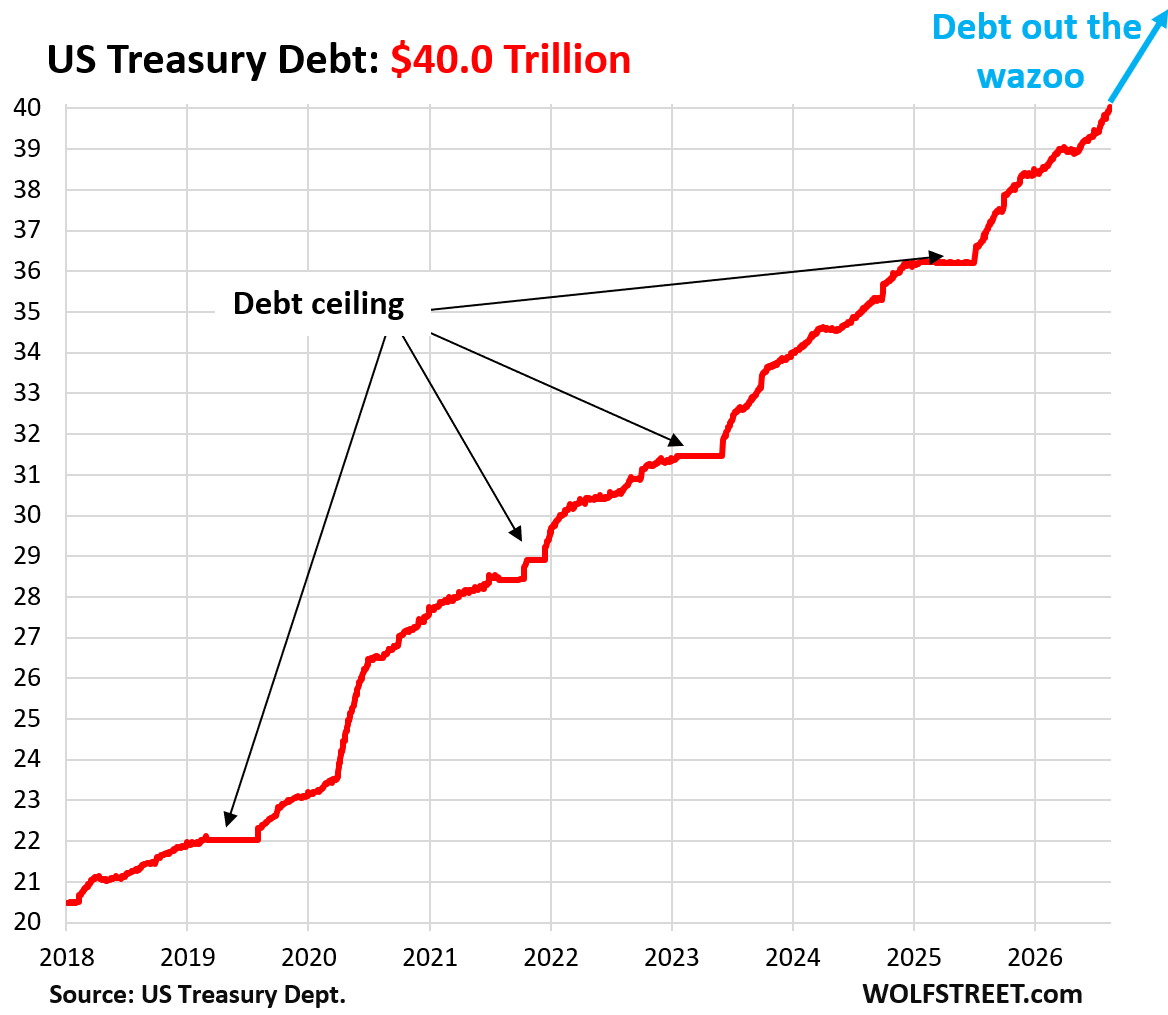
The $32 trillion Treasury market – the publicly traded portion of the $40 trillion in total Treasury debt – has taught Bessent a gentle lesson after he performed his Hocus-Pocus 1 (joint US-Japan yen intervention at the beginning of August) and his Hocus-Pocus 2 (announcement of doubling of the Treasury buybacks last Wednesday), both designed to manipulate long-term Treasury yields down. They did drop for a day or two, but then yields rose again and wiped out the decline. The message from the bond market was clear: Don’t mess with us, don’t play games with us.
Tricks just whittle away at his credibility, and they make the bond market nervous, and a nervous bond market will charge even higher yields. The bond market wants solutions to its primary issues – deficits and inflation.
The US government desperately depends on the bond market to fund its gigantic deficits that have been running at around 6% of GDP for the past four years through 2025, and are in the same range in 2026.
It was just a little rap on the knuckles. Nothing serious. And that was another sign that the bond market is finally functioning again, after 14 years of being cowed by the Fed’s interest-rate repression – or financial repression, as it’s often called.
When the Fed started QE in late 2008 by buying Treasury securities and mortgage-backed securities by the trillions of dollars, thereby forcing bond prices up and yields down, it quickly turned the bond market from a generally gentle but potentially vicious guard dog into a cute lapdog.
And having a lapdog that would go along with anything, instead of a potentially vicious guard dog, has resulted in a lot of damage, including unspeakable profligacy by the government, allowing the government to become addicted to nearly free money, which led to that $40 trillion in Treasury debt.
That wasn’t Bessent’s fault. But he took the job to sell those bonds, come hell or high water. And that’s getting harder.
The Fed’s bond purchases started during the Financial Crisis, and continued, except for a break in the middle, until early 2022.
During covid, the Fed went haywire – as did the federal government. In just the three months of March, April, and May 2020, the Fed bought about $3 trillion of Treasuries and MBS while the government issued about that much in new Treasury securities.
This was financial repression at its maximum. In the summer of 2020, the 10-year Treasury yield fell to 0.5% and the 30-year Treasury yield was just above 1%, and people were talking about long-term Treasury yields going negative, which would be the only reason to buy long-term Treasuries at these yields.
Since January 2020, the Treasury debt has grown by $17 trillion – from $23 trillion to $40 trillion in 6.5 years. And that continues: $1 trillion over the past three months alone. This was beyond reckless, and the Fed aided and abetted this recklessness.
The Fed’s balance sheet ballooned by a factor of 10, to nearly $9 trillion at the peak in 2022, from $900 billion in 2008. This interest rate repression triggered all kinds of historic distortions.
By the summer of 2020, the bond market had essentially died. It was no longer pricing in any kind of risk, it wasn’t pricing in inflation, it wasn’t pricing in the tsunami of supply coming at it that had to be absorbed. Nada. The bond market had lost all signs of life by the summer of 2020. It had ceased to function as a bond market.

But then, there were the first signs of life. Despite continued QE at a pace of about $120 billion a month, bond yields began to rise in late 2020. And ever so slowly, risks began to matter again.
By the time the Fed finally ended QE in early 2022 and switched to QT in the second half of 2022, inflation was shooting toward 9%, the worst in 40 years, and home prices were exploding as buyer mania had broken out, triggered by below 3% mortgage rates.
Throughout, the government ran gigantic deficits, throwing money willy-nilly left and right. In fiscal 2020, the annual deficit to GDP ratio reached 14%, in fiscal 2021 nearly 12%, and in 2022 through 2025, it hovered around 6%, despite above-average economic growth. For fiscal 2026, the Congressional Budget Office projects it to be 5.8%, same bad as last year.
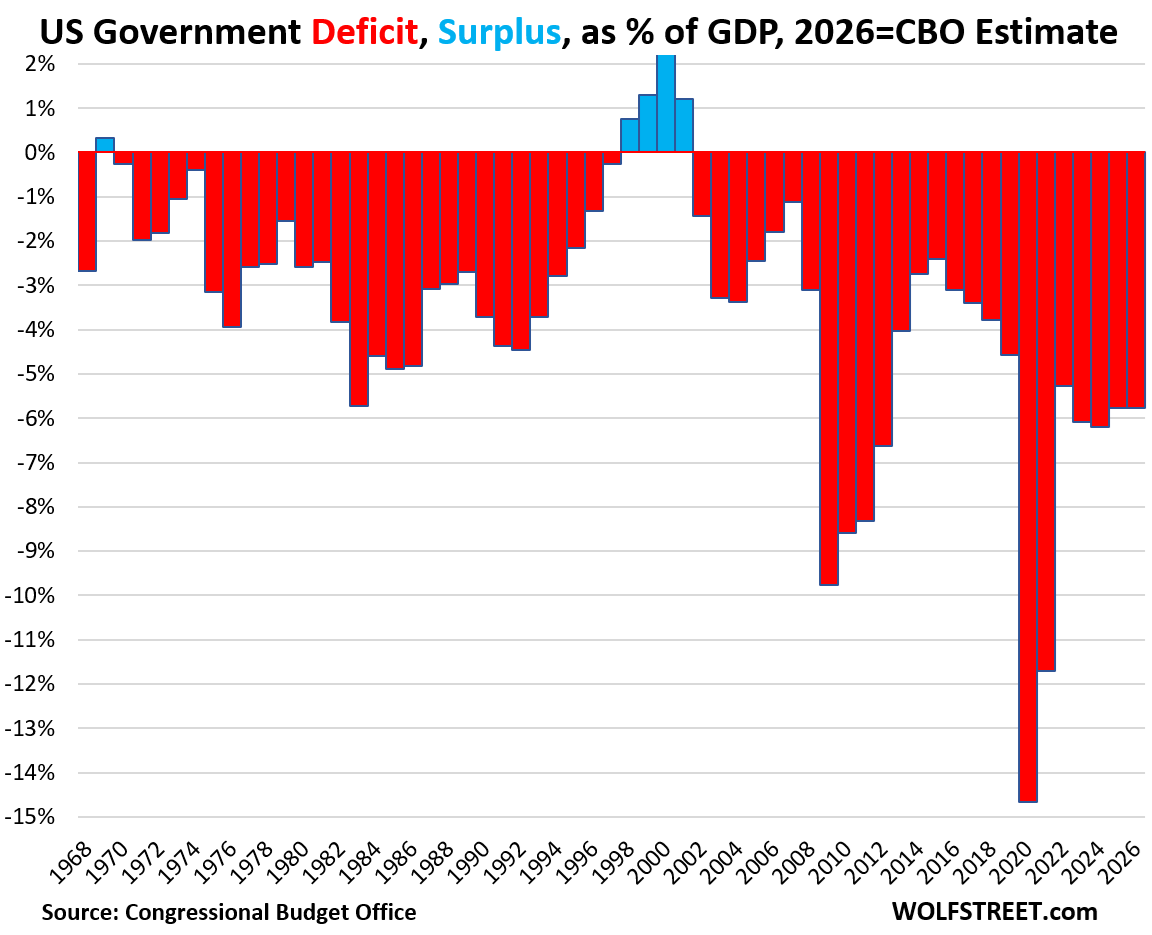
And the bond market kept funding these gigantic deficits without quibbling. Long-term yields rose as the Fed shed securities during QT and hiked its policy rates in 2022-2023, gradually stepping away from interest-rate repression. But it still hasn’t stepped back all the way. With its still huge pile of Treasury notes and bonds, that it replaces like for like as they mature, it keeps the thumb on the scale, but to a much lesser extent.
Warsh, the new sheriff in town, has sworn up and down that he would try to move the Fed further out of the way of the bond market. In the years before he became Fed chair, Warsh complained about the issues caused by the Fed’s interest rate repression through QE. He is determined to reduce the Fed’s balance sheet.
But any major move by the Fed is decided by vote; he needs a majority of the 12-member FOMC, and that takes time. So far, there was a first baby step: As of mid-August, the Fed stopped the “Reserve Management Purchases” of T-bills, after tapering them in the prior two months. The RMPs were started by the Powell Fed in December to re-inflate the reserve balances. The Fed is now only purchasing T-bills to replace the MBS that come off the balance sheet at a rate of about $17 billion a month.
The huge balance sheet, at $6.75 trillion currently, is still impacting the bond market but much less than during the era of the interest rate repression. Discussions about the size and composition of the balance sheet – and the coming recommendations by Warsh’s balance sheet taskforce – were mentioned in the minutes of the last meeting but any decisions require a majority on the FOMC.
Warsh wants the bond market to do its thing and get the Fed out of its way, despite huge institutional resistance within the Fed.
And the bond market is gradually coming back to life.
The first real sign was in the fall of 2023. Amid the projections by the Yellen Treasury of massive issuance of notes and bonds to fund the deficits, and with no efforts being made to trim those deficits back, with inflation still hot, QT still going on, and Fed policy rates over 5%, the bond market fired the first major shot before the bow of the government:
The 10-year yield soared and briefly pierced 5% at the end of October 2023, which scared the bejesus out of Treasury Secretary Yellen, and by April 2024, she came up with the infamous Treasury buybacks – the same hocus-pocus show that a rattled Bessent is planning to double starting in September.
Despite the warning shot, the deficits continued to balloon. That’s the problem – not the current 10-year or 30-year Treasury yields.
The second real sign was in August with the surge in long-term yields despite Bessent’s Hocus-Pocus Shows 1 and 2.
The buyers in the bond market are now pricing in some risks, and they’re demanding to be paid for some of the risks they’re taking. Ever more new buyers have to be pulled off the fence and into the market with higher yields. And the cost of funding (yields) rises as the deficits rise and risks accumulate.
Borrow too much, go broke – that’s what happens on Wall Street. But it doesn’t happen to the federal government. What does happen is higher yields, higher interest payments, and higher inflation until Congress cries uncle and starts dealing with the deficit.
Bessent, rather than trying to influence the bond market with his hocus-pocus shows, should work on getting the White House and Congress on board for fiscal consolidation and point at the growling bond market as a reason to get serious, before the bond market starts to bite and tear out a piece of flesh.
Enjoy reading WOLF STREET and want to support it? You can donate. I appreciate it immensely. Click on the mug to find out how:


I’m still amazed at all that buy these trash bonds. They don’t keep pace with monetary inflation. You pay taxes on the interest. And they pay you back with dollars worth less. What a Ponzi scheme.
…. Sure, put everything into the stock market, maybe mostly in tech….because Equities can NEVER go down or crash
Long bonds crashed 50% and haven’t even begun recovering in real terms. Bond bear markets are worse than equity bear markets.
“50 percent? Hold my beer.”
— early 2000s NASDAQ
Bessent will not cross Trump because he will lose his job. The markets will have to do all the hard work.
What if you were in Bessent’s place, what would you do “better”?
Buy bitcoin and big tech long bonds with newly hatched $.
🤣
Bessent should: Graduated increase in payroll tax withholding with matching on corporate side, graduated increase in Medicare withholding. Supercharge waste, fraud abuse, in Fed and State govts. Phase in slower defense spending. A little Hocus Pocus, smoke and mirrors, shift Fed govt budget expenses from Fed to state where applicable. I’d rather pay higher relative state taxes than Fed taxes. At least I know it’s being used in my own back yard.
Bessent isn’t going to speak to fiscal consolidation before the midterms, but I agree that he & Warsh need to be more vocal about these huge deficits. This year is already $1.798 with two final months to be reported.
Why is it their job to be “vocal” and what do you think being “vocal” would accomplish?
The entire country knows very well the that deficit is unsustainably gargantuan. They’ve known it for 25 years. Yet voters keep electing politicians who are fixated on taxing less & spending more every year.
No one is going to react with “Oh gosh, Bessent said we have a deficit, I had no idea! We need to raise taxes and balance the budget!” or “Golly, Warsh said our debt is growing, i’ve changed my mind and now agree with cutting the military spending”
^ The long lost voice of common sense right here.
When is the last time any politician got voted out of office for spending too much money?
How did it become the job of the Federal Reserve and the Treasury to micromanage the bond market in an attempt to keep it from crashing for just a few more months at a time?
Look at how many people utterly hate JPow and Yellen, and especially Greenspan. And when you ask them why they hate these bureaucrats they say because they made the national debt so high. Really? Maybe unplug from the partisan media influencers who are paid to make you think budgets aren’t passed by Congress and approved by the President.
Well said. Everyone knows we have an issue. Few are really prepared to take the necessary steps and make the necessary sacrifices to address it. The hand will need to be forced. It will not be a voluntary effort, from anyone. What we have been doing works, until it doesn’t.
Bingo. The problem is that even if a politician is legitimately concerned about the deficit and spending, there’s always someone willing to run against him, offering more deficit spending to fund goodies.
So even those who do care about these things lose interest and focus on other matters once they realize that they can’t do what they want to without being replaced by someone who will continue the status quoa.
People blame politicians, but no one blames the American people for wanting to live beyond our collective means.
“…but no one blames the American people for wanting to live beyond our collective means.”
Well, I do. And it seems maybe a few others here do too.
But if you take us and then divide by the total US population, then yes, that depressingly rounds down to “no one”.
Yep. It’s a matter of values. We all adopted consumerism as our philosophy of life, and so of course we vote for the politicians who offer us a way to buy more and fancier stuff.
Those luxury Shopping Utility Vehicles you see driving around are only possible because we aren’t paying much of anything in taxes. Over the past 5 years, I’ve never paid more than 3.5% of AGI to the federal government, and that’s with no fancy tricks at all. No wonder the country owes $40T. It was a tradeoff.
In other countries, people feel an obligation to work together and make their nations strong. The US is all about just looting everything for a bigger TV, some fast fashion from Shein, some extra bedrooms, and a luxury vehicle.
When people hear about our form of government weakening, they think maybe this means stuff will go on sale and they can buy more of it?
No, you dipshite. It means we are about to become a post-industrialized basket case country like Venezuela, Turkyie, or Russia where everyone is poor and a self-enriching dictator is in command.
From a layman’s standpoint, the Fed is the bank of the USA. If the CEO of a bank thinks his biggest customer is spending itself into oblivion, then that CEO probably needs to be vocal about how that said company needs to run itself.
Bessent is the CFO so to speak of America. He more than anyone should be vocal about what’s going on.
Change always starts with a conversation. To think that Bessent & Warsh have no sway in crazy. Their words carry a lot of weight, and they should be using it more & more.
Finally, there are no two people with a more front row seats to what’s happening & will happen, once we fall over the cliff.
The Treasury Secretary is not an elected official. Thus there is no mechanism to hold them accountable, except to be fired or impeached by our elected officials who we vote for.
Similarly, lecturing Congress and the President about fiscal responsibility is not in their job description.
So, no. I do not expect Bessent to be doing the work we need to be doing as voters.
Average US consumer debt per household is about $105,000. Average national public debt per household is about $297,000 per household. When would you like to start paying back your $400,000? I happen to live in a debt-free household… but that assumes the Federal government doesn’t come after my assets, to pay for Social Security that I already paid for.
The great bargain right now is to quit the United States and take up citizenship in a lower-debt country with a more solid democracy like Australia, Uruguay, or Finland. If you do it now, your US dollars still have enough exchange value to buy a pretty nice lifestyle, in a country that won’t let you die due to a drug patent.
You walk away from $300k in public debt per household, with a lot more of that burden eventually falling upon those households with any positive net worth. Plus you get to not live amongst absolute mouth breathers.
If we wait too long though, the bill will come due and our USD will be worthless.
Stanley Druckenmiller:
Addressing this primary deficit is the “only thing that durably lowers long-term yields. The reward is enormous: A credible fiscal package would do more for the long end of the curve than a buyback program 1,000 times this size.”
Why is this coming from Druckenmiller & not Bessent & Warsh?
Sure, Wolf says Bessent the Premier of US Bonds sales, but why is he not screaming at the top of his lungs that we may actually be getting fairly close to the fiscal cliff?
Why is this only something that Thomas Massey should be doing or the rest of Congress or you and me for that matter.
The more people who are in power that start to point out the calamity we’re heading towards is a good thing.
I see no reason in the world to exclude Bessent & Warsh for this very important task.
Bloomberg: US Long Bonds Risk Deeper Selloff Without Clear Warsh Guidance
IMHO, we’re approaching the point where Warsh is powerless unless he does real yield curve control. Lowering the Fed’s balance sheet is a fantasy at this point. Lowering inflation to 2% outside of a big recession is, again, fantasy.
Maybe Bessent & he will get lucky & the stock market will sell off 30% soon. I could see a GOP wipe out in Nov with all sorts of radical DSA candidates winning helping this happen. Then, the AI bubble will start deflating, as Americans wake up & tell Congress to pass a law that says current & future data centers must provide their own power & to use closed loop steam systems.
But it’s the tax-cut and spend Repubs that have brung us here. Check the numbers. Just like Dick the Cheney said (when he was in power), deficits don’t matter. Hmmm.
Nice spin. No matter how hard the Repubs try to lower spending, the Dems, using their media attack force threaten total disaster. And they were not tax cuts. They were the prevention of tax increases. It is Fantasyland to think if those taxes were increased, that the federal government would have used the money to lower the deficit and debt. No, they would have just found more programs to send out more money to buy more votes.
Warsh and Besent can’t influence rates lower, but there is a massive amount of twitchy money invested in late-stage equities right now that could flee to government bonds in a panic.
That’s the real reason I’m not shorting TLT and ZROZ at the moment. We’re one bad unemployment report away from dropping 50bp on the 10 year treasury. Too dangerous for this degenerate gambler.
not sure Bessent or anyone else can stop the deficits, difficult at any time, currently imo impossible……so we careen forward to whatever resolution the mkts determine, non of the possibilities pleasant……and inflation will always be preferred to deflation in a crisis, so………
No one needs to stop the deficits. They just need to bring the deficit’s rate of increase down and let nominal GDP run hot to where nominal GDP (+6.5% yoy in Q2) outgrows by a significant margin the growth of the overall debt, so that the debt-to-GDP ratio comes down over time. It’s really not that hard to accomplish.
Another metric to look at as provided by Wolf is the amount of tax receipts paid required to pay the interest on debt. At the moment it is about 35%. As in the past minds will be more focused when that metric is about 50%. Then taxes will be increased, probably initially on closing the loophole companies using Luxembourg et al. tax avoidance route.
Maturing bonds, originally sold at near 0%, are gradually being replaced with those at a higher %. So, probably, the % will increase slowly over time towards to 50% mark. A lot of howling heads out there give the impression that the % will instantly rocket upwards. This is not the case as long as the economy grows reasonably well.
Good point.
The easiest way to reduce the deficit would be to hire a lot more IRS agents to do a lot more audits. Right now, cheating on one’s taxes is practically legal because there are so few IRS agents and audits going on. No other government job as an ROI like this, many times higher than the cost of the employment. But tax cheats are now a major constituency, and so probably nothing will happen.
Where else an extra $500B per year might come from? Not a lot of options, except perhaps managing to go just a few years in between Middle East oil wars.
nominal GDP of 6.5% for a number of years based on inflation level of 3/4/5% ? What interest do I reqr to buy a 30 yr bond in that circumstance ? And thus what price mtgs, corp., financing etc.
Besides, what evidence is there that the administration is willing to raise taxes, except those called tariffs, or lower spending…..might suggest that the disruptions from tariffs and trade wars, thinking farmers here, are requiring even larger ‘handouts’.
Ai is the happening thing, and it, together with ancillary industries, are carrying the economy. Savings rates are zippo, debt is high, and AI will need to curtail expansion because the capital reqd will become too expensive……..where do we find the fuel to run the economy hot, or is the whole 6.5% inflation ?
Further, it is true that current regime has successfully blackmailed, persuaded, forced, companies to invest substantial capital into the U.S………but I doubt there’s a second chapter to that, it’s one and done……and U.S. may find itself leaking capital to stronger, better run economies…..
So, I hear you, and what you’re suggesting is the normal game……I just don’t buy it this time, for the above reasons and more.
Three ideas:
Waste
Fraud
Earmarks
Easier said than done though. That’s for sure.
Four more concepts:
Subsidized industries
National assistance programs
Exclusivity periods
Disaster funding
Even harder to wean from
Don’t forget that will take the government to make tough changes which they find hard to do.
“ The core math: spending is growing faster than revenue on autopilot, mostly from an aging population (Social Security/Medicare) plus interest costs compounding on the existing debt. Nothing “brings the deficit down” without either slowing those two spending categories, raising revenue, or the nominal-growth-outpaces- (higher financial)rates”
Let’s not forget about increased military funding.
Maybe not hard in principal. Seeming impossible in practice.
“Inflation will always be preferred to inflation.”
No, at some point, America will need a spat of deflation. In fact, a run of the mill recession would be nice. ICYMI, we haven’t had a real one for almost 17 years now. However, I’m not sure we’re at the point where the Fed is going to allow this to happen.
That one was never allowed to run its course because “if money isn’t loosened up this sucker could go down”. Instead we just use government borrowing to keep kicking the can which is now a snowball on its way to avalanche when it does reset.
Repeal tax cuts of the past 25 years, and match every tax dollar increase with cuts. Done.
Interesting points in this article…
“Bessent, rather than trying to influence the bond market with his hocus-pocus shows, should work on getting the White House and Congress on board for fiscal consolidation and point at the growling bond market as a reason to get serious…”. These clowns aren’t going in the direction of fiscal consolidation. Wishful thinking.
Besides, if there were any meaningful financial consolidation, the illusory economy would completely collapse.
You FINALLY let it slip that these people are responsible for this out-of-control housing monstrosity – ”This interest rate repression triggered all kinds of historic distortions.” Now we know why homes are unaffordable to most, unless you want to move to W.R.’s beloved Tulsa.
“You FINALLY let it slip that these people are responsible for this out-of-control housing monstrosity”
I’ve said this for at least 10 years, maybe longer. You’re just not reading my housing and mortgage-rate articles.
This is quite old news around here. We are trying to see if Congress will let it slip.
“Bessent, rather than trying to influence the bond market with his hocus-pocus shows, should work on getting the White House and Congress on board for fiscal consolidation …”
The problem is that he can’t! He has a boss whose claim to fame is the phrase “You’re fired!” and has no hesitations saying that to someone who isn’t seen as fully loyal. Claiming that the bond market is about to bite is likely to be seen as disloyal… right up to the moment that it does actually bite.
We shall see… like I said on an earlier post I think the Administration is just grasping at straws to get costs (ANY costs) down until after the November election.
Really that November election has been a lost cause for some time.
👍I don’t know Jack about finance, really, but just looking at Bessent, it’s a face you want to slap!
He doesn’t just jawbone markets…
And if we listened to experts like you Iran would have a nuke and intermediate ballistic missies to deliver them with, like North Korea. Status quo isn’t a solution with homicidal theocracies, and while its comforting to take a ‘peace in our time’ position, that doesn’t always work out so well.
make believe has no place on this blog
It is now much more likely that Iran will pursue nuclear weapons than it was before this stupid war. It is the biggest foreign policy error since Vietnam.
Everyone knows Israel is the most ruthless genocidal country on the planet so your argument isn’t that good
Everyone knows Israel is the most ruthless genocidal country on the planet.
These folks don’t care about the bond market or anything remotely like that. Our culture is preparing us for much worse than higher yields on things like debts however this all shakes out. The Bond game players need electricity and oil too.
It is not Bessent’s job to jawbone Congress, or guilt-trip the President into spending less.
His job is to borrow on behalf of the government. He is a purchasing agent for government debt.
That said, to get the job of Treasury Secretary or FOMC chair nowadays it appears you have to take a sworn oath to stay in the news to deflect blame from the politicians.
It is not his “boss” that is the problem. It is Congress. Blame Trump for the things Trump has the power to do but don’t blame him for the faults of others who, by the way, have been voted in by the American public. Do you really think a blue wave in November is going to bring about a new wave of fiscal austerity? Not when the platform is free everything.
If I were Bessent I would keep a lid on it for a while. However, I expect some more jawboneing. These folks love to hear themselves talk.
Bessent’s boss has a real estate developer’s understanding of interest rates: higher is BAD; lower is GOOD. He isn’t interested in hearing that excessive gov’t spending – ‘debt out the wazoo’ – might be the cause of higher bond rates leading to higher gov’t interest burden because … well … higher BAD; lower GOOD. Bessent and Warsh are both in a tough spot.
Bond market coming to life – dare I say “green shoots”
Hypothtical question: If people started selling Treasuries and moved a lot of cash to bank accounts, would that put pressure on banks to increase lening to “make use” of deposit account balances? Would such an action cause banks to lower interest rates, as they desperately tried to find ways to loan out those deposit balances?
I don’t think banks would see any crunch.
They’re competing for your dollars, against stocks and bonds.
Some banks are actually trying (offering interest on savings), while others don’t, and rather stick to transactions and fees.
If a savings account is yielding 3.5-4+%, the bond market will be able to support a lot of this, and lending will be the gravy.
“High yield” savings accounts are in the higher 3-lower 4% range, and they will adjust their rates accordingly (mine has sagged in the last year, but it is better than nothing).
Banks will lend if they are confident they will get their money back plus a nice profit. Otherwise, they’ll take your cash and buy treasuries with it to get some interest on it.
Great analysis. Bonds have reemerged as a legitimate asset class again, and that has important implications for valuing shares. When even long-duration bonds were yielding next to nothing in 2020 and the risk-free rate was close to 0%, you could justify almost any valuation for high-growth companies. Hopefully, now that this has changed, we will see more rational pricing of shares. It’s not happening yet as retail investors continue to chase blue-sky growth – the best example being SpaceX – but it should happen soon.
Has there been any period where American’s experienced real austerity?
No, not the Bill Clinton years that has been our collective nostalgia for so long and embellished by media each time the story was retold.
Thanks to Wolf’s chart: Those 4 Years of positive Federal income (I’ve almost forgotten the word is “Suplus”) can either offset the 4 years of deficit before it, or 4 years of deficit after it, not both, and that it was squarely more than 20 years ago.
Taxes are going up… just like your HOA and insurance. Except politicians will still try to say someone is paying for it. Based on how it’s going with Iran, it’ll have to be Mexico or Canada I’m guessing.
You will know Congress is getting serious if they start taxing Billionaires at the same rate they tax working people.
Or maybe tax everyone at the same rate. 50% of “working” (or non working) people pay NO taxes.
Why raise taxes when you can lower dollars?
The public is apparently ready to accept the explanation that it is all one functionary’s fault, and not the fault of the politicians.
Can definitely feel Wolf’s eloquence and emotion in this article. So well-written.
I only wish that the MSM and Internet News Regimes (the latter having been around long enough at this pt to start sharing serious responsibility of news dysfunctions…) would have been as remotely as pissed off about the 2002-2022 repression than 1 week of Bessent “hocus pocus”.
Which had more impact upon hundreds of millions around the world?
20 *years* of gvt interest rate manipulations (stealthily transferring trillions in spending power from hundreds of millions of savers to money printer governments) *or* anything Bessent could have possibly tried in a week?
Are there still people getting news from non-internet sources? Nursing home patients maybe?
I’ve only heard people who are over 50 talk like there are two medias.
Always the optimist. Government bonds the world over are manipulated by the corresponding central banks, none of them are truly reflecting the risk that we are all currently facing.
Very interesting. Great piece, but raises a question for me. WHY is the bond market coming back to life? Is it Warsh’s disposition toward the free-credit era? Thank You. I’ve also posted a similar question on 𝕏. I’ll keep an eye on both places for your reply. In any event, thanks for writing this.
Why? This is the subject of the article. you need to read it. It’s explained in the article.
I’d guess the answer to the “why now” question is the acceleration curve of the national debt. A lot of risks that in early 2020 looked like they were 20 years away now look like they might be 2-5 years away. Think about what happens if the national debt more than doubles again in the next 8 years like it did in the last 8 years. In that scenario, either interest rates went sky high or inflation went sky high, and neither is good for someone buying a 10-30 year treasury or MBS.
1. As usual, Wolf’s article is perfectly rational but real world is not
2. QE will start again (!) sooner.
3. The bond vigilantes will tuck their tails sooner.
4. May be a recession or two will see more money printing or QE infinity.
5. Even if yields go to 6%, only for a short term, then comes down to 2% normal.
6. I wish I am wrong but in this state of the world, any one could be.
This stupid manipulative QE-mongering here in the comments started in late 2021 when assorted internet morons said that the Fed would NEVER taper QE, and then after it stopped QE, they said that the Fed would immediately restart QE, and then after it started QT, they said that the Fed would immediately stop QT and restart QE, and while the Fed was doing QT, they said day-in and day-out here in the comments for three years, that the Fed would immediately stop QT and restart QE because whatever…
Do your QE mongering somewhere else.
FWIW, KevWar has still not started selling down the balance sheet, which would be QT. That would be the responsible way to lower inflation without raising rates.
I think he realizes he can’t. The S would hit the Fan, because data center construction seems to be the only thing keeping GDP growth positive, and it requires a constant firehose of money. Tightening money supply right now would kill the golden goose before it dies of old age.
“I think he realizes he can’t. The S would hit the Fan…”
No, he can’t because the other 11 voting members on the FOMC will outvote him. They’re the ones that voted to end QT in 2025 and start RMPs. He needs to build a majority among them through persuasion to do a U-turn. That’s what the taskforce on the balance sheet will be for. He needs to persuade at least six other voting members, and preferably more, to vote for reducing the balance sheet. If he gets 5 dissents on that vote, it would look really bad. If he gets 3 dissents, that would be better. Unanimous would be great.
Kevin Warsh selling treasury balances? He could really make Bessent look like the NEW car salesman!
I mean, sure, if you assume that inflation will magically disappear from one day to the next. Otherwise, press X for doubt.
I thought at first this was maybe a typo, but I really like it as is:
“For fiscal 2026, the Congressional Budget Office projects it to be 5.8%, same [bad] as last year.”
Not a typo. Part of my humor. Maybe it fell flat, maybe it didn’t.
Article was featured on Google News yesterday and this morning, in the Business section.
If the Treasury needs investors to absorb trillions of dollars of new debt, and the Fed isn’t creating money through QE, where do investors get the trillions to buy it?
Are investors telling the Fed “hey, if you pay me this amount, I will move it from stocks to bonds” ?
Who is the FED competing against for the investor’s money?
I’d be interested in your take on this latest jawboner: Treasury would use the general account to buy long term bonds? That seems weird — they’d just have to sell them again to have liquidity to fund government!
It’s a tactic to scare bond traders into selling their long term bonds.
And if that’s all that’s holding this market together…
CNBC: Bessent could tap near $1 trillion Treasury General Account to fund bond buybacks
🤣 These morons at CNBC! The TGA is the only checking account of the US government. Every single dollar that the government spends on ANYTHING comes out of the TGA, and so the government “taps” the TGA to send you your tax refund or pay off maturing bonds; and every single dollar that the government takes in from taxes and Treasury sales goes into the TGA. That’s the only checking account the government has. WHERE ELSE is the money supposed to come out of? A cookie jar? These morons at CNBC and elsewhere are just regurgitating the latest effort by Bessent, via “sources,” to manipulate the bond market.
Sure, the government can draw down the TGA, as it does periodically, but eventually is has to refill the TGA by increased debt issuance. The government will hit the debt ceiling of $41.1 trillion late this year or early next year, and then the government will draw down the TGA. And if Congress doesn’t immediately agree to life the debt ceiling, it will draw down the TGA all the way to the last moment before it runs out of money, and if it draws down the TGA before the debt ceiling, it will have less time left before it runs out of money during the debt ceiling. And then it has to issue $2 trillion in new debt within 6 months to refill the TGA and fund the deficits. We just went through this in 2025. Have these morons at CNBC already forgotten?
hot off the press:
https://wolfstreet.com/2026/08/24/that-was-quick-bessent-issues-hocus-pocus-3-via-cnbc-may-tap-treasury-general-account-to-fund-treasury-buybacks/
Speaking of the debt ceiling later this year…
If Dems were to win control of one house of Congress (unlikely), I wonder if the lame ducks would allow the US to default on its debt in order to have them take the blame?
I.e. the incentive to make a deal would be gone.
Last time they had about six months with that balance in the TGA before they’d get close to running out of money. So no matter how the vote comes out, the lame ducks are out in January, long before before the TGA would be seriously drawn down.
MW: Trump, Vance and Bessent try to calm the bond market with ‘alternative facts’
That’s REALLY a bad sign when you get these kinds of headlines.
There is no free lunch. The country is about to pay a massive price for the years of Fed interest rate repression.
Well the massive price would have to exceed the massive savings the government enjoyed during the ZIRP era, for it to be regrettable.
And no, I don’t think higher rates would have reigned in government spending. The politicians Do Not Care.
With The Fed now holding approximately 50% of the 10-20 year issuance, how is this a real “market” for true price discovery?
Do tell.
We’ve been seeing some of the price discovery right in front of us. That’s what this is all about. But as I said in the article, the Fed still weights heavily in the bond market, and Warsh is trying to get it further out of the way.
Yeah, well, good luck to Warsh, especially with the administration pissing off all potential buyers outside of the U.S. Isolationist policies are historically not good for government bond sales.
Not only that, but there is also the trend of worldwide treasuries slowly stepping back from US dollar assets. Wolf has written about this a few times, and Ray Dalio is pointing to it and yelling in the hope somebody will listen.
Net Private Savings as a percent of fiscal deficits
10/1/2013 569.795 2462.787 680 3.622
1/1/2014 667.866
4/1/2014 715.105
7/1/2014 714.945
10/1/2014 750.067 2847.983 485 5.872
1/1/2015 828.313
4/1/2015 781.359
7/1/2015 766.046
10/1/2015 786.573 3162.291 442 7.155
1/1/2016 808.121
4/1/2016 726.508
7/1/2016 713.29
10/1/2016 736.869 2984.788 585 5.102
1/1/2017 788.971
4/1/2017 872.081
7/1/2017 883.02
10/1/2017 822.514 3366.586 665 5.063
1/1/2018 880.197
4/1/2018 939.953
7/1/2018 1028.508
10/1/2018 1137.964 3986.622 779 5.118
1/1/2019 1316.642
4/1/2019 1178.103
7/1/2019 1117.232
10/1/2019 1100.657 4712.634 984 4.789
1/1/2020 1470.14
4/1/2020 4411.2
7/1/2020 2649.41
10/1/2020 2116.35 10647.1 3132 3.399
1/1/2021 3945.74
4/1/2021 1917.1
7/1/2021 1592.12
10/1/2021 1253.78 8708.74 2773 3.141
1/1/2022 700.784
4/1/2022 458.376
7/1/2022 630.666
10/1/2022 741.876 2531.702 1374 1.843
1/1/2023 1107.54
4/1/2023 1219.53
7/1/2023 1137.91
10/1/2023 1171.99 4636.97 1687 2.749
1/1/2024 1330.69
4/1/2024 1262.57
7/1/2024 1127.24
10/1/2024 1052.42 4772.92 1815 2.630
1/1/2025 1163.27
4/1/2025 1140.34
7/1/2025 1013.12
10/1/2025 870.398 4187.128 1775 2.359
1/1/2026 915.577
4/1/2026 669.435
Savings to fiscal deficits are running lower and bolstering rates
On the other hand, aren’t some folks are actually receiving a positive real rate of interest on US Treasury debt? Is that a bad thing?
“…come here or high water…”
That’s a good one, Wolf! Can’t say I remember ever seeing it before.
In Buddhist doctrine there are many different hell-worlds. It occurred to me the other day: maybe this IS one.
Perhaps paper of any kind is just no a good asset anymore, that includes bonds, currencies, anything a government can play around with. And the government just keeps playing around, QE, GT, interest rate repression, etc. They all think they can game the system forevermore.
Perhaps this is why gold went up from $1850 last rear to $4600 recently. Gold is one of the few things a government respects. Notice they do not ever really find out how.much is in Ft. Knox, government officials call it the debasement trade, Roosevelt tried to make all Americans turn it back in to the government, and Nixon got ride of the.little gold backing the dollar had. It is the economic tail that wags the government dog. Many central banks are buying more of it!
Gold is actually lower than it was earlier this year.
It’s odd to me that the explanation usually given is that higher long-term rates have increased the opportunity cost of owning something that pays no yield.
By that logic, people in Turkyie, Russia, and Venezuela should be the most eager to get rid of gold, because they can earn very high yields on their governments’ bonds!
I suppose the sell-gold, buy-treasuries trade, if it is occurring, would only make sense if the trader assumed USD interest rates had to be range-bound. It does not make sense to chase a 5.2% yield if you believe the USD is at risk of a major devaluation or inflationary lost decade.
> “It does not make sense to chase a 5.2% yield if you believe the USD is at risk of a major devaluation or inflationary lost decade.”
I agree. My take is, a sizable chunk of them don’t believe that.
I don’t think true financial repression has happened yet, sure we had 14 years of inflation running above real rates, but this is soft repression, or monetary only. This current yield jump is just the bond market trying to function like a free market.
True (hard) financial repression is coercive. It’s when the state uses legal and regulatory monopoly to force a captive audience. Probably via a combination of pension mandates, bank capital requirements, maybe even overt YCC like after WW2 (but that’s a last resort). My fear is that’s becoming more and more of a structural reality with each passing day.
Ya see, Wolf, you ‘disappeared’ my super important comment about the Big Man saying he may use the military if needed to stabilize the Treasury bond market.
I think behind the scenes they are fearful of the natives getting restless if the bond market seizes up. That could be Mad Max 2.0. Your thoughts?
Trash goes to trash.
Brilliant Article.