
If bond buyers lose confidence, they’ll demand even higher yields. Bessent better watch out with his games.
By Wolf Richter for WOLF STREET.
Bessent is playing games with the hugely important bond market, trying to fool the buyers and sellers with his two hocus-pocus shows – the big kahuna joint US-Japan yen intervention at the beginning of August, and the announcement of the doubling of the Treasury buybacks on Wednesday. Those two shows were designed to push down long-term Treasury yields. But the bond market doesn’t want to be played with. It has bigger problems. Real problems.
This time, the hocus-pocus show worked for only one day. And that effect was wiped out in two days. Long-term Treasury yields have now fully re-gained the drop on Wednesday.
The 30-year Treasury yield rose by another 4 basis points on Friday to 5.27%, having in two days regained the entire 10-basis-point hocus-pocus drop on Wednesday. On Monday, the 30-year yield had gone over 5.30%, the highest since June 2007, more than wiping out the effects of Bessent’s first hocus-pocus show, and it had spooked Bessent, and rattled, he came up with the second hocus-pocus, which has now also flopped.
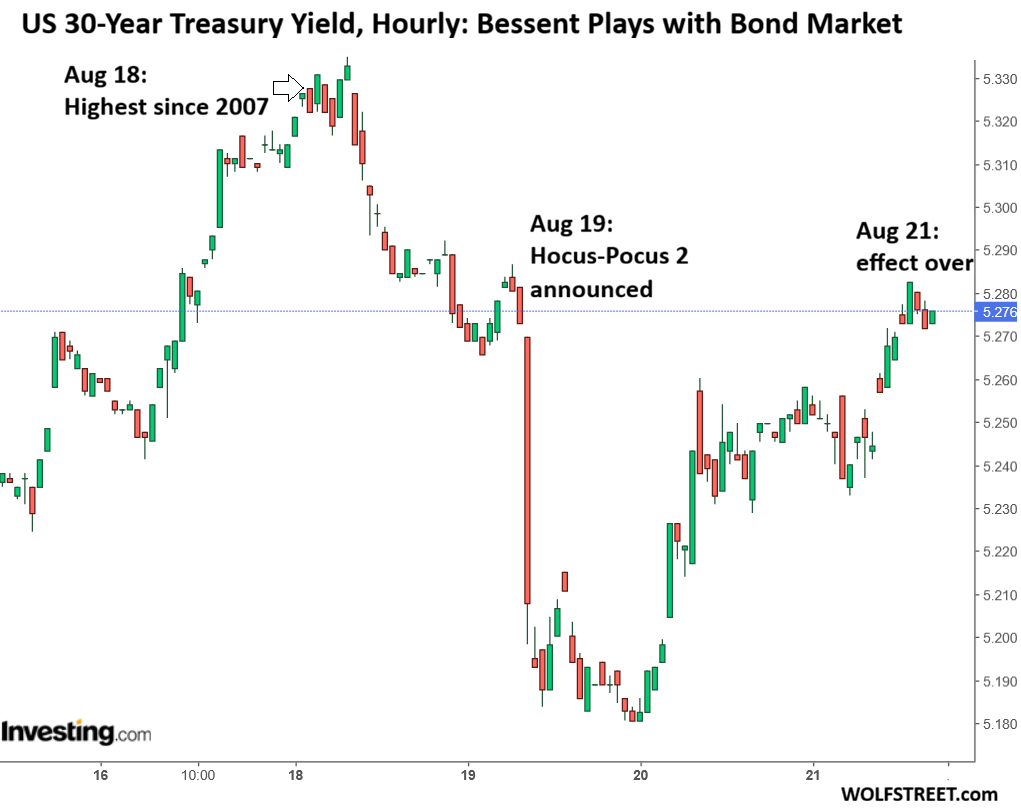
It took the bond market only two days to undo the one-day effect of Bessent’s second hocus-pocus show in August. It had taken the bond market almost two weeks to undo the effect of Bessent’s first hocus-pocus show at the beginning of August. If there is a third hocus-pocus show, the effect may be gone in one day (and we’ll start labeling them Hocus-Pocus 1, Hocus-Pocus 2, etc. to be able to keep track of them).
The chart below shows the last 14 years of the 40-year bond bull market (when yields fall, bond prices rise), and the first 6 years of the bond bear market (when yields rise, bond prices fall).
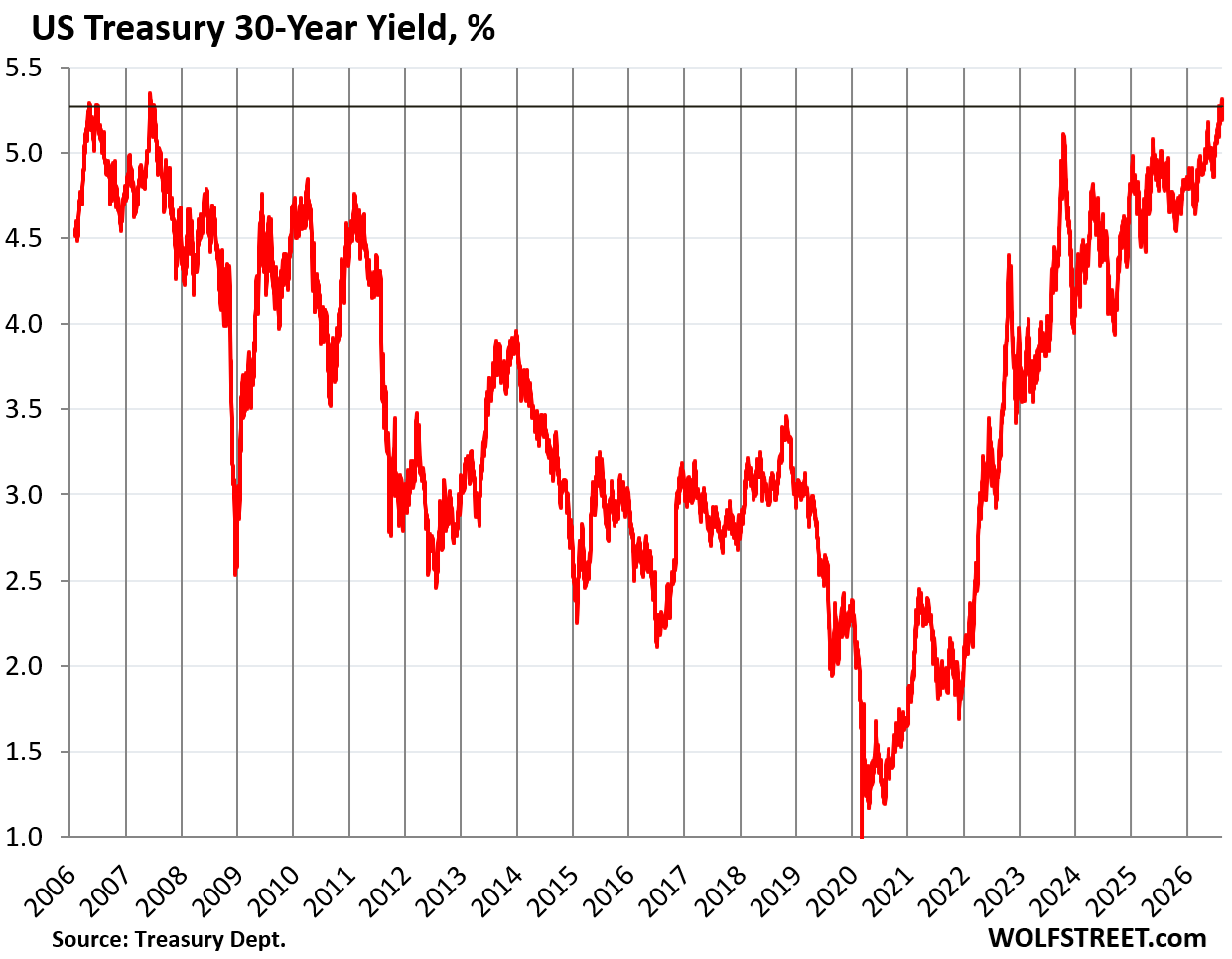
Investors who bought these low-interest-rate long-term bonds at Treasury auctions in 2020 and 2021 are sitting on huge losses, in some cases exceeding 50%, in terms of the market value of these bonds.
And the effects of the two hocus-pocus shows were so minimal and brief that they get lost in the regular bond-market squiggles.
The 10-year Treasury yield rose by another 5 basis points on Friday to 4.74%, having regained the entire hocus-pocus drop on Wednesday, and is just 1 basis point short of July 31 (4.75%), on the eve of Bessent’s Hocus-Pocus 1, and that had been the highest since January 2025. So back to square one.
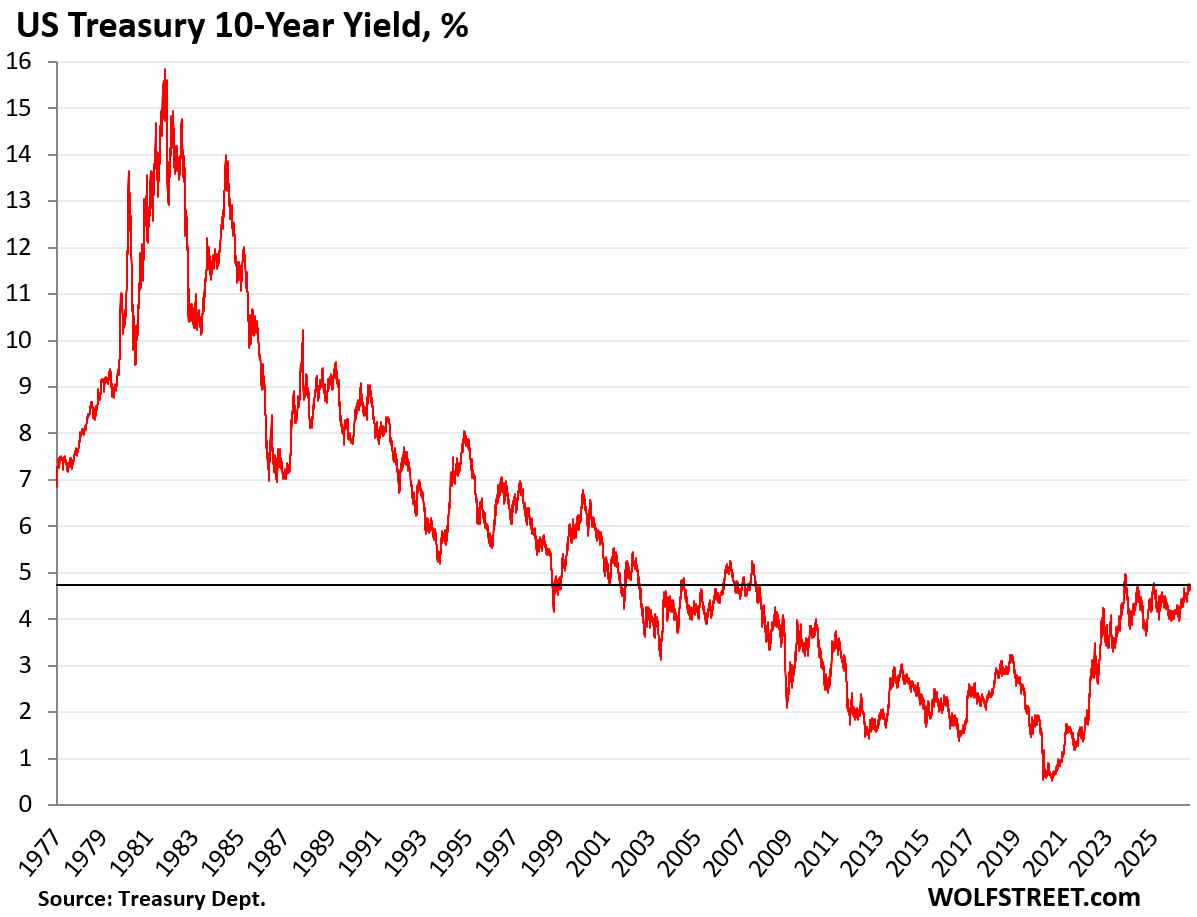
But historically, yields are not high. Here we’re looking at the last four years of the brutal bond bear market through late 1981, the 40-year bond bull market through August 2020, and the six years of the current bond bear market.
Yields are only high in the context of the Fed’s interest-rate repression via QE which started in late 2008 to deal with the Financial Crisis.
What caused yields to rise over the past three months wasn’t some sort of market dysfunction that needed to be straightened out with a series of hocus-pocus shows.
No, it was that the government had to sell $1 trillion of new bonds to investors over the past three months to fund the new deficits, and those buyers demanded higher yields to get enticed off the fence and buy this $1 trillion of new debt while at the same time refinancing the massive pile of maturing debt.
They demanded higher yields to overcome their triple-fears: Fears about future inflation and a lax Fed that will refuse to crack down on it (which wipes out the purchasing power of long-term bonds); fears about the unsustainable trajectory of the fiscal deficits (made even worse by the war in Iran and by the Supreme-Court-triggered tariff refunds); and fears about the flood of new debt that must find buyers at an eyepopping rate of $1 trillion every three to five months, come hell or high water.
In addition, the government is now competing with the AI investment mania that is also trying to find investors for bonds with much higher yields and much bigger risks.

And the market did its job and absorbed the $1 trillion in three months, and the higher yields made that possible.
But the higher yields that buyers demanded to buy this onslaught of new Treasury debt caused Bessent to blow a fuse.
What did he expect as $1 trillion in new debt must be sold every three to five months despite all the risks piling up around the market?
The solution would be fiscal consolidation. Most of that has to be done in Congress. But Congress has become a fiscal joke, as has the White House, handing out tax cuts left and right, and firing up spending, including on the war in Iran.
Bessent, lacking a real solution, came out with these hocus-pocus shows to push down long-term Treasury yields, and both were effective only for brief periods.
Bessent admitted in an interview with CNBC Thursday morning, the day after Hocus-Pocus 2, that a big part of the show was just jawboning the yields down. “Part of it is signaling here,” he said, using versions of the word “signal” multiple times during the interview.
Bessent is now the world’s biggest bond salesman. To fund the deficits that are decided in Congress, he’s got to sell these bonds, that’s his job, and he wants to do so at the lowest possible yield.
Think of him as a used-car salesman who absolutely has got to hit his quota, and he has got to get high prices (low yields), but the vehicles in inventory aren’t good enough to be sold at high prices, and customers are walking out, and he’s desperate and has got to do something to sell those cars, and so he puts up his hocus-pocus shows, instead of selling the vehicles at lower prices, but it doesn’t take long for these customers to see through the hocus-pocus, and then they get really worried because now they’re losing confidence.
If bond buyers lose confidence, they’ll demand even higher yields for the bonds that Bessent has got to sell. He better watch out with his games.
Enjoy reading WOLF STREET and want to support it? You can donate. I appreciate it immensely. Click on the mug to find out how:


Federal bonds are subject to taxes. Munis aren’t. Subtract the tax from the federal bond yield and it doesn’t look so hot.
Interest from Treasuries is subject only to federal taxes, but not state taxes. Important detail in states with high state income taxes.
Also the risk profile is very different: Muni issuers can, do, and did file for bankruptcy, and bond holders can face haircuts or payment moratoriums. Detroit bondholders got whacked during the bankruptcy.
Muni bond interest is not taxed in the state that the bond was issued. So if you live in CA (or NY, or IL) and buy bonds from your state, you pay neither state nor federal taxes on the interest.
True, but those munis also have lower yields so it’s usually a wash.
Correct, the risk of course is that, unlike the U.S. treasury, municipalities can default.
Caution: some states do not exempt their own issuances from state income tax…
Some munis are subject to AMT under Fed Taxes.
Yes – When the marginal bond buyer becomes individual investors rather than institutions, people will demand after-tax yields that exceed inflation, not just nominal yields above inflation.
I bought 30-year TIPS on August 29th. The yield is 2.95%.
“… people will demand after-tax yields that exceed inflation, not just nominal yields above inflation.”
Does this yield satisfy that?
August 20th, I meant
IMHO – this is the beginning and a small taste of the coming ‘strike’ by bondholders over the risk of U.S. Treasuries.
When the interest rates paid on U.S. Treasuries goes over 15%, that’s when we are really in the weeds. And that is coming.
The only way out is to inflate-away the debt, either over a few years, or in one overnight currency re-issuance (e.g. Isael Jan 1, 1986).
Happy Friday !
They were there in theearly 80s when Volcker inheirited the mess Burns an Nixon cooked up. Just another example of Republican malfeaseance. The S&L mess, disintermediation, repeal of Glass Steagall, no regulation of derivatives, the Iraq invasion, the 2008 recession, Covid, tariffs, inflation. It never stops until they wreck our economy, retiree security, healthcare…..etc.
How many voters who only hear “woke” or “criminal immigrants” or “vaccines will kill you” have a clue about any of this? Therein lies your problem, and it seems to have become a little too embedded here.
I could point the finger the other way buts its not both worth the time. Reality is that both parties are responsible for this mess.
repeal of Glass Steagall…
The repeal passed with bipartisan support:
The Senate passed it 90–8
The House passed it 362–57
President Bill Clinton signed it into law on November 12, 1999.
“Hocus-Pocus 1, Hocus-Pocus 2, etc. to be able to keep track of them”
“We’re going to need a bigger boat”
Noah’s ark.
The bond holders got their real revenge using the 20Y the same day.
When you’re the one that needs the money, squeezing the big dogs on their bond shorts bites back hard.
Anyone thinking bond vigillantes still exist must be high. If the economy goes into recession, there will be a stampede into bonds and yields will go back down to 2% very quickly. There’s already a mini stampede, which is why yields are so low with the debt and inflation the US had had for years.
At some point high oil prices, higher interest rates and tech stock insanity starts to bite. After the election, I’d advise watching out.
I’ll take the under on that.
LOL! I’ll take the other side of that trade. Anything priced in dollars with shoot up in price and the dollar gets crushed, and THAT is what is about to happen. We cannot default, and do not see CONgress suddenly doing their job and balancing the budget, so inflation will soar while the treasury and the Fed work to manipulate rates as low as they can keep them. Yes, nominally rates will rise relative the the “published” GDP. In real terms, inflation will be much, much higher.
The so called bond holders are like sheep in a field, oblivious to the impending doom
All the while the well off are shearing them, even though they far outweigh the sheep shearer
There is another possibility which could be devaluation of USD (we have 6% deficit and no any plans to cut it)
U.S. $ has already devalued 98-99% since 1970.
80% devaluation since 1990.
30% devaluation since 2020.
Since 1970: -88%
Since 1990: -61%
since 2000: -48%
What I am afraid is that USD could lost value with respect to other currencies and this could undermine USD as the main world currency. Combine this with recent treatment of US partners (tariffs) and friendly NATO countries this could open Pandora’s box of many other problems and could bring destabilization of international business and movement of capital. But perhaps I am just only too pessimistic.
Serious question: Why do you want the USD to be the main world currency? Does it get you (as a person living in the USA) anything you really need, but is not available to the many “middle power” nations who are minority players in the global marketplace?
Or is it just bragging rights?
@Jan
There is no replacement currency for the USD as reserve currency.
The euro isn’t going to happen after the last decade of open EU subservience to the US, inability to control member country deficits, and self immolation of their industries to name a few of the problems.
As for the the yuan/renminbi, China has made it very clear that it doesn’t want the position by keeping the currency controls.
The yen, the economic woes of Japan prevent that.
Pound, same problem with Great Britain.
And that is precluding that basically the entire international financial system since Bretton-Woods is setup with the US and the Dollar as central country & currency.
The result is that central banks have started hoarding gold again.
@Grant:
Control, well until a bunch of idiots trying to hide the costs of waging wars (and slowly ever more of the other costs of running a country) decided that the need for money now allowed them to cheat the rest of the world. Granted it has taken almost 60 years before it has become so blatant that the rest of the world is now trying to wean of the dollar as reserve currency.
Wolf, where did you get your numbers?
BLS CPI calculator. Other CPI calculators also work. I could also figure it on my CPI spreadsheet, where I set up formulas for a bunch of more recent ranges, such as “since Jan 2020,” etc. and you see those in my CPI reports.
So what? MATH is real and you can ALWAYS divide a number by 2 (50% loss)…
We cannot default on our debt, and I don’t see congress suddenly doing their job (it’s clear that they are bought-and-paid for by the corps/people looting the country), so inflation is will be for the foreseeable future.
Imagine loaning the US government money for 30 years.
Anon –
What else do you recommend, out of curiosity…
Diversified portfolio with 60% Melania Coin, 30% monkey jpegs, remainder in 6x leveraged AI chatbot ETF
That is exactly correct
only as an tax arbitrage
Another great article. “Don’t fight the Fed”… fight the Treasury instead.
We live in a country that has been taught taxes are bad and debt is good. Eventually politicians will realize there is no such thing as a free lunch.
I’m buying long duration T-Bonds. Given my tax residence, I don’t have to pay tax on sovereign bond coupon income, and I like the idea of getting a 5% after tax yield. I understand the risk that the yield curve could steepen further but I’d prefer to take this risk than buy US equities are current levels. And with the yield curve steepening the opportunity cost of keeping cash or buying T-Bills has increased. Finally, if long duration bond yields do increase substantially, it makes it very hard to justify equity prices. Bond proxies like utilities look less attractive and applying a higher discount rate to the future cash flows for growth stocks makes their present value (ie their share price) very hard to justify.
Problem. Anything denominated in USD is going to have to fight that battle too. Nearly all countries are fucked to some degree….I’ve diversified to many different ones (either equities or bonds) to protect the USD downside if the tomfoolery continues.
Bman, where is your tax residency? I like the idea of not paying tax on sovereign debt too.
Nevis? Cayman Islands?
Thanks
Hong Kong
I heard it the 80s hong kong was the coolest city in the world from a good friend who was extremely well traveled. I have never been there. Thanks
Lacy Hunt: Fed’s Been “Stealth-Easing” Since December
“Since mid-December, the Fed’s balance sheet has expanded by roughly $200 billion. So for all the talk of a hawkish Fed, they’re still a net buyer of Treasuries.”
Not so. Deposits held in Federal Reserve Banks have dropped by 290693b since July 3rd 2025, reflecting a tight money policy.
What’s happened during the interim is that savings/investment type deposits have been shifted into means-of-payment money. I.e., the ratio of DDs, demand deposits, relative to TDs, time deposits, has risen. This is corroborated by the drop in the savings rate. This impetus is finally running out.
September is traditionally the worst month for stocks. Not sure why
I notice that stock valuations are at a level normally associated with the moment just before the cataclysmic failure of an obvious financial bubble.
Bro forgot about FX swings?
That means you are long dollar too.
Dollar has gone down 15% since Trump…
+5% -15% = -10%
Nothing like having two speculators run the world’s largest economy. Trump and Bessent.
Bill Clinton’s chief strategist James Carville famously said: “I used to think that if there was reincarnation, I wanted to come back as the President or the Pope or as a .400 baseball hitter. But now I would want to come back as the bond market. You can intimidate everybody.”
“ key economic policy-makers are beginning to come to grips with the fact that they are not the only ones who will be calling the economic policy shots.
“The U.S. government’s huge debt–nearly $4 trillion–and the resulting clout of bond investors here and abroad means that the seat of economic power, once firmly rooted in Washington, will to a greater degree than ever also reside…
… “ Power will not be held only by the Treasury, the Federal Reserve and Congress. Thousands of bond owners and portfolio managers around the world also will have a collective influence–some economists even say veto power–over the Administration’s policy choices.
“There will be serious constraints on the policy options of the President of the United States –and it doesn’t matter what his name is,” said Richard B. Hoey, a bond portfolio manager and the chief economist for the Dreyfus Corp., a purveyor of mutual funds.
All of the above from the LA Times … in 1992.
30y Treasury yield quoted as 7.7%, up from 7.2% and forcing policy realignment by the Clinton administration.
The National Debt was only $4 trillion in 1992.
It has grown 10-fold in only 34 years!
THAT is inflation. We owe 10x as much which means someone thinks they own 10x as much in “assets”.
But the real economy hasn’t grown 10x!
Yes but defense industries have done spectacular. 8 trillion alone of our debt is the “war on terror” which is really just foreign policy payback karma.
what that really is ‘inflation’
a govt made up word to hide real meaning
DEVALUATION FIAT $DOLLAR
GDP is 5x what it was in 1992.
Even after adjusting for inflation, real GDP is almost 2.5x what it was in 1992 (though if you adjust GDP for inflation, you have to adjust the debt by inflation too).
Congress just keeps spending and the topic of debt is avoided or dismissed. I’m starting to think that they know exactly what they are doing and that I should not worry about it at all.
Possibly the most amateur move possible. Announce in advance a miniscule amount of refundings, funded with new debt. What a better way to scare the bond market. And who made out like bandits on this one? The carry trade?
Has Bessent ever traded bonds? This was a deal designed to go into someones pocket.
There was also the crypto meeting at the White House on about the same day. Then, bitcoin surged, as it will do when it looks like more liquidity is available. I agree, Trump and Bessent do nothing without a profit motive.
What happens to the price of assets that are purchased with loans when the rate of that loan goes up?
You bought a house in 2021 for $500,000 and financed it with a $450,000 mortgage with a rate of 3%. Now mortgage rates are 6.7%. What happens to the price of the house? (the asset).
The link is not direct. In some cities, home prices have fallen substantially; in others, home prices continued to rise.
With stocks there is even less of a link. The rates brokers charge for margin loans don’t really impact the prices of the stocks that are being bought with these margin loans.
There are other asset classes where the links is a little more direct.
Look up Hocus Pocus by Focus on YouTube. Watch a live version and imagine Scott Bessent as the yodeler. This is our future. It will all make sense.
Lol. They had a decent guitarist though.
The flute playing reminded me of Tull!
On the upside,me in hand metals are rising,of course,if I sell they just buy the same amount of stuff for most part.
I’ll finally spill the beans. What is this hilarious nonsense about commenters spelling out the numbers in their screen names? Someone started a conspiracy theory here a few months ago in the comments that it was numbers in the screen name that sent comments into moderation. I saw this, and laughed my ass off, and didn’t say anything. I have had a blast watching this. The guy that came up with it keeps coming up with similar conspiracy theories about everything he doesn’t understand — instead of trying to find out how it actually works. That’s just how his brain is wired. But this stuff is just funny.
Well,when I did 1911 to differ from other James(and love me 1911’s),there was a time comments would not go thru,weird computer glitch my end or what do not know so Nineteen Eleven it was.
I tried now and site said number not allowed in name,so….,there is that.
Numbers have zero to do with it. Your comments go into moderation at least temporarily if you:
1. violate the 7 deadly sins of commenting.
2. Violate the 1001 guidelines of commenting
3. If you use an email or screen name that had been used by spammers, or if your comments get routed through a spam server, which causes your comments to get flagged as potential spam.
Time to hoard currency to force the Fed gov to capitulate!
It’s funny, yields rise just a little bit back to normal levels, and suddenly it’s panic mode? I’m glad the bond market is finally free to do its job.
“If bond buyers lose confidence, they’ll demand even higher yields for the bonds that Bessent has got to sell. He better watch out with his games”.
I can’t imagine a Soros trained billionaire hedge fund manager would expect the bond market to dip because he moved from $2B to $4B in a $7 or $8 Trillion Dollar treasury Market?
These guys are master manipulators and they don’t make rookie mistakes. My guess is there’s probably a massive disinflationary or even deflationary pressure coming.
He didn’t move any money at all. That thing won’t even start till September. He tried to jawbone down the yields. He said as much in the interview, as I pointed out in the article. There are times when jawboning works, and it did work, but not for long.
> “My guess is there’s probably a massive disinflationary or even deflationary pressure coming.”
I’ve been thinking the same thing. I understand the government’s fiscal mess, combined with the Fed’s unwillingness to tackle inflation, should cause rational bond buyers to demand higher rates. The question is then, why aren’t rates even higher than they already are, to offer greater insurance against inflation? Well, maybe there’s a signal there, from wealthy interests who have decided that owning bonds at today’s rates is not such a bad deal. If there’s a deflationary shock, and the stock market tanks by 50% or more, and interest rates fall as no one wants to own risky assets, those bond buyers would appear prescient.
Inflation adjusted 10-year yields are about 2.3%, which is very close to their historical average. The bond market very rarely demands more than about 3-4% over inflation, with the one major exception being 1981-1986, where it spiked to about 8%.
Interestingly, the best time to have bought and held 10-year treasuries in history was 1981. People who bought then got 10% annual yield *after* adjusting for inflation.
Good info, thanks!
This is incorrect.
The 10-years you bought in 2016 which just matured all LOST to inflation.
And you have no idea whether the 10-year you buy next will or will not beat inflation, because no one knows what inflation is.
Next, the TIPS yield above inflation is higher than 2.3%. So if you really think the current 10-year yield is only 2.3% you’re better buying TIPS.
Finally, not one of these beats inflation after taxes, unless you’re in a low tax bracket.
Considering Japan is the largest foreign holder of our debt right now, how would a stock market blowout on their side play out on our side? Would they finally resort to mass unloading on their side to stabilize and strengthen the yen? That would wreak havoc on this side of the Pacific.
Also, quite conveniently, China restricted rare-earth exports by more than 50% in July. It would be quite the astute economic warfare by China to kill their stock market by suffocating their tech exports that they rely so heavily on.
I think Japan might have their hands on the balls.
Of Bessent. Ouch!
It’s insane to think that half of our current
$40 Trillion debt (yes, $20 Trillion) was accrued since the year 2020. I just read that recently, and almost fell off my chair. In-friggin-sanity!
Yeah, but look what we got for the 20 trillion.
A slight exaggeration: total debt was $23 trillion at the beginning of 2020. It hit $20 trillion in mid-2017. Almost $4 trillion of the total debt was added between Mar and Jun 2020 as a response to the pandemic.
The only amazing thing to me is that yields are still 5%. When rates were in double digits debt to GDP was a third of today, the US economy was still robust (making stuff – import/export) and there were some adults in the room. The only way out of the mess is default by inflation and they are satisfied with 5% over 30 years?
Maybe it’s because default by inflation is not the only way out.
I would not count on yields staying at a mere 5%.
I just can’t wait for the world to go full on crapto currency! Think of the possibilities’
Perfect seamless smooth wealth transfer from those who bought the cryptos to those who sold them.
Haha….
Probably
Hocus-Pocus,watch the pea is the new normal.
More jawboning by Bessent. He said hey no worries we’re going to grow our way out of the debt and later Trump echoed that.
May the vigilantes are doing the math.
“At a sustained 3% real growth rate (the administration’s stated target, and something the US hasn’t sustained for 30 straight years in the modern era): the ratio (Debt/GDP) still rises, but much more slowly — leveling off around 130%. It doesn’t shrink; it plateaus well above today’s level.”
i’m an old trader that has never stopped going to college, since the 1970s. i am finishing up a summer class on the revolutionary USA financing and other related topics. i know i wasn’t taught this in my rich HS or state university way back. i might have had other priorities at the time. sex drugs and rock and roll. please allow this to be posted for you and your customers of your blog. might help.The financial fallout of the American Revolution is the most significant historical example of an actual currency collapse and massive debt restructuring (haircut) in U.S. history.Because the Second Continental Congress did not have the authority to levy taxes, they had to fund the war for independence almost entirely through the printing press and promissory IOUs. This led to a catastrophic financial failure.1. The Continental Currency: A Complete DefaultBetween 1775 and 1779, Congress issued over $200 million in paper “Continental dollars”.The Hyperinflation: Because the currency was backed by nothing but the promise of future tax revenues from the states—which rarely materialized—the money rapidly depreciated. By 1781, it took $100 in paper currency to buy $1 in gold or silver coin. The currency completely ceased to function, giving rise to the famous phrase, “not worth a Continental.”The 99% Haircut: In the Funding Act of 1790, orchestrated by Treasury Secretary Alexander Hamilton, the new U.S. government officially demonetized the Continental. The government offered to buy back the old currency in exchange for new U.S. government bonds, but at a rate of 1 cent on the dollar. Holders of the currency lost 99% of their face-value investment, a deliberate repudiation of the currency’s original stated value.2. Revolutionary War Bonds and “Loan Office Certificates”To keep the army fed and equipped, the Continental Congress and individual states issued various bonds, “loan office certificates,” and indents (paper promises to pay interest) to citizens, merchants, and soldiers.The Pre-1789 Default on Interest: By May 1782, the Continental Congress was completely broke and stopped paying interest on its domestic bonds in coin (specie). Instead, they issued more paper IOUs (indents) to cover the interest, essentially defaulting on the promised cash payments. By 1787, these domestic debt certificates were trading on the open market for as little as 10 to 15 cents on the dollar.The Hamilton Restructuring: Under Hamilton’s landmark “Report on Public Credit” and the Funding Act of 1790, the new federal government assumed all national and state wartime debts to restore the nation’s creditworthiness. However, creditors did not get exactly what they were originally promised.The Rate Reduction: Hamilton realized the government could not afford the original 6% interest rate on the total volume of domestic debt. Creditors were forced to accept a restructuring: two-thirds of their principal was funded into new bonds paying 6%, while the remaining one-third was placed into “deferred” bonds that paid 0% interest for the first ten years. Arrears on past interest were paid out at only 3%.Summary of the Revolutionary Era FinancesAsset TypeOriginal PromiseUltimate OutcomeContinental CurrencyRedeemable at face value in gold or silver.99% loss. Redeemed at 1 cent on the dollar in 1790.Wartime Bonds / Certificates6% interest paid reliably in cash/specie.Interest default from 1782–1789. Forcibly restructured in 1790 to lower the effective interest rate.While Hamilton’s debt assumption plan successfully stabilized the new nation’s credit and allowed the U.S. to borrow on international markets going forward, it only succeeded by forcing massive losses onto the original citizens, soldiers, and merchants who funded the Revolution.If you’d like to look closer, we can examine how foreign loans from France and the Dutch were handled, or delve into the political fallout of Hamilton’s plan, which directly triggered the Whiskey Rebellion.AI can make mistakes, so double-check responses WikipediaEarly American currency – WikipediaContinental currency. … After the American Revolutionary War began in 1775, the Continental Congress began issuing paper money k…Office of the Historian (.gov)U.S. Debt and Foreign Loans, 1775–1795 – History State GovDuring the American Revolution, a cash-strapped Continental Congress accepted loans from France. Paying off these and other debts …US House of Representatives: History, Art & Archives (.gov)The Continental Congress Holds a LotteryThe Continental Congress Holds a Lottery. November 01, 1776. The Continental Congress Holds a Lottery Image courtesy of the Librar…Show all
What about England after WWll?
“Those who cannot remember the past are condemned to repeat it” — from philosopher George Santayana
“• When gilt prices collapsed after Dalton’s cheap-money push failed, it wiped out capital for banks, insurance companies, and pension funds that held large gilt portfolios — since gilts were considered the safest possible asset, this shook confidence in the whole system.
• Dalton was forced to abandon the policy in 1947, and the reversal itself was destabilizing — investors who’d been coaxed into long-dated low-yield gilts got burned, which made them warier of government debt generally.
Credibility damage
• The episode damaged trust in the Treasury’s ability to manage interest rates. It became a cautionary tale that trying to force yields artificially low, especially amid inflation and heavy war debt, could backfire rather than smoothly cheapen the cost of financing the debt.
• Dalton himself was pushed out as Chancellor in November 1947 (though technically over an unrelated budget leak scandal), and cheap money as a strategy was largely seen as discredited by the establishment for years after.
Longer-term effects
• It contributed to a shift in UK debt management strategy — instead of pure yield suppression, later governments leaned more on the broader financial repression toolkit (captive buyers like banks and insurers required to hold gilts, capital controls, etc.) rather than trying to jawbone rates down directly.
• Gilts developed a lingering reputation as a shaky, low-confidence asset class for much of the late 1940s and 1950s, which fed into higher risk premiums investors demanded even after the immediate crisis passed.
• More broadly, it fed into a difficult postwar stretch for Britain economically — sterling convertibility crises, austerity, and rationing were all happening around the same period, and the gilt market wobble added to a sense that Britain’s finances were fragile despite having “won” the war.
It’s often cited as an early cautionary example of what happens when a government leans too hard on financial repression/yield-curve control without market buy-in — a comparison that’s come up again in modern debates about central banks doing yield curve control.”
Nobody even looked at the gold price here !! It is the most interesting of all markets. It will tell you more about the world’s present economic mess than any other, because nothing controls it. Yes, the us 30 year bond is also difficult to controll. So what is it telling me now.
Good chance of another us debt downgrade.
You can not put stock market profits in the US long term bond market for safety. Perhaps gold is the answer?
The world’s central banks are buying gold in anticipation of a debacle in many countries, not only the us.
“It will tell you more about the world’s present economic mess than any other,”
Gold is down 17% from earlier this year. So what does that tell me about the “world’s present economic mess?”
Does that mean my USD are worth 17% more than earlier this year? :-D
Yes, when you buy gold, but the percentage varies of how much more you can buy of silver, 30-year bonds, homes in certain cities as documented here, and a whole bunch of stocks, gasoline, eggs, chicken… obviously we’re just having fun with this 🤣
Henry Kissinger linked the price oil to the US $ dollar under the Nixon administration.
DXY
That connection unraveled a long time ago, if it ever existed. The oil landscape for the US has completely changed since the 1970s. Now the US is THE dominant oil and gas force in the world, and a huge exporter, documented in many articles on this site.
Gold does well when it appears central bankers and governments are not doing their jobs. Earlier this year Gold corrected (healthy) and perhaps a lot of investors re-deployed some Gold profits into the various tailwind sectors energy/AI + there was an assumption that there would be a resolution to the Iran conflict. Now no resolution in sight and the world is at a breaking point in terms of Petroleum products (diesel) and when have a FED that is still reticent to hike (I’m sure Warsh will plead the case to all of them for more data) and a TSY secretary that clearly wants to obfuscate the bond market. Gold is back for now.
Gold does well when there is a speculative mania, and all the commenters tout gold everywhere. Gold goes through gigantic manias, followed by years or decades of steep declines. Like a lot of things. Look at a 70-year chart.
Over the very long term, gold has proven to be a good hedge against inflation. Over the medium term, it’s boom and bust, and a good trading vehicle.
China was/is buying gold in 2026.
Why don’t you people tell me who is SELLING all this gold to the Chinese??? Why this constant hype about a few buyers? Who is dumping this gold? Every single troy ounce that China buys, someone else sells.
Russia is selling Gold (and gold miners obviously are)
Most Central Banks have been accumulating gold and gold is a Basel 1 Tier 3 asset
I think the most public are Poland? but also China and many others
Sadly it reflects US financial weaponizarion against Russian account and geopolitical instability (not good)
Is there a measure of bond market volatility?
Does the VIX capture some of that?
I remember working an office job in 2007-2008 and watching the wild gyrations in the equite markets leading up to the financial crisis.
I would like to know if we are seeing abnormal volatility in the bond market.
Check out the MOVE index, full name Merrill Lynch Option Volatility Estimate.
Maybe I’m missing something here but, why can’t we just ask AI like ChatGPT or Grok to figure out a solution to all this mess? AI is a super intelligence on the verge of waking up after all.
A better alternative would be to just ask Wolf himself, as he has a better understanding of the issues. He tells the truth and leaves us to decide what to do with the information.
He does not, however, make predictions or give guidance.
I think Trucker Guy was being sarcastic.
That did occur to me but seeing as how we are in the AI saturation era, many look to it a shortcut solution to many issues. and if he was not being sarcastic, I was still right!
Sure, AI can fix the human condition right after it designs warp drives, cold fusion, and a diet cola that tastes the same as regular.
No difficulty at all, barely an inconvenience.
Sometimes I’ll ask Copilot for its superintelligent opinion on this kind of stuff and it basically just says that we should be doing what everyone already knows we should be doing.
I ask it whether the reason we aren’t is because of the human condition, or is it just ignorance or something.
It says that it’s basically the human condition and that our capabilities have outrun our institutions. But if we want to be optimistic, it says, we have to remember that we can and have created institutions that can address long-term problems, listing:
– Property rights reducing some commons problems.
– Independent central banks helping control inflation.
– Pollution regulations improving air and water quality.
– International agreements reducing some global risks.
I’m laughing and going, you know, given the direction that our current elected leadership is going on those things, are you *sure* the root problem isn’t ignorance?
Washington is so dysfunctional and no political force seems to disrupt the “Establishment” structure. Maybe the market will finally twist congress’s ear into fiscal responsibility.
I think our loss in Iran is having some effect on bond yields, as well as the 40T debt milestone. Just a hunch.
We’ve painted ourselves into a corner. Every option will be painful beyond what any of us have experienced since the Great Depression.
I know a lot of people consider Bessent smart because of his background or maybe just in relative comparison to other Washington clowns. Hopefully it is recognized he is just another puppet and not that bright. His one use would be in a zombie apocalypse as would be one of the few people that would go before me and might slow them down.
You don’t jump out of a giant hole you have built but you need to develop long terms plans to build stairs to gradually climb out of it. Our political system, just like Western Europe, is not built for stability but election cycles.
Somehow Bessent’s past association with George Soros does not provoke outrage in people with Soros Derangement Syndrome. Odd that the dog isn’t barking? Maybe he’s always gotten more credit for finance savvy than deserved for simply working at a trading desk executing strategy for other people, and now it’s catching up with him? At least Scott’s trying to signal the markets – something Warsh might try at some point.
bessent was a failure running his own money. he worked FOR soros. he did not run the place. he’s obviously an idiot to go work for trump. he’ll be mocked for generations. he’s a text book nihilist. no there, there.
I won’t pass judgment on Bessent but in my opinion he is better than many of those who previously held his position and whoever comes after will be worse.
The US Treasury debt is asset backed and secured by the ‘full faith and credit’ of the US, isn’t it? How much is the Grand Canyon worth?
If there is one thing I’ve learned after 80 years, it’s this; these are the good old days.
I agree with you that ZIRP was not normal, but neither was the Volker shock. Is there a broad consensus regarding what the bond market should look like under normal, healthy conditions? It seems there’s debate over what the natural rate of interest is.
3% real yields on long dated TIPS look like a good deal for someone nearing retirement.
If the bond market helps to end the war with Iran, can the Nobel Committee award it the Peace Prize?
There’s not even consensus on what causes inflation, let alone what the bond market is “supposed” to look like.
WSJ ran an article last week profiling three economists who are likely to have some strong influence on the Fed. Each one has their own pet theory of what causes inflation.
Headline: “The Three Minds Leading the Fed’s Inflation Rethink”
What causes inflation is price gouging.
I restaurant I go to has quit serving vegetables due to all the recalls. The sandwich I get, no longer has lettuce or tomato. The price has not come down to reflect lesser nutritious ingredients. This is now the world we live in.
My fixed income of choice is Munis. I’m uncomfortable with treasuries because of political uncertainty, how will they react to gridlock?
Main benefit to munis is diversification. They aren’t all going to default, they rarely do. Using Detroit as an example is like saying your neighbor’s broken down car died, therefore don’t buy a car. Best to choose counties and cities that you know are growing and have good economies. I’m buying discounted bonds in the 12-14 yr range that yield 4-4.4%. Yes the principal will lose purchasing power over the years but a stock can lose purchasing power in months, maybe weeks.
SUPPOSEDLY: Bessent sold Euros from reserves to buy Yen … it was not until after the transaction did he inform the EU central bank.
Interesting note if true.
I guess the “signal” is they are willing to do this on a larger scale.
What’s the possible of a recession if the 10-year hits 5 percent?
It already hit 5% in October 2023, and there was no recession. If it stays over 5% but under 6%, that won’t change much in the economy, except dragging down real estate further, but it’s already so low, it won’t make much difference. Back before 2000, the economy had more economic growth than today while the 10-year was at 6%+.
Inflating the debt or cutting spending further beyond DOGE will only forment civil unrest among the masses. So, what’s left to start stabilizing the US bond situation?
Something horrifyingly unthinkable: Taxing wealthiest income and estates at Eisenhower-era rates. No! Never, never, never !! NOOOOOOOOOO!!!!
yeah, the poor have been taxed to death with inflation; a regressive tax; while rates haven’t moved a whole lot for other entities.
Maybe this week we get to see what Bessent will do to calm the middle durations with the 2, 5, and 7 year auctions. Will be fun to watch
The U.S. debt ceiling is $41.1T, and the debt just hit $40T, so we are at 97% of the limit. In absolute terms, we have $1T to go. The debt is increasing at $270B per month. So in 4 months, i.e. at the end of the calendar year, the U.S. will hit the limit. The new Congress gets sworn in on January 3, 2027. There is a reasonable probability of “extraordinary measures” by the Treasury, beyond just issuing new debt. Does the Treasury have to stop issuing new debt, once the debt limit is reached? And what measures would it likely take to keep the government funded until the new Congress acts? Does the market assume that Congress will raise the debt limit, or is there some risk factored in that Congress would not, and fix the problem differently, e.g. by cutting spending and/or raising taxes? And the POTUS has to approve the raising of the debt limit, but is that 100% certain, even if Congress approved it? Trump could not approve it, cause some market chaos, and eventually approve it, pocketing profit from the chaos, for example. If there is a big swing in Congress, and an existential threat to his administration, then maybe he refuses to approve it, as a negotiation chip?
Bessent’s incompetence aside, I found your choice of words here interesting because your commentary regarding the market isn’t usually bearish:
“What did he expect as $1 trillion in new debt must be sold every three to five months despite all the risks piling up around the market?”
What risks are piling up that people haven’t been doomposting about for months or years now?
To me, it just seems like the bond market is finally starting to become rational about how persistent inflation is and how bad bonds look as a long term investment.
Maybe it’s as simple as Powell’s bogus dot plot no longer giving the bond market false hope.
Thanks for the obvious – everyone in the MSM is focusing on the tiny and then not so long lasting relief and few dared to spell it out: This move is undermining the credit score of the US at a time when it really can’t afford it.
This short text has been written by someone from Europe, now living within the eurozone, who has come to some important discoveries about the value of money. Specifically, the typical form of money that is mistakenly regarded as the only one: cash. And how this relates indirectly to interest rates and inflation.
I own quite a few coins, having inherited a collection from someone who did so purely out of curiosity and to train their mind to categorise objects, in this case, coins. And everyday coins at that. This person collected not ancient coins, but everyday coins. Wherever he travelled, he tried to collect the coins in circulation, including those from my own country.
And now for the part about inflation and the devaluation of money. I have in my possession coins that have been taken out of circulation but which were kept whilst they were still in use by the public and legal tender. These are coins of which millions were produced; in one case, which particularly catches my attention, 17 million coins of this particular type were issued. Not a rare coin. This coin dates from 1951; it is a little worn from use and, here’s the surprising part, if I were to sell it now to collectors, it would have appreciated in value at least by around 11% per year (CAGR). Over the same period, the average annual inflation rate in my country was 6.5%, since 1951. In other words, the coin has not lost value due to inflation. On the contrary, it has outperformed the returns on my country’s Treasury bonds and stocks. So, money didn’t devalue with the inflation as it is often said.
My message to the readers of this site is this: are you really sure about what is often said regarding the devaluation of money?
Bloomberg: Bessent Has No Easy Fix for What’s Really Driving Bond Yields Up
?? Am I the only one who’s read the article about the possibility of Venezuela beginning to use the USD ?? Pretty sure that would make things a bit more interesting. How does that work? How does the FED make available enough USD to start circulating in Venezuela??
Quite a few countries already use the dollar as official legal tender, including Ecuador, Panama, British Virgin Islands, El Salvador, Marshall Islands, Federated States of Micronesia (six countries), Timor-Leste, and a bunch of others. If Venezuela goes that route, it would not impact the US at all, but having a functional currency that the local government doesn’t control might bring some sanity to the Venezuelan economy.
The bond market also needs to absorb ~$2.3 trillion in treasuries that the Social Security trust fund will not be buying (and will possibly be selling) over the next 6 years.