
Total separations drop to the lowest since 2015 beyond the lockdown months.
By Wolf Richter for WOLF STREET.
The Job Openings and Labor Turnover Survey (JOLTS) of 21,000 business locations, released today by the Bureau of Labor Statistics, tracks labor market churn: How many people quit their jobs, how many were fired or laid off, how many retired, died, or separated for other reasons, how many job openings those people left behind, and how many people were hired to fill those job openings.
Voluntary quits are very low, layoffs and discharges are very low, retirements and other discharges are very low. So, total separations have plunged to the lowest since 2015, with the exception of the lockdown months. The low number of separations means fewer newly vacated jobs are left behind, so job openings are lower, and the number of hires to fill that lower number of job openings is lower.
The crackdown on illegal immigration and the tightening up work-visa-related immigration also plays into this as it shrank the supply of labor, making hiring more difficult.
All this makes for a peculiar labor market.
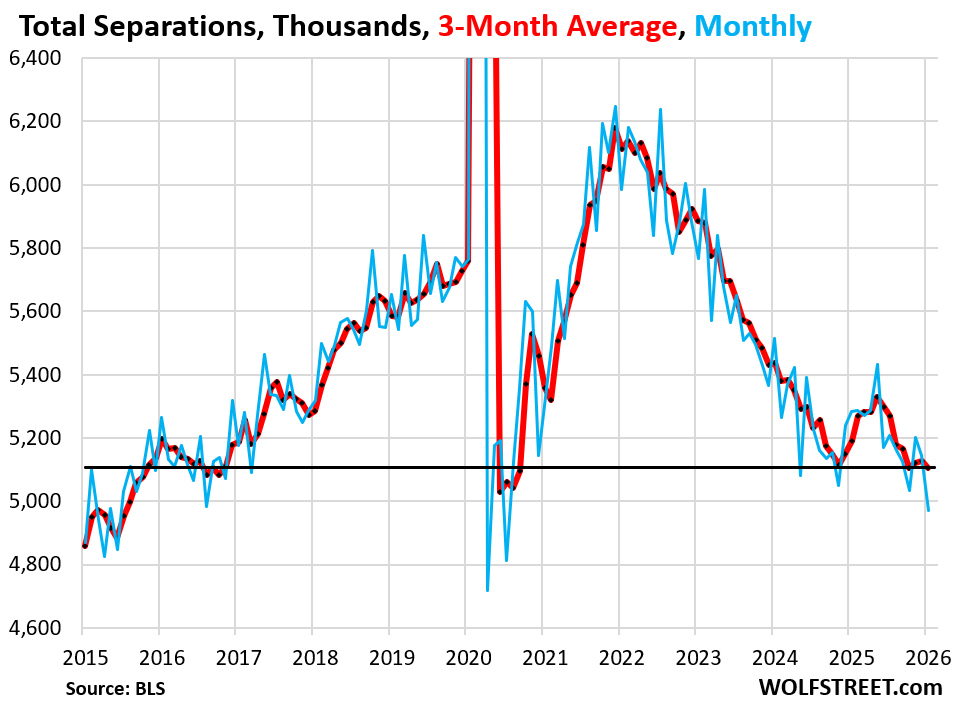
Total separations – voluntary and otherwise – plunged in February to 4.97 million, the lowest since the lockdown months, and before then the lowest since 2015 (blue in the chart).
The three-month average, which irons out the month-to-month squiggles, dropped to 5.11 million, also the lowest since the lockdown months, and before then since 2016 (red).
Total separations consist of voluntary quits (60% of total separations), layoffs and discharges (33% of total separations), and retirements and other separations (6% of total separations). More on them in a moment.
But during that decade, employment has risen substantially, and this low rate of separations shows that a form of stasis has spread over the labor market, an unusual equilibrium in the US labor market, which is efficient for employers. But it makes it hard for young workers to enter the job market.
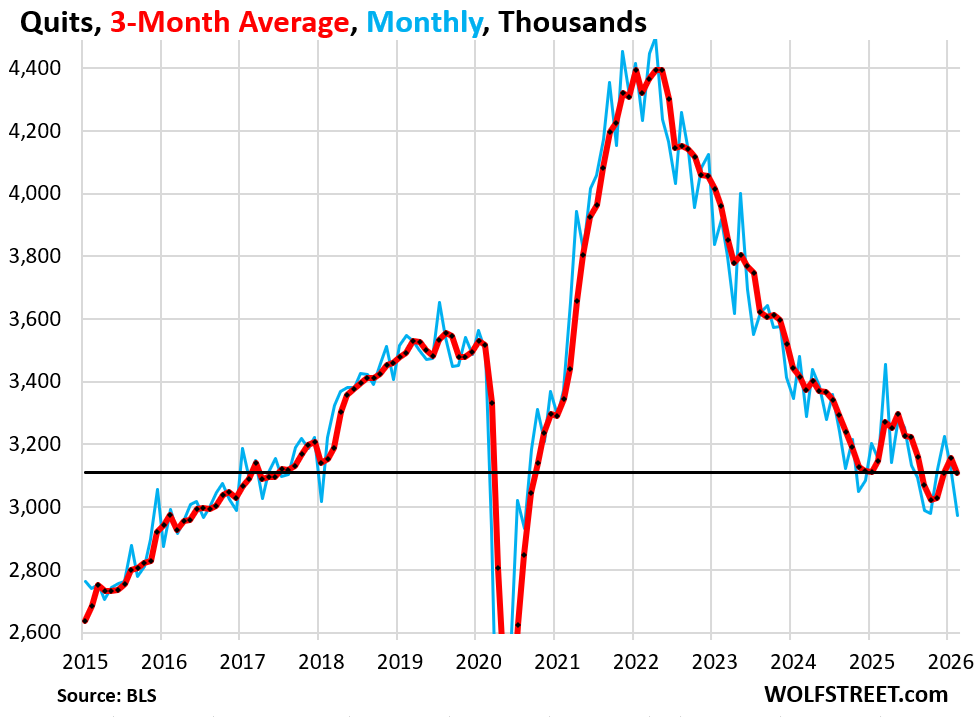
Voluntary quits plunged in February for the second month in a row, to 2.97 million, the lowest since the lockdown months, and before then the lowest since 2017-2018 (blue in the chart below).
These are people who quit their jobs voluntarily, such as to take a better job somewhere else, but do not include people who retired, died while employed, etc., who are tracked separately.
The three-month average dipped to 3.11 million (red).
Quits are the biggest source of the labor market churn and account for 60% of total separations.
Fewer quits means fewer open slots left behind that would turn into job openings and then into hires to fill those job openings.
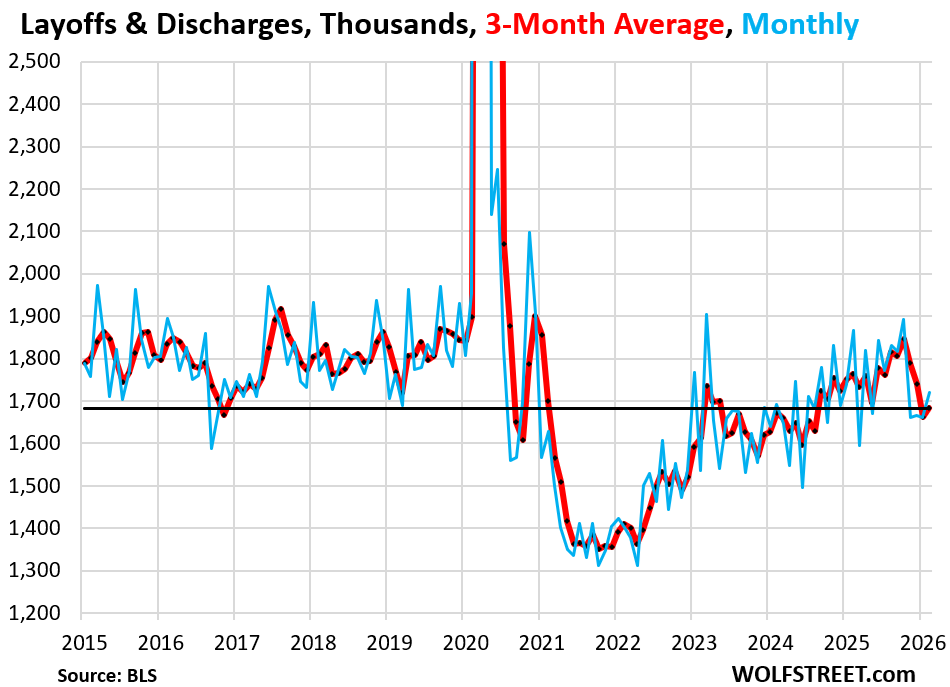
Layoffs & discharges ticked up to 1.71 million in February. The three-month average ticked up to 1.68 million, well below the prepandemic years, except for one month (Oct 2016). Only during the time of the labor shortages, and coming out of it, was the level consistently lower.
Getting fired for a variety of reasons, or for no reason, is a classic feature of the American labor market.
Layoffs and discharges accounted for 33% of all separations.
These low layoffs & discharges have been confirmed by other data, including very low unemployment insurance claims.
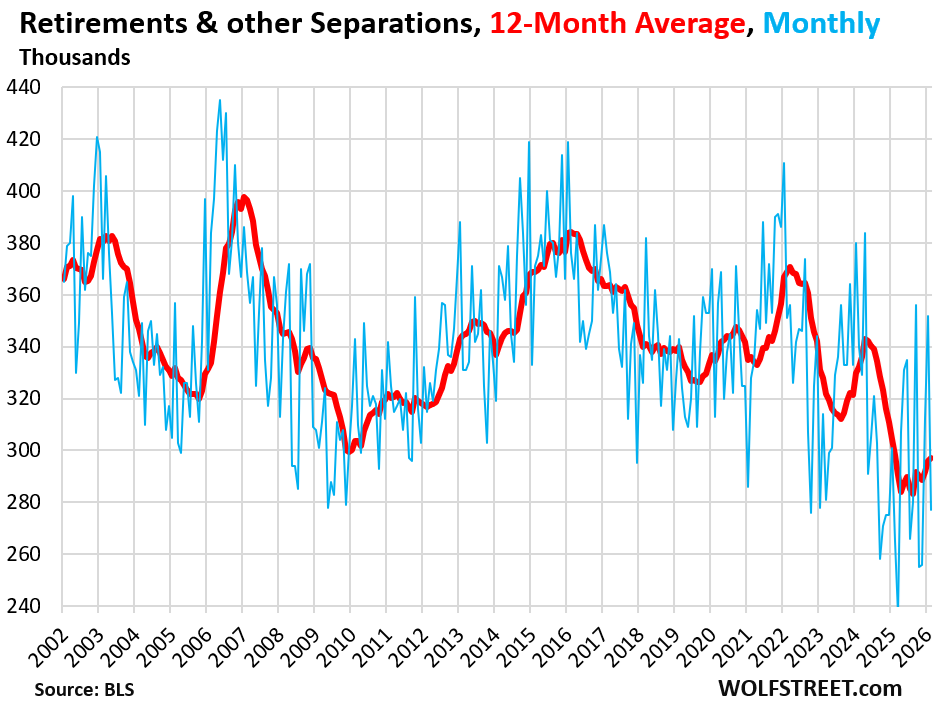
Retirements and other separations (including deaths while employed, etc.) fell to 277,000 in February.

The 12-month average, which irons out the huge month-to-month squiggles, edged up to 297,000. The last few months were the lowest in the data going back 25 years!
They account for about 6% of total separations.
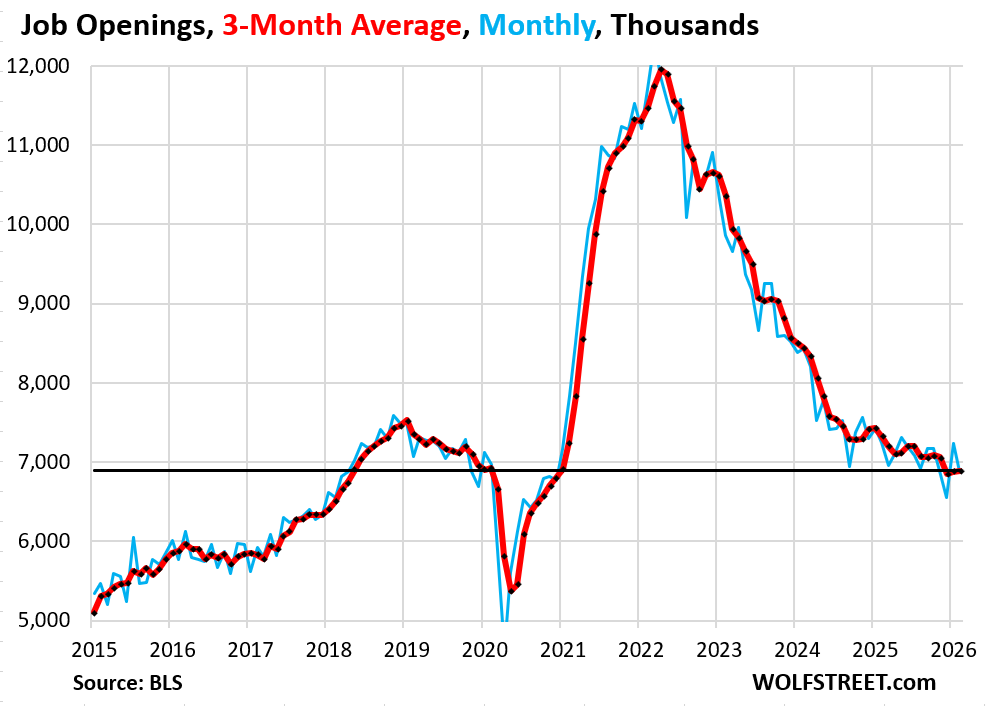
Job openings are a result of total separations that have dropped to a decade low. So job openings have sunk below where they’d been in 2018-2019. In February they fell, giving up part of the jump in January.
The three-month average, which irons that stuff out, was roughly unchanged for the third month in a row at 6.89 million openings.
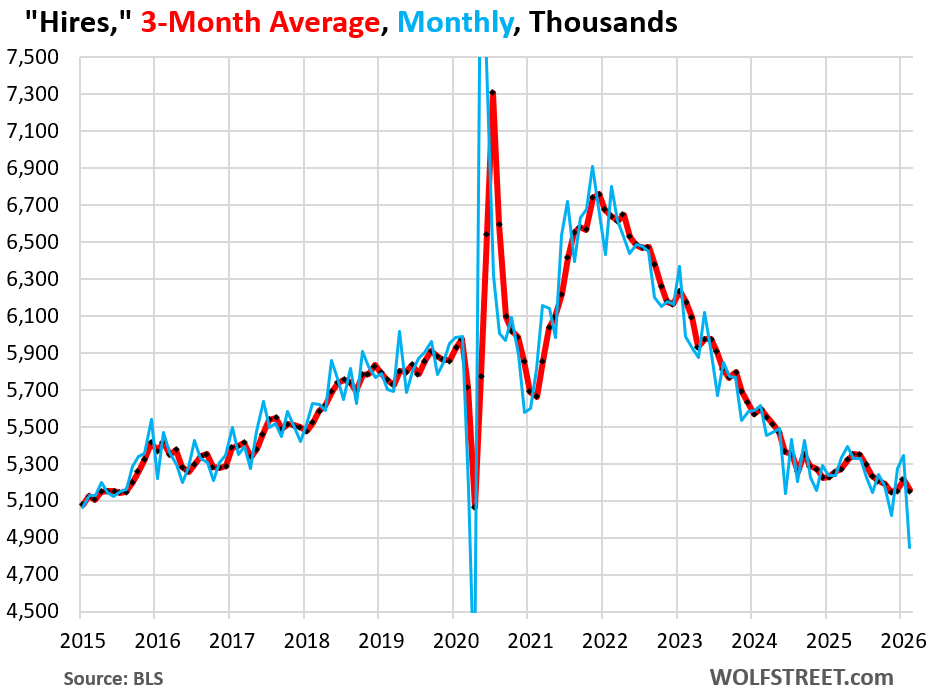
The number of hires dropped in February, after the jumps in December and January. The three-month average dipped to 5.16 million, right where it had been in December and above November. So roughly stable for the past four months.
Most of these hires replaced workers who’d separated from the company, leaving open slots behind. Only a tiny portion were hired to fill newly created jobs. But the JOLTS data doesn’t track that; the employment report to be released this Friday, attempts to track that.
These are low levels of hires, the lowest since before 2015 beyond the lockdown months. But with so few total separations – the lowest since 2015 – there are fewer job openings left behind, and less need to hire people to fill those openings.
Turnover in the labor force had exploded in 2021 and 2022 during the labor shortages. A lot of churn like that in the labor market is expensive and inefficient for employers. But it resulted in a reshuffling of the labor force, with more people switching to jobs and industries that were better fits for their aspirations, and who were better fits for their employers, which allowed for the churn to calm down in this peculiar way.
Enjoy reading WOLF STREET and want to support it? You can donate. I appreciate it immensely. Click on the mug to find out how:


Given the age demographics of the US, that post 2002 “retirements” chart is pretty interesting.
Despite the accelerated aging of the population of the US for the last 25 years, the number of actual retirements (per JOLTS at least) is flat to *down*.
There has been some tendency for people to work longer…but I don’t know that many/any pundits have suggested that trend was *anywhere* near enough to offset the massive influence of the US demographic profile.
It would be interesting to see that JOLTS retirement chart next to a chart showing the annual number of people in the US turning 65/67/68/70/ whatever every year.
It isn’t much of a stretch to posit that the 70’s saw a huge increase in 2 earner households in order to help keep peoples’ head above water – now people are having to work substantially longer too.
That is what a multi decade degeneration of living standards looks like.
(I’m sure somebody is going to try and spin these large scale demographic changes as “happy choices” – yea! Mom *gets* to work – yea! now grandpa, too!” – but they certainly weren’t conceived as positives when the US macro economy was healthier).
Boomer retirements are slowing down since lots of them have already retired — boomers are now 60 to 80– and they’re not making any more of them.
So retirements slowing down makes sense.
“They’re not making any more of them” LOL
Maybe I’m just delirious from tax season, but I am cracking up over here.
Thinking that too. Boomer births ended in 1962 or 1964 depending on who’s counting. I was born in ’62 and retired at 62 so already out. The last possible batch turn 65 in 2029. It would be interesting to know what percentages retire at what age.
I might have it wrong but.
Why would retirements slow down gen x is/was bigger than baby boom. Based on the absolute number of the age cohorts retirements might slightly accelerate.
Further Baby boom more often than Gen x had only one of the couple employed. This means more acceleration.
But again i might over look something.
Details below com from chat gtp.
Born in the USA
Baby Boomers (born 1946–1964): ~64 million
Generation X (born 1965–1980): ~65 million
Current U.S. resident counts by cohort (including net international migration over their lifetimes)
Assumptions: cohorts defined by birth years — Baby Boomers 1946–1964; Gen X 1965–1980. “Including net migration” means current resident population of each cohort in the U.S. (i.e., people born in those years who currently live in the U.S., regardless of birthplace). Figures are rounded to nearest hundred thousand and based on recent U.S. Census Bureau age/sex population estimates (April 1, 2020 baseline, updated to 2024 population structure and typical cohort survival/ageing patterns).
Baby Boomers (born 1946–1964): about 58.8 million
Generation X (born 1965–1980): about 65.1 million
Notes (brief):
Estimates reflect current U.S. residents in each birth cohort and thus incorporate historical net international migration and emigration effects implicitly via census-derived population counts.
Rounding and data vintage introduce uncertainty ± ~0.5–1.0 million. If you want exact counts with sources and year-specific age-bin methods, I can fetch and tabulate Census age-structured data.
You’re missing a key detail. That’s current levels. Many boomers have already died and are no longer counted in those numbers. The boomer generation peaked around 2000 at nearly 79 million people (vs the “baby bust” generation (Gen X) ) peaking at about 65 million.
Bob
Nonsense. Lots of boomers have already died. they’re not only retired, but also dead. Boomers WERE by far the largest age group before they started dying off in large numbers. The early boomers had an average life expectancy at birth of 72 years for males and 78 years for females. Now those still living early boomers (near 80) are past or way past their life expectancy at birth (kudos!!!).
And the oldest GenX’ers (60) aren’t even retirement age yet (65). That wave of retirements is still to come.
Dow up 1,000 points in final hour as stocks surge on hope of U.S.-Iran truce
The hardest part of a 48-hour war is the first five years.
Nice.
Also, “Pay no attention to those 15-20 year wars that just ended. This time is “different” – because.”
This really messed up my buying. lol
Oh well.
Sell the rip? Volatility begets volatility.
I am not convinced of any particular trend at the moment. Near term downside seems more likely.
Still buying in the 401 tho.
Reminds me of the housing market.. nice and frozen
Exactly what I was thinking. Shelter in place.
First thought that came to me.
Folks smart enough to grab the cheap money mortgage are likely to be conservative enough at this time period to not want to risk house or job.
I had exactly the same thought. And they might be connected. People feel locked in with their 3% mortgages, and instead of quitting a job to move and grab that better job elsewhere, they stay put because they cannot afford a new home at the higher prices and higher mortgage rates. Just speculation. But there’s probably some of that. When mobility goes down, a lot of things go down.
May this also explain the increase in productivity on the FRED graph since 2023?
If people aren’t changing jobs as quickly, might they stay in a job/situation long enough to “get good at it” and then “be good at it” for a while, pushing up the average?
Yes, that’s been my hunch too.
Productivity plunged when there was so much churn in the labor force. Churn is really costly for companies in the short term, in many ways.
Job to skills matching is much faster today with AI.
“IBM has already eliminated 8,000 HR positions through automation. “
Since IBM has been hiring mostly in India, and shedding employees in the US, for the past 15 years — it has hardly any employees left in the US — it doesn’t matter in the US if it replaces its HR employees in India with AI.
I had to hire a bunch of people fast to fill my positions (87). Human Resources did such a lousy job that I bypassed them and ran my own ads and had the resumes mailed to a lockbox I set up. And I also asked for a higher skill set and got better applicants. Turnover be damned. HR organizations suck.
If I am reading your post correctly, you had 87(!) openings.
What were the job titles used by HR and by your own ads?
Man, how does one mail to a lockbox?
Does the postman know where it is?
Heh
I not only audited the post office box processing at our bank but audited the U.S. Postal Service too. I found 4 trays of months old checks there that hadn’t been applied. Watch you back.
Thanks WR for this report.
I work in Tech and I can tell you, the job market is extremely bad for Tech sector.
Ofc, they over hired like crazy during covid times and now mass lay offs happening. Oracle laid off 30K today.
Cutting 20,000 to 30,000 employees ucould lead to $8 billion to $10 billion in incremental free cash flow, TD Cowen analysts wrote in a January note.
Executives have said its AI investment will pay off, over time. (Oracle)
Lots of folks should read the room, data centers are the new tech jobs, if you are lucky to work for these companies or buy their stock while it’s still $20/share. From software to hardware to storage to cloud memory, it’s seems everyone is still guessing about capabilities and what on the other side of the mountains of cash being deployed. I’m looking for the next Google (internet search engine champ).
Given so much of AI seems to come down to compute and data, it would take a lot for Google to screw up being the AI champ too.
Quiet before the storm. The labor market is going to roll over faster than Tiger Woods’ SUV.
You have to admit the Tiger still has it:
A roll in one!
I don’t know, isn’t this recent Tiger car crash par for the course? What’s this now, three?
As a junior-ish employee in the Gen Z cohort, lots of my more experienced colleagues retired in the last 5 years. A big wave. Great article as always, Wolf.
I’m starting to wonder whether an additional component of the “frozen labor and housing markets” comes from the creeping monopolization of huge sectors of the economy. Too many mergers & acquisitions have been permitted, due to expanding use of a flawed reinterpretation of the antitrust laws starting in the 1990s.
There’s demonstrably not enough competition in agriculture and food production, in education, in healthcare, in defense, in retail (Amazon, Walmart), in advertising (Google)…. I could go on and on! Banking? The TBTFs dominate. Telecommunications? There are only a few cable providers left, only a few serious mobile providers. Consumer products – the illusion of many brands in stores is belied by checking the actual ownership of multiple “competing” brands – all by the same few conglomerates.
Even computing is now dominated by Microsoft, NVIDIA and a handful of other mega-caps. Software used to be a hub of innovation, but software-as-a-service with its “walled gardens” is driving stagnation.
Once companies know they face no significant competition, and they can buy up any competition that does emerge, their section of the economy tends to stagnate. The reduction in competition and innovation (“creative destruction”) results in fewer layoffs and hires.
That excess of corporate power also shows up in the huge excess of corporate profits as a share of GDP, and the corresponding drop in labor compensation as a share of GDP.
It also shows up in the decline in stocks listed on the exchanges. It shows up in the utter dominance that the top 10 stocks currently have as a share of the total stock market. Not just the U.S. market but even the total of all stocks in the world.
Amazon and Walmart EACH have revenues larger than 2% of U.S. GDP. One out of every 25 dollars spent in the U.S., is spent at just those two companies! That’s insane.
Some strength and stability can be good, compared to the chaos of the 1930s or 1970s, but this appears to be too much.
AI might be a good thing here, but it seems there are only a handful of competitive AIs and they’re all funded by the same megacap tech overlords.
What would really, really help is a fresh look at the evils of corporate consolidation, and a refresh of the Sherman & Clayton acts (among others).
Break up Google.
Break up Microsoft.
Break up Monsanto.
Break up UnitedHealth and CVS.
Break up any corporation with revenues greater than 0.01% of U.S. GDP.
Break up any corporation whose market cap is greater than 2% of the S&P500 as a whole.
Lina Khan was there and Americans decided no thank you. She was the right pick for a long overdue moment and then poof we’ve now exchanged that for out-in-the-open insider trading.
Yeah, I remember when they consulted me, regarding the chair of the FTC. It was right after I required congress to pass the balanced budget.
Unfortunately, these are the same folks who provide funding for congressional campaigns. The Citizen’s United decision by the Supreme Court ended competitive capitalism in the US, IMHO.
And the corporation influenced patent office change to “first to file” from ” first to invent” severely stifled independent innovation.
It’s not politically feasible to break them up. Wouldn’t it be better to add more progressivity to corporate tax rates so companies don’t want to become oligopolies? Higher taxes would offset the size advantages, and smaller companies would have better footing.
“I’m starting to wonder whether an additional component of the “frozen labor and housing markets” comes from the creeping monopolization of huge sectors of the economy”
Totally agree with this part. Hard to resolve this complex matter, but I’d sure like to start with fewer mergers, and possibly at least a handful of breakups…
Some might say that it is the employees’ hankering to discover and experiment with new things being satisfied for the moment by the AI toys their current employers are throwing at them, and that career-wise it is worth to play along, if for nothing else then for CV padding reasons. That might be one facet of the truth.
It’s a weird time in the labor market. I hire a lot of people and a reasonable feel for most parts of the market and there are all these new pressures pushing the market in different directions and its hard to see which one will prevail. You have the AI effect which is holding down entry level college hiring and also mid career white collar since most CEOs are waiting to see what the final state of AI is, but you also have the restriction on immigration and an actual decline in population- which pushes down labor supply on the front line hiring and pushes up wages, but you also have companies uncertain about the future economy and therefore more conservative with hiring, but then you have this massive AI boom where a trillion dollars is going to spent in the next YEAR !! On Capex which drives hiring, but then you have technology layoffs because of AI and the need to pay for the Capex. It’s hard to really know what is happening other than to say- the times are interesting.
+1
Both labor and manufacturing productivity have been meaningfully increasing lately.
I work in tech and I’ve been looking for a job. I’ve had a handful of interviews this year and every time I manage to schedule one I read some announcement of thousands of layoffs. The most recent one being the Oracle layoffs and then this morning I was notified that 1 position I applied to was cancelled and the interview I was scheduled for was filled already.
My anecdotal experience: we can’t quit because there’s plenty of laid off folks competing for the same open roles, and that laid off pool appears to continue growing. Realistically I can get an open role if I’m willing to lower my expectations but the good paying roles have gotten ridiculous in terms of competition lately.
“Realistically I can get an open role if I’m willing to lower my expectations but the good paying roles have gotten ridiculous in terms of competition lately”
Just curious. If you don’t mind sharing, what are the salaries that are being offered (that you aren’t interested in), and what would you say is a good paying role?
Best regards
I had worked with HS-age kids in the past, and so many of the kids were “pushed” into college by their parents, teachers, and social pressure. Many of them, pardon the harshness, were dumb as stones, but the colleges were eager to take their money. All were convinced they would be so much better off with college vs. another route to employment.
Many were also not aware that much of the wage data they were presented did not break out wages for kids with apprenticeships, certificates, etc., in great detail. They also never examined the opportunity costs of college.
The bottom line is that America will have many underemployed as AI use grows.
If you are actually dumb as stones, get a degree and whatever job you can. Being successful in a trade requires intelligence too. Otherwise you’ll sit at the bottom and likely get hurt.
I volunteer to train my competition.
I’m ashamed that we have allowed our education
system to hit such a low point.
I have college kids who can’t do simple math on the job site.
Unable to pay attention for more than a 10-15 minute span.
Read a manual??!! Operate machinery??!!
It will take time righting this ship.
The attention span is the electronics addiction.. blame the apps companies vying for their eyeballs not the education system.
The education system isn’t allowed to fail students anymore. The teenagers realize this, and do mediocre work.
I’m an engineer located in the Midwest and the job market is very odd right now.
Most companies are running lean and are extremely dependant on their senior employees. Those employees are overworked, but also paid very well to retain their talent.
The companies interview because they need to derisk from those senior employees who now hold a lot of leverage. The senior employees interview because they are overworked.
No job changes end up being made because no one wants to take any risk. The companies are unwilling to match pay and/or have the time to train new hires. The senior employees don’t want to lose the leverage they’ve gained.
Normally, the companies would hire new grads and train them. But there aren’t enough quality new grads nor resources to get them trained. So companies continue looking for unicorns while the job market is frozen.
which field are you in where you cant find new grads ? stem grads have been facing unusual high unemployment rates.
Haha, it sounds so negative when you put it like that. From the perspective of an employer of engineers in the Midwest, and builder of truck equipment…
We have been running lean to try to retain our best people despite a 60% drop in revenue. Those lower on the totem pole got axed last year. We shed 61% of our shop head count during 2025 and operated a reduced schedule for office folks in Q4-25 and Q1-26 but still posted a wall of red ink at the bottom line for the last 9 months. It’s hard to remain profitable and solvent without absolutely gutting the place when faced with that kind of downturn. I just learned through experience why grandpa always said to keep the cash pile tall and the debt load light.
We were investing right up till tariff time, but we were forced to slam the brakes on all hiring and capital investment last February when the market for new trucks dropped off a cliff. Inbound orders tanked in Q1, and we burned the backlog off until it was hand-to-mouth mid Q3.
Things are finally starting to show signs of life with buyers stepping back in to get some new product. We actually hired a half dozen people last week, producing a small uptick in the head count for first time in over a year. That said, I fear this war is going to send us right back to slowsville if it drags on much longer and commodity prices keep climbing. Even worse, the market is still historically soft, so competition for deals is fierce. Add in rising commodity prices, and gross margins are being squeezed tight even with an uptick in activity.
Lean for the foreseeable future is the plan.
No quality new engineering grad (let alone a unicorn) would want to work at a company you just described.
Tech billionaire’s 6am email that wiped out 10,000 jobs as AI layoffs spiral
One of the largest US tech companies at the forefront of AI has slashed up to 10,000 jobs, notifying employees in abrupt early-morning emails as they logged on for the day.
You’re talking about Oracle. There have been many announcements of this type since mid-2022. All the big names made those announcements which then got turned into clickbait by the media.
Yep, Oracle has got to pay for Paramount somehow…
I believe that the majority of these jobs were India-based.