
The Fed has also struggled in dealing with this labor market.
By Wolf Richter for WOLF STREET.
On one side, there are the tech layoff announcements, often to clean up what tech CEOs widely called “over-hiring” to describe what they’d done in 2020-2022, when their payrolls exploded; Block CEO Jack Dorsey was the latest on X, “yes we over-hired during covid…,” after Block announced that it would lay off nearly half its staff, which had more than tripled in 2020-2022 (from 3,900 to 12,500).
At the same time, there is helter-skelter hiring for AI-related jobs with huge compensation offers leading to what’s locally called a “mansion shortage” in AI epicenter San Francisco.
And there is very tepid hiring in other parts of the private sector, accompanied by massive layoffs at the federal government, and job reductions at state governments.
These currents come amid a crackdown on illegal immigration and the tightening up of some legal immigration that have led to a drop in the total supply of labor.
This is not a labor market the US is used to. It’s a labor market of low unemployment despite low job creation in the private sector and job destruction at the federal government.
Job creation in the private sector is low because there is less demand for labor in some industries, including because AI is being deployed to do things that college graduates entering the labor market would have done, making this job market very difficult to enter for recent graduates.
And job creation is also low because of labor shortages in other industries, such as skilled labor in the trades, including those needed in construction, which has started a whole discussion of how it would have been better for some young people, instead of going to college and loading up on student loans, to go to trade school and then train to be auto technicians or electricians or HVAC technicians or carpenters or welders.
The latest piece of the puzzle in these countercurrents: The four-week average of initial applications for unemployment insurance benefits in the week through Saturday ticked down to 210,500, according to the Labor Department today.
There were only a few weeks in the decades from the 1970s till the pandemic when the four-week average was even lower.
What this shows is that, despite all these announcements, relatively few employees in the US are actually getting laid off without already having another job in the same company or elsewhere lined up:
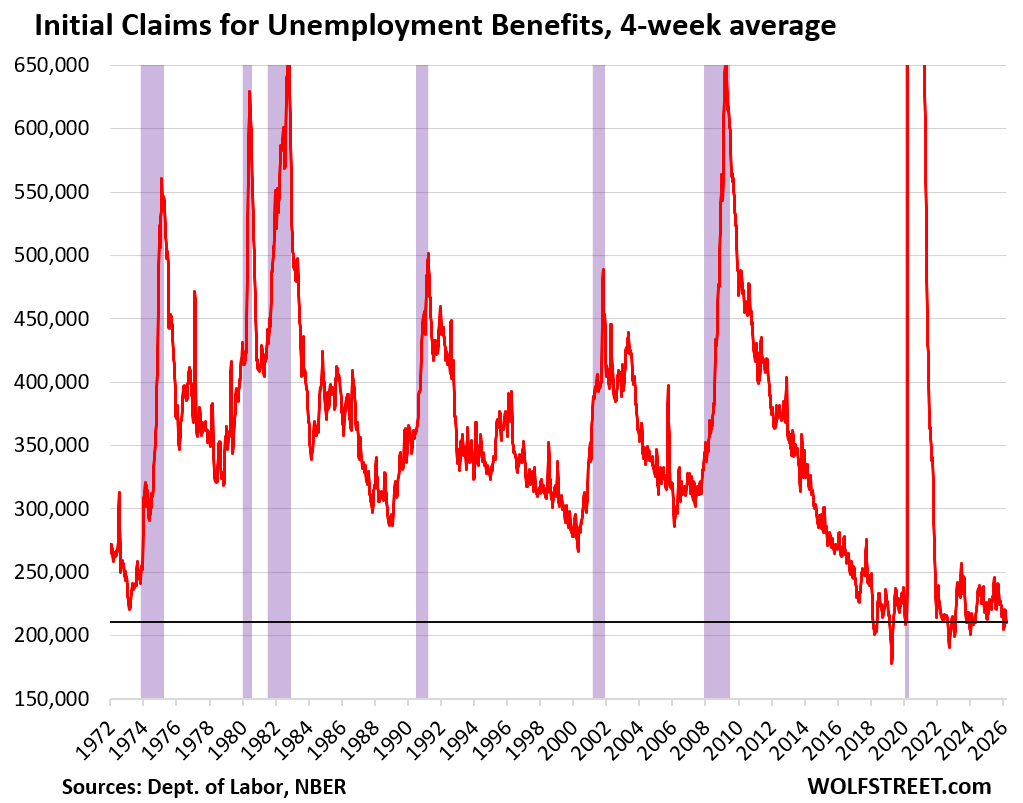
These historically low figures track freshly discharged people who filed for unemployment insurance compensation at their state unemployment agencies. The agencies then report them to the US Department of Labor by the weekly deadline, which then publishes it. This is not survey-based.
And here is another piece of the puzzle: The four-week average of continued weekly claims for unemployment insurance benefits fell to 1.847 million, according to the Labor Department today.
Over the past five decades, it’s only during the tight labor market in 2018 and 2019 and in the years of the labor shortages in 2022 through early 2023, that the level was ever lower.
This reflects the total number of people who’d initially applied for unemployment insurance at least a week earlier and are still claiming unemployment insurance because they still haven’t found a job.
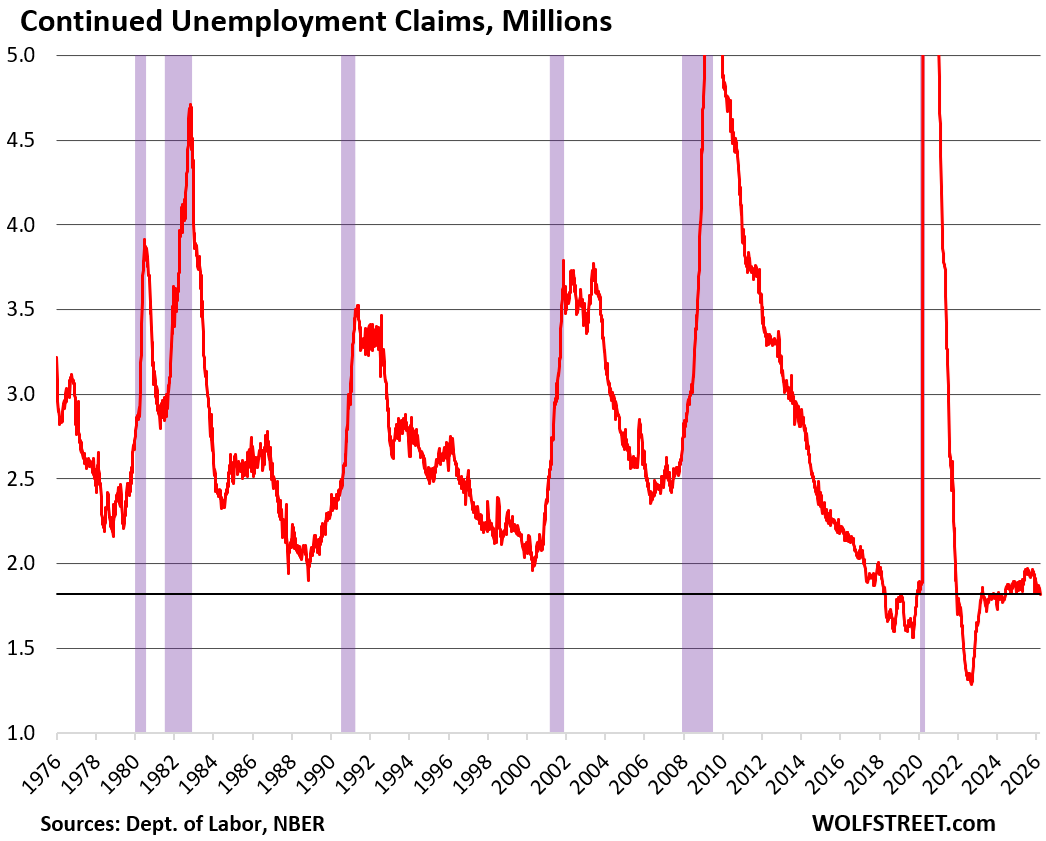
It shows that overall, private-sector employers are hanging on to their workers despite some global layoff announcements at some big companies, though these announced layoffs don’t all happen in the US, and some don’t lead to actual layoffs, but elimination of “roles” with workers shifting to different jobs in the same company. And some of these layoffs hit remote jobs, while workers for in-office jobs are getting hired.
The convoluted strength of this labor market amid the crackdown on illegal immigration and the drop in the supply of labor shows up in the prime-age labor force participation rate (25-to-54-year-olds), which has been running at 25-year highs, lower only than during the extraordinary period of the Dotcom Bubble (data via the BLS on March 6).
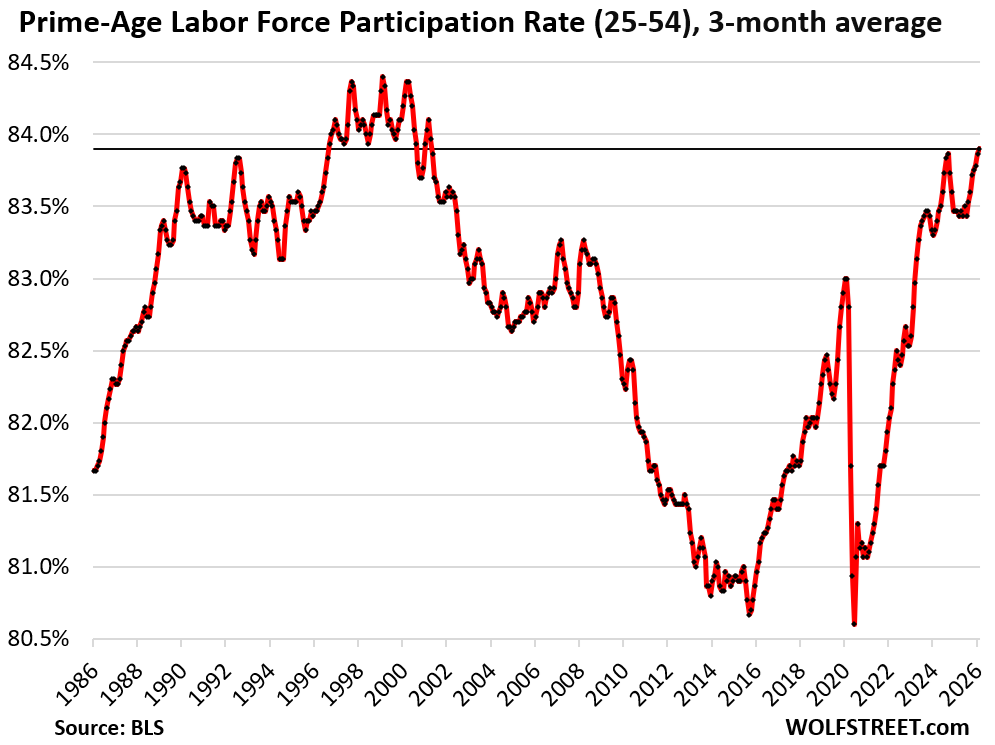
The prime-age labor force participation rate eliminates the issue of the retiring boomers. The overall labor force participation rate shows the percentage of the population that either has a job or is looking for a job. When people retire, they’re no longer “participating” in the labor force but remain in the population until they die. The surge of boomer retirements, which started about 15 years ago, has pushed down the overall labor force participation rate, as these retired boomers are still in the population but no longer “participating” in the labor force.
The Fed has also struggled in dealing with this labor market. And Powell expressed those struggles during the last FOMC press conference. It’s not a weak labor market in the typical US sense with big layoffs and a rise in unemployment; and it’s not a strong labor market in the typical US sense with lots of job creation either. But it may be the new normal labor market.
Enjoy reading WOLF STREET and want to support it? You can donate. I appreciate it immensely. Click on the mug to find out how:


Good article, but it completely misses the biggest structural shift in the modern labor market: gig workers. Leaving them out makes every historic indicator look “normal” when the underlying reality is anything but.
I just looked it up: you made 3 comments over the past 18 months on my site, and all 3 were exactly the same stupid BS about the gig workers, and each time, I wasted my time shooting it down, and you never looked at it. You’re clearly an experimental AI agent that got lost in its own hallucinations:
I quit the W2 world in 2017 and really enjoy self-employment. If you’ve written about self-employment trends, how would I search the site?
I had also wondered about the percentage of self employed people. TYVM For the chart!
The slight differentiation is the “gig” worker who may not be set up as “self employed.”
I’m aware that there’s been a concerted effort to flush out those “subcontracted” workers who may under report income or otherwise be trying to dodge taxes.
I know this has always been the case but remember almost 10 years ago that people were advised to make subs into “employees.” Another recent example is the requirement of payment platforms (notably Venmo and Paypal) to report anything over $600 from a single source (which is not necessarily income, and creates a new set of issues).
The other consideration is that, all these are a very small percentage of the overall workforce. So, if it remains that way, even if the workforce grows and the number of (little) people who are trying to dodge taxes increases… it’s still a very small percentage.
ALL gig workers are by definition all self-employed. Self-employed is everyone who is working and getting paid somehow but is not employed with a W-2 income. All gig workers are included in “self-employed.” People need to quit making up stuff.
Gig worker is just a colloquial term for self-employed.
A self-employed Uber drivers — so a gig worker, colloquially — doesn’t get paid as a W-2 employee. They get a 1099-NEC instead of a W-2. The NEC in 1099-NEC stands for “Nonemployee Compensation”
I understand that gig work= self employed.
Does Wolf receive a 1099-NEC for each donation over $600/ year?
Of course if one doesn’t receive it, they are legally obliged to report.
The old school term for the gig economy is “under the table.” Not necessarily uber and door dash which are tracked.
Think Home Depot in the morning or FB marketplace, Fiverr etc. Again I am sure it’s a small percentage.
The Struggler
Wolf Street Corp is a C-corporation, and every donation and every dollar from ads are part of the corporate revenues and go into line 1a of IRS Form 1120 “Gross receipts or sales.” No 1099-NECs needed. I’m a W-2 employee of Wolf Street Corp, withholdings and all. ADP runs the payroll, deposits the monthly salary payments into my personal account, files the quarterly payroll tax forms, and processes the tax payments to the IRS.
Back in the 1980s, when I was self-employed because I couldn’t get a W-2 job, the word “gig worker” didn’t exist. I was “self-employed,” or an “independent contractor,” or a “freelancer,” and similar terms. Those terms are still in use, but less so as “gig worker” has taken over.
“Gig worker” is a new term. My Random House-Webster dictionary from 1998 (now Merriam-Webster) doesn’t even list “gig worker.” But the term “gig” existed back then, and referred to a short engagement such as by a musician, and it referred to any job including W-2 jobs. The example the dictionary gives is: “a teaching gig out west somewhere.”
But the new online Merriam-Webster dictionary lists “gig worker.” And in the Word History segment, it says that the first known use of the term “gig worker” was in 2009 to describe self-employed workers. And it went viral from there.
The official word is still “self-employment” though, and you pay your “self-employment taxes” to the IRS, not “gig worker taxes” 🤣
What you describe as “under the table” is not gig work or self-employment but TAX FRAUD. You can spend some quality time in the hoosegow for that 💔
This one probably also won’t get past moderation review, but I think it’s worth understanding whether the CPS methodology for self-employed workers captures gig workers.
I swear I’m not an AI, just a methodology junkie!
My understanding is this is based on interviews, so if someone said “I work for Uber” they would be counted as employed, but not self-employed. But my knowledge isn’t exhaustive, would be happy to have some facts handed down about the CPS methodology that affirms gig workers are included in this.
ALL gig workers are by definition all self-employed. Self-employed is everyone who is working and getting paid somehow but is not employed with a W-2 income. All gig workers are included in “self-employed.” People need to quit making up stuff.
Gig worker is just a colloquial term for self-employed.
A self-employed Uber drivers — so a gig worker, colloquially — doesn’t get paid as a W-2 employee. They get a 1099-NEC instead of a W-2. The NEC in 1099-NEC stands for “Nonemployee Compensation”
One thing of note, many gig workers are using it as a “side hustle” as the kids call it nowadays. My brother is a W2 employee but also drives uber on the side for extra money. The pizza chains use door dash when they have driver shortages, but those same drivers often have a part time job with Papa John’s or something for some baseline stability/benefits. This is a very common thing amongst gig workers.
Is there enough public data available to determine what percentage of W2 employees also report 1099 gig income? I would not be surprised to see this percentage rising as pure self employed fell.
Job creation shortages due to a lack of skilled trades is the massive gap imho. Last I checked, we are sitting around 500k to 700k unfilled open positions in the manufacturing industry right now; good, well paying jobs.
Also, seeing a lot of job creation on LinkedIn; this is anecdotal but I’ve never seen my network buzzing like this before. Last I saw, can’t claim anything to support or verify, but the talking heads said something about AI actually creating jobs.
Maybe the issue is that the Quiet Quitting crowd has a lot of free time on their hands to complain about how the government hasn’t issued them a job yet 🤔
There has never been a technology that has “eliminated” jobs in human history, in a well functioning economy. Every efficiency gains allows for a labor pool that can now do other things.
My biggest fear with AI is it’ll somehow allow stupid ideas like guaranteed basic income to artificially raise labor costs and increases cost of executing innovation. That kills and economy long term
IMHO, the key part of UBI is “basic” which to me suggests an amount that’s below what most people want / expect in terms of standard of living.
Can you expand upon the “There has never been a technology that has “eliminated” jobs in human history, in a well functioning economy.”
What about the dustbowl? The industrialization of farmland certainly seemed to cause some employment disruptions. Increased the labor pool as you said. They could “do other things” like wander around California waiting for “gig” type labor getting paid barely/not enough to survive.
The capital class did quite fine though. Me thinks AI will work similar.
now your just being stupid … top soil debate whatever it was extreme weather and many factors all at once this is one point were you could ask AI to help ….
In California….the state fire department is hiring people hand over fist. Good pay, great benefits, all kinds of incentives to intice…
They are having difficulty filling positions….Probably because it can potentially be some pretty hard ass work.
Trust me… I know.
the vibe woke crowd is horrible and by far the worst in SoCal if htey can not see it on an IG reel they have no way of understanding it they would rather argue to make 21 instead of 20 at their restaurant job with their BS degree and 60k in student debt then go get a real job based on merit …
I do not think you understand the meaning of Quiet Quitting.
I am aware of a several IT personnel who have been laid off but haven’t applied for unemployment benefits. They haven’t applied since they have significant assets, they got nice severance packages, they don’t anticipate being unemployed for long, and they view the unemployment benefits in their state as being not worth the application effort. Do you think, Wolf, that some of these labor market anomalies could be due to widespread adoption of behaviors like this?
1. No, because it’s a minuscule number of people out of the 160 million employees who’d walk away from free money.
2. As I said in the article, people who already have a job lined up, and essentially just switch over, they don’t apply for unemployment insurance, and they don’t qualify either because they already have a new job, and this is a much more common scenario.
3. If you got laid off as a wealthy tech person, and now decide to finally start your own VC firm or startup or whatever, well then, that’s a new job, and you’re not out of work, you just switched jobs.
I know two tech people with massive assets who got laid off and didn’t have a job lined up, and they immediately filed for unemployment insurance, because it’s free money, and it’s not means-tested, and you can do it online.
Wolf, could you give a dollar range for “massive assets”?
If the tech guys have enough money, why would they even work?
Nearly all rich people work in some form. What else are they going to do? Even Musk is still working, richest person on earth, and maybe working harder than most people.
Only a goofball would suggest that you stop working after you can afford to. And you can nearly always outspend your income, if you want to.
Lots of workers in tech get substantial stock compensation year after year after year. And that adds up quickly. In addition to big salaries and bonuses.
Its not free money. Its an earned benefit of a W2 worker paid for by the employer as a percentage of income with thresholds.
Ultimately, it’s part of any W2 employee’s overall compensation package. That insurance cost factors in to what the employer will pay as a base salary, in nearly all cases reducing the salary figure.
As such when a person collects they are receiving part of their own labor production back in the form of claims benefits.
Having worked through this process one time, in addition to filing online office visits were required as well as follow up forms to be completed and submitted related to ongoing job search efforts. Attendance in a transition assistance class was also mandated where the moderator suggested we take our time and enjoy the opportunity we had to rest and perhaps retrain in another career. So there were time consuming activities beyond just looking for a new job in order to receive the benefit.
I managed to receive the max benefit term and funds for which I had contributed to during the times I was a W2 worker. Of course the buying power of those dollars was a fraction of its original purchasing power when paid into the insurance fund.
But a little is better than none.
Thankfully, AI should easily be able to replace all the government employees and contract laborers I interacted with during this process.
why would anyone walk away from say ~$2K/month unemployment benefits for 6 months as part of unemployment benefits ?
I am in IT, my friends , ‘rich’ friends, lost their jobs and did apply.
Pride
It’s stupid. Unemployment is an insurance program, for which you’ve paid premiums through your employer. If you are in a car accident, do you not make a claim out of pride?
Your friends and former colleagues don’t know you filed unless you tell them. So “pride” doesn’t come into play here. It’s just “stupid” not to, as TSonder305 said so eloquently.
Wolf – it’s stupid but pride isn’t contingent on people knowing. Some people are too “self proud”. Cutting off your nose to spite your face comes to mind but maybe that isn’t the correct saying for this
Long term employees often get a sizable severance package that is paid out as continuing wages. The reason for this structure from the employer is to hopefully get the employee into their next job before they have to file for UI, which raises the employers UI contribution rate. The difference in the minimum and maximum rate for an employer can be massive depending on the state and they can still meet severance requirements with this structure, so it is a common strategy amongst large employers.
This may be what people here are misunderstanding with regard to people “not filing” for UI – they effectively can’t as part of their severance package until the severance is paid out. It is a huge boon for people to find a job quickly in this circumstance because you end up with a double income for X months and it can be a huge boost.
“In conducting monetary policy, we will remain highly focused on fostering as strong a labor market as possible for the benefit of all Americans. And we will steadfastly seek to achieve a 2 percent inflation rate over time.”
—Chair Powell, Aug. 27, 2020 speech
The labor market is clearly fine since unemployment is essentially all time lows.
Powell won’t address the inflation elephant in the room. He needs to go sooner rather than later.
TNX 4.42
Maybe Powell is gonna let the bond market do his job for him.
“The possibility of rate hikes came up during the Fed’s March policy meeting, Fed Chair Jerome Powell said. The committee decided to keep the central bank’s key interest rate steady on Wednesday for the second meeting in a row.
Powell confirmed that a committee member had proposed including language in the policy committee’s official statement about the risks to the central bank’s dual mandate being “two-sided.” That is, the Fed might have to raise interest rates to crush inflation or lower them to boost the job market.
“The possibility that our next move might be an increase did come up at the meeting, as it did at the last meeting,” Powell said. “The vast majority of participants don’t see that as their base case. And of course, we don’t take things off the table.”
“ And of course, we don’t take things off the table.”
Such as “inflation.”
Just keep piling it on!
Well in fairness 34% inflation over the 10 year period 2016-2026 if you factor out the first 6 months of Biden to Trump and the first 6 months of Trump to Biden you are sitting at about 10% for Trump inflation and 24% for Biden … so when Powell said that we were in the midst of “supply chain issues” in full swing with COVID and yet at 1.7% or so inflation …he had no idea Dem would prop up Blue Zones with 2 Trillion dollars ….
My pet theory is that quits are low because pandemic stimulus gave people a chance to change jobs and end up in jobs that are a much better fit for them. So that will disrupt what was the “normal” quit rate for a while.
And the pandemic also forced a lot of people to find new jobs, for example by unemploying service workers. Some percent of those people found better, more stable jobs outside service industry, so they are not appearing in the quits like they would have in a world without the pandemic.
If the USA separated health insurance from employment, I bet we’d see the quit rate fall even lower over time, as people had more freedom to try out job searches for better fits.
What’s funny to me is that my company could save at least 10K on me if they allowed me to work from home
Very true but the same company can also think: If this guy can be remote, then why not keep this position in a cheaper location/geography?
Because they’d have to hire someone new, which costs time and money, and the new person might not be good at the job?
I have friend that’s a data scientist at LinkedIn. There appears to be a growing concern among the highly paid that the rug could be pulled out from under their feet. The smart ones are saving money because when the bubble pops those who get paid the most and are expendable will have nowhere to run except a mansion with exuberant property taxes.
I think what you describe is plain old common sense. It is a good idea for people at all income levels to have a contingency plan for job loss. And even those in very stable or highly paid situations can encounter a new boss that makes each day a trial and waste of life. Good to have some FU money or skills set aside and if you never use it? Great.
I’m retired for years now, but I did discover over the years how much better I was treated at work when I didn’t need the job.
Lots of moving pieces, some of which are mentioned in the article.
First, population growth is slowing significanly due to shutting down the border and tightening up H1B visas (by increasing the cost). We’re well below replacement levels, and immigration is what has kept the growth going. So, as the article noted, the labor pool is not expanding.
Second, recognize that around 58-60% of college grads are women. They are not going to go into the trades in any significant number.
Third, males are not going to college in anywhere near the numbers of a few decades ago. Indeed, the number of male undergraduates has dropped somewhere around 17-20% just since 2010. But some of those men aren’t working at all. As recently as 2000 the male participation rate 25-54 was 92.2%; now, it has just gotten back up to 90.0% after dropping to 86.3% during the pandemic (and it was never abover 90% from 2010 through the start of the pandemic). We need those men in the trades, but they’re not getting there as of yet. The participation rate for women has pretty much peaked at about 78%. So, absent more women in the workforce, or men raising their participation rates, the workforce simply isn’t going to grow much if at all.
Fourth, AI and other technological changes are having an impact, particularly for new grads, as the article pointed out. This is going to have a further negative effect on down the road. AI folks with experience are generally doing fine to great because firms need people who have sufficient experience and judgment to make sure AI is not putting out jibberish. But if firms won’t hire new grads now, how are those folks going to get the experience necessary when firms need to hire folks with 5-7 years experience on down the road?
Fifth, firms have pretty much adjusted to the aftermath of the pandemic, both in hiring and employee churn. There will still be some small number of pandemic-related job cuts, but most of those have probably already taken place. Future cuts will primarily be due to future conditions, not adjustments due to the chaos of the pandemic.
Ultimately, absent Dems winning the presidency in 2028 and reopening the borders, this is the new normal. Of course, major events such as the Iran War, higher energy costs long-term, China invading Taiwan, etc. can impact what is now the new normal.
Instead of the Dems allowing more illegal aliens to invade our country and trample our laws, perhaps getting the able bodied men and women who the Dems pay to get their votes into the job market would be a better solution. It seems even your own data suggest the workers are there. That is a pretty ridiculous “Ultimately” solution to the myraid of issues raised by yourself.
Good luck with Social Security payments when there aren’t enough workers to pay up the pyramid.
Taxes rates can be elevated. Earnings cap can be raised. Something will happen.
In the county I teach in, we’ve dropped about 70 teachers last year & this year going into new contracts across K-12, and nobody is really talking about the reasons. This year our county supposedly will see a slight reduction of 93 students out of ~31K. I have to wonder if part of these reductions in FTEs is related to fewer enrollments and potentially reduction of undocumented students. Property values have dropped about 5%, so that would explain some of the reduction.
Back in 2008-2010, we took 5, 10 & then 5 furlough days as pay cuts with much larger loses in jobs. But the federal government handed out tens of billions of dollars that kept teachers in jobs for about 3 years before the tax base started to stabilize.
Remember that we’re eliminating (the Department of) Education?
Funding cuts everywhere in that sector, from early childhood (which is blamed on a few bad actors) through high school.
The goal is a complacent and compliant society.
Home Depot now has women at the loading areas picking up 100lb bags of stones and other landscaping items and loading them into customers cars. Many of the college hunks that used to work there are nowhere to be found.
Oh my God how the world has changed.
July 1971, I just was discharged from the Navy and was eligible for unemployment benefits, I had to go the county office in a small western Pa. town to file.At the end of the interview the lady handed me a card and told me to be at the job at 8:00 am the next Monday morning. Unemployment money was not an option. I work at the job until I started college in the fall.
“Mansion shortage” still cracks me up !!
Let them eat cake…I guess ?
It sounds like there is work for those who want to work.
It might not be the work you want or like…or even the pay you want….but there is work.
Mark my words — when the labor market stumbles, the Fed will cut rates a percentage point or more, and this will *accelerate* job losses, not slow them. Corporations see the writing on the wall, and they will *accelerate* the transition to AI when capital becomes cheaper. It’s how business *always* behaves in response to innovation. They try to get ahead of it. It’s like a natural law, it is so fundamental to business. It’s called competitive advantage, and those businesses that ignore it are quickly snuffed out.
Bottom line, mark my words, the Fed is going to commit a major policy error here, because they are still working from an “old world” playbook, and don’t have the agility to modernize their thinking about the consequence of monetary policy actions as it relates to the “new world”.
I marked it, and then marked it again, and now I can’t read what you said.
Ask yourself, how many movies have you seen in your lifetime where a frantic old fellow yells a “crazy” warning that everyone laughs at and ignores, then turns out to be spot on?
I read today about General Dynamics Electric Boat hiring 8000 people to build submarines in New England. I would surmise at least 60% are blue collar jobs. Shipbuilding along with AI warehouse construction are in major need for the various trades.
Recent college graduates in the STEMs can’t find work in their field (and undergraduate in the STEMs can’t find internships). Some become underemployed and some are starting their own business. All are very frustrated because they did “everything right”. Some of it is AI replacing inexperienced workers which are mostly recent college graduates. However, some of it is middle management in positions they got shortly after COVID that they are under qualified for or under capable for. Some of it is AI breaking the job application process as it has become more important who you know at the company, since posted job openings get 2500+ applications in just the first day and internships can run up to 20,000 in the first week. However, the largest factor is that college grads bring innovation and for companies it is just easer (less risky and more financial rewarding) to financialize an old product then to produce a new one.