
But if they pop: There are only so many trillions that can vanish from portfolios before it triggers a recession.
By Wolf Richter for WOLF STREET.
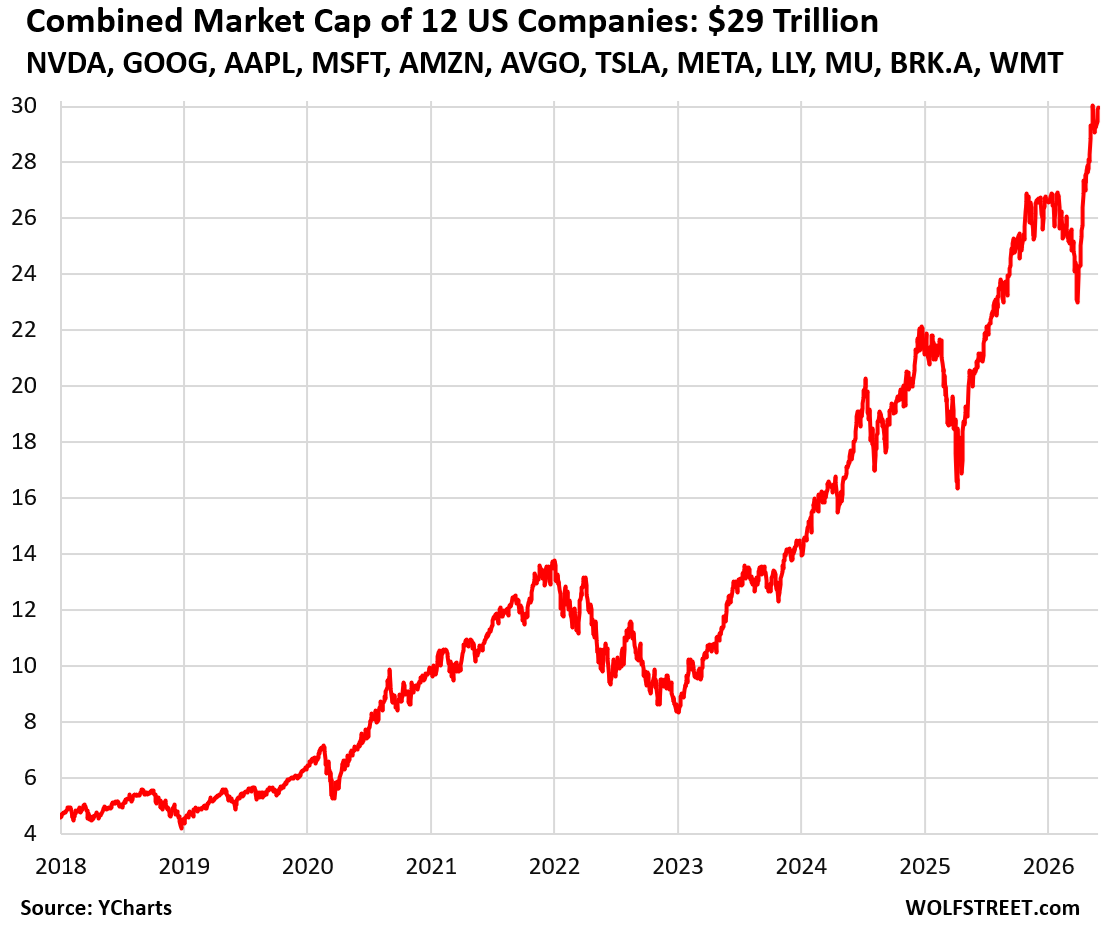
Trillions of dollars fly by so fast they’re hard to see. By now, 11 US companies have a market value of $1 trillion or more. Combined, they have a market cap of $29 trillion.
Walmart [WMT] was already in the $1 trillion club for a few weeks, if barely, but recently fell off the wagon. If we add Walmart back into it, the 12 US companies have a market cap of $30 trillion – roughly 43% of the total market capitalization of all S&P 500 stocks.
During that little dip from January 28 to March 6 this year, the combined market value of these 12 companies dropped by $1.8 trillion. Over the 58 trading days since then, their combined value jumped by $4.9 trillion. Over the past six years, market value exploded from $6 trillion to $30 trillion. These are generational gains (data via YCharts):
Micron Technology [MU] became the latest entry into that club. Since the low of April 3, 2025, the stock exploded by 1,315%, and its market capitalization exploded from $72 billion to just over $1 trillion. And it did the second half of that trip, from $500 billion to $1 trillion in just 48 trading days, an all-time record — creating another WTF AI Mania Chart.
The 11 US companies in the Trillion Dollar Club:
- NVIDIA [NVDA]: $5.11 trillion
- Apple [AAPL]: $4.58 trillion
- Alphabet [GOOG/GOOGL]: $4.57 trillion
- Microsoft [MSFT]: $3.34 trillion
- Amazon [AMZN]: $2.91 trillion
- Broadcom [AVGO]: $2.12 trillion
- Tesla [TSLA]: $1.64 trillion
- Meta Platforms [META]: $1.61 trillion
- Micron Technology [MU]: $1.09 trillion
- Eli Lilly [LLY]: $1.04 trillion
- Berkshire Hathaway [BRK.A/B]: $1.02 trillion
- Walmart [WMT]: $922 billion
Eli Lilly is threatening to fall off the wagon. It wouldn’t take much for Micron to fall off the wagon either – just a minor day-to-day squiggle would do it. These are volatile stocks at this point.
$30 trillion used to be a huge amount. Not long ago – only four years ago exactly – the entire debt of the US government was $30 trillion. Of course, four years later, it’s $39 trillion. And not because it gained in value, or anything.
There are three other companies with market values of over $1 trillion, but they’re not US companies: chipmakers SK Hynix and Taiwan Semiconductor Manufacturing Company (TSMC) and Saudi Aramco.

Every little dip in market cap of these 12 companies combined represents trillions of dollars of market value vanishing from portfolios without a trace. And every little rally represents trillions of dollars in value being created in portfolios out of nowhere.
If there is even just a 20% dip, God forbid, it would wipe out $6 trillion. $6 trillion in stock market losses used to be some serious money. Now, just another dip by 12 stocks?
A tried-and-true tech selloff in just these top stocks, of the kind we’ve seen before several times after periods of these kinds of generational gains, would… well, whatever else that would do, it would throw the US economy into the recession that people have been feverishly predicting for years.
There are only so many trillions that can vanish from portfolios before it begins to impact economic decision making by consumers and companies alike, and derail economic growth.
That was the case during the 2.5-year-long Dotcom Bust: A year into it, in March 2001, the recession started; and it lasted to November 2001. The Dotcom Bust didn’t bottom out until October 2002, by which time the Nasdaq Composite had collapsed by 78%.
It had shaken up a lot of economic decision making, particularly in areas where internet companies (names that ended with .com), telecom companies, tech hardware and software companies, and biotech companies were densely concentrated, such as Silicon Valley, San Francisco, Seattle, and Boston – they had a depression in those locations.
But the turmoil largely passed by other parts of the country, and the overall recession was pretty mild, compared to the mess that came afterwards which was triggered by the Housing Bubble falling on top of overleveraged and reckless but tightly interconnected banks.
Enjoy reading WOLF STREET and want to support it? You can donate. I appreciate it immensely. Click on the mug to find out how:


But but, Yes, this time it’s different! 💔
That was exactly what I was thinking as I got to the comments.
You beat me. Nice post!
P.S. I would be okay with a solid 20% drop.
Yes. This time IS different. The fall will be crushing. The stakes are much higher. People have been conditioned for a lot longer to think it only goes up. Young investors haven’t seen what happens when things begin to tilt. The AI race verdict is still out.
The issue is that even AI is “groundbreaking,” it certainly won’t be groundbreaking in terms of profits for all of the companies that shot up based on AI hype.
I work across enough industries to realize what a lot of this is. There are some real benefits to AI software, but a lot of the accolades you see people piling on it are either people trying to justify their spend or prop up their own holdings (for example, see Ken Griffin talking about who some AI bot replaced highly-paid Ph.Ds), or pure groupthink.
Regarding groupthink, think of it like a new trendy restaurant in a large city. A lot of people may feel it’s overrated, but no one wants to be the party pooper. So you book a reservation there when you’re visiting, you go, and you wonder what all the hype is about. But no one wants to be the first one to say it.
This usually continues until someone says in a group, “You know, I really don’t think X thing is worth the hype.” Then others in the group start nodding, saying “I thought the same thing, but didn’t want to say anything, thinking maybe I just had bad luck.”
I think that’s what’ll happen with AI eventually.
Well said!
I think Microsoft just said that about Claude
AI is the mechanism being sold to landowners to extract value from their property. Turning your land into a data center is the new mineral rights. It really comes down to the terms in the contracts as to who would eat the losses if a data center isn’t profitable. They’re putting up several thousand acre data centers in rural montana! The investors in that better have good contingencies.
Howdy Folks. US Sober/Drunken Sailors at my local Squirrels Anonymous all bought the dip. Will sell before the mid terms.. We lived our lives knowing Cash is King but just could not resist… Aint war hell?
I’ve got a group of friends that went all in on TQQQ and SOXL both 3x tech and chip ETFs and are up more than 100 percent on their holdings . They are low spenders are retired and have no debt .
They are looking to sell their 2 million home in San Diego suburbs and move to VN (They are VN refugees from the fall of Saigon .
The point is there are many playing the leveraged and options game . This group has been selling half into the rally . They say they plan to hold the other half of their tqqq for more years or forever
Yep, the amount of leverage in the system is astounding. It amplifies things on the way up and on the way down.
I haven’t seen any blood in streets
with crowd going one way
patience is key
been waiting couple years for decent investment
smelling some rotten meat, but dogs are devouring that right now
not in hurry – lots of playing to do yet this summer(vacay)
Eli Lilly?
I thought drugs were terrible, the scourge of mankind.
Somebody better let Officer Bacon of DARE know about this.
So now trees grow to the sky…….
And how much cash does Berkshire Hathaway still have?
BRK has over 300 billion in cash if my memory is correct
“This business will get out of control. It will get out of control and we’ll be lucky to live through it.”
– Fred Thompson
“When the going gets weird, the weird turn pro”, Hunter Thompson
The mag7 are down from $23.33T in May 19 2026 to $22.15T, but SPX
made a new all time high. They peaked at $25T. We are not in 1999. The high tech sector laid off highly paid software engineers (but not hardware). Boomers and gen X engineers are replaced by zoomers and gen alpha out of community colleges who practiced AI in factories. A single L7/L8 engineer can cost $500K/Y/$800K/Y (salary, bonuses and stock grants). A 22Y community college grade costs $80K/Y. To balance
their books companies aggressively trimmed their software engineers
to finance AI and power stations. They finance capex with a bank loan. The lower K finance themselves with C/C and car loans. Those loans enter the economy. They expand the money supply and its velocity. If the mag7 loses $5T and the rest gain more the US economy will be more diversified.
1. Markets can remain irrational longer than you remain solvent.
2. TINA- there is no other alternative. Longer you wait for a recession, money loses its value soon.
3. This is the time to pay all your debts, save money, do not do anything risky and wait patiently in the sidelines.
4. I believe, recession is a very good outcome, compared to depression, world war and global shortages.
5. Regular people do not a piece of the pie in this 30 trillions?. Average person do not have an idea about the stocks and the current economy.
6. Walmart and amazon are more useful to a common man than the micron technology.
7. If there is an recession, which stocks or ETF is on your radar. Mine is VYM.
Ha bank financing for Ai data centers ? Can you please provide some facts behind that statement?
From what I read PE firms , life insurance annuities , and some circular financing from the likes of NVDA cash are financing the hardware. I don’t do any research myself so all of the written information is suspect except from the original content from this site .
“At 10x revenues, to give you a ten-year payback, I have to pay you 100% of revenues for ten straight years in dividends. That assumes I can get that by my shareholders. That assumes I have zero cost of goods sold, which is very hard for a computer company. That assumes zero expenses, which is really hard with 39,000 employees. That assumes I pay no taxes, which is very hard. And that assumes you pay no taxes on your dividends, which is kind of illegal. And that assumes with zero R&D for the next ten years, I can maintain the current revenue run rate. Now, having done that, would any of you like to buy my stock at $64? Do you realise how ridiculous those basic assumptions are? You don’t need any transparency. You don’t need any footnotes. What were you thinking?”
Scott McNealy, CEO of Sun Microsystems, 31st March 2002
That was an epic rant for all times!
Another CEO would have used the stock spiking as an opportunity to do an IPO.
I vividly remember HERTZ going bankrupt in 2020, turned into a Meme stock & tried to do an IPO.
One more story of a catalog of degenerate activities coming out of Wall Street.
Meta & Microsoft won’t be on that list long.
Yeah divide that $30tn by 7bn people and assume all those businesses are unicorns as suggested in that quote, and each man woman and child in every corner of the world is sending $450 ish a year their way for 10yrs.
I’m all for being positive about humanity’s future but these expectations have overshot a bit.
Unless this is all inflation trade hypothesis? But getting high inflation in a depression can be tough work, and the bigger these numbers get the more likely this gets too big to bail out.
All great fun to watch, assuming you’ve not bet more than you can afford to lose on it all.
MU looks to be trading for nearly 19x revenues, soon to be even higher than that as the stock nears 1K per share. This might be a really good time to get some buy orders ready for the Micron inverse ETF, or heck even for the NASDAQ in general. Party like it’s 1999 again.
The best widowmaker out there is SOXS. Good thing I’m not married. Whomever times it well right before Black Tuesday. And Micron is of course in it.
Treasury printing for government contracts to QQQ companies is a circle jerk for wealth effect trickle down that won’t end well.
Oligarchs are feasting, but moving their families to Patagonia.
Using Wolf’s market caps, and revenue from their last 4 quarterly earnings reports, I present to you…
Price/Revenue for the Big 12:
NVIDIA [NVDA]: 20x
Apple [AAPL]: 10x
Alphabet [GOOG/GOOGL]: 11x
Microsoft [MSFT]: 10x
Amazon [AMZN]: 4x **see below
Broadcom [AVGO]: 31x (winner!)
Tesla [TSLA]: 17x
Meta Platforms [META]: 7.5x (pikers!)
Micron Technology [MU]: 19-20x
Eli Lilly [LLY]: >10x
Berkshire Hathaway [BRK.A/B]: 2.7x
Walmart [WMT]: 1.27x (still 2x it’s 20-year norm near 0.6)
**Amazon has a gazillion dollars of low-margin retail revenue, which should be valued similarly to WMT, plus a high-tech side with lower revenues and an insane valuation.
When did this become a game of revenue and not profits? I can also make a million million dollars in revenue if I don’t have to make any profit.
Reminds me of the .com bubble. People started “valuing” companies based on clicks or number of page views. Ahhh, the good ‘ol days. Lol.
Useful appendix to Wolf’s article, Ghost.
If SpaceX IPOs with the targeted capitalization of $1.75 trillion, that will be 90.67 times its trailing twelve month revenue ($19.3 billion) through March 31, 2026.
Polymarket thinks the closing share price on IPO day will tie to a market cap of $2.0 to 2.5 trillion. The upper end of that range would be a multiple of 129.5 times TTM revenue.
SpaceX may be the IPO that breaks the market.
But Chat GBT and Anthropic need to be in the sucking of the wallets too. Tulips are cheaper today in Holland.
And there is a huge wage of other companies, owned by PE firms, that are headed for the IPO market at stratospheric valuations so that PE firms can cash out. So there will be a lot of sucking out of wallets this year. My gut feeling is that these massive stock sales via IPOs and share offerings by big companies (Alphabet et al) will break the market.
Those swallowing too much market hype here are going to experience a bad case of McNealy’s Revenge…
It’s going to be epic.
I have been saying that for about 2 years now.
I follow the markets a reasonable amount. I didn’t even really know what Broadcom was a year ago. And now it’s a 2 trillion dollar company. I’m wrong so much no one should listen to me, but when Micron has a vertical chart, SNDK has a vertical chart, a company I haven’t heard of is the 6th most valuable company in the market, and every chart you look at is parabolic and makes the Nasdaq bubble part of the chart look like a minor bump, that doesn’t seem good.
Broadcom has been the king of Ethernet switches, which are used to transmit data from Point A to Point B.
Broadcom’s products are as essential as memory chips and processing chips.
Sure, but at a 31x price/sales, how much will it need to grow sales in order to provide even a zero net return to shareholders within your lifetime?
Looking at the QQQ going back makes everything look like a bump because at 1000 a 50% jump is 500, at 7000 a 50% jump is 3500 so same % changes look dramatically different.
The NASDAQ approximately tripled in 2 years during .com. The current market hasn’t ran that much yet
Yes but it took the Nasdaq until late 2016 to surpass it’s .com high. And now in a little under 10 years, the surge has been so great that .com just looks like a little hill next to mountain. We can pretty definitively say .com was a bubble so completely flying past a bubble high says something.
And companies like micron have basically been in the same range for like 25 years and in less than a year are 10x that range.
You are comparing Billions to Trillions.
I clearly remember the .com bubble. My Merrill Lynch advisor talked me into a “technology fund”. Put in about $35,000. Over 2 years, it lost 75% of its value. From that point on, I no longer had a financial advisor. I figure I can’t do much worst than that. Started investing through Ameritrade and stayed diversified. I don’t have big movements either way, but I know what I have and it continues to grow.
When 100+ billion dollar companies swing 10% in a given day, something is broken in the market. Dell is the latest example.
When a company trades many multiples of the number of shares that it has available in a given day, the market is acting like a casino.
Icebox….
My wife had a large bank financial advisor that had her losing money 50% for 3 years…. Kept saying wait for it you will make money. It was loaded account and the fees were more than the account was making.
I understand ups and downs… but dang…
Half the money gone with fees and investments.
Closed the account, and handle it myself now… not the best investor, but at least in the positive…. And I am free.
I will not name any names… but I despise Chase Bank.
Not the only problem I had with them either.
Credit Unions are the way to go.
Zacks has a screen for Price/Sales Ratio > 10.
There are 254 companies P/S > 10 and Market Cap > $1B
plus another 79 with market cap <$1B.
That's a lot of overshoot…
Not only that but during the dot com bubble before it blew got even worse.
Was reading a book from a British pro in the field, he would travel around finding fund managers to grow their money. He was quite the expert. He goes into great depth at how troubling the index weighting system is during that particular bubble. He said he and his colleagues were demanding to pull back on their investments in these top companies.
One fund I like, actively managed as it is though, they limit the investment totals to 5% of any company in the weights.
The typical bogle type “just let it burn and do nothing” , if they knew how the weighting killed them, I think they would do something.
You can always go with an equal weighted rather than a market cap weighted fund.
Real world data shows that equal weighted funds underperform market cap weight funds. Part of this is due to more rebalancing and fees needed.
@sufferin
If an actively-managed fund says “they limit the investment totals to 5% of any company in the weights”, it’s worth checking.
That 5% rule might only be true at quarterly reporting time. (If they swapped into just 5 stocks in between reports, how would you know?)
You may want to inquire:
Is that rule held to all the time, every day, and how can you prove that to me?
Or, as a practical example, what does this fund do when a company like Dell or Micron goes up 30-50% intra-day and its weight goes immediately from 5 to 7%?
It’s a vanguard fund,
You can see what they own.
I bet they were around the last dot com bubble and were burned. The powers that be put in some checks and balances. Just a guess
Honestly I look at half of the stocks these funds own and some of them make me want to puke. Like Meta, ugh. Raymond James? Like wth
but hey they are the pros.
I’ll prob put together my own portfolio one day of ones I really like. But I’ll prob under perform the index. But hey I tried!
Is it too extreme to think we’re repeating the 1920s all over again?
Yes, it is too extreme to think that. 1920s will look like walk in a park.
If they crash the system, they know they’ll get elected again in 4-8 years cuz everyone is pissed off and resentful.
An IPO going bad could prick the bubble.
SpaceX going public will be fun to watch.
What will it do to the the other tech’s if that goes bad?
Apparantly in the S&P because the initial shares available, the float, will be so small, that its weight in the S&P will be tiny.
As insiders sell their stock, that weight will grow. But it will take time.
Just from a POV of karma, I hope it crashes. But I’m not very lucky with things I want. Haha
It’s something curious, when somebody sells a share somebody else pays for it. so the $$ does not evaporate, or/ on the way does not get created out of nothing. it’s just the other party does something else with the $$, goes into real estate, or other sector. but still things go into recession, for 10-20 years people were afraid to invest in stocks, the whole thing is behavioral economics. group psychology behavior? there are ups and downs in real estate too, fear, greed, jealousy and survival?. some books on that?
No, this is totally wrong. The last trade of a stock determines the value of all shares of this stock in all portfolios that hold this stock. Your Apple holdings drop 1% if that last trade of APPL by someone far away is 1% lower than the prior trade. No one gets any money in this, it’s not a transfer of wealth, it just vanishes. The reverse takes place if the last trade is 1% higher than the prior trade. It just creates value across all shares of AAPL in all portfolios. The last trade sets the current value of the stock. It’s not a transfer of wealth, it’s the ongoing constant creation and destruction of wealth by the market.
The mag7 radical hiring led to radical firing, ex AAPL. AMZN is an anomaly. The mag7 are useful. They transferred knowledge to the gov and the rest of the economy. AAPL became a “conservative” co after wiping out the Apple car team and a chip project. They hire only a few young engineers. They rotate workers to new projects. Jobs are almost forever. Attrition cut payroll. AAPL hemorrhage in old age. Chinese ev cars lost 50% of their value in Germany after one year due to selling to leasing co. They rot bc they changed new models too fast.
Is it just me or does the paywall in this article look a bit shaky. Could use a fresh tuck pointing.
Keep an eye on it, it changes every few days, six episodes. A hilarious guy climbs it with a ladder in the next episode, then sits on top of the ladder, then sits on top of the paywall, and then invariably falls off the paywall, which turns out to be an huge wall that is part of an old fortification.
The underlying fundamental economic structure of the US has much in common with the Japanese experience . There is a very high probability that the US is facing a deflation , rather than the popular view of another embedded inflation , similar to the 1970’s
Just as there is no future in nostalgia , extrapolation is no substitute for analysis. Deciding the future in such a manner is nothing more than the extension of the present, which defies historical experience and dismisses the unpredictable nature of the human experience.
I disagree. The difference is that the American people will demand that the government “do something,” which is always inflationary. The Japanese people also can be handed money and will save it. Americans will spend every dollar like it’s burning a hole in their pocket.
There’s a reason the COVID measures caused inflation to skyrocket and retail goods sales to skyrocket. Americans took that and bought flat screen TVs, new cars/trucks, and so forth.
Great comments. Clearly, something is looming with over hype and over valuations.
Back in 2008……
“If money isn’t loosened up, this sucker could go down!” Bush reportedly declared during a meeting with his top advisors on the White House lawn.
What will the next version be? Maybe….
” If these companies aren’t protected some very fine people, friends of mine, really, great people, these people will lose a lot of money through no fault of their own”.
Not this American.
^^^ This I think every sane investor knows this is a bubble but they also know the govt quickly steps in on any weakness.
If it pops they’ll likely declare a state of emergency freeze mortgages, send out checks, drop interest rates. There’s a recession if they actually let things reset, but what do you think the chances are our govt actually lets a recession happen?
20% pullbacks are normal in history of stock markets for the past few centuries. i am old enough to remember when 100 dollar bill was baller money and a millionaire meant you were living large like thurston howell the third and lovey on gilligan’s island.
being a millionaire in 21st century is like being a thousandaire in the 20th century. if you ain’t a billionaire, you are a piker.
I originally found WS because I was looking for a house years ago and the articles about housing kept popping up in my news feed. Since then, I read all the others because they’re fascinating and unbiased… I don’t pretend to be much in the ways of high finance. Basically just an average dude with some general understanding of things.
With that in mind, I look at that list and am like, “Which of these makes something (that is important / really can’t do without in the modern world?”
When I see Tesla and Meta there, I think to self- that’s not so good. A car company, one among dozens, (that I like btw) that is basically whittling down it’s lineup to like 3 cars and some robots and another company who’s main value was making some VR headsets for a failed multiverse and Marketplace. Yet they clock in at #7, #8. Also kinda not high up on BS Hathaway, they seem more of a leach than anything productive, but they own others that do stuff, so they begrudgingly get a pass.
Oh well.
Dude, Berkshire is a hugely valuable company. Its assets are ridiculous.
Go study
Use the Brain
Yes, Berkshire Hathaway has a Market Cap of $1 Trillon, but it also has about $400 billion in cash. It wholly owns many companies (e.g., GEICO and BNSF Railways) and has controlling interests in many more. Then its massive stock portfolio of Apple, Coca-Cola, Chevron, American-Express, etc.
Berkshire might be undervalued.
Wolf’s term for it is “consensual hallucination”. As long as we all believe the company is worth a trillion, that the stock price will keep going up, and that we’ll all soon be living in a futuristic VR AI robot utopia on Mars or something, then the stock price *will* go up and we’ll all be rich. Keep in mind that’s the stock price, independent of any underlying value.
If you don’t go along with that…well then what else are you going to do? Invest your retirement money in a well-diversified portfolio? In that case, what’s better-diversified than an index fund? Nobody can beat the whole market! And if that’s what you go with, then you had better hope that everybody *else* continues to be totally stoked about our imminent superintelligent fusion-powered transhumanist intergalactic empire.
Will SpaceX top them all?
That would be a stretch even for Musk. But it might make it into the club.
The bottoms in stocks occur when money flows bottom, e.g., Oct. 2002 and March 2009. The tops aren’t so easy.
To quote economist John Gurley, “Money is a veil, but when the veil flutters, real-output sputters.”
Hard to have a “pop” or a recession when the government is just overspending alone $2 Trillion.
What you will get is continued wild overvaluations, Inflation, Inequality and social unrest.
Not until people can’t afford all their streaming services! Don’t think America knows how join together and of course purposeful by the ruling class. Divide people on somewhat irrelevant issues and keep the status quo is the playbook.
What’s going to pop will be society. The wealth concentration is obscene. People getting rich on speculations, subsidized by government.
Should be fun watching Anthropic, Open AI and SpaceX. SpaceX would be a decent company on paper if they didn’t bolt on the AI component to grab a lot of cash to burn. I am sure the Musk effect will be at play with this one.
Anthropic likely can be a solid player although not at current valuations and seems like OpenAI will implode and be sold for pieces, whatever value that holds.
I think for AI to succeed in the US, Chinese AI LLMs will have to be banned for companies to utilize. The cost differential is too great to ignore. Obviously embedded ones will do fine like Google though although still unclear how the make profit although for Google not an immediate concern.
Large cap graphs looking like meme coins/stonks… Surely no one would dump them when they can just keep going to the moon.
BTW, what is a trillion in today’s inflation adjusted basis?
A trillion.
I see what you did there, Wolf
esop, “inflation adjusted” requires that you specify a year as your baseline
No, $1 dollar inflation adjusted is still $1, no matter what the time period. Because it’s a currency, not an asset with a price in dollars, or a consumer item with a price in dollars. You cannot adjust dollars (or any currency) to inflation, but you can adjust assets and consumer items (measured in dollars or any currency) to inflation.
But you can discuss the “purchasing power” of a currency. How much will $1 buy today, compared to how much $1 bought a year ago. It’s still $1, but you get less for it.
I was being kind of tongue-in-cheek technical here because these are important concepts. But I understand what esop meant to say.
Excellent article. Could this be 21st century repeat of the 20th century’s roaring 20’s?! At that time everyone had stock advice even the shoeshine boys.
When considering that Nvidia has a valuation higher than the GDP of Germany with Microsoft and Apple not far behind, the bubble becomes more apparent. CAPE is above 42 and Buffett Index is over 230, but the naysayers say that these metrics are irrelevant because of lower interest rates, earnings have increased so quickly and companies earn more money abroad. Then you have brokerages and banks pumping up the market with research that really just pads their bottom lines with more trades. This time is different until it’s not.
What is the ENTIRE balance sheet of the Federal Reserve? Isn’t it around $6 trillion these days? Stock speculators have bid these stocks up to a market capitalization of around 5 times the entire balance sheet of the Federal Reserve it would appear. Quite an interesting situation!
At this point in time I can’t think of anything but a black swan event to derail the AI boom. My daughter’s company just selected 20 people to access an AI system and is sending them to training to learn how best to use to improve their skills. Now multiply that times a few 1000 to cover the country.
And as for the suffering Americans, I went out to dinner last night at The Marsh Walk in Myrtle Beach area. There are about dozen restaurants and at 6:00 traffic and parking were impossible and the restaurants were packed.
We just came back from Japan. Both flights were booked to the last seat, despite much higher ticket prices. Drunken sailors.
When in Rome, do as the Romans do.
When in Japan, do you speak Japanese?
No. I studied it for a while in the mid-1990s and forgot almost all of it.
I think you are one of the K’s.
I just have to keep trending down my spending, couponing, credit card rewards, thinking about the future etc.
I’m going to Costco more, way more. Joined Sam’s Club too cuz it was basically free thru Fetch.
I’m reading a few threads on Reddit where they are cutting back hard too. It’s not fun or enjoyable. Health insurance went up a ton as well for 2026. It’s paying out claims better tho, so might be a wash if you need a lot of care.
Groceries are going up, bracing for the new prices that may show up in the near future.
I don’t vacation. Savings rate went down too from last year.
Was thinking of buying a small house but abandoned that idea.
Keeping the suv running , hopefully drive it into the ground.
Hoping for a raise to keep up with inflation, but not holding my breath.
So anyway I think either the K tops (the upward arrow of the K)
1. Don’t care about saving extra
2. Are spending their market gains (messes up compounding?)
3. Might be fiscally irresponsible
4. Perhaps are going into debt, some.
5. Selling their nest egg homes and not being careful with the proceeds.
No shame on them just different thinking I guess. They don’t mind paying the high prices to get the experience and convenience
“This time is different” is Classic line. I agree. One day the bubble has to burst. But aren’t 15 years of QE and ZIRP different than how FED used to operate? When did FED expanded balance sheet 10 times in span of 15 years in history? After hitting 9.1T and with QT to 6.7T is good direction. but still far away from optimal levels.
The Reckless FED enabled Govts, Real Estate markets and Stocks to go ATH.
There is optimism in all players in Markets that FED will come to Rescue.
I disagree that FED will; but Markets believe FED will. As soon as markets are little disturbed, FED starts fearmongering. Little bit Labor markets disturbance, FED cut 100BP in 2024 and then again 75BP. In 2024, data showed Labor market was in trouble. So can understand 75 BP but by December we all saw it was false alarm. Little bit liquidity crunch, Start RMPs. FED always had tools to handle liquidity issues (including Sept 2001 crash).
We keep talking about Bond vigilantes. Where are they? I mean 40T debt (in booming economy) doesn’t make them worry then what will? 10 Yr still range 4.5-4.6% and 30 years around 5%. With current Inflation levels, REAL rates have become 0 or negative.
Only time will tell if Losers are in market now or on the sidelines? Hope they are live to see when it happens.
They are selling treasuries. Lol
To be a bubble SPX has to drop 5,400 pt to its base to 2020 low.
Since Oct 2022 low (3,492) SPX took several breaks to fill the tank. Since Apr 2025 low (4,835) SPX took only one bathroom break: between Jan and Mar 2026. During the next few breaks there will be rotation from the high tech to the rest.
The 12 companies you single out as bubble candidates are, collectively, among the most profitable enterprises in human history. NVIDIA, Apple, Microsoft, and Alphabet alone generate hundreds of billions in annual free cash flow, which is quite different than the revenue-free dotcom names that collapsed ~78% in 2000.
Your wealth effect argument assumes that paper losses in mega-cap equities translate directly into consumer spending retractions, but equity wealth at this scale is so concentrated among institutional holders and the ultra-wealthy that the marginal propensity to consume from those gains (or, conversely… losses) is pretty modest compared to, say, a housing correction that hits the middle-class.
The Micron example actually weakens your thesis here (as I pointed out in your previous article surrounding that company’s dramatic price movements in the past decades). If you do not already know, HBM is genuinely supply-constrained, DRAM pricing cycles are pretty well-understood by industry analysts, and a stock rising on actual forward earnings expectations is not remotely the same as pets.com rising on absolutely nothing but hyperbole.
You also seem to treat market cap as wealth that exists and then vanishes, when in reality most of these gains were never converted to cash by anyone. The so-called “trillions lost” in a correction are essentially a repricing of future earnings expectations, rather than being a destruction of spending power that was ever deployed. The concentration statistic (43% of S&P 500 cap in twelve stocks) sounds concerning until you realize that these companies represent a similarly outsized share of index earnings; so, the ratio reflects real economic dominance as much as it does an excess of speculation. The recession risk from a major selloff, of course, is definitely worth taking seriously, but in my humble opinion, your framing appears to confuse valuation risk with structural fragility, when really, the two are not the same thing. Thanks for your insights!
Then obviously, these companies are massive PRICE GOUGERS charging far more than their products costs to provide and they should all CUT THEIR PRICES MASSIVELY rather than continuing to rip off their paying customers.
During every chip rally, chips are supply constraint, and prices spike — there have been quite a few over the past few decades. So chipmakers ramp up production and invest heavily in new factories (happening right now in the US and globally), and then when this production comes on line, there is a flood of supply, and then demand fizzle because the boom is over, and suddenly there is a glut of chips, and prices collapse, and chip makers lose tons of money. This is why the chip industry is so cyclical. Huge booms and busts. Nothing will ever change that. Watch it happening.
God, I hope it will be soon. I want a new gaming rig in a couple of years!
I am tired of this stupid tech shit jacking up the price of my cheap hobby. First, it was private fiat money no one understood. Something-chain. Now it is artificial intelligence that’s neither artificial (it’s regurgitated, arguably pirated stuff due to a massive expansion of the “fair use” doctrine by the courts) or intelligent (probabilistic and mindless chat boxing).
Incorrect.
They “used to” generate enormous free cash flow.
Now they burn cash and borrow money to build short-lifespan datacenters.
Suggest revisiting their financials, because we no longer live in 2024.
P.S. They wouldn’t be betting the farm on AI unless their high-margin near-monopoly revenue streams were vulnerable. Potential double-whammy there. I bet half of them are no longer in business in 10 years.
But if companies are so profitable today and they were not during the dot-com bubble…why are the PE ratios the same ? The CAPE is an exact match..if the companies were so profitable now….wouldn’t the PE ratios be lower today?
There is a newer version of the Cape Schiller re did. Something about the last 10 years etc. think they had to adjust it for several reasons.
Was just reading about it.
It shows a tad lower than the older version.
Agree –
These are not dot-com era wannabes. These are real businesses — strong earnings, massive free cash flow, and genuine dominance in AI infrastructure, cloud, semiconductors, and pharma.
The warnings are fair and if these names hiccup, trillions could go poof from portfolios – But I think the doom narrative gets ahead of itself — household balance sheets are in good shape – Debt service payments are way below 2008 levels, credit card balances fell last quarter, delinquencies are stable and concentrated mostly in younger age groups, and overall leverage? Nothing like the housing bubble.
And stocks? — the top 10% hold roughly 90% of equities, so most people aren’t checking their accounts every morning and adjusting their grocery budgets. So a hard correction hurts the investment class most but if it doesn’t spill into employment, corporate earnings outside tech, or credit conditions — the broader damage could be contained and temporary – like 2022.
So — caution, yes. But “this definitely triggers a recession”?
Not so sure.
“massive free cash flow,”
No, precisely not. they’re blowing their cash flow plus lots borrowed money on AI investments.
There are 100 reasons it could blow out.
Just look at the lack of discipline in all aspects of the government right now.
Markets run funny even when geniuses are running them.
It’s a miracle it has not blown up yet.
The greed fountain can only last so long, once people start hoarding their piles of gold away from the risk, those dominos are gonna tumble.
Wolf – shouldn’t you retitle this article to “The Biggest Casino in the History of Mankind”? Sadly, many retirement funds are dependent on stocks such as these.
Might I say that if the music stops playing, it may look more like the Great Depression. Twelve companies, $30 Trillion!!! But as our jovial Wolfman would say – “Not to worry. The banks aren’t on the hook this time. It’s the working man/woman.”
Investors losing megatons of money because stock prices are falling will dent the economy a little, but it’ll pass; so it’s essentially OK and part of the deal.
The banking system collapsing is not OK and is not part of the deal because everything would shut down if it did.
These are two very different categories of events. And the banks aren’t really on the hook when stock prices tank. If they have margin loans, they will sell the securities when they reach the margin limit and rarely lose money on them.
So when is the top. When is that ‘ring the bell’ moment we all are looking for?
Years ago I always thought that the biggest of semiconductors like Klac, Amat, Txn, Lrcx were the canaries in the coal mine. For when they went, Katie bar the door… these days I’m not so sure, but when the poop hits that rotary oscillator, it’s going to be like a football stadium of people trying to get thru a single turnstile imo.
It seems everyone has forgot about the fed/govt put. Is it a bubble? Yes. How far it will crash and if we’ll have a recession probably depends on the level of govt intervention though.
Nobody has forgotten. It’s the whole reason we have what we have here today
Post COVID it seems the mantra is the central banks will always come to the rescue. We have witnessed rolling bubbles in many asset classes and very little larger corrections. Players just keep rolling into the new thing and winning so far. Not very healthy for the overall market. If this keeps up inflation is going to roar back worse than 2022 and the non-asset holders that have been thrown under the bus by the FED + inflation are going to be in worse shape especially those with families.
The only question bothering me is getting the timing right to short the crap out of these markets.
Too early and you can pay dearly. The rubes pile in at the latest stages of a bull run, and the market can stay irrational, as they say, longer than you can stay solvent.
Too late, and you miss out, if it becomes elevator down.
Watching it closely. I’ve seen this rodeo before. I don’t plan to miss out this time.
Hey-Ho! S-O-S flare?
“The 30-year U.S. Treasury yield is actively hovering around the 4.98% to 5.05% range, reaching levels not consistently seen since 2007.”
John Edwards, Kerry’s VP in 2004, was right then and is right now.
We have 2 Americas. One for the rich and well connected, and one for the rest of us. Both parties are at fault. Why is no one bringing that theme back? All I hear is BS from both side of the isle.
“Everybody knows that the dice are loaded
Everybody rolls with their fingers crossed
Everybody knows that the war is over
Everybody knows the good guys lost
Everybody knows the fight was fixed
The poor stay poor, the rich get rich
That’s how it goes
Everybody knows”
Leonard Cohen
Probably because both sides are benefiting from it.
1) Modern Dow theory: chips (digital drivers) and R/R (physical drivers).
SOX: if high, businesses are investing heavily in the future. Tech demand is healthy. R/R: if high, physical products are bought, sold and
shipped across the US. Higher oil prices are good for trains. They are more efficient than semi trucks. They move one ton for 500 miles on a gallon of diesel. They charge higher prices when diesel prices are rising. Yet, demand for trucking is high, ex CA and AZ.
2) When SOX and R/R are high they rule out recession. If one of them drops, the other can compensate for it. The tech sector provides high margin and future earning growth. The R/R proves that heavy industry, mfg, construction, consumer goods and commodities are moving. If one drops the economy can fly on one engine.
3) Recession: both R/R and SOX drop. In 1920/21 the Dow and the R/R dropped, but Ford produced over one million cars and trucks per year. Planes shipped mail and flew wealthy travelers. The modern Dow checks the macroeconomic pair: chips and trains, if the digital and the physical movers agree, or disagree.
Congratulation Paris Saint Germain F.C. I hope u win every year until 2030 for a total destruction.
My bet: France wins the Mondial in the US, Canada and Mexico. Best wishes !!
Carlo Ancelotti, an Italian (AC Milan, Real Madrid) coach Brazil national team in the 2026 Mondial and in 2030.
It sounds like if a guy had some money in
these…..he might want to lock in some profit…..
Everyone has ideas and opinions about how and when things n’ stuff will happen. I have been around long enough to know that…
Nobody knows exactly when and how….
Take it when you can git it !!!
I have no crystal ball, but one thing that makes the stock market attractive is the ease of buying, owning, and selling. There are no maintenance costs with owning stock(unlike real estate), and the spreads are now virtually zero(use to be a quarter or half a point). There are also no commissions any more really. And there is also no sales tax of course (unlike almost everything else unless you are in business and have a resale certificate), and long term capital gains is also an advantage. It is all just paper really, and it is not even that anymore. All birds fly to warmer weather where the feeding is easiest.
If no one is buying or selling a stock can go up infinitely or down infinitely and it doesn’t matter. If you own 50% of a stock you can manipulate it any way you want. And you can take a loan to prevent true dips. return on risk is generally the same no matter how high stock prices go. If a stock can go up a trillion in a year it can go down a trillion in a year. Or it can go up two trillion in two years, and follow to go down two trillion in two years. Or faster, if you watched fridays ticker of NVIDIA, where a hundred billion in cap disappeared over 14 minutes.