
Bessent’s job is to sell these bonds come hell or high water, and at the lowest possible yield.
By Wolf Richter for WOLF STREET.
The US Treasury debt reached fabulous and much-anticipated $40 trillion today, after having ballooned by $1 trillion in three months, and by $3 trillion in 12 months, as tax cuts, profligate spending, the war in Iran, and the Supreme-court-triggered tariff refunds sped up the process.
These new trillions – flying by so fast that they’re hard to see – got funded, and existing debt got rolled over, at huge Treasury auctions every week, week after week, such as $742 billion in auction sales last week.
The only thing that the repeated, hackneyed debt-ceiling charades in Congress accomplished is the appearance of some flat spots in the chart, followed by spikes to make up for them.
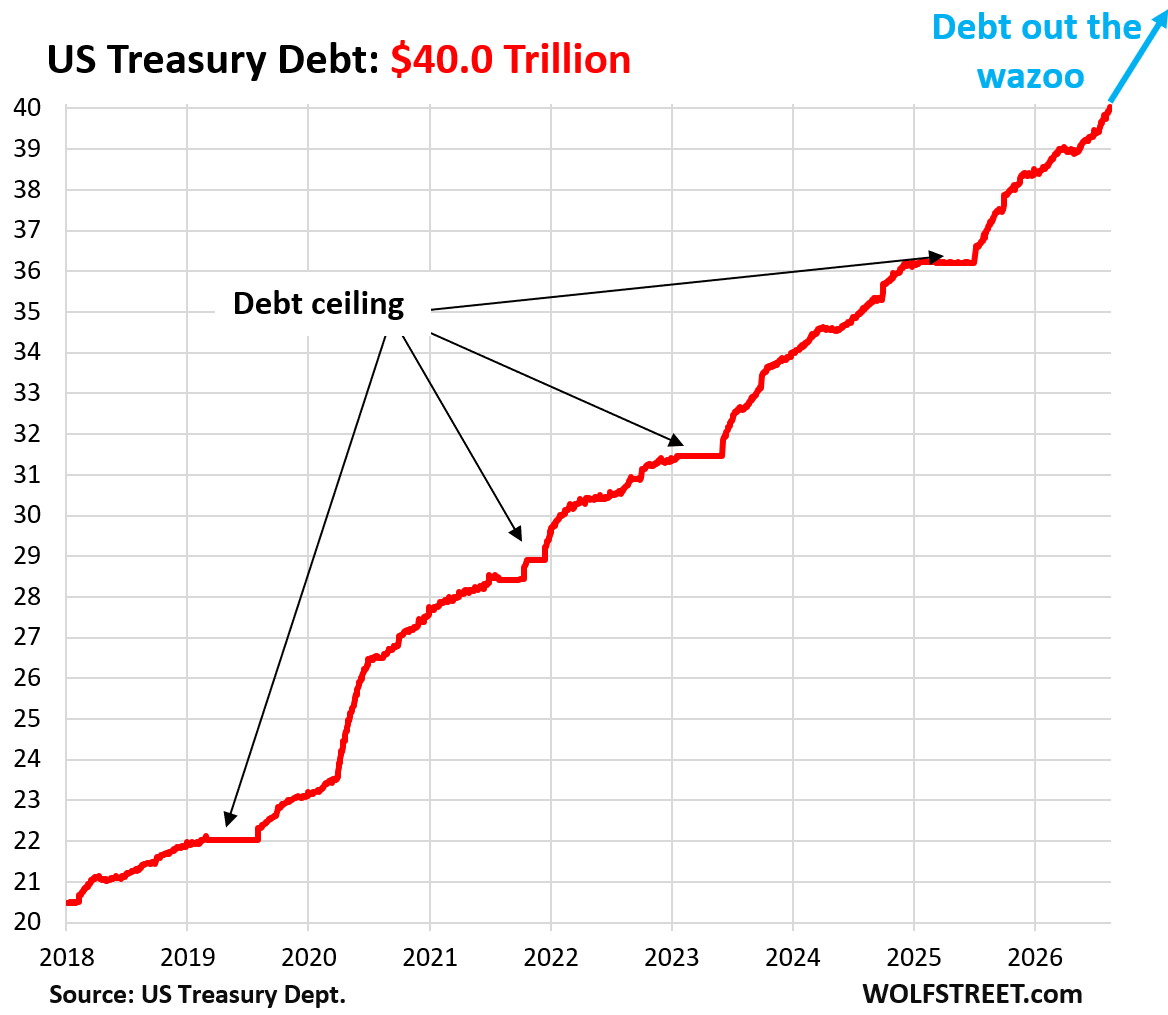
Of that $40 trillion in Treasury securities, $32.3 trillion are “held by the public,” most of them publicly traded and held by investors, hedge funds engaged in the basis trade, banks, insurance companies, the Fed, other central banks, etc., of which $9.3 trillion are held overseas. But some of the securities are not publicly traded, such as Series I Savings Bonds (I-bonds).
The remaining $7.7 trillion of the Treasury securities are held in federal government pension funds, Social Security Trust Funds, and other “internal” government accounts. They’re owed to the beneficiaries of those accounts, they’re a true debt that is owed, but they’re not publicly traded, and are not subject to vagaries of the market with its second-to-second price changes.
Investors had to buy $1 trillion in new Treasuries over the past three months. That’s what that means when the amount “held by the public” ballooned by $1.0 trillion in three months.
That $1.0 trillion was the new supply of Treasury securities that global bond buyers had to buy in three months, in addition to refinancing all the maturing debt, and to do that, new buyers needed to be pulled off the fence and into the market.
That’s the job of yield. And yields rose during those three months until they were attractive enough, auction by auction, to entice enough investors off the fence – despite fears about inflation, reckless government spending, and even higher yields in the future – to buy $1 trillion in new Treasury securities over the past three months, in addition to refinancing the maturing debt. So yield did its job.
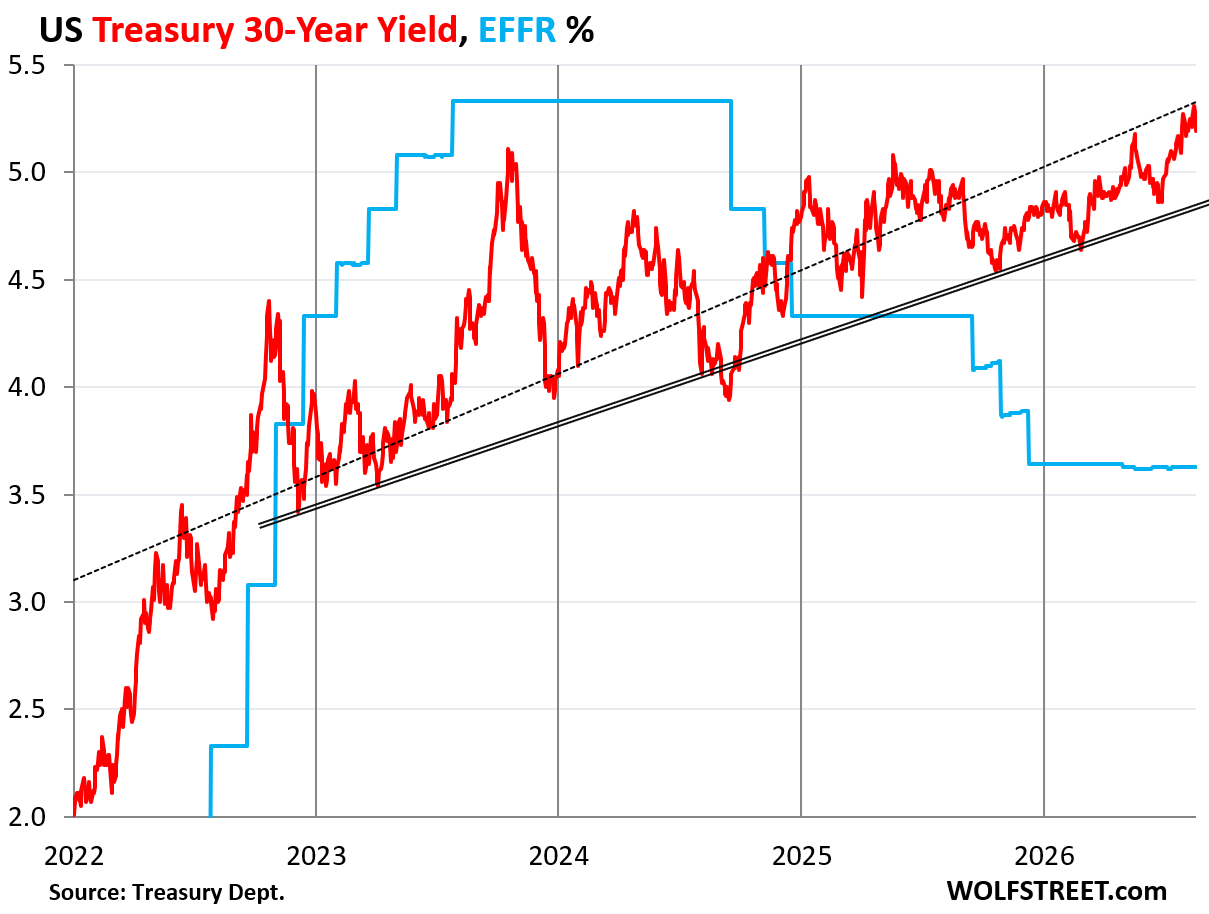
But that rising yield – the 30-year Treasury bond sold at auction last week at 5.22%, the highest auction yield since 2001 and then rose to 5.31% by Monday – caused Bessent to blow a fuse.
Today, the Treasury department announced that it would double the hocus-pocus Treasury buybacks that a desperate Yellen had started in April 2024 after the 10-year Treasury yield had pierced 5% briefly in October 2023.
The Treasury Department cannot create money, unlike the Fed. It has to sell new securities to buy back old securities. The buybacks are just a debt swap. And Bessent could accomplish the same thing but in much larger quantities by keeping auctions of long-term notes and bonds unchanged, and increasing the T-bill auctions, and thereby shifting issuance to T-bills, and it’s already doing that.
But Bessent wanted to soothe the bond market on the spooky day that the Treasury debt hit $40 trillion. So he came out with the hocus-pocus announcement, and long-term yields fell instantly, though the actual increase of the buybacks won’t start till September 9, and though the amounts are small compared to the $1 trillion in new debt that investors have to buy every three to five months going forward, and tiny compared to the $40 trillion in Treasury securities outstanding [my detailed analysis of Bessent’s hocus-pocus show is here].

Going forward, yields will have to be high enough to entice bond buyers off the fence and buy an additional $1 trillion of new Treasury securities every three to five months or so; yields have to be high enough to overcome their fears about inflation, government profligacy, and the new supply pushing up yields even higher.
Bessent cannot do anything about the quantity of debt coming at the market. His job is to sell these bonds, come hell or high water, and at the lowest possible yield.
Hocus-pocus debt-swaps aren’t going to do much to change those dynamics. Bessent’s last hocus-pocus announcement at the beginning of August, the big kahuna US-Japan joint intervention, pushed the 30-year yield down by 11 basis points over two days, and more intraday, from 5.28% on Friday, July 31, to 5.17% on Tuesday, August 4, most of it right after the announcement. And that was it, and the yield began to zigzag higher and hit 5.31% on Monday this week.
Today after the announcement, the 30-year Treasury yield fell by 9 basis points, after having declined by 3 basis points the day before, to close at 5.19%. Just another squiggle in the trend:
Enjoy reading WOLF STREET and want to support it? You can donate. I appreciate it immensely. Click on the mug to find out how:


Happy 40th!
(Maybe. Sort of. Ok, not really.)
Lights are going out the party is over!
Twenty trillion in debt added just since 2020 is absolutely mind-boggling. How long can this continue, and isn’t this also adding to inflation?
Sure, we’ve got debt out of the wazoo. But so what? Deficits don’t really matter. After all, it’s not like we’re ever going to pay it off. Instead we’ll softly default on it all.
In any case, there’s never been a better time to be alive (if you’re a billionaire). The gilded age is back baby! America is great again (but not if you actually work for a living).
“Instead we’ll softly default on it all.”
Weimar softly?
By that measure, it will double again in 6.5 years.
that would be $80 billion by 2033.
If you think hyperbolic and add 20 T in every halve time (3, 1.5, 0.75 y ….) you wouldn’t reach the end of 6 years before total collapse of the confidence in, and value of the currency.
And Bitcoin is up^^
Faster and faster as investors lose all confidence and must be lured back with sky high yields like in 1980s
Freudian slip? Try 80 with a T for Turd!
So, when those Freudian johns can no longer afford Bessent’s tricks they’ll rely on hand jobs while the Barbies forgo urinal cakes for the Totos during the great inflation until replaced by cheaper chatty Cathy and John the robots at 100 trillion.
Up to the point where a government can’t even pay the interest on the debt.
Or starts issuing debt in a currency not under control of their central bank.
All of it to blow asset price bubbles for the wealthy, and now they still refuse to take the medicine and raise interest rates to stop raging inflation. In fact, they WANT the raging inflation, but at the same time they don’t want to pay investors a fair price for funding the shenanigans. F**k these people who caused this. All of them.
It’s called Don’t fight the Fed for a reason.
They create all of the money that protects banks.
Financial haircuts for the wealthy are a thing of the past.
Long ago on an internet board like this one, with folks discussing finance and investing, I remember the phrase “Don’t fight the Fed” being said a lot. It was the first half of 2008.
“F**k these people who caused this. All of them.”
Decades and decades worth.
Of both parties.
Who were only really ever serving themselves.
And looking at the state of the US today, what did the $40 trillion in debt actually buy?
How many miserably failed wars?
Including the War of “Poverty”? (over the long term, for the median American, the trend has been down, not up)
How many insanely failed, perpetually engorged “programs”?
Congress can’t even do one thing like making earmarks illegal.
During the middle of COVID, Congress brought them back after having not used them for 10 years.
We have zero chance if we can’t find as much waste & fraud as possible & eliminate it.
I agree. It’s all a joke & the day of financial reckoning is coming.
When it gets bad enough, currency will be measured in ammo, food & water. Gold & Crypto will be worthless.
Because they actually found out that earmarks were actually the thing that was enabling useful compromises, and when they got rid of them, things got even worse in Congress!
All part of the greatest pump & dump of our life.
Suddenly, buying those 100 year negative interest bonds seems like a bad idea.
I must laugh or I might cry.
“Hocus-pocus debt-swaps aren’t going to do much to change those dynamics”
Is anybody paying attention?
More importantly is anybody doing anything to prevent or stop this inevitable train wreck?
Nobody cares. Politicians need to benefit their constituents or else they will lose their seat to someone who will promise whatever funding is needed to whatever pet project is going on in their region. Don’t look to them to fix it. Party on until it stops my friend.
“To infinity and Beyond” – Buzz Lightyear, future Secretary of the Treasury
Today after the announcement, the 30-year Treasury yield fell by 9 basis points, after having declined by 3 basis points the day before, to close at 5.19%. Just another squiggle in the trend:
Well I think that the management of the long term interest rate that the US government organs seem obsessed with
War is inflationary on many levels. Perhaps too many to count…especially in the beginning.
I guess the question is how long does it take before Warsh starts buying all this bill issuance being used to buy the long end ?
Warsh: “We will listen to the bond market.”
Bessent: “Hold my beer.”
The Fed has been replacing MBS with T-bills since late last year, and as per the minutes today, they’re going to think about replacing maturing long-term notes and bonds with T-bills. They’ve been talking about thinking about it for two years. It would be like a reverse operation twist. And they need to get on with that. They can easily replace $2+ trillion in long-term notes and bonds and TIPS with T-bills, but there aren’t enough T-bills out there now for them to do it.
Will believe it when we see it in Action.
All those FED talks are Just talks and no action. Logan gave a speech 2 years ago about selling MBS to reduce balance sheet. No action. Lot of talk in between about balance reduction and changing the duration mix% . But no action. Powell told us reduce QT pace so FED can go longer. Stopped too soon and did RMPs.
I remember when they had to reduce QT and stop the QT, they were very prompt. Did it a month’s time-frame. So why it takes so long when need to tighten the markets.
I sincerely hope Kevin Warsh builds the majority and succeeds in reforming Federal Reserve.
Agree, and will only add that The Fed is quickly becoming irrelevant. The more they abuse the FRN, the quicker it will be dumped.
Replacing MBS with T-bills is replacing the collateral of bricks and mortar with just promises. What promises are there to sell?
Replacing long term debt with short term debt makes the day of reckoning nearing faster and faster. As in: “I will pay you next year, next month, next week, tomorrow, uh… never”.
Nonsense. The MBS the Fed holds are guaranteed by the US government (“agency MBS”) because every single one was issued by a government entity, same as T-bills. So there is no credit risk for the Fed with either security. Those are the only MBS the Fed holds. The taxpayer is on the hook for those, not the Fed.
The non-guaranteed MBS (“private label MBS”) collapsed during Housing Bust 1 and threatened to take down the entire financial system. The Fed holds none of those. Today, these private label MBS are a pretty small pile, compared to the government-backed MBS.
MBS are backed by pools of mortgages. Each mortgage in the pool is backed by brick-and-mortar. But in practice, that connection has turned out to be less than secure and has been contested in numerous cases in the legal system.
If realistic inflation expectations are eventually reflected in long term US Bonds-then short term T Bill rates should return to a normal yield curve.
It looks more like a desperate move from Bessent.
Isn’t this the same move that Argentina and Turkey also did… That’s not a good sign
Yellen started it in April 2024. Bessent just doubled the pace. No, nothing to do with what Argentina and Turkey did.
Bessent had a lot of negative comments about Yellen doing it. He was very dismissive of such behavior, until he got the job.
He is the most interventionist Secretary in recent memory. What happened to ‘trust the markets’?
Bessent is now a bond salesman, the world’s biggest bond salesman. He’s got to sell bonds come hell or high water, and at the lowest possible yield. Think of him as a used-car salesman who absolutely has got to hit his quota and who has got to get high prices, but the cars in inventory aren’t good enough to be sold at high prices, and customers are walking out, and he’s desperate and has got to do something to sell those cars.
You can’t force investors to buy dogsh!t. Sounds like Bessent is greeding out like everybody these days. Offer higher yields and the bonds will fly off the shelves. The FED needs to start raising, too. Time to pay the piper.
Prediction: $50 trillion by December 31st 2029. Likely a earlier as it amplifies as it goes higher and higher. 😳
Take any and every 10 year period since 1971. Find the average growth. Apply that number to your calculation. I came up with somewhere near $67T at 2030. I include the FED balance sheet.
It’s doubled almost exactly every 10 years since 1990, which is a growth rate of 7% per year.
GDP has doubled every 14 years, which is a growth rate of 5% per year.
Voodoo economics
Mathematically it makes sense for
me to delay Social Security but now
I have to take FedGov’s deficit and interest payments and add them to the equation. What a mess.
It seems like 2029 is a re-occurring timeframe for a lot of P(doom) predictions, etc.
Buy real assets quickly. Your saved dollars are about to be worthless.
No. The value of the US Dollar will rise quite nicely as interest rates rise.
Until the Fed starts doing full on Japan style yield curve control & monetizing all the QE they’ll do.
I keep saying that this feels a lot like late summer 2007.
There’s no telling how sideways things will start to go, if the GOP get’s whack-a-moled in Nov.
For now, Trump is boxed in on Iran. After the mid-terms he’s got about 75 days to really go after Iran. Whether or not he does is hard to say, but if he does, I think there will be 12-15 GOP Senators who will vote with the Dems to find Trump guilty of impeachable offenses. They’ll be happy to flush in down the toilet and move on to 2028.
Do you know why Rome fell? Because they didn’t sell bonds.
Indeed, they just clipped the coins instead. Nothing new under the sun
$40 trillion – whatever – its really only $20 trillion in Busch administration money – LOL
Carry On…
I remember when Reagan was just in office for about two weeks,and the national debt increased to 1 Trillion dollars….
And they blamed him the mess in Washington…
Have you ever seen a chart for the national debt under Reagan? From just under 1T when he came into office (as you noted) to just under 3T when he left.
Reaganomics was a horrific deficit spending administration…
And by the time he left office it was $2.7 trillion and he raised taxes.
As a percentage of GDP, Reagan/Bush presided over one of the largest increases in debt in history, rising from 30% when took office, to 50% when he left, to 63% by the time Bush 1 was finished.
and what was it when obama finished?
Three presidents and 24 years later? Probably different, why do you ask?
What happened next after Bush 1 was the Clinton years. In those 8 years, debt to GDP decreased from 63 to 55%, and the end of his second term was the only time in modern history the US ran a surplus instead of a deficit.
Then came Bush 2 who erased that decrease, and oversaw an increase from 55 to 77%.
Then Obama saw an increase from 77% to 103%, and Trump 1 acsaw an increase from 103 to 124%, where it’s approximately been ever since.
So the deficit increased under Reagan, Bush 1, Bush 2, Obama, and Trump. Where’s the gotcha?
there is no gotcha.
it was just a question
Is it a good sign when you are the best bid on your own debt?
Is it a good sign when you exchange currency to a foreign nation so they won’t sell your debt on the open market?
And how about all that off the books AI funding debt?
The credit market is what will break the stock market, IMO.
They’ll duck and cover and all in unison scream –
“Nobody could have seen this coming!!!”
Did Bessent do this to squeeze shorts so that they will be less aggressive when shorting in the future?
Japan is calling, they want their monetary policy back…
If 2008 didn’t make things clear for you, you should now realize that the “rule of law” is dead. CONgress is now fully owned by global oligarchs and is intent on looting what’s left of the country.
Hedge accordingly.
Bessent brought a plastic knife to a gun fight, but it’s clear that the poor man’s attempt at yield curve control by the treasury is becoming structural rather than ‘just a one time market manipulation before an election’ thing. Back when Yellen did it, Bessent was still a critic of the very policy that he now sells as good.
The long term effect will be to increase political pressure on the FED. The shorter the government’s debt duration, the more it’s set to blow up if rates have to rise too much. And which FED governors will really be ready to call it out and cause a public funding crisis in order to fight inflation?Inflation would need to become a much bigger political issue before that’s going to happen. My bet would be that we will continue to see the ‘Transitory’, ‘Supply side disruption’, ‘One time tariff effect’, ‘Putin’s fault’, ‘Iran’s fault’, ‘Whoever’s fault but ours’ rhetoric as the years go by, while inflation stays above target, and short term real yields turn negative.
Send Scotty to Japan to learn from the masters on debt monetization and yield curve control…
As an aside, anyone else remember Mr. “We would never monetize the debt” Bernanke?
When to the trials for treason start?
LOL!
Interesting times.
Bessent, Warsh and the JCB crew are finally facing the invisible hand of the long-lost Bond Vigilantes…
It’s one thing to borrow when you have the credit capacity and don’t especially need the money.
It’s quite another when you need to borrow and don’t really have the capacity to carry the debt.
“Bessent, Warsh and the JCB crew are finally facing the invisible hand of the long-lost Bond Vigilantes…”
But an interesting question is “Why now?” as opposed to any other time over the last 55 years of American fiscal degeneracy.
If I had to guess, the vigilantes were in a contestant struggle against the bond market manipulation done by the govt to repress rates for decades, but the govt finally ran out of steam
Rolling over old debt at higher interest rates.
Issuing 2 trillion debt at higher interest rates.
Hemingway: “How did you go bankrupt?” “Two ways. Gradually, then suddenly.”
The government cannot go bankrupt. But yields and inflation can go much higher.
That fact does not make things better. Pretty soon the MATH will be such that the path of Argentina becomes unavoidable.
Hedge accordingly.
Argentina had a different problem: it borrowed in currencies it didn’t control (USD, EUR, YEN). That’s very risky.
That does not change the math or the implications. I certainly DO NOT want all the FRNs out in the world rushing back into the U.S.
Wolf, IDK if the US has control over the dollar. I.e. they can’t keep printing money while forcing rates down and expect the rest of the world to trade their hard work for our monopoly money.
The DXY dollar index went from 99.65 to 98.75, a decline of almost 1% in just the past 4 days. Maybe we have an intentional weak dollar policy, or maybe it’s the thing that has to move when you push interest rates down?
But Forex stuff is too confusing to voters, who get their news from TikTok and YouTube influencers and can’t imagine value being exchanged in multiple competing currencies.
The DXY has been around 100, sometimes a lot over, and sometimes a lot under since its inception in 1972s. So 100 is normal. Anything between 90 and 110 is normal. If it goes outside that band, it gets weird. Look at a 50-year chart… here is one that I haven’t updated since March, and it’s still near 100, no difference 🤣
So we can paraphrase Hemingway on inflation – Gradually and then all of a sudden.
BOND ‘RESCUE’ FLOPS
SAFE HAVEN FADING
DOLLAR AT RISK
DEBT TOPS $40,000,000,000,000!
A comment re the treasury securities held in Social Security as obligations owed to beneficiaries … they have no value , as the money that was raised in the offering of the bonds has already been spent
in order to make good on these obligations , another round of bond auctions will have to take place to fulfill the obligations
all governments funding pension obligations with their own debt , funded by the taxpayer is an equivalent of an internal ponzi scheme
“A comment re the treasury securities held in Social Security as obligations owed to beneficiaries … they have no value , as the money that was raised in the offering of the bonds has already been spent”
Why does this stupid-ass BS keep getting spread here? The Treasuries in my portfolio have “no value” because the proceeds from the offering “have already been spent?” Why would the Treasuries in the SS Trust Fund be so radically different from the same Treasuries in my portfolio??? Are you morons born without a brain? Or did the brain just leak out and vanish recently? This same braindead shit has been spread for decades. I have no idea who the fucker was that came up with it. But if you abuse my site to spread it here: Adios. You don’t belong here. You belong in kindergarten.
There are two types of capital: equity capital and debt capital. Both forms of capital, when they’re issued, raise money, and then this money GETS SPENT. That is what capital is for. If you issue bonds, it’s with the intent of doing something with the proceeds and spending the proceeds on something, and then the money is gone. That’s how capital circulates. What investors, such as me or the SS Trust fund, get with debt capital: interest payments along the way and the principal back at maturity.
MW: Treasury’s buyback blitz may end up driving bond yields higher, warns JPMorgan
This is going to work out swimmingl¥
Cool. Cool. The “Jesus Take The Wheel” monetary policy (long bonds can tighten for us; forward guidance bad) seems to be doing great 👍
Monetary policy is running out of tools to cover for fiscal policy. And they can’t say so.
Con men can only pull the exact same con so many times.
And the internet has lowered that number.
The end date gives the game away… November 4th. Election Day is November 3rd. They are trying to push the 30 year and 10 year rates down in the last two months of the election cycle since so many mortgages and consumer loans are tied to those baselines.
Nov 2 and 4 are the dates for the next quarterly refunding estimates and statement. They come on two separate days. Happens every year. Those are scheduled forever in advance. The last ones were on August 3 and 5:
https://home.treasury.gov/news/press-releases/sb0584
Those conspiracy theories are really funny. No one in the US public pays any attention to the Treasury’s quarter refunding announcements. They’re arcane and very technical and are barely even discussed in the financial media. No way in hell that they can influence an election in any way 🤣
“No one in the US public pays any attention to the Treasury’s quarter refunding announcements.”
hey now, those of us that ladder treasuries on the conservative side of our portfolios certainly do…
Give your readership some credit.
They are not going to stop spending.
Why not just remove the debt ceiling charade, stop lying to themselves and everyone else and call it what it is.
Pull all the stops and hit full send.
Skinny petal to the floor….
Nobody can hold them accountable… and it has been working pretty darn good for them for a long time.
Soaring US Treasury yields (interest rates) will curb excessive federal spending regardless as to what any politician wants.
I know what you are saying.
But there is a long, long history of “leadership/control elements” of nations taking their countries right over the cliff by perpetually refusing to reform/change, regardless of endless real-world warnings.
Is it almost suicidal – the absolute refusal to change even a bit, in the face of ever worsening risks.
From start to finish, they loved their absolute power much much more than they loved their countries.
True from time immemorial.
Bond yields will eventually force a stop to this nonsense. A reckoning is coming.
In the words of JP Morgan.. gold is money everything else is credit.
JP Morgan got immensely rich and powerful with credit. Credit powers the world. If you control credit, you control governments, and JP Morgan knew that and did that. But gold just sits there. His statement was a disparagement of gold.
Partly true. JP Morgan also knew that you cannot be a creditor unless you have the desired collateral. Productive capacity is one form of preferred collateral, GOLD is the other and why central bankers (like JP Morgan) accumulate it.
You got the collateral part backwards. The debtor provides the collateral to the creditor. It’s YOUR house that’s the collateral for JPM’s credit. The creditor (JPM) makes the money, allows you to buy a house, and if you don’t stick to your end of the bargain, the creditor seizes your house.
But the creditor needs to have some “capital.” That capital can be all kinds of instruments, including gold, and maybe that’s what you meant to say.
Yes, but when you’re dollar’s are being used as bathroom tissue , gold will just be… sitting there.
GDPnow’s preliminary calculations for the 3rd quarter shows economic strength. This could push up yields.
Swapping long-term debt for short-term T-bills only pays off if the Fed slashes rates fast. If rates stay sticky at 4.5%, interest costs will compound into crisis territory—consuming 50% of all federal revenue in just 12.5 years
US Treasury yields (interest rates) are likely headed towards 10%
If treasury yields make it to 10% and stay there for any appreciable time, that’s $4T in annual interest expense. Uncle Sam will be toast long before that.
No, but the US federal government will simply have to raise taxes and cut spending.
Think of him as a used-car salesman who absolutely has got to hit his quota and who has got to get high prices, but the cars in inventory aren’t good enough to be sold at high prices, and customers are walking out, and he’s desperate and has got to do something to sell those cars.
I will do that once I quit laughing hard! Good analogy.
And speaking of blowing a fuse, the line about ‘blowing a 50 amp fuse’ comes from ‘you cant always get what you want’ which might fit as well.
Thanks for all you do.
That’s my all-time favorite song, and I linked the YouTube in some of my articles. I didn’t really get the lyrics when I was a teen when the song came out. But the older I got, the more I appreciated the lyrics.
I can’t believe anyone signs up for a job like this, especially in this administration. Last year we had Bessent trying to sell bonds while Trump is blowing everything up with his Liberation Day thing, at the same time Musk is burning everything down with his DOGE thing to the point that Bessent has to go fight him. Just lay the smackdown on him like this is a White House UFC match. That wasn’t in the job description but okay Musk is gone. Now this year we have Warsh, who’s trying to have it both ways by letting the bond market raise rates for him. Markets starting to question whether any of these guys are serious and boom, right on cue, 40 trillion. Impressive. Nobody’s seen anything like it. Hegseth says “hold my beer” and asks for a 1.5 T defense budget because he’s got us into another forever war. We could have just stayed in the last one. At least we didn’t have to fight that one entirely with expensive standoff munitions while standing on the deck of a ship flexing our biceps. Well, at least the Navy has better food, but no, the goat herders blew up our naval base with a ballistic missile and now its back to hardtack and weevils. “Sir!” they say, “we don’t have enough carriers for this, and the new ones are behind schedule! What should we do?” “I want steam catapults,” Trump says, “and battleships. I want gold-plated battleships with lasers.”
Bessent’s next abracadabra trick might be the one where he disappears in a cloud of smoke.
Bessent is Treasury secretary. His background is as a trader. A trader seeks to exploit contradictions in market pricing and extract profits from them. The Job of Treasury Secretary seems different to me. It seems like the Treasurers first job is to create and maintain an aura of confidence and stability around the Nations money or credit.
Perhaps the traders instincts are in conflict with the Treasurer’s
If money/credit is a confidence game it’s odd to see so many actions taken over the last decades that undermine that confidence.
“You are either with us or against us.”
“If you insist on doing business with [Iran], either transferring money, buying their oil or doing seaborne ship transfers, then the U.S. Treasury and the U.S. government … will put its full might and force toward enforcing against you,” Bessent said.
“This is going to be the greatest coordinated economic isolation in the history of the world,” he said.
+++
Yentervention: F
Bondervention: F
3rd times the charm? Oil up again, Bonds sell off bigly. Put your Bessent foot forward Scott.
Stocks slide as Treasury buybacks fail to calm bond market
It seems like this national debt issue is rapidly reaching a tipping point! I’m really surprised neither of the national political party leaders are willing to raise this issue. Something needs to be done before it blows up.
Neither party can say a peep. The entitlements are a third rail that no politician who wants another term would dare mention.
Social Security: Takes up roughly 22% of the budget to provide monthly retirement, survivor, and disability benefits.
Medicare: Accounts for about 15% of the budget to fund health insurance for older adults and people with disabilities.
National Defense: Accounts for about 13% of the budget to fund military operations, personnel, and weapons via the Department of Defense
Net Interest: Consumes about 15% of the budget to pay interest owed on the national debt.
Health (including Medicaid): Makes up roughly 13% of the budget for joint federal-state medical assistance programs for low-income individuals and public health services.
Not correct: “Social Security: Takes up roughly 22% of the budget to provide monthly retirement, survivor, and disability benefits.”
SS is self-funded and is NOT part of the budget. Not even the deficit is part of the budget because it is paid out of the Trust Fund. People need to quite posting this BS.
Not correct, partially: “Medicare: Accounts for about 15% of the budget to fund health insurance for older adults and people with disabilities.”
A big part of Medicare is self-funded and NOT part of the budget, and has its own trust fund. Only part of Medicare is in the budget.
But all of Medicaid is in the budget.
Tax cuts are also an entitlement that is too taboo to roll back. If we repealed every tax law of the last 45 years, we’d have a balanced budget, and a recession, the following year.
Can you imagine if the federal budget was balanced? Can you imagine if we could begin paying down the debt? Even John Lennon couldn’t imagine that.
Bill Clinton could imagine that. It helped that tax receipts were buoyed by dot com capital gains and the Bush II tax cuts weren’t enacted yet.
The combo of Democratic President and Republican Congress is really good for Federal spending and tax policy.
1998-2001. Last years the Federal Budget was balanced. I remember them well. Then the dot come bubble burst, we had a mild recession, and that was it for fiscal responsibility. You have to be 25 years old to have even been ALIVE last time the budget was balanced.
And now we have states passing laws to go after those who put a spotlight
on fraud and thievery.
U.S. bond yields are already surging again, a day after Bessent’s debt-buyback plan
Is it possible that trading long term debt for short term debt will cause short term interest rates to eventually rise? Won’t have much effect I guess. Maybe it is just window dressing prior to the election. Maybe it is just “stupid is what stupid does”. I have visions of Bessent busting out a window like at the end of “One Flew Over The Cuckoos Nest”, and breaking free of it all. I wish he would. At least we would have something to laugh about.
Wolf can you explain what would cause “the basis trade to unwind” in a disorderly fashion?
I know bond volatility via $move has been trending lower, seems counterintuitive to me with the long bond going up like a freight train.
Thanks
Delusional
The basis trade unwound in a disorderly fashion in March 2020 and caused the Treasury market to lock up. The basis trade consists of highly leveraged futures contracts backed by Treasuries. So when you buy Treasury futures, you’re buying a product that a specialized hedge fund created, and that’s the basis trade. When those Treasury futures go haywire, that’s when problems arise. I’m not sure what it would take next time though.
This is all payback for never landing the plane. Core PCE YoY never went back to 2.0%, it was 2.6% at the lowest in April ’25 and they called it mission accomplished on rates.
“Walmart Shares Slump on Weakest Sales Growth in Over Six Years”
Atlanta’s GDPnow is too optimistic. I used to say that I didn’t need a disclaimer. Now, I don’t entirely trust my numbers. But my numbers show that short-term monetary flows, the volume and velocity of money, are falling rapidly.
I adopted my short-term money flows from the Bank Credit Analyst in 1979, its debits/loan ratio.
1979? Was anyone alive already 🤣
i was selling beer and soda on gas lines in 1970s as a teen ager in NYC. sold beer to cops in summer when we were young teens. ha ha ha. great preparation for selling stocks and bonds on wall street
In 1979 I bought my 4th & 5th houses, two for the price of one. Houses were cheap in my unpopular city. My parents and departed grandmother were enablers. I was also about to marry an electrician, that helped a lot. He taught me plumbing and I picked up electrical knowledge as he talked about his work day.
Wolf,
I’d love to see your thoughts on whether now might actually be a good time to use a mortgage loan* to buy a house that you can afford and plan to live in.
* Fixed rate, with no prepayment penalties, and w/ the option to recast for a reasonable fee.
I’m asking not only for my own self (we recently bought a SFH using a Jumbo Mortgage w/ 20% down and meet those conditions), but also because I think many readers might be surprised at what I think your answer will be.
This is obviously the furthest thing from financial or marital advice ever:
It’s always a good time to buy a home that you can afford, and want to live in for a very long time, like a forever-house, and that you can be happy in forever. And “afford” means a 20% non-borrowed down-payment, and you can keep making the mortgage payments and live comfortably in your house even if you lose your job for a while. Just don’t expect the house to turn into a money-making investment. Expect it to be a money-suck, and then you won’t be disappointed. Enjoy your life.
But if you expect to move in a few years – such as for career reasons – the above recommendation is null and void. Rent a nice house, save a bunch, remain flexible, and enjoy your life.
When I was planning on buying my first home back in the day, I bought the Home Buyer’s for Dummies book….. haha. It was actually good stuff.
If I remember correctly, it stated something similar to what you said for a primary residence.
It also said not to plan or expect for equity gains for at least 10-15 years.
Of course this was before GFC Distortions, etc.
I even went as far as being my own mortgage broker….It worked out in the end, but I now know why people hire mortgage brokers… haha
People really are conditioned to expect rapid home appreciation, and to be able to color coordinate the paint like on HGTV and sell it for $100k more than they paid.
In reality, the typical American SFH is a money pit on par with our typical cars. Young people would be wise to avoid them. Almost nobody has a 4-5 person family anymore anyway, so what do you need to buy 3 BRs from a dying boomer for?
Stay flexible, avoid herds, and enjoy your life.
If the Treasury is buying back some long term paper , does that also mean that the Treasury needs to replace those purchases with selling short term paper . And given that there is no indication that the government is going to sell long term paper in the future , does that also
require higher short term rates
Yes. But the political goal here is to prevent 30 year mortgage rates from exceeding 7%. If that happened, it could tip the RE market into another 2008-level correction.
The positive is that if all stays the same, the total deficit won’t reach 50 trillion for about 7 years. By that time the US will be the leading technology exporter and drowning in growth.
That’s a very generous assessment. Way way more likely we are headed for a bond market blowout and a come to Jesus on Federal spending, which is wildly out of control.
I was being sarcastic although I’m not so sure about a bond market blowout. My prediction is there will be creative methods utilized which won’t fix underlying issues but will provide a narrative. I do think this will lead to more of a debasement of currency, which in my view, is how it will hurt most people.
Obviously trying to bail out Japan to protect American bond market didn’t work and feels like UK not far away from darker times.
This debt trend doesn’t seem like it will reverse anytime soon. But someone will be left with the hot potato and elections will not be kind to them.
The worst part is that I don’t think I can say where this money is even going (besides interest payments on existing debt). wtf.
This a treasury bond fire sale. Secretary Bessent, seriously?
Smells like bear in here.
Look, monetary policy has been trying to cover for fiscal policy for so long that we think that’s how it is supposed to work. But there is no level of operation twist, or keeping rates below inflation that can prevent the market from setting interest rates and exchange rates.
Bessent just blew billions of taxpayer dollars, exchanging lower-rate debt for higher-rate debt, and the effect lasted a day. KevWar gave a robust speech about how determined they were to address inflation while doing nothing, and the USD has lost 1% of its value in the past 3 weeks.
They’re throwing everything they can at a problem Congress and the Presidents created, and we’re falling for the ruse if we don’t blame Congress and the Presidents for the fall of the USD, the rise of interest rates, and the hell to pay that is coming next.
“…Bessent wanted to soothe the bond market on the spooky day that the Treasury debt hit $40 trillion.”
I.e. Bessent wanted to punish anyone who was trading on the expectation of rising yields, in order to force the vigilantes to take losses and cut their parlays in the trade.
But it was a drop in the bucket, and changed no minds. Next catchphrase might be Buy the Bessent Dip.
By the 2030s, shorting TLT might be remembered as the trade of the decade. We’ll remember it as being so obvious in hindsight, if this is the best the government can do.
The FED tightened again this week.
The FED is more concerned with inflation.
Idk who would buy duration with “Talk Tough” Warsh.
I mean, inflation has exceeded target for 4 years and he holds and says transitory.
Inflation *will* moderate. Why?
BASE EFFECTS. It’s math. When you wait long enough oil will be compared to high oil.
Will it feed to PPI and wage inflation?
This is: Base Effect + hope the war in Iran ends.
They will stand pat on 3-4% inflation and inflate the debt away like WW2