
Exponential curves for investments burn out, often with a pop. But they can last longer than imagined.
By Wolf Richter for WOLF STREET.
The race to build and equip $1 trillion of AI data centers as fast as possible, no matter what the costs and hurdles, has run into revolts that have triggered local data-center construction moratoriums and bans across dozens of states, with a bunch of states considering data-center construction moratoriums and bans – New York already implemented a 1-year moratorium until it gets its regulations sorted out – amid concerns about soaring electricity costs, blackouts, water shortages, the issues caused by onsite gas-turbine or diesel power-generators, etc. Some of the planned data centers would consume multiple gigawatts of power, but the grid cannot supply that kind of power all of a sudden.
At the same time, there are enormous unanswered questions about the commercial viability of these massive amounts of investments, amid doubts that AI will generate the trillions of dollars in revenues to make that investment worthwhile. Where are these trillions of dollars in new revenues supposed to come from? No one knows. But build it, and the revenues will come?
Nevertheless, the race to build AI data centers continues unabated. The amount spent only on the construction of data centers spiked by 6.2% month-over-month, and by 57% year-over-year to a seasonally adjusted annual rate of $75 billion in July, according to construction data from the Census Bureau today. Since the beginning of 2021, monthly construction spending on data centers has spiked by 717%, along a near-exponential curve:
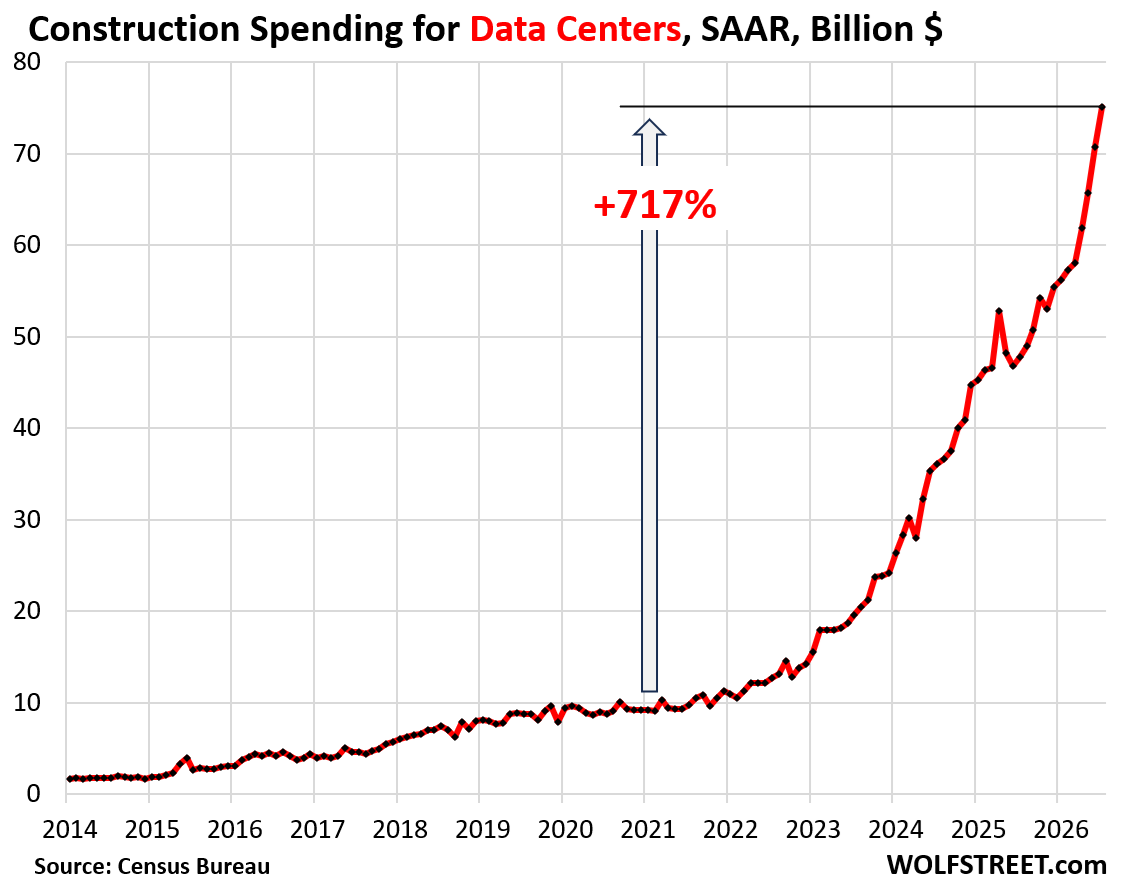
Obviously, these kinds of the-sky-is-the-limit near-exponential curves eventually fizzle. But they can last longer than imagined.
These amounts only reflect the construction costs of the buildings, the improvements around the buildings, and the equipment integrated into the buildings, such as HVAC systems.
The amounts do not include the most expensive parts of a functioning data center: the servers, the racks, the electronic and optical equipment to connect the servers to the internet, the electrical equipment to supply power and cooling to the servers, the power generators, the transmission lines, etc.
To accommodate this mad rush to build data centers as quickly as possible, construction companies and suppliers have developed technologies that speed up the work of building and equipping data centers to get them up and running faster. According to a report by the WSJ, they include:
Custom concrete: “Cement manufacturer Amrize uses predictive modeling to design custom concrete mixes, a process traditionally done through lengthy trial and error; time savings: several weeks.
Robotic concrete driller: “Stanley Black & Decker’s DeWalt brand and August Robotics have created a robot that drills thousands of holes to anchor server racks and other systems to the floor; time savings: six weeks.”
Off-site construction of electrical and mechanical rooms: “Clayco and Turner subsidiary xPL Offsite make modular electrical and mechanical rooms at off-site factories, then truck them to data centers for installation; Time savings: several months.”
Optical cable connectors: “3M makes components for fiber optic cables that allow servers to be connected in seconds, not minutes. A data center can have hundreds of thousands of connectors. Time savings: six months.”
Bottlenecks and shortages have dogged the manufacturers of on-site power generation equipment, especially gas turbines. Companies have started repurposing retired jet engines for on-site power generators. Musk has jumped into the fray to alleviate the shortages for his own data centers. In July, he acquired APR Energy, which makes among other things gas-turbine power generator sets. But the biggest bottleneck for gas turbine manufacturers are the blades and vanes, so Musk confirmed over the weekend that SpaceX will start manufacturing turbine blades and vanes.
Shortages of semiconductors, including memory chips for AI servers, have caused prices of semiconductors to soar, and they have started to spread to consumer electronics, and from there to inflation metrics.
There are now shortages of specialized labor, such as electricians. This kind of sudden maniac spending boom, funded by corporate cash and massive debt and equity issuance, leaves its marks everywhere, including by helping to push up government bond yields as they all compete for the same pool of money.
This drive to build and equip and power up gigantic data centers, no matter what the costs and hurdles, is pulling resources and labor from other projects, and costs are rising, and we’re already seeing it in the inflation data.
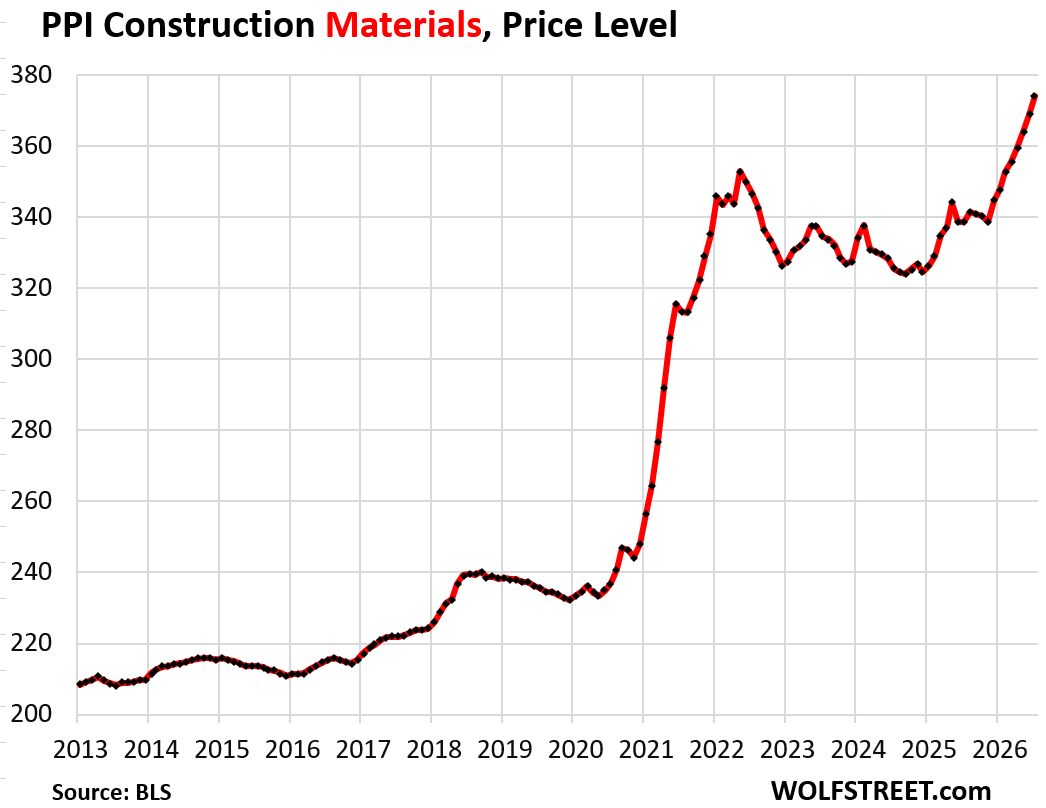
For example, the Producer Price Index for construction materials – steel mill products, concrete, lumber, gypsum, etc. – spiked by 10.5% year-over-year, the biggest increase since June 2022.
Drilling down into the product category level, the PPI for “Fabricated Structural Metal Bar Joists and Concrete Reinforcing Bars” – which includes steel joists and rebar – spiked by 17.7% year-over-year.
Since January 2021, the PPI for construction materials has spiked by 46%; since January 2020, by 58%. This chart shows the price level of the index.
For more, see our analysis: Construction Inflation for Nonresidential Buildings Soars amid AI Investment Mania
Enjoy reading WOLF STREET and want to support it? You can donate. I appreciate it immensely. Click on the mug to find out how:


Like the Space Race this is big. Control AI and AI related operations and you lead. China vs USA.
Unlike the Space Race, the output of all the billions spent in training fancy LLM models is a just a data file full of mathematical weights which can be both distilled from other models or simple stolen as a data file. Once created or stolen it can then hosted in relatively small machine to provide inference models to use without limits and offline. That’s right, billions spent on data centers and training frontier models can be copied in seconds and then used privately by a machine that fits in a single server rack. Vastly easier to copy than funding and engineering rockets, training astronauts, building launch infrastructure and space communications systems and executing space missions.
you nailed it Ben. there’s no impenetrable moat being built here.
Good point. Just like old IBM 360s all the huge data center equipment will be miniaturized quickly into a laptop size Gizmo, and the huge data centers will just be another unused shopping center mall.
The phone in your pocket has as much computing power as the super computers from the 1980’s.
I think the bigger problem is that AI is now generating a large portion of webpages and documents. AI is now being trained on that output. Like a self licking ice cream cone.
Easier said than done. We started hitting the limits of Moores Law a while back.
Amen. Also, while certain gpus that use CUDA are useful because most AI projects can and are most easily run on them, inference can run on a potato. Even older CPUs like my AMD 5600h with a 6Gb vram gpu CAN RUN the best, smaller ~35b or smaller models with quantization plus 48Gb of ram. Two old computers can do a lot of work, if more slowly.
Hence, the real value opportunity is getting robotics or video generation or AI-assisted creation of drugs/ materials, e.g., like Coscientist. The AI ARE incestuously buying each other to ensure they share in any breakthroughs.
However, as most such work only requires INFERENCE, it can be done in cheaper ASIC or Chinese GPUs. Meanwhile, as Felix & Friends on YouTube just masterfully demonstrated there are few safe havens now. Those governments cannot have reasonable budgets without taxing the principal component that has had the highest US/EU/UK/Japan growth: Capital.
FORMER JCPENNEY CO BUYER, YUP!
You’re spot on! No one has ever thought about cybersecurity in an AI context! /s
Of course, the same threats exist for any digital infrastructure.
Your characterization of AI implementation is, so say the least, a bit simplistic.
There is an outside probability that, aside from competitive/productivity reasons, AI is being pushed into overdrive for a reason largely separate from all these issues (some of the issues are legitimate even if this opposition is being funded in large amounts by foreign interests).
What will fit into the solution space for that $40+ trillion debt/sinking petrodollar existential threat?
Lead what?
China seems to be doing just fine. China has achieved parity with US in R&D investments. And based on where the trajectories and government supports are, it will likely outstrip and push ahead. China’s open source models are competitive with US peers, their paid AI offerings are significantly cheaper. US companies are being propped up by protectionist policies against importing Chinese technology. If the Chinese EVs landed here – US consumers will have real choices at mass market prices for a change.
The reason US was ahead in space sciences because it’s investments were supported by being an attractive hub for talent globally. Now, knowledge is more democratized and accessible than ever and the country with the best ability to attract, nurture and grow the brightest minds will pull ahead, like it has been the recipe in the past.
I’m not sure what US is going to lead in 10 years from now, considering it’s already behind in significant areas that matter to the future, and actively sabotaging it’s relationships with reliable partners.
I don’t know. have you seen the performance of Chinese Big Tech stocks. Smart money says they are way behind. BABA is down 60% from its peak in 2020 and at the same time NVDA is up 2000%.
They are un investable companies. The stocks have been flat or trending down for several years during one of the biggest technological moments in history?
China has 1 tech stock with over a 1 trillion market cap and that is tencent at 1.1 trillion. The US has 12.
That global talent came from 1940’s Germany.
Who got their ideas from an American named Goddard, largely ignored in his own nation.
It’s all a big circle.
“US companies are being propped up by protectionist policies against importing Chinese technology.”
So what you’re suggesting is that we hand our tech & car industries over to China for lower prices?
Wait a second, haven’t we tried that since before 2001, when China joined the WTO?
The simple fact of the matter is that things / everything in the USA costs more due to labor costs. That’s a fact.
So you’re arguing for untold numbers of people working in tech, car mfg, etc to be replaced with cheaper Chinese products.
How many people in the US are going to go for this, when that means they lose the job?
BENW wrote: “….. everything in the USA costs more due to labor costs..”
Maybe it is time to look at why ?
What makes labor in the USA more expensive ? What do other countries do to make their workers less expensive ?
I can think of a few things to look at.
1. Health care. This is a sector screaming for reform.
2. Education. Getting rid of the private for-profit diploma mills and how they sell their service to gullible students with debt.
3. Housing. Why is housing unaffordable for so many working people ?
I am sure there are other areas the posters here can add to this list.
“Like the Space Race this is big”
Right – Just imagine how poorly the US macroeconomy of the last 55 years would have fared without Tang.
I suppose with all the hype, and insane amounts of money involve….
This AI thing better change the world and make boat loads of money doing it.
I def ask it very complicated questions in a line of thinking.
Before this you kind of had to run down the info yourself. And of course it’s still a good idea to double check the info if it’s important.
I just use the Google one on their website, not any of the more sophisticated ones, because I really don’t have time to sit down and integrate them into life.
Thinking of booting up the PC and messing with some of them. The costs associated are kind of annoying. They want quite a lot to access them.
Depends upon what you are going to do with the AI. All the major players offer some useful levels of function for free. The first paid level expands considerably upon that, but doesn’t cost more than say a premium streaming TV service.
It does take some experience to get best use out of them. Most people approach it initially like a super Google search. It can do this kind of okay. There are better ways to query them however. You’ll get much better results by assigning them theoretical characteristics and limiting scope prior to the AI answering. It will take a bit more thoughtfulness and effort on your part to get good results. When you get over the initial threshold however those results can be multiples more useful than just basic searching for answers to questions.
Right now the entire house of cards is being built on the promise not to MAKE money… but to save it. The Tech Bros are trying desperately to convince general industry that they need AI because they will be able to do more with fewer people. No one is answering the question: “and if those people get laid off, and no longer have jobs, and no longer buy stuff… how are those companies going to grow revenues when consumer spending drops 20%?”
I thought, “Self, AI is so darn great I should ask AI!” So I did:
“is AI data center buildout a lot like lemmings?”
AI Data Center Buildout: A Lemming-Like Rush
The rapid expansion of AI data centers is often likened to a lemming-like rush due to the aggressive and uncoordinated nature of the buildout. This comparison highlights several key aspects of the current situation.
Characteristics of the Buildout
Aggressive Expansion: Companies are rapidly constructing data centers to meet the soaring demand for computational resources driven by advancements in AI.
Lack of Coordination: The expansion is happening without a unified strategy, leading to potential oversights in sustainability and community impact.
Implications for Communities
Sustainability Concerns: The swift growth raises questions about the environmental impact, particularly regarding energy consumption and resource allocation.
Local Impact: Communities may face challenges such as increased noise, pollution, and strain on local infrastructure as these large facilities are built.
Conclusion
The analogy of lemmings captures the urgency and potential recklessness of the current AI data center buildout, emphasizing the need for careful planning and consideration of both environmental and community impacts.
This is partially sycophancy. It will adapt its answers to fit whatever narrative your question implies.
Try asking the question again but with a positive spin.
Yes, this is a big problem with AI.
I have very limited experience, but a friend of mine is much more attuned to this type of query. AI is useful for him.
I once use AI to generate an image based on a photo I provided. It did what I asked, but made other, unwanted, modifications to the image. I’ve never gone back. If I have to constrain it against some unknown self-directed action, it is not worth the effort. Good luck to others.
I’m curious as to how much the construction spending/demand for construction labor for data centers has had an impact on residential construction material costs/labor costs and how that’s had an impact on housing costs. Does anyone know of any reports/studies that would provide some more clarification on that?
Thanks for the article Wolf!
Large scale multi family residential apartment buildings may overlap with the contractors and sub contractors that data centers use, but as the size of the residential project drops off that overlap would shrink.
Materials would overlap a decent amount, except the steel bar joists–those are usually only used in commercial construction, although I have worked on one condo building that used them.
Re: ‘To accommodate this mad rush to build data centers as quickly as possible, construction companies and suppliers have developed technologies that speed up the work of building and equipping data centers to get them up and running faster. ”
I infer these efficiencies will facilitate the arrival of the consequences of the buildout sooner than expected.
The data centers are consuming huge amounts of steel right now – to the point of nearing shortages. Beam is hard to come by and sheet is really tight. It’s driven prices up around 50% for us this year. Our primary steel supplier told us to shop around (as opposed to utilizing our purchase program) for the rest of the year because their primary mills are missing coil delivery dates by months, and they can’t get enough material.
They cited data center demand as the elephant in the room with transportation equipment still being soft, and agricultural equipment suffering from a prolonged downturn. Under the cover of tariffs, mills are jacking prices to the moon, rivaling the wild numbers of 2021.
Looking forward to that bubble popping.
I would imagine steel scrap prices are soaring or will be about to also.
MW: Bessent now says debt-reduction plan could be months away. It will face hurdles when it arrives.
Bessent’s debt-reduction plan just months away meets the newly elected 2026-2028 Legislature. That should be entertaining.
What, me worry? I leave worrying to my wife. She’s really good at it.
I can’t wait to see what that plan looks like and the sparks that it causes.
Not sure how the Treasury Secretary has any say so in reducing the debt.
I would love for him & Warsh to be very vocal about the need to reduce the debt.
Their best playbook is to get serious about squashing inflation by raising rates which will cause debt service to balloon faster. That might be the only thing that gets America’s / Congress’ collective attention.
There is a lot of clever AI financing going on, much of it being made by entities who create the financing, then somehow manage to disengage themselves from the responsibility of many of those loans. So it looks to me like the average investor might need to be even more careful than usual where they put their money.
The limitations of building data centers might be the one thing that saves companies a lot of money and maybe even get some good press. If everything was super cheap and power available there would be massive excessive compute. AI is like a normal calculator versus an expensive scientific. The majority of people will be fine with a normal AI model, can likely run it locally, and do it in the cheap. Happy to have slightly slower code production or slightly less quality if I don’t have to buy tokens.
OpenAI is clueless as they are chasing better frontier models when others are pursuing products(some more successfully than others). Still unclear how any make it profitable.
This is the most grotesque waste of natural resources in human history. By God somebody stop this greed. It is despicable beyond words.
One thing about you DC, you really know how to sugarcoat it. I had lost whatever faith I might still have had in man’s morality until you cleared it up for me.
You were being sarcastic, right?
;)
Look at it as a new deal WPA program with all the jobs it Is creating, but just for one time….
Then someday all the overbuilt data centers can be repurposed for something else…..maybe.
Rusting junkyards?
Perhaps someday it will lead to hundreds of jobs in nuclear waste clean up, after the reactors meant for powering AI melt down.
I put this query to the free version of Chatgpt:
Assuming your were an investor, how would you characterize the current level of investment going into AI, Data centers and related resources? Do you think a crash is going to happen or that a bubble is forming?
The answer was far too detailed, large and far reaching to quote here. I’d encourage readers to copy this query and paste it in. Then peruse the results.
I will quote one short striking passage from the result. Mind you if you paste the query in it won’t be word for word the same result, but should be very similar. Anyway it said as a historical analogy it would describe the current situation with AI as:
I’d compare it to railroads + electrification + the dot-com boom, with a little bit of 2008-style financing layered on top.
The content that you read in your AI results was stolen by ChatGPT from publishers around the internet, including wolfstreet.com, and ChatGPT then sold it to you, and you paid for this stolen material via your ChatGPT subscription.
AI is killing publishers by stealing their content and their traffic and their ad revenues.
AI will in some form of another destroy almost everything on earth. It may start out being gradual over time, but at some point, we fall off a cliff. Then, we’ve all got to be concerned about survival.
It’s only a matter of time before some rogue or intentional cyber attack makes everyone think, “Oh shit. AI might need to be put back in a box.”
Exactly. Why are AI / tech CEOs building bunkers?
One YouTuber made a video on how AI is like Soylent Green. It is the people, stolen, mushed up, and then sold back to you. Pretty hilarious take on it.
he said it was free version of chatgpt. i’m old enough to remember the .COM bubble and bursting. great things came from it. but of course many got slammed and many companies were ripped off. i’m also old enough to remember being on the DARPA net during grad school. people thought we were lying when we told them we were communicating to Stanford from Columbia U. nobody knows where this AI race will go or end. nobody. not me. not wolf. not bessent or the hobo in the park living in a tent.
I didn’t pay anything for it. I would say it was collecting content in one spot in a coherent manner more quickly and easily than I could go collect it myself. Such activity is something AI is very good at doing.
I do look at sources most of the time, and sometimes go visit sources I didn’t know about. I do understand in aggregate the activity of AI’s is hitting viewership and revenue of other sites. I’m not sure how that should be handled. I do think it is a case of not being able to put the genie back in the bottle.
I would be interested in any thoughts if you have any on what could be done differently.
This wasn’t a personal attack against you. You did what everyone is doing.
AI is amazingly good, if you know how to prompt and iterate. But our copyright laws were not designed to deal with AI. So it’s running all over publishers. Some big publishers made a deal with some of the AI companies and are getting paid for their content. For example, News Corp (WSJ) made a deal with ChatGPT. Small publishers cannot make any kind of deal. Our content is just there for the taking. Given the trillions of dollars of AI-related investments, and full government support behind it, no one is going to even think about thinking about slowing down for small and not so small publishers. We’re just getting run over.
Publishers with paywalls are now mulling over the idea to lock up their firewalls so that no crawler or bot can see the content. That would prevent AI from getting access to the content. But it would also cause the entire publication, including all articles, to vanish from any search results. So that’s a no-go for me for two reasons: one, I don’t want a paywall, the site is mostly supported by donations; and two, you could no longer find WOLF STREET on the internet. You’d get wolf street pizza in Philadelphia instead.
So “what could be done differently?” I don’t know. AI will be, and is already, killing stuff off left and right as it moves forward. I’m totally amazed — both as a passenger and as a pedestrian –how awesome the Waymos are now. They’re much better than human drivers. They have 360-degree vision, night vision, rain or shine, etc. They have a screen inside, and you can see on the screen what they see… amazing. Uber drivers need to find another job fairly quickly. I love using AI for tech support (these service providers’ AI is limited to their knowledge base, they’re not combing through the internet). People who work at tech support call centers, if they’re still any left, need to start looking for another job. AI is going to kill lots of economic activities along the way. That’s just collateral damage … like the internet, and before it, computer networks, and before it, factory automation, did a lot of collateral damage. But the world went on, and overall employment kept growing, though entire job categories were wiped out. No one can get in the way of that. No one can stop it.
As publisher, I’m in the collateral-damage department. Now what do I do? Well, it’s just one more challenge that fate put into my way, nothing was ever handed to me on a silver platter, and I have to deal with it creatively. And that’s what I’m doing – I’m dealing with it because no one is going to change the way AI works. In addition, I try to offer something that enough people want to read here on WOLF STREET that they cannot get on AI: my voice, my humor, the comments, my nasty replies to comments, my charts (they ARE protected by copyright and AI cannot copy them other than as thumbnails), the whole experience of being on WOLF STREET.
Outstanding (he said respectfully) vista into your mindset Wolf.
Since my youth, owing to a smart pops who broadened my education, I have been forever heavily influenced by the thinking of Schumpeter, specifically his examination of the “Gales of Creative Destruction”.
I’ll dispense with a narrative on his analysis (you already know it). I would highlight his observation that when these gales arrive, legal systems are modified in order to promote their ascendancy. This is a good place to monitor to ensure one isn’t getting trucked – your copyright infringement example fits in here. It used to be be called “fighting the man”. I don’t know what form that takes here – the change is coming like you state – but there is room for some. Another is the data itself/data management processes. AI depends on it obviously. So do you. Another area to dedicate close attention to.
I do believe there is always room for truth; short of that, solid, unbiased analysis supported by authoritative data sources. People still read Homer and Aristotle, thinkers whose writings were passed down by voice for centuries despite writing, printing presses, video, TV, cinema and other technologies and institutions (e.g., religion, academia, media).
A lotta AI, at this point, still makes mistakes and feeds back obviously “engineered” (in the worst sense of that term) responses. Truth earns trust – even in our age where ideology seems to trump almost everything. Trust is one foundation for an audience.
I’m off the soapbox. Stay in the fight until you decide there are better pursuits to follow in your life. There is no failure in this.
Its occurred to me that in addition to the theories about model collapse from AI content displacing real information on the Internet, you also have a couple of other adjacent effects: There’s AI search hurting the creators of any original content that’s left, and I’ve also noticed that it seems like all the AI is doing when you ask it a simple question is basically a Google search and a results summary, with only a handful of references for its information. In that case, how well it can find reliable information online might depend on search provider rankings, which are derived indirectly from human input (references, popularity, etc., notwithstanding SEO manipulation). AI’s ability to find high-quality, human-generated information online should also degrade when AI content messes up search rankings.
So I kind of anticipate the enshittifying of the internet, but I don’t think the demand from humans to read human-generated content is going to go away. It will probably just be harder to find in the near term until AI degrades itself to the point that AI-generated content is even more obvious than it is now (and most of the AI players go bankrupt). I think trust will also be a more important commodity online when you can’t just scroll through aggregations of information and assume everything is real. I think sites like Wolf Street will be the thing that people will be looking for in that kind of environment, in addition to some traditional news sources – just single outlets of information that can distinguish themselves by trust.
You’re joking right?
I remember at the inception of the world wide web some famous thought pieces/predictions that pervasive accessibility to the web would lead to a “critical mass” of reviewers which ultimately democratizes the pursuit and content of “truth”. Man was that ever a miscalculation/flawed view of human nature, government, and ownership!
The hot mess has been waiting for AI to catch up!
@phillip What I see is that the web has increased the availability of information (and disinformation) overall, but the problem is whether people actually want to look for the truth online or apply any critical thinking to what they’re seeing. I think what you’re saying is that AI is going to help people summarize and find truth online? The internet is currently being buried in AI slop and disinformation. We have hallucinations, we have Grok, we have fully automated spammers, scammers and hackers now, so none of this is helping.
Without AI, how did people find information online if they really wanted to know something? Google, Wikipedia, or you could spend all day on Scholar if you really wanted to. Blending all of that into one single AI-generated, probabilistic, entirely statistical, “may be incorrect” answer is really not a good idea if the goal is to widen people’s access to factual information. If anything, we’re going backward.
Matt…not my “angle”. I’m suggesting that that there are different approaches to search for “truth” (don’t get too caught up in that word btw). That search has two participants – a provider and a searcher. That interaction can occur over many mediums. The participants have their respective sets of responsibilities, capabilities, etc., for discovering, understanding, providing truth/cogent argument/knowledge (whatever you want to label it). The game in all of this is to be trusted – a state that transcends the medium. AI is another medium. The Wolfs of the world are on level ground with AI when it comes to the matter of trust. My anecdotal note on early WWW dreams simply noted that the promise of that technology was not uniformly (shall we say) achieved because there are factors that can supercede the medium/technology. In the end, we get to decide who we trust and at whose wells we drink. May sound Panglossian – but nevertheless I get to decide who I trust (whether I do that intelligently is another matter!).
On one hand you have the tech bros saying AI is smarter than the smartest human. On the other hand you have people who understand that AI is only as good as the information it is built on – and how easy that is to influence or manipulate. And then underlying it all is that many people aren’t smart or educated or sophisticated enough to tell the difference – and abdicate critical thinking to a black hole of technology that doesn’t even begin to pretend that the information it is regurgitating is correct. Angels weep! The only good thing I can say is that AI doesn’t play NFL pro football yet.
What if…Just imagine for a moment. …Perhaps an even more dramatic seismic shift in AI occurs where data centers become obsolete… It is possible. The other side of the globe leapfrogs the US as “We” pour trillions of dollars at this only to be one-uped.
I asked Gemni the following, and got the following answer:
A typical smart phone in 2026 is equivalent to a supercomputer from what year?
“A typical smartphone in 2026 is equivalent in raw computing power to a top-tier global supercomputer from the late 1990s to the early 2000s. While it completely dwarfs iconic 1980s machines like the Cray-2 by thousands of times, its raw processing throughput matches the absolute fastest multi-million dollar supercomputing clusters built at the turn of the millennium.”
I put the question to Google about my Jitterbug phone.
“A typical Jitterbug phone in 2026 is roughly equivalent in processing power to the absolute fastest world-champion supercomputers from 1993 to 1994.
While it might seem surprising that a phone designed specifically for seniors with basic features—like large text, simplified menus, and an emergency response button—is a powerhouse, the evolution of mobile silicon has made computing power incredibly cheap and dense.”
I wondered how a Tracphone would measure up ? To my surprise, it was even better than the more expensive Jitterbug.
“A typical low-cost, budget smartphone (like a TracFone) in 2026 possesses raw computing power equivalent to a world-class supercomputer from the year 1997 to 1999.”
Google should change their name to “HAL”. And HAL was right, it is “human Error”.
Take each letter of HAL and replace it with the letter one place to the left in the alphabet.
Yup, HAL was ahead of….
I forget, what’s the letter to the left of A?
Ha! I meant my other left.
Takes me back to when I would screw up right-hand rule physics problems because I couldn’t be bothered to put down my pencil and just used my free hand. Ugh.
Amazing article and comments.
This article reminded me of the Gold Rush days when rumour and hype took over reality. Yukon….many heading for Dawson City. People went nuts with iconic pictures of long lines of hopefuls trudging up the Chilkoot Pass, then stopping to build rafts to get to the north. Except for a few lucksters at the beginning, you know who made the money? Suppliers, boozers, whores, etc. Some people left prospecting to stay in the support column, but most returned home utterly broke and defeated.
I remembered working on my own gold rush event. 3 days a week I was hired to fly a ton of beer and pop to a mining camp in the NWT, 200 miles each way. They chartered aircraft to haul beer even though there was an available road (long nasty drive, but still). Several drill tent camps in the mountains, and 7 helicopters on site to move men and supplies around. Not one mine was ever built there, in fact….the company town of the highest paid miners in the World, Tungsten NWT, was shut down just a few years later as a new tungsten mine opened up in China and undercut them by 30%. The entire town was abandoned. A few years later I flew over the same long and nasty road and watched giant orange Allied Moving van trucks heading south. A 300 mile gravel road.
All this recent mining hype was paid for with Investor Money. All of it. Data mining, gold mining…all the same. One more thing. In my twenties I was going to buy some miner stocks. A wealthy customer of ours…..multi millionaire, he shook his head NO when I asked him for his advice. His words, “It isn’t about the mining property, it isn’t the property, it’s the promoter that makes you the money. Wrong promoter, don’t buy it”. Same thing today, even more so I would imagine.
Just saw an article headline that says AZ AG is calling for a moratorium on new data centers. I can’t remember when the last time I read about a NEW data center being approved. I’m sure there are some, but it seems to be about 10 or more are being shot down for each one that’s approved.
GO VOTERS! More power to you. Make yourselves heard.
Ford sales for Aug 170k
this is small inc of july, but about the same for June
last year aug sales were higher than june
so does this imply sales in aug were “Terrible”?
Last year was distorted by the end of the EV incentives on Sep 30, which caused a huge front-running surge in EV sales which boosted total sales. So the year-over-year comparisons are against this inflated base a year ago. Then after the EV incentives went off on Oct 1, sales plunged. So you will see HUGE year-over-year sales gains starting next month.
The learning curve cost reductions on data center construction and on server power efficiency must be some of the steepest declines in human history.
The pace of innovation in these areas is truly astonishing.
It will be very interesting to see what things look like in 20 years, after enough time for new entrants based on these technologies to have replaced today’s incumbents.
An example: 20 years ago, many small towns still had a functioning, subscription-based newspaper. Today, they’re almost all gone, replaced by “content creators” using online tools like websites and social media.
I wouldn’t say that content creators are an equivalent replacement for local journalism.
The local news companys could survive if they get their act together. Google news is a bunch of shock value divisive trash. Top story in the nation is some stupid lady that killed her own kids. Then the fake political division stuff about mail in ballots, uniparty congress districts, contaminated baby wipes, oh no!, Tim Cook, the guy whose company evades taxes and gives the president gold saying the US is heading for a 100 year flood. It is stupid as hell.
Every time I see one of these articles, Global Crossing comes to mind.
BOND SELL-OFF DEEPENS
I work in the tech industry and my companies “token maxing” approach just flipped on a dime, with many coworkers abruptly losing access to critical AI tools as AI spending blew past budget expectations. Many other businesses are adopting the same approach as AI-driven increases in productivity and innovation are nowhere near expectations.
As Wolf alludes to here, eventually these capex investments run out of steam and reach a sharp inflection point. Given broader industry trends, I think we’re 1-2 quarters away from this exponential increase in spending rapidly leveling off. As soon as that happens, AI bubble begins to pop. I think we’re in the 7th or 8th inning here.
100% correct. Biotech jumps of stuff like this all the time, quickly squeezes it for productivity/innovation gains, does an honest assessment and then moves on.
The profitable companies one are already moving on.
LOL! This will be the largest mis-allocation of capital and resources the human race has ever seen, exponentially larger.
Hedge accordingly.
Lotsa money being spent on something that will only benefit the jaded oligarch class. In two years we’ll be talking about a glut of unemployed electricians.
Polticians who vote for this crap will be voted out. AI will have the same fate as flock cameras.
“Lotsa money being spent on something that will only benefit the jaded oligarch class.”
Waitaminute. It’s THEIR money that’s getting spent on this stuff. If it blows up, it’s THEIR money that’ll blow up. If it takes the stock market down with it, it will be biggest reduction in wealth inequality in history, I would say.
Precisely!!
But do we allow deflation in anything, especially stocks, anymore?
I thought Ben “I would never monetize the debt” Bernanke and Janet Yellen outlawed inflation for the safety of bankers and financiers everywhere.
What is amazing to me also is that the cost of AI producing higher and higher quality output is rapidly going down. They are all driving AI user costs down to $0 and then who is going to be the “winner.” You’ll be able to use the best AI to write your own clone of the best AI, just like they are gutting internet content providers, they are gutting their own future profits as well. Seems the HW vendors are going to be the real winners as the cost of software gets cheaper and cheaper. I can’t imagine this ends well for most of the developers of frontier models.
Great article! Look forward to further coverage of the AI-mania. Another great data point to look into is the price of the computer hardware itself. Nvidia recently revised prices upwards (even for existing contracts as I understand). Each new build continues to generate pressure on the already strained HBM supply chain crisis, so each new build causes prices to build these kind of hyperscaler DC’s to skyrocket (and indeed all computer in general, including a lot of consumer electronics). A vicious cycle if I have seen one.
The NY Fed President John Williams said that the increased yields in treasuries are due to a strong economy.
How did this moron get to where he is?
He was at least partly correct … just another way of saying: They’re letting the economy “run hot,” with higher inflation and higher nominal growth (+8.0% nominal GDP growth annualized in Q2), and therefore higher yields reflect that. It all goes together, it’s the official policy now to deal with the government debt. We’ve been talking about this for a while.
The spending on AI related services will happen, just a matter of when.
Will it be before the Chinese commodification of AI models makes it make more sense to have a free local AI doing the majority of the AI-ing on locally secure servers, or after.
Not saying to use Chinese AI’s! Sometimes free is the most expensive option, lol
Why aren’t these cheap AIs being made here, or are they?
Datacenter construction is driving up demand and pushing out lead times for the base materials used to construct circuit boards. I’m not talking about chips or anything fancy like that. I’m talking about the fiberglass epoxy laminate they use to make the boards themselves. It’s a certain kind of fiberglass and a certain kind of glue.
This is a very ordinary commodity material used in pretty much every electronic product. Only an unprecedented demand for servers would cause a shortage.
Bottom line is this – when you take away the (AI) heroin, there’s going to be a major day of reckoning. It won’t be pretty!
The day of major reckoning is closer than you think already – whether IA arrives or not.
I will cry tears of joy! This charade has gone on too long. But then I remember it was only about 6.5 yrs ago the spx fell 33 pct. But we need one that grinds even lower for a long time, wiping out all the dip buyers, me included, lol.