
“…is partly a result of the significant rematching between employers and employees that happened at scale” after Covid.
By Wolf Richter for WOLF STREET.
In his Jackson Hole Speech, Fed Chair Warsh, when discussing the labor market, said: “In my view, the relatively low turnover in today’s labor market is partly a result of the significant rematching between employers and employees that happened at scale in the post-pandemic environment.”
He was referring to the huge historic wave of voluntary quits in 2021 and 2022, as labor shortages – due to people being slow to going back to work as they were receiving extra government money for not working – caused employers to raise wages and aggressively hire workers, including by poaching from other employers, and as employees saw opportunities everywhere and jumped jobs and industries.
The result of this huge churn in the labor market was that workers found jobs that better matched their aspirations and skills, and that employers found workers that were a better fit. And then everyone settled down, and the turnover calmed down.
Warsh’s “relatively low turnover” comment refers to data tracked by the “Job Openings and Labor Turnover Survey” (JOLTS) by the Bureau of Labor Statistics, which released the July data today. It tracks this “turnover” in the labor market; it doesn’t track employment growth, unemployment, etc.; the jobs report for July (released August 7) already did that.
Labor market turnover is a function of slots left behind by people who quit their jobs (“quits”); by people who got laid off or fired (“layoffs and discharges”); and by people who retired or separated for other reasons, such as died while employed (“other separations”). Those left-behind slots become “job openings” when employers try to fill them. And when employers successfully fill those job openings, they become “hires.” All these stages are tracked by the JOLTS data today.
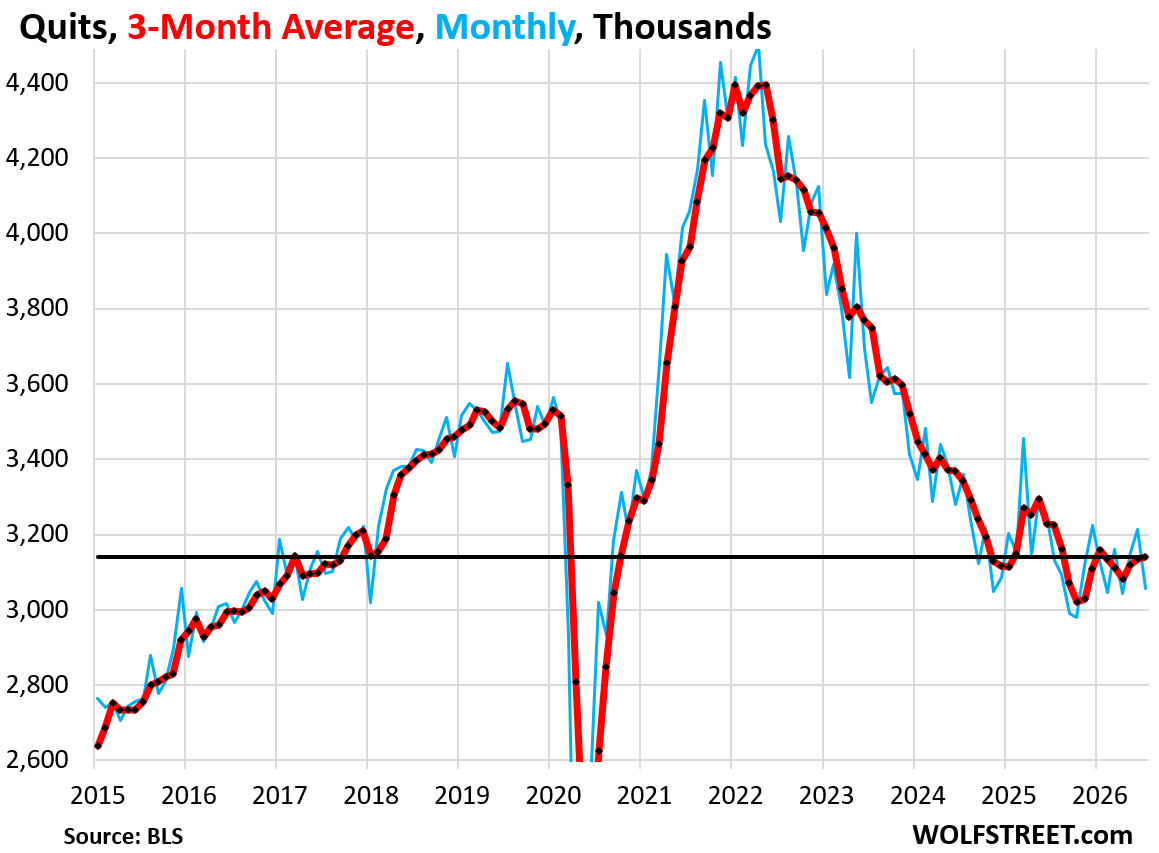
Voluntary quits declined by 157,000 in July, to 3.06 million workers who walked out and quit their jobs voluntarily (blue in the chart). The three-month average rose to 3.14 million (red).
Quits account for 60% of total separations and are the biggest source of labor market turnover. Fewer quits mean fewer job openings left behind.
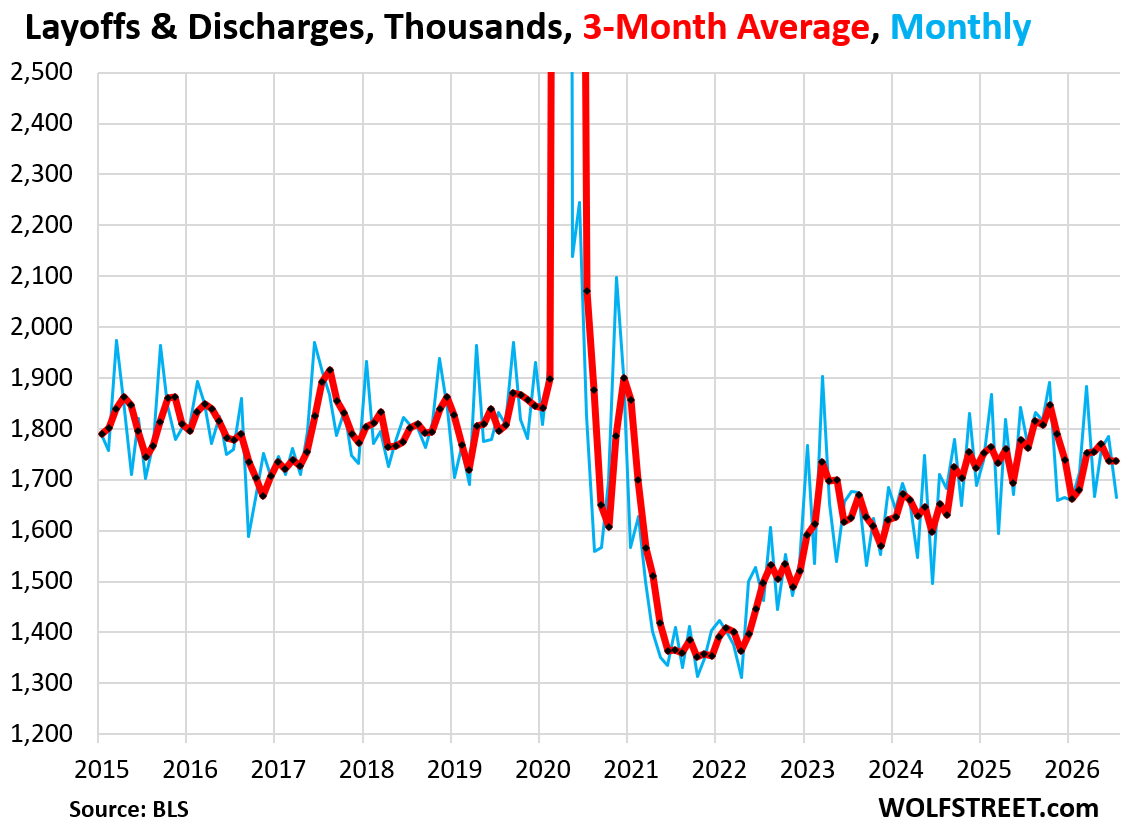
Layoffs & discharges declined to 1.67 million in July, down year-over-year by 106,000. Getting fired for a variety of reasons, or for no reason, is a standard feature of the US labor market.
The three-month average remained at 1.74 million. These levels are at the lower end of the range of the prepandemic years.
Layoffs and discharges accounted for 33% of all separations.
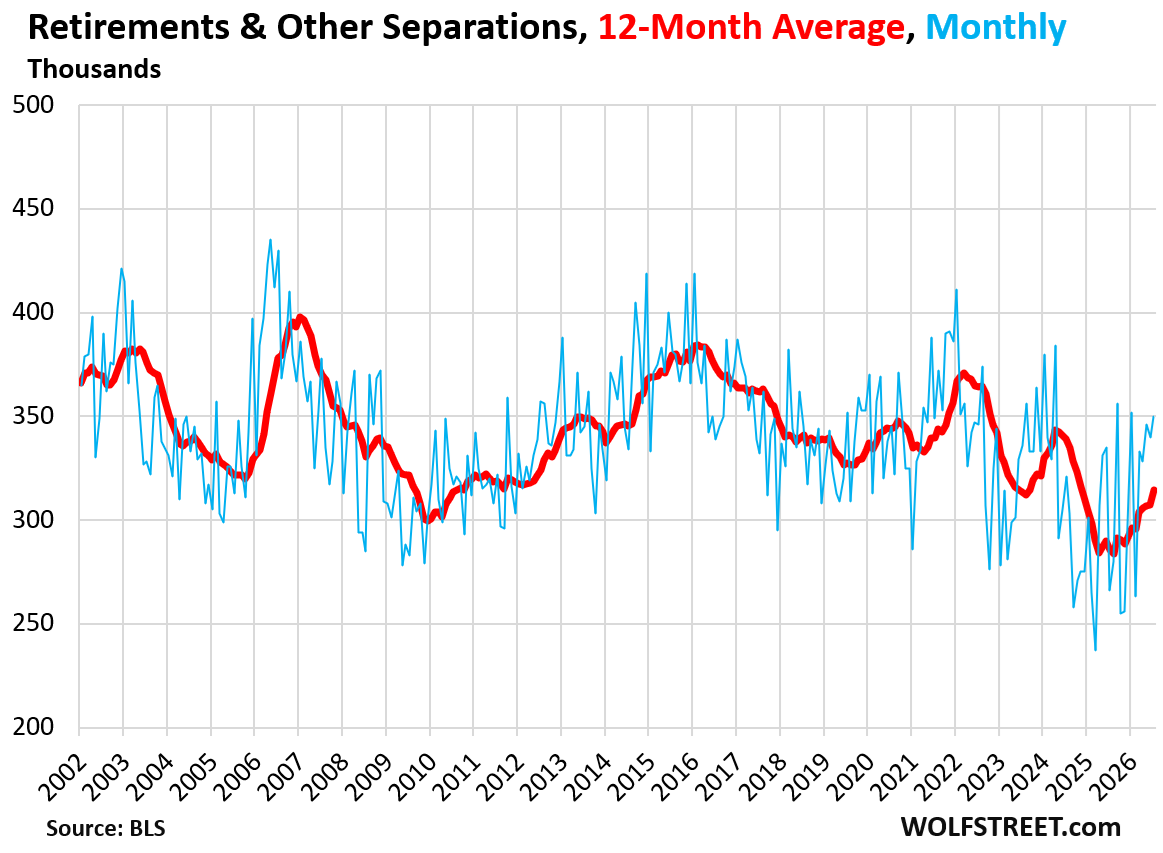
Retirements and other separations (including deaths while employed) accounted for only 7% of total separations. They’re only a small element in the turnover equation.
They rose to 350,000 in July. The 12-month average, which irons out the month-to-month spikes and plunges, rose to 314,000, further coming up from the 25-year low in 2025.

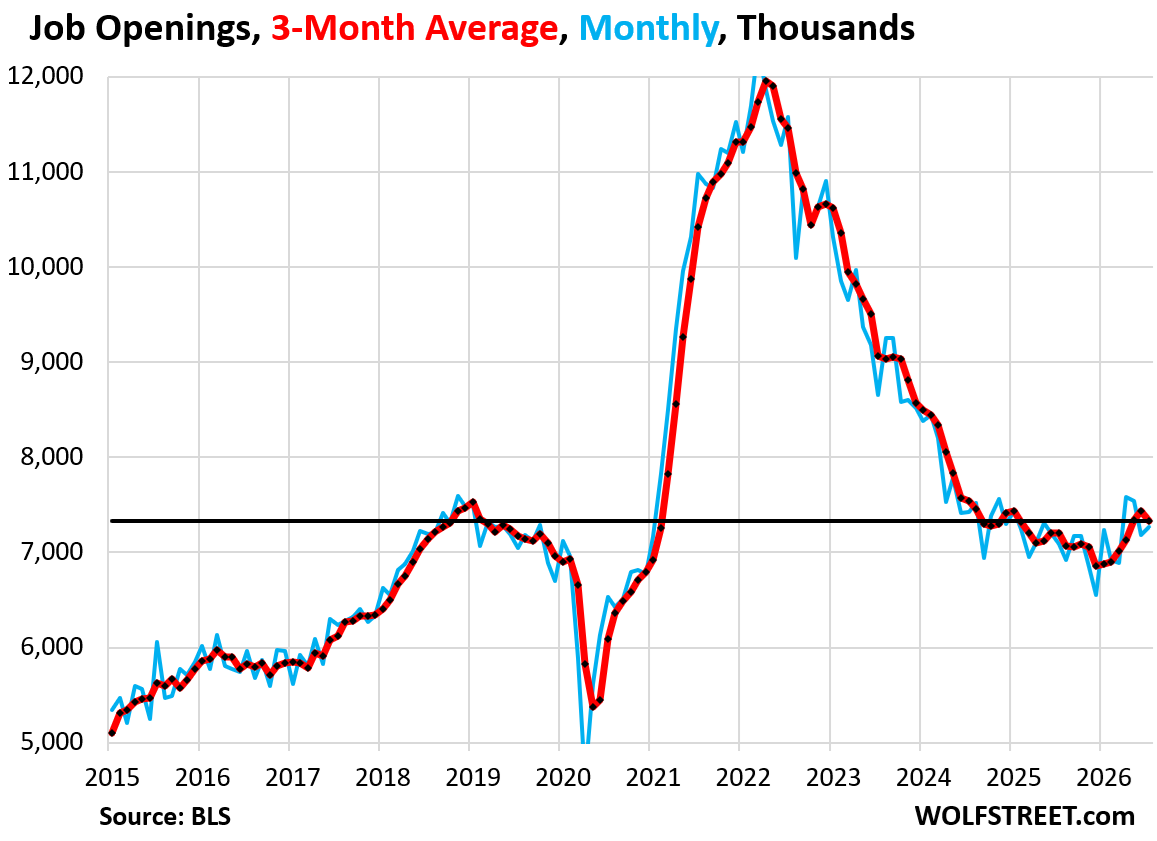
Job openings rose by 89,000 in July, to 7.27 million. The three-month average dipped by 105,000 to 7.33 million, up by 129,000 from a year ago.
The data for job openings is based on a survey of the HR departments of 21,000 business locations, not online job postings. A job is “open” only if it meets all three conditions:
- A specific position exists, and there is work available for that position.
- The job could start within 30 days.
- The employer is actively recruiting workers from outside the establishment to fill the position.
Excluded are positions open only to internal transfers, promotions, demotions, or recall from layoffs; positions for which employees have been hired but have not yet started; and positions to be filled by employees of temporary help agencies, employee leasing companies, outside contractors, or consultants.
So with low number of quits, and low layoffs and discharges, the number of left-behind slots is low as well, showing the effects of lower labor turnover. This turnover has normalized at a level that is near the peak turnover in the years before the pandemic.
The number of hires to fill those fewer left-behind slots fell by 278,000 in July to 5.05 million. The three-month average declined to 5.21 million.
The number of hires is mostly a function of slots left behind by separations (quits, layoffs and discharges, and other separations). Nearly all of these 5.05 million hires filled slots left behind by previous separations. “Hires” do not speak to changes in payrolls, such as the number of jobs added to payrolls (reported by the employment report in early August), but mostly to “labor turnover.”
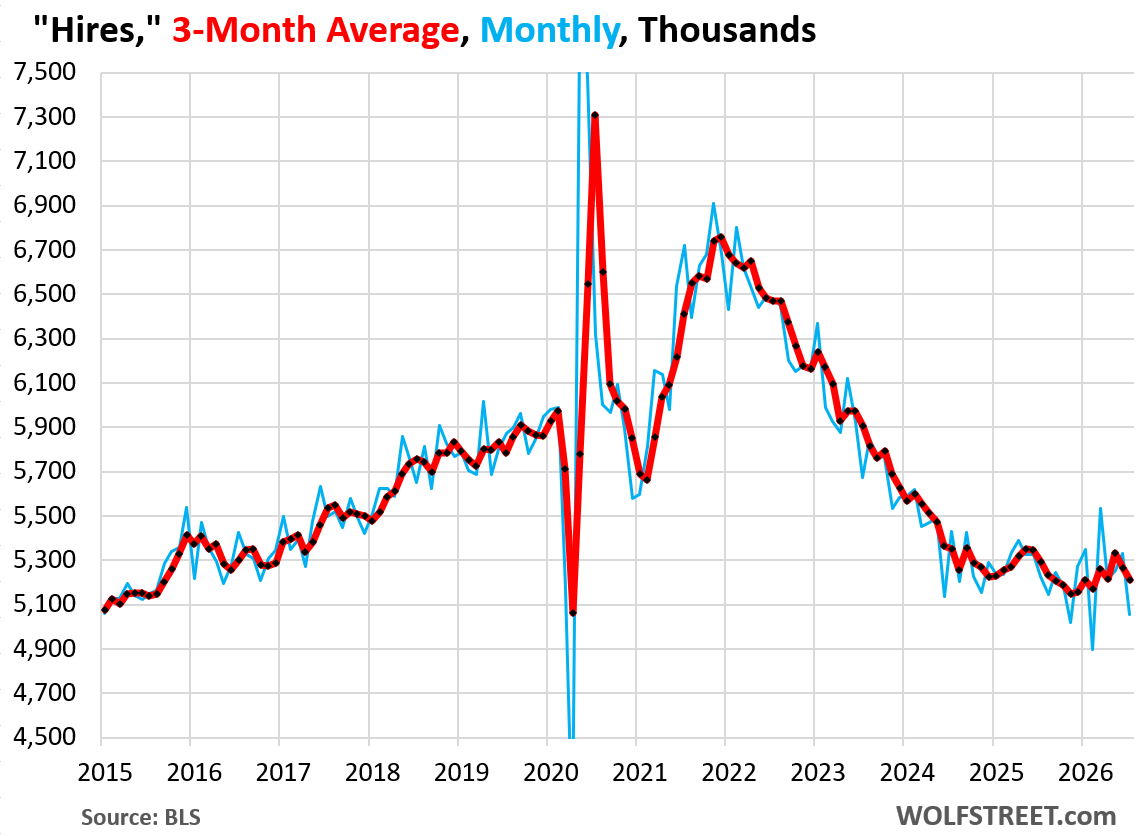
For employers, there were big costs associated with the massive labor turnover in 2021 and 2022, and measures of labor productivity declined from late 2020 through late 2022, as the large number of newly hired workers had to climb the learning curve. But after they settled in and learned the ropes, productivity rose to relatively high levels.
These dynamics were not signs of strengths or weaknesses in the labor market, but signs of a reshuffling of the labor market that resulted in a broadly better fit of workers and employers – as Warsh phrased it: “…the significant rematching between employers and employees that happened at scale in the post-pandemic environment.” It’s refreshing to see the Fed chair point that out, after Powell had been abusing this JOLTS data for years to support his views of strength or weakness in the labor market.
Enjoy reading WOLF STREET and want to support it? You can donate. I appreciate it immensely. Click on the mug to find out how:


Wolf, I think Warsh reads your blog. Or at least has people close to him that do. Didn’t you point this out months or years ago?
I’ve been pointing it out for about two years off and on because that is exactly why there is even JOLTS, to measure this kind of “turnover” which is the T in the JOLTS. But the interpretation got perverted somewhere along the way.
I think the perception is (and was with everyone I worked with) that leaving your job would be stupid. You don’t get off the chair you’re sitting on while the music is still playing.
Make nice with your bosses, learn as much AI shit as you can.
Pray you aren’t culled.
LOL here we go. Job changers get higher pay and advance their careers faster than job stayers. There is a lot of data on this, including from payroll firm ADP: Pay increases for job changers have consistently outrun by a substantial margin the pay increases of job stayers. So stay on your chair at your own risk.
But maybe more of the restless job changers finally found the job that suits them better?
sure hope there isn’t recession and companies decide to slim down
LAST IN = 1st out
Very wise and tactful reply, Wolf. Some people are stayers, some people are more motivated.
Personal anecdote, but I actually was one of those switching jobs over the past 10 years and would consistently find higher pay at a new job. But this year I found a WFH job in a pretty sable sector with great bosses and I don’t plan on changing jobs unless I find some unicorn job.
I have had recruiters reach out to me with hybrid or on-site jobs who scoff at my inflexibility when insisting on full-WFH. I scoff back in equal measures. I will never (God-willing of course) go back to daily commutes and brain-dead office work.
Not only that! I saw this many times: a person receives an offer from a different company at a higher salary. Said person notifies the current employer – who matches the raise plus a few concessions.
Pay tribute to how great capitalism is. A socialist planner is supposed to be able to sort all this out?
Apparently, quite a few people (who even post on this site) still believe in the socialist planner’s abilities.
When I was an officer in the Navy 45 years ago, I was supervising about 50 enlisted men. I spent 10% of my time on the middle 80% who were good dedicated workers, 10% of my time on the top 10% overachievers. I had to keep an eye on them as they sometimes would start repair work on a piece of equipment without all the necessary approvals, and it would bite both of us in the butt. I spent 80% on my time making sure the remaining bottom 10% did their job. If I let them slack off, everyone else would quit working. A valuable lesson for a 24 year old just 2 years out of college.
I recall reading on the web about a university professor who wanted to teach her class about the differences between capitalism and socialism. She told the class they had a choice of grading for the semester. One was the traditional method of you get what you make on the exams, and the other was that she would average all the grades and each person would receive the average. The class voted for the second, though not unanimously. After the first exam, the students who made the higher scores saw that they were not being rewarded for their hard work, as the exam average was below their exam scores. Some of the class saw their grades improve, but they did not have an incentive to study harder for future exams, as they were already getting a free ride. The upshot was that throughout the semester, the average exam grades made a steady decline as the students (especially the above average students) began to put less and less effort into the class.
That is why the socialism model has never worked. It does not punish the “lazy uncle who wants to lay on the couch all day”.
That is not at all how it works. Whoever that professor was, made all that up. Just need to read Marx 101 to tear that down.
or watch how RUSSIA economy happen to mimic this exact phrasing
Yea…nothing like Ricardian economics!
Marx was probably the first great thinker wearing his sociologist hat; as an economist….pffft.
This is why the economy is faltering. We have socialism, but only at the very top.
Just don’t conflate that with welfare-state capitalism. The two are different. I must have missed the folks arguing for hard core socialism on here.
The University of Michigan, where I am a humanities professor, has decided that first-semester first-year students will not be graded in their courses. I will report the results at the end of the semester, since I am teaching a freshman seminar (on jokes and other humor). Will they dog it, or will they throw themselves into it without worrying about a grade?
Couple things seem like reasonable assumptions:
1. Fixed grade (known up front)? Then allocate more study time to those classes where dash average is not the limiter.
2. The burden is simply passed down the line to all sorts of interests:
– does the degree mean anything?
– do prospective employers actually have less data to assess candidates? For example, GPA matters, but so does trend.
– in the long run, does this practice render an institution less attractive to the better students?
– are teachers less energetic in reaching/pushing the top students? Can they given the whatever assessment mechanism used is modified by the altered incentives?
– how does this even work in knowledge areas such as math?
Can whatever assessment method used even be accurate given the altered incentives?
I don’t know brother, in my 25 or so years in and around the c-suite planning has been at least 50% of the job.
Great article and points stated in the past by WR on this topic. I also know that if I was still in the labour force and depended on same for health care coverage and 3 hots and a cot, quitting now in these unsettling haywire times would never even cross my mind. You want/need a safe and assured landing place if you want to move on. And then you have to trust any new employer your job will be safe.
I used to have two rules for moving on, and learned them the hard way. (I have always had work by the way).
1) Never ever apply at any organisation that advertises “___________ is now accepting applications for ___________” (Like they are doing you a favour)
2) If they say during the interview, “We are like family here”. Run, don’t walk away.
A bit tongue in cheek but pretty true in my experience. In aviation and construction (my background) employees are by definition nomads. If you want same old same old you have to go airlines or work in building maintenance. In construction the buildings always get built and the job changes by definition, and in aviation tough times means air travel is curtailed, pronto. My rotary (helicopter) buddies move on to new jobs every year it seems, always to a higher paying _______. And the owners have no loyalty either. None.
MW: Stocks sliding in final hour, Brent crude hits $95 after new U.S. strikes against Iran
Stocks slid all day but rose in the final hour. Low point was at 2:45 PM for the S&P 500.
Another factor in the low turnover is demographic graying. A lot of people in their late 50s and 60s are holding down jobs because they couldn’t get hired anywhere else (sometimes ageism, sometimes they legitimately did not keep their skills up). Queue the usual complaints from younger workers about the old folks holding up their progression.
The pandemic era stimmie checks and labor shortages did enable re-sorting of this ossifying workforce, which alongside WFH led to improvements in productivity and margins.
But now lots of people are just a few years into their latest promotion and many are WFH. Both these factors tend to discourage turnover, especially among older workers.
WFH is a huge incentive to stay put and the older you get, the less you
want change and of course ageism
does come into play. The question
is what happens when the labor market turns down and power shifts back to employers ?
As a tech worker speaking for my little social clique: We all landed good jobs during the post-covid hiring frenzy. Companies felt they had to speculatively overstaff “before it was too late” which created a salary bubble.
Now that the bubble has popped, and the tech labor market is rebalanced, and both hiring+layoffs have slowed… there’s very few new positions that pay as well as what we negotiated 4-5-6 years ago.
This doesn’t mean we’ve found a better “match for our aspirations & skills”… it means we’re tolerating moderate mismatches to avoid the lower pay / harsher work at today’s new market rates.
OT for this thread but on topic for W in general.
Ten year bond hit the illusive 4.8% today. Should be an interesting week. Yen down, oil up….now there’s some JOLT! when it comes right down to it. I doubt many here have ever endured a real bear market in bonds for any length of time.
I don’t even remember a bear market long term for bonds when was the last time 1970s?
We had a short one in 2022 from the post pandemic mess we received from an ill prepared government giveaway .
The point mentioned about the parabolic rise in SS retirement age baby boomers could very well have contributed to the decline in job change coupled with home ownership and 3 percent mtg no move mode.
Labor turnover is also suppressed by those sub-3% mortgage rates.
People aren’t going to look to a job that requires them to move, unless they also see moving as a sensible choice.
Correct. The recent (and ongoing) increases in the mortgage rates will cause people to think twice about taking a job which involves moving.
I’m surprised the retirement curve doesn’t slope upwards reflecting the wave of boomers leaving the workforce.
Most of the boomers are already retired. Mid-boomers are now 70, the youngest are 60. I would expect the curve to go lower over the next few years as boomer retirements fade. GenX are next, but that’s a much smaller generation.
What did Fed Chair Warsh mean by the “relatively low turnover in today’s labor market”?
https://wolfstreet.com/2026/09/01/what-warsh-referred-to-with-the-relatively-low-turnover-in-todays-labor-market/