
Crackdown on illegal immigration and boomer retirements continued to reduce the labor force, causing unemployment to drop further.
By Wolf Richter for WOLF STREET.
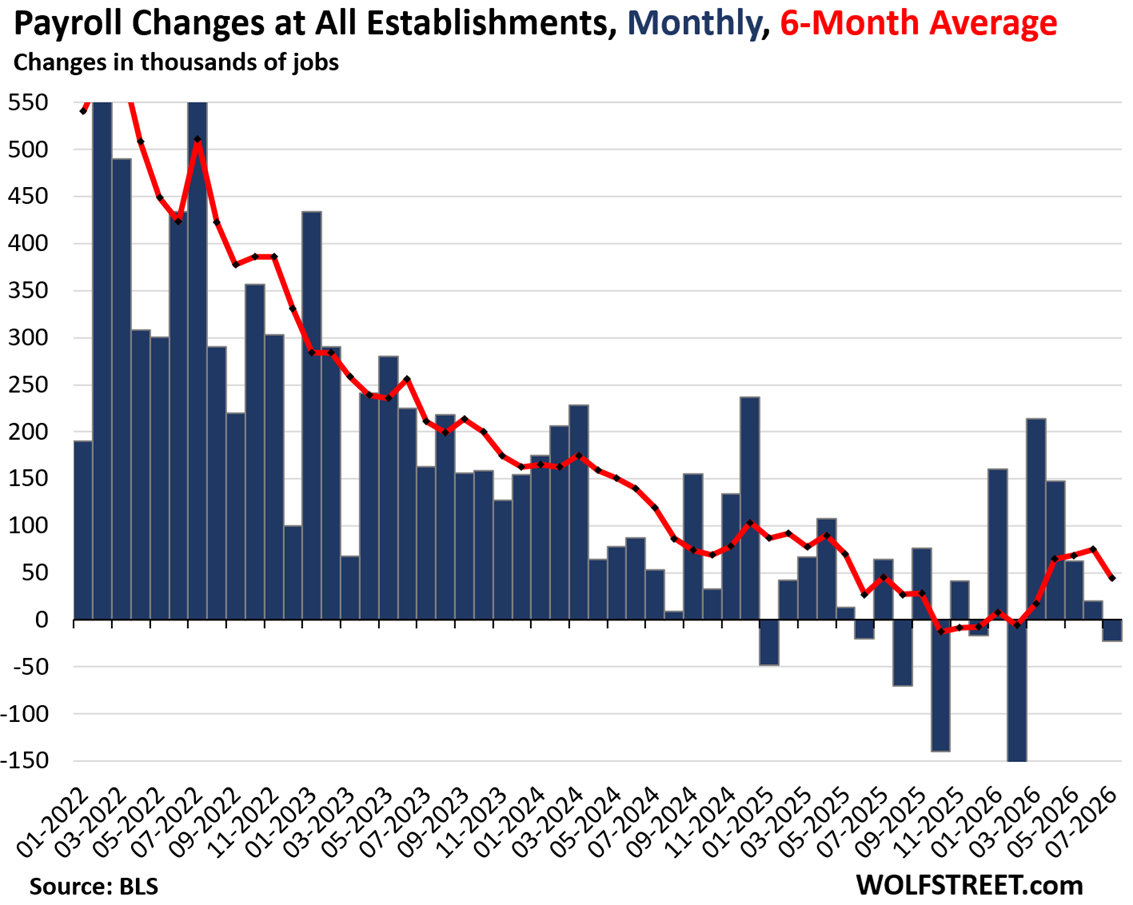
Total payrolls at nonfarm employers fell by 23,000 jobs in July from June, as local government jobs plunged by 57,000, the biggest month-to-month drop of local government jobs in years.
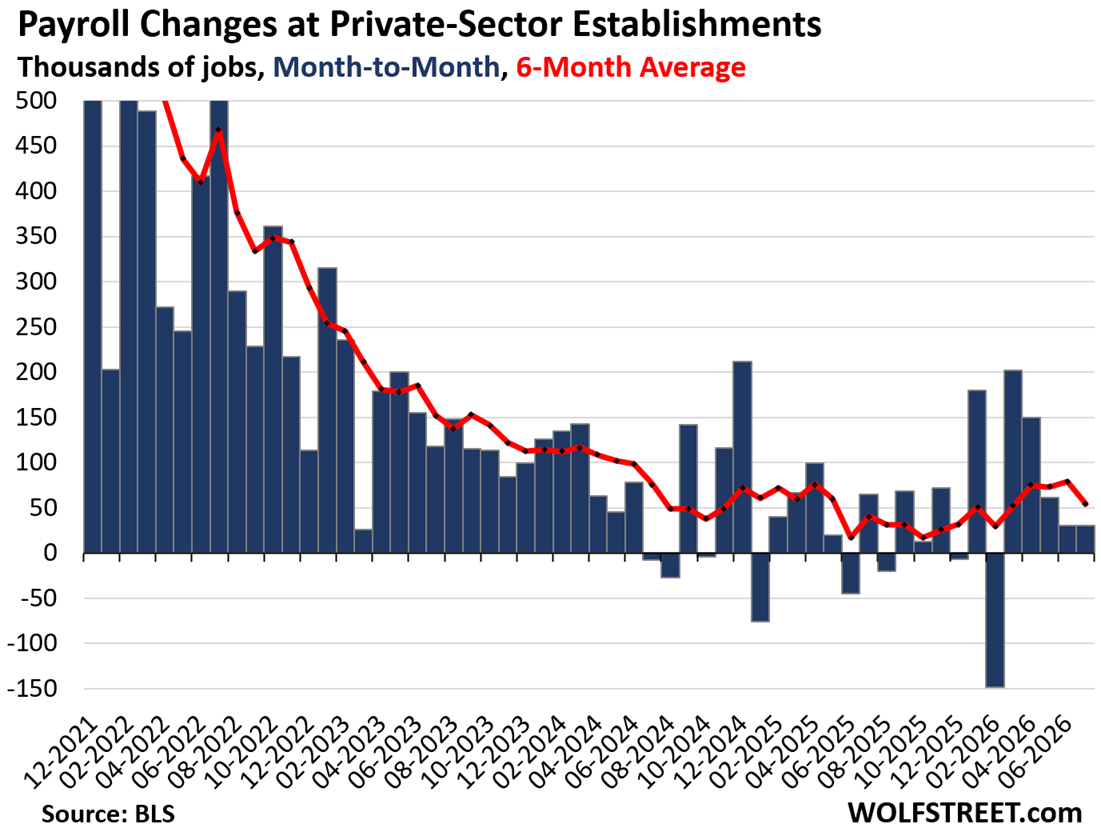
But private sector payrolls rose by 30,000 jobs in July from June, same increase as in the prior month, to 135.59 million, according to the Bureau of Labor Statistics today (blue columns).
The six-month average job gain, which irons out the month-to-month squiggles, dipped to 54,000 (red line).
By category of private sector employers.
Three major private-sector categories shed jobs:
- Leisure and hospitality (-40,000);
- Retail trade (-19,000);
- Financial activities (-14,000).
All other major private-sector categories gained jobs, including the two categories where many of the tech companies are (Information and Professional and Business Services):
- Construction (+22,000);
- Manufacturing (+5,000);
- Information (+11,000);
- Professional and business services (+18,000);
- Healthcare (+22,000);
- Wholesale trade (+5.000);
- Transportation & warehousing (+10,000);
- Other services (+9,000).
Total nonfarm payrolls were dragged down by local government jobs (-57,000) and federal government jobs (-3,000). State governments added 7,000 jobs, the first gain in many months.
Since January 2025, all governments combined have shed 166,000 jobs:
- Federal government jobs: -327,000.
- State government jobs (largely higher education such as state universities): -54,000.
- Local government jobs (largely education and first responders): +94,000.
The six-month average gain of total payrolls, which irons out the revisions and month-to-month squiggles, declined to a gain of 44,000 in July (red line).
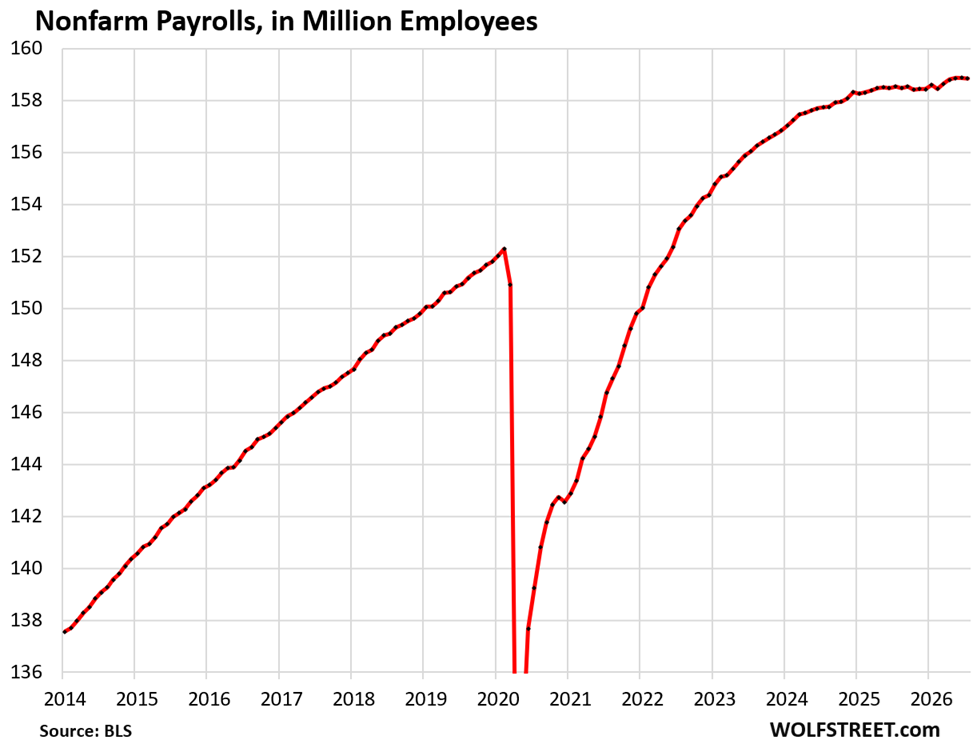
The level of total nonfarm employment in July, driven by the drop in government jobs, dipped to 158.86 million:
Labor force declined further. The labor force consists of people who are working and people who are not working but are actively looking for work. It represents the supply of labor.
The crackdown on illegal immigration and the continuing boomer retirements have substantially reduced the labor force. And that continued in July.
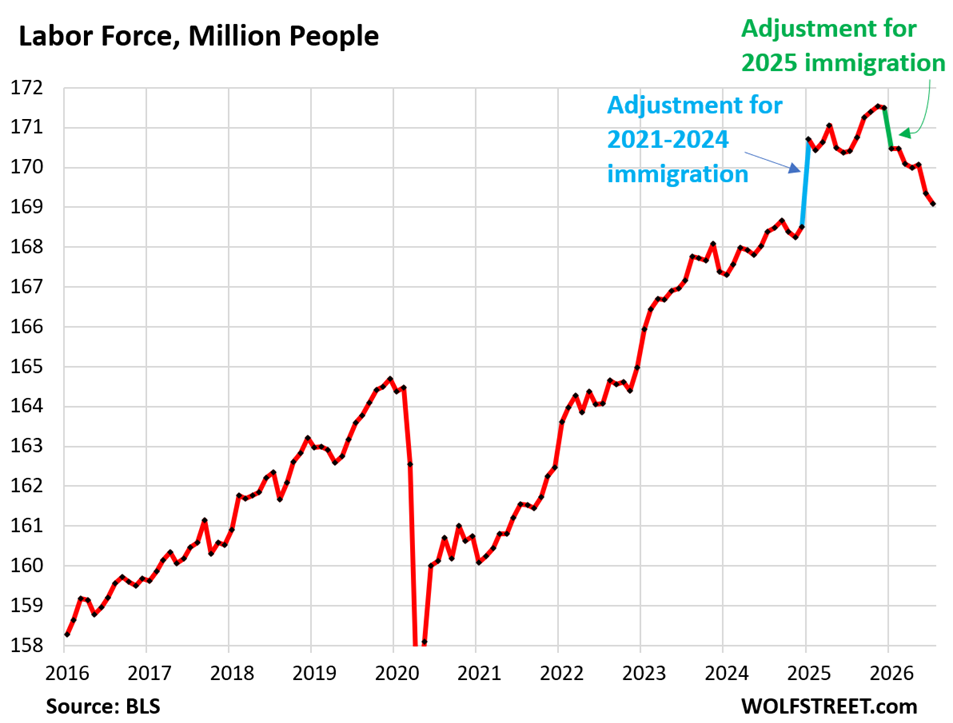
The labor force in July dropped by another 264,000 people to 169.09 million, the lowest since the massive up-revision in January 2025 that finally accounted for the surge of immigration in the prior three years (blue segment).
Over the past 12 months, the labor force – the supply of labor – has plunged by 1.32 million people! In prepandemic years, the labor force would grow by about 1 million to 2 million per year.
This continued drop in the labor force has dramatically changed the dynamics of the labor market, leading among other things to falling unemployment, a falling and very low unemployment rate, and a very high prime-age labor force participation rate.
The number of unemployed people dropped to 6.92 million in July, the lowest since January 2025.

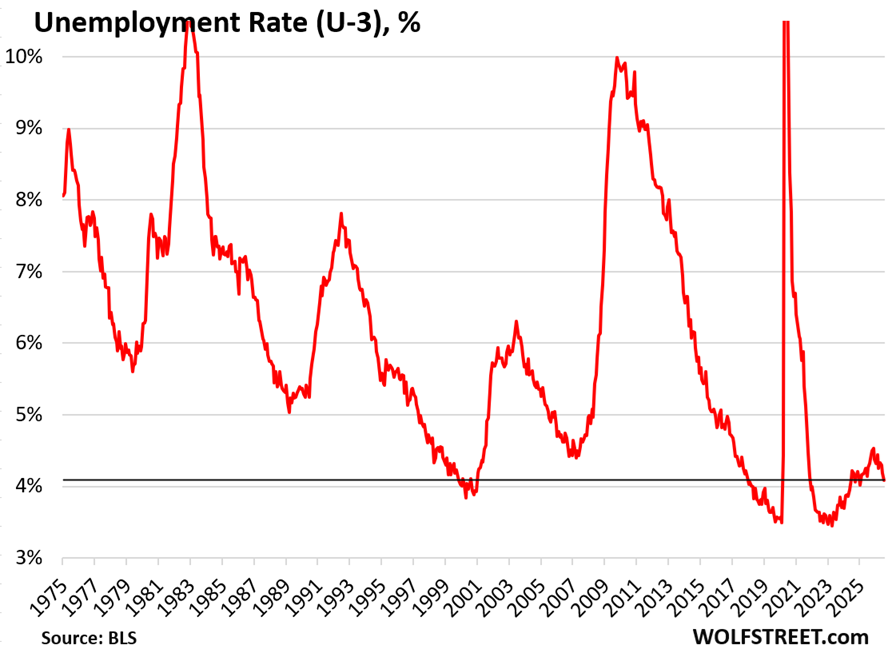
The unemployment rate declined to 4.09%, the lowest since January 2025. The unemployment rate reflects the number of unemployed people who are actively looking for a job (6.92 million) divided by the labor force (169.09 million) – and both, the number of unemployed and the labor force have been declining.
Within a 50-year timeframe, the current unemployment rate is low, largely because of the shrinking supply of labor.
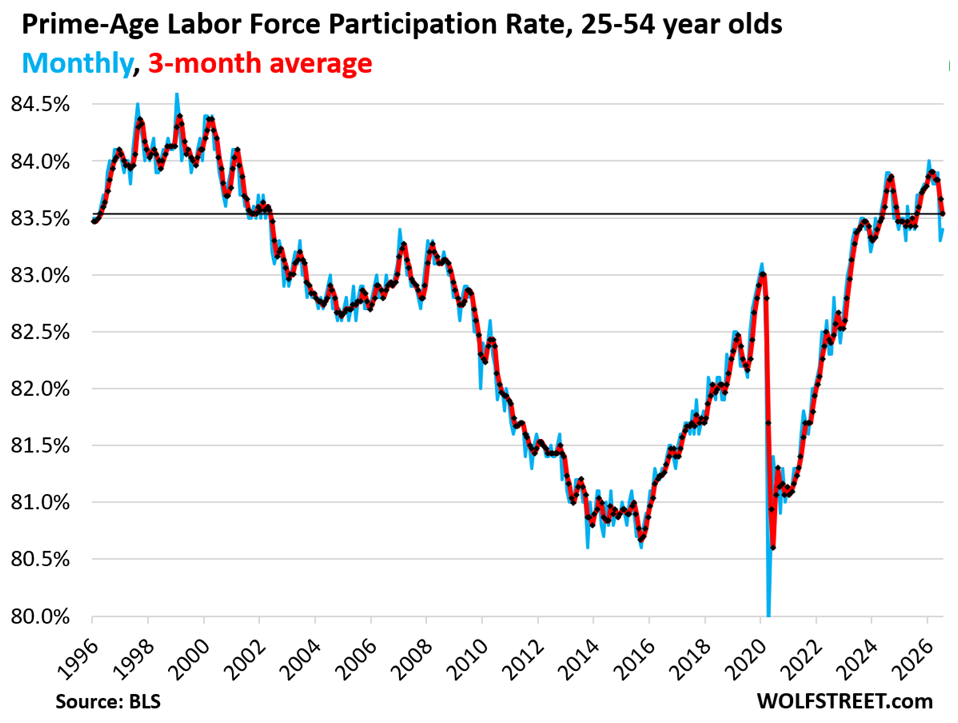
The prime-age labor force participation rate ticked up to 83.4% in July, after the drop in June (blue in the chart below).
The three-month average, which irons out some of the squiggles, declined to 83.5%. This range has been the highest in over 20 years.
The prime-age labor force consists of people between 25 and 54 years old. It eliminates the issue of the retiring boomers. When people retire and stop looking for a job, they’re no longer “participating” in the labor force but remain in the population until they die. It’s the surge of boomer retirements over the past 15 years that has pushed down the overall labor force participation rate (not shown here).
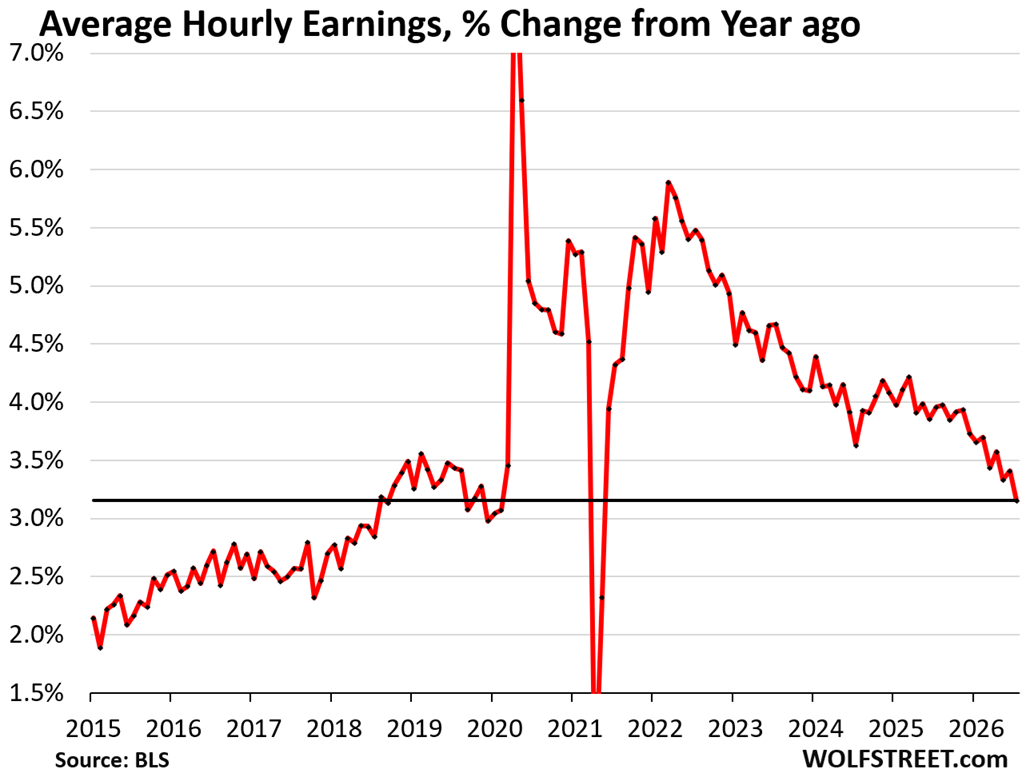
Average hourly earnings rose by 0.05% in July from June, and by 3.2% year-over-year.
Inflation has been running hot for months, and this wage gain of 3.2% is now below the rate of CPI inflation of 3.5%, after outrunning CPI inflation over the past three years.
Enjoy reading WOLF STREET and want to support it? You can donate. I appreciate it immensely. Click on the mug to find out how:


In San Francisco more and more Uber drivers are H1B talents trying to pay for their Tesla Y. So that tells the techology sector is growing.
I see construction increased. But no mention in your post of AI. AP headline story was much longer and also did not mention AI once. Might be time to take your chips off the table.
“But no mention in your post of AI.”
You just didn’t read the article, you only and lazily searched for “AI”. But if you read the article, you will find this section:
All other major private-sector categories gained jobs, including the two categories where many of the tech companies are (Information and Professional and Business Services):
Speaking of chips on the table, I wonder what happens as problematic AI merges with problematic gain of function biology for producing future improved humans, or not.
Stanford and MIT had AI produce 16 never before seen brand new viruses. What could go wrong with AI replacing Daszak?
Context is always helpful in these areas. As with almost anything there can be dual purpose and that is a human issue. This technology could come in handy since the largest dangers come from man getting every closer to natural habitats where animal strains can more easily evolve to impact humans, COVID and ebola as two examples.
Wow, harsh. But it’s your website and you can be harsh if you like. I obviously read the article as I cited the increase in Construction which is so obviously driven by AI that I felt not worth mentioning. You missed my point. In every recently released jobs-related article, AI is plastered all over the place front and center. But not now. The hysteria is subsiding.
There is NO job category of “AI.” There is no employer category for “AI.” It does not exist. It’s complete nonsense to throw “AI” into an article about employment by employer category. This has ZERO to do with “The hysteria is subsiding.” I gave you the categories of employers that include those that are developing AI systems and AI infrastructure. Many employers from manufacturing to teaching now USE AI, and pay for AI, but that doesn’t change their category of employer. AI is just another technology, like the internet.
There is another factor – forced retirements. Hundreds of thousands of tech workers have been laid off over the past couple of years. It is only increasing because of AI. It is practically impossible for anyone over 50 or 55 to get a job in tech. All interviews are video and as soon as they see your age most companies find a way to ghost you. With 5 or 6 qualified people per job there is no problem doing that. It is the older workers who cannot re-tool at 60 who are forced into early retirement. Younger tech workers can leave tech more easily.
That is plain old agism. Age discrimination is the only form of illegal discrimination that is not only tolerated but also encouraged, and it’s worse in tech than in some other sectors, and it has always been a huge issue. Nothing has changed. Same as before AI. It has always been part of the labor market, unemployment, and retirements. I have several friends with great resumes who fell into this category years before AI became a factor.
On the one hand we need people to retire later for the good of social security and on the other hand you can’t get a job.
Not actually. There is a strong correlation between average lifetime earnings (AIME), age of taking social security, and lifespan. So you get a lot of high earning workers waiting to take it, getting their relatively large baseline payment (PIA) plus the age adjustment upwards, and then living into their 90s receiving large checks. Meanwhile those with low earnings further reduce their check by taking st 62 and then die from lung cancer or whatever at 75. That’s the current reality.
The two fixes needed IMO are more bend points in the pia calculation that are more progressive and the number of years of wages taken into consideration for calculating the pia vary by when you take payments. Right now everyone uses highest 35 years of earnings, whereas it should be those that take at 62 use their highest 30 and those that take at 70 use their highest 40. Both would be good both for long term funding viability and fulfilling the point of SS as a social welfare system rather that government retirement savings plan.
so I put out ad for gig work per se
had lots of ‘interested’ workers
finally went to on-site interviews
of 2 – 1 was to busy after saying they’d be there in hour
other showed up with son(40)
gave me bid, no one else did
so hired them – got 3 workers OVER 65 for $500 for 5 hours
so basically $35 hour for retirees
but have to admit in 105 degree heat they not only worked, but came back 2nd and 3rd day
had 1 other worker(40 year old) who
1) showed up late – 11:30
2) complained
3) didn’t come back 2nd day
we have NON-worker shortage
ie – NO SKILLS, NO WORK ETHIC and don’t care = TAKERS
I have no doubt agism exists, but people gotta take whatever job they can get. I could see myself trying to get a job as a garbage man or whatever in the future if need be. If someone is taking unemployment when there are basic jobs available, that is wrongly taking resources from society, especially a society in massive debt. These older tech workers can get jobs in grocery stores for example. Nothing wrong with that.
Agism unfortunately doesn’t seem to matter for our elected officials regardless of political affiliation.
While ageism exists found it interesting and refreshing on job I partially work on(kinda retired)and home for sale a bit invested in.
We have 2 plumbers who are doing a great job(just passed all rough inspections),one is 80 and the other 75!These two move and function and keep a steady pace/no helpers but if needed would if onsite assist in a heartbeat.
I know they will stop one day but hope thru the decades they passed on their knowledge.
And it happens both ways. Much bigger issue of gen z workers struggling to find jobs now as gen x managers like myself have certain biases against the spoiled brats.
Thanks Wolf for pointing out the aged out leaving the workforce and hats off to you for forging an entrepreneurial mindset and creating some employment for you through retirement . As a highly skilled engineer in the energy business I was unable to find any employment opportunities contract or permanent due to my age (60) from 2016 . I am now 68 .
I was fortunate to have enough home equity to live off of my downsizing homes. Now SS has kicked in. I also am fortunate that I could work at wages probably 10 percent of what I earned as a PETE but maybe not . I probably underestimate my ability to work on my feet for 50 hrs a week.
Very surprised to see the consumer side of the economy holding up with the shrinking labor force .
As you mention the increase in USA manufacturing has offset this .
As well as the fossil fuel industry export rise .
You touch on all of the macro economic forces on this article and I appreciate the need to keep up mentally with the impacts on our country economy and future
Ageism far damn shore Wolf, been there and done that!
When forced to move home to FL to care for very aged in laws, first I sent out the updated resume previously used to land several ”top line” jobs, with not one reply; next, I redacted everything that could indicate age and every company I sent it to called, then when I went in for interview found some BS reason not to hire me.
Fortunately, a recruiter in CA found my resume on line, sent me 5 pages of questions, then scheduled an interview.
The COO couldn’t make it, so an owner interviewed me and hired me on the spot, to start ASAP…
Just another reason I love CA!
@VintageVNvet:
That’s awesome! Good for you!
On the job that I got, I had to take a test with some questions on electronic circuits, and I had to write out some coding examples. The guy who hired me was nice enough to give me a little advance notice on what the test would cover. So, I had a weekend to prepare. Still the test took me about 2hrs to finish. Very stressful!
As a 63-year-old tech worker I was laid off from my job in April. All I can say is if you want to find another job, don’t give up. You never know. I had several video interviews, which led to a couple on-site interviews. I got a new job in June. I took a big pay cut, pretty humbling. But I have health insurance again, and I can delay drawing down my retirement savings. My goal right now is to work until 67. I had several connections at other companies that tried to help me get jobs at their companies, but no luck. There is a company that is 2 miles from my house. They had an add up on Indeed.com for an engineer. I submitted my resume. About 3 weeks later a man called me up and said he has my resume in hand and was wondering if I could talk to him. We talked for an hour and then he asked if I could come onsite for an interview. He ended up hiring me. He is about 69 years old. There are a handful of guys there who are in there 60s. Searching for a job was a lot of work. I spent at least 8 hours a day working on it. Also, I was studying up on retirement strategies in case I couldn’t find a job. I learned a lot. Now, the hard part is learning all of the details of the new job. It’s harder than I expected it to be. The funny thing is, I wasn’t even going to apply for this job, it wasn’t the same exact job that I had before. So, we’ll see how it works out… crossing my fingers.
Very mature attitude, exemplifying the value of older workers. Happy to see you have the end goal in sight.
Only advice is on your working to 67 comment–ensure that you’ve run proper calculations on social security implications (not hard to model out in a spreadsheet), the impact of spending down vs saving your 401k, and IRMAA Medicare look back periods. Quite a bit has changed under the radar in recent years wrt retirement planning finance and it’s really easy to make smart short-term decisions that become poor long-term ones.
@William McDonald:
My plan is to work until 67, but delay taking social security until 70. That gives me a 3 year window where my income will be very low and the perfect time for doing Roth conversions. For me, RMDs start at age 75.
Yeah I use MS Excel for running all kinds of scenarios.
BS and Harve,you both have decades of experience and cannot understand why if you can handle the physical end of job why no hire or tough to get a gig.Even if limited mobility etc. the knowledge is worth a lot at least in my opinion especially if you stayed up on changes etc..
I feel if you chose to you could both do side/gig contracts etc.,anyhow,best of luck with work and life.
@James at Nineteen:
Contracting was something I was considering and had several discussions with technical recruiters regarding how contracting works. My strategy was to first focus on local jobs and if that didn’t pan out, I was going to look into contracting. There were some contracting jobs available for my skillset, but most of them were not near my home.
I know this an anecdotal data point but my wife is 55 and she gor a job in tech in March of this year after being away from tech for almost two years. I know lots of other 50+ year kids who have switched jobs. I also know some that were effectively forced to retire (or take “lesser” jobs).
I think the key factor in all of it is the dynamism of the person. An older, but experienced, person who stull has the ability to learn new skills (or at least adapt old skills to a new environment). Experience still matters, but only if it is a dynamic type of experience.
Older people who say “I have always did things this way because it was the most efficient at the time, but things have changed so I need to change (while keeping the same general principles in mind).” will succeed. Those who say “I have always did things this way so I am going to continue to do so because it worked for me.” are going to fail.
Would you add “upward inflation pressure” to this “leading to” list?
“This continued drop in the labor force has dramatically changed the dynamics of the labor market, leading among other things to falling unemployment, a falling and very low unemployment rate, and a very high prime-age labor force participation rate.”
I wonder how AI and robotics will affect employment numbers in the future. Farm worker and manufacturing worker numbers have declined for decades. It seems likely distribution chain, and office workers will be next to see large scale layoffs due to AI. Large categories like call center and distribution center staff come to mind. People who handle, analyze, and check documents of all types better be looking over their shoulders. These global numbers like national and regional unemployment rates need to be broken down into narrow sectors to get a better idea of what is happening to us. If all we have left are baristas, and robotics engineers, society is going to be in for a rough road.
“These global numbers like national and regional unemployment rates need to be broken down into narrow sectors to get …”
I gave you the major categories of industries in the article. All you have to do is read the article. Baristas are in “Leisure and hospitality” – go back upstairs and look for it.
I am afraid this will give an excuse to Doves at FED to hold or even cut in Sep meeting. Last 2 years we saw; where July is heated up meeting and labor market shows little weakness and FED cuts in Sept. In 2024,
100 BP and 2025, 75 BP.
Markets already dropped probability of hike in Sep meeting.
Inflation target is missed for last 5 years.
FED always talks about fundamentals change and talks to look through Supply shocks and all. Well; Tech companies are not going to stop laying off because FED dropped the rate. They are not short of cash or revenue. They have huge piles of cash to spend on Data-centers. They just dont want to employ people.
That’s the crux of it. You hire people if you need the labor. If you’re need the labor with a FFR of 3%, you’ll need it at 4% too. At the margins, borrowing money may increase employment if you’re doing it to support capital expenditures, but encouraging people to borrow money for plain operations is not a good thing.
Hi Sanderp,
Gary Cohn and others addressed this issue on Bloomberg. Basically their suggestion is a 25-50 bps increase won’t materially affect inflation and could have other unexpected consequences.
Meanwhile, Lisa Cook had read a speech at a recent AIDEC meeting that my son, a bond guy attended. Although her comments warned of the possibility of higher rates in the coming months, my son was not impressed. After what he characterized as an algorithmic bond market response to her remarks, he took the other side of the trade. In this instance I followed his lead.
You pays ur nickel and you takes your chances. Here’s a link to her appearance:
https://x.com/bloombergtv/status/2085131424676327910?s=42
These reports are such a god damn joke. You have the unemployment rate ticking down (4.2% -> 4.1%), prime labor force participation ticking up (83.3% -> 83.4%), yet somehow the economy lost 23,000 jobs.
The BLS need to fix its methodology on population estimates & combining multiple surveys to prevent nonsensical self-contradictory results like these.
Unfortunately the headline number is what Wall Street is fixated on, and likely gives the doves ammunition to argue for not raising rates, even though PCE inflation is running at almost twice the FOMC’s supposed target.
I don’t think they are a joke. You are just reacting to instant raw numbers and not smoothed trends. If you understood why month to month squiggles could be deceiving, you would better appreciate what is going on.
I don’t think Jackson Y read the article all the way because the continued drop in the labor force (#4 chart) perfectly explains what stumped him. He’s just not interested in understanding this stuff.
But I agree with him that it would be nice to have data with fewer flaws. Which is why I also show and emphasize either 3-month or 6-month averages, because the month-to-month squiggles could just be noise, seasonal adjustments done awry (such as the huge job loss at local governments in July when teachers are off work), but over time, they balance out and show trends.
The hit to college enrollment of anti-immigrant politics partly could partly explain state government decreases. I am surprised by the local government increase since Jan. 2025. K-12 enrollment has gone down in the high immigrant school districts I see, a mix of self-deportation but also fear, keeping the kids home in a bullying anti-immigrant school environment where school employees also bear the brunt. Homeschool has also drained public school enrollment in some places. Maybe breeding citizens are making up the difference.
Retirement-eligible teachers can withstand a lot for a pension, but not double-digit enrollment drops.
Interesting to me as how changes in demographics(boomers and reductions in immigration) impact people making policy decisions. For me, at least, a low unemployment rate isn’t a bad thing but without larger context you can’t view it in the same way when they were the biggest part of the work force. I know people don’t make decisions on one metric but at the same time it is also political to say “lowest unemployment level ever” which glosses over a lot too.
Trump should mandate E-Verify for all small and large businesses. Anyone that deliberately hires illegals should face a $10,000 fine. What’s he waiting for?
Down the road from us we have some people who love to fly trump flags. (Cool if that’s your political preference). However weirdly enough they keep seeming to hire illegals to do their yard work. If they are so adamant about trump and illegals why don’t they put their money where their mouth is?
There are a lot of states, both red and blue, that would fight this.
Neither party wants to solve our immigration issues. It’s a political football that has been going on since 1986 after Reagan signed the Immigration Reform and Control Act.
I would argue that with sides want to solve the immigration problem. They just want to solve it in different ways with different weights and goals.
I think the bigger issue is that too many people look at it as an easy, binary problem and don’t get into details. Once you get into details it becomes much more complicated.
People don’t like complications. Their mind isn’t big enough to handle them so they fall for binary thinking.
JimL 40 years is enough time to come up with a solution. And there were bi-partisan bills under George W Bush and 2024 under Biden that both failed because of politics.
Both sides use it to gin up voters come election time.
Swamp Creature,
You do realize the GOP refused to pass this last time. They have no interest in doing it, just ask Kevin McCarthy. This also occurred earlier with verifications where penalties for businesses were not penalized if they “thought” paperwork was valid. My neighbors who owned a winery utilized this often.
100% agree. So tired of the bs comeback of who will do the work.
What they are really saying is I want my slave labor.
I have been saying this for years. Unfortunately, the E-verify system isn’t very robust so there are huge problems with it. Like many systems, there is a conflict between speed and accuracy. You can get a fast answer that has a moderate chance of being wrong, or a accurate answer that takes a long time.
How the system handles that conflict matters a lot.
Then the whole $10,000 fine is naively binary. For some businesses, that level of fine is deadly. For others, it would be treated as the cost of doing business and laughed at.
Also, there is the complication of the modern age where people are not “hired”. They are brought on as temporary contractors.
While saying what you said makes a good sounds bite, reality is much more complicated.
Take AI. My wife, at age 55, has become a moderately big user of AI for her job. She recognizes both the power and faults of AI. Her description is that it is like having a very smart, but very naive (inexperienced) assistant. It can do very very mundane tasks very quickly (with a little bit of supervision). It can also provide some incredibly insightful views (with lots and lots of supervision).
It can be incredibly helpful if used correctly with supervision. He similarly aged colleagues who disparage AI and say it produces slop and is therefore not useful are going to struggle to find jobs.
JimL
I don’t think people who have knowledge of AI as binary good or bad, and if they do, they likely see the world that way. Will LLMs, the one aspect of AI currently talked about be useful in some situations, absolutely. Society would be best served to see where it fits as well as whether it will be able to generate a profit. Tech is burning cash and most of their limited revenue is from other tech companies doing AI burning cash. One would think Google has lots of money but they are doing a massive bond release soon and the interest rates might be 150 points over the 10 year. I find Gemini to be entertaining anecdotally but wrong the majority of the time but that should be expected with a probalistic vector database.
What tools does she use for AI and in what capacity?
What I see from this article is that the U.S. is on a path where they are going to try and shrink their way to prosperity. Unfortunately this means the costs of the social safety net are carried by a smaller and smaller portion of the population. Something will have to give.
Unfortunately I think it is the social safety net. The U.S. is going through a period where the unfortunate are convinced if we give billionaires one more tax cut it will be better for themselves.
I’ll wait for the revisions
The prior revisions are included in the 6-month averages.
People are also dropping out of the labor force because of the wealth effect. New wealth from the semiconductor and AI run. No need for the day job until their paper wealth takes a hit.