
That looming 7% mortgage rate…
By Wolf Richter for WOLF STREET.
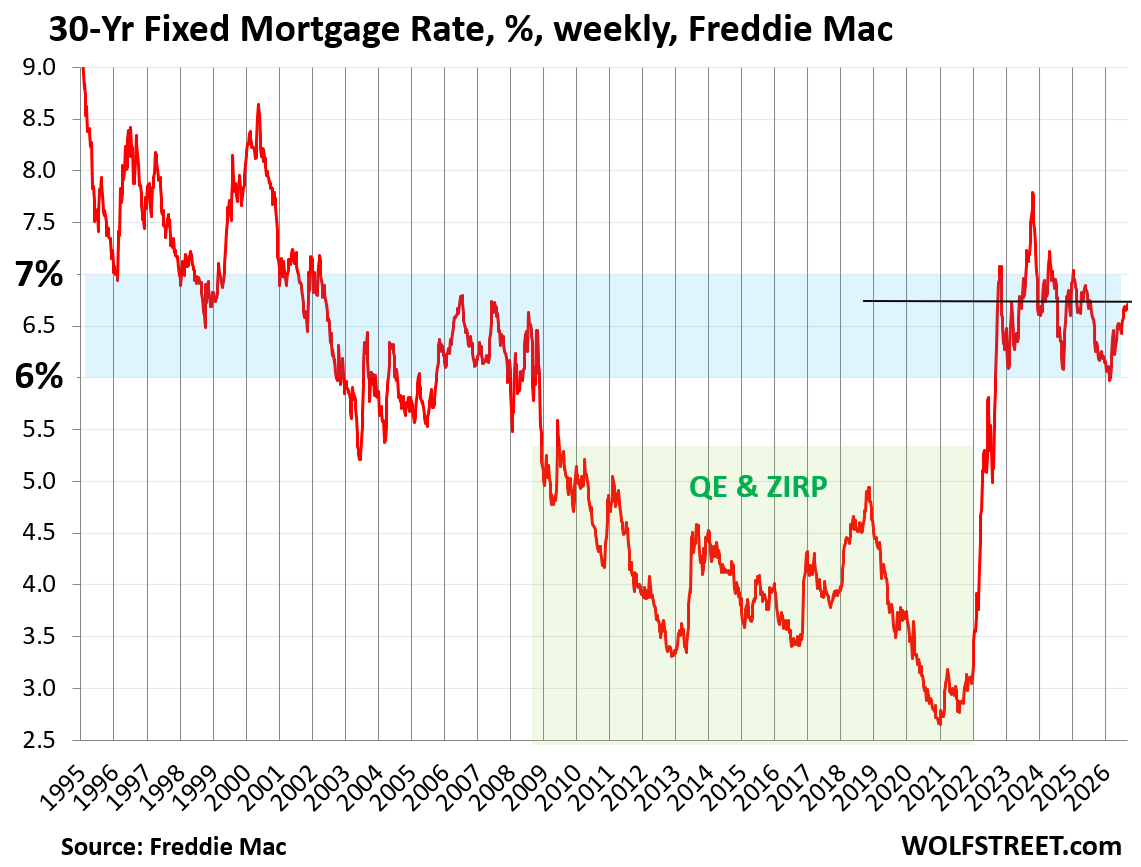
The average 30-year fixed mortgage rate rose to 6.71%, the highest since July last year, according to Freddie Mac’s weekly measure today for the week through Wednesday September 2.
It has been in this 6.0% to 7.0% range since September 2022, except for a few spikes to the upside.
These 6-7% mortgage rates are not high historically. They’re just high compared to the 14 years of financial repression between 2008 and 2022, when the Fed cut its short-term interest rates to near zero and pushed down mortgage rates with trillions of dollars of purchases (funded by “money printing”) of mortgage-backed securities (MBS) and Treasury securities.
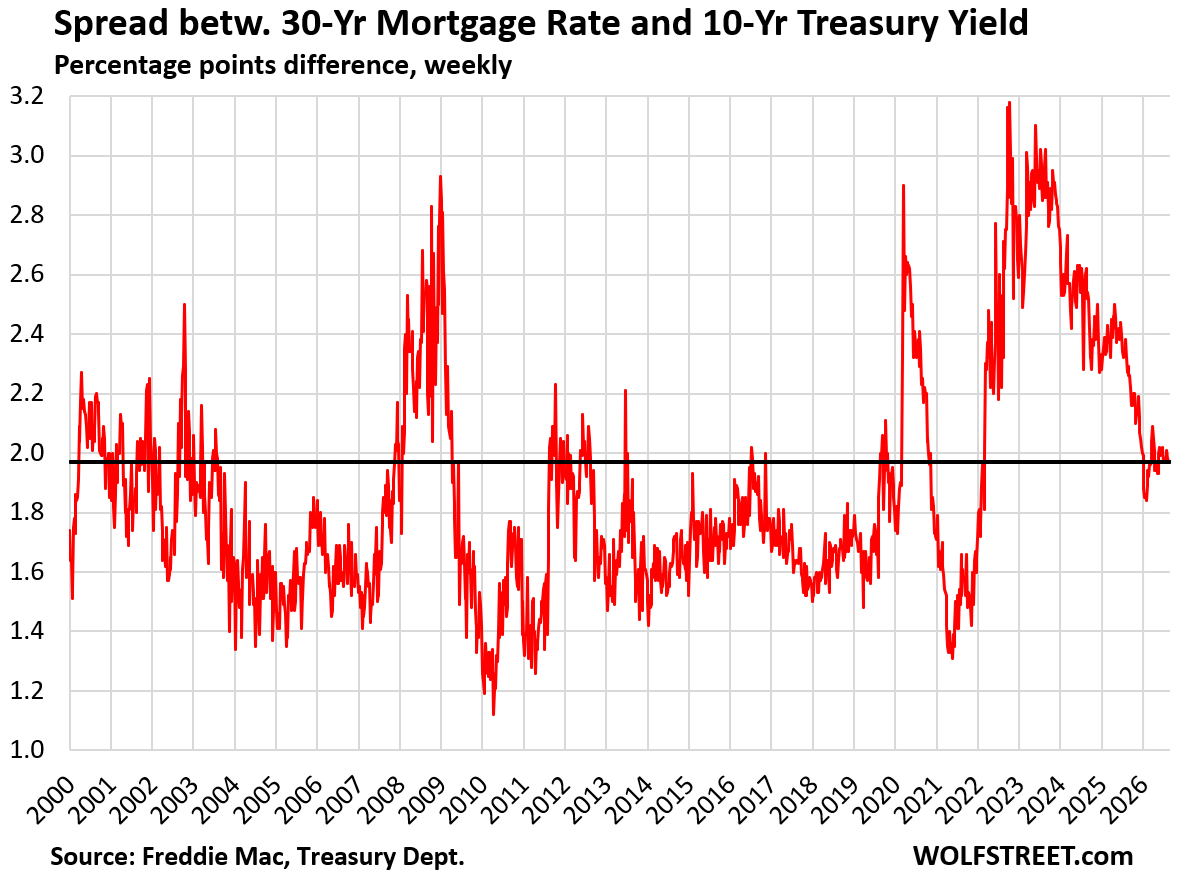
The 30-year fixed mortgage rate tracks the 10-year Treasury yield but is higher. On average, a 30-year mortgage gets paid off in about 12 years as homes are sold or refinanced. The amount by which it is higher – the spread – varies.
That spread had widened in 2022 and 2023 to more than 3 percentage points, the most since the early 1980s, meaning that mortgage rates were relatively higher compared to 10-year Treasury yields. Then the spread began to narrow again and by the end of 2025 was down to 2 percentage points.
To narrow the spread further and bring down mortgage rates, Fannie Mae and Freddie Mac – under government conservatorship – announced with great fanfare on January 8, 2026, that they would substantially accelerate the buybacks of MBS that they’d previously issued.
To fund these buybacks, they use operating cash flow that they would have used to buy Treasuries, and they shed Treasury securities already on their balance sheet. They’re thereby replacing Treasuries with their own MBS.
These buybacks have turned Fannie and Freddie, two big buyers and holders of Treasuries, into shedders of Treasuries, thereby helping push up Treasury yields. So a narrower spread from higher Treasury yields.
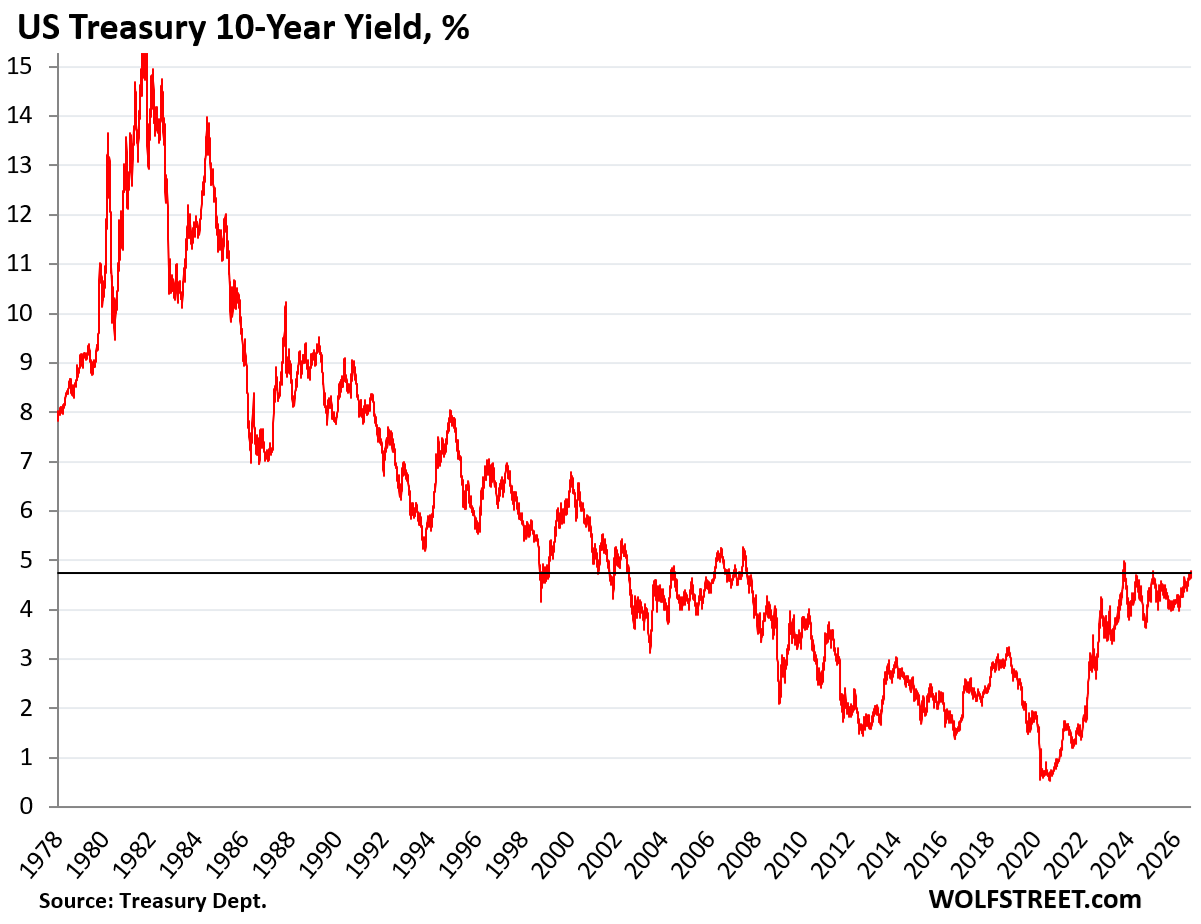
The 10-year Treasury yield, after rising earlier this week dipped today to 4.77%, in the upper part of the 4-5% range that has prevailed since mid-2023.
Before the Fed’s financial repression started in 2008, that 4-5% range was considered at the low end of the prior four-decade spectrum.
But note the spread: The 10-year Treasury yield is essentially unchanged compared to October 2023. But the 30-year fixed mortgage rates have dropped by a full percentage point over the same period, and the spread between the two has narrowed by a full percentage point.
The spread.
The weekly average of 30-year mortgage rate through Wednesday was 6.71% (Freddie Mac’s measure today). The weekly average 10-year Treasury yield as of Wednesday was 4.74%. So the spread between the two as of Wednesday was 1.97 percentage points.
This was just about exactly where the spread was at the end of December 2025 and at the beginning of January 2026, before Fannie and Freddie – and Trump – announced the big kahuna of MBS buybacks.
But all of them were 1 percentage point narrower than in mid- to late 2023, when the spread was around 3 percentage points for some periods.
A lot of factors move the spread, including:
- Buyers and sellers in the huge $12-trillion market for MBS, the second-largest bond market behind the Treasury market.
- The Fed contributes to a wider spread by shedding MBS. Under QT, the spread had widened in late 2022 and through 2023 to about 3 percentage points. While QT ended in December 2025, the runoff of MBS has continued.
- Fannie and Freddie contribute to a narrower spread by buying back their own MBS since late 2025.
The average 30-year fixed mortgage rate was 6.21% before Fannie and Freddie – and Trump – announced the increase of the buyback program on January 8. By the end of February, mortgage rates had dropped to 6.01%. But then they began rising again, as the 10-year yield had begun to surge. And now mortgage rates are at 6.71%, highest in over a year, and the spread has been stuck at about 2 percentage points, despite the buybacks. But where would mortgage rates be without the buybacks? Over 7%?

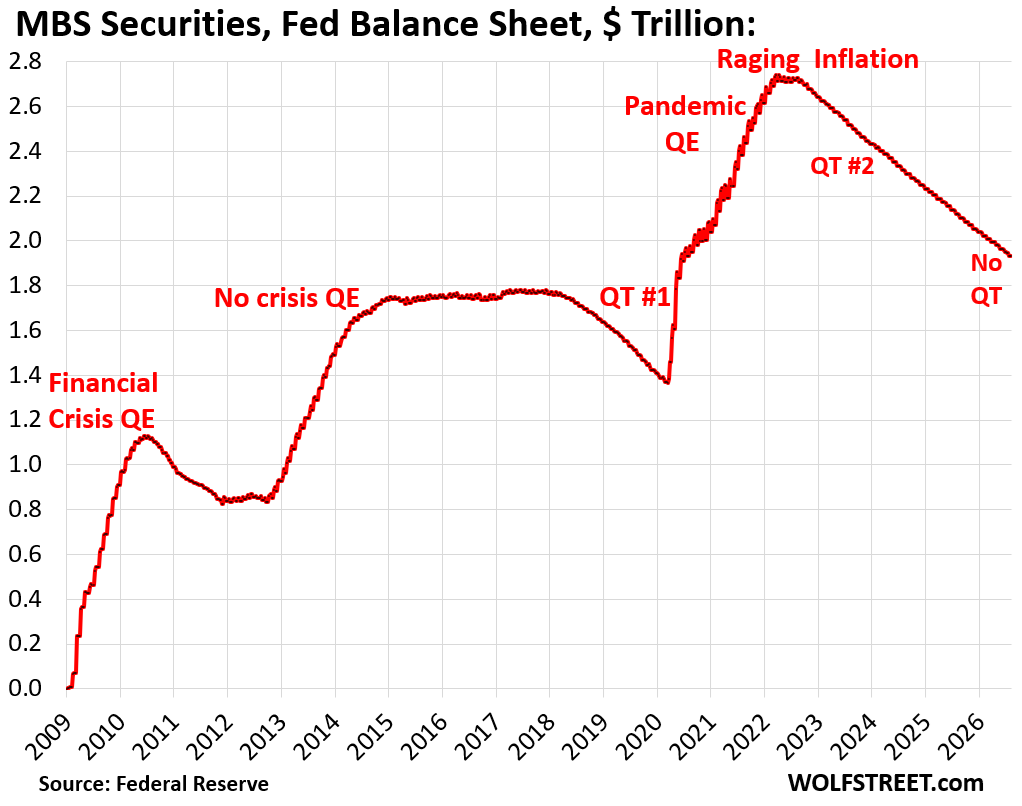
The Fed’s impact on the spread: During QE, the Fed bought MBS to narrow the spread between Treasury yields and mortgage rates, and also to push down long-term yields in general, and thereby repress mortgage rates in two ways, and the spread narrowed to less than 1.5 percentage points, and as Treasury yields also fell, mortgage rates fell below 3%, even as inflation surged toward 9%.
That was the Fed’s financial repression which resulted in the worst inflation in 40 years and the biggest home price explosion ever, which caused the current “affordability crisis,” as it’s called.
But QE ended in early 2022, and QT started in the second half of 2022, when the Fed started shedding MBS, and it continues to shed MBS at a rate of about $15-18 billion per month (determined by the passthrough principal payments that MBS holders receive when the underlying mortgages are paid off or are paid down via monthly principal payments). After QT ended last December, the Fed purchased T-bills to replace the MBS runoff.
So far, the Fed has shed $827 billion, or 30%, of its MBS that it had acquired during QE, including $190 billion over the past 12 months and $17 billion over the past four weeks.
The end of QE in early 2022, starting with the expectation of the end of QE beforehand, and then QT and shedding MBS were big factors in the widening of the spread at the time. And then the slow-down of QT in 2024 and the end of QT in 2025 took a lot of pressure off the spread, and it narrowed by 1 percentage point through the end of 2025. But the MBS runoff continues to pressure the spread.
That looming 7% mortgage rate…
At 6.71%, mortgage rates are not far from that 7% line that they’d already breached in 2023 when the spread was 3 percentage points. It seems the Fannie and Freddie buybacks counteract the Fed’s MBS runoff in terms of the spread, though they may push up Treasury yields by pulling Fannie and Freddie out of the Treasury market.
The buybacks may be the only thing that keeps mortgage rates below 7% by keeping the spread close to 2 percentage points, rather than letting it drift wider.
In this scenario, the 30-year fixed mortgage rates would breach 7% when the 10-year Treasury yields goes over 5%, and stays over 5% — rather than just kiss 5% on the cheek and back off, as it had done spectacularly in October 2023.
In case you missed it: Oh Dear, Condo Prices Fell by 15% to 33% in 33 Bigger Markets, Some Below 2006 Levels, as Historic Condo Bubbles Deflate
Enjoy reading WOLF STREET and want to support it? You can donate. I appreciate it immensely. Click on the mug to find out how:


Very very interesting analysis. Of course being an oldster and long time homeowner I shrug at the 7% fear of becoming the normal rate, but certainly realise the ‘shake out’ in RE could be huge. However, I am also wondering just how much of an effect this will really have on falling house prices (which most believe is beyond necessary).? I am a long time carpenter still working on my own stuff. I know what it costs to do renos and build new….it is in my wheelhouse. There is currently no room for massive price drops in materials and labour unless there is some kind of massive recession forcing it. And, while many reflect back to when houses were once affordable I submit it isn’t just about the house prices. All currencies have been debased so much by inflation, RE prices will not and cannot go much lower because of building costs. Including labour it costs approx $300 per sq foot in the USA, with a high ender going $450 sq foot and more for luxury fittings. In other words if you have the property paid for, think $450K for a basic 1500 sq foot rancher. Say $650K total. That will still be $4000 per month payments, minimum.
With currency debasement it is also just as much about the value of actual take home wages as it is about mortgage rates and prices.
60 years ago, when houses were affordable and a working guy earning regular wages could afford one, it was just as likely the spouse stayed home and it was all done on one income. A blue collar guy (like myself) could afford a home, a pickup truck, could buy a few beers on Friday night and go out once in awhile. But after the insane rates of the late 70s and 80s and all the dislocation it produced there was never really a recovery for normal wage earners. And for decades it has been a treadmill for breadwinners, a real nightmare.
Interesting comparing the tax rates of the super wealthy….then and now.
For the very wealthy, “In the 1960s, the top marginal federal income tax rate in the United States was 91% at the start of the decade, before dropping to 70% by 1965.” Ah, the vaunted golden age so longed for by today’s politicians.
My Dad had a small insurance business back then. Somehow he managed to buy a house, support a family, and my mom stayed at home. Before that he had a small store, like a red and white, back in MN. He was living the American Dream as a high school graduate. Try that now after decades of financial shenanigans by all players.
7% is a distraction. It is all relative. House prices might go down a bit but payments will be the same or higher. The only constant will be the regular wage earner will take the hit, (a nice way to say it).
And who will be paying off the national debt? It will be the wage earner taking a reduction in ‘entitlements’ and paying higher taxes. Or it will be done with debasement and inflation. same thing.
regards
You paint a nice picture and I guess in essence you are implying that Trickle Down was a sham for the working man.
One of the best comments regarding the housing industry I’ve ever read, thank you! Your lifetime experiences make a great read and definitely support your understanding of this issue.
While you suggest that higher construction and labor costs will keep new home prices higher, is it possible that prices of new/existing homes will further disconnect?
If seller’s desperation to find any willing buyers continues, couldn’t prices of existing homes fall well below replacement cost? This could be especially true of sellers who have decades worth of equity. They could sell at a very low price and still have a great profit if the bought 50 years ago.
This is not “profit” it is inflation.
don’t forget about insurance on said properties
I just got doubled with no were to go
since I plan on selling into this market I have no choice
and if market says I can’t sell then I’ll put it back into rental
Correct. The feudal system never ended. The workers that built the pyramids were paid in bread and beer (albeit a more nutritious and lower alcohol beer) but just enough to sustain them. Regardless, the real reason property values will not drop too far is because then how will all these bloated municipalities survive? All those property taxes keep these corrupt overpaid individuals in the money.
Municipalities can go, and do go, bankrupt, and get relief in bankruptcy court and restructure their debts, and “survive” just fine. We’ve got some here in the Bay Area that did that, and they’re still here.
sure wish us voters could put that on ballot
ours just keeps raising its vig(property taxes)
just got NICE 12% increase on primary
Yes, but I worked in the bay area and witnessed how many taxpayers went bankrupt BEFORE those municipalities did. We cannot fix stupid, but we should be able to punish bad behavior, especially when its a public position.
The difference between bloat and corruption is not an insignificant one. Why are the corrupt not being voted out in your municipality? Seems like an easier problem to solve than bloat.
Show me how construction and labor costs have tracked the house price inflation beginning in 2020 to today and I will give your post some credibility.
While I agree there is likely a floor for new housing, existing housing doesn’t really have a resale floor as 2008 demonstrated, people may end taking a loss.
Replacement cost is the cost to build. Fair market value is the cost something would sell for in an open market transaction. Those could be wildly different.
Where builders will run into problems is if/when the price of existing homes drops significantly the price of new homes to the point even rate buy downs don’t make new homes competitive.
@ Paul S,
Wolf posted an article back in June, “What Homebuilder Lennar Said about the Tough Housing Market: Average Sales Price Down 24% from Peak, back to 2017”, showing their average new home sale price around $370k when incentives are included. I wonder if they are losing money to keep some revenue coming in, or if they have access to cheaper materials.
Lennar is still profitable, but a lot less than before, everything is down by about 50%, profits, gross margin, stock price, etc. The only thing that’s up is home sales. They’re gunning to become #1 in the US, and may already be.
Great comment and crazy true. The cost to build and maintain is crazy. Or only seems crazy.
It may in fact just be the first inklings of a change in the economy where the balance between capital and labor begins swinging back to labor. If I can find a good, reliable carpenter that I trust I don’t blink and eye at his asking $80/hour. On the one hand we think that is a bad thing, but on the other it’s good. If we, as a country and society need to “bring production home”, it means the economy will have to pay more for skilled trades and labor.
The challenge at this moment however, is finding the person with those “skills” who is productive, reliable and honest. Once found, those people are a treasure. Those qualities used to denote “virtue” . Labor that is not virtuous is hardly worth minimum wage (at least to me). The unknown in our collective circumstances is how do we recover that virtue as a society ?
The other thing that I find crazy is how archaic the whole building process is. Certainly there have many productivity enhancing tools and techniques and standardized parts and elements added to the process over the last 100 years….but still, in many ways the whole process is circa : 1900’s
The one thing no one seems to talk about is that a starter home “back then” used to be pretty basic materials – laminate countertops and vinyl flooring. Thin plywood cabinets. etc.
Now we have normalized putting granite-like countertops and higher end flooring and cabinets in every build. The price of a new home could drop quite a bit if we went back to the same materials.
15% mortgage rates with a minimum 20% cash down would be great for the housing market.
I’d also like to see higher property taxes for rentals, second, third, forth properties until it stops making sense to keep owning additional homes.
That would just massively increase the cost of housing for the large majority of folks in the US who are renting or leasing housing. I thought the goal was to somehow get housing prices down…
It would make becoming a landlord less attractive. People would sell their home and move into another instead of keeping it. More properties would become available increasing supply and drive prices down. People renting would have a better chance at entering the market at lower prices. More vacancy in rental properties drives prices down as well to attract more renters.
Yes that would certainly lower rents also.
Right….
It ultimately comes down to what we as a society view as both the righteous and effective way to model the housing market.
Does society believe that every American deserves the chance to own his own home provided that they work honestly for it?
Or do we believe that it is more important that people have the freedom to do with capital whatever they wish, making it possible to buy properties and rent them out, constraining the supply of houses available to own?
If we look long term, western societies have been making a massive transitions in home ownership over the past two centuries. In the 1800s homeownership in cities was well under 33%, while rural ownership rates were above 75%. This was the result of rapid urbanisation during the industrial age where factory workers were attracted to the cities, being provided housing by factory owners. In the 1900s the trend started shifting, with some major fluctuations during the great recession and second world war, the average city dwelling American was lifted out of poverty and had chance to own his own home. Peaking in the late 10s of this century to a whopping 69% ownership rate accross the entire country. This has since dipped back down partially due to the housing crisis of 2008 to 63% in 2025 and 65% today.
The majority of people that rent are dutifully paying their rent each month, many are doing that for their entire lives. This is often generational, as people from renting families statistically are just a lot less likely to later own a home than people from house-owning families. This rent they dutifully pay covers all the expenses of the house-owner and then a not insignificant gain on top. Whenever that stops being the case, home-owners are inclined to sell this property and put their capital to use elsewhere. After all, they don’t ‘need’ the house, they just need the income that it generates. The question then remains: is this societal, regulatory, and financial construction we’ve build, which currently destines about 35% of all americans to not own their homes and essentially not grow their family capital through home-ownership both righteous and effective?
Idontneedmuch suggests it is not, and science agrees with him. Higher homeownership rates lead to longer tenures, more civic engagement, better neighbourhood upkeep. On a personal level it leads to less stress and improves mental and physical health. All of which in turn leads to lower need for social programs, lower healthcare expenditures, and a bigger internal consumer market.
So the question is not ‘how can we lower rents’, the question is ‘do we need and want 35% of americans to only be able to rent’? The housing market is not a law of nature, it is a construct, it changes constantly as a result of our political decisions and economic progress.
FYI only 2.6% of the population lives in social housing projects, and only 54% of those units are urban properties. Rental market is dominated by private ownership, about 90% is owned by individuals (the ‘mom-and-pop’ landlords).
Well written
Hey Jorg, thanks for your well articulated comment. I believe home ownership is central to the American Dream. I agree with much of what you said. To the others, I am not a socialist. I am very afraid of the fact that this affordability crisis has young people turning toward socialism. Corporate Capitalism, bailouts, interest rate suppression, and rampant speculation has put home ownership out of reach for so many. Single family homes shouldn’t be an investment vehicle. They should be a place to live and create a family. If people want to invest capital in real estate there are lots of opportunities in multifamily, office, industrial, etc. We should tax properties appropriately.
Yes, very socialist thinking.
This may surprise you, but the Rental business is surprisingly low margin these days. The numbers basically only work if you carry very little or no debt.
The other model that works (for now) is the large corporate model that can enjoy relatively low cost access to capital and operate on scales of hundreds and thousands.
I dont know if you have rented from a corporate landlord or property manager vs a smaller mom and pop operation. Give me a relationship with a human landlord anyday vs a corporate landlord.
10-4 DC:
First actual House I purchased (as opposed to raw land) was 20% down and 18% interest.
Price was $40K… last time I looked, a couple years ago, it was priced at $800K.
Makes no sense for young folx today to buy at the still staggering prices, eh?
And BTW, last house purchased was $84K and we get offers every week in the $350K range == ridiculous…
And if you accepted their offer and sold, what would your replacement housing cost be, including insurance, furnishings and local taxes? Does their offer include all that? Do you take the profit you made today, or do you keep holding the asset in the belief it’s value will continue to increase?
That would be great for investors and corporations because only they could pay those prices. So they would own all the homes!
We’re pretty much at the historical average based on kept records. If you bought below now, you made out like a bandit. If you bought in the 80’s, you were not happy.
That minimum 20% down is what we really need.
More than 50% of the folks buying houses priced at $2 million or more don’t even use mortgages but rather simply pay cash. That saves a lot of money and voids the need for even using mortgages.
But the $2+ million portion of the market is fairly small in the US overall.
Not here in Southern California anywhere near the coast where $2+ million houses are nearly 100% of the market.
Sure, same in SF. And in lots of other pockets. But the US is huge. Even in expensive California, half of the single-family homes sold for less than $888k in July.
The oldest boomers are 80, so they’ve easily started to die off in droves over the last five years. Among several factors, this transfer of wealth is propping up the housing market. Lots of people nowadays buying houses way less than $2M can afford to put lots of money down.
Did you miss Covid? Was like thanos snapped his fingers for the boomers and the silent gen.
but yeah the ones who were careful or Mother Nature spared will have their heirs listing to break into that golden nest egg!
The boomers are estimated to have between $85-90T in wealth.
After all expenses are paid, there’s going to be a STon of money to be handed down & has already started to be handed down.
There’s simply no way around this. When you have inherited a half million dollars or more as a Millennial and you’re looking to either buy your first home or to upgrade, you’ve got a lot of purchasing power. Sure, you can ask the buyer to reduce their price some nowadays in most markets. But prices across the board are still way higher than pre-COVID levels.
BenW
Yeah, us boomers are dropping like flies. But you’ve gotta be patient. You’ve gotta put your life on hold waiting for us flies to drop. A mid-boomer (70) has a remaining life expectancy today of another 16 years. An early boomer (80) has a remaining life expectancy of 10 years. A late boomer (60) has a remaining life expectancy of 23 years.
And not every boomer-kid is going to get “half a million.” Many will get nothing. Lots of boomers are poor, and their kids are doing better than they are. Other boomers that did OK will pass down very little or nothing because their remaining money, after a long and active retirement, will get handed over to PE firms during their final years. And then some boomer-kids get billions of dollars, but that doesn’t matter for the housing market because they’re already rich and already have the home they want.
Many are borrowing against stock market equity. Coming in with a “cash offer” helps with house bidding wars. But they then take out the actual mortgage after the purchase.
How can you actually verify they paid cash though?
What does that even mean?
If you get a mortgage and your bank transfers the money into escrow, how is that any different than you transferring your money from checking into escrow?
“They paid cash” is kind of silly
If the money reaches your bank account for the sale minus ALL the various fees, realtor costs, blah blah. Then who cares?
If there is a mortgage it is notated on and secured by the house deed, and if there is no mortgage then the house is owned free an clear which means the owner paid cash.
Yes but some banks, including failed SVB and failed First Republic specialized in lending money to people with lots of shares in startups that they couldn’t sell. They took those un-traded shares as collateral for loans to buy expensive homes with, and those homes were free and clear. I know one of the guys that used to do that for First Republic back in the day, one of our readers here. That is a very common practice in startup land.
There’s another reason for high spreads between 30-year mortgages and the 10-year:
When rates are rising, it’s less a mortgage gets refinanced or paid off early. So the effective duration of the mortgage and associated securities goes up. And lenders want a higher return for tying up their money for 15-20 years instead of the typical 10-15 years.
With $200B of MBS coming off the Fed balance sheet per year, that would be about 5 years until zero. Do you think the natural pace will pick up? Or does 5 more years sound right? (Assuming the Fed doesn’t go on another buying spree!)
Yes, 5-6 years sounds like a good bet. There has been no slow-down in the runoff, as you can see from the line in the chart.
When QT first started and the MBS runoff pace became established, people here in the comments were complaining that it would take 10+ years. And now, four years later, it’s 5-6 years. Time flies!
The interesting thing with MBS is that the runoff is determined by homeowners paying off and paying down their mortgages. The Fed has no control over this. And that pace has been fairly consistent between $15-18 billion a month for four years. It has not slowed down. Most of the MBS that the Fed holds were from 2020-2021 when everyone and their dog refinanced their mortgages, and those MBS are now backed by low-interest-rate mortgages that people are reluctant to pay off, which is why the MBS have been coming off so slowly, but life happens, and mortgages get paid off anyway.
SF Murph and Wolf, I’m not following your 5-6 year timeline. The rate is approximately $200 billion per year. The FED has approximately $1.9 Trillion on its balance sheet. I’m getting 9-10 years, assuming the constant rate.
Are there reasons to assume that this rate would increase through pass through payments? Or through the FED selling MBS?
I don’t trust this new combo of Bessy and Warsh my car.
Not one bit
FED stopped QT. Now pass thru and maturing MBS roll-overed into in T-Bills. To cover that pressure Fannie & Freddie stopped buying Treasury securities and started buying back MBS. Till Midterm, all efforts will made to keep the lid on Mortgage rates.
FED should start selling MBS now to reduce balance sheet. That wont happen for various reasons. All Warsh Task-forces will present the results after Mid-terms. Go figure.
Dove FED governors have come out to beat the rates down.
Yesterday Williams and today Waller. Already telling Markets will support holding on the rates in Sep meeting. Come on!! At least ACT like you are waiting for data. Waller was so hawkish in Biden term now he is trying to serve Mr T. He still hopeful he might become FED Chair.
What Waller actually said was that his support for a rate hike depends on the coming CPI report, same thing he said before the last FOMC meeting, and when that CPI report came out soft, he voted for a hold. If this CPI report is soft, he’ll again vote for a hold. The speech was almost copy and paste. Last time he gave that speech, markets sold off. Today they rallied. It’s a fool’s errand trying to figure out why markets do short-term what they do.
Fine, but why talk at all? Why can’t these guys just STFU in between official meetings?
Because they want to talk long rates down and not actually have to do anything…
Two reasons; they like the sound of their own voices and they are aif for their utterances.
Warsh is trying to do exactly that, by ending forward guidance. But Waller has already come out against ending forward guidance, and so he’s not playing ball. Waller may be Warsh’s staunchest opponent on the committee. He’s also come out against a smaller balance sheet.
see that’s what I don’t understand about attacks on journalists.
They literally want to find you more information at the expense of those in power.
Warsh saying no forward guidance is fishy!
The FED is still tightening. Interbank demand deposits at Federal Reserve banks are now down 331449b since July 3 2025. Down last 4 weeks in a row.
Dr. Scott Sumner says: “Changes in the base affect the money supply, which in turn influences prices, output, and employment. Sumner emphasizes that the base is the most direct control point for achieving NGDP targets.”
Elliott Wave Update ~ 3 September 2026
Well, here we are. We’ll label the recent low which bounced off of major support Minute [ii]. The call is for wave [iii] of 5 of (5) of [5] up. Should be grand if it happens.
Concerning the BOOMER longevity and patience.
I have a friend in medical research. I am 64. He told me if someone my age can hold on just another 15 years the chances that I then live another 30 after that are rising exponentially, becoming considerably higher than not with the advances in the pipeline. (of course we have heard this before…)
Just hold on BOOMERS. We may get a solid chance at sticking it to them for decades and decades to come lol.
Love the comment 8T, if only for the humour!
Luckily for wife and me, the ”offspring” are doing well, better in fact for their age than their parents, for which we can be thankful…
Just a challenge to decide how much to leave to offspring?,,, how much to ”aim” at various and extensive ”goals” for ALL???
Not at all clear, yet, but appears likely that some of the recent uber wealthy have a good focus on benefiting ALL.
Good times far damn shore for those of us hoping to HELP ALL…
As a boomer, your comment is most gratifying to me (my kids, not so much).
In 15 years I will be 89, so please accelerate those medical advances in the pipeline! I don’t want to miss that breakthrough anti-cancer drug by a year!
I guess the whole mantra of the Boomers is “sticking it to them” and it certainly lines up with my experience of them over the last 45 years
🤣❤️ Kernburn & commenter (below),
Your brains were apparently misconfigured and cannot recognize humor even when it slaps you in the face. Another boomer failure. Boomers cannot do anything right.
Imagine taking pride in sticking it to your own kids. The “Me Generation” indeed.
CNBC: World’s biggest sovereign wealth fund to cut U.S. Treasury holdings…
Good. Let Americans buy those Treasuries and lets keep the interest payments in the US. No reason to ship this taxpayer money to overseas investors.
We’ll all retire when the 10y yield hits 10%!
Right?
Maybe!!
But I’ll always think of a reason why not to. Like if the 10yr hits 10% maybe inflation will also be at 8%
“Your Money Or Your Life”
Remember old Joe Dominguez?
MW: S&P 500, Dow and Nasdaq fall as jobs data raises chances of a rate hike
The current inflation is due mostly to supply side effects (energy –> food –> all else). Playing in the T-bond/MBS casino to cause a +/- 25 basis point spread won’t change the fundamentals, just the optics. For Trump, the optics are everything.
If/when the sh*t hits the fan due to deteriorating fundamentals, I think stability of the real economy (mitigating a crash) will take precedence over inflation, given the futility of interest rates for the underlying problems: closure of the Strait of Hormuz and high sovereign debts (for which higher interest rates make things much worse).
The problem is, we really don’t know how fragile the global economy is under the multiple stresses (and associated correlations) of kinetic wars, trade wars, sanctions, export controls, elections, Fed actions/inactions and the capital flows (e.g. derivatives) in the casino.
We do see some signs — higher leverage in the shadow banking sector, Ponzi finance, higher AAA-junk spreads, problems with Commercial mortgages and Main Steet closures. Suppose there is a major downturn while the supply side problems persist? I can see the Fed being more concerned about solvency and contagion than inflation, and going back to massive QE and putting on the “Warsh Put”.
We may soon find out….?
Too bad that you fell for this QE mongering nonsense, in an otherwise interesting comment. People have been QE-mongering here every day ever since QE stopped in early 2022. That’s now for over 4 years, every day, week after week, month after month. I’m now deleting most of this QE mongering BS. I didn’t delete your comment because I didn’t want to delete the interesting stuff that came before the QE mongering nonsense. You have posted multiple of these manipulative QE mongering posts here recently, and my patience is now exhausted.
Has anyone else noticed that the Trump administration has quietly dropped the idea of privatizing Fannie Mae and Freddy Mac – an action that most certainly would blow this spread much wider?
I’ve chatted with some people who backed the truck up last year, figuring they’d sell their common shares for $35 or so this year or next. Instead they’re down -44% YTD for believing the words out of a politician’s mouth. Definitely not happening.
If home prices trend down enough, new construction will not make sense for builders. No profit. Costs more to build than they can sell for. Building comes to a halt. Supply shrinks and eventually catches up to demand and prices go up again.
“Building comes to a halt.”
No, it won’t. For two reasons:
1. Big builders have to stay in business. They’re publicly traded. They have to show revenues, and homes sold, and gross margin, etc. They HAVE to keep building, they cannot just shut down their companies, and send everyone home, and tell shareholders to get lost. Look what Lennar has done: It got very aggressive on pricing, average selling price of its homes sold has dropped by 24% from the peak. Everything is down by 50%: its stock price, gross margin, profits, etc. But its home sales volume is up. It’s gaining market share. And it can cut prices further. It can even lose money for years. Companies lose money all the time. Lennar will never lose as much money as SpaceX.
2. Construction costs are not a fixed item. Big builders have been working and using all kinds of technologies — including shifting much more of the process to off-site manufactured components — to bring their costs down. And that’s working. The off-site manufactured content of a house keeps increasing. Mass-production is a huge force in bringing costs down. The homebuilder industry is just 100 years behind the curve on this.
So, 37 years ago when I bought my first house, I was paying 10.5% on a 30 year mortgage. Fast forward to 9 years ago from the present when I purchased my current home on a 3.99% mortgage for 15 years. I paid this house off early a couple of years ago – 100 equity. Yes, I am a baby-boomer and my daughter will inherit this, paid-off house when I pass. However, I can tell you that rates go up and they go down. This was true with the three other houses I bought and financed between my first home and my current retirement home. Buckle up. Suck it in. This “near 7%” 30 year mortgage rate mostly affects new buyers. It locks in current homeowners who either bought or refinanced during the artificial rates created by the Feds huge buyback of MBS’s during the heady pandemic years. One must eventually pay the piper. The bill may be coming due. Cheers.
I bought my first home in San Diego in 1990, right before the S&L crisis, VA financing at 10.5%, purchase price was all of $92K. Heck, my parents had a 17% mortgage on their beach home. LOL, the artificially enhanced rates of yester-year are over, get used to it.
What was the average 30-year fixed mortgage rate reported by Freddie Mac for the week ending September 2, 2026?
LOL, are you joking?? Read the first paragraph!!!