
During the last debt scare, the 10-year yield hit 5%, and the floodgates of demand opened. Now the debt is $6 trillion bigger; no guarantee 5% will open the floodgates again.
By Wolf Richter for WOLF STREET.
Long-term Treasury yields surged this week as the bond market got nervous about longer-term inflation prospects and edgy about the onslaught of new debt needed to fund the ballooning deficit. Huge amounts of new debt will have to be issued over the next many years to fund it all, and those securities will have to find new buyers, and the fear in the bond market is that ever more buyers will have to be enticed into the market with higher yields, and higher yields mean lower prices for existing bondholders, who’ve already been through a bloodbath since mid-2020 when the 40-year bond bull market flipped to a bond bear market as longer-term yields began to soar.
The 30-year Treasury yield jumped by 10 basis points this week to 5.16%, after briefly reaching 5.19% on Thursday intraday. These were the highest yields, along with May 19, since July 2007.
The Fed has cut its policy rates by 175 basis points since September 2024, even as inflation had started to accelerate again. And over the same period, the 30-year Treasury yield has risen by 120 basis points. The 30-year yield is now 153 basis points above the Effective Federal Funds Rate, which the Fed targets with its policy rates (EFFR, blue), after having been 140 basis points below the EFFR before the Fed’s rate cuts began in September 2024.
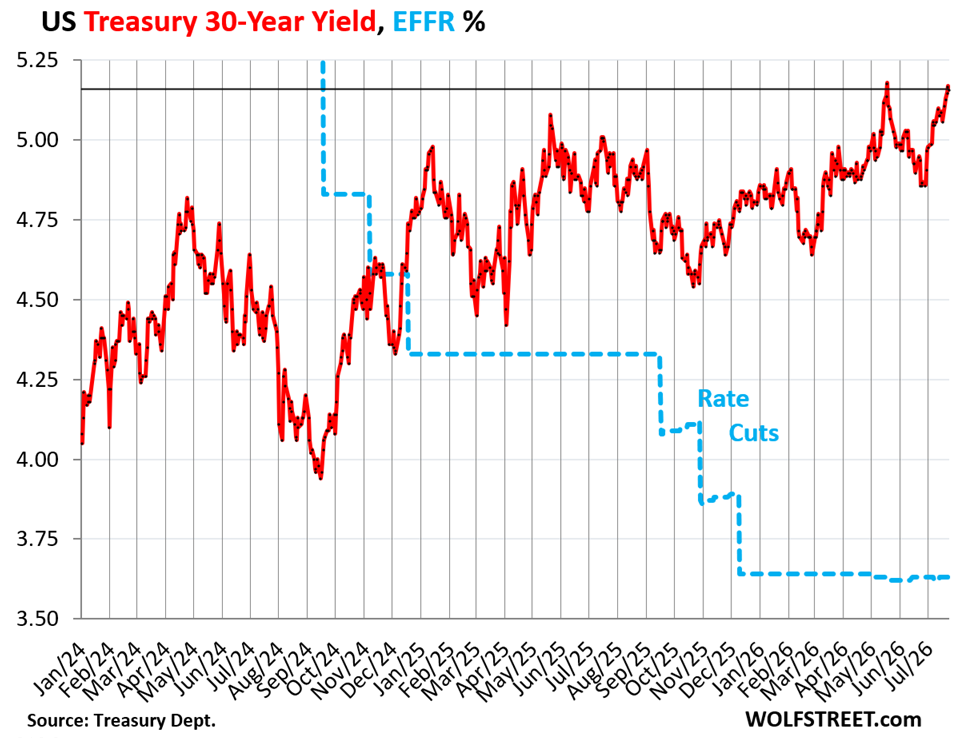
These rate cuts spooked the bond market. The bond market fears inflation because it eats up a big portion of the purchasing power of long bonds. It fears a dovish Fed that allows inflation to happen. And it fears the onslaught of new debt.
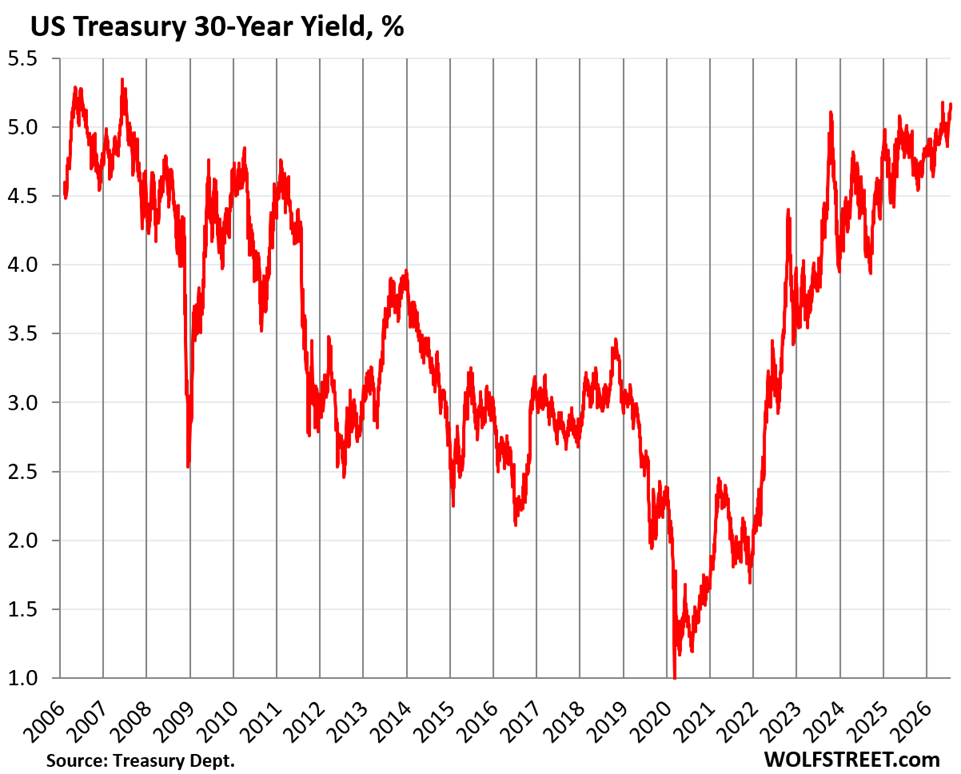
The two-decade chart below shows the final 14 years of the 40-year bond bull market and the first six years of the bond bear market. The 30-year Treasury yield took 14 years to zigzag down from 5.2% to 1.0% (March 2020), and then took only six years to rise back to those levels.
The market value of the 30-year Treasury securities purchased in March 2020 at the Treasury auction has dropped by over 50%. This is the bloodbath these bondholders have been through, and they fear that there’s more to come, and they’re demanding higher yields to buy these securities to be compensated for those risks.
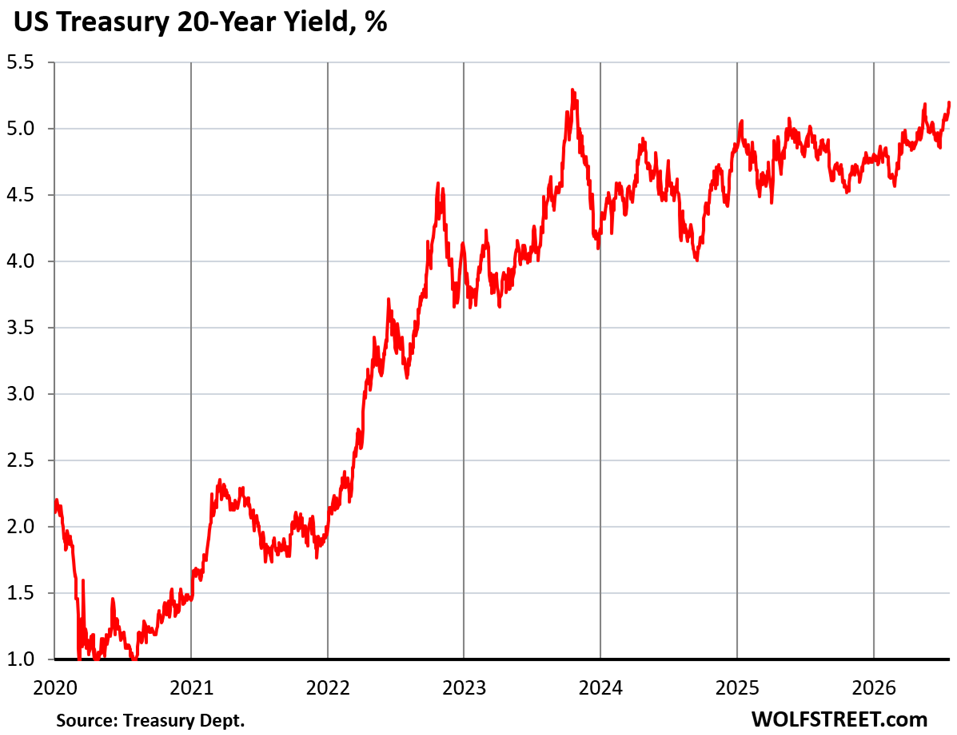
This was trading in the secondary market. But there were two long-term Treasury auctions this week, and both were revealing of the situation: The 20-year Treasury bond auction on Wednesday and the 10-year Treasury Inflation Protected Securities (TIPS) auction on Thursday.
The 20-year Treasury bonds sold at auction on Wednesday at a yield of 5.163%. Then in the secondary market on Thursday, the 20-year yield rose to 5.20%, the highest yield since the debt scare of October 2023, which had produced the highest yield since 2007. The 20-year yield closed on Friday at 5.18%, up by 11 basis points for the week.
The debt scare of 2023 ensued after the Treasury Department had revealed just how much long-term debt it would issue over the next few quarters. That flood of projected new supply gave bond investors the willies.
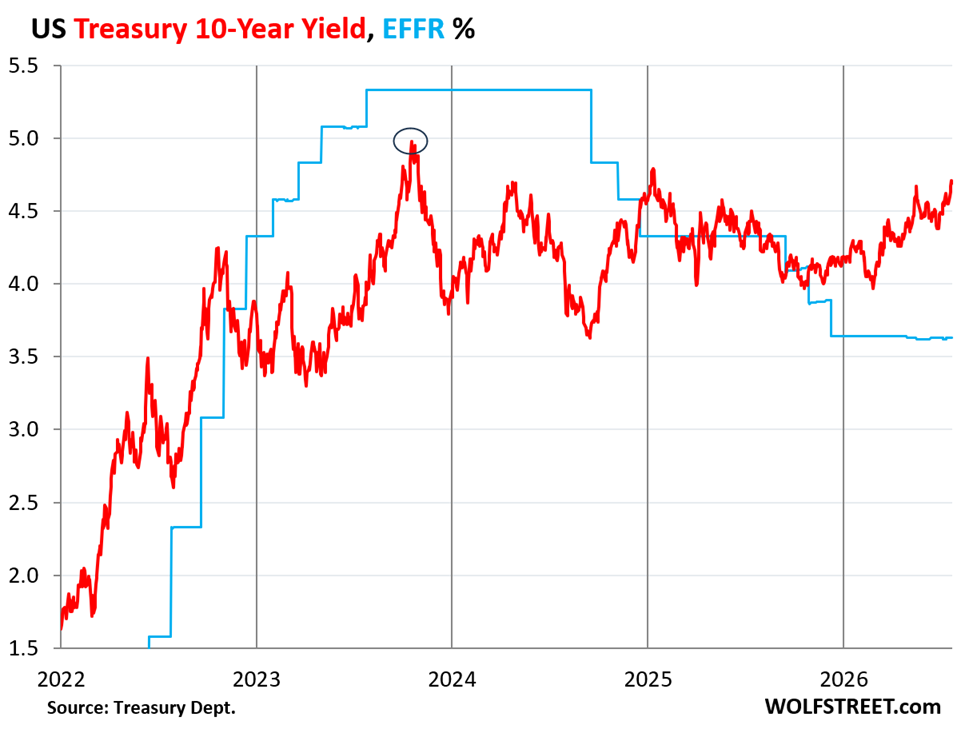
During that debt scare, the 10-year yield surged relentlessly from 3.4% in May 2023 to over 5% on October 23, 2023 — 160 basis points in seven months. But 5% opened the floodgates of demand and in hours drove the yield down to 4.83%, which was quite a spectacle.
With the 10-year yield at the time, 5% was where the floodgates of demand opened, and it hasn’t hit 5% since.
That’s what happened last time there was a debt scare. There is no guarantee that the floodgates of demand will open sufficiently again when the 10-year yield hits 5% next time because by now, the debt has gotten $6 trillion bigger.
After seeing the bond market’s reaction, the Treasury Department walked back its issue plans for long-term securities to focus more on shorter-term maturities and T-bills. And it’s treading carefully to this day about long-term issuance. The 10-year yield going over 5% was a scary moment for the Treasury Department.

But back then, the government didn’t have to actually sell 10-year Treasuries at 5%. The last 10-year note auction before October 23, 2023, was on October 11, and $35 billion of 10-year notes were sold at a yield of 4.61%. And the first auction after the debt scare came on November 8, and the $40 billion of 10-year notes went through the auction at 4.519%.
The last time when it took 5%+ to sell 10-year notes at auction was in June 2007. But at the time, the Treasury Department only had to sell $8-12 billion of 10-year notes per auction, and there were only 8 auctions per year. Now there are 12 auctions per year, and each is running in the $40-$50 billion range.
So the 10-year Treasury yield rose to 4.71% on Thursday, the highest since the three days in January 2025, and beyond that, the highest since the debt scare in October 2023, and beyond that the highest since 2007.
Note how the 10-year yield spiked to 5% in October 2023 during the debt scare (circled), and how blistering demand pushed it back down below 4% two months later.
The 10-year TIPS sold at auction on Thursday at a yield of 2.438%. TIPS holders also get the inflation compensation based on CPI that changes every month with CPI, which is added to the principal, and the principal grows with CPI, while the coupon interest payments are paid on the combined amount of original principal and the accumulated inflation protection, and so the interest payments rise.
In the secondary market, the 10-year TIPS yield closed on Friday at 2.43%. Those were the highest yields since the debt scare in October 2023, which was a few basis points higher, and beyond that, the highest yields since 2008.
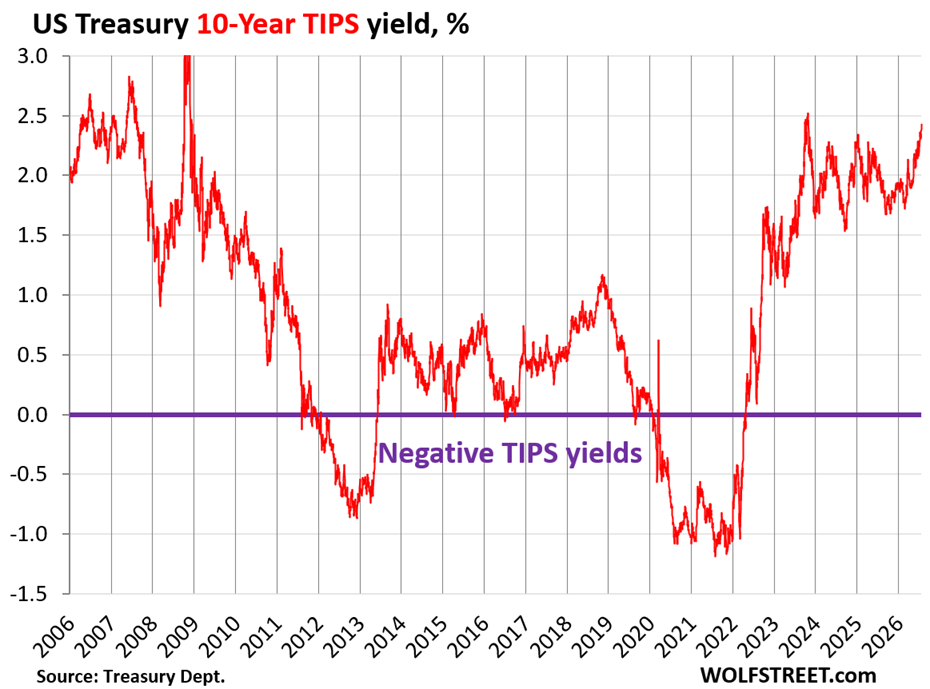
The bond market – given the inflation dynamics, the massive flood of new debt that has to be absorbed, and the bloodbath it has already been through – remains remarkably sanguine still. It’s just squiggling a little. It hasn’t thrown a major hissy fit yet. So this would be a good time for Congress to sit up straight and start paying attention and act when there isn’t a crisis on hand. But it won’t sit up straight and pay attention until there’s a crisis on hand, like there was in the 1980s. And then the whole thing gets a lot more difficult to manage.
In case you missed it: Fed Chair Warsh scuttled forward guidance, markets are on their own. However this comes out, it promises to be a rougher ride, but in a fresh breeze: Bond Market Just Flipped to “Rate Hike in July” as 2-Month Treasury Yield Spiked by 13 Basis Points
Enjoy reading WOLF STREET and want to support it? You can donate. I appreciate it immensely. Click on the mug to find out how:


How will new-issue investment-grade municipal bonds be affected? I understand that they generally track the 10-year treasury rate.
Let’s go 10% plus interest rates.
Would love to see the chaos that ensues.
“Because some men aren’t looking for anything logical, like money. They can’t be bought, bullied, reasoned or negotiated with. Some men just want to watch the world burn.”
I’m in favor of higher interest rates too, within reason. But I also don’t want to have to live in a debt-soaked society that suddenly has to deal with 20% unemployment and all the desperation that would follow.
I think there has to be a middle ground where greed and stupidity get punished (looking at you, private equity/credit bubble) but we aren’t collectively flung over a cliff. I wish I knew what that number was. I’m pretty sure it’s bigger than 5% but smaller than 10% if we’re talking about the 10-year T-note and mortgage rates.
I wish there was a way to recommend posts here. You nailed it.
Reticent Herd Animal-
Good comment.
Just curious as to your reasoning for 10% is an upper bound. The prior bond BEAR market from 1940 to 1980 relentlessly lifted rates up to nearly 20% (with accompanying unemployment). And that period began with US debt-to-GDP in the neighborhood of today’s.
Not saying your opinion is wrong…instead maybe looking for justification for a hope that the current cycle won’t match that cycle.
Don’t overthink this. The solution is simply a society with a system that PUNISHES (not rewards) bad behavior and bad choices. Allow bad ideas and bad management to actually fail for real. Lose ALL their assets/wealth or sell to repay creditors for whatever another party will offer, period.
2007/2008 and the great financial FRAUD should have made it crystal clear to the entire world that America was an oligarchy, just like the former Soviet Union.
Despite all the history on empires humanity seem to continue to make the same mistakes. The outcome from 50+ years of rewarding bad behavior and siphoning all the capital and wealth to the new kings/queens will be no different this time around.
This time around however there are 8+ billion people on this rock, and yes, despite the ignorant claims to the contrary, demographics do indeed matter.
Interesting times.
Good comment WB:
How some ever, I want to add to your “2007/2008 and the great financial FRAUD should have made it crystal clear to the entire world that America was an oligarchy, just like the former Soviet Union.”
Yes indeed, USA is and always was an oligarchy!
And my addition is that USA here and now just conforms to the same system of control that has gone on for eva, and NOT just the Soviet Union or any other fascist group on either the reactionary right or the reactionary left,,, but every ”society” from when the biggest and baddist folx willing AND able to physically dominate in person, until today when the domination is more in the line of financial but still includes weapons of all sorts from the space based right down to troops on the dirt…
Somehow and Somewhen, WE the PEONs might gain a bit, as we clearly did and continue to do in the experiment of USA…
Although HOPE is clearly NOT a strategy, it’s a good tactic, especially when linked to the teachings of JFK and MLK and Gandhiji, and SO many others who saw clearly the ONLY path to peace and prosperity for all, not just only the oligarchy…
In this age of performative rabid individualism, I think we are way past such reasonable ways of prosocial thinking, WB. Thank you for reminding me there is still some sanity left in the world, though.
The Fed saved everyone associated with SVB except the stockholders, and I would bet there were some people / companies with money in that bank that were doing risky business / stupid things BUT didn’t take haircuts.
I’m in the camp that says the Fed forevermore will do everything they can from letting a financial situation turn into a recession risk.
Give this man a cigar and a fed governor seat.
Ha! Most people don’t get it.
That’s where I’m at. You need to pay me at least 10% to have any confidence in a 30 year US Treasury given all the profligacy being demonstrated by this administration. You can fool some of the people all of the time, but you can’t fool me. Too much criminality and self dealing going on to have faith in these guys. They are con men and thieves.
Congress can cut “this administration” off anytime it chooses.
You’re barking up the wrong tree.
They could also choose to issue money directly, rather than taking on more debt. It might cause inflation, but we’re going to get that anyway.
The looting will continue until the elite move to another continent.
Because they can.
Because they have no fear of backlash legally.
Because they have no concept of moral behavior.
Because most of the subjects are illiterate of basic math much less economics.
Because fiat collapses without infinite growth.
As you said Trucker, the parasites will kill the host and then slither along their way.
Spot on comment. Why would anyone in their right mind buy a 10 year treasury at the current rates? The unsustainable debt made worse by fighting stupid wars and inevitable rate rises just to cover the interest on the 39TRILLION DOLLAR DEBT will only be repaid in inflated away dollars.
For a 30 year bond, is a mere 10% enough?
Yep. Like it or not, RISK is being repriced globally. The Fed has long overplayed their hand and will quickly become irrelevant.
Interesting times.
These interest rates are still being repressed. There is nothing “Free” in a “Free Market.” From Yahoo finance Dec. 10, 2025:
“WASHINGTON, Dec 10 (Reuters) – The Federal Reserve on Wednesday said it would imminently start buying short-dated government bonds to help manage market liquidity levels to ensure the central bank retains firm control over its interest rate target system.
The technically oriented purchases will commence on Friday, the central bank said as part of the policy announcement associated with its latest Federal Open Market Committee meeting. When it begins buying, the initial round will total around $40 billion in Treasury bills per month.”
Outdated. Have you been asleep? That was a 4-month burst that’s finished. In mid-April, they tapered them, and they have been at $10 billion a month in June and July. $10 billion a month is so little on their $6.7 trillion balance sheet that you can barely even see it (see first chart below).
The Fed’s balance sheet always grew before 2008 with the economy, and before QE, it HAD to grow with the economy because of its liabilities currency in circulation and reserves, that was the normal condition (see second chart below, which shows the balance sheet before 2008 before QE). This normal growth of the balance sheet has ZERO to do with QE but is a function of demand for currency in circulation through the banking system (getting $100 out of an ATM) and a function of reserves (banks pay each other through their reserve accounts, $ trillions a day flow through those, and so there is always a balance, and the more and the bigger the transactions, the bigger the balance, like your checking account. These are liabilities on the balance sheet, and they MUST be counterbalanced by assets (it’s called a “balance sheet for a reason because assets = liabilities + capital… ALWAYS on every financial statement in the corporate world.
The Fed is still shedding its long-term MBS at a rate of about $16 billion a month, so that’s long-term debt that they’re shedding and replacing with short-term T-bills, which is a “reverse operation twist” which pushes up long-term rates (see third chart below).
The Fed’s balance sheet always grew. This is before 2008:
It continues to shed its MBS:
Abstaining the tax cuts and restraining the QE is is the most formidable and easiest approach to flow stability in bond market.
Instead of issuing new debt, rollover the expiring existing short term debt towards stablecoins demand.
‘Stablecoins’ are just fake tokens pegged to the value of the US Dollar, so how would your suggestion help anything at all?
“before QE, it HAD to grow with the economy”
Indeed
But it seems since 2009 the balance sheet grew to pump the economy / markets rather than “grow with it”.
Yes, QE starting in 2008 screwed up everything. Bernanke did it. They thought they could get away with it. But they didn’t. Now we have a major inflation problem for the first time in 40 years, and it’s not going back into the bottle.
Indeed Bernanke …. and a Noble Prize
Let me print several Trillion and I’ll make things look good too….
for a while
“Sometimes fallin’ feels like flyin’…….for a little while” T Bone Burnett
Wolf, your description of the recent history of the 10-year yield was masterful! We’re lucky you have this skill… and share it.
Good one RA, and exactly why we send him $$$ every year, and I hope others on here able to do so do so…
In 1976, the treasurer of Armstrong World Industries told me the country would not survive 10% interest rates. They went to 22% and we survived. We are in a mess now because of the tax breaks passed in 2016 and renewed in 2025 and Bernankes ZIRP and QE farce. The GOP has once again sent us down the rabbit hole. When will this country ever learn?
Nonsense!
As an always NPA and always voter since 1966, I can testify at this point that it should be SO clear to everyone that is not a puppet, that BOTH, of the so called political ”parties” are really just both sides of the very very same Uni-Party coin, doing exactly the very same damage to working folx and retired folx.
To think otherwise is to be a product of the vast continuing propaganda of the oligarchy trying, and succeeding so far, to keep the vast majority of folx around the world in subjugation SSOOOO similar to what the ”lords and ladies” of the royalty/nobility had and have done for eva.
That’s exactly why BOTH parties are trying to get rid of Luna and others who are at least trying to represent in interests of their constituents instead of just lining their own pockets…
Both parties are really just the Uniparty, and you heavily disapprove of the actions of said Uniparty. So then you certainly don’t waste your time voting or supporting either party, do you?
ABSOLUTELY NOT MG…
I vote every election but I vote for a person, definitely NOT for these so called ”parties” that are SO very clearly corrupt organizations that are controlled only by money, etc., and have nothing to do with the quality of the candidates as so clearly shown recently.
Thanks for your very good question …
Charts showing the growth of deficits would disagree with the claim that there is no difference in the party in power.
A chart of stock returns would also disagree.
I have been trying to decide just how high the 30 year would have to yield before I would consider buying it. I cannot come up with a number because it is clear that this administration and congress doesn’t care in the slightest about fiscal discipline so debt is going to continue to go insane. The administration has also made it clear it doesn’t care about inflation. Furthermore, it is equally clear that the FED is going really slow in acknowledging inflation. They are looking for every reason to ignore it or at least delay in dealing with it.
I mean I seriously cannot put a number on it. Even if the 30 year yielded 10% I don’t think I would buy. Just too much inflation uncertainty with no lne taking it seriously.
Agree totally JimL:
While keeping as low a profile as possible, mainly in the 4 week T-bill,,, I keep trying to figure out that exact question.
Maybe start with the long term at low $$ in??
Can’t even get there, yet.
Until and unless the politicians stop lining their own pockets with massive insider trading, etc., and start facing economic realities of the vast debt,,, no ”rational” decisions are possible.
What do you think of Brazillian bonds, priced in Brazillian real?
13.8% yields from a country with a 77% debt/GDP ratio as opposed to the US’s 124%.
You’re taking a bet on an emerging market currency. That’s the primary risk here. That currency bet might work out, and then great. If not, then not so great.
What do you believe is the likelihood of Congress failing to sit up, the Fed failing to raise rates but instead buying the bonds that no one else wants to keep long term rates down?
There is no such thing as a free lunch. The Fed’s bond buying would be inflationary. Inflation = unhappy consumers. Unhappy consumers = Congress getting voted out of office.
That’s why they are trapped. They’ve been playing hot potato for too long, and now the potato has gotten too hot so that there is no safe solution. Either raise rates and hurt the economy, or lower rates and raise inflation.
How high does the 10-30yr rate have to be to entice investors to dump their stocks and buy in?
If you could make 8% on a 30 year treasury, why would you gamble anything in the stock market?
Very thorough source of information on the relationship between rate increases and debt.
It would be comforting to see officials do what is right for the population and country.
Remember this quote? “ask not what your country can do for you–ask what you can do for your country. My fellow citizens of the world: ask not what America will do for you, but what together we can do for the freedom of man.”
So many in govt are simply out for themselves and personal interests. At the same time Kennedy made that inspiring often quoted speech “the president proposed in 1963 to cut income taxes from a range of 20-91% to 14-65% He also proposed a cut in the corporate tax rate from 52% to 47%.”
And on and on to where it is now. One day 40 trillion chickens will come home to roost in the money tree.
Every where a future of financial repression, similar to that applied post WW2, is appearing to be a possibility.
But inflation will explode and the dollar will plunge if they do that, and so they won’t do that, because no one at the top of industry and government wants inflation to explode and the dollar to plunge.
Even Japan was forced by inflation and the plunging currency to give up YYC and QE and hike policy rates and shift to substantial QT:
https://wolfstreet.com/2026/07/03/qt-instead-of-rate-hikes-to-put-a-floor-under-plunging-yen-bank-of-japan-sheds-15-6-of-its-massive-assets/
It could happen the other way where inflation explodes and the dollar plunges first…
The US Dollar is certainly not going to plunge at all and if anything will continuing rising in the years ahead, particularly if US interest rates continue to rise.
@Wolf
I would be careful with the assumption that “no one at the top of industry and government wants inflation to explode and the dollar to plunge.” in a world where there is credible evidence of insider trading or online betting by government officials around on-again/off-again tariffs, Middle East wars, and government contract announcements.
For the people at the top of industry, their assets are real and their debts are in currency, so if the currency plummets so does their debt.
In a nation with a fast growing debt/GDP of 124%, debt devaluation might delay a debt crisis compared to a strong dollar scenario.
@SoCalBeachDude,
The UK and Australia are paying higher rates than the US, so if interest rates are what matters why wouldn’t wealth flow out of dollars and into pounds and AUDs? Australia is arguably more credit worthy too.
When inflation explodes, nothing withstands the turmoil it creates, not stocks, not real estate, no nada.
Were those charts taken from the Federal Reserve website or did you download the data to an excel spreadsheet and create your own graphs?
I downloaded all data to an Excel spreadsheet and created all graphs. Nearly all my charts are built that way. And I’m proud of the way they look. And I design the charts so you can see even on a smartphone what they’re saying. I take this stuff pretty seriously. Very rarely do I post a chart someone else created.
Most of the downloading is pretty easy. But downloading the data for the Bank of Japan balance sheet (directly above your comment) from the BOJ’s “English” website is so counterintuitive and complicated that I have to re-figure out every time how to do it.
And a data-geeky note: The Fed is now in the process of shifting all its data from its Data Download Program (DDP) to FRED. In an update a couple of weeks ago, it said that it would remove its “Build your Package” from DDP soon (there goes my data), and that it will retire all of the DDP. So I’m going to have to make that switch, which is going to be a time-consuming hassle. But from the Fed’s point of view, it makes sense. FRED is part of the Federal Reserve System, and DDP is doing the same thing, and so they’re consolidating them. The Fed has lots of different kinds of data on DDP, and all of it has either already been or will be shifted to FRED.
@Wolf,
I think you have good reason to be proud of your charts: I see them copied and repeated by influencers all over the internet. Smart to include your website in the image.
Then what WILL they do?
They will hike rates and they may eventually and slowly trim the balance sheet
I remember the 80s. I bought 10% municipal bonds. It felt good even though I was probably being killed by inflation. Now I’m old enough that I just need a return that does not lag inflation by too much and survive the coming AI bubble bust and $200 oil. I recently bought a Bolt EV with my neighborhood gas at $6/gallon. I should have put solar on my roof. Maybe it is still not too late, though at my age (74) the return may not be good.
At your age, and mine, it’s more about convenience and less about return.
If you want it, get it!
No worries about oil.
It will never ever reach $200.
$120 tops and very temporary as well as the world would cease to function at levels above that very long.
Depends if you measure paper or spot. Current price of delivered oil right now is around $140 already, which of course has other factors built in but the key is the spread between the two, which I would expect to shrink and paper catches up. Both China and US utilizing its reserves to keep prices down is running out as China is expected to start pushing in the fall and the US stockpiles are close to hitting technical minimums. The US of course is a net exporter but that doesn’t mean we don’t import. It just means oil and oil related companies are very profitable.
July 23, WTI spot price FOB in Cushing: $93
Wolf,
Yes I get the WTI and Brent prices. I was pointing out the delivered price which for the US isn’t consequential but if it has to go around Horn Of Africa then it adds to cost for markets more impacted by geopolitical events. I’m sure the extra insurance, weeks on the ocean lead to overall higher costs. Delivery costs probably difficult to quantify as with any delivery related cost since variable. In the end those lead to higher energy costs which would likely feed inflation.
Crude oil could be $200/barrel and the world would keep right on rolling.
It was stuck around $100 for nearly 4 years from 2011 thru 2014 and no one even remembers that.
There was also a sustained spike in 2008 that went to $140 and was well over $100 for nearly a year
Adjust any of those for general inflation and $200 is actually quite a reasonable expectation.
In fact perhaps the real question is why oil isn’t even higher already?
“…perhaps the real question is why oil isn’t even higher already?”
Yea, I keep seeing charts about how the US Strategic Petroleum Reserve started the year less than full and is near depletion now, as the US exports more of its oil products to the rest of the world to replace Mideast oil.
Somehow that’s not factoring into the oil futures market, or else it is fake news or irrelevant news for reasons I don’t fully understand.
Fellow Bolt user. It’s a nice little car to run around in and ignore gas prices.
4% inflation
5% ten year
which one is out of whack?
Both
too soon to tell…the numbers are going to shift around..bond mkt volatility for a while. traders can make use of this moment. FOMC under new leadership has yet to do anything. They have tools that may be more effective than they know…..doing something would send a strong message. doing nothing would be a very poor message…. these analyst “groups” that WARSH describes seem to have been enlisted at an inopportune time …interesting he didnt want to get more comfortable w processes and people before doing this. doesnt he trust himself and the excellent staff? I’ve worked in settings where they pull in task groups. Much ado for negligible results.. usually the answers w the necessary/ excellent analysis is right in front of you.
So now what? A long time ago I was in Brazil and cashed 100 US dollars for Brazilian money at the bank. They gave me a two(2) foot stack of 10,000 denominated notes. The same type of thing happened in Chile a few years later. Is this the USA in a few years?
These countries still operated because everyone kept there savings in foreign currency or gold. So much so, that when I sold my dollars the next time at the street value I got a lot more Brazilian or Chilean money.
Both these countries retired their currencies and started new one. Both countries tried Socialism. Perhaps they learned what we are about to learn, and are better off today
The US dollar is doing very well on the $5+ trillion a day FX exchanges and will continue to be the dominant and most used currency in the world as there is nothing whatsoever that could ever come close to replacing it.
Doing well against other fiat currencies, yes.
Doing well against real assets? Not so much.
Tides have turned. The dollar surged against gold and silver over the past five months. The dollar also surged against home prices in many markets as we have documented here. The dollar soared against cryptos (well, OK, I concede, cryptos are nothing and don’t count as real assets).
I encounter quite a few Japanese investors that sandbag their Yen in Hawaii. I look at their investment and say, “wow! selling at a big loss!” They look at it and say, “I made a killing by getting out of Yen.”
The smart ones buy low in Hawaii and sell when it’s high in Hawaii but those are few and far between. In the long run they are better off out of the Yen.
On another note, when we see how dysfunctional the US gov’t has become, just take a moment and watch a couple of the Fukushima documentaries that have come out in the last couple years. Japan is on a hard road.
For exchange:
How about a software-based commodities/forex exchange that can instantly equalize prices, so that oil can be bought in any currency without a major bid-ask spread penalty? OR, how about a digital yuan, floated freely on the market?
For savings:
How about brokerages that allow you to switch currencies and invest in bonds around the world? OR, how about the growing sophistication and depth of Eurozone bond markets?
10 Year Real Treasury Rate (I:10YRTR) was 2.43% for Jul 23 2026
Real interest rates have been tightening economic conditions
It is impossible to completely escape the echo chamber I am in but feels like so many headwinds that will drive bond yields up. I’m not an AI doomer as I believe it will have its use cases but just overvalued, Iran, Ukraine conflicts unlikely to resolve quickly but perhaps demand destruction will offset that to some degree, and of course just the growing debt. Feels like only thing that will send bond yields down would be a run from the stock market into the safety of returns that at best stay even with inflation but beats a correction. I know outside of my brokerage account I have sidelined a lot of my equity positions already.
At least in my opinion these are pretty reasonable positions but feels like navigating any objective media is tricky since narratives seem to try to dominate algorithms or simply manipulate general public.
Glen: “It is impossible to completely escape the echo chamber I am in…”
My best advice? Get out of your echo chamber!
I find it is useful to ask myself what explains the zig zags. I.e. if all these factors are conspiring to push rates higher, then why didn’t they go up forever? Why did they go back down at various points over the past year or 2?
I think the answer is that people are making bets about whether rates will rise due to inflation, or fall due to recession. As those odds oscillate, so do rates.
My deceased father-in-law was born in Frankfurt-am-Main 1915 and lived through Weimar Republic’s 1923 era hyperinflation before emigrating to the UK in 1936 (his father was a non-practicing Jew and his wife was Catholic).
I asked him what was the cause of the inflation? Germany’s war debt? The Versailles reparations? The loss of the Ruhr and Saarland?
His simple explanation in retrospect many years later was simply ‘we quit believing’.
OBC-
Interesting post!
It’ll take you some time, but if you haven’t already, you could peruse:
The Economics Of Inflation A Study Of Currency Depreciation In Post – War Germany, 1931, Constantino Bresciani-Turroni (which is available in paperback, and exists online)
He is highly credentialed, and almost unheard of today. Bresciani-Turroni is synopsize in my old 1987 Palgraves in a brief and complimentary way…
He goes a long way toward answering your question, IMHO. Paraphrased answer: Sky-rocketing debt (war and otherwise), accompanied by unbridled paper money-printing. Of course the details are much more complicated, and interesting.
Did your father-in-law reveal what it was that “we quit believing” in? Monetary discipline, perhaps??
Great article that exposes the wounds of a pirate society. We treat it like the whole episode is a normal demonstration of a society in control of it’s faculties. About that:
I think the incredible love based American society deserves a shout out. Such tolerance when all around them the macro economic wars rage. Indicative of a society that Ben Franklin, the American genius, described correctly so long ago.
The 95 pct of Americans who are struggling financially.
And the remaining 5% of Americans are homeless?
“95% of Americans are struggling financially” is a braindead zombie line that refuses to die no matter how many times it gets killed. It just keeps popping right back up.
The 2008 crash left a big impression on people. Five years after it I remember driving through small town America where I had family and it was rough. The towns were dying.
Today their main streets are full of small businesses. This is a real thing that I have seen happen over the past decade. If the economy is so bad, why would there be prosperity in the countryside.
I concede not every place is like that, but the general condition of the countryside has improved since the 2010s.
I see a lot of these headlines but then I think if more n more people are struggling then it’d show up in economy as 65% plus of us gdp is driven by consumer spending.
It’s a weird reflex. We had headlines a couple weeks back saying: 1 in 3 homeowners can’t pay their mortgages. Big frontpage news for a couple of days, discussed in talkshows and what not.
Turns out, it was based on a survey that asked people how they felt about their financial situation. That’s right, ‘felt’. The survey was running since… 2024. The report itself also contained quantitative research which, among other things confirmed that since 2015 the amount of people behind on mortgage payments dropped by factor 4, and the average amount behind on payments dropped by factor 7 (!).
The headline came from one of the questions in the survey where 8.8% of home owner respondents said: ‘Our monthly income is kind of insuficient to pay for all fixed and other costs”, and 26.8% said “Our monhtly income is just enough, but we’re not saving a lot”. They combined these two and slapped a neat onliner on it. Everyone losing their minds. Literally impacted the nation-wide debate on regulations and tax-breaks on home ownership. Over a misinterpreted two year old survey based on feelings that nobody actually read.
People are fucking stupid.
🤣❤️ thanks!!
Dang.
Here in America, we are living in some of the most comfortable times in the history of the world. Yet people still complain and cry.
Many of the people I know that have financial struggles, are due to poor money management and budgeting.
For instance they won’t buy a gallon of milk for the kids or a pound of beef because it is too pricey, but have no problem paying hundreds per month in streaming and app subscriptions, or a huge note for decked out new vehicle, etc.
They have different financial priorities.
I would fair to bet that the average American citizen today is far more comfortable and well off than the average American citizen in year 1900.
A flat screen TV in every house…..
You ever try giving away a tube TV ?? Nobody wants it… not even dirt poor people, because they bought a flat screen.
W I see the lifestyle bling decked out by the vast majority of people I just shake my head.
$500 for a trip to the hair stylist?
My wife knows many that go monthly. That doesn’t include the clothes, nails, on and on.
Recently went through Rice Village in Houston. Beautique kids’ store…$250 T-shirts! Moms decked out in thousands of dollars of “style” country clothes were buying, the lines in the boot shops were a 45 minute wait for service to buy a pair boots starting at $500 entry level. Stupid is as stupid does.
“$500 for a trip to the hair stylist?”
My wife won’t even tell me 🤣 (it’s her money). I just seal my lips and cut my own hair in defiance (not because I’m “financially struggling,” but because I like doing it, and because I’ve gotten less bad at it, and because it saves me time).
If that is the way people wanna spend their money…. Rock on !
Not necessarily my style… but to each their own.
Those same people probably did’nt buy eggs when they were “too expensive” …haha
I cut my own hair.
Like any human being out there, there is a desire in me to smaller or larger degree to look good i.e. vanity. I try to fulfil this desire by staying healthy and fit.
My mantra is: If I have a good physique/health/fitness , then even a $5 T shirt from Walmart will make me look good with a home done hair cut.
At the same time I totally understand we all are getting older n marching towards death.
I think that the Federal debt could easily be paid off by taxing the wealth accumulation provided by Ben Bernanke’s fraud. At that level of other Harvard and Princeton economists, one would think, that one of those professors would have pointed out the obvious, compromised position we currently find ourselves in the fullness of time
Sometimes we need to look inwards.
The top two federal expenditures are social programs. Medicare and Medicaide and Social Security.
Add to that the fraud that is projected to be over a trillion dollars, and suddenly you are talking about real money.
Projected by whom? Or are you throwing around accusations of fraud without evidence?
Did you hear about the DOGE employee who said on a live podcast that they found very little fraud, and the waste they found was due to compliance with Byzantine government rules? He was fired in the middle of the interview. You see, the new administration had already decided that the programs they didn’t like were rife with fraud, and they weren’t going to hear otherwise.
“Fraud” is code for “we don’t like this spending and are looking for a reason to cut it”.
I think you are mistaken.
Just look:
Four Men Plead Guilty to $2M Minnesota Medicaid Fraud
Claiborne County woman indicted for $28K SNAP fraud
Former Obama spokesperson charged with financial felony in city engulfed by fraud scandals
You look at the headlines and see this every day.
You guys are talking about two different types of fraud.
— DOGE was looking at fraud committed by government employees;
— Medicaid fraud and similar is fraud committed by nongovernment people against the government by abusing government programs. What that shows is a political refusal to investigate and throw the book at these people.
Why would you buy a 30 year at 5%?
Maybe because you think the Economic, Fiscal doctor is going to say: NOW WE HAVE NO CHOICE, We have to treat the cancer. We have to do radiation and chemo therapy and that is going to make you so sick it is almost going to kill you.
At that point 5% interest rates might look real good. Just say’in.
QT or Bust!!