
Orders for computer & electronic products; electrical equipment & components; machinery incl. power generation equipment; fabricated metals products; and core capital goods – all surged.
By Wolf Richter for WOLF STREET.
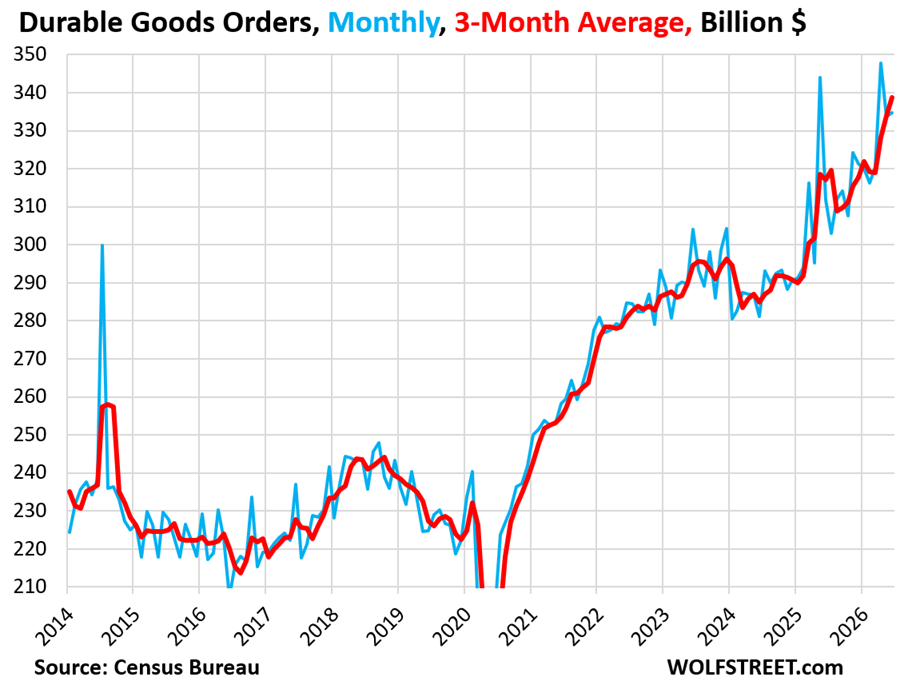
Total orders for durable goods received by manufacturers in the US, including aircraft and defense, ticked up by 0.3% seasonally adjusted in June from May (blue line). Year-over-year, not seasonally adjusted, total orders jumped by 8.9%, to $360 billion, according to data from the Census Bureau today.
The three-month average, seasonally adjusted, which irons out some of the month-to-month squiggles, spiked by 1.4% in June from May and was up by 6.9% year-over-year (red line).
But this includes orders for aircraft and defense. When Boeing receives an order for 113 jet aircraft in one month – as it did in June which will be reflected in durable goods orders over the next months – it pushes up durable goods orders by billions of dollars. But the following months, Boeing might not receive any big orders, which will push down durable goods orders. So in a moment, we’ll look at categories of products that are needed for data centers, and we can see the effects of the massive investment surge.
Where the AI data center investment boom shows up:
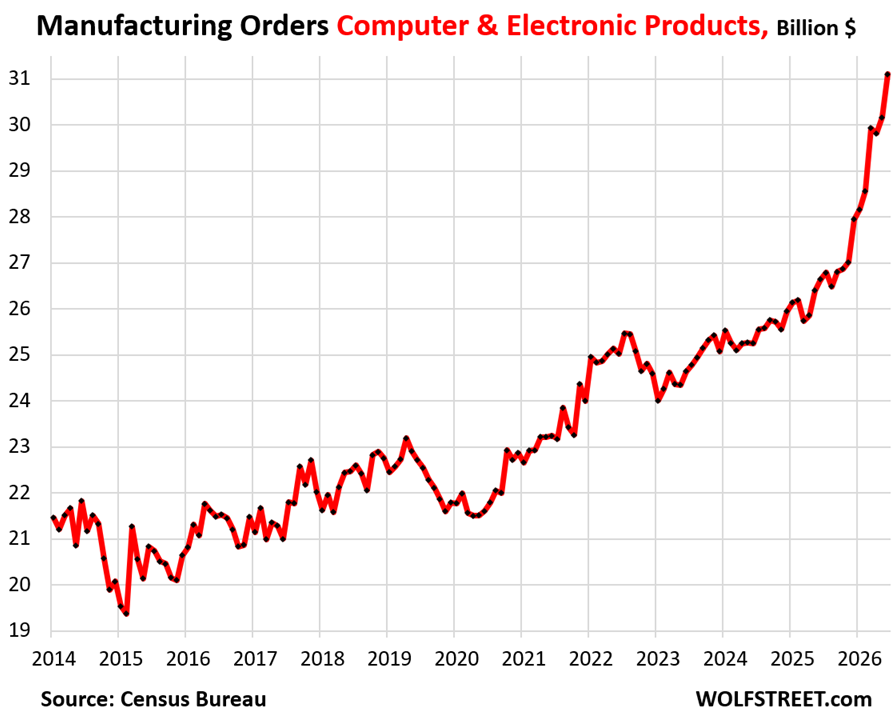
Orders for computer and electronic products spiked by 3.1% in June from May and by 16.7% year-over-year, to a record $31.1 billion. This includes orders for semiconductors at US-located semiconductor fabs:
Industries in computer and electronic products manufacturing (NAICS 334) consist of:
- Computer and Peripheral Equipment Manufacturing
- Communications Equipment Manufacturing
- Audio and Video Equipment Manufacturing
- Semiconductor and Other Electronic Component Manufacturing
- Navigational, Measuring, Electromedical, and Control Instruments Manufacturing
- Manufacturing and Reproducing Magnetic and Optical Media
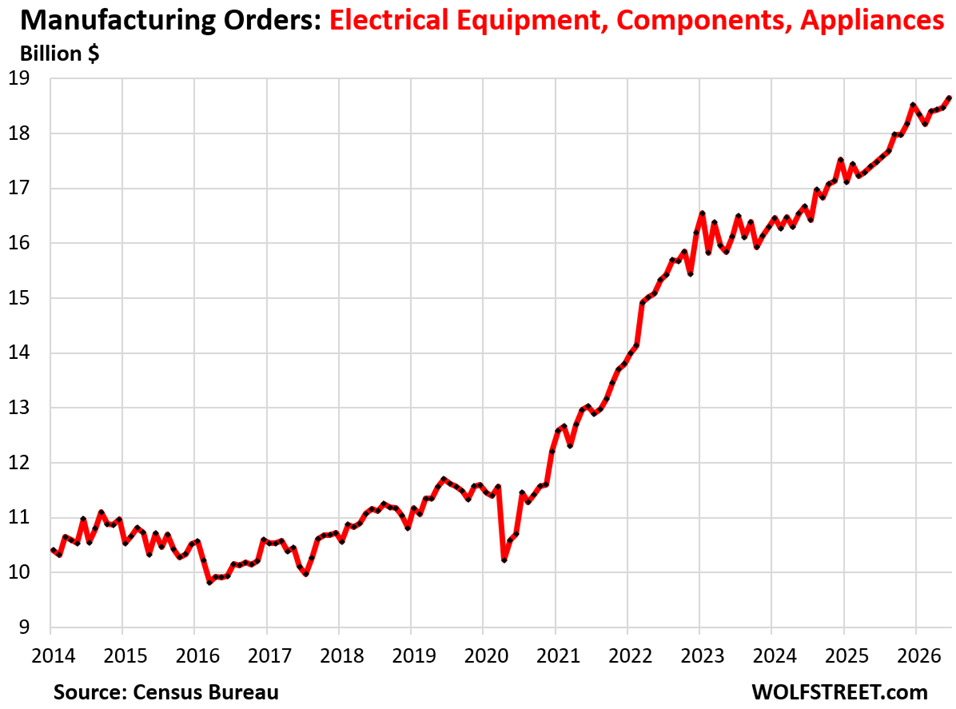
Orders for electrical equipment, components, and appliances, which includes some of the electrical equipment needed in data centers, rose by 0.9% in June from May and by 6.7% year-over-year to $18.6 billion.
Industries in Electrical Equipment, Appliance, and Component Manufacturing (North American Industry Classification System, NAICS, code 335) consist of:
- Electric Lighting Equipment Manufacturing
- Electrical Equipment Manufacturing
- Other Electrical Equipment and Component Manufacturing
- Household Appliance Manufacturing
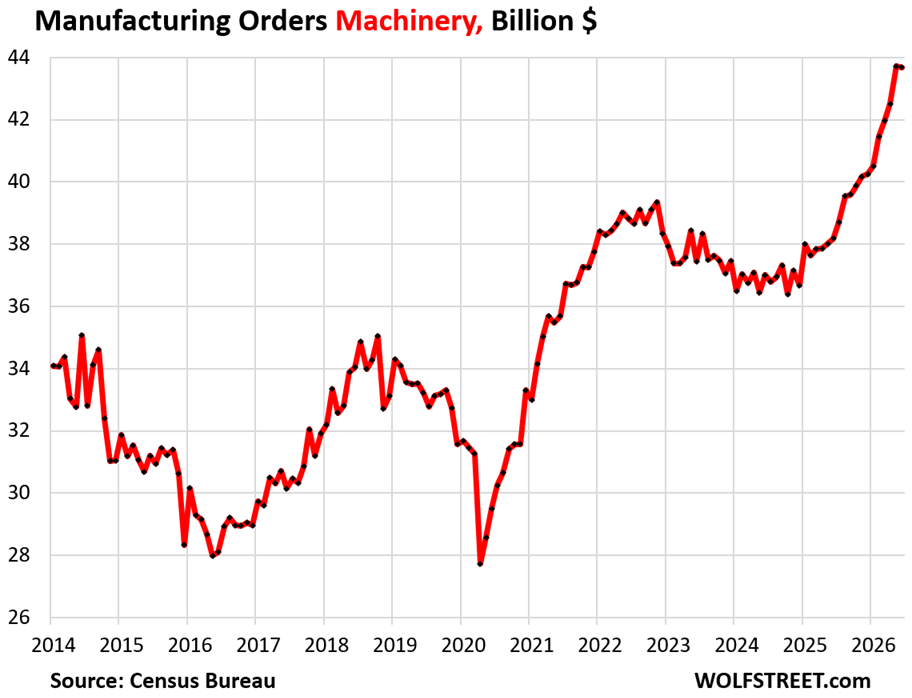
Orders for machinery, after a huge spike in May, was unchanged in June, and spiked by 14.4% year-over-year, to $43.7 billion. This includes power generation and transmission equipment to power data centers, HVAC equipment for data centers, etc.
Industries in Machinery Manufacturing (NAICS 333) consist of:
- Engine, Turbine, and Power Transmission Equipment Manufacturing
- Ventilation, Heating, Air-Conditioning, and Commercial Refrigeration Equipment Manufacturing
- Agriculture, Construction, and Mining Machinery Manufacturing
- Industrial Machinery Manufacturing
- Commercial and Service Industry Machinery Manufacturing
- Metalworking Machinery Manufacturing
- Other General Purpose Machinery Manufacturing
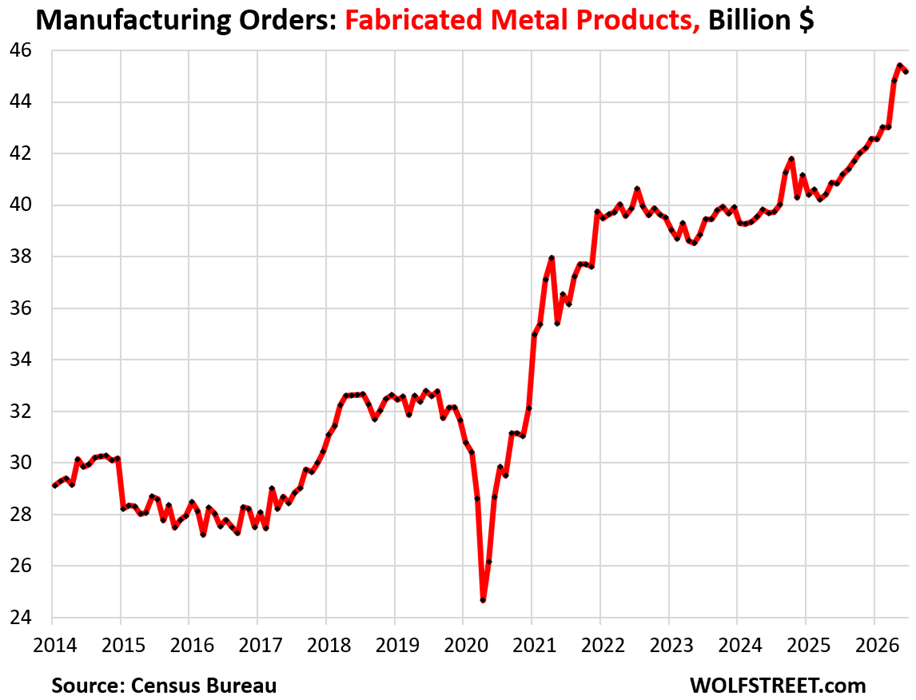
Orders for fabricated metal products dipped in June from May to $45.2 billion, but were up by 10.6% year-over-year.
Industries in the Fabricated Metal Product Manufacturing category (NAICS 332) use processes such as forging, stamping, bending, forming, machining, welding, and assembling metals into intermediate or end products (other than machinery, computers and electronics, and metal furniture).
Core capital goods (nondefense capital goods less aircraft) jumped by 0.8% month-to-month and by 12.5% year-over-year, to $85.1 billion.
This category includes some but not all of the above products, plus other products that are not included above, such as heavy trucks, railroad rolling stock, and ships.
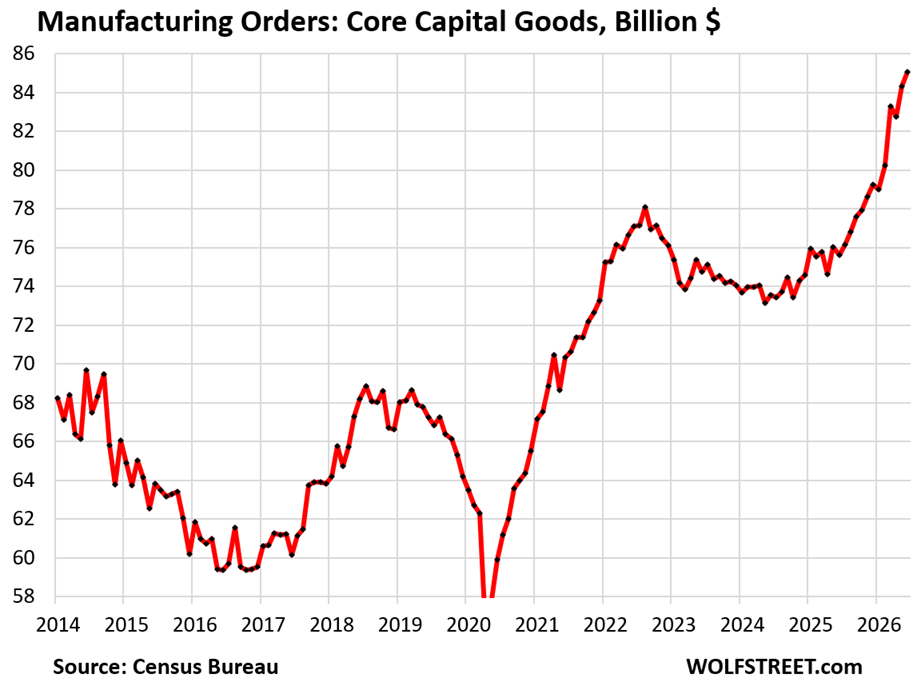
“Orders” are an early indicator of future economic activity. It may take months before orders emerge from the backlog and become actual economic activity of production, sales, and investment.
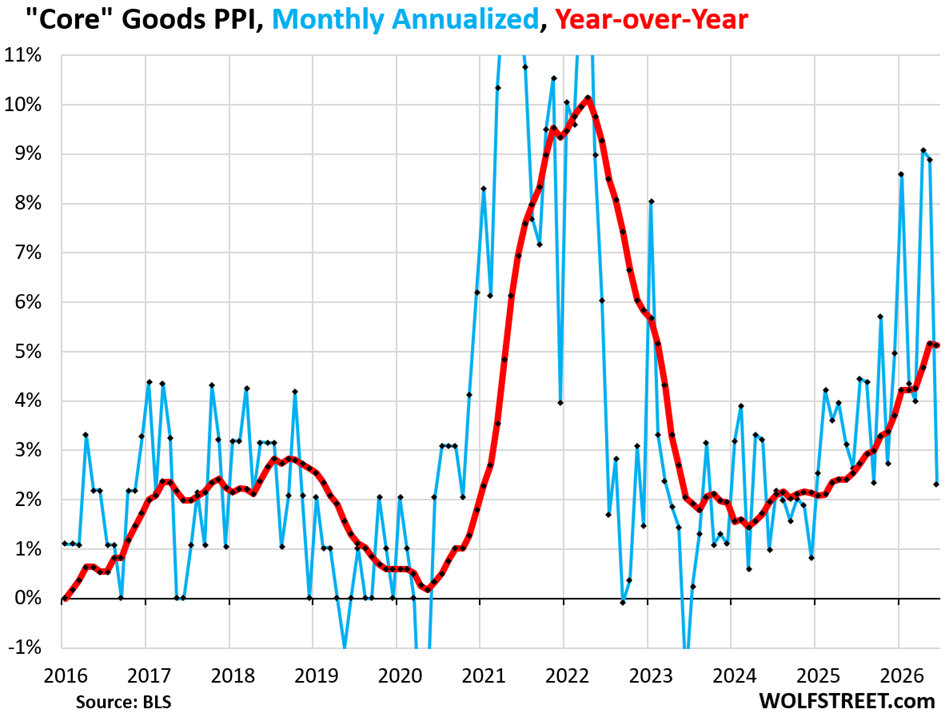
This demand pushed up prices, and inflation played a role: The demand from the data center investment boom, especially for electronic products and machinery, was in part responsible for driving up prices of affected products.
The Producer Price Index (PPI) for “core” goods – a relevant inflation measure here – rose by 0.2% in June from May, after the spikes in the prior two months, and was up by 5.1% year-over-year (my analysis of PPI):
In case you missed it: AI May Not Cause Total Jobs Armageddon Afterall: Google Reports on How AI Is Being Used at Work
Enjoy reading WOLF STREET and want to support it? You can donate. I appreciate it immensely. Click on the mug to find out how:


Beauty of this AI mania – within 3-5 years these chips become obsolete and needs to be replaced with more advanced chips. I see no reason this AI is going to bust unless cost of electricity and water goes so high that data centers end up paying for it and some of these data centers will shut down or they will start building their own power plants. Another interesting fact – China is second when it comes to AI and not that far from U.S. China has only 450ish data centers and we have 4000 active and another 3000 either under construction or in planning or pending approval of counties.
Unlike mortgage crisis of 2008 when people lost jobs and foreclosure became a focal point. Big techs are not going to run out of money and they will always go for workforce reduction before shutting down data center. Anthropic revenue is $47 billion and OpenAi is collecting $25 billion. We don’t realized but our employers are already paying subscription for these services and there is no going back. Its like asking our employer to terminate Microsoft account and stop using all office products. If its not office then we will have to find substitute.
Don’t you think the Data Centers should have to pay for their water and electricity use? And if they push the prices higher for all consumers should they not also pay higher prices? This should be priced in to their forecasts and there is no reason why they should be subsidised other rate payers.
The solution is for centers to either build their own NG or Nuke power plants, (and pay for the infrastructure) or locate to where there is already a surplus of energy like Alberta and Quebec. The data flows at light speed and centers do not have to be located anywhere in particular unlike Wall Street betting (oops) investment/buying edges where 1/4 of a second matters.
HELL YES, they need to pay for their own electricity generation capacity up front as well as water usage. Absolutely.
I read an article on Fox News today where this DC proponent was whining about my home state, GA, about how we’re on the cusp of approving a DC moratorium. This guy is like, GA, what are you doing? You’re going to turn your back on 550K jobs and $850M in tax revenue. And then he ends with the growing / big lie. He says, “Don’t worry. DC’s will actually cause electricity prices to fall as you spread that cost over a larger ‘footprint’.”
What a joke. Like the guy above said, I read that 4K vs 400 DC stat six months ago. I don’t want us to fall behind China, but I also sure as hell don’t want my electricity & water costs to get out of hand.
I read where electricity in San Diago costs $0.60+ per kwh. That’s CRAZY!!!
Wisconsin is requiring g $ORCL to put up $7 Bln in collateral.
There’s only so much supply for these chips and the memory needed to run the chips. My projections show the amount of memory available by 2030 will be roughly 50-70% more actual chips than is available today. That means the top spenders will be competing for a pizza pie that’s only so big and growing incrementally, while demand is (today) growing much faster. If the law of supply and demand holds, the cost of these items will be much much much higher since everyone is after those memory chips, how much capex can the market bear? How much can it bear when FCF goes negative and chips depreciate and the 10y is at 4.6 and openai/anthropic aren’t even close to recouping thier costs?
Same goes for water, power and labor force (building) for those datacenters, they are only increasing in cost, and doing so quickly.
The big question is if the demand stays on for next few years
My gut feeling is .. hyperscalers will retract the Ai opening on Ai data centers in next few quarters
I think AI will be transformative. Hopefully this will happen without destroying millions of jobs.
But the future of AI will not be in massive data centers. It will be in open source with enterprise running what they need on their own compute. In that case, the 5 year life of GPU’s may or may not be real.
With Open Source running on your own hardware, companies can integrate AI into their operations efficiently aiming at the low hanging fruit first and managing their costs.
There may be great opportunities for the first round of software folks laid off prematurely starting up their own consulting businesses.
Good models and weights are out there on github. Go get it and learn. Your big tech employers have shown you how they view you. They have capital and mass and name, but they lack the dynamic of human ownership.
Get independent. Milk your corporate employer for what you can while investing in yourself. Take your own risks, commit to the hours and effort that are investments in yourself. This may be a once in a lifetime opportunity.
Of course if you work for a company that does view you as a human being and is itself owned by identifiable human beings, act honorably and consider yourself fortunate.
Agreed, small businesses going to win the most out of AI revolution as it seems now.
“Big techs are not going to run out of money”
LOL! Heard the exact same thing during my company IPO in 2000.
Yeah, “it’s different this time”…
Correct, the big tech companies use their monopoly pricing power to charge whatever they want, and businesses grumble about it, but pay. The tech companies then take these profits and dump them into AI infrastructure.
The question is what will happen if we have a real recession such that companies fold and other companies reduce their ad spend.
… or move to Chinese AI which is considerably cheaper. Not all companies need the latest and greatest.
Employers are scaling back on AI spend and are looking ways to reduce AI spending as the ROI is not yet there.
On top of this open weight AIs are making a big splash in AI world.
The biggest problem with AI is: ROI is no where in the picture yet. It is an amazing tech in many ways and I use it on daily basis.
AI will revolutionize the world but I doubt if we’d see the ROI in the near future.
In a year or two we will start seeing first ai native unicorns- companies built since the Claude code era started. Maybe we already started with companies like Cursor getting to billions of revenue within few years of existence. We might see many more of those soon. That’s how productivity increase might materialize in the economy
Remains to be seen. we are in the 1st inning. Will this stuff be worth what they have to charge and how many go bust. Popcorn out.
What is the benefit (return) on all of this consumption of real resources, power, and water?
I have yet to hear or see a viable answer.
people doubted the benefits of the automobile when they first started appearing. Horses were working just fine, and there was no need for anything else. In additional, automobiles were costly and finnicky, they constantly broke down, etc. The same questioning happened with the internet. And I guess with all technologies. The benefit of AI for me is that I can do things I could not do before, and I would have had to pay someone to do, and some things I likely wouldn’t have done at all. And I’m just a nobody.
And maybe you wouldn’t do them again if the service cost $50 or $100 per calculation. So the real price if it goes to those levels will as you say create demand destruction.
The benefit is we get to bring about our demise a lot sooner than most would want. If we all knew today what the REAL probability is of all these companies, US & China et al, actually getting it right such that AI doesn’t take us out some day, we all say “HOLY COW we need to put the brakes on this and stick with non-AGI / ASI level of advancement and ban anything beyond about what we’ve got now.
There are undoubtedly benefits. I guess it could be person specific, but I can use it to help me stain a table, troubleshoot my car, mock up an image to see what siding is going to look like on my house, go through my inbox and find items I missed, help diagnose my windows 11 locking up, plan an event, Identify which bug is eating the leaves on my tree, etc. The question, which I think you may be asking is – the benefits at what cost – right now the costs are heavily subsidized. Maybe I wouldn’t be using it to help with my inbox if it costs $1 per scan, but right now I’m using it without paying anything.
The costs are also environentally externalized, not just financially subsidized.
I too find some LLMs convenient for some uses (no, not making funny videos or other shallow stuff), but it also seems to be making quality information hard to find.
I used to depend a lot on articles written by experts in various fields for work, and now more and more stuff that AI search tools return is either outright hallucinations (often weirdly altered versions of accurate information) or machine-translated/-generated slop.
Verifying AI output takes time, it makes sense. But on top of that it’s gotten extremely hard to find actual authoritative sources needed to do the verifying, no matter how much time I spend.
I work for some of those hyperscalers, unfortunately. Based on their internal processes I’ve seen so far, neither accuracy nor any objective improvement in people’s lives are big priorities for them. And that should be telling.
PS: I’ve been experimenting with locally-run LLMs with promising results lately. Hopefully, this kind of private LLM usage will become more commonplace and both open-source models and software will allow us to do more and more of the stuff that only Big Tech online models can handle now.
“Verifying AI output takes time, it makes sense. But on top of that it’s gotten extremely hard to find actual authoritative sources needed to do the verifying, no matter how much time I spend.”
AI is burying truth. Searching the Net has become like digging through a brick wall with a popsicle stick.
When you issue an AI request today, how often do you come back with an answer “I can’t answer your request because there are not enough AI resources available”? Do we really need 10x the capacity of what we have today? In 5 years, when the current and new data centers go though upgrades and become 3x more space/power efficient, where will the demand come from?
Make no mistake, this is an arms race. Open AI, Anthropic, Google and others are planning to win this war. Losing may completely destroy the company. If your model is superior and you do not have enough compute capacity, that is also the same as losing. What this means is that there is guaranteed to be massive over capacity at the end.
This is much like the fiber wars of years past. Many companies staked their lives on being the first large scale network of fiber across the US. Companies went out of business and there is STILL a massive amount of dark fiber all around the world. This will be no different.
The bad news is that once there is a victor and much of life relies on AI, the victor will charge exorbitant rates to everyone.
Think it will be much as its always been. There will be a number 2 attempting to take ove first, so prices will be lower.
I remember when we thought our first computer would never run out of memory. How long did that last? Ever since each new system was much larger. The first cell phone I used to connect to the internet locked up and quit. I stopped by the poviders office and questioned about the problem. Solution was to buy a new phone. So I bought a cheapee on advice from an expert. Later bought one of the first compatable with 5G and here we are.
….and we all will be stuck with dark data centers with weed trees growing out of the backup generators
But maybe we can finally get some RAM for our PCs.
The big question is what’s the lifespan of the computer components especially chips and memory in a compute intensive environment. If it’s only a few years, the build out will be an ongoing capex with short depreciation. Companies will have to turn a profit on these expenses before investor say no. Even if lifespan is double, will newer models require the latest chips?
Then there’s Jevon’s paradox where despite efficiency gains consumption and demand grows instead of falling.
I rarely comment on these posts but I see a lot of hopium in the comments and that worries me. I am young but I have worked in the tech industry for the past 12 years and while I see some marginal uses for AI, that pales in comparison to the insane market frenzy that has been whipped up by the tortured circular financing deals and crazy private debt financed SPV’s.
Please look into what the demand actually is for these products. Please look into what it actually costs these companies to serve up their free and even paid users. Please look into look into how exposed pensions and 401K’s are and how Oracle (who is spending $340 billion on data centers for OpenAI) been downgraded to just 1 level above junk status.
I will say that I am not an AI doomer, I think there is a future there in on-premise open-source AI compute for companies who recognize AI is a useful but dumb personal assistant that can do a lot of boring legwork and should always be double-checked (hallucinations are a mathematical part of LLM’s). But this market is not reflective of what is effectively a sleepy 10 to 20 billion dollar software market segment.
The AI investment bubble will blow up, there is no longer any doubt in my mind. Just like the Dotcom bubble blew up, with the Nasdaq plunging 78% in 2.5 years, and with 1,000s of companies – startups and mature companies – vanishing and taking their investors with them. But the internet thrived, and it’s because of the Dotcom bubble that the internet is what it is today. I no longer have doubts that the AI investment bubble will go through a similar process.
But AI is a LOT more than just LLMs. LLMs are just one specialized tool of AI. If LLMs is all you’re looking at, you’re missing the boat.
It could blow up, but I don’t see this as a dot-com thing. These are the giants ( I listed the companies in other comment) in a race to capture AI. They are super profitable with almost unlimited dollars to invest.
A correction is more likely. 20, 30%? Will they slow spending and stocks correct or will stocks correct and then they slow spending?
And what happens if they get a whiff that AI is exponentially increasing their revenue?
It’s the giants that imploded during the Dotcom bust, including Sun Microsystems, Lucent, WorldCom, 3Com, 360Networks… they’re gone, either shut down or acquired for scrap value. Cisco was the #1 stock at the time, the first stock to get close to $1 trillion, and it collapsed by over 80%.
Amazon shares collapsed too, but it is one of the few of these stocks that have enormously thrived since then. It’s one of the exceptions.
Oh I recognize AI is more than just LLM’s, but it is LLM’s that are driving the bubble. And when the bubble pops, unlike fiber which was useful for longer for a variety of purposes and internet based businesses, GPU’s with a ton of HBM are only really useful for AI. Also unlike the fiber buildout which drove the dotcom bubble, GPU’s are a rapidly depreciating asset. So when the mania ends and datacenter contracts fall through, GPU’s will be selling for pennies on the dollar, mostly to nerds like me for their homelabs.
In the midnight hour, they want more, more, more
With a rebel yell they cry more, more, more…
The biggest spenders are:
1. Microsoft – Investing heavily in AI data centers, cloud infrastructure, and AI services, including its partnership with OpenAI.
2. Amazon – Through Amazon Web Services (AWS), it’s expanding AI data centers and buying large numbers of AI chips.
3. Alphabet – Google is investing aggressively in AI infrastructure, custom AI chips (TPUs), and expanding its cloud business.
4. Meta Platforms – Spending tens of billions of dollars on AI computing to power its apps and develop AI models.
5. Oracle – Rapidly expanding cloud infrastructure to support AI customers.
6. OpenAI – Although it doesn’t spend at the scale of the cloud giants on its own, it drives enormous infrastructure demand through its partnerships and training needs.
as Wolf explained, this pattern of over investing helps the tech advance. whether it’s AI, internet, television, radio, railroads and many other examples in world history of new technologies. i don’t see too many folks commuting or vacationing to the shore via horse and buggy. of course there are luddite communities in tiny numbers everywhere and always. to each their own. i was using AI in the 1980s for satellite imaging analysis in grad school and jobs at NASA and beyond. it was magical and the colors seemed artistic.
I asked Grok to relate the latest versions of AI released by the hyperscalers to Moores Law. The answer was that Moores Law is an 18 month cycle and AI is a 6 to 12 month cycle. Make of that what you like.
You asked AI about AI???
The latest improvements to the operating software that handles the agentics from individuals and companies.
Help America in One Location
Rebuild San Onofre Nuclear Generating Station at Camp Pendelton
A Remarkable Number of Benefits
1. Desalinate Water for Drinking in Southern California, free up Colorado River water for other states
2. Generate Electricity – Distribution lines Are in Place
3. Use electricity and Water generated to Create Hydrogen Fuel
4. Storage – Camp Pendleton has More Than 125,000 Acres
5. Federal Land Should Escape Coastal Commission Rules and we already had Nuclear Power
Ai and other Tech companies could JV on the development. Then build Ai server farms on Camp Pendleton. The high security Ai server farm would include State and Federal high security use. Max security for Government use. Camp Pendleton has more land than they need for modern warfare. As a frame of reference, an area that is 20 miles long and 10 miles wide contains 128,000 acres. Being part of the Marine Base, the military would protect the data.
The Greatest green Energy and Drinking Water Opportunity in America
San Onofre, CA FRESH WATER OUT SALT WATER IN ELECTRICITY AND WATER MAKES HYDROGEN NUCLEAR POWER ELECTRICITY OUT
U.S. Navy Owns The Land – Stop the dismantling abd rebuild