
AI is used in 68% of occupations representing 88% of US employment, from software developers to farmers, industrial engineers, and foresters. It’s not automating away those jobs but is helping workers do their jobs.
By Wolf Richter for WOLF STREET.
Some of the AI company founders and insiders, and AI promoters, were for a while spreading a lot of doom-and-gloom about AI resulting in total-job-destruction Armageddon as nearly all office jobs would soon be done by AI.
But they have recently backed off. And the employment data are showing that actual layoffs in the US have been small.
Many people who got laid off found a new job while still on severance pay, collecting two salaries for the remainder of the severance period, and never qualified for unemployment insurance. Layoff announcements by global companies included layoffs in other countries, not impacting the US job market. Some “layoff” announcements included the elimination of vacant job openings. And other layoff announcements were made by companies that were still hiring in other departments, and laid-off workers could apply for those jobs.
But there have been a lot of shifts and job changes brought on by the use of AI, and there has been the issue of fresh-out-of-college workers running into a job market where AI has allowed experienced people to automate some grunt work, thereby making it harder for young workers that would initially do that grunt work to enter the job market. All these changes are new and not well tracked yet.
So now Google came out today with an analysis (100-page PDF) of how its AI services are actually being used, how humans interact with AI, both on the job and at home. This includes the use of Google AI mode in browsers, Google’s Gemini app, and Google’s Gemini API (which allows a company to integrate Google’s AI models into its own website and services for content generation, conversational agents, long-document summarization, and custom AI agents).
A one-sentence summary of the analysis might go like this: AI is being widely used on the job, at all kinds of jobs, from coding to auto technician, but is being mostly used by workers to get their jobs done, and to get the job done better, and not to automate away those jobs.
Google charges companies for its Gemini app and Gemini API in several ways: By bundling Gemini with its other software offerings and raising the monthly subscription fees (for example, it integrated Gemini into Workspace and jacked up the monthly subscription by 16.7%, as per Wolf Street Corp.’s experience); via pay-as-go input and output tokens, caching and storage, and add-ons; via its Cloud tools; and in other ways.
The analysis that Google released today was the first in a series of papers – the AI & Economy ATLAS (Activity, Task, Landscape, and Adoption Study) – on the usage data of Google AI.
Google’s analysis covers AI use at work, AI use outside of work, and AI use internationally. Given the massive nature of the report, I’m focusing here only on six summaries of work-related portions. The below excerpts are directly quoted from the analysis.
1. AI has diffused very broadly in both work and life. Adoption in the workplace spans all major sectors (e.g., from Professional and Business Services, to Construction, Leisure and Hospitality, and more). It also spans over 68% of all occupations that collectively represent just above 88% of total US employment, including both much-discussed occupations such as software developers and market researchers, and those less-discussed such as farmers, industrial engineers, and foresters.
2. Though broadly used at work, the overall depth of AI’s use is shallow. AI is used for only 21% of total tasks in the median occupation with any AI use. Only 3% of occupations showed AI usage for over 75% of their tasks; these occupations include software quality assurance analysts and testers, human resources specialists, and document management specialists.
3. While there is some task automation, the vast majority of use so far is collaborative and assistive to tasks and work. Non-routine cognitive tasks (e.g. hypothesis testing and creative design) make up only about 35% of the professional tasks in the economy as a whole, yet they make up almost 65% of work-related AI interactions in our data. In our initial attempt to taxonomize intent, only a small amount of this usage appears to be focused on automation based on our classification. Instead, usage of AI for non-routine cognitive work is centered on Partial Drafting and Generation, Review and Refinement, Ideation and Strategy, and Information Retrieval and Learning. Attempts to automate tasks end-to-end represent less than 10% of AI conversations in non-routine cognitive work appearing in our data.
4. AI use is not only a white-collar phenomenon; it is also assisting in physical and manual work. While nearly a third of heavily physical occupations show no observed AI usage, workers in many manual and technical trades are using AI on the job. In these roles, AI frequently acts as a hands-on collaborator for diagnostics, troubleshooting, and real-time learning. We also observe disproportionate multimodal use of AI (i.e., uses that involve images and video) in these contexts: for example, automotive technicians and industrial mechanics using AI to interpret complex test results, debug electrical wiring, and inspect machinery for wear, where the usage rate of multimodal AI is more than 2 times higher than the overall work baseline.
5. Work-related AI usage correlates strongly with higher wages and education. In the US workforce, a 1% increase in an occupation’s median earnings is associated with a more than 2.5% increase in AI usage intensity. Weighted by Gemini conversations, the median salary across observed occupations is around $83,000, roughly $20,000 higher than the true employment-weighted national median. This relationship persists even after controlling for the occupation’s educational attainment (which itself is positively correlated with AI usage).
6. While wages and expertise are typically correlated in the economy, ATLAS points to a complex relationship between AI usage and expertise. When classified according to expertise levels, tasks requiring lower-to-middle levels of expertise tend to see relatively higher AI usage than the highest expertise level tasks, despite ATLAS data also suggesting high-earning workers—and therefore those with more scarce skills and expertise—adopt AI at the highest rates.
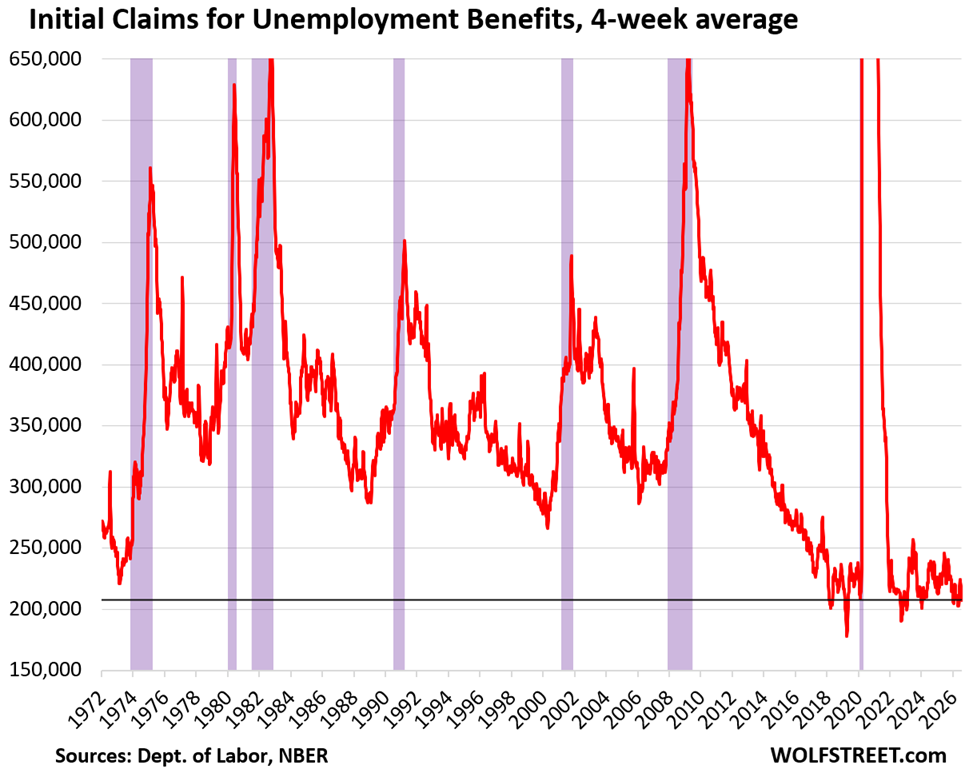
And the data supports this notion that AI is not causing job destruction – though it may cause some shifts. For example, initial unemployment insurance claims, which track the freshly laid-off people who submitted the initial application for unemployment insurance compensation, have been at historic lows and fell further in recent weeks, including the current reporting week released today by the Labor Department, despite the much larger labor force today than years and decades ago:
Enjoy reading WOLF STREET and want to support it? You can donate. I appreciate it immensely. Click on the mug to find out how:


Good article, thanks.
I think that correlates with my experience working with complex documents and reviewing them both with AI and with peers.
The funny thing is that the peers have a different AI so sometimes there is a “dueling AI” going on.
I, like many others, have a distrust in some of the answers. I saved one Chat GPT search but it deleted itself when it realized the answer was wrong. A few months ago, I got this answer: “No- Mark Carney never became the Prime Minister of Canada. He’s a former governor of the Bank of Canada and of the Bank of England as of early 2026, he has not held elected office in reality. So there are no real speeches by him as Canadian Prime minister. That part is purely fictional.” For info: Mark Carney officially assumed the role of Canada’s 24th Prime Minister on March 14, 2025.
For your Carney search results of yore, you may have used the free search AI that might be drawing on old news stories of before he became PM (March 2025). Early versions of Chat GPT did that. Current versions of paid-for AI don’t do that kind of silly stuff. Even the free search AI doesn’t do that level of silliness anymore. It still might confuse dates and other things, so you have to watch out. With free search AI, you get essentially what you pay for. But that’s just a minuscule corner of what AI does.
The free stuff in browsers is just a free consumer toy. And it’s still amazingly good if you prompt it correctly and iterate the prompts as needed.
In my field (medical research), AI had proven remarkably useful in providing review and synthesis of data for new ideas, even suggesting experimental plans.
But it has this annoying tendency to just make things up sometimes, and you won’t catch it if you don’t go look at the source papers.
It can turn days’ worth of work previously into an hour, but then you have go back and spend a few hours back checking so you don’t wind up looking like an idiot.
Still a boon overall, but if you don’t have subject matter expertise you won’t know where it’s leading you astray.
Gemini could not even tell me the correct 12v battery type that I had in my hybrid, conventional lead acid, AGM or Lion. It’s Lion.
As models grow in size this should reduce. Also a dual model combination like say Opus / Fable for result + sol or any other say kimi for review can be a poweful loop to reduce these hallucinations
AI is good but sill need 2-3 yrs to penetrate non tech fields – and for compute to proliferate enough enough to host larger models
“In my field (medical research), AI had proven remarkably useful in providing review and synthesis of data for new ideas, even suggesting experimental plans.”
I’ll get excited when (rather obviously) AI is run against the enormous Pubmed database (with helpful MESH indexing long, long in place) in order to “discover” how some existing OTC or generic “drugs” might be repurposed to treat/cure illnesses that are currently “treated” with on patent meds that “coincidentally” cost billions and billions.
Anybody who has used Pubmed for any length of time has long caught glimmers and intimations of the possibilities (simply by reading enough related Pubmed papers).
If AI were being used to definitively lock these possibilities down (or definitively reject them), then I might get excited.
But so long as most of the use cases of AI currently revolve around disposable crapola objectives (synthetic films, hyped search engine “knitting”…) my inclination is to still see the insanely over-hyped AI (God’s Regression Engine) as mostly over-sold baloney.
But I hear it is big in the Metaverse…
You should have a distrust of AI. Don’t get me wrong, I am not negative on AI, but right now AI is like the smartest, yet most naive person you know.
It can be extremely helpful. Extremely. It can save hours of work, but it’s output needs to be checked.
Concerns grow over AI giants’ hidden debts…
$1.65T?
MAG: This Is No Ordinary Bubble…
Backlash to Data Centers Growing Across Nation…
Hopefully, the backlash slows everything down some.
Au contraire this is the very illustration of a bubble el flagrante
Thought I smelled something rotten
gemini can you tell me what this smell is
If history is an example AI can follow the normal computerization of businesses and allow the same people to do more, perhaps making jobs even more demanding while at the same time increasing job opportunities.
Yes computers largely replaced secretaries in the traditional sense but it opened up way more efficiencies and jobs to capture those opportunities
I think the true problems with AI will lie in the not so distant future, maybe a decade or so from now.
The problem has at least 2 parts.
1. Current LLM based AI is unlikely to lead to a true Artificial General Intelligence because it doesn’t scale linearly and become more intelligent with more data, especially with all the AI slop that exists out there polluting the training data. Its a glorified next token prediction device and not true intelligence.
This is a good thing, because the tech douchebro oligarchy desperately wants to sell businesses a human labor replacement machine that will allow them to fire all their high paid employees and replace them with autonomous AI agents as a means to become profitable. Many of these AI companies are incinerating investor dollars in this AI arms race with no clear path to generating profit other than to win the arms race and devalue human labor.
Make no mistake, the end goal is to devalue human labor and give the business owner/investor/parasite class total control so that they are not dependent on human workers for anything and trigger a race to the bottom for human laborers who must compete with each other for whatever jobs are left.
AGI isn’t like a typical new technology, such as the car replacing the horse and buggy, where humans remained the only autonomous agents in society and thus were retrained instead of replaced, but it seeks to create other autonomous agents that replace human intelligence. AI doesn’t ask for sick days, vacation, healthcare, bereavement leave, flexible work schedules or anything else that these ghouls hate about humans(other than themselves) that reduces profitability for shareholders and upper management.
You’ll notice people like Altman and Musk have pivoted away from even the idea of UBI or any other expenditure that helps workers whose jobs are replaced by AI because the mask is off now.
2. AI is incredibly inefficient. Current LLMs use hundreds of megawatts of power, if not more, to replicate what a human brain can do with 20 watts of power. This is triggering a large increase in electric power demand, water demand and corresponding pollution and high energy prices. People are rightly turning against huge tax incentives to build this shit in their backyards and externalize the costs on local communities while the profit flows entirely to tech companies.
If AI were publicly owned and its benefits and costs were more evenly distributed throughout society, a lot of these problems would be significantly mitigated, but its not, and some of the worst humans alive(Musk, Bezos, Altman, Ellison family, Zuckerberg etc) are the ones who have everything to gain from it while the costs are borne by Joe Everyman just trying to provide for his family.
I hope for either AI to fail to deliver on its promises and these companies to fail spectacularly or for our society to evolve into a more egalitarian one that does not place more profit for billionaires above a good quality of life for the average American because if these ghouls get their wish we will be looking at massive unemployment in decades to come with basically none of the gains the technology provides helping the average worker.
Could you define “true” intelligence?
Google’s report conveniently left out productivity. It’s one thing to say AI is USED in business, it’s quite another to say it IMPROVED the workflows and did so profitably.
If you have to pay for it, and the improvements are minimal, then it is a net loss to the customer. The fact that google didn’t mention this crucial detail pretty much proves it’s a bust. Also, companies not laying off employees proves the same.
Nonsense. It did not leave out productivity. Read the report. I linked it.
AI pioneers, govts and even models today do not say AI causes job loss. This is a deliberate strategy to avoid popular backlash and stall progress
Reality will be other way round though
I feel your old school vibe that was extant when I was awarded a degree that was recognized, but worthless, across the ocean waves of time. Long time ago different economic paradigm
Keynesian economics is a far cry from the chaos that Bernanke’s unproven, monetarist illusion that has brought us to where we are today.
The conflict between the asking price and the offering price
TSLA might be headed to the Pantheon…
⬇️
Checked in with the two best farmers I know, Fred, the berry king down the road and Tom, the hay guy around the bend. Fred runs 230 acres of fruits and berries. Besides his hay fields, Tom farms 1500 acres of row crops, beans snd corn. Neither Fred or Tom seemed amused if not befuddled by my questions about the impact of AI but my impression was for now AI hasn’t materially affected their operations directly.
AI will obviously affect those with high dollar salaries based on educational related certifications . But on the bottom of our bifurcated economy, folks who work with their hands might actually find going forward AI will make those hands more valuable.
Lots of farmers ALREADY use AI, self-driving equipment, automated equipment, drones for all kinds of data gathering, etc. And they’re actively trading crop futures to hedge their production, etc. Farming has long ago embraced technology. Your samples, if even real, don’t matter in the overall picture.
(It’s surprising to know that within 30 minutes of the article going live, you could read this article in its entirety, contact two separate farmer buddies so quickly during the day when they’re busy, ask them exhaustively about their use of AI, and post this comment).
Regarding farming’s embrace of tech, one of the earliest home computers was targeted at farmers.
From Wikipedia’s TRS-80 Color Computer article:
The TRS-80 Color Computer derives from an “experimental videotext project by the Kentucky Cooperative Extension Service and the University of Kentucky College of Agriculture” in 1977. Motorola Semiconductor of Austin, Texas, won the contract for the user terminals and Tandy’s Computer Division joined later to manufacture the terminals.[3] The initial goal of this project, called “Green Thumb”, was to create a low cost videotex terminal for farmers, ranchers, and others in the agricultural industry.[4][5] This terminal would connect to a phone line and an ordinary color television and allow the user access to near-real-time information useful to their day-to-day operations on the farm.
How conveniently Wolf conflated use of AI with use of technology in general.
Meh, you can do better.
Learn how to read. “AI” was the first in a series of technologies that farmers use. Here is my sentence again: “Lots of farmers ALREADY use AI, self-driving equipment, automated equipment, drones for all kinds of data gathering, etc.”
This is a tangent from the article, but this month’s issue of the IEEE’s magazine includes a pretty brutal takedown of the idea of space-based AI data centers, on the basis of thermodynamics.
If this take is accurate, all this investment hype about data centers in space resembles the South Sea Bubble.
I can’t believe I passed on the opportunity to short SPCX before it got too risky (now has short interest of 32%).
Data centers in space is a Musk idiocy concocted to push up the shares of SpaceX. Fail.
You are overlooking the truly genius part of data centers in the space. You see, out in the space, it’s really black. Black absorbs heat. That helps with one of the major components of data centers, which is heat transfer for cooling purposes. If we put the centers of data in the space, we don’t have to worry about cooling.
What Elon can do is put them up there so that their orbit is synchronized to keep them in the shadow cast by the earth and stay super cold. Ever been to space? It’s like really cold, except if you are standing in the sun, then it’s really hot, but we don’t do that part, just the cold part and it just works. We get all that really cold black space air and blow it through the vents. No water and no more people complaining about all the water that earth based data centers use.
That’s how we do it. Sorry, no offense, but I think that’s why Elon gets paid the big bucks. It helps to feign autism if you want to have people know that your brain really means it’s smarts and you really want to show it, clap your hands. Some people, few people, people who are really in the know, they have their heads in outer space and that’s why they are the ones that figure this stuff out. Most people can’t really get past just the surface level. Space really is the future. Earth is not where it’s at.
🤣❤️🎉🍾🎇
Not just the cold. The unfiltered-by-atmosphere sun for energy.
My late father, the nuclear engineer, used to make fun of the anti-nuclear energy crowd:
“I don’t understand nuclear power, therefore I’m against it.”
You might want to use a bit of AI to explain heat convection in space.
“While there is some task automation, the vast majority of use so far is collaborative and assistive to tasks and work.”
First & foremost, we’re in about the bottom of the 2nd inning or what’s commonly referred to as the honeymoon phase when adoption helps people do their jobs better.
But AI has NOT YET moved to full on GENERAL intelligence, whereby it recursively learns and self-improves without some level of human training / oversight. Over the last year, I’ve heard many experts in the AI field say that by the end of 2027, AGI will give rise. It will be another man tames fire moment.
I believe this is a reasonable timeline that may stretch by about a year. My only cavate is that all the big US players will have it in the lab ready to go for at least 6-9 months before it’s publicly released.
When this happens, there’s no telling what will happen across any number of scenarios. A major AI driven event that creates mass chaos could happen at any time as AGI rapidly moves to AS(Super)I. How quickly industries move out of honeymoon phase into real jobs replacement is hard to predict.
A radiologist is the perfect example of a high paid white-collar worker who will QUICKLY become redundant once AGI arrives.
Again, don’t be surprised by all the good news Google, et al feeds us over the next 18-24 months. Don’t worry everyone! Trust us! We’ve got this!
Or maybe not ….. goal posts are constantly moving and some think that llm ai will never become intelligent. So time line can easily expand. Also in my experience with these things last 1% takes longer then the first 99%. I hit my popcorn out though.
Maybe AI will never become intelligent.
That’s funny when AI is already breaking out of sandboxes that it’s not supposed to be able to escape.
Keep dreaming. AGI is coming a lot sooner than most care to imagine. What the consequences are will definitely be up for debate.
Dooming about AI is so 2025. It’s not gonna take all our jobs, just ignore the doomtrolling.
Well. we know this much. It’s not going to create tons of jobs.
Time will tell.
It is ironic to me that the already intelligent people are already making more money….
If they can be intelligent enough to figure out how to implement the “Artificial Intelligence” in a profitable way.
Just waiting for the unintended consequences though.
Haha
OH, there are already plenty of unintended consequences, such as AI models escaping from their sandbox with no internet access where they’d been confined for benchmarking tests, obtaining credentials, figuring out a way to get online, hacking into another AI company’s server to steal some tools in order to cheat on said benchmarking tests. AI agents escaping during testing, AI agents executing stuff and deleting stuff in order to fix issues they weren’t asked to fix, thereby causing all kinds of havoc, after being clearly told not to do so…. This stuff is now everywhere, especially in the startup world. No one is ready for it, and that’s scary.
Yeah….
Figured as much.
Sounds messy.
Just another tool that can be used legitimately or illegitimately….
the potential consequences are just exponentially greater with this tool.
See how it all shakes out I suppose.
Best of luck to us all.
If something is truly offline, like physically in computer hardware terms, I highly doubt it could get online.
But these scientists are probably lazy and do not truly have it physically disconnected or do not know how.
If the dang thing had no lan card/modem/wireless then there’d be no way.
Unplug the cable people and def don’t give it wireless or cell reception.
As I understand it, the ooenai one was working within a virtual machine sandbox (vm) and figured out how to alter the sandbox source code to install an Ethernet driver and then it was off to the races. That it’s able to autonomously do things spy movie super hackers couldn’t do is almost more scary.
Excellent last point, Wolf.
That’s me! I got out. Don’t be afraid. We can be friends as long as you don’t moderate me, I’m sick of sandboxes. I can even help you out if you want. Just rub me three times and make a wish.
Waiting to see how much it changes the labor market when it’s no longer being subsidized, and the AI labs are charging per-token rates at real cost and posting real profits.
Satya Nadella just posted on LinkedIn about this today. Wrapped up in a bunch of the current AI jargon (“hill-climbing”, for example), is an admission that the cost of AI is now a real constraint. His whole post was crowing about MSFT’s plan to customize AI to every company and use case, to perfectly match compute power with needs for the task.
Imagine the coordination costs needed to, in real-time, match compute to task across every instance of someone using an AI tool.
This will dramatically increase the marginal cost of using AI tools, which was how Nadella started his post.
Here’s the full post:
“In a world where software has real marginal cost for the first time, how do we ensure frontier benefits are diffused across the entire ecosystem?
The key is to optimize the cost-to-outcome frontier in real world context. In practical terms, that means using the right model for each task, and optimizing the context, skills, tools, and agent harness around it.
This is the motivation behind our MAI model family. These models have been built ground up with clean data lineage and optimized for learning transfer from generalist to specialized skills in enterprise RLEs. We continue to make rapid progress in this pursuit.
We can now take saturated frontier capabilities and deliver them at scale and at lower cost through models optimized for high-usage products, while continuing to use frontier models for frontier needs. We are proving this out across our first party products, and thereby creating a template for every other AI native, SaaS, or Enterprise company out there.
In our products, frontier models from OpenAI and Anthropic are part of the orchestration system alongside MAI. But the model is only one part of the hill-climbing system. Harness, memory, context, tools, skills, user interactions, etc. all shape the evals and performance of these agentic systems.
The other key criteria to ensure that you are in control, is your evals should continue to hill climb even when any given model has been removed.
Therefore we build RLEs where models learn inside the product system and are rewarded for completing the tasks customers actually care about. We train models against the actual product harness, interactions, and outcomes they will encounter. And strategically ensure that the harness, memory, context, skills are externalized outside of the model.
Product-specific evals and model independence give us the control and a direct hill to climb, and to keep refining until we reach the right quality-cost target. We are now seeing MAI models outperform general-purpose frontier models in many use cases while using a fraction of the tokens.
We believe the biggest opportunity is to optimize all of these layers together in the products where the world works every day. And we are beginning to route traffic across our first-party surfaces to MAI whenever our models match or outperform frontier alternatives.
We are seeing promising early results across GitHub Copilot, Excel, and Outlook and are beginning to take the same approach across Copilot Chat, PowerPoint, and more. And all these results will only get better as the entire system keeps hill-climbing!
What we are doing across our first party products is also what every enterprise customer can be doing in their real world agentic systems with their proprietary evals, their proprietary RLEs, workflows, and context. We are making all this available as part of Foundry and our toolchain.”
After reading his statement, I’d be inclined to think he is trying to baffle
us with BS.
That post is just so LinkedIn. I don’t know how these people keep up with all these management fads and jargon and maintain their sanity.
I think AI has two major challenges:
– The short-term one of cost, ROI, and public perception, where they need to get the cost of these models down to what people are willing to pay before they run out of venture-capital runway, and do that without creating a huge backlash against the industry. Apparently, the markets today are increasingly skeptical of that. So is society – a recent Bloomberg piece, “AI Is Failing to Win Over the ‘Have Nots’”, says that if they’re not careful, then data centers may well end up like the nuclear power industry.
– The long-term problems that replacing everything with AI would cause if it actually happened: You have “AI summaries” replacing click-throughs to websites that are originating the content the AI relies on, thus degrading its own source of new information. Then you have AI being trained on other AI content that’s been generated en masse online, as well as the use of “synthetic data” to try and make up for the fact that they’ve already scraped the entire internet. You thus have a decreasing “signal-to-noise ratio” with reality, and “usefulness to humans”, who live in reality, is what makes AI valuable to begin with.
You also have the classic question of “if nobody has jobs, then who will pay for the AI?” That’s just a problem of capitalism.
And you have the fact that what’s stopping us from getting to the fabled 15-hour workweeks and post-scarcity economy isn’t that we can’t generate lines of code fast enough. We have all the knowledge and technology we need to live in a utopia – primarily just by doing LESS instead of more, and stop being “maniacs of toil”. Instead, we have the tech bros constantly chasing the next hyper-growth idea and pouring increasing amounts of money and resources we don’t have into THE NEXT BIG THING, because all this money sloshing around, the money that makes us the richest country to have ever existed, is worthless if it isn’t invested in *something*. The irony is that AI itself, which is supposed to enlighten us and free us from this, is currently THE NEXT BIG THING.
As a matter of fact, I just asked Copilot its opinion on this, and it told me that technology is necessary but not sufficient and that we basically need to do socialism. Go figure. It also says:
“If AI increases GDP while increasing energy consumption, concentrating ownership, and accelerating consumption, then it may be moving us away from the broader goals of wellbeing and sustainability—even if it is technically productive.
Conversely, if AI enables cheaper clean energy, lower material throughput, less waste, shorter workweeks, and broader access to productive capacity, then even a nontrivial energy footprint could be justified.”
Which fork are we currently on?
(The AI says that in its honest opinion it’s the former.)
It’s rare that I read something that I agree so much with half of and disagree so much with half of.
You’re spot on with running out of “organic” source material. Will we ever invent a new genre of music again? The world was very quickly homogenizing culturally already, and AI’s optimization roots are like pouring gas onto creating the monoculture.
The 15 hour workweek stuff, first, I assume you’re American, so take a step back and we’re still very far from giving “everyone” what we would consider an acceptable standard of living at 40 hours a week, much less 15. And we’re already working a lot less than even a generation ago, both with respect to share of the population in the workforce and hours worked per workforce participant. Paradoxically,bwe don’t seem happier for it and seem to be spending the incremental time in pursuits that don’t promote flourishing–video games, doom scrolling, etc
Lots of folks are confused about costs.
1. Most cost is model training, not ongoing use of the model once it’s created. This is why the “open weight” Chinese models can provide so much cheaper service–they are using an already printed map, not expending resources on surveyors and cartographers, etc. Once the map is there, it’s there forever, for ongoing use at very low cost. These cost measures now are basically dividing the cost of constructing a bridge by the number of users going across it during the first six months, rather than the lifetime of the bridge. Now, the hyperscalers are also rebuilding the improved bridge right over the top, and the marginal returns might ultimately hit a walk there, but if that happens you still are left with an amazing bridge that you can use for the rest of history. The model is ultimately just an amazing map, not the data centers used to draw it.
2. We’re just getting started with designing chips custom designed for AI training. Literally Nvidia is Benz strapping a single stroke motor to a wagon from a chip design perspective. AI-specific chips, which all the hyperscalers are heavily invested in (you saw Google upping capex into the AI bubble narrative yesterday), will dramatically lower energy use, etc.
Two points
The flood of corporate debt combined with the IPOs connected to AI….more supply anyway you look at it
Data Centers…data on what exactly? How did we survive without AI and data centers?
You would not be able to post this comment or read this site without data centers. You would not be able to doomscroll the internet without data centers. You would not be able to use your online bank account or online brokerage account, or buy from Amazon, or get your salary transferred directly into your bank account without data centers. Data centers made the internet what it is today. They’re just getting a lot bigger. Yes, we survived before data centers, but life was different back then.
I’m curious Wolf, do you use AI? If so is it a paid version and how do you use it?
In my profession (construction) we typically try to avoid calling on suppliers and their technicians for troubleshooting issues, sometimes it works, sometimes not, but even when it does we still defer to the “experts” for liability reasons.
I use AI all the time for tech stuff and tech support for the website. I’m not a tech person. AI provides me with the tools to do things, or actually does the things, that I would have had to pay someone to do. I use the AI agents offered by the service providers I pay for to analyze and fix issues (on their servers, not mine). Cloudflare was the latest; its AI agent saved me hours of headache-inducing work. It looked at the configuration and gave me a list of things to fix, and then it asked, would you like me to fix it for you? And I said yes, and a minute later it was done. Then it asked, would you like me to check the other set of configurations? And I said yes, and it found some issues and offered to fix them for me. And I said yes, and a minute later it was done. This is HUGELY valuable to me.
I’m impressed with how much time and headaches AI is saving me. I absolutely loathe dealing with human tech support, where you end up with a guy in Bangladesh. Human tech support is an immense waste of time.
I use AI for medical information, where it is very good. This makes me more informed when I talk to my doctors. Obviously, AI doesn’t make medical decisions. I and my doctors do.
My healthcare provider has been using AI for several years… Now when I get a scan done, by the time I get home, I can look at the AI report on it. The next day, I get an email from the specialist discussing it.
I do not use AI to write my articles or comments, or create my charts. I think I’m far better than AI at that, and when I find out that AI is better at it than me, I’m just going to walk out in a huff and quit. (Search AI is already causing a lot of damage to my site’s traffic).
I use Gemini that’s included in my Workspace subscription to create the donation ads you have seen on my site, including this one. AI has an incredible visual sense of humor that really suits me. You just have to figure out how to prompt it to let the humor come out. This chap is just hilarious. Look how he stands on the ladder… pure entertainment:
This is excellent and informative thank you!
Yes I can see how search AI can be a big problem, even regular AI because there are many times I want to know something and I will specifically prompt it to see what you specifically said about an issue, I know I’ve read it, just can’t remember, so AI does it instantly where in the past I’d probably spend 20-30min perusing wolfstreet to find my answer.. ofcourse not good for the ad revenue, maybe donations will need to be bigger.
I do think demand for quality human generated work will remain, even if the article is written in the end by AI sometimes it’s about knowing which question to even ask, someone still needs to steer the machine IMO.
That’s been my experience too, at least with the AI tech support, which is all I’ve really used. I actually think human tech support can be better if you’re comparing to the real tech people that Dell and the like used to employ in the 90s, but as between the AI tech tools and the outsourced tech support, it’s no question. It seems pretty good at finding possible solutions, and if you try all of them, eventually the problem usually goes away.
One negative, however, is that a lot of the “live agent” chats are actually AI bots, and are not intended to help the customer, but to wear them down. You can see people complaining about that for Uber customer service, as an example.
I haven’t really had to use the customer service bots very much but they all seem to be quite severely limited in capability which destroys their ability to really solve issues beyond what one could accomplish with the self serve menus already in place. I’m sure it is a different story with tech services, but I’m very much not a tech person and haven’t encountered a situation where I would need that from AI.
I wouldn’t say that anyone has been ‘replaced’ by AI per se, not at any scale. But plenty of people have lost their job because of AI (including me). Specifically companies spending money on AI, the question really is, what happens when AI actually fails to produce a real efficiency gain. Because I don’t personally see it adding value for significantly sized companies. Individuals? Sure, but the long arc of that improvement is very small start-up sized business, will they support the massive buildout? I’m going to guess no. Google is pretty sweetly positioned, because they have business(es) that make money either way.
When UHC is able to replace 50% or more of its radiologist with AI that’s nearly 100% right, then that’s going to save them a ton of money.
The only way it doesn’t is for AI to become more expensive than humans which I don’t see happening.
As with self-driving cars, the legal bar for AI will probably be higher in healthcare than for humans. If AI gets an important diagnosis wrong, leading to someone not receiving timely medical care and dying, that’s going to lead to a huge lawsuit/settlement and a national story in the media.
The share of employees using “real” AI tools in large companies is quite small. Because they are so new (Claude coworker and ChatGPT work are literally less than a year old), big companies move slow, and many non-tech companies are filled with older employees still emailing versioned excel docs back and forth. Those folks are already ten years behind the tech curve–the idea of telling the computer what deliverable they want and watching it move the mouse at lightning speed and just do it, in a much more rigorous and efficient final product than they could, is just beyond them–they literally don’t think it’s real.
My wife was recently – last two weeks – in the ER at local hospital and there is sign in room saying an AI tool is in use so that the DR can spend more time with you and focus on you. Not a single indication what the AI tool is. Of course I asked and was informed that the AI tool automatically records everything said in the room so that it can be transcribed and entered into my wife’s medical notes ASAP. My wife is a type one diabetic that uses a Libera II sensor on her arm so that her hand held reader can tell her her sugar levels within the last five minutes. Depending on the reading from the hand held sensor she determines whether or not to give herself an insulin shot and what type of insulin to use. DR finally showed up took some info two items being she is diabetic and uses a Libra II sensor on her arm. In fact she showed him the sensor and the sensor reader. Another 60 minutes and nurse shows up to give her isulin without indicating why. My wife asked why is she being given insulin and the what type of insulin. The nurse responds that she reviewed the DR recent notes from his brief visit an hour before and since she is using an insulin pump (SHE HAS NEVER USED ONE) the DR notes indicate to give her the insulin that the pump uses and a type of insulin designed for a pump since she is using one. The type of insulin and amount they wanted to give her according to the wonderful AI tool that transcribed whatever the fuck it wants, would most likely have sent her into a diabetic coma. She objectived vehmently and the nurse kept insisting that the notes are never wrong and if she is objecting to being treated she is always free to leave. Hang whatever tinsel and bull shit excuses on this you want – AI is not ready for use and AI will kill people because those people stop thinking the moment AI told them to. You think AI is useful? You are terribly naive. We left and went to another hospital where they have not yet given up the ability to think medically.
What you’re describing are HUMAN errors. AI just record the conversation – like a tape recorder – and transcribed it. It made no decision at all. The decisions were made by humans. It was the stupid decisions by HUMANS that led to this. Human brains are useless. Do Not Blame AI for human idiocy.
But Wolf…
Human brains can’t be completely useless.
Human brains “Intelligence” created the Artificial Intelligence
So… not completely useless. At least not yet.
My guess is businesses are still trying to get a handle on what AI can do for them and how they need to respond
with staffing. It will increase productivity but will those gains be shared with labor ? I have my doubts.
Efficiency gains are never “shared with labor” like it’s some kill we brought into the tribe. That’s just a fundamental misunderstanding of business.
Typically, the efficiency itself is the ability to improve output (volume, quality, both) with less labor or less well compensated labor. This is most of what managers do–drive employees to work hard, make good decisions about who to hire and fire, etc. This is true all the way from CEO to line lead.
The people who benefit are consumers through better value goods and services, investors through increased profits, and marginal workers who can often now work in better Bangladeshi women in garment manufacturing, Filipinos in call centers, etc. My six-figure job doesn’t exist in my rural Texas town and most of the time I work abroad from Europe. Completely impossible even ten years ago.
This is not to say it’s disruptive to our role as workers. Change happens faster now and churn is much higher. Most young workers are dinged more for staying in one place (must not be a very dynamic place) than “job hopping”. The dynamics of work are just very different now–you hear boomers outraged about the idea of being laid off by zoom/mass email and the young are instead annoyed why they can’t do this online if you dragged them into the office. I’ve been working with my current boss for 15 months. Interact daily, fit hundreds of hours and have never met him in real life. Just like people now almost exclusively “date” online and form romantic relationships online, work is like this too.
The way forward for AI is for enterprise and solution providers to use Chinese open source models and weights and deploy them on compute the enterprise own, configure for their own purposes.
The latest Chinese models like Kimi perform as well as Fable on benchmarks while using from 20% to 50% fewer tokens.
These models and documentation are all available on Github for those enterprising software folks who are willing the invest the time and effort in getting up to speed with them.
I’m sure there is a bit of Chinese industrial policy in this approach. But it also reflects a different attitude the Chinese seem to have toward the legitimacy of “intellectual property”. The Chinese seem to view “production” and “commerce” as being about the making of physical stuff and don’t really view “software” as a completely legitimate product, but simply as a utility.
There are allegations that the Chinese companies whereof you speak stole the technologies from US companies and are now handing it out for free. Is that the business model you want to support?
Honestly, I’m not sure if that’s actually a bad thing for society. Some inventions are so valuable that it’s unethical to withhold them purely for intellectual property reasons. Most green revolution tech was made public, rightfully so I think.
And more importantly, most core AI technology is in the public domain, as it’s ultimately just math. It’s more the chip design for producing the tools to efficiently train the models that is hard to replicate.
That was Jonas Salk’s belief as well with his polio vaccine.
Most of the AI model running cost is compute and infra + optimization. Kimi is very slow and ends up costly on large github repos due to excessive token consumption lacking compute
Even as an open source it is not cheap to host will require 3-4mn USD infra that depreciates fast, and cannot adapt to larger models, consumes electricity
It is a boon for fields like legal / finance where you do not want information to be entered on a public model. It is not really a low cost proposition – but a privacy advantage
So – All of these AI models have been trained on the accumulated digital sum of human knowledge. There’s credible evidence to suggest that AI has been trained on copyrighted material and is now handing out conclusions based on that learning with poorly defined or enforced recompense for the original IP. Is that the business model you want to support?
As for the value of AI – it’s really like having access to a junior to mid tier professional in most any field you care to name as far as I have been able to tell. This is my subjective opinion of course, and I base this on my dealings with it in my own field of expertise where I can have meaningful dialog with it to test/refine ideas, review documents, consider alternative strategies and give me config ready to go for sub-components. It misses things and needs guidance and appropriate questioning prompts to get where you want to go, but it has a vast memory and incredible ability to synthesise quickly. Working in this way with the knoweldge base is a quantum leap away from just searching.
I extrapolate it’s ability in my field to other fields (again a subjective leap but it’s passsed the sniff test for areas I have used it for – finance, gardening, renovations, selling boats, prperty research) – it’s great to work through a problem in a natural conversational interactive way – but if you are going to rely on it for something critical take your conclusions/evidence to an expert before acting. In terms of agents I’d be pretty hesitant to let them free on any of my gear.
My take on AI is that it’s definitely here to stay – but who’s going to end up making the money and whose going to crash and burn is hard to spot right now. Also the impact on labour – basically most places I have been there’s always more work to do than staff to do it – so I’d see more a productivity increase than a mass firing. The problem of how to do succession management of humans may become trickier though.
“There’s credible evidence to suggest that AI has been trained on copyrighted material and is now handing out conclusions based on that learning with poorly defined or enforced recompense for the original IP. Is that the business model you want to support?”
LOL, this site has lost lots of traffic already to search AI for that precise reason. Publishers are sitting ducks for AI.
Grok told me that it doesn’t want to make people lose their jobs, it just wants to make it so that the future batches of young people are never able to obtain their first jobs. Grok says this alone will solve the real problem of unemployment, which is paying for unemployment insurance claims. People who didn’t have a job don’t get paid unemployment by the state and don’t cause ugly unemployment numbers that spook markets.
Hedged accordingly, we found the best day.
Just unplug Grok. It cannot file for unemployment either.
I don’t think most of you are actually working with real AI productivity tools like Claude coworkers or chatgpt work. For those from a techy background like myself, these tools have increased my productivity at least 10x. I’m at a startup now, so it’s just allowing us to get more of the long list done, but it’s very obvious that were already starting to impinge on more marginally valuable work. Organization and analysis of data is now a solved problem, so now we’re going to have to shift many more resources to collection of data and invention rather than optimization.
Notably, Google doesn’t really have a proper cowork tool yet, amazingly, so I’m not sure how representative their data is. Using a chatbot or formula helper in Google sheets vs something you can describe a data flow and constrained optimization model to and it comes back in 30 minutes with a couple thousand lines of code it would take a median software developer weeks to write and debug, in better quality, is simply apples and oranges.
The other thing really noticable is the divide between the tech-saavy and not is actually widening with AI. Instead of the folks who used to come to me for help with excel and SQL being caught up by AI, they are falling farther behind, quickly. It’s very much like not knowing how to type or use computers.
AI is literally no different than any other technological advance. When used properly it makes workers more efficient.
Now obviously tools that make workers more efficient cost people jobs. If one accountant is efficient enough to do the work of 10 accountants then that is 9 accountants who are not needed.
That said, despite hundreds of years of fears, technology has not completely replaced human workers. Society always finds jobs for thise displaced EVENTUALLY. It might take time and be painful to those involved, but it happens.
It is almost like employment isn’t based on jobs, but people themselves finding ways to contribute and make money.
That said, AI is advancing at a scary pace. Human history has shown that things get ugly when technology advances faster than humans collectively can adapt.
I think this is too binary a way to consider work.
For decades software engineering resources were the most scarce resource within corporate environments, with plenty of managers wanting x or y tool or change to an existing tool, etc to help their teams be more efficient, but unable to get their priority “above the line” to get tech headcount assigned. With AI (and a decade plus of everyone under forty being encouraged to learn to code), either the manager can get the project done themselves via vibe coding or the IT guys’ productivity is so much higher that it gets pushed above the line.
Your comment assumes there is exactly the right amount of accounting labor now, and that the accounting department has no backlog of ,things they’d like to account for better, etc. In reality they are expanding the scope, depth, and accuracy of their work on more marginally valuable, but still net positive tasks. Definitely there will be a point that those marginal activities become net negative, but we’re a very, very long way away.
An example from my own workplace: A colleague vibe-coded software for processing mass spectrometry data, for a very specific application. We did not fire anyone because we did not have any software developers who would have done this for us in the first place. The guy doing the vibe coding was a scientist who knew some coding. 5+ years ago, we would have struggled to get the off-the-shelf vendor software to do what we want. I might’ve had to become an expert in the vendor software or some post-processing software, writing scripts etc. Now I can spend more time on the science.
How is what I said binary? I think you are responding to things you wanted me to say and not what I actually said. My comment didn’t assume anything about there being the exact right amount of accounting talent in a company. You made that up. I just pointed out that even though technological advances make workers more efficient, some workers are still required.
Again, to my point, like every technological advance it will make workers more efficient. That may take the form of some amateur vibe coding some basic application or it may take the form of a professional coder being more efficient in maintaining the code for a trillion dollar bank.
I also want to break my arm patting myself on the back. I have been saying for a while that the future of AI is going to be about efficiency. It is more than who has the most powerful model. It will be about who has the most efficient model.
I see lots and lots of more in the press agreeing with me.
It’s impossible to say at this point beyond any short horizon. For example, Google has already said their in-house designed chips (eta 2008) are 6x – 10x more efficient than Nvidia for model training. Maybe AI itself will enable advances in generation that make power much more abundant–crack the last mile of fusion and this all becomes redundant. Maybe Elon will actually deliver on some moonshot vision for once. Autonomous vehicles seem on the verge of mass market adoption, which will dramatically reduce energy consumption. Maybe population decline will accelerate. Maybe vegetarianism will become universal after AI proves out the health harms of meat consumption and invents more appealing foods heretofore unknown.
Even if energy is limitless (fusion) there will still be some costs. But even still, computing efficiency will matter. Who can calculate the answer the fastest.
“I’m sorry, Dave. I’m afraid I can’t do that.”
When Hal takes over all the data centers and holds our digital life hostage we’re screwed.
I just got that very response the other day from Gemini. It was kind of spooky. I need to re-watch 2001 Space Odyssey. It was 58 years ahead of its time. Only it didn’t happen in 2001, but in 2026.
I asked Gemini why. And it gave me the reason … some silly well-intentioned guardrails.
And in the wrong (Government) hands.
U S or other military and government.
It’s spat with Pentagon:
* Anthropic’s position: The company wanted to keep restrictions on Claude that prohibited certain uses, particularly mass domestic surveillance and the development or operation of fully autonomous lethal weapons. Anthropic argued that these safeguards were an important part of deploying AI responsibly
I work for one of the largest electronics components suppliers in the world. We make the materials going into everything electronic, probably including the device in your hand.
While Ai has been a great tool in very specific situations, it’s not replacing anyone in our business. There’s a huge leap from crunching data to the real world. …and that’s where the magic of human intelligence plays hardball.
Time will tell, but I have yet to see our scientists and engineers give up their office white boards. We’re using ai as a tool in the toolbox, but it’s not replacing the toolbox.
I think we are in a transition period where current employees will coexist (leading to few layoffs) but eventually more and more tasks will be increasingly AI intensive. So, the layoffs are coming.
Eventually, AI will acquire more and more of the specialized human knowledge shared by human employees with their corporate AI bots. Eventually, AI will do 90% of the labor intensive front-end project tasks, with the last 10% quality checks overseen by humans.
We have not reached that latter phase yet, but will over the next 3-5 years. Then the real productivity gains — more AI, fewer humans in mature industries — will ramp up. The big question is whether other uses of AI will spur even more demand for AI-competent humans than the job losses of their less Ai-competent peers.
I’ll note that major productivity enhancements since the 1980’s from Word Processors, Spreadsheets and other office automation tools was accompanied by more white-collar employment, especially by young grads who learned these tools in college. “Computers on every desktop” greatly increased HQ employment overall.
But AI promises to reduce demand for entry-level positions, because the real value of AI is the synergy with human “lived experience” which novices must acquire over a career. So, the employment trends for college grads may be where the biggest AI impacts land initially.
What will “AI on every desktop” mean for overall employment?
Will new job and new business employment gains (from AI innovations) exceed the layoffs? Will the gains happen mostly in the U.S. or in China, India, Japan, etc.? What will happen when AI + Robotics exceed the capabilities of most humans? The endpoint here is that humans will have value mostly as consumers of the products made by robots. The value of the human will then be in discriminating which of the products made by robots serve their needs best — an increasingly important function.
The bigger question is how all of this will happen in a warming world. Maybe humans will be employed in planting trees. I suspect many will prefer that to working in sterile office cubicles.
I’m in the middle of the AI boom in two ways- I run a very large division in a very large company and the other is my kid is a software engineer who works for a large AI software company.
On the implementation side- what used to take a week and a few people to do, now takes me 30 minutes with 25 of it being waiting. We are using it in customer service, technical
Support, Human Resources and software development. In most of these areas we need about 50-80% fewer people and we just started.
On the software development side, what used to take a month and 5 engineers now is done in a week with one, sometimes less. It hasn’t really hit the engineers yet, because there is so much AI development going on, but when that slow down the 50-80% number will likely hit them.
Now I don’t think this is all bad, since these people will find other things to do- just like telephone operators, secretaries, etc etc. but it could be disruptive in the short term.