
Promising another morose summer in the housing market.
By Wolf Richter for WOLF STREET.
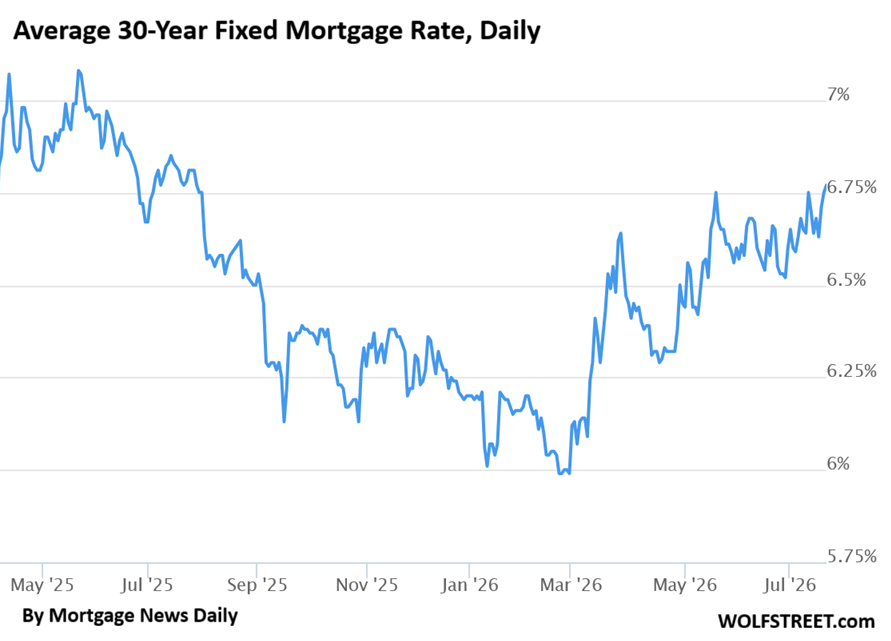
The average 30-year fixed mortgage rate rose to 6.77% today, the highest in a year, and a hair above the highs earlier in July and May, and up by nearly 80 basis points from the February low, per the daily measure by Mortgage News Daily.
Last fall there was talk that this was going to be the spring and summer when mortgage rates would drop below 5% again, and all this “pent-up demand” would be unleashed, and the housing market would shoot to the moon or whatever.
But reality is that inflation is high, and in “real” terms – adjusted for inflation – mortgage rates are fairly low, and so this is it, and sales of existing homes continued to scrape along the bottom.
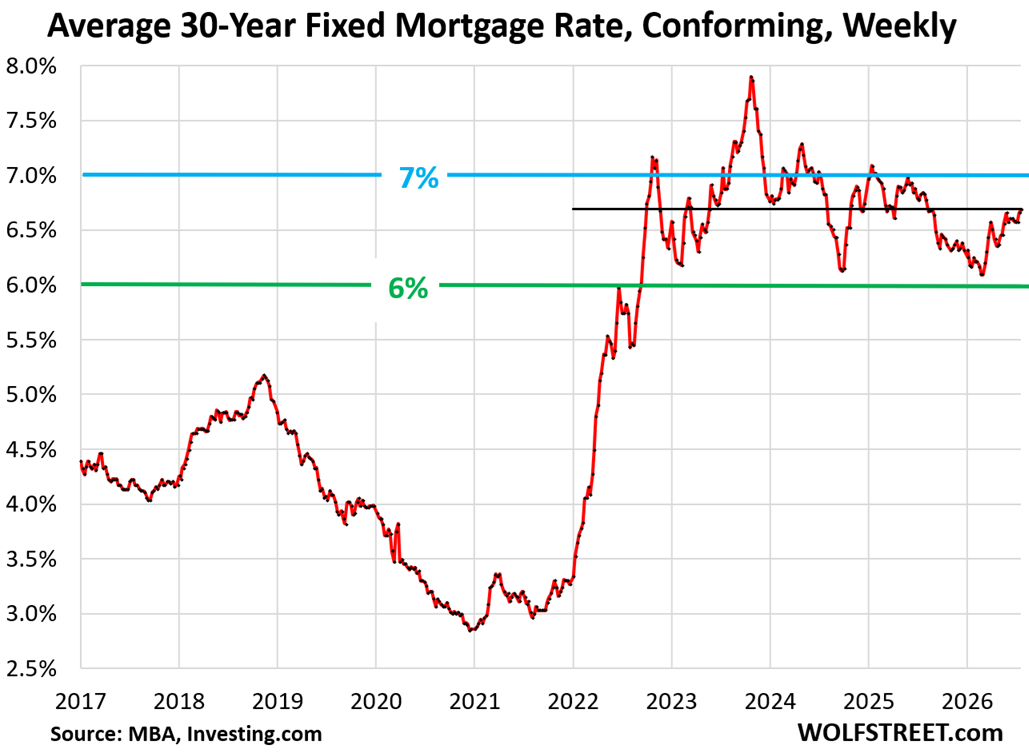
The average weekly mortgage rate in the latest reporting week for conforming 30-year fixed mortgages, released today by the Mortgage Bankers Association, rose to 6.69%, the highest since August last year.
This measure of the average 30-year fixed mortgage rate has been in the 6% to 7% range since September 2022, except for some breakouts to the upside.
The 30-year fixed mortgage rate tracks long-term Treasury yields, such as the 10-year Treasury yield, but is higher, and that spread between them varies over time. And those long-term Treasury yields don’t follow the Fed’s short-term policy rates but are motivated by fears of inflation, which destroys the purchasing power of bonds, and by fears of an onslaught of new debt needed to fund the ballooning government deficits. And those bond-market fears flow through to mortgage rates.
So the 30-year fixed mortgage rate may go into the opposite direction of the Fed’s policy rates when the Fed cuts interest rates despite re-accelerating inflation – see the fall of 2024 when the Fed cut by 100 basis points, signaling to the long-term Treasury market that it will let inflation run hotter, and mortgage rates, following the frazzled Treasury yields, jumped by 100 basis points. And the spread between the Fed’s policy rates and mortgage rates widened by 200 basis points. That was an evil surprise for lots of people, especially in real estate.
To get mortgage rates down, the Fed must be hawkish and inflation must be low and it must stay low. And those three conditions are currently not met and may never be met.
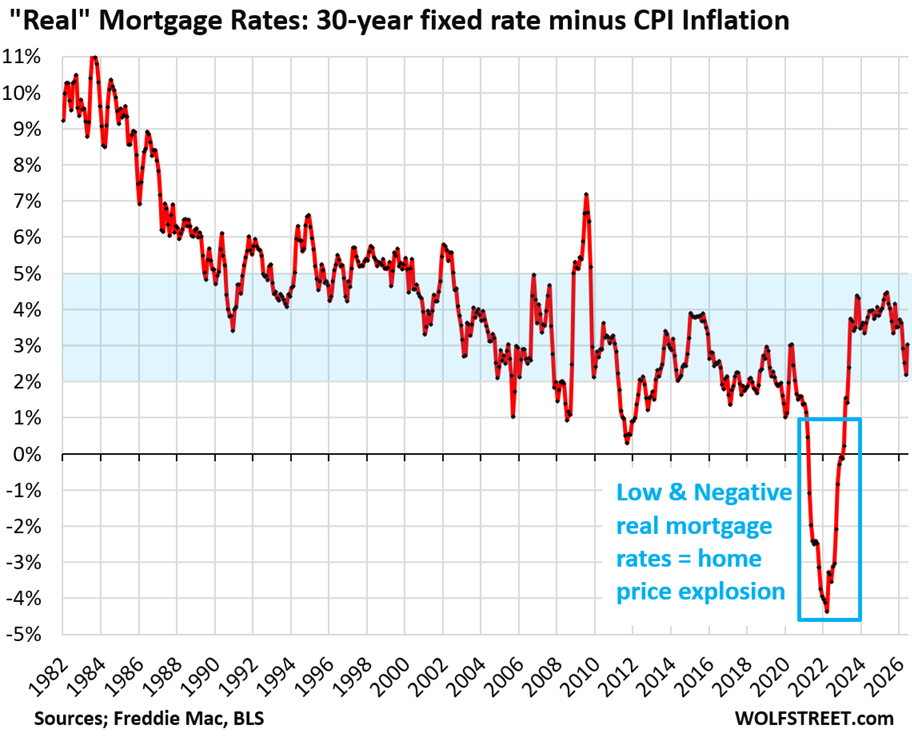
“Real” mortgage rates are not high. With inflation currently in the 3.5% to 4% range, the “real” 30-year fixed mortgage rate (mortgage rate minus inflation rate) is only at about 3%, which is relatively low compared to the periods before 2009, before the Fed’s QE began forcing down long-term interest rates with trillions of dollars of purchases of Treasury securities and Mortgage-Backed Securities.
In 2021, the Fed’s QE repressed mortgage rates below 3% while inflation had begun to surge, leading to deeply negative “real” mortgage rates that triggered the worst home-price explosion in history.
Those too-high home prices are now the hangover that the housing market is suffering from – not the normal-ish mortgage rates. And that inflation has refused to go back into the bottle, and has been rising since mid-2025, which has pushed “real” mortgage rates down since then, even though nominal mortgage rates have risen.

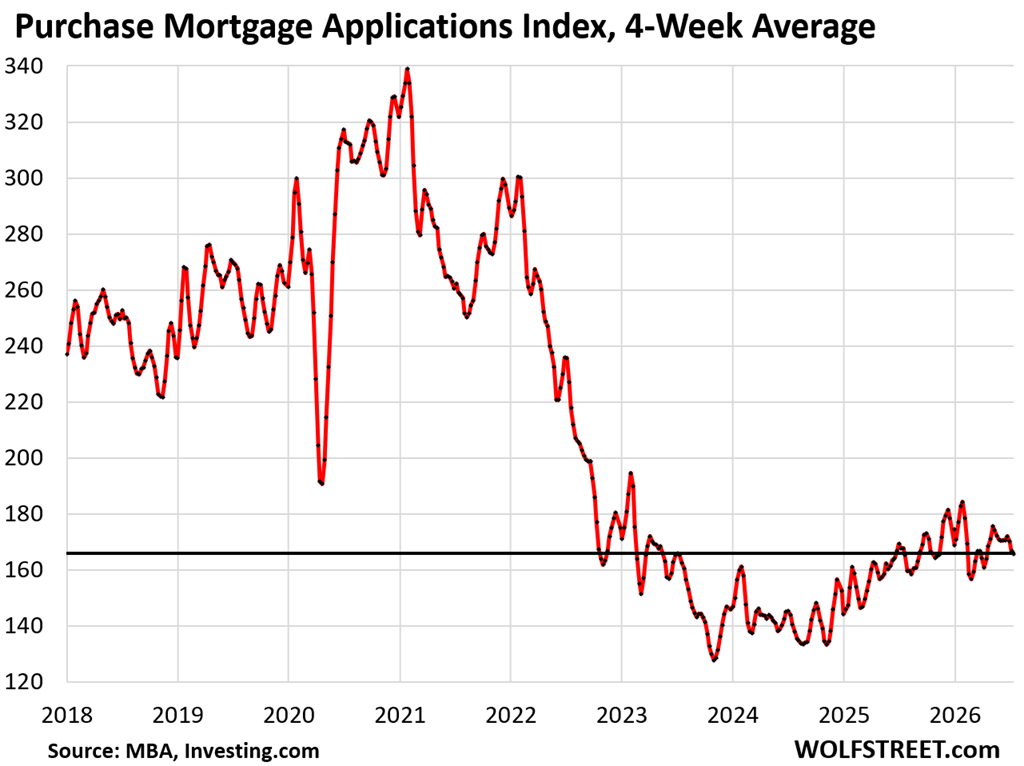
Applications for mortgages to purchase a home – a forward-looking indicator of home sales – have been scraping along the bottom all year. In the latest week, they ticked up a little, but the four-week average, which irons out some of the weekly squiggles, fell for the third week in a row, according to data by the Mortgage Bankers Association today. The weekly measure was roughly unchanged from a year ago, and down by 36% from the same period in 2019.
Applications for mortgages to refinance a home are in an inverse relationship with mortgage rates: They fall when mortgage rates rise and rise when mortgage rates fall.
In the latest week, refinance mortgage applications (red) were down by 55% from the same week in 2019 and by 75% from the same week in 2021, as mortgage rates (blue) have risen.
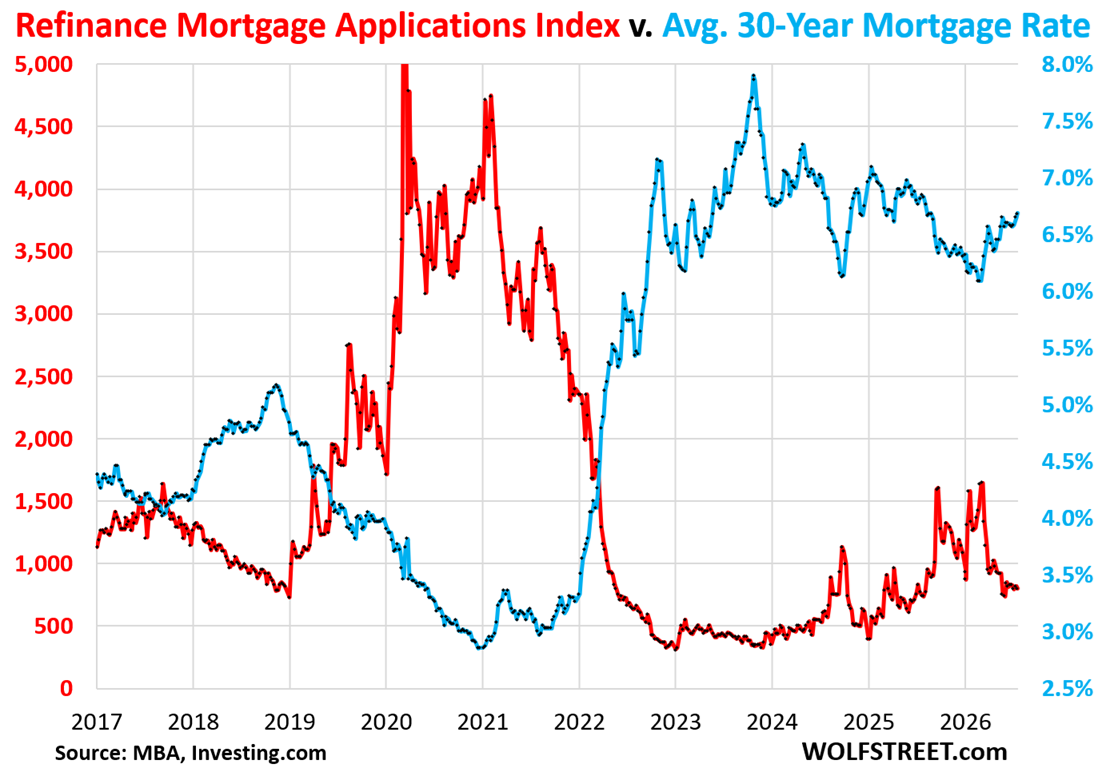
Refinance mortgages have no impact on home sales per se, but were the promised land for homebuyers over the past few years who fell for the real-estate hype, “Date the rate, marry the house,” and then found out they actually married the high price, and married the rate too, and now they’re having to support both.
But some refis are still happening for a variety of reasons, including cash-out refis though a lot of the cash-out demand has shifted to Home Equity Lines of Credit, and the use of HELOCs has surged.
In case you missed it: Home Prices in 33 Big Expensive Cities in America: 25 Fell Year-over-Year in June, 2 Rose to New Highs
Enjoy reading WOLF STREET and want to support it? You can donate. I appreciate it immensely. Click on the mug to find out how:


My only surprise is that it’s not even higher considering how lax the Fed has acted lately.
Agreed. They’ve known for 2-3 years that inflation was not broken. Then Powell creates / perpetuates the ample reserves justification that says the Fed can’t let its balance sheet go below ~ $6.2T, so they’re now doing IMHO stealth QE by buying treasury bills. M2 is zooming higher instead of falling like it should be.
I kind of hoping that there will be a big issue with private credit by the end of the year. It will be interesting as to what new backstop the Fed creates to ensure nobody takes haircuts except the stockholders.
excellent – I loves owner carrybacks
make money 3 times
on buy, then sale, then interest
all inside ROTH IRA
yum yum
“so they’re now doing IMHO stealth QE by buying treasury bills.”
Uh huh, and where have they shifted the majority of their funding since 2020? Remember how the republicrats were criticizing yellen for doing that and then changed absolutely nothing? We’ve had no recovery since 2008. Just printing.
Money printing and government deficits are FISCAL policy made by our favorite politicians.
The Fed does not get to choose to print money to fund the government, the politicians do. Their paid social media influencers then deflect the blame from the politicians to a hapless scapegoat – the Fed – and tens of millions of people believe it because the influencers seem so “authentic”.
The Fed’s balance sheet was inflated when voters and politicians demanded that the government do something to improve the economy and stop deflation, and so they did QE, flooding the economy with stimulus. Now everybody is blaming their own choices and accepting the scapegoating argument being promoted on social media algos.
The risk is that we one day actually elect one of these “abolish the Fed” politicians who drinks their own kool aid. Then we’ll get to experience monetary policy as it was in the 1930s.
The voter unanimously said no to bailouts in 2008. So I disagree with your comment.
“I was there, Gandalf. I was there 3000 years ago when Isildur took the Ring. I was there the day the strength of men failed.”
“stop deflation”
Not one single normie voter chose “stop deflation” as a reason to vote for a pol, ever- normie voters think/know that decreases in prices over time are a *good* thing for the vast majority of Americans.
Since 2000, *deflation* has been a hobgoblin of the political class’ invention to justify their own completely friggin’ relentless deficit spending – and to prop up the highly leveraged ZIRP speculator class that buys off said political class.
That real rates crater below 0% in 2022/23 is crazy! That one chart perfectly explains why the housing market is so screwed up.
I don’t believe anyone, Warsh or otherwise, from the Fed who say the Fed should or will never buy MBS again.
At the time, sub 3% mortgage rates, all of the mortgage / rent relief & the stimi checks were such a massive over reaction that it boggles the mind looking back on it all.
There’s now the better part of two generations that cannot afford to buy a home for the foreseeable future.
Higher for longer. Bring it on, baby!
Agree, looking back and even in the moment, it was a complete overreaction. I remember getting the third check, and I knew inflation was going to get really bad. Also remember the NFTs were getting their time in the sun.
I do disagree with your last statement. Americans are very adaptable. Some people will have to accept that a “home” =/= single family detached property. A home can be a SFR or a townhouse or a condo or a multifamily.
That culture will be a massive blow to the real estate industry and create a low of disinflation for all properties. Add to that jobs/homes/third places will be closer together; some American families will drop the 1k plus car payments and maybe only need 1 car.
That will only expedite economic decline overall.
Outlook not good for younger generations. At some point, inter-generational transfers of wealth will also subside.
Let me ask, why use a term like ” socialist”, when it doesn’t define the candidate?
Which candidates?
AOC, for example?
Fun with semantics!
Are you saying nobody will want the spacious macmansions with 20-40 year outdated trim and decor, and old carpet, which sell for a premium on the coasts?
“Some people will have to accept that a “home” =/= single family detached property”
Yes. And the “winners” of the current generation of young people will probably be the ones who pay half or a third as much for housing by renting, by staying mobile to pursue job opportunities anywhere, and by staying out of debt. This involves rejecting the boomer-era values of lawns, giant detached houses full of decorations, and BBQ grills in favor of high savings rates and economic agility. Instead of shopping for lawnmowers, young people (and arguably many old people) should be shopping for apartment roommates.
Yes. The problem is that they assumed that all of the potential problem areas, like work from home, lack of travel would spill over into the larger economy, so they poured money into every aspect to make sure that wouldn’t happen. But in the end, they dumped $6 trillion into an economy to replace $1.4 trillion (I think that’s what I read the numbers were) in lost output. Inflation was inevitable.
The worst part is that there are STILL people who say that it was the right move and “some inflation is a small price to pay for the fast recovery we had.”
These people are sick.
National Emergencies create distortions
No. National emergencies create need for additional work and sacrifice, not monetary distortions.
There is no magic monetary wand.
The asset inflation started way before the pandemic. Think of how long ZIRP policies were in action. Its been a decades long process.
Risk assets climbed steadily pretty much throughout the 2010s except for a few periods of sideways grinding (14-15, 18-19). And then the post-covid crash surge added to that crazy situation.
In reality, inflation was a lot more damaging than the 1-2% reported amount in the 2000’s. It was the reported amount PLUS the price increase necessary to offset the natural deflation that would have otherwise occurred in a free market.
If normal productivity gains allow us to produce 2% more goods each year, which would normally lead to 2% price reductions, and money printers create 3% price inflation, the price inflation reports out as 3%, but it’s really 5% in substance.
That’s what happened for many years. Inflation was hidden.
Inflation is a benign term. Positive even, “inflation, getting bigger”. And not an informative term. It’s really the currency devaluation rate. Calling it the “devaluation rate” would be more informative to the public. The rate measures prices in terms of a currency. Prices rising = inflation; currency losing purchasing power = devaluation. And the purpose of the 2 percent target is to devalue the currency to encourage spending now, versus saving and losing purchasing power.
Walsh needs to get ahead of the bond market and start increasing the Federal funds rate immediately. Otherwise, he will be stuck like that Fed Chief Miller under Carter, chasing interest rates up after it was too late. Result was 18% mortgage rates under Volcker and a housing market meltdown.
History does not repeat itself, but it often rhymes – Mark Twain
LOL. Thus is not the 70’s. What was our DEBT/GDP in the 70’s?
Yeah, go ahead Walsh, raise those rates, I triple dog dare you!
The Fed is becoming less relevant every day, but I am sure CONgress will act fiscally responsible soon…
LOL.
Hedge accordingly.
That’s not how it works.
The Fed’s higher rates only raise the T-bill yields (securities with terms of 1 month to 1 year. T-bills are about $6.7 trillion of the $39.5 trillion in total debt. Higher Fed rates would start filtering into the interest expense quickly, as T-bills with lower rates mature and are replaced with T-bills with higher rates.
The rest of the debt is longer-term securities (2-yr to 30-yr) whose yields mostly run off inflation fears and supply fears, not Fed policy rates. They impact interest expense only when the securities mature and are replaced with a new security with a higher rate. This happens twice a month for a tiny portion of the outstanding securities, and I cover that in my articles about the 10-year and 30-year auctions, the last one here:
https://wolfstreet.com/2026/07/10/us-government-sold-743-billion-of-treasury-securities-this-week-30-year-treasury-yield-at-5-06-on-fears-of-inflation-lax-fed-new-supply/
So the best thing for long-term interest expense that the Fed can do is to raise its short-term policy rates to crack down on inflation, and keep it that way, so that long-term yields can come down, and when those $33 trillion in longer-term securities are replaced over the next many years, they’re replaced with new securities that have a reasonable yield.
Talking past me Wolf and doesn’t change a damn thing. The longer CONgress FAILS to act fiscally responsible, the more likely we are to suffer an argentine or soviet-style result.
Simply put, RISK is being repriced globally. The once favored status of our bond market continues to be destroyed. ONe can argue about the rate of that destruction, but the fact that our reputation is being destroyed on the global stage is not up for debate.
I am beginning to think it will take some kind of bond market disaster happening again to instill any kind of discipline in either Congress or the Fed.
That was an very interesting perspective. Thanks.
Wolfman –
I see the perfect storm a-brewin’. Perfect storm.
Lifeboats?
Too late for that. “At 7 p.m. a main hatchway caved in
He said, “Fellas, it’s been good to know you”.
There is nobody out there with a keener insight into the domestic economy then Wolf Richter. If you are not making a regular donation to him, please consider it.
The 30 year mortgage rate is not even remotely determined by free market forces. GSEs (Fannie Mae and Freddie Mac) enjoy unlimited government backing against insolvency, and the government showed during the 2008 crisis that it will print any amount of money required to ensure holders of MBS’s aren’t ever fully wiped out. This significantly reduces the risk that would otherwise normally be present for a 30 year loan given in a true free market, thus artificially lowering the 30 year mortgage rate by a huge amount.
Most other world governments aren’t willing to provide the same level of explicit taxpayer-backed guarantees, which is why 30 year fixed rate mortgages are almost unheard of everywhere except the US.
The 30 year mortgage rate is keyed of the yield (interest rate) of 10 year US Treasuries which are set by the biggest free bond market in the world plus around 3% and that is how they have always been ever since 30 year US mortgages became available.
You ust copied and pasted a comment you made from like two days ago, that’s all you’ve got?
Everything he says is sarcasm, not to be read seriously. Haven’t you figured that out?
Germany 20 year fixed mortgage rate: 4.23%
Dutch 30 year mortgage rate: 4.11%
Japanese 35 fixed (Flat 35) rate: 2.50%
Spain 10 year fixed: 2.58%
Switzerland 20 year fixed: 2.25
I’m currently at a 1.78% 30 year fixed rate. Thank you 2020. My broker at the time advised me to go for the 5 year fixed term because that was 1.65% :’)
Fannie Mae and Freddie Mac are corrupt GSE’s and should have been eliminated long ago. They have no useful functions. They have just introduced regulations which will kill the already dead housing market.
If Fannie & Freddie vanished, you’d get things back to how they were pre-Great Depression where only the very wealthy will be able to purchase a home. Is that REALLY what we want? More unraveling of the New Deal programs. Yeah!
if rates were set by the market, and risk was assessed and borne by the private lender, prices would be much lower. Not so much for for realtors, contractors, lenders, etc.
@ Gimp,
Mortgage rates are set by the market- Fannie and Freddie don’t set mortgage rates. And I stand by what I wrote- pre 1934 (Pre-Fannie Mae) the private market would make it nearly impossible for a working person to buy a house which is why VA loans and Fannie came along in the first place. I’ll never understand why Americans feel a need to go back to how things were done pre- New Deal era.
Rik
The government is assuming all the loan risks.
Who wouldn’t lend the money?
You are advocating privatizing the profits and socializing the losses
Which works for you apparently, so good for you.
For recent grads trying to buy real estate, it’s not much fun.
@Gimp
Okay- I understand what you’re saying now. I mistakenly thought you wanted to abolish Fannie and Freddie. I too would rather both return to what their status was pre-financial crisis.
Because yes right now they are propping up a ridiculous market and they need to be unwound from the government as they were pre-2008. Not to mention their cash is being used by Bill Pulte to purchase MBS again which is further market manipulation.
I think we agree more than we disagree.
MW: The bull market faces higher likelihood of a Fed rate hike as Iran crisis intensifies
Thing about inflation and giant wealth divides is it tends to cause political extremism…
When inflation is low, the cost of living is reasonable and the middle class isn’t struggling you have much more stability.
We’re on the same path that many South American countries have gone down and it never ends well.
And before anyone says the middle class is fine, student loan debt, bad job market, and unaffordable housing I’d hate to be a 22 yr old today without family money. Meanwhile back in the early 80s my parents could afford a house at 24 yrs old on one income.
Many South American countries have certainly had this problem, but Germany’s history reminds us of one of the worst cases of what out-of-control inflation can create. Hyperinflation of 1923 was a primary catalyst for the rise of Adolf Hitler and the Nazi Party. In November 1923, the exchange rate reached a staggering 4.2 trillion marks to one U.S. dollar. One wonders where the US national debt of $40 trillion, growing at $17.5 billion a day, is going to take us.
MM
We’re already in third world country status. It’s just many people are not aware of it yet.
This is correct for many swaths of the US. If you travel.outside of the urban/suburban enclaves, and truly see “flyover country” and the rest, you see it.
“The future is already here – it’s just not very evenly distributed.”
Ah, yes, those utopian urban centers. All streets paved with gold, nobody living without basic necessities like housing.
The chart showing Spread of mortgage rates over treasuries is fascinating.
Would the “normalish” spread of 2-5% hold for the 1960’s and 1970’s?
Given that the 40 year bond BULL market flipped to a bear, I’m wondering if graph going back to 1982 is the right time frame to examine. At the risk of delving too far back in history, what was the “normalish” spread during the last bond BEAR market (say 1942-1981)? Does the 2-5% hold over a complete bond market cycle?
Thanks
Technicality:
I have a chart of the spread between mortgage rates and the 10-year Treasury yield. But it is not shown in the article. That spread is smaller. It’s usually between 0.5 and 2 percentage points but can be wider at times, and varies a lot. It’s about 1.1 percentage points today. I’ve shown it in prior articles.
But the chart in this article reflects the spread between mortgage rates and CPI inflation.
As mentioned here before, I like to take bike rides around Tucson. While I’m pedaling, I’m counting “for sale” signs.
This past weekend, I hit a new record. During a 16-mile ride, I counted 33 signs.
A lot of the properties are SFR rentals owned by investors. Looks like they’re all cashing out at once.
Why the sudden rush to the exits?
I suspect two reasons.
First, the University of Arizona’s enrollment is declining. Second, the students who still are here are gravitating toward the new high rises that have been built near campus.
Those high rises aren’t cheap to live in, but they’re nice places and they offer amenities that students want. And, sorry investors, your 70-year-old rental house can’t compete.
Anecdotally, I was riding my bike around my neighborhood and a little beyond and saw more For Sale signs than usual. When I got home I looked up the Zip Code on Realtor.com and was surprised by the number of listings. Don’t know what to make of it.
“Second, the students who still are here are gravitating toward the new high rises that have been built near campus. Those high rises aren’t cheap to live in, but they’re nice places and they offer amenities that students want.”
I wish there was an easy way to find out how much of the student loan “crisis” is actually caused by this kind of lifestyle creep. Maybe not much but I am curious.
riding on “the loop”?
Not on my life!
Last fall, a bicyclist was murdered on The Loop. Link:
https://www.kvoa.com/news/local/memorial-bike-ride-to-honor-tucson-bicyclist-enrique-kix-mercado/article_0cdb4fa1-9e41-47c5-b859-fa78b9367416.html
Ive heard great things about it.
Notwithstanding your link, which I guess could happen pretty much anywhere.
Happy pedaling
There still aren’t a ton of “forced sellers” at the moment, hence, prices are not coming down at the pace that some think they should come down at.
Assuming rates stay elevated and job losses stay low, it’s going to take a long time, especially in hot markets, for much correction to occur.
Wolf
This article is so dated. -g-
Todays bond action is screaming “rate breakout”
I don’t see an exit strategy for the US to exit Ukraine war, Iran War or any other confrontations. Higher rates ahead.
Think past the mid-terms.
Way too far in the future to ponder.
To each his own!
The US is not ‘in’ the Ukraine war. If anything, the elevated defense and oil/lng exports are strengthening the dollar and surpressing rates.
We should expect a sustained wave of inflation from imported goods though as an effect of elevated oil prices in Asia. The Iran war might do more for the re-shoring of US production than these tarifs.
Wolf…
Is there a point at which rates in the market place rise enough to make the SRF rates out of whack ?
In other words, can the market action cause the SRF rates to be changed?
ie 6 month bill go over 4%, etc…
Market pressure forcing the Fed to adjust?
Just rolled some tbills forward, 3 month exp 3.975 just a few months ago I couldn’t get better than 3.6%.
10y 4.7% today?
…..and despite this….nothing changes.
MW: US Treasury market signals that 7% rate on 30-year mortgage could be next…