
Condos face some special challenges. Oakland (-31%), St. Petersburg, FL (-28%), Austin (-26%) … the names pile up.
By Wolf Richter for WOLF STREET.
In 31 bigger markets, prices of mid-tier condos through March have dropped between -12% and -31% from their respective peaks. In five of them, prices dropped by over 20%. The 27 most salient of those markets are shown in charts below, plus the City of Chicago, though it doesn’t belong on this list, but like other cities, it has a condo market where prices are back where they’d been 20 years ago.
Expanding the range of drops to -10%, the list grows to 38 bigger markets.
Expanding the range of drops to -7%, the list grows to 51 markets, which are shown in the table below.
Not included are smaller markets, such as Killeen, TX, a city with about 160,000 people, where condo prices have collapsed by 51% over the past three years through March, including by another 1.9% in March from February and by 20% year-over-year. Condo markets, which are very speculative and attract a lot of investors during boom times, can get rough quickly.
Most of the markets here are “cities.” But it also includes five counties. And it includes one metropolitan statistical area, the Phoenix-Mesa-Chandler metro (cities of Phoenix, Mesa, Chandler, Scottsdale, Glendale, Gilbert, Tempe, and others), because the cities are roughly moving in lockstep with each other.
In some densely populated markets, such as Manhattan or San Francisco, condos and co-ops make up a big part or the majority of home sales. In most other markets, condos are a much smaller portion of home sales.
The 51 bigger markets where condo prices fell by 7% to 31% from their peaks:
| Market | Since peak | Year of peak | |
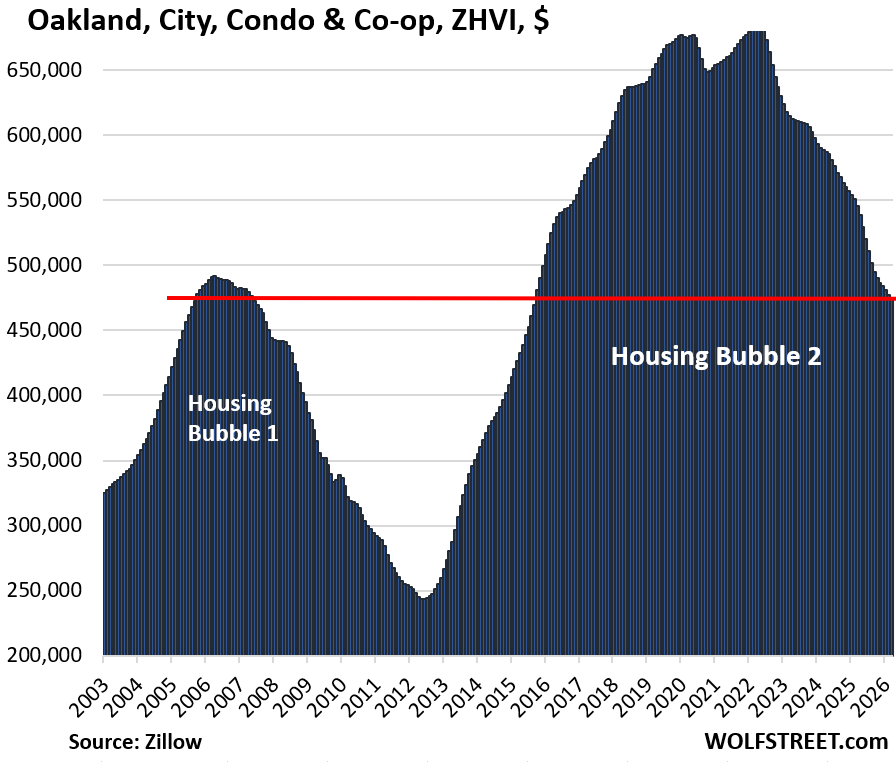
| 1 | Oakland, CA | -31% | 2022 |
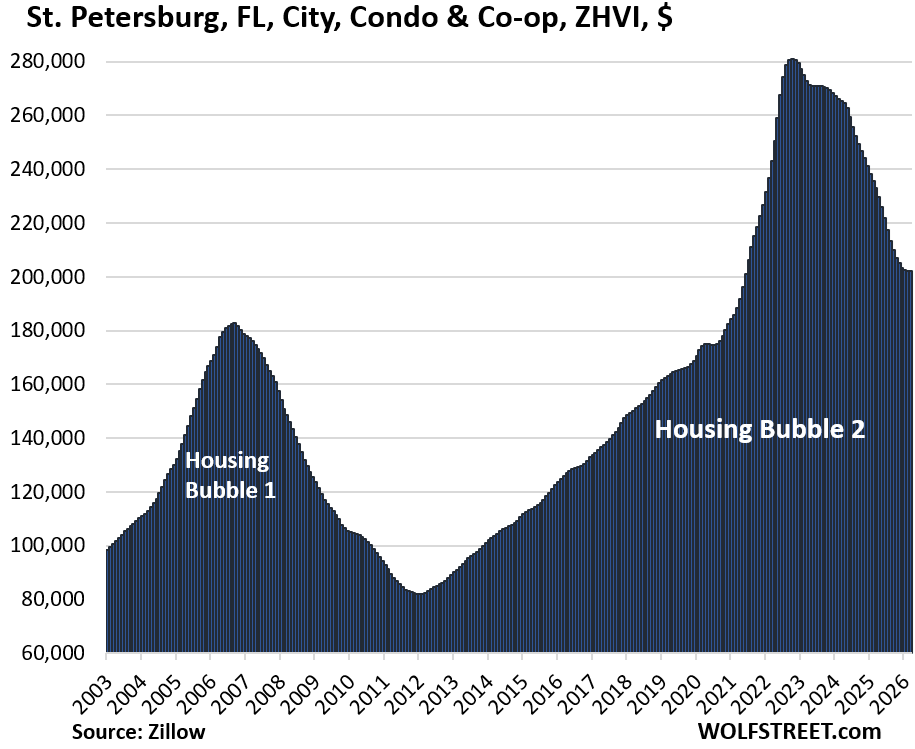
| 2 | St. Petersburg, FL | -28% | 2022 |
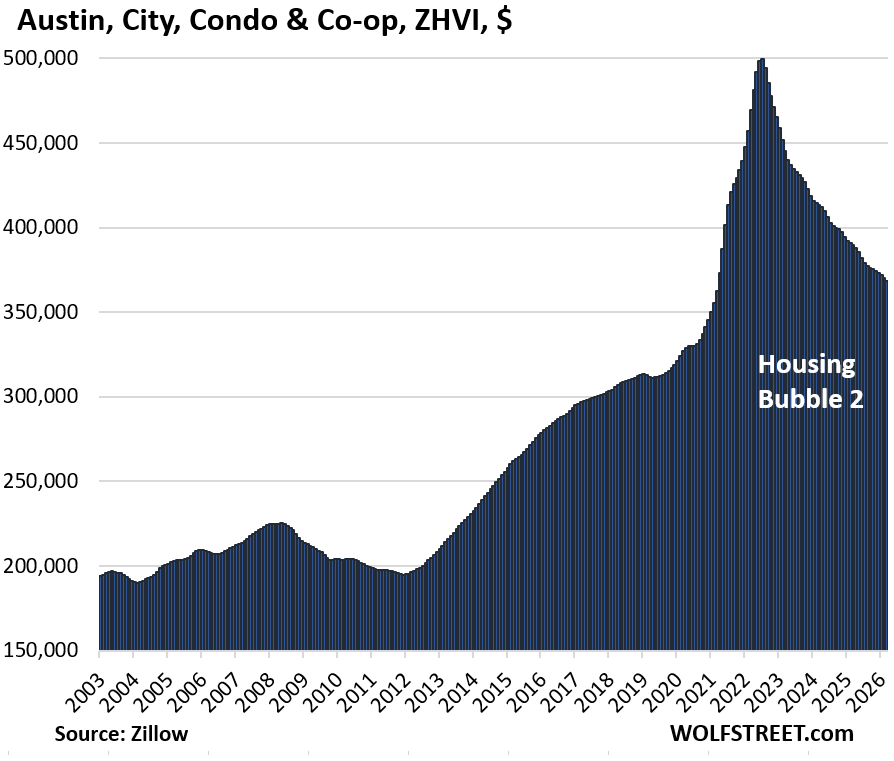
| 3 | Austin, TX | -26% | 2022 |
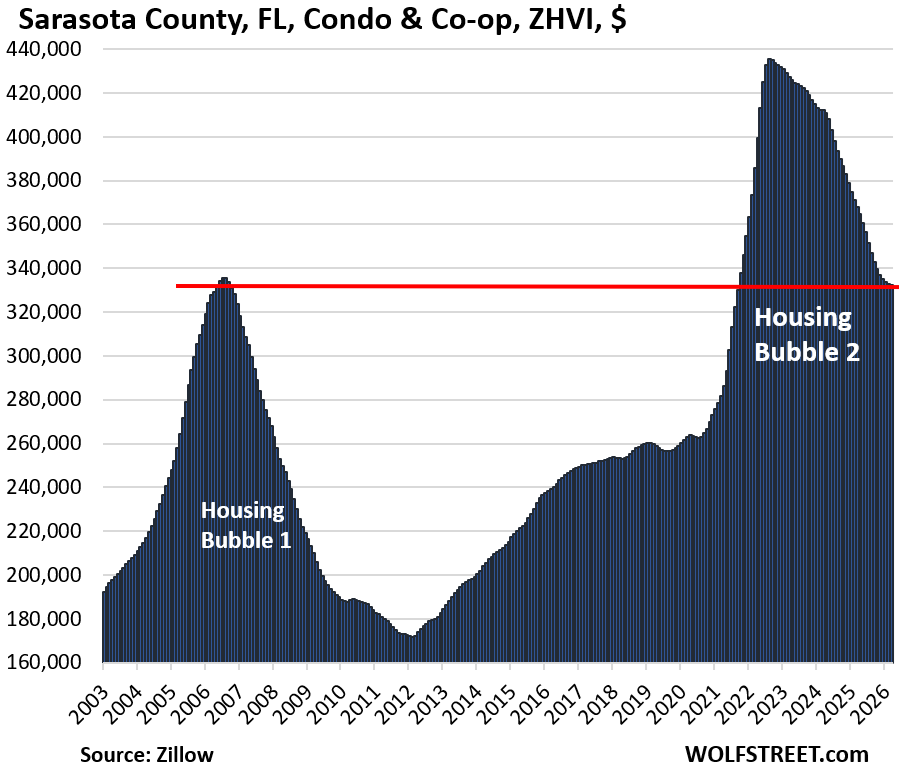
| 4 | Sarasota County, FL | -24% | 2022 |
| 5 | Lee County, FL (Cape Coral, Fort Myers) | -23% | 2022 |
| 6 | Jacksonville, FL | -19% | 2022 |
| 7 | Tampa, FL | -19% | 2021 |
| 8 | Detroit, MI | -19% | 2021 |
| 9 | Garland, TX | -19% | 2022 |
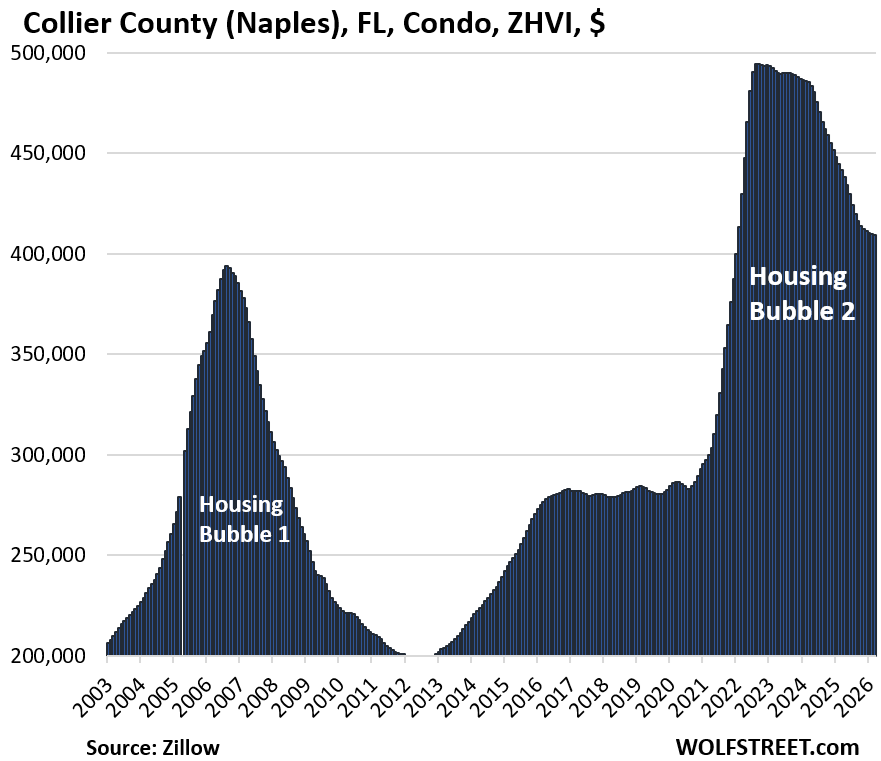
| 10 | Collier County (Naples), FL | -17% | 2022 |
| 11 | Manhattan, NY | -17% | 2022 |
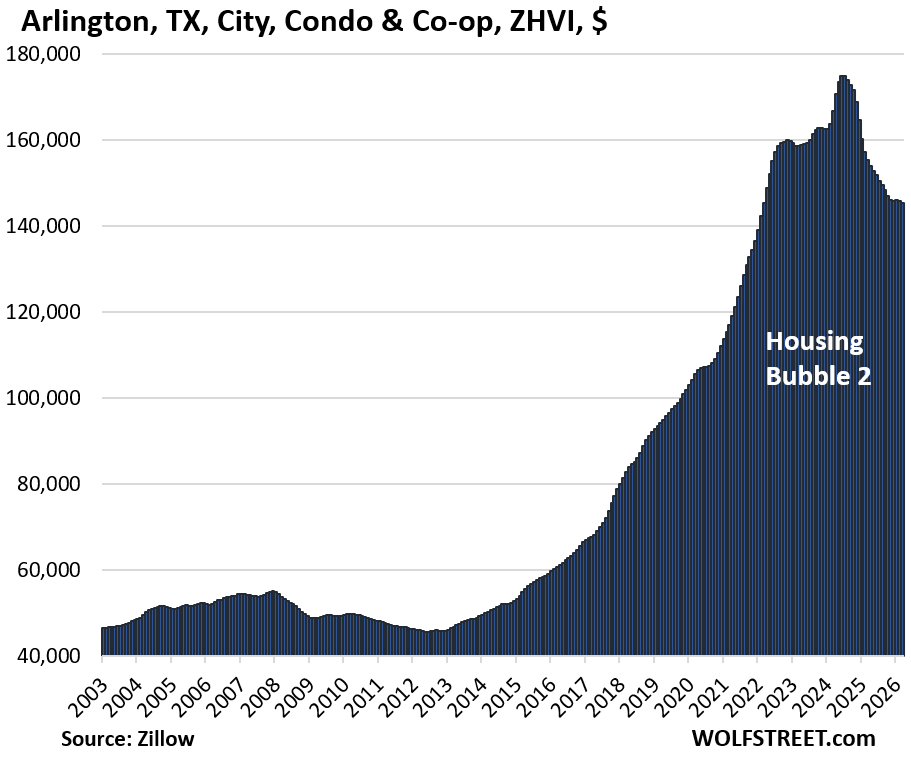
| 12 | Arlington, TX | -17% | 2024 |
| 13 | Port Saint Lucie, FL | -16% | 2024 |
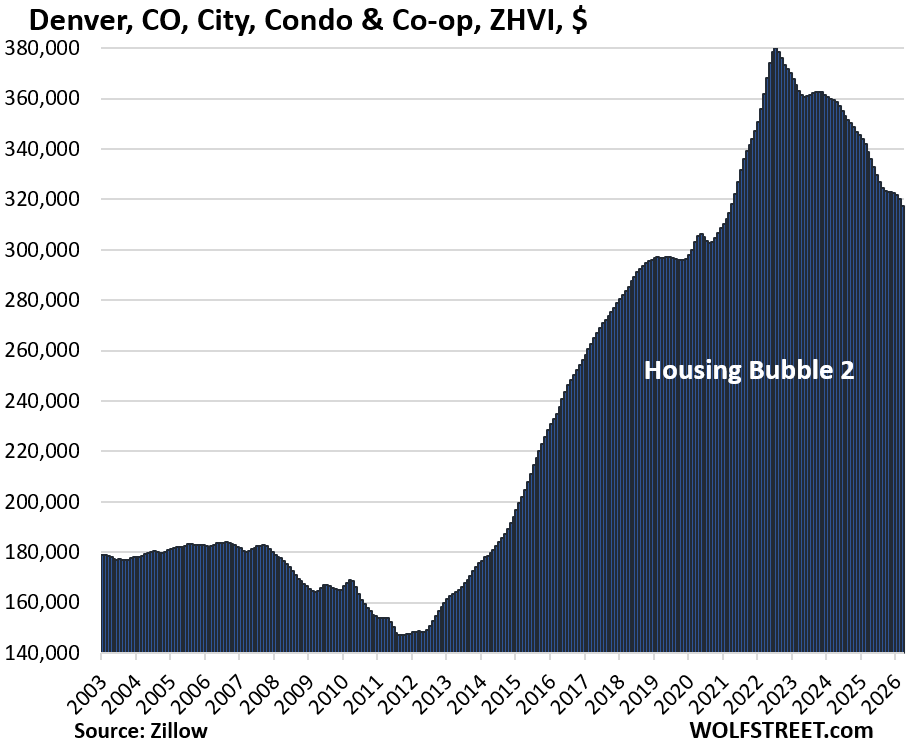
| 14 | Denver, CO | -16% | 2022 |
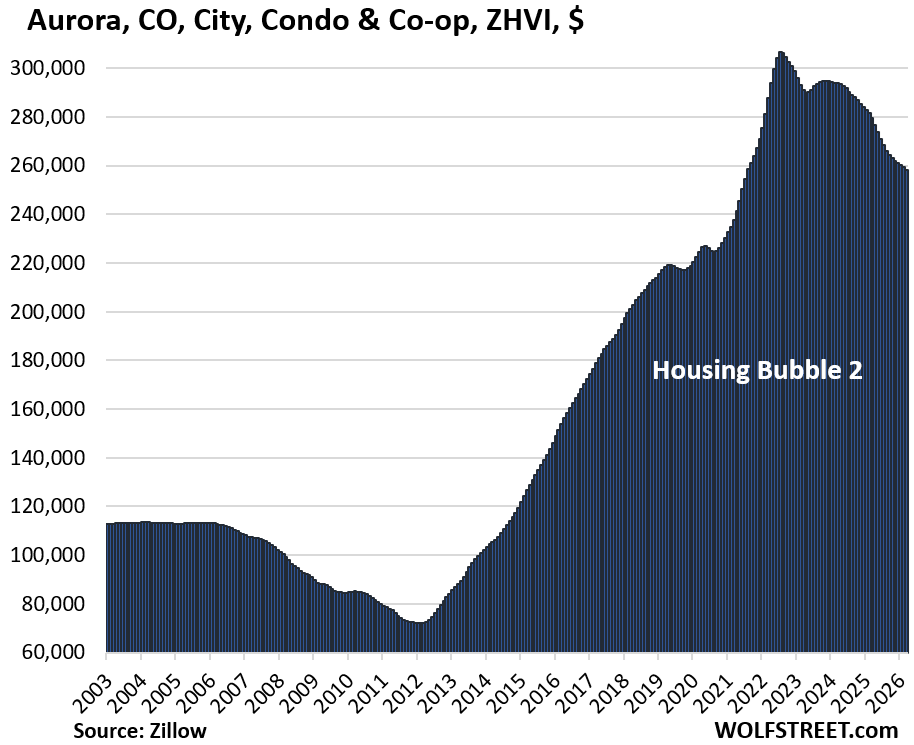
| 15 | Aurora, CO | -16% | 2022 |
| 16 | Orlando, FL | -16% | 2024 |
| 17 | San Mateo County (northern Silicon Valley), CA | -15% | 2022 |
| 18 | Reno, NV | -15% | 2022 |
| 19 | Raleigh, NC | -15% | 2022 |
| 20 | Queens, NY | -14% | 2022 |
| 21 | Seattle, WA | -14% | 2022 |
| 22 | Plano, TX | -14% | 2022 |
| 23 | Houston, TX | -13% | 2024 |
| 24 | San Antonio, TX | -13% | 2024 |
| 25 | Boise, ID | -13% | 2022 |
| 26 | Portland, OR | -13% | 2022 |
| 27 | Phoenix-Mesa-Chandler metro, AZ | -13% | 2024 |
| 28 | San Francisco, CA | -12% | 2022 |
| 29 | Sacramento, CA | -12% | 2022 |
| 30 | Fort Lauderdale, FL | -12% | 2022 |
| 31 | Huntsville, AL | -12% | 2022 |
| 32 | Dallas, TX | -11% | 2023 |
| 33 | Colorado Springs, CO | -11% | 2022 |
| 34 | New Orleans | -11% | 2022 |
| 35 | Stockton, CA | -11% | 2022 |
| 36 | Henderson, NV | -11% | 2022 |
| 37 | Corpus Christi, TX | -11% | 2023 |
| 38 | Las Vegas, NV | -10% | 2022 |
| 39 | Salt Lake City, UT | -9% | 2022 |
| 40 | Nashville, TN | -9% | 2022 |
| 41 | Spokane, WA | -9% | 2022 |
| 42 | Washington, DC | -9% | 2022 |
| 43 | Atlanta, GA | -9% | 2023 |
| 44 | Fort Worth, TX | -8% | 2024 |
| 45 | Miami, FL | -8% | 2023 |
| 46 | Memphis, TN | -8% | 2024 |
| 47 | St. Louis, MO | -8% | 2023 |
| 48 | San Diego, CA | -7% | 2023 |
| 49 | Oklahoma City, OK | -7% | 2023 |
| 50 | San Jose, CA | -7% | 2022 |
| 51 | Los Angeles, CA | -7% | 2022 |
Some people buy condos to live in an urban center, close to work, or along the shore, with big views, nice amenities, without having to worry about maintenance, repairs, and yardwork. They are like other homeowners and provide some stability.
But other people buy condos as rental properties – a popular way for mom-and-pop investors to get into multifamily rentals. Others operate condos as short-term vacation rentals. Others, especially nonresident foreign investors, buy condos to park some cash in the US and watch the price appreciate while the condo sits empty. Condos are popular second homes and vacation homes, including for Canadians in Florida. And there are reports about Canadians having soured recently on their condos in the US, and on buying condos in the US.
These investors can make condos very speculative, with big mind-bending manias followed by big crashes, as the charts below show.
Condo prices in many of these cities had exploded by 50%, 60%, 70% or more in the two years from mid-2020 through mid-2022, driven by mindboggling absurd buying behavior, investor-mania, and Free Money, such as in Cape Coral (+76%), Fort Myers (+71%), Phoenix (+70%), Huntsville (+67%), Sarasota (+66%), Tampa (+61%), Austin (+56%), Las Vegas (+52%), Raleigh (+52%), Jacksonville (+50%), etc., etc.
In the 10 years to the peak, prices had soared by 180% (Oakland), 200% (Jacksonville, Tampa), 260% (Arlington, TX), 300% (Detroit, Aurora, Chandler), 350% (Phoenix, Mesa), and by 500% in San Bernardino, CA, where prices just started to decline, and it hasn’t made it on this list yet.
The biggest year-over-year price declines.
These are the markets, among our 51 markets, with the biggest year-over-year price declines in March.
- Lee County (Cape Coral, Fort Myers), FL: -14.3%
- St. Petersburg, FL: -13.2%
- Oakland, CA: -13.1%
- Garland, TX: -13.0%
- Sarasota County, FL: -12.0%
- Tampa, FL: -10.4%
- Orlando, FL: -9.5%
- Jacksonville, FL: -9.4%
- Collier County (Naples): -9.4%
- Port Saint Lucie, FL: -9.1%
- Plano, TX: -8.5%
- Raleigh, NC: -7.9%
- Aurora, CO: -7.6%
- Huntsville, AL: -7.5%
- Houston, TX: -6.6%
- Detroit, MI: -6.6%
- San Mateo County (northern Silicon Valley), CA: -6.6%
- Denver, CO: -6.4%
- Arlington, TX: -6.4%
- Stockton, CA: -6.4%
- Dallas, TX: -6.2%
- San Jose (part of southern Silicon Valley), CA: -6.0%
- Las Vegas, NV: -6.0%
- San Diego, CA: -5.6%
- Austin, TX: -5.5%
- Seattle, WA: -5.1%
Methodology and data: These prices here are seasonally adjusted three-month averages of “mid-tier” condos and co-ops from the Zillow Home Value Index (ZHVI), which is based on millions of data points in Zillow’s “Database of All Homes,” including from public records (tax data), MLS, brokerages, local Realtor Associations, real-estate agents, and households across the US. It includes pricing data for off-market deals and for-sale-by-owner deals.

The Condo Bust by market in 27 charts, plus Chicago.
The tables for each market below show from left to right: price decline from the peak, change from prior month (MoM), change year-over-year (YoY), and remaining increase since January 2000.
| Oakland, CA, City, Condo Home Prices | |||
| From May 2022 peak | MoM | YoY | Since 2000 |
| -31% | -0.7% | -13.1% | 142% |
Lowest since August 2015, over a decade ago, and below the peak of Housing Bubble 1 in mid-2006, 20 years ago!
| St. Petersburg, Fl, City, Condo Prices | |||
| From Oct 2022 peak | MoM | YoY | Since 2000 |
| -28% | -0.1% | -13.2% | 183% |
| Austin, TX, City, Condo Prices | |||
| From Jul 2022 peak | MoM | YoY | Since 2000 |
| -26% | -0.5% | -5.5% | 108% |
| Sarasota County, FL, Condo & Co-ops Prices | |||
| From Jun 2022 peak | MoM | YoY | Since 2000 |
| -24% | -0.8% | -12.0% | 134% |
Prices are below where they’d been at the peak of Housing Bubble 1.
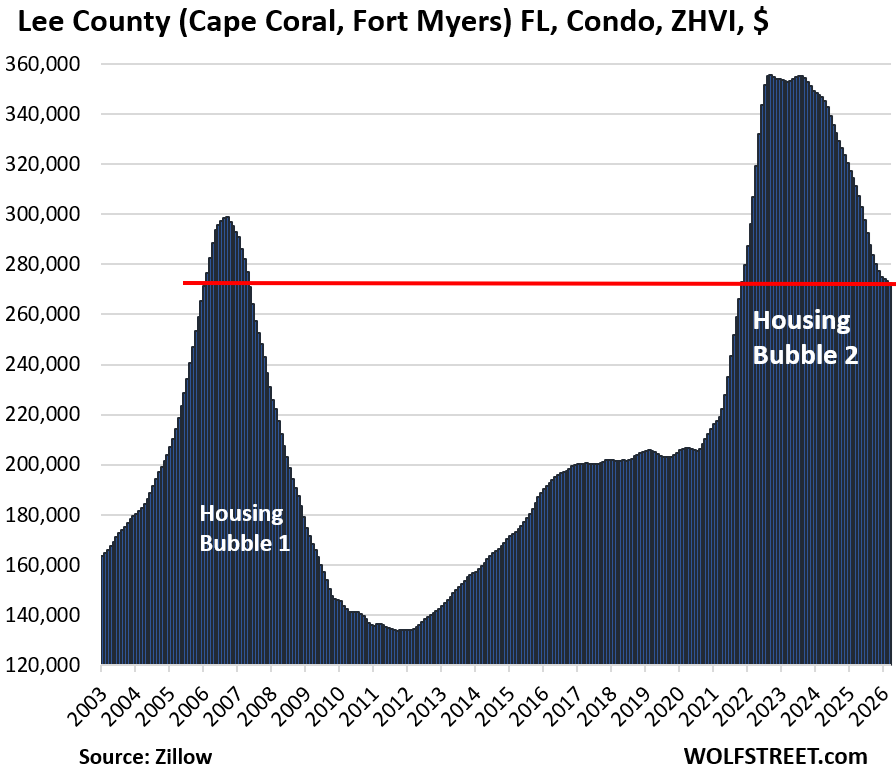
| Lee County (Cape Coral, Fort Myers), FL, Condo & Co-ops Prices | |||
| From Jun 2022 peak | MoM | YoY | Since 2000 |
| -23% | -1.0% | -14.3% | 113.7% |
Condo prices in the City of Cape Coral itself have plunged by 32% and are below where they’d first been 20 years ago in October 2005, below the peak of Housing Bubble 1. Cape Coral is the epicenter of the Florida condo bust.
In the City of Fort Myers, condo prices plunged by 27%.
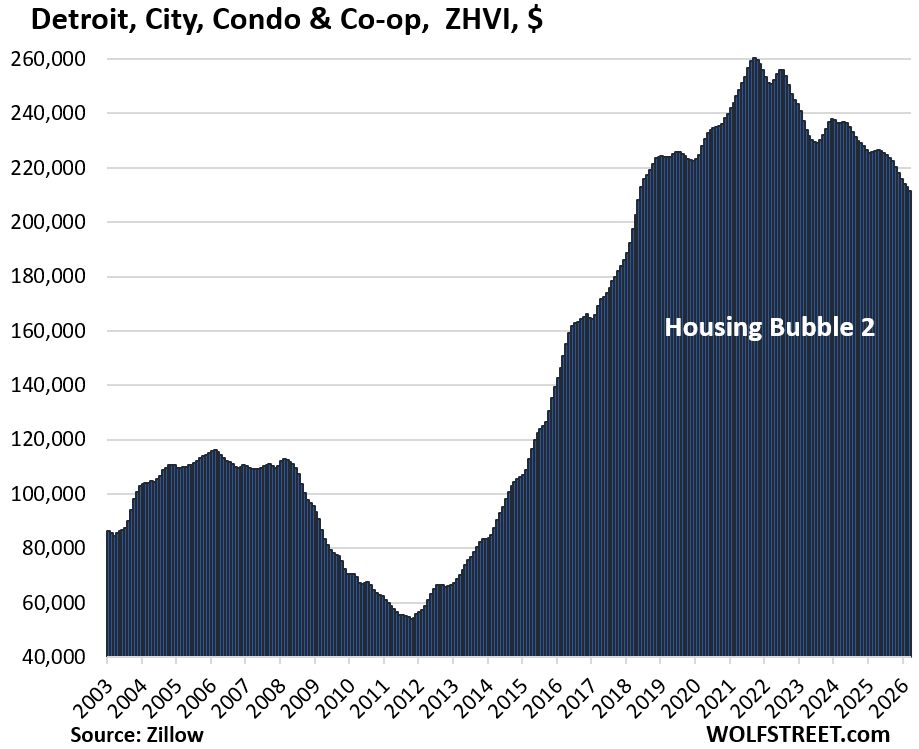
| Detroit, MI, City, Condo Prices | |||
| From Sep 2021 peak | MoM | YoY | Since 2000 |
| -19% | -0.7% | -6.6% | 247% |
Lowest since June 2018.
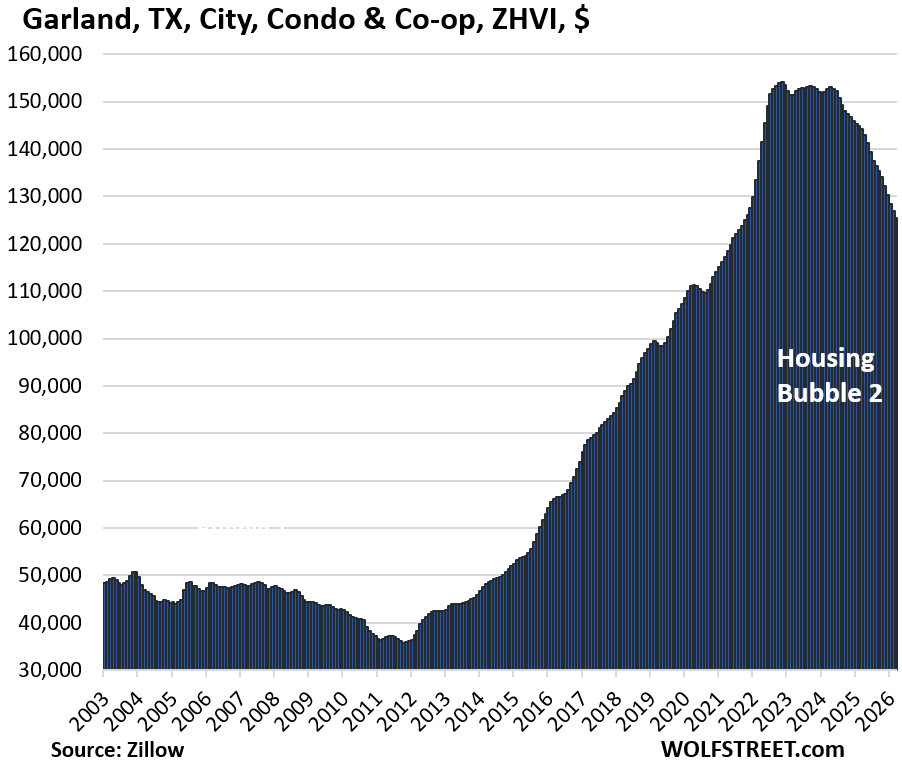
| Garland, TX, City, Condo Prices | |||
| From July 2022 peak | MoM | YoY | Since 2000 |
| -19% | -1.1% | -13% | 212% |
In the decade between 2012 and 2022, prices had shot up by 320%.
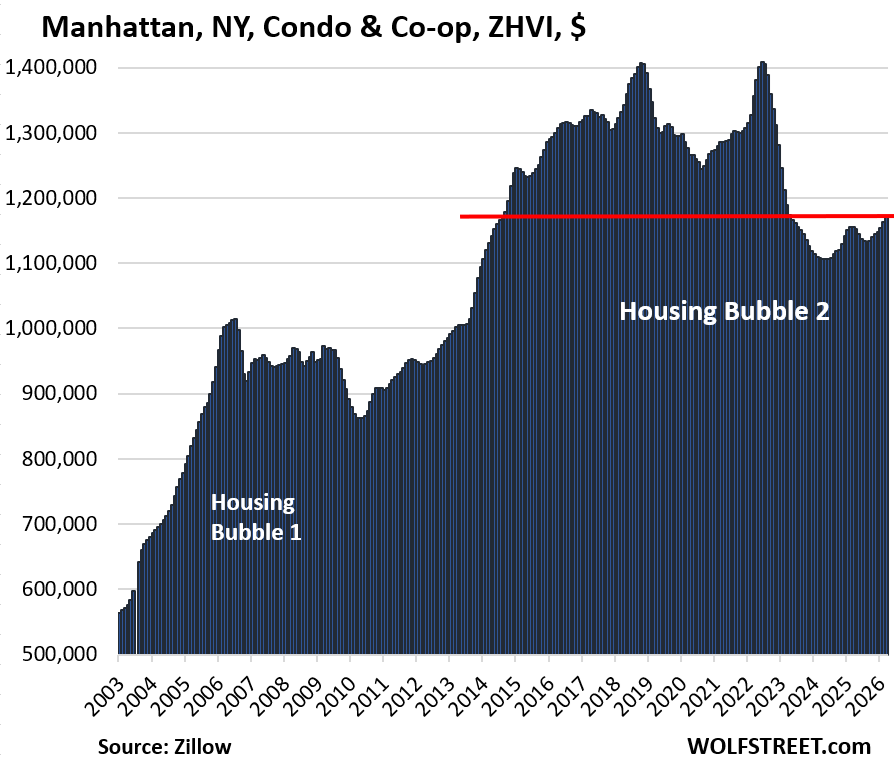
| Manhattan, NY, Condo & Co-Op Prices | |||
| From Jun 2022 peak | MoM | YoY | Since 2000 |
| -17% | 0.4% | 1.4% | 211% |
Prices in the Borough of Manhattan (New York County) are where they’d first been in August 2014.
| Arlington, TX, City, Condo Prices | |||
| From Jun 2024 peak | MoM | YoY | Since 2000 |
| -17% | -0.3% | -6.4% | 229% |
In the four years between mid-2020 and mid-2024, prices exploded by 63%, after having already shot up in the prior decade.
| Collier County (Naples), FL, Condo & Co-ops Prices | |||
| From Jun 2022 peak | MoM | YoY | Since 2000 |
| -17% | -0.4% | -9.4% | 158% |
| Denver, CO, City, Condo Prices | |||
| From Jul 2022 peak | MoM | YoY | Since 2000 |
| -16% | -0.8% | -6.4% | 133% |
| Aurora, CO, City, Condo Prices | |||
| From Jul 2022 peak | MoM | YoY | Since 2000 |
| -16% | -0.6% | -7.6% | 198% |
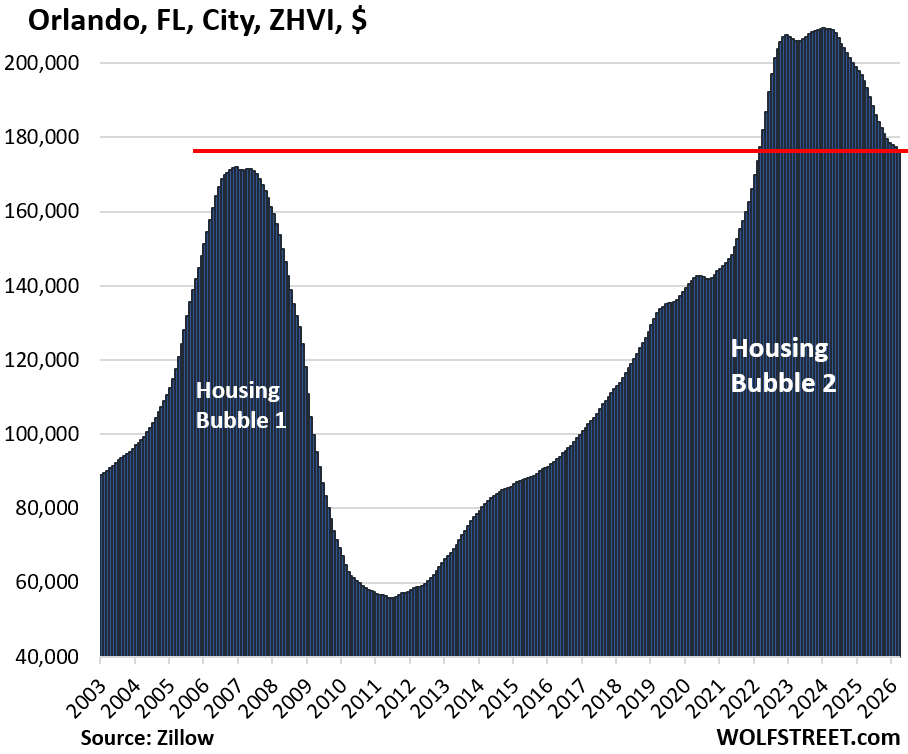
| Orlando, FL, City, Condo Prices | |||
| From Jan 2024 peak | MoM | YoY | Since 2000 |
| -16% | -0.4% | -9.5% | 152.2% |
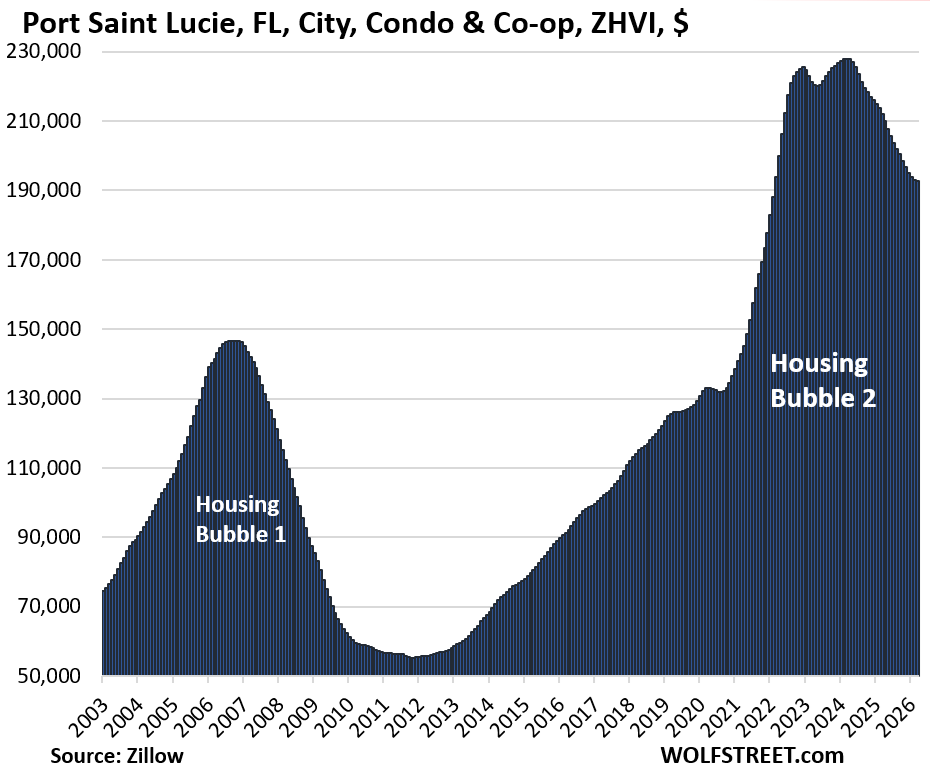
| Port Saint Lucie, FL, City, Condo Prices | |||
| From July 2022 peak | MoM | YoY | Since 2000 |
| -16% | -0.2% | -9.1% | 229.2% |
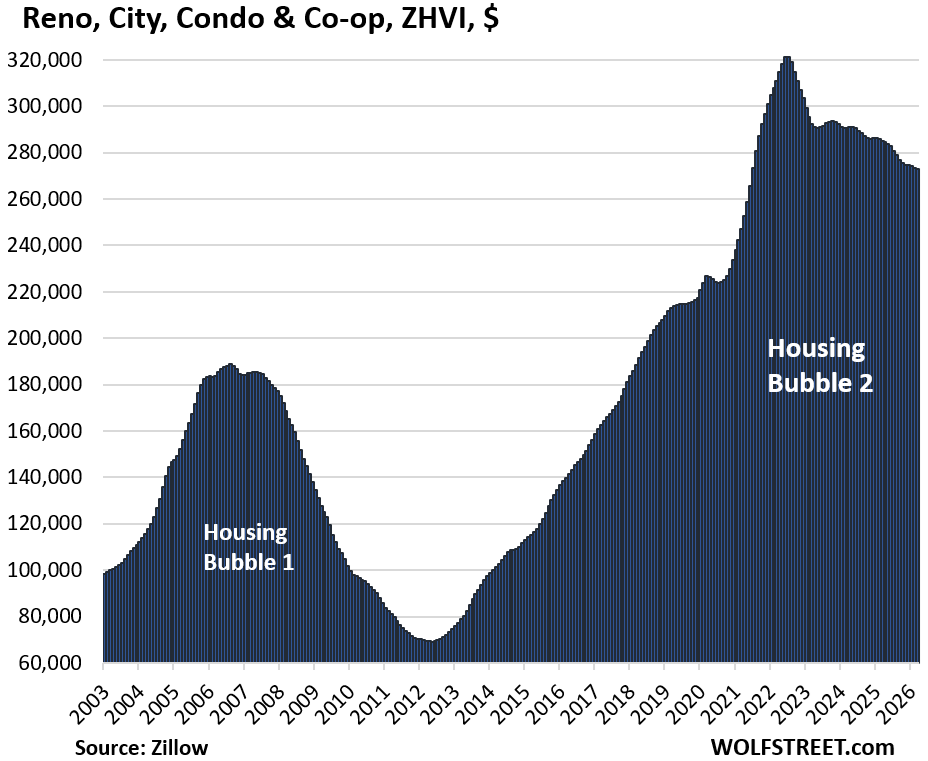
| Reno, NV, City, Condo Prices | |||
| From Jun 2022 peak | MoM | YoY | Since 2000 |
| -15% | -0.2% | -4.2% | 241% |
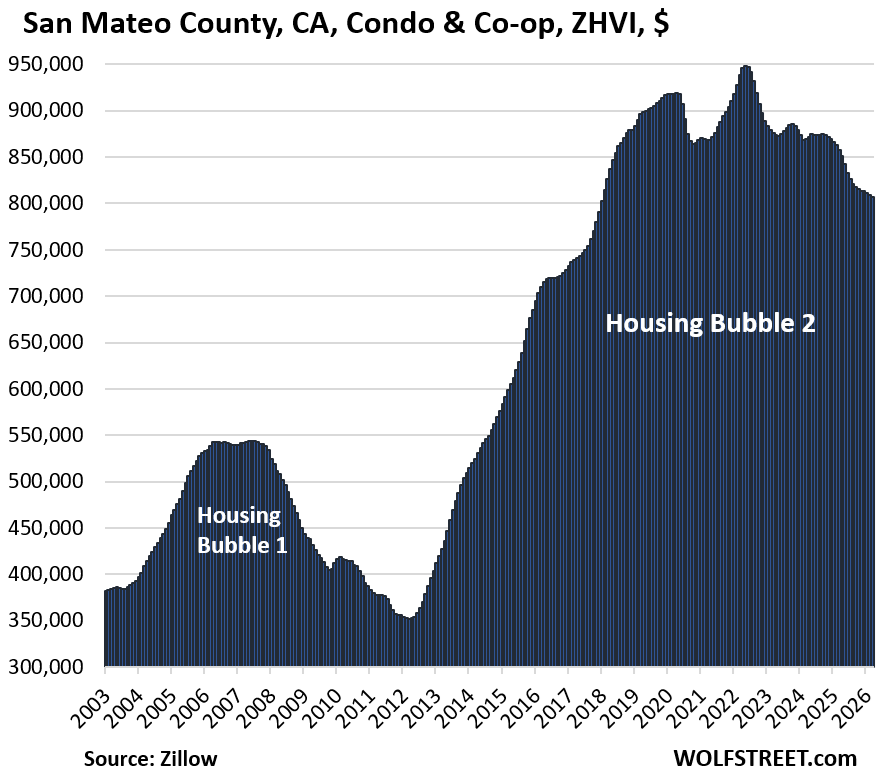
| San Mateo County, CA, Condo & Co-op Prices | |||
| From Jun 2022 peak | MoM | YoY | Since 2000 |
| -15% | -0.2% | -6.6% | 197% |
San Mateo County, just south of San Francisco, encompasses the northern part of Silicon Valley. There are no big cities in the county, but lots of smaller ones, packed together, such as Redwood City, Menlo Park, San Mateo, Daly City, San Carlos, and others.
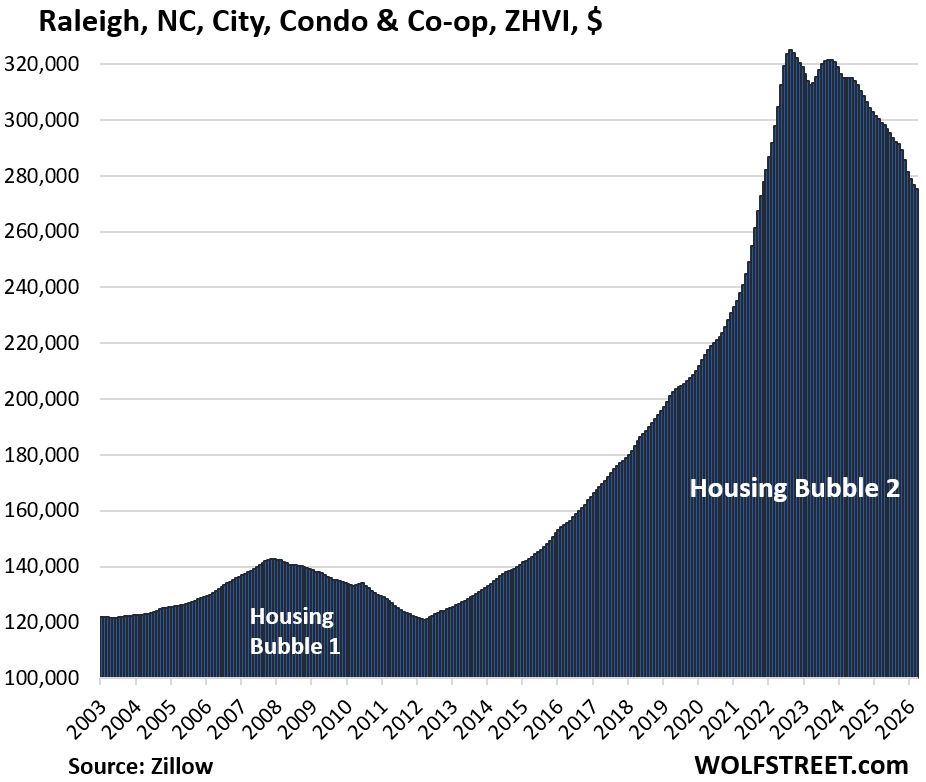
| Raleigh, NC, City, Condo Prices | |||
| From July 2022 peak | MoM | YoY | Since 2000 |
| -15% | -0.5% | -7.9% | 135.3% |
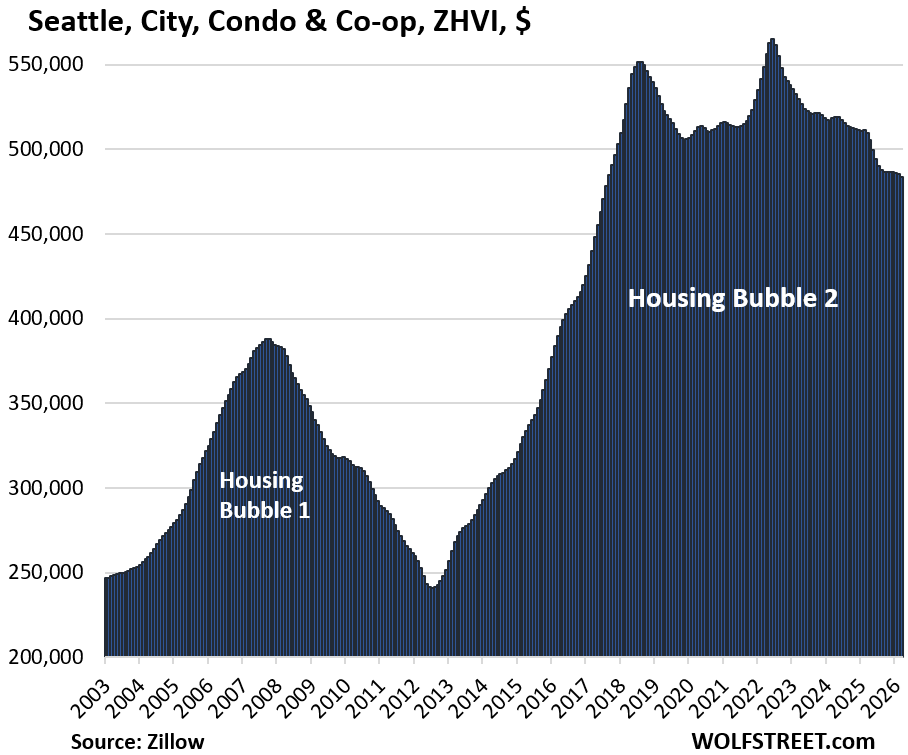
| Seattle, WA, City, Condo Prices | |||
| From Jun 2022 peak | MoM | YoY | Since 2000 |
| -14% | -0.4% | -5.1% | 135% |
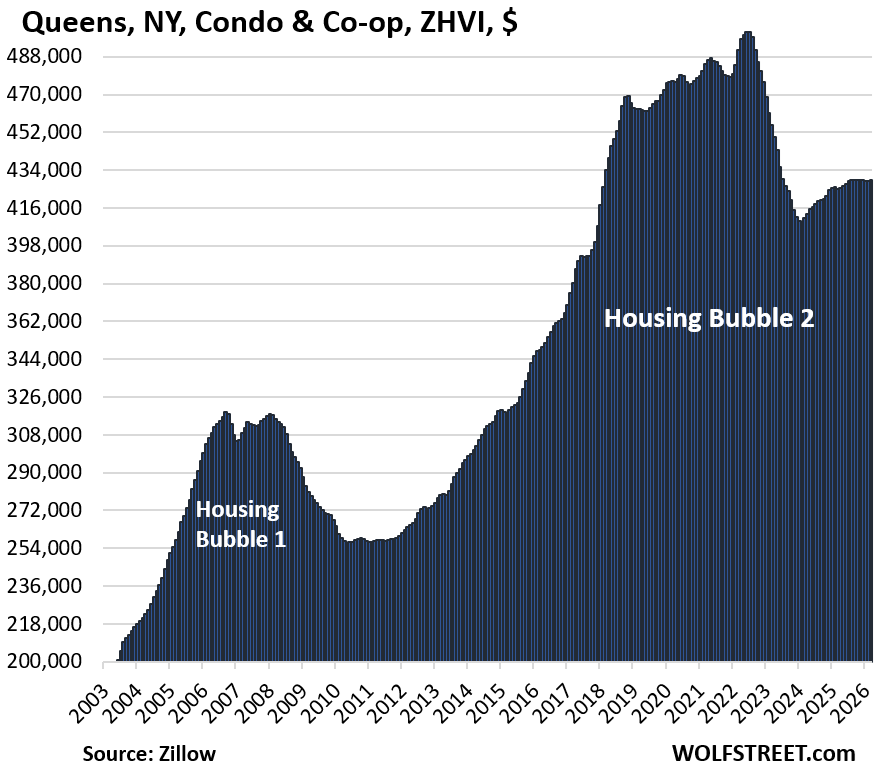
| Queens, NY, Condo & Co-Op Prices | |||
| From Jun 2022 peak | MoM | YoY | Since 2000 |
| -14% | 0.0% | 1.9% | 191% |
Prices in the NYC Borough of Queens (Queens County) are back where they’d first been in March 2018.
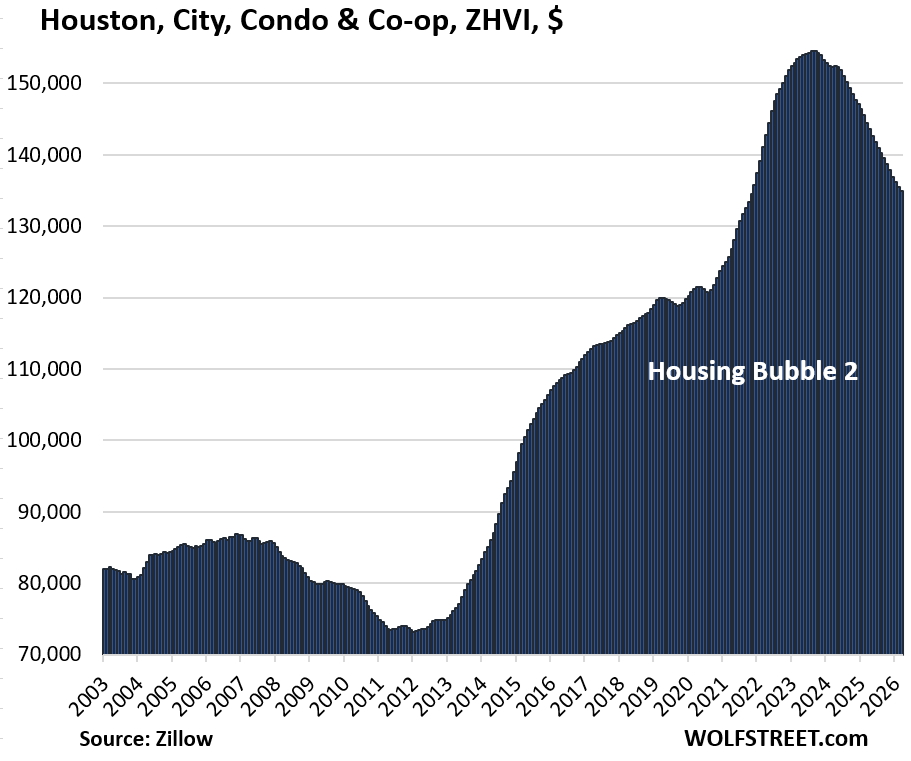
| Houston, TX, City, Condo Prices | |||
| From Aug 2023 peak | MoM | YoY | Since 2000 |
| -13% | -0.4% | -6.6% | 67% |
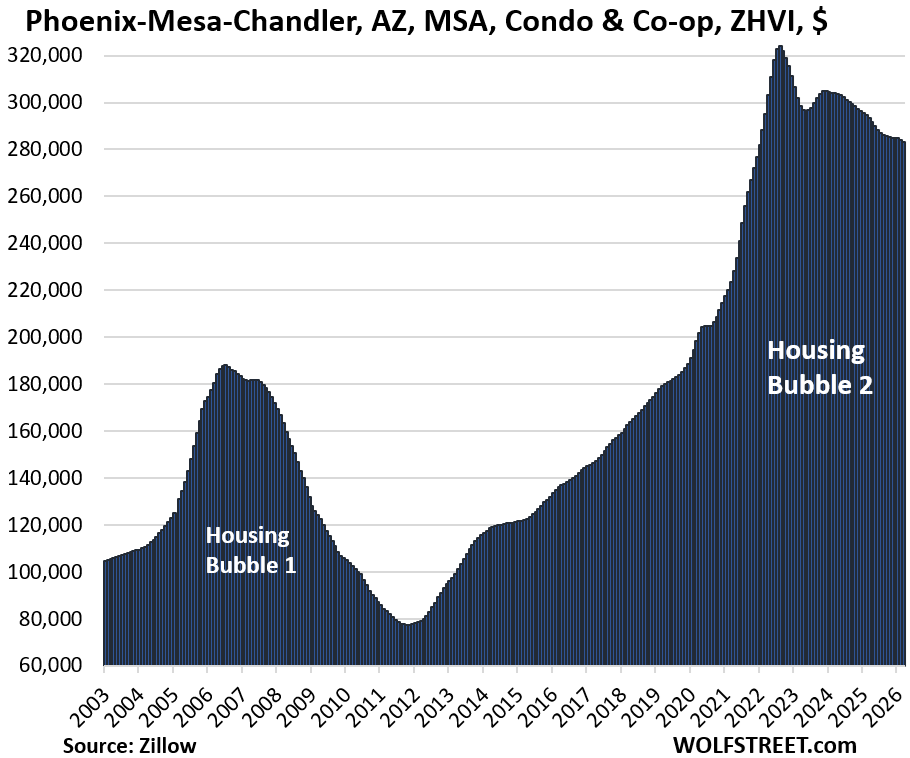
| Phoenix-Mesa-Chandler MSA, AZ, Condo Prices | |||
| From Aug 2022 peak | MoM | YoY | Since 2000 |
| -13% | -0.4% | -3.5% | 207% |
The Phoenix metropolitan statistical area includes the cities of Phoenix, Mesa, Chandler, Scottsdale, Glendale, Gilbert, Tempe, and many others. Condo prices have moved very similarly, all down between 13% to 14%. So it makes sense to show prices at the metro level.
If these cities were tracked separately, it would raise the number of cities that dopped by -12% or more to over 37.
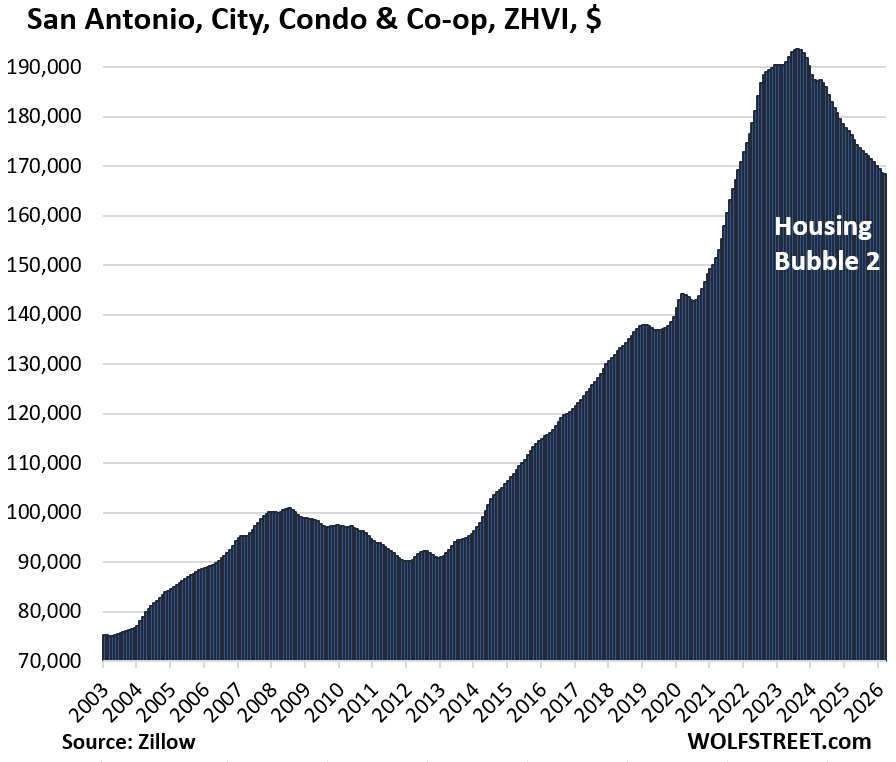
| San Antonio, TX, City, Condo Prices | |||
| From Aug 2023 peak | MoM | YoY | Since 2000 |
| -13% | -0.2% | -4.5% | 125% |
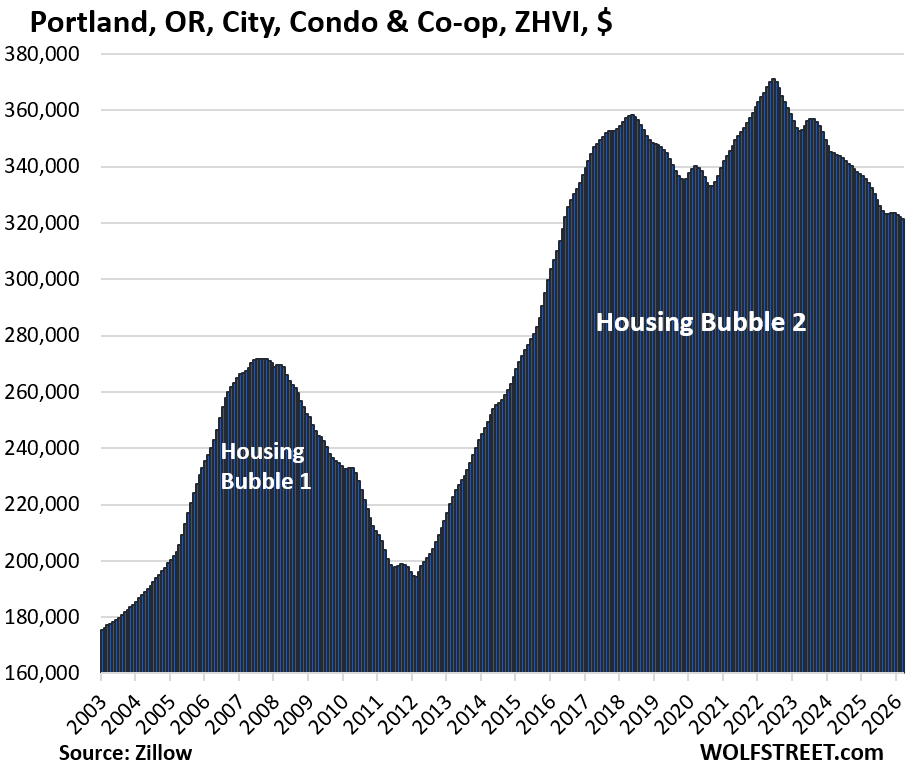
| Portland, OR, City, Condo Prices | |||
| From Jun 2022 peak | MoM | YoY | Since 2000 |
| -13% | -0.2% | -3.8% | 109% |
Lowest since May 2016, a decade ago.
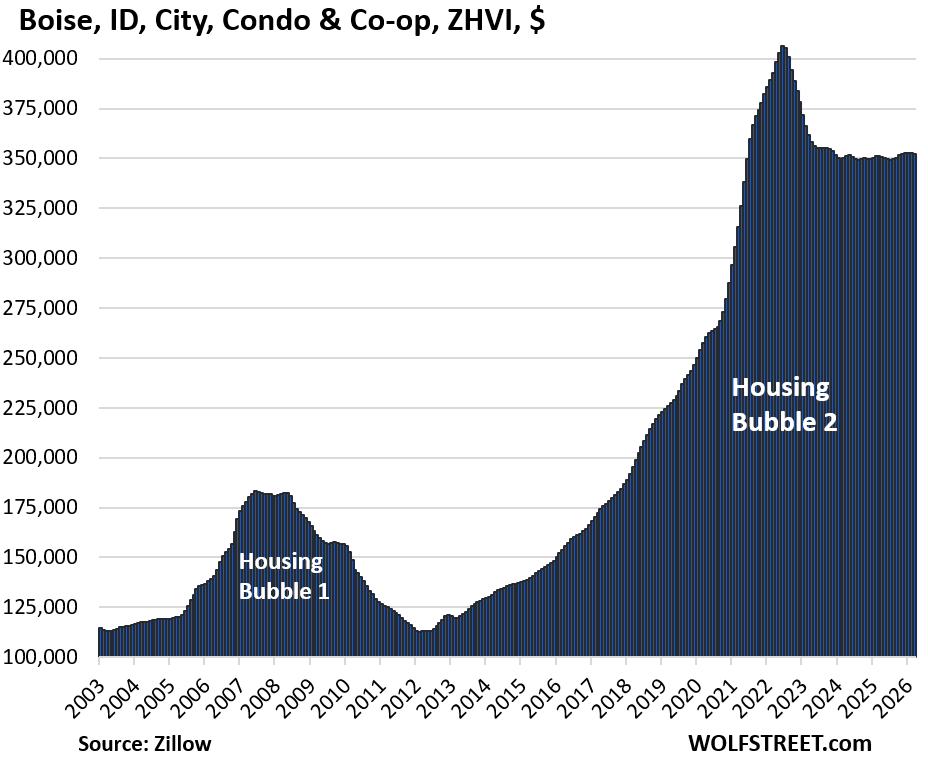
| Boise, ID, City, Condo Prices | |||
| From Jun 2022 peak | MoM | YoY | Since 2001 |
| -13% | -0.2% | 0% | 221% |
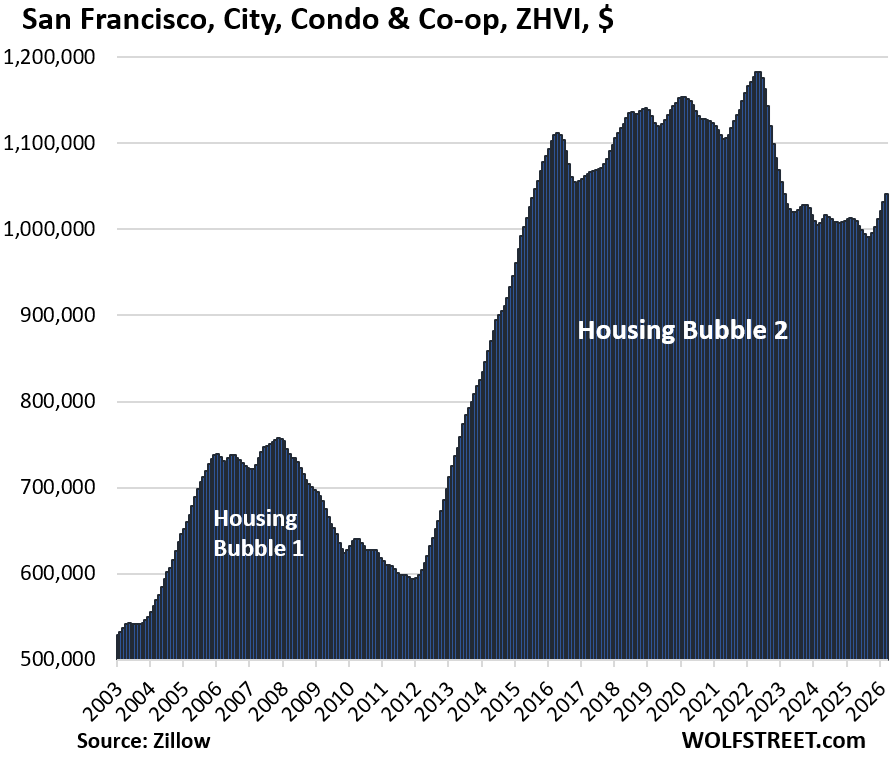
| San Francisco, CA, City, Condo Prices | |||
| From May 2022 peak | MoM | YoY | Since 2000 |
| -12% | 0.9% | 2.8% | 152% |
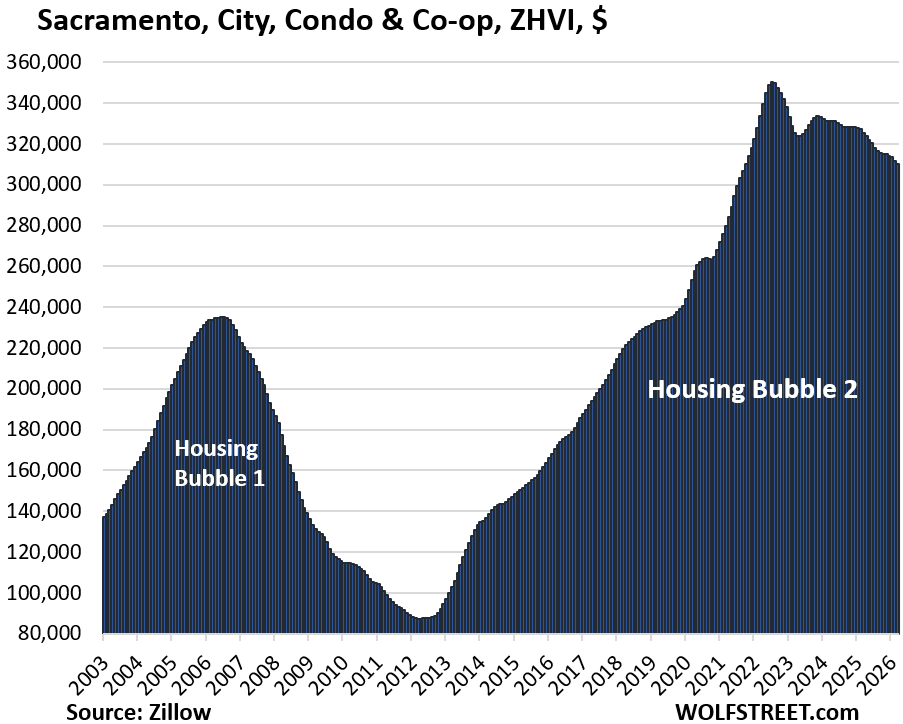
| Sacramento, CA, City, Condo Prices | |||
| From Jun 2022 peak | MoM | YoY | Since 2000 |
| -12% | -0.6% | -4.8% | 275% |
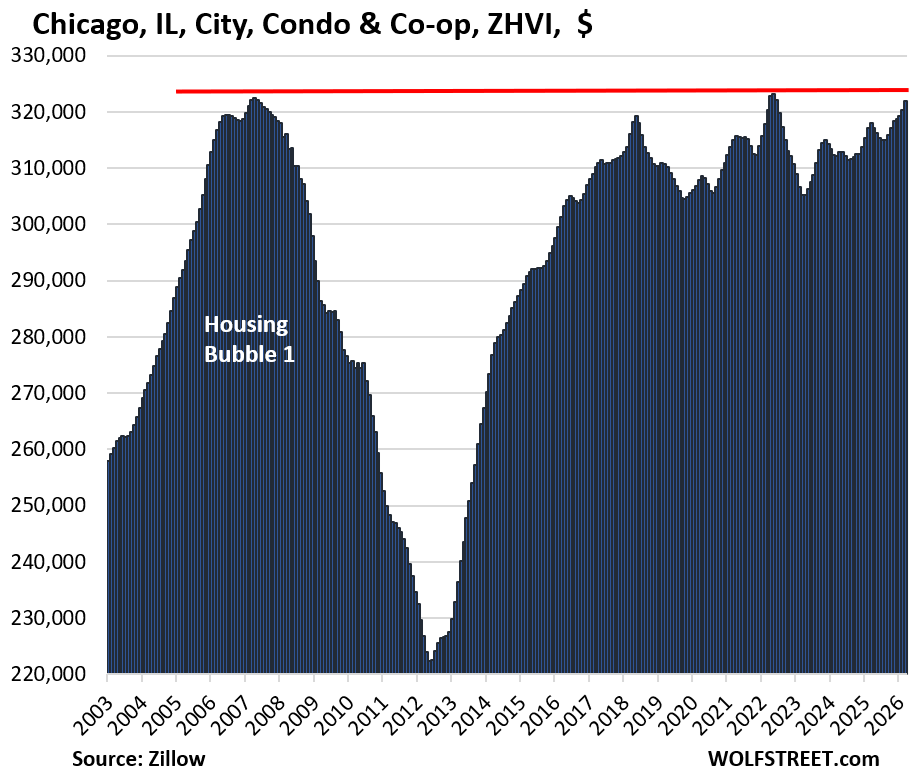
The City of Chicago doesn’t fit on this list because in March, condo prices were just a hair below the record of mid-2022. But it’s like some other markets in the US that are now about where they’d been 20 years ago.
| Chicago, IL, City, Condo & Co-op, ZHVI | ||
| MoM | YoY | Since 2000 |
| 0.5% | 1.2% | 73.3% |
And a reminder of the special issues that condos confront:
- Over the long term, land appreciates, most buildings depreciate to zero and are eventually torn down. The land that big condo buildings sit on can be very valuable, but each condo owner only owns a tiny slice of it. The rest of their investment is in the building. A single-family house may sit on less valuable land, but the homeowner gets 100% of any appreciation of the land.
- Prices that exploded over the past few years ended up being way too high, once the mania settled down.
- Hefty special assessments – or the fear of them – for long-neglected major repairs dog some older condo buildings.
- Big increases in HOA fees at many properties, partly driven by spiking insurance costs in natural disaster zones, add substantially to the monthly costs of condos.
- If a condo building is on Fannie Mae’s Blacklist, financing a unit in that building gets very difficult, and sales may be limited to cash buyers who’ll exact their pound of flesh.
- The Free Money has ended, and mortgage rates are roughly back to a normal range. Buyers of single-family homes face the same issue.
- Foreign-based owners who’ve had it with the US and want to sell. And there are fewer foreign-based buyers.
- Investors in condos as rental properties are facing stiff competition from a wave of newly completed higher-end apartment buildings that developers are trying to find tenants for.
And in case you missed it: The Most Splendid Housing Bubbles in America: Price Drops & Gains in 33 Big Expensive Cities, March 2026
Enjoy reading WOLF STREET and want to support it? You can donate. I appreciate it immensely. Click on the mug to find out how:


2008 is repeating itself.
The difference is that big banks don’t have 35-40 billion dollars tied up in underwater mortgage backed CDOs the way they did then. And there is the “too big to fail” paradigm, which makes another Lehman unlikely (fun fact, they even tried to bail out Lehman with a Korean bank but Fuld was too stubborn to do anything). For instance we saw the government step in to bail out SVB et al in 2023. Banks have shied away from the same kind of investing as 2008 and households and consumers carry lower debt as well, making mass foreclosures less likely.
@CSH The government did not bail out SVB investors, only the depositors.
So as a 30-ish year old guy currently renting in Tampa, but hoping to someday start a family, a condo purchase right now doesn’t seem to be in my best interest at current prices. I’d be happy to be proven wrong, because living near downtown would be nice, but I anticipate that would be somewhat short term for me. Goal is to plant roots in a block construction single-family home within 20-minute drive of downtown outside of flood zones.
I’m very happy with prices dropping. It’d be nice if they dropped faster!
I met someone this week from Tampa that moved here to Texas because he said he gets higher pay here and cost of living is lower and can actually afford to feed is kids. That must be part of what is going on is Tampa just doesn’t have the jobs, even if prices come down. It’s still a retirement state.
Historically when have condo prices have reached near the bottom and begin to stabilize? I imagine they could stabilize however if we have a recession I think prices will drop substantially more. Thoughts?
Florida is famous for condo prices making huge price gains and falls over time.
If you can catch it at the right time, it could work out very well.
..Denver, FL: -6.4%.. ??
Otherwise, very interesting as always.
Thanks,
🤣 Thanks At least I got the other three Denvers in the right state.
Speaking of, what’s the goal of splitting out Aurora given it’s part of the Denver sprawl at this point?
Aurora is a pretty big city, which is why I put in there in the first place. I have done it that way for a while. But it’s really not necessary because they’re so similar. I’ll probably drop Aurora next time. If they keep moving in lockstep, I might instead switch to the Denver MSA, which includes Aurora plus the rest of the sprawl.
Just like he does with Dallas, Fort Worth, Garland and Arlington. For those of us in DFW, that is quite helpful. I own a condo near Garland, it’s depressing, only 8% gain over 7 years. It’s a blue collar area – so I think deportations are driving the issue. Half the people in my other rental in DFW are also illegals.
My guess is that half the residences in DFW under $400K are primarily housing illegals.
Thanks Wolf for presenting the most comprehensive reporting of the approaching financial hurricane
Where prices fall precipitously
Thanks wr
Condos are usually the first dominos to fall.
bingo. IMHO that’s because many condos are investment properties or second homes.
IMHO – When the money spigot from the Treasury stops, prices will collapse, and then the Treasury will step in and try to stabilize nominal prices with a huge currency devaluation and reverse split into a new currency, like the Israels did in 1986.
Thank you as ever. Always interesting.
St. Petersburg, Austin, and San Antonio appear to be almost fair value, now. Orlando might be fair value after about a $20K drop. On the other hand, with all the current economic chaos, the housing bubble may burst nationwide, similar to 2008 but not as severe, bringing out some pretty good deals, below fair value.
We still haven’t seen the effects of the end of extend-and-pretend forbearance, and the leading edge of those effects might just begin to show up in about six months, in the form of a wave of national short sales and foreclosures.
Off topic
Your comments on Luskin’s WSJ article 4/21
excerpt
“The exact operational and accounting mechanics aren’t important. From the Fed’s standpoint, the Treasury would effectively buy back $4 trillion of Treasury and mortgage-backed securities—much as the Treasury does from time to time with outstanding bonds that have become illiquid. That transaction would change nothing for markets. Those securities aren’t in the markets now (they are held at the Fed), and they won’t be in the markets when they are returned to the Treasury. The Treasury would pay for those securities by assuming $3.9 trillion of the Fed’s liabilities: the $3 trillion of so-called excess reserves and its own $0.9 trillion General Account. The Treasury would put those liabilities into a new kind of security it has never offered before—what amounts to a savings account. Nothing would change for the banks now holding so-called excess reserves at the Fed. The Treasury savings account would offer fullfaith-and-credit, daily liquidity and a floating rate indexed to the Fed’s policy target. Over time, Treasury could make this new savings account available to the public. Stablecoin issuers would be especially interested in a Treasury facility that provides perfect collateral, and the Treasury would be thrilled to have them as a new source of funding debts ..”
And thereby Treasury would create a huge risk for itself, by opening itself up to a “run on the Treasury,” when depositors (stablecoin issuers, LOL) yank out their cash all at once since they have daily liquidity. That would be the one thing that could cause the US government finances to collapse.
This was an opinion piece in the WSJ. The stupid-ass manipulative shit being spread around never ends. The WSJ is full of it.
So IF (big if) this happens, which country are you moving to, Wolf? Or at least which currency are you going to predominantly hold?
I don’t prepare for the sun not rising tomorrow or for the flat earth to break in two. If those things happen, I will just take it like a man and cry into my pillow.
Dang! That HB2 slope in Naples looks almost vertical. Yikes!
Oakland, for example, is now back HB1 levels. Nice!
Maybe someday Wolf will publish existing homes graphs that look like these.
I’m not holding my breath.
We’ve seen some substantial single-family declines in those cities too, but not as steep… I posted some charts in November (markets with 10% to 25% price declines of single-family homes), and it has gotten worse since then, see charts below.
Single-family is more stable… But what we haven’t seen is a big wave of mom-and-pop investors that are bleeding cash dumping their single-family rentals on the market — both long-term rentals and vacation rentals. But there is going to be a shakeout.
Since family, data through October:
https://wolfstreet.com/2025/11/23/the-14-bigger-cities-counties-with-the-biggest-price-declines-of-single-family-homes-10-to-25-from-peak-through-october/
Chicago is not in the top 50 markets?
Read the article for crying out loud. The article is about the top 51 DECLINERS in terms of condo prices. This article is about big markets where condo prices FELL the most. Chicago’s condo prices didn’t fall. Chicago is only in it as an extra because condo prices are where they’d been about 20 years ago.
I was watching Oakland prices over the last decade with amazement. However I can understand the one-third drop. Frankly I see another 5-10% drop in that part of the eastbay. Besides, the city government is in shambles but thats another story.
For amusement, I took the “Since 2000” numbers to plug-and-chug in Excel XIRR for a 26-year compound annual growth rate. Some statistics:
mean = 3.7% CAGR
stddev = 0.00823
min = 2.0% CAGR (Houston)
max = 5.1% CAGR (Sacramento)
My takeaway is that looking through all the FOMO and then cliff diving there isn’t a lot of juice to squeeze from condos as a long term growth investment (setting aside the arguments for shelter or rental income while ignoring all carrying costs).
People think condos are an investment. But they’re a cost. People confuse that. The ultimate value of the building is zero. Only the land has long-term value, but each condo owner only owns a small slice of the land, and along the way, they have substantial and rising carrying costs. And then they’re surprised that they lost their shirt on their condo investment.
Condos work great when used as a home, and you don’t expect to get rich off it, but you expect to live there in comfort, style, and happiness, and are able to pay for it without breaking a sweat, and understand that the carrying costs will increase as HOA fees increase over time. To live in a condo, find a condo building that is mostly occupied by the owners, and has few or no rental units, and zero vacation rentals. Stay away from buildings with lots of rentals, vacation rentals, and absentee owners.
Ownership of a condo should be about security and consistency of the payments you make every month, not about a big ROI. With HoA and tax increases that stability is gone in a lot of situations.
Right, but you forget about leverage. If you can buy a rental that at least breaks even on paying the costs (not hard to do if you wait for good deals and don’t overpay), and then pay let’s say a 25% down payment, then your gearing is 1:4 which means that 3.7% CAGR becomes nearly 15% on your actual cash investment. Not to mention that if it’s a stable market, you can expect about 2-3% yearly rent increases, tracking inflation, which also benefits from the leverage.
The downside is that all of this only happens if you a) don’t overpay and b) be willing to put in sweat equity by doing a bunch of the maintenance and other work yourself. Paying a management company 10% of your gross revenue to handle it for you will kill your returns (leverage works the other way too).
That’s the part that people underestimate. Unless you’re a big landlord with your own inhouse management team, as a mom and pop, you can make good money on rentals but you will be working for that money. There’s no free lunch.
“If you can buy a rental that at least breaks even on paying the costs (not hard to do if you wait for good deals and don’t overpay)”
Agreed: if you are smart enough (or lucky enough) to time the market you can do very well. And leverage will amplify your gains if you’ve nailed the timing perfectly. That much seems pretty clear just looking at those peaks and valleys in the post’s charts.
But if you’re just looking for shelter at time X and need to sell to get different shelter at time Y some TBD years after X then the math appears to be saying you’d probably be better off rolling your condo down payment into treasuries and renting. Wolf seems to agree. YMMV.
Just toured the Trump tower (Ka La’i) in Waikiki. Ritz Carlton residences later.
Prices not dropping here.
Wouldn’t FOMO in the instance mean:
Fear Of Moving (to) Oakland?
So FOMO up and FOMO down? I feel ya: the FO stays the same but the MO changes at the peak.
I wanted to reach out and thank you for your latest deep dive into the condo price drops across major U.S. markets.
The data you provided on cities like Oakland and Austin is incredibly sobering. It is rare to find reporting that cuts through the noise to highlight how specific segments—like the “speculative” condo market—are reacting differently than single-family homes.
Your explanation regarding the “special challenges” condos face, from HOA fee spikes to the depreciation of buildings versus land, provides a level of context that is often missing from mainstream real estate coverage.
Thank you for keeping Wolf Street such a high-quality, transparent resource for those of us trying to navigate this “relentless mess” of a housing market.
Honolulu made the list of single family metros but not condos? I would’ve figured the reverse.
Good info! Crazy to see how many metros are back to pre-pandemic values already, without a recession or any real calamity, and rates are higher but still at a pretty low/normal level.
It didn’t miss the list by much. Condo prices -5.4%. The cutoff was -7%.
Would be interesting to see this list with HOA costs factored in — something like average monthly mortgage payment + HOA costs.
Curious whether Florida, for instance, has gone down or the costs have just shifted.
ED, interesting point. Here in the Coachella Valley, there are tons of gated SFR and condo projects. Over the past 5 years, HOA fees have gone from expensive to ridiculous.