
Inflation and the deteriorating yen pushed the Bank of Japan into a hawkish stance, and bond yields are on their own.
By Wolf Richter for WOLF STREET.
The crucial 10-year yield of Japanese Government Bonds (JGBs) rose by 5 basis points on Monday, to 2.432%, a hair higher than in February 1999, and the highest since July 1997.
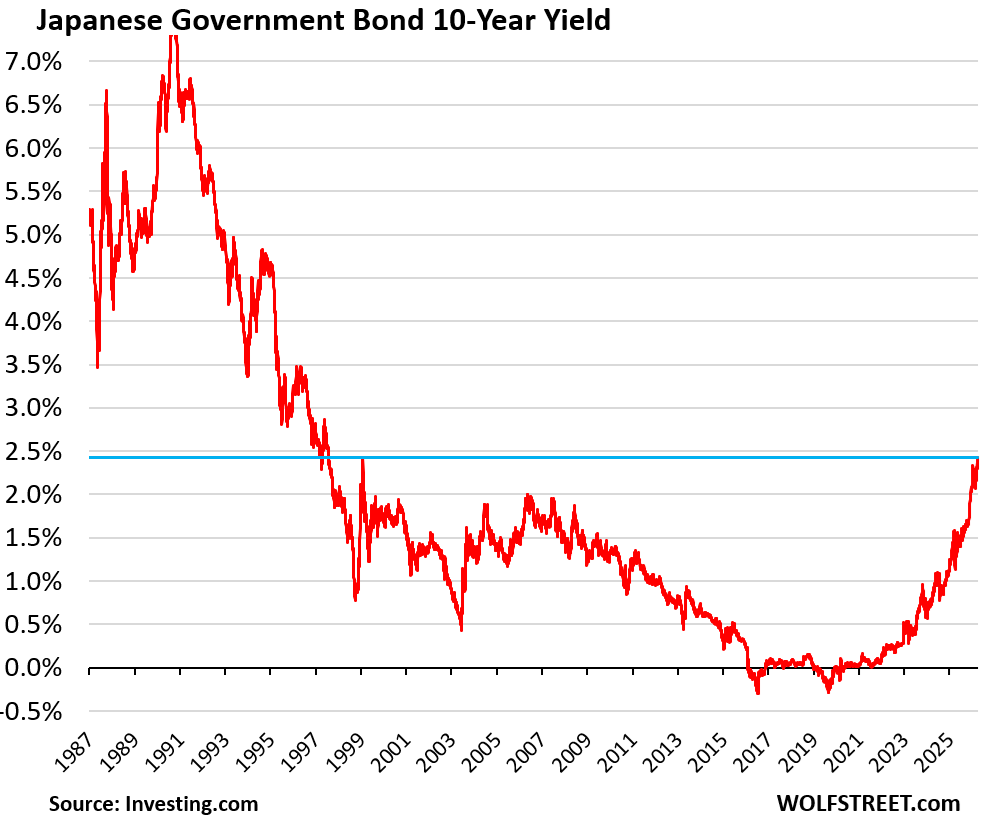
Despite the four-year spike up from around 0%, this yield doesn’t adequately compensate investors for the risks they’re taking over those 10 years and is extremely unappetizing during inflationary times and for a country that is in the worst fiscal position among developed economies with by far the largest debt-to-GDP ratio.
Projections of debt issuance over the next few years, including to fund rising interest costs, are now being ratcheted higher. New investors will need to be enticed to wade into Japan’s fiscal morass, and higher yields may be needed to do that.
Inflation in Japan’s overall economy – not just consumer price inflation – was 3.4% year-over-year in Q4, as measured by the GDP deflator in Japan’s GDP figures, barely below where US inflation in the overall economy was in Q4 (3.8%).
Japan’s credit rating by Fitch (‘A’) is five notches below ‘AAA’ while S&P’s rating (‘A+’) and Moody’s rating (‘A1’) are four notches below ‘AAA’ (my cheat sheet of bond credit ratings by rating agency).
To deal with inflation and the yen, which has become a wet rag, the Bank of Japan stopped increasing its JGB holdings at the end of 2023. It started QT in 2024 and has been reducing its holdings of JGBs and other assets. As of the quarter ended December 31, the BOJ reduced its total assets by 10.4% and its JGB holdings by 8.1%.
The 30-year JGB yield jumped by 8 basis points on Monday to 3.76%. Over the past seven trading days, it has vacillated up and down around that range.
Since July last year, the 30-year JGB yield has been moving around at all-time record levels in the life of the 30-year bond which was introduced in 1999.
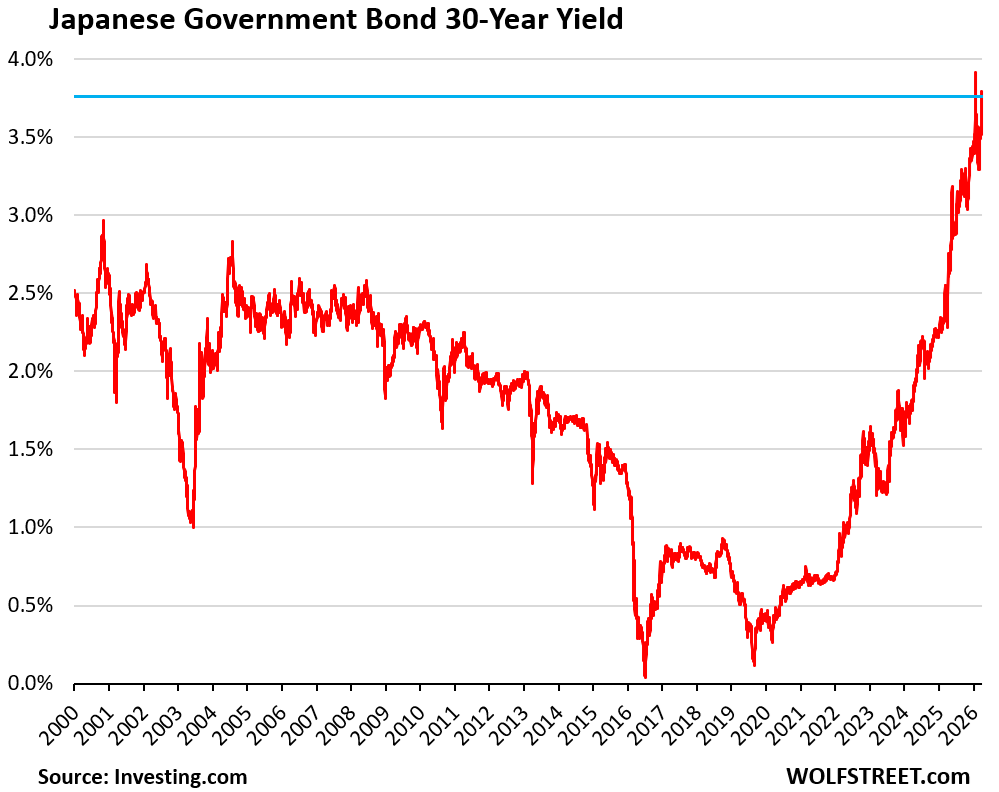
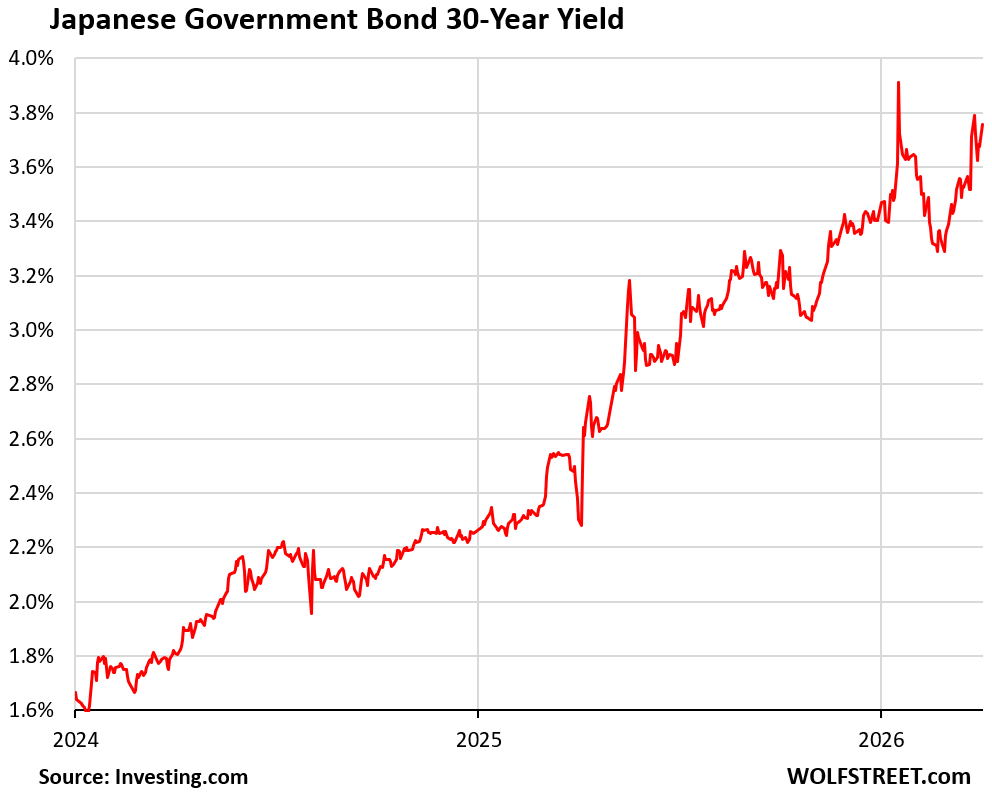
In the two trading days through January 20, the 30-year yield had exploded by 42 basis points to 3.91%, after the new Prime Minister Sanae Takaichi called for increased government spending with simultaneous tax cuts by pausing the 8% consumption tax on food purchases.
After numerous efforts by authorities to calm the waters in January – including by Bessent in the US where Japanese bond yields had begun to roil US Treasury yields – the 30-year JGB yield declined and dropped by over 60 basis points to 3.29% by February 24.
But then it turned around and has been marching higher again. Here’s a close-up of the situation:
But still dead are the “bond vigilantes” – big institutional investors that refuse to buy government bonds because risks are too high and yields too low. Decades of QE killed them. The BOJ still holds 50% of all JGBs outstanding.

Government-linked institutions hold another big chunk, including Japan Post Holdings which is 35% owned by the government and includes majority stakes in Japan Post Bank, the fourth largest megabank in Japan, and Japan Post Insurance, one of the largest life insurers in the world. Institutions that the government can lean on are not going to gang up with the bond vigilantes.
Another big chunk is held by the Government Pension Investment Fund (GPIF), one of the largest pension funds in the world, and part of the government.
JGB holdings as of the end of Q3, figures by the Ministry of Finance:
- Bank of Japan: 50.0%
- Insurance companies, including Japan Post Insurance: 16.2%
- Banks including Japan Post Bank: 14.6%
- Foreigners: 6.6%
- Public pension funds, including GPIF: 6.5%
- Private pension funds: 3.0%
- Households: 1.7%
- All others: 1.5%.
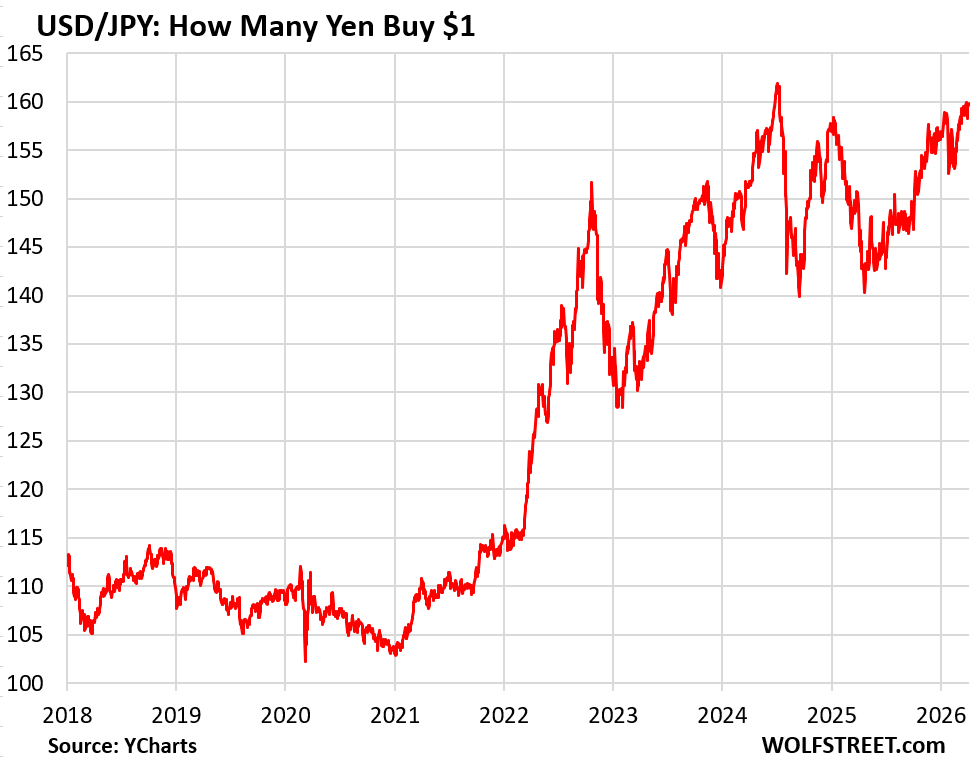
The yen has been tiptoeing around the 160 line for days, despite threats of “decisive” intervention by Japanese authorities a week ago. Currently, the yen trades at 159.77 to the USD.
The MOF with intervention talk: “We are hearing that speculative moves are increasing in the currency market, in addition to the crude futures market. If this situation continues, it may be time to take decisive measures,” Atsushi Mimura, the vice-finance minister for international affairs at the Ministry of Finance, told reporters. “We are prepared to respond on all fronts, and our focus is broad and comprehensive,” he said. But it didn’t help.
The BOJ with hawkish talk: Also on Monday a week ago, Bank of Japan governor Kazuo Ueda told Parliament: “We don’t guide monetary policy directly to control foreign exchange rate moves…. But currency market moves are obviously among factors that hugely affect economic and price developments.”
When asked by a lawmaker if the BOJ could raise rates to staunch the yen’s bleeding, which has been driving up the costs of imports and fueling inflation, Ueda replied: “We will guide policy appropriately by scrutinizing how currency moves could affect the likelihood of achieving our growth and price forecasts, as well as risks.”
Since the beginning of 2021, the yen has lost 34% of its value against the USD. Since the beginning of 2012, when the massive QE started, it has lost 46% of its value against the USD.
To put a lid on the currency’s deterioration, the BOJ started QT in 2024, shedding 10% of its assets, accompanied by timid baby-rate hikes to a whopping 0.75%, with more rate hikes expected.
And with the yen where it is and might be headed, and with inflation where it is and might be headed, any efforts by the BOJ to push down long-term bond yields with another round of QE or yield-curve control would have a brutal effect on the yen and on inflation. And those options are off the table. Instead, there’s this hawkish talk.
Enjoy reading WOLF STREET and want to support it? You can donate. I appreciate it immensely. Click on the mug to find out how:


The “Yen Carry Trade” is kaput?
A prophetic look at the USA in coming years?
Maybe DC can be renamed Wazoo in honor of Wolf.
1) Wolf, you noted that 50% of JGBs are held by the central bank. So is the 237% debt/GDP ratio cited by various sources* actually more like 118%? I.e. if the government prints currency but holds onto it, does it actually exist or affect anything?
2) Anyone know how to short JGBs?
For US bonds, US investors can just use options on TLT or ZROZ. But I’m unaware of an easy way to ride the Japanese interest rates escalator up.
Seems like the myth of the yen as a stable currency is ending.
Correct, the BOJ has “monetized” about half of Japan’s debt, which is why the yen has collapsed by 45% against the hated USD. All sins ultimately lead to the currency.
Most of interest the BOJ earns from its JGBs is remitted back to the government. The government still owes this money, but it’s not impacted by it. As the BOJ sheds this debt, the impact increases.
Thanks. So basically, the massive Japanese debt is simply an accounting entry reflecting money printing in the past (so much for stimulus during 2-3 lost decades) which lowered the value of the currency proportionally. As Andes Frank notes in their comment, those yen were spent into the economy on salaries and other exchanges.
However, as you note, the effect on the real economy increases as the Japanese government performs QT – dumping the bonds into the economy to reel in the money supply.
I wonder if the size of the Japanese national debt signifies the potential to do QT indefinitely. Thus, this intimidating QT ammunition pile does two things: It sets a floor on the value of the currency and it sets a ceiling on interest rates. Seen in this light, having such a massive reverse-war-chest should be advantageous to the Japanese, no?
The ratio is accurate. The govt owes that money. How the Process functions..
1. The spending arm of the govt needs money to pay bills. It borrows the money by issuing bonds of “high” desirability.
2. The lending arm of the same govt prints money in exchange for those bonds.
3. The govt pays its bills thus putting the money into circulation.
4. The recipients of those expenditures have the cash to spend/invest as they desire.
5. Some of those recipients directly or indirectly are the partially govt owned/influenced Post Bank & Post Insurance entities who use their newly received cash to purchase those govt bonds.
6. Other non govt reciepients use that cash to buy some of the bonds nut as of late other currencies etc which is reflected by the collapse of the yen. Until the recent past the BOJ would buy yen in the open market to prevent its slide. It has a number of assets in its portfolio to exchange for those yen. When it sells bonds it holds for the yen that increased supply translates to a discounted value hence the rising rate on the 30yr note. More supply/Less demand/Higher rate/Lower price.
7. At no time does the govt not owe the money. Its just owes it in several cases to other govt or quasi govt entities. Its Peter owing Paul with Post and a few othe P’s added to the equation. The Policy survives on the Premise that bond holders will by and large always want to renew their holdimgs upon maturity with the same debt intstrumemts albeit at varying rates of interest. Its only labeled a Pyramid scheme when a large number dont want to renew and want cash upon maturity. When it realky unravels after receiving the currency at maturity they sell the cash often at huge discounts in exchange for other more stable assets. That day historically always arrives when the sun doesnt rise.
Maybe lawmakers in the US should learn from Japan’s mistakes and start reducing the budget. The $1.5 trillion military request for 2027 is the wrong direction.
House and Senate members won’t get re-elected by voting to cut Social Security and Medicare. No politician in DC has the courage to propose a national VAT to pay for all of our military spending around the world. I think we are heading for the same fate as Weimar Germany.
IDK. The American voter has been acting erratically in the internet age. In short, we’ve lost our damn minds. I think with enough advertisement, the politicians who vote to cut SS, Medicare, and Medicaid could convince most people that they didn’t actually do what they did. How would that be less strange than the Easter Bunny joining a presidential discussion on a war in the Middle East?
Best Freudian slip I’ve seen here in awhile 😂💹
Government-linked institutions hold another big junk…
Why would BOJ raising rates strengthen the Yen against the USD?
Is the idea that some capital would move out of USD and into Yen to chase the higher rate, increasing the demand for Yen and raising its relative value?
Trying to learn.
yes
To prop up the yen, the BOJ has been much more aggressive in reducing its balance sheet (-10% so far) than it has been in raising its policy interest rates (it raised to only 0.75% so far).
While falling into a hard nap, I hit the road to dreamland. In the background an old Asian woman wandered about endless muttering some undecipherable chatter. Finally she sat down on a lounge chair and continued on yapping whatever it was. Suddenly I realized she was just going over the same line again and again, “So who’s in charge of the economy?”. Knowing that it was now being understood, she stopped, looked up, smiled and blurted out, “Nobody!”. She then spit on the ground, and as her facial expression soured, she stood up and sauntered out of the room. Maybe you know her too? I’ve never seen her before but my guess would be don’t challenge her wisdom on this.
Japanese has declining population and no immigration. They have no natural resources and are thus totally dependent on trade with others for natural resources.
As they lose population, who is going to make their products? If they don’t have something good to sell, how will they pay for imported energy?
And then there is China. No love lost there. Looks grim to me over the next couple of decades for Japan.
1. Japan is an immensely crowded country. People don’t live in the mountains. They live in big cities in the plains. About 40 million people are packed into the Greater Tokyo Area. About 19 million people are packed into the Osaka metropolitan area. That’s where the jobs and opportunities are. People have tiny homes (by US standards) and face long commutes in super-packed trains. A smaller population is exactly what is good for these people. And people figured it out and have fewer kids. They live there every day. They understand. Though it’s not good for keeping the fake promises the government has made over the decades.
2. There is some immigration. But not millions of people just walking across the border every year.
3. China’s fertility rate is also below replacement rate, and its population has declined for the fourth year in a row. Ever been to these little red dots on the map? These are immense densely populated cities that you may have never heard of before. And those are the smaller cities.
I still remember the days when companies like Toshiba, Nissan, and Panasonic were the best of the best. Japan was the envy of the world for a while. What happened?
Voters wanted to stimulate the economy and raise asset prices.
They still are. But just like American titans of industry, they’ve shifted their actual production to other countries like China, Taiwan, Vietnam, and (for the car industry) even the US.
Wolf is quick to point out (previously) that these are currencies and that people don’t understand currencies. I guess they do – they are asking for MORE return on their hard earned money. 💴 💰
You’re twisting what I said. I said that people who compare gold (an asset) to the dollar (a currency) don’t understand what a currency is. A currency is NOT an asset. It’s a measure. You measure assets in currencies, or in weight, or in size (3,000 square foot home), etc. You need to compare gold to other assets, not a currency, that’s what I said.
Yen was 360 to the dollar when I was in Japan in 1970. You could get a nice date in Yakuska for $20. Tokyo was a little more expensive, $30.
Blame the costly Vietnam war which also forced the US off of the gold standard.
The yen has been pegged at roughly 159.5 per dollar for over a week. Pegged is the correct term because USD vs EUR has been gyrating, while yen remains effectively fixed.
Because the 160 line is the threatened trigger for intervention. They’ve been talking about intervention for a week.
California top performing economy in USA — and any developed nation!
California Economy Now Surpasses Japan…
Two recent gut punches to Japan do not bode well for the little island: tariffs and high energy prices.