
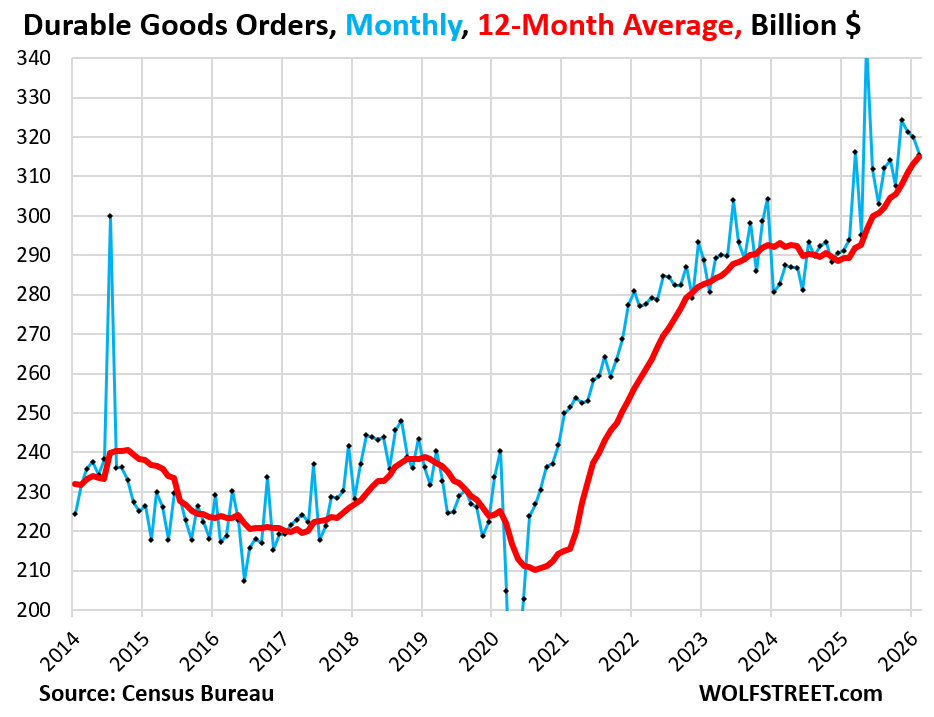
The 12-month average, which irons out Boeing’s huge orders, shows the trend: +8.8% year-over-year. Orders excluding aircraft & defense jumped by 1.5% in February from January.
By Wolf Richter for WOLF STREET.
When Boeing receives an order for 30 jet aircraft in one month, that huge order of billions of dollars pushes up durable goods orders that manufacturers in the US receive and that are published monthly. The next month, Boeing might not receive a big order like that, which will push down durable goods orders. We’ll sort that out in a moment.
Total durable goods orders, including aircraft and defense, fell by 1.4% in February from January, to $315 billion, seasonally adjusted. But they were up by 7.3% from a year ago (blue line), according to data from the Census Bureau today.
The 12-month average shows the trend in US manufacturing (red line). It irons out the month-to-month spikes and plunges of huge aircraft orders. In February, it rose by 0.5% from January and by 8.8% year-over-year, not seasonally adjusted. The surge started in early 2025, after flatlining in 2024, and after a multiyear surge out of the pandemic. Orders had essentially stagnated for years before the pandemic.
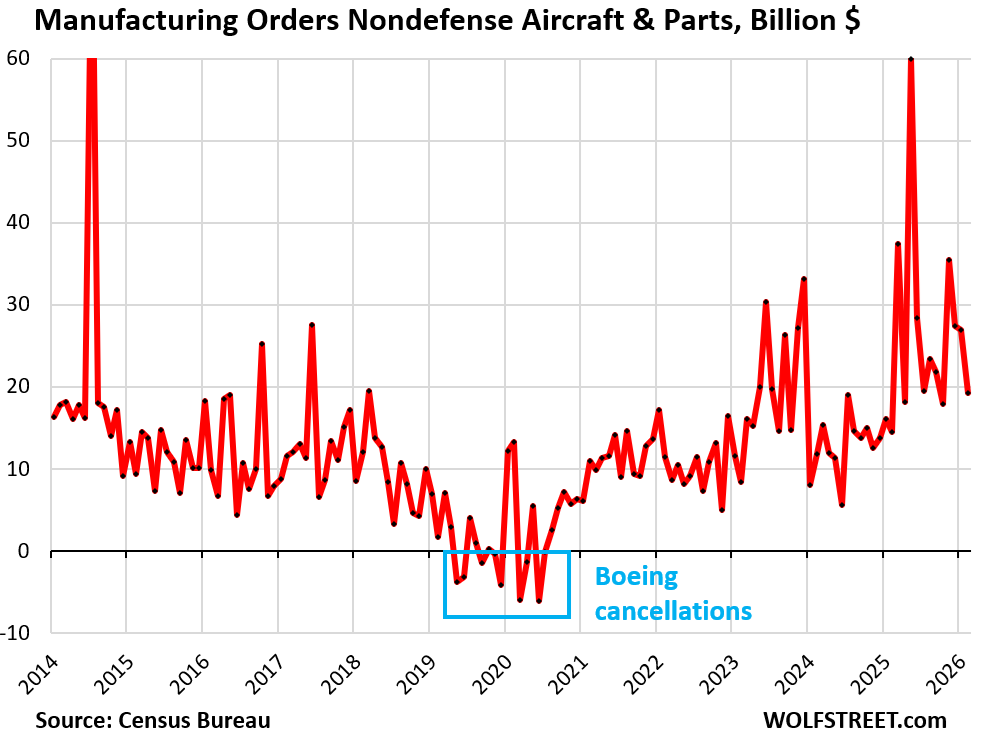
Orders for nondefense aircraft and parts spike and then plunge by huge amounts, largely driven by orders that Boeing receives. In February, they plunged by 7.7% from January, to $19.2 billion. But compared to February last year, orders were still up by 33%.
It’s not that aircraft orders are not important – they’re very important. But they’re randomly volatile on a month-to-month basis in a meaningless way that distorts the month-to-month figures.
In addition, orders for defense aircraft and defense capital goods might be erratic, especially with a war going on, and we can exclude those too to see through the fog.
So, orders excluding aircraft and defense jumped by 1.5% in February from January and by 5.8% year-over-year to a record $278 billion, seasonally adjusted.
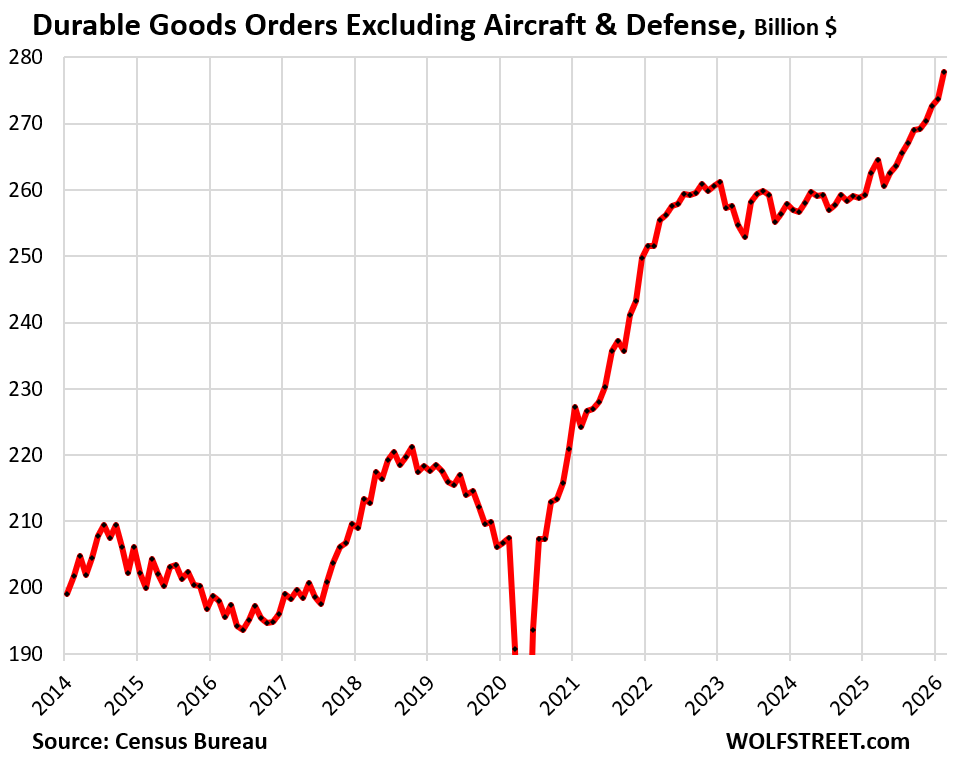
The increase of durable goods orders excluding nondefense aircraft and parts and excluding defense was driven by month-to-month increases in orders at manufacturers of:
- Computers & electronic products: +4.9% to $28 billion
- Motor vehicles & parts: +3.1% to $71 billion
- Primary metals: +2.2% to $29 billion
- Machinery: +1.5% to $41 billion
- Fabricated metal products: +0.5% to $43 billion
- All other durable goods: +0.5% to $50 billion
Only one major category had even a slight month-to-month dip, Electrical equipment, appliances, components: -0.1% to $18 billion. But that was a blip; year-to-date, orders were up by 6.4% from a year ago.
Shifting more manufacturing to the US is crucial for the economy and is crucial for strategic reasons. Trump and Biden were the first Presidents in modern times that understood this. Trump 1 encouraged it with tariffs on imported goods to incentivize companies to shift production to the US. Biden encouraged it with large-scale taxpayer-funded grants and loans paid to companies under the CHIPS Act and other programs to build factories in the US. Trump 2 encouraged it by imposing additional wide-ranging tariffs, and he largely maintained the CHIPS Act but rebranded it.
But it’s not instant. Even shifting production from a factory in another country to an existing factory in the US by adding shifts and more automation, such as GM has been doing, takes time. And the process of building a modern factory, from the moment the decision is made until mass-production starts, takes several years. Manufacturing is complicated and requires a lot of inputs, but it, and its secondary and tertiary effects, are hugely important to the US economy.
Enjoy reading WOLF STREET and want to support it? You can donate. I appreciate it immensely. Click on the mug to find out how:


There’s going to be a big spike in any electronics that use memory or other chips as people front run probable spikes in prices due to the war.
While oil and gas are spiking, the biggest electric car company in the world is tanking. Tesla cult is now a support group.
😂
I think people tend to have shorter attention spans and less patience for the overall goal, which is why so many people cry about the short term effects of the tariffs.
That is why America is in this situation.
China was patient and implemented long term goals…..
America implemented goals that had short term rewards and did it for a very long time.
Hopefully enough people will actually see the real numbers and see that it is slowly working.
The effects of decades of decisions will not be changed in days or weeks. Hopefully everyone will be patient and ride it out long term like our competitors… or maybe enemies.
China doesn’t have elections so there’s that
Yeah….
That is why hopefully the American
voter/public has the patience for a longer term plan that seems to be working for their long term benefit.
We don’t, though. Our midterms are 2 year cycles and are essentialy a media driven frenzy
And our voters cast their ballots based on whether the price of gasoline went up or down.
We don’t deserve to succeed.
CNET had an article yesterday saying the FCC is banning routers with foreign components, which is pretty much every router. Also it appears firmware updates may stop in March 2027, if this plan holds.
Without firmware updates, routers become much easier to hack.
This means huge on-shoring of router manufacturing, both parts and assembly, by early next year.
I would expect a spike in further factories next year, under the CHIP act and Trump’s incentives
President Trump’s policies are bringing us prosperity! After that war is won, we will even have more prosperity.
😂
You forgot the /s
You own an oil company don’t you?
We lost that war any benefits will overshadowed by increased costs
James Abney
You don’t know what “lost a war” means. You should have spent some time in Nuremberg in 1946 and look around at what was left (not much) after years of carpet-bombing. I have some pics of former residential areas and churches turned into piles of rubble. That’s what “lost a war” means.
So…basically…well thought out tariffs, especially reciprocal tariffs, are working.
Worth pointing out that order cancellations for Boeing aircraft 5-7 years ago were largely their own doing, i.e., not related to public policies, when management prioritized profits over safety.
The ones 5-7 years ago were in large part because the airlines weren’t sure what demand after Covid would be, not because of concerns about the max
I left the following as a ‘reply’ but really want to see feed back so…,
If you adjust for the price increases due to inflation in those same areas (less defense etc.) what is the actual growth?
Only card-carrying goofballs would adjust orders for durable goods that factories receive to consumer price inflation, such as CPI, which is dominated by services such as healthcare, insurance, and housing. In GDP, each narrow category of goods and services is adjusted to price changes in that narrow category. So if you want to know inflation in factory orders that a manufacturer receives, you can go look at the Producer Price Index (PPI) for that narrow category, and you will see that prices of many of the categories have DROPPED. Others have risen.
In overall terms in all goods except food and energy – so that’s a lot more categories than there are in durable goods – in 2023, the PPI rose by only 1.9%. In 2024, it rose by only 2.1%. in 2025, it rose by 4.2%.
By comparison, durable goods orders for the 12-month period through February was up by 8.8%.