
The business of selling used cars to people with a history of stiffing creditors, financing their loans inhouse, securitizing them, and selling the ABS to bond investors is not for the squeamish.
By Wolf Richter for WOLF STREET.
America’s Car-Mart, a dealer-lender chain specialized in selling used vehicles to subprime-rated customers and directly lending to them to fund their purchases, filed for prepackaged Chapter 11 bankruptcy today. Five subsidiaries, including Colonial Auto Finance, Texas Car-Mart, Colonial Underwriting, and Auto Finance Investors also filed for Chapter 11 bankruptcy, and requested joint administration of their cases
The company has agreed to sell substantially all its assets (not the corporation) to Cardinal Asset Holdings LLC, a privately held investment group formed specifically to acquire the assets of America’s Car-Mart, but will consider other higher bids, should they emerge.
The company said that under the deal, there would be enough funds to pay the unsecured trade creditors, but warns existing shareholders, which would be left holding the empty corporation, could get wiped out.
The CEO of Cardinal Asset Holdings, Tilman J. Falgout III, was chairman of America’s Car Mart until 2011. He is currently listed as Senior Executive Advisor at PE firm Brookside Equity Partners, and as Chairman of dealer chain Superior Auto Group.
After having closed 60 of its dealerships, America’s Car-Mart is down to 94 dealerships as of July 31, according to its quarterly filing with the SEC. These dealerships would remain open for business during the bankruptcy process.
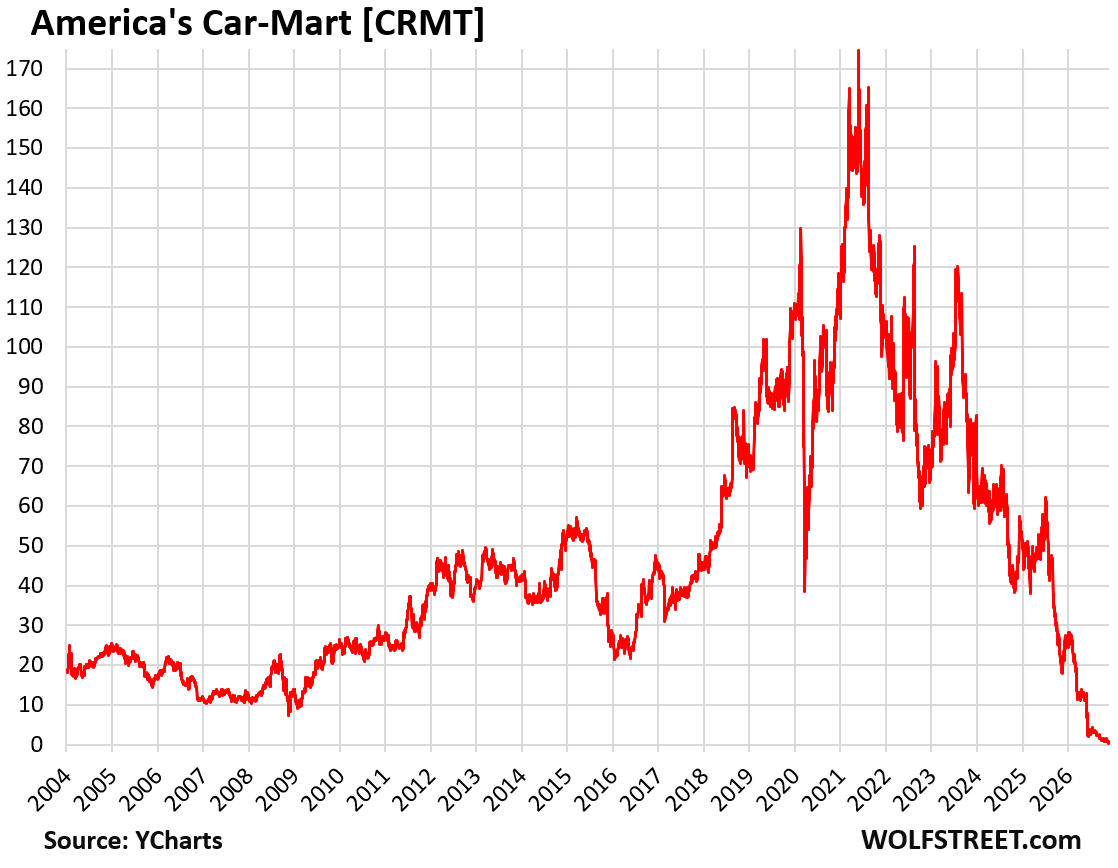
Nothing goes to heck in a straight line: In December 2023, America’s Car-Mart confessed for the first time to massive problems, and its shares [CRMT] tanked that day by 21%, but had already been down substantially, and at that point, were down 61% from their all-time high ($174.52 on May 26, 2021, during the free-money era). Earlier that year, several PE firm owned subprime-specialized dealer-lenders had collapsed.
In November 2024, the shares of America’s Car-Mart entered our pantheon of Imploded Stocks, as they’d plunged over 70% from the all-time high. The minimum requirement to qualify is a drop of at least 70% from the more or less recent all-time high.
The following year, in October 2025, another big subprime-specialized dealer-lender chain, Tricolor, collapsed amid a mushroom cloud of fraud allegations by its Wall Street lenders.
The high-risk and potentially high-profit business of selling older used vehicles at very high prices and huge gross profits to people who have a history of stiffing their creditors (which is why they’re rated subprime), financing those sales via in-house loans with sky-high interest rates, packaging those subprime loans into Asset-Backed Securities, and selling the ABS slices (many are rated “A” or higher) to institutional bond investors is not for the squeamish.
America’s Car-Mart shares are now trading at about 31 cents.
What pushed the company into bankruptcy was a senior secured $300 million loan by Silver Point Capital. On June 19, the credit agreement was amended whereby America’s Car-Mart obtained temporary covenant relief in exchange for lender fees of up to $18 million.
The loan was then extended and covenant provisions were waived several more times while the company was looking for a buyer or new capital.
In the bankruptcy filing today, the company said that it has received a commitment of $60 million in new-money financing from existing lenders of the now defaulted $300 million senior secured loan, Silver Point Capital.
Silver Point Capital would provide the new $60 million in Debtor-in-Possession (DIP) financing in two draws. In addition, Silver Point Capital would provide “roll-up loans in an aggregate principal amount of up to $65 million, plus all corresponding accrued and unpaid interest thereon through closing,” whereby $65 million of the defaulted $300 million loan, plus related interest, would be converted into a DIP loan.
DIP loans, which are provided to keep the company funded during the bankruptcy process, are super-senior to all other debts, and get paid off first if the company fails to emerge from bankruptcy.
Car-Mart’s DIP loans accrue interest at a rate of SOFR (currently about 3.90%) plus 10.50%, so about 14.4% currently. With each Fed rate hike, the rate moves up about 25 basis points.

Subprime dealer-lenders engage in a risky business.
And that business got a lot riskier when the Fed started raising its policy interest rates, which allowed investors to buy T-bills that currently earn over 4% and in 2023 earned over 5%. But ABS investors, who accepted a yield of 5% when T-bills were yielding near 0% in 2020 and 2021, demanded to be paid much higher yields than T-bill yields, which has made the exit pipeline for those loans from dealer-lenders’ books – the securitization of subprime-backed auto loans – more daunting, and some have had trouble selling their loans.
And overly aggressive and often reckless underwriting and risk-taking on the lending side has produced substantial credit losses that dealers or the ABS holders had to eat. And these subprime specialized dealers got squeezed from both sides.
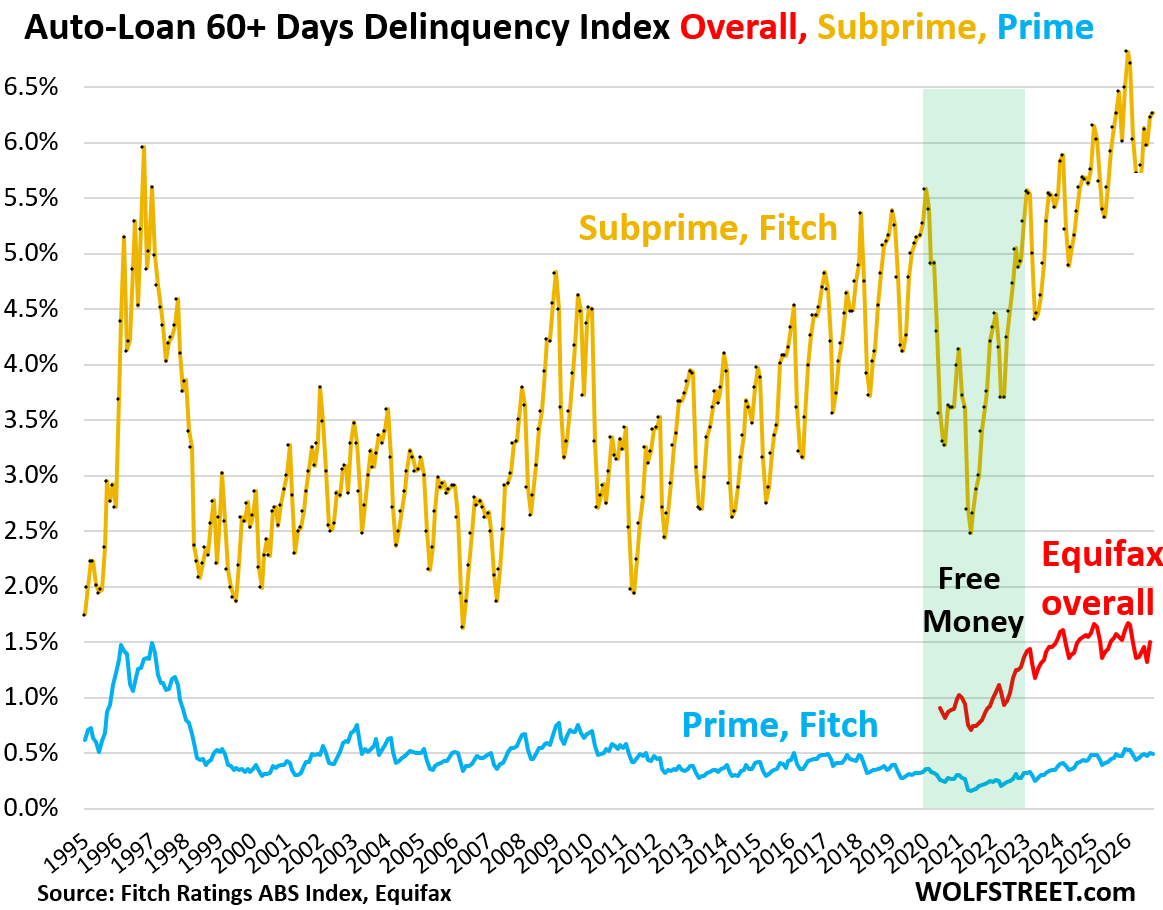
Fitch tracks the default rates of these subprime-backed ABS. Amid aggressive and often reckless underwriting, those defaults reached new highs in 2025 and early 2026, made worse by the Tricolor bankruptcy as many of their customers stopped making payments when Tricolor collapsed.
The bankruptcy of America’s Car-Mart could drive the delinquency rate even higher for the same reason.
Last week, I discussed the State of Americans’ Auto Debt: Delinquencies, Loan Length, Amount Financed, Credit Scores, Balances, and Burden.
And it included this chart of Fitch’s delinquency rate of subprime loans that had been securitized into ABS (yellow line). The chart also shows the overall 60-plus day delinquency rate per Equifax, which includes subprime (1.50%, red line) but only goes back to 2020, and the prime delinquency rate per Fitch (0.49%, blue line).
Enjoy reading WOLF STREET and want to support it? You can donate. I appreciate it immensely. Click on the mug to find out how:


In the year of our lord 2026, are lenders not probing what actually makes up an Asset-Backed Security….? Burry taught us nothing
They want to ride these people who do not plan and do not save for all they are worth.
I know this type very well, because well most Americans used to be like this.
You had kids, you had a job and you consumed. You afforded what you could. You didn’t save.
Sometimes people got behind and their credit was messed up. Sometimes you lost your job and got behind.
Sounds like this company preyed on these people. I mean I guess right?
Well they got their just desserts!
My belief/prediction is that this financial crisis/cancer, which this case is just one sterling example of, will spread extensively over the next several years.
Unfortunately, the upcoming elections will massively affect and exacerbate this situation, as liberal democrat financial policies will put more and more americans into the buy here, pay here category of car buyers.
I’m afraid we’ll all see this type of financial instability move into traditional car buying, and perhaps even housing and certainly banking.
The solution? Have a passport and plans for another country when the instabilities in the US become to problematic. Defeatist? Perhaps, but always have a plan B and C, at a minimum.
YMMV….
I thought this one was already gone and shut down a long time ago.
Cars depreciate way too fast for subprime lending to be successful. By the time the loan is in default, the car is most likely worth less than the lien itself when it goes to auction. I am guessing that the goal of these companies is to pay executives and founders enough salary that when the whole scheme blows up, investors eat all of the losses.
All about dodgy auto financing for customers needing it.
Yes yes I know, Not Nividia, but maybe someone will now order the company made solvent?
One particular aspect of auto financing and dealerships….supposedly established and top notch….that absolutely pisses me off is when the sales dept deal with senior elderly people who will never outlive their loan. This happened to a past tenant and friend of mine. He needed wheels when his truck calved so I took him to the dealership he has used for 50 years. They sold him a piece of crap used car that when questioned he told me it was for a lower price than what he actually signed up for. I was his executor and did his bill payments so I asked him why he did not just pay cash? (No, he paid more for the car and couldn’t do it. I think he was ashamed of what he paid, actually). Then he deteriorates and goes into a care home and I started dealing with his GD car. After sussing it all out, (underwater), and my options for selling it, (nil and none) my decision was to simply stop the account auto payments. So I did. Then the phone calls started and threatening letters. I told the reps “you don’t understand, just come and get it. I have it all washed and cleaned and ready to go for you. More threats until finally one day a tow operator came up to repossess two vehicles, both from senior seniors. Since then, I have talked to many people who have gone through the same thing telling the people to just seize the GD vehicle and quit with the threats. One was a jeep sold to an 85 year old guy with 6 years still owing.
Somebody will cover these losses one way or another and it won’t be the dealership.
My 84 year old neighbour actually thinks he got a deal with “LIFETIME $10 OIL CHANGES”. He boasts about it all the time but I don’t need to tell him the full amount he paid for a Nissan Pathfinder that seats 8, that he paid $80K for with all the bells and whistles, that he might get 2-3 more of the fabulous $10 dollar oil changes before he loses his license, probably covered the deal of the decade for the next 100 years.
The entire industry is tarred with these practices. You wonder why the auto showrooms look like luxurious cathedrals, polished floors, lots of space? Somebody is simply making too much money selling and financing autos.
Regarding America’s Car Mart… good riddance to the 60 dealerships already closed, and let’s hope the remaining 94 get consolidated too. These businesses do not deliver value to their customers. They rip off people who are bad at math, and are more like payday lenders than transportation providers.
——————————–
The real story is the rise in subprime delinquencies to levels above what happened during the GFC when the unemployment rate was 10% (last chart).
I wonder if this percentage based measure is missing that the overall subprime population has decreased as more folks have stable employment now than they did in the past, and so the people remaining in the subprime category are the perpetually troubled? Or maybe it’s the same percentage of all borrowers? IDK.
If the subprime population hasn’t gone down, then the rise in delinquencies represents either too much loosey-goosey lending OR a macroeconomic phenomenon of everyone getting poorer. Either diagnosis would be a big deal, so I’d like to know if anyone has the answer.
“The real story is the rise in subprime delinquencies to levels above what happened during the GFC when the unemployment rate was 10%”
No, that’s not the real story. Read the article. What’s in the article is the real story.
Subprime auto loans are a specialized small part of auto lending and an even smaller part of total auto sales since about half of used vehicle sales are cash deals and don’t involve loans at all. And of the other half of used vehicle loans, only about 15% are subprime. Subprime auto loans have zero impact on the economy or banks. The high subprime delinquency rate – see the last chart in the article – is a result of reckless underwriting and the bankruptcies of the big specialized lenders that caused their customers to stop making payments. Read the article, it explains it.
I write a lot about the car business, given my background. And this is another article about a specialized part of the car business – particularly one company in it. It has zero to do with “consumers” and says nothing about “consumers,” but has everything to do with the recklessness and worse among the specialized subprime dealer-lenders and their Wall Street banks running the ABS.
Wolf, love your attention to the automotive sector – it’s just such a huge chunk of the American economy at so-o-o many levels! Wondering if you might take a look at the “classic” car market sometime?
Happy Thanksgiving
“Car-Mart’s DIP loans accrue interest at a rate of SOFR (currently about 3.90%) plus 10.50%, so about 14.4% currently. With each Fed rate hike, the rate moves up about 25 basis points. Subprime dealer-lenders engage in a risky business.
And that business got a lot riskier when the Fed started raising its policy interest rates, which allowed investors to buy T-bills that currently earn over 4% and in 2023 earned over 5%. But ABS investors, who accepted a yield of 5% when T-bills were yielding near 0% in 2020 and 2021, demanded to be paid much higher yields than T-bill yields, which has made the exit pipeline for those loans from dealer-lenders’ books – the securitization of subprime-backed auto loans – more daunting, and some have had trouble selling their loans.”
This is yet another perfect example of the kind of dogshit that the FED’s policies created, and how it led to exploding car prices and massive inflation.
As a foreigner I must congratulate you on your wonderful invention of someone called “Tilman J. Falgout III”. That satire brightened up your tale of woe.
Hello, Google says he actually exists: “active owner of a recreational boat dealership in Austin”. Did you ever? I suspect that “recreational boat” doesn’t mean little dinghies for small boys to potter about in.
Yes, he owns that too. And he owns part of a bank in Texas, and he is on the board of other stuff, and has other known investments. I just listed what is relevant to the topic: PE Firm and auto dealer chain.
The fact that you’re too dumb to google him properly is your fault, not mine
🤣🤣🤣🤣🤣🤣🤣🤣🤣🤣🤣🤣
Were you confusing him with Senator Beauregard Claghorn?
No mention of how the deportation of tens of thousands of low paid immigrants probably is inpacting a big segment of this loan market?
1. Not with America’s Car Mart because it didn’t cater to illegal immigrants.
2. But Tricolor did cater to illegal immigrants. Tricolor was one hell of a mess. So click on the link above to my article on Tricolor — it discusses the issue of illegal immigrants. And then come back and report what you read.
3. Illegal immigrants do NOT have a credit rating at all, and therefore weren’t “subprime” and don’t figure into the subprime data. They normally pay cash and maybe borrow from each other. They normally don’t borrow from a lender at all — unless they have forged documents with a stolen SS number, and that’s loan fraud. By catering to illegal immigrants, and by allegedly committing all kinds of fraud, Tricolor blew itself up.
4. Subprime doesn’t meant “poor.” It means “BAD CREDIT” — people with a history of having stiffed their creditors. That young dentist getting into it over his head with student loans, a fancy house, fancy cars, etc. is a classic example of high-income subprime. He’ll get it worked out and will eventually be super-prime. But he’ll spend some time in subprime purgatory.
The stockholder purchased the stock expecting outsized returns. High risk, high rewards/high losses, ya take your chances…….
Speaking of subprime. Any chance we get an update on ole Cathy Woodshed?
As it should be Wolf. What the world needs is in fact serious asset deflation. As much as the bankers and financiers don’t want it, gravity (fundamentals) will reassert itself.
Hedge accordingly.