
Three months before insolvency of the SS Trust Fund in 1983, Congress passed and Reagan signed a fix that lasted 40 years. Now Congress needs to stop dilly-dallying around.
By Wolf Richter for WOLF STREET.
Congress needs to get serious about tweaking Social Security, but this time to improve the financial aspects. Last time it tweaked the “Old-Age and Survivors Insurance” (OASI), as it’s called officially, was by passing the Social Security Fairness Act, which President Biden signed on January 5, 2025, which caused the Social Security deficit to worsen. The Act expanded benefits to retirees with careers in government, education, and law enforcement who were already covered under public pension plans, and included retroactive catch-up payments. The Act substantially expanded the costs, but it did not expand the contributions.
The Social Security Administration (SSA) has now released the income and costs for the fiscal year ended September 30, and it’s an ugly situation:
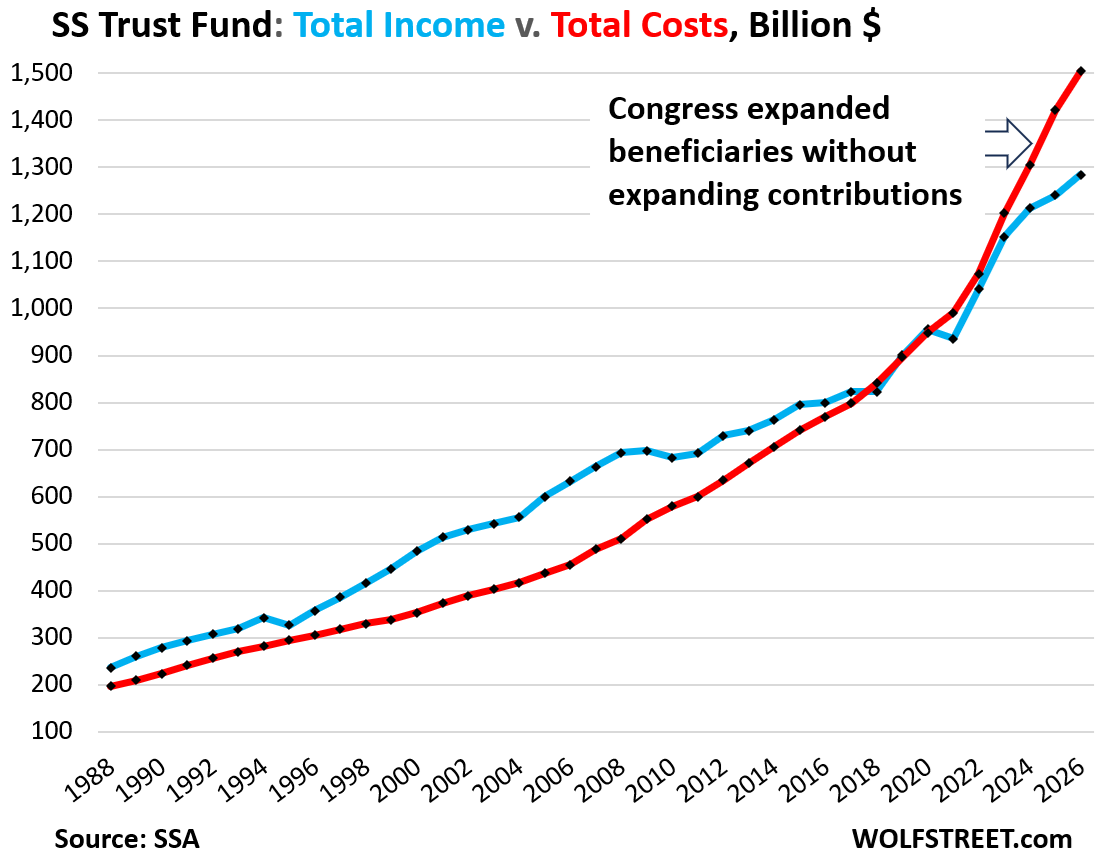
- Total income rose by $43.5 billion from the prior year to $1.28 trillion, up by 3.5% year-over-year (blue in the chart).
- Total costs soared by $83 billion, or by 5.8%, year-over-year, and by 16% in since the Social Security Fairness Act became law, to $1.50 trillion in fiscal 2026 (red).
All of the figures here exclude the Disability Insurance Trust Fund, which by law is a separate entity from the OASI Trust Fund, and is not part of this discussion here.
When the total income (blue) was above the total costs (red), the Social Security Trust Fund ran a surplus, which caused assets to accumulate, and the Trust Fund balance grew. In 2018, the costs exceeded income for the first time, creating the first deficit in over four decades, and the Trust Fund declined. That deficit has now blown out.
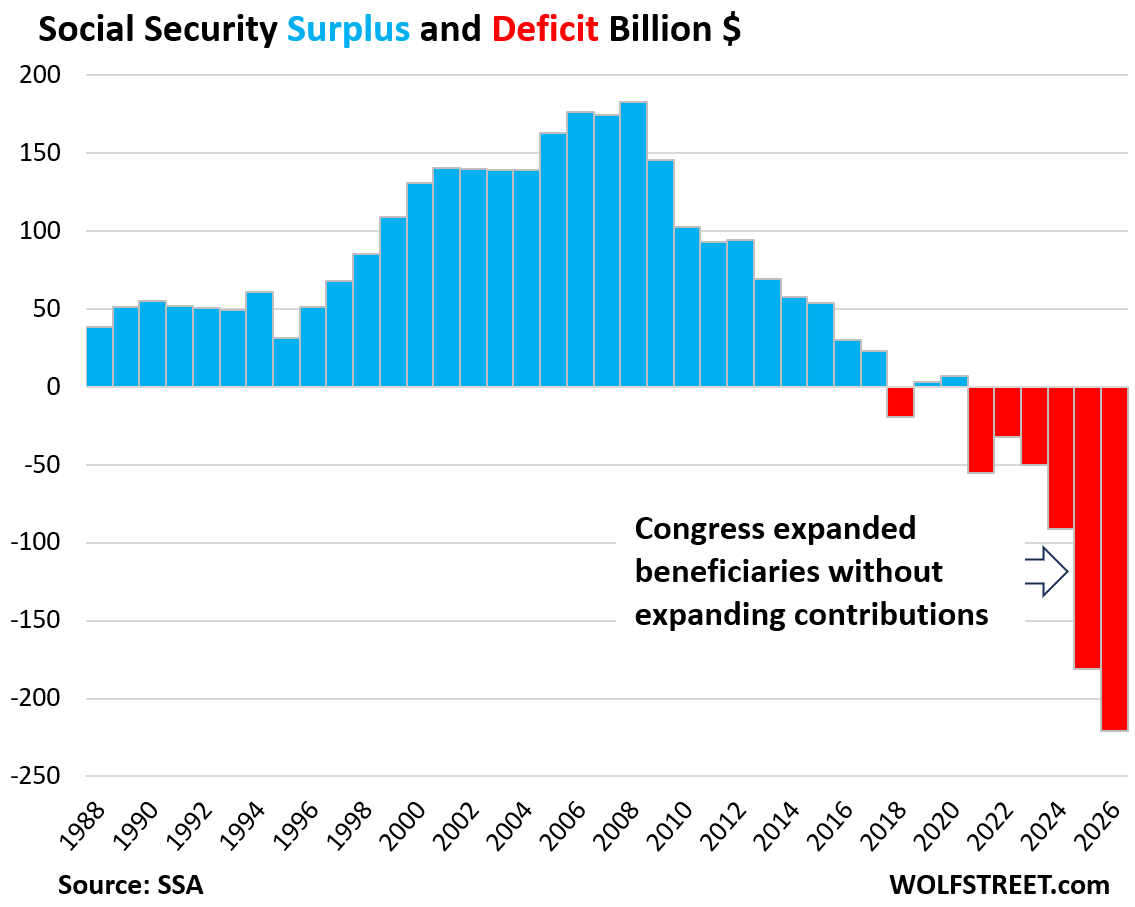
The deficit – the difference between the fund’s income and costs – already in bad shape in prior years, worsened further over the two years since the passing of the Social Security Fairness Act. In fiscal 2025, the deficit doubled year-over-year to $181 billion, driven in part by the retroactive payments and expanded number of beneficiaries, and then further soared in fiscal 2026 to $220 billion.
Compared to fiscal 2024, over those two years, the deficit has soared by 141%.
The Social Security Trust Fund balance fell by the amount of the deficit, by $220 billion, or by 9.2%, to $2.18 trillion at the end of September.
Over the years from the mid-1980s through 2017, the Trust Fund ran surpluses each year, and they totaled $2.82 trillion by 2017, before the deficits started to eat into it.
Since the peak in 2017, the Trust Fund balance has dropped by $640 billion, or by 22.7%.
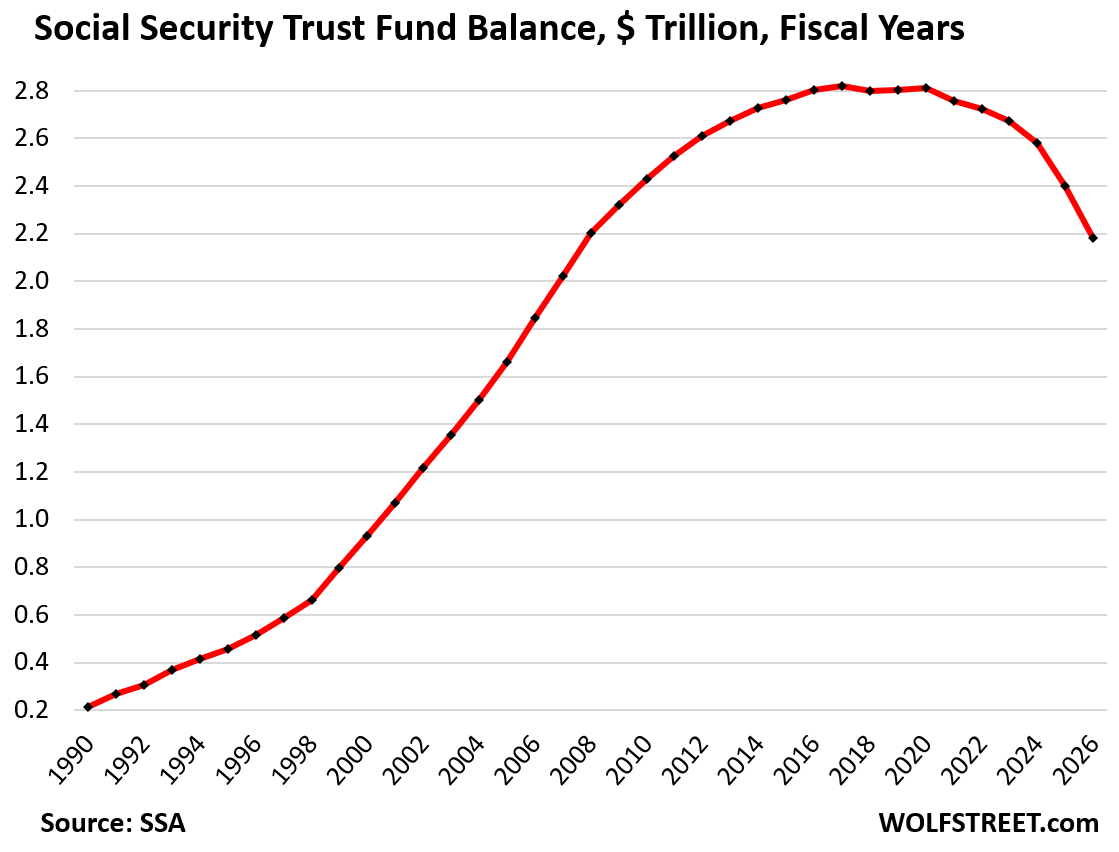
In April 1983, three months before insolvency of the SS Trust Fund, Congress finally passed by a bipartisan vote, and President Reagan signed into law, the “Social Security Amendments of 1983,” which tweaked various aspects of the system, creating the surpluses that caused the Trust Fund balances to rise for over 40 years, to peak at $2.82 trillion in 2017.
In the House, 163 Democrats and 80 Republicans voted for it; 51 Democrats and 38 Republicans didn’t vote; and 54 Democrats and 48 Republicans voted against it. In the Senate, 26 Democrats and 32 Republicans voted for it. It was not smooth sailing. But they passed it. Here’s the tally.
Now, the Social Security’s Trustees and the Congressional Budget Office (CBO) both expect that, without changes by Congress, the Social Security Trust Fund will run out of funds by mid-2032, at which point retirees either see their benefits get cut by 23%, or Congress fills in the hole from the general budget.
One minute before midnight is usually when Congress finally gets together to resolve thorny issues. Compared to the nail-biter in the early 1980s, there is still some time to fix the system. But the longer Congress dilly-dallies around, the bigger the Social Security deficit gets, and the more difficult it gets to fix.
Several proposals have been floated in Congress in recent years to fix the system, but they have persistently gone nowhere. Each proposed to tweak the system in several ways simultaneously, with each tweak being relatively small, but combined and over time, they’d add up and fix the system for decades, such as the tweaks under Reagan had done.

Income and costs in fiscal 2026.
Total income (blue line in the first chart) rose by $43.5 billion, or by 3.5% year-over-year, to a record $1.28 trillion. Total income consists of contributions, interest income, and taxation benefits.
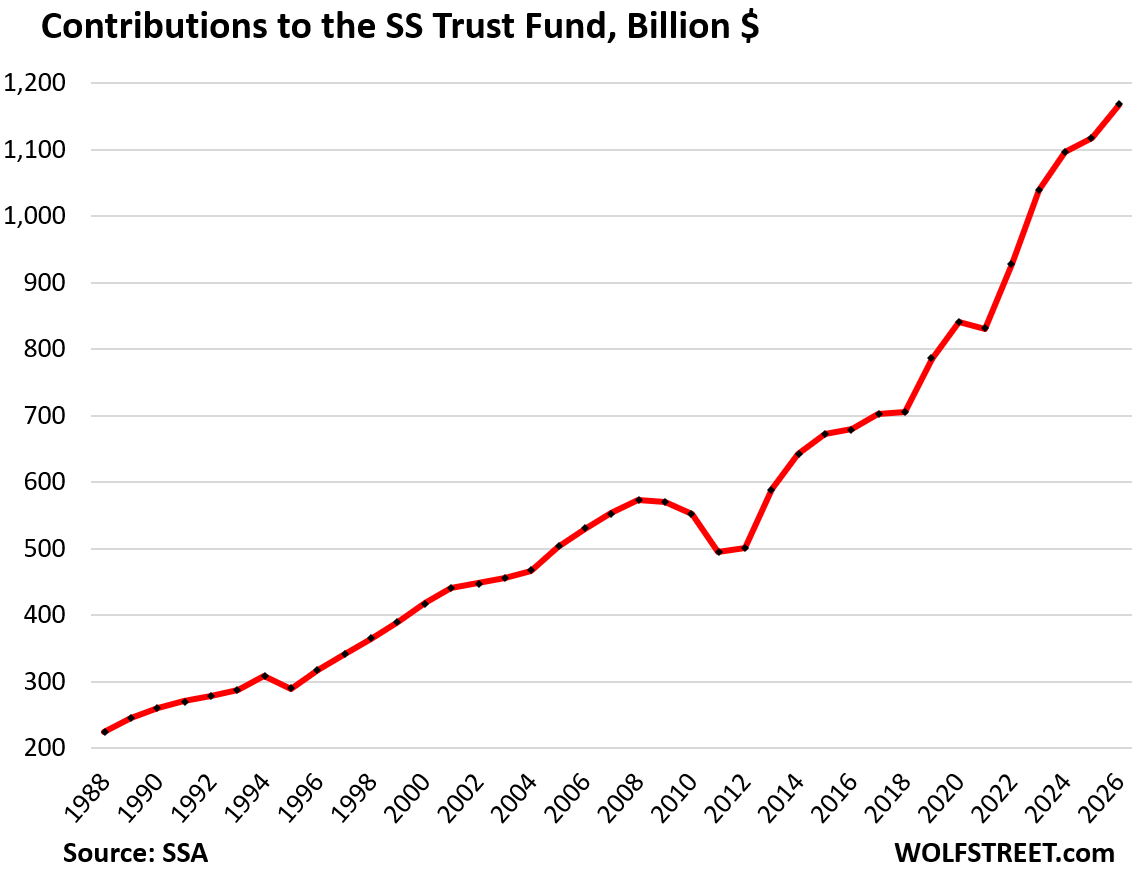
Contributions rose by $49.7 billion, or by 4.4% year-over-year, to $1.17 trillion. This increase was driven by the growth of wages and salaries. The increase was more than double the increase in the prior year (+1.9%) as the labor market improved in 2026.
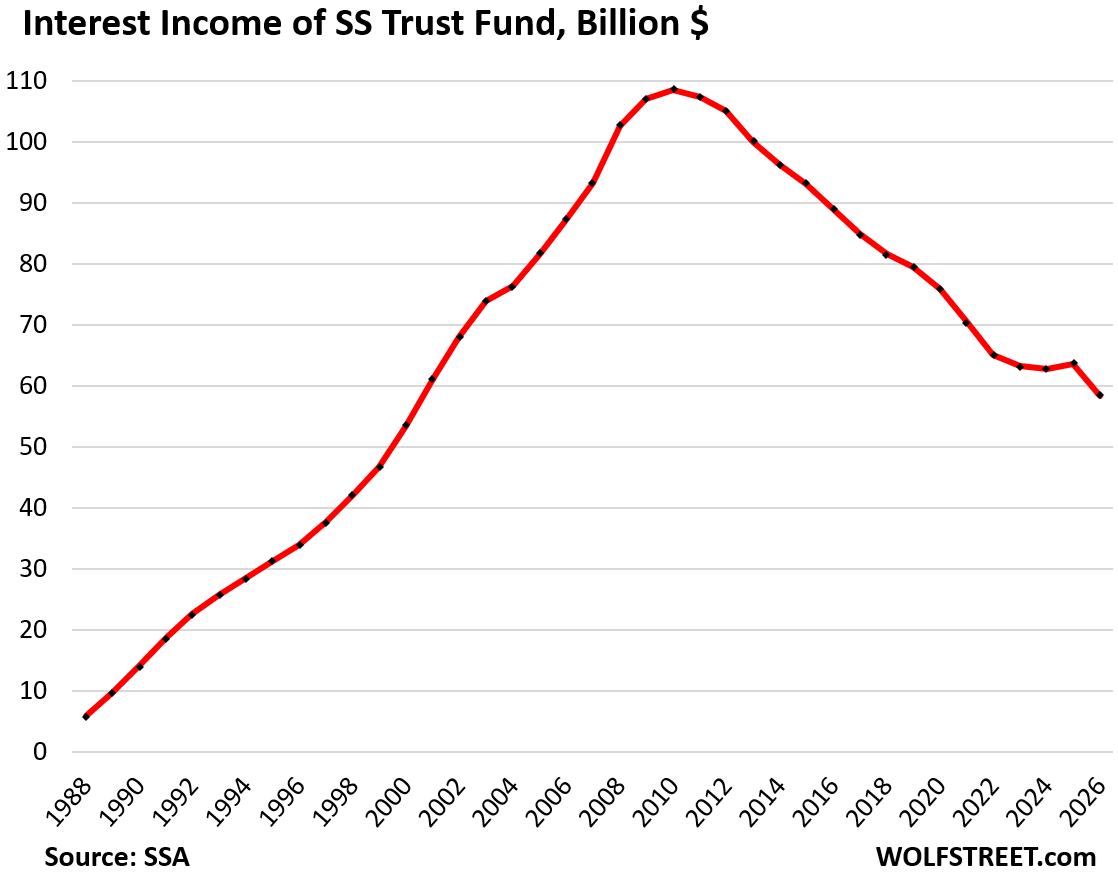
Interest income from the securities in the Trust Fund declined by 8.3% to $58.4 billion, largely because the balance in the Trust Fund that earns interest dropped by 9.2% year-over-year.
With the exception of fiscal 2025, interest income has been declining since 2010, when the Fed’s reckless financial repression (QE and ZIRP) had caused short-term rates to collapse to near 0% and long-term rates to very low levels, even as the Trust Fund balance was ballooning at the time.
The higher interest rates since 2022 have started to filter into the securities in the Trust Fund, but now the Trust Fund balance is much lower due to the exploding deficits.
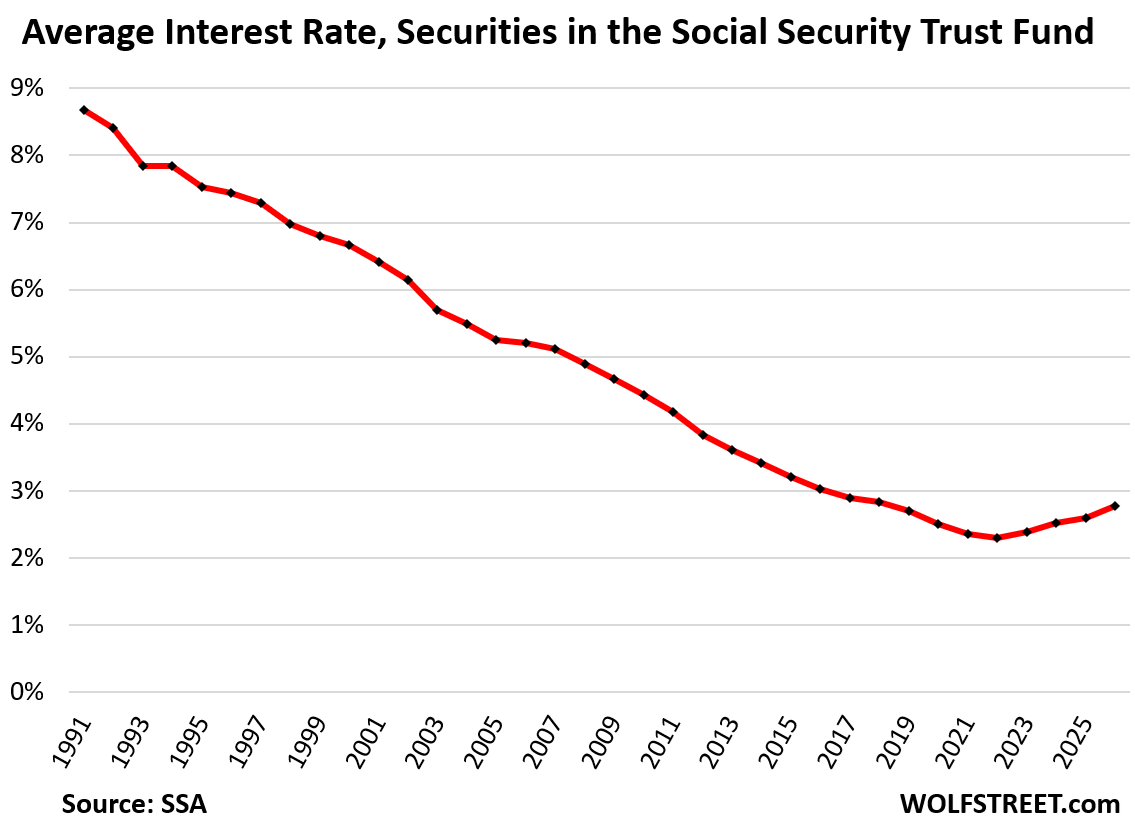
The average interest rate that the Trust Fund earns on its Treasury securities ticked up to 2.78%, the fourth year in a row of slow increases, as low-interest-rate securities from the QE and ZIRP era matured and were replaced with higher-interest rate securities with shorter maturities.
Taxation benefits declined by $2.4 billion from the record in the prior year, to $55.8 billion in fiscal 2026, the second-highest on record.
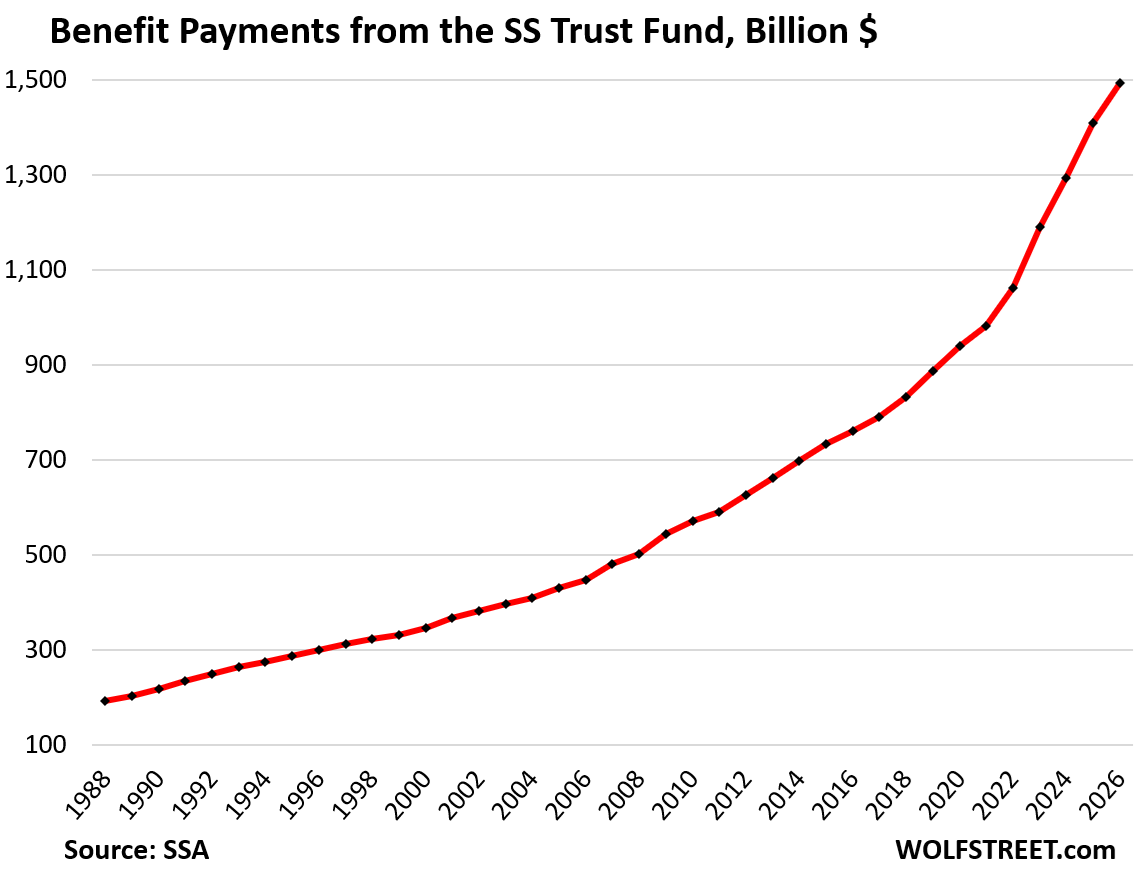
Total costs (red line in the first chart) spiked by $83 billion in fiscal 2026 through September 30, or by 5.8% year-over-year, and by 16% from two years ago, to a record $1.50 trillion.
Benefit payments spiked by $83 billion (+5.9%), to $1.49 trillion, attributable to more retirees drawing benefits, including through the Social Security Fairness Act, and to Cost of Living Adjustments (COLAs).
Other costs: Administrative expenses fell for the second year in a row, this time by $800 million, after the $300 million decline in fiscal 2025, to $3.7 billion, amounting to 0.17% of the Trust Fund balance. And Transfer to Railroad Retirement Program rose by $300 million to $6.3 billion.
How the Trust Fund invests the $2.18 trillion.
Of the Trust Fund’s total balance, $1.98 trillion was invested in interest-bearing special-issue Treasury securities and $198 billion was invested in short-term cash-management securities (“certificates of indebtedness”).
The interest-bearing special-issue Treasury securities are not traded in the secondary market, and their prices don’t change. Series I savings bonds that are popular with retail investors – the current generation I bonds pays 5.51% annualized rate for the next six months – work on the same principle: They’re held at accounts at TreasuryDirect, they’re not traded in the secondary market, and to cash them in, investors sell them back to the government. So, day-to-day price fluctuations in the bond market are irrelevant for the Trust Fund.
Enjoy reading WOLF STREET and want to support it? You can donate. I appreciate it immensely. Click on the mug to find out how:


While they dilly dalley I’m going to eat some fiddle faddle
I’d like to just keep my SS deductions at this point and be paid only relating to what I’ve already contributed when time comes.
Sir: I was disappointed in your description of what the last change to Social Security did: “The Act expanded benefits to retirees with careers in government, education, and law enforcement who were already covered under public pension plans, and included retroactive catch-up payments.” An honest description of this would be to indicate that if at last created a level playing field where all non SSA pensions are treated equally. For example, previously, people receiving pensions from State retirement systems would lose their SSA benefits while this receiving pensions from, for example, federal retirement systems did not. It is important that someone in your position be “honest” about these kinds of things. Thank you.