
Continually improving technologies, from automation to the computerization of everything, have caused labor productivity to soar.
By Wolf Richter for WOLF STREET.
The generation of semiconductor plants currently being built in the US require an enormous amount of investment, and they will employ relatively few workers – a portion of them highly paid engineers and technicians – but the output, once running near capacity, will be enormous.
So just some sample figures. It may take $3 billion to build the facility, and another $17 billion to equip the plant with the machinery that actually produces the semiconductors. When operational, the fab may have 2,000 workers, including engineers, technicians, and people working in supply chain logistics, security, facility management, etc.
As most of the actual work is done by machines at a fab like this, the share of the output that goes to labor compensation (salaries and benefits) is relatively small.
Modern auto manufacturing plants are automated to the maximum possible degree, with industrial robots having taken over numerous operations. Other operations are still done by labor, such as the installation of wiring harnesses. A plant like this is a far cry from the auto manufacturing plants 100 years ago when every operation was done by labor.
The cost of human labor in a motor vehicle is now down to about 8% to 12% of the costs of manufacturing the vehicle, according to the Center for Automotive Research, and also according to management consulting firm Oliver Wyman, a division of Marsh (formerly Marsh McLennan).
But the relatively few workers in factories are now highly trained, and quite a few are engineers and technicians.
The pools of secretaries taking dictation in shorthand and typing business correspondence manually on IBM Selectrics don’t exist anymore, having been replaced by computers and email. A lot of white-collar labor, such as data-entry, inventory management, invoicing, payroll, accounts receivable, etc. was computerized decades ago, and now machines do most of that work. Automation and computerization have spread across the entire economy. Ever more advanced technology in all forms does much of the work.
These massive shifts were brought about over the decades by constant innovation and technological changes to reduce the labor component of output – and businesses invested massive amounts of capital to accomplish that.
Technology & automation have made labor immensely more productive.
Labor makes the output happen, but much of the actual work is done by machines.
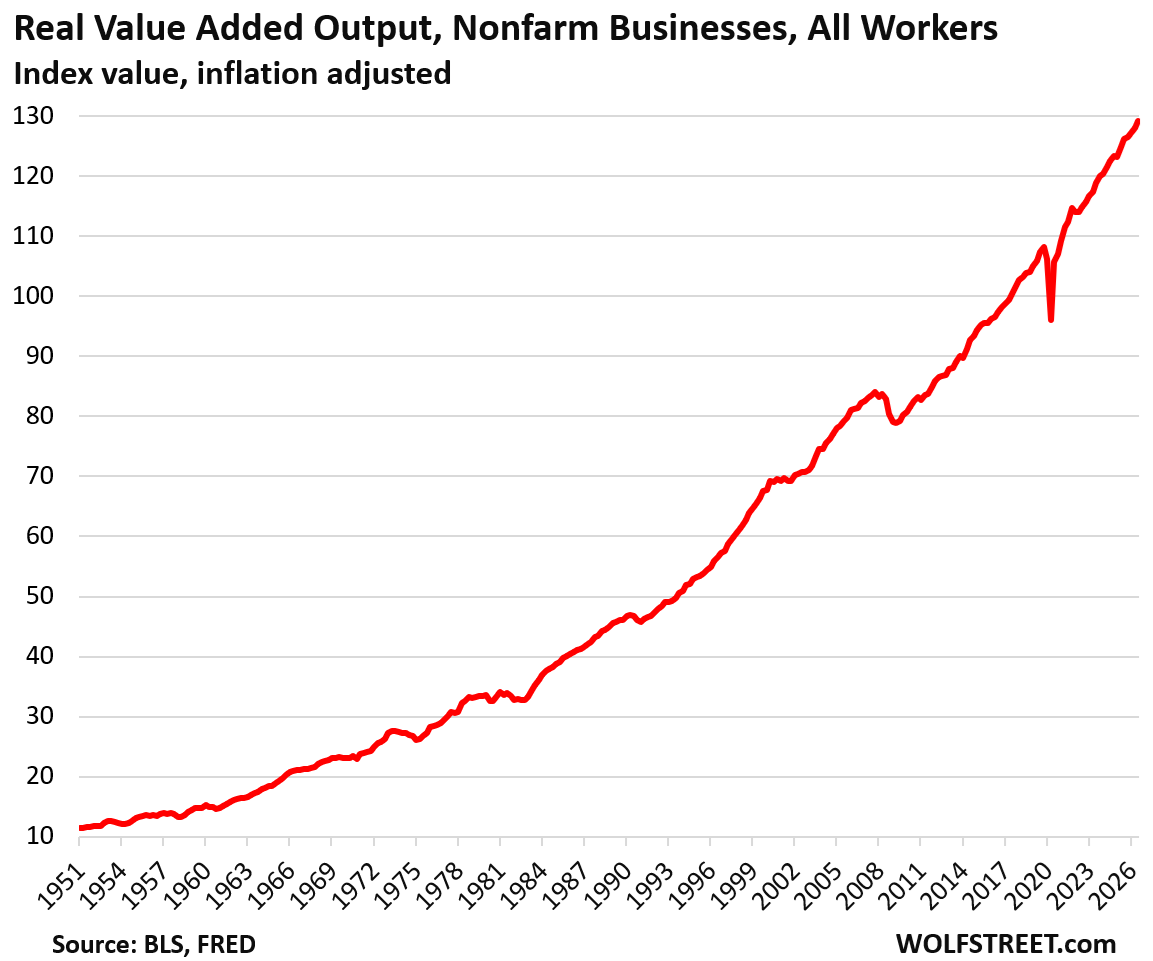
The index for “real” (inflation-adjusted) value added output for all workers in nonfarm businesses has doubled since 1999 and quadrupled since 1982.
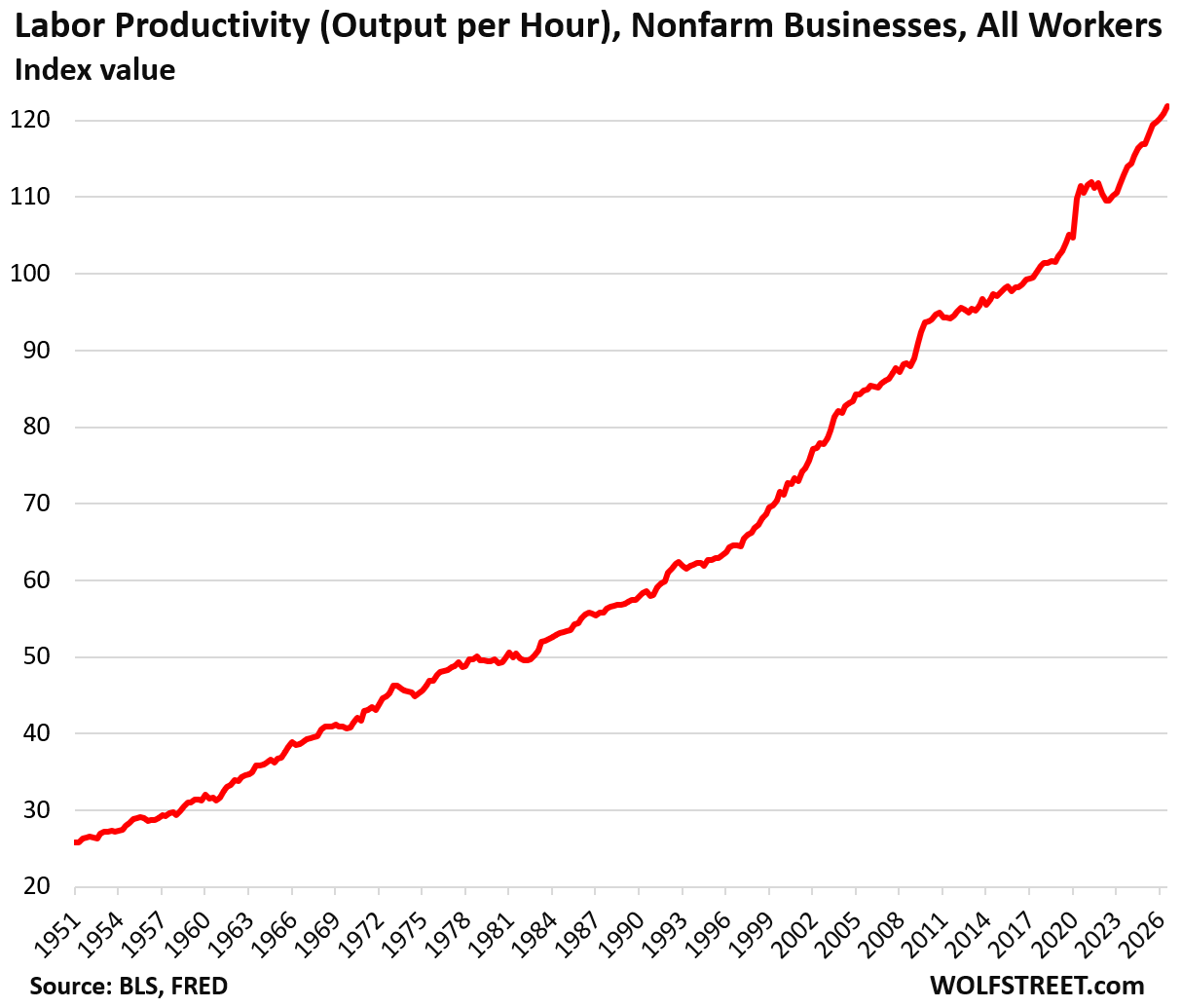
Continually improved technologies of all kinds, including automation and the computerization of everything, has caused labor productivity to soar.

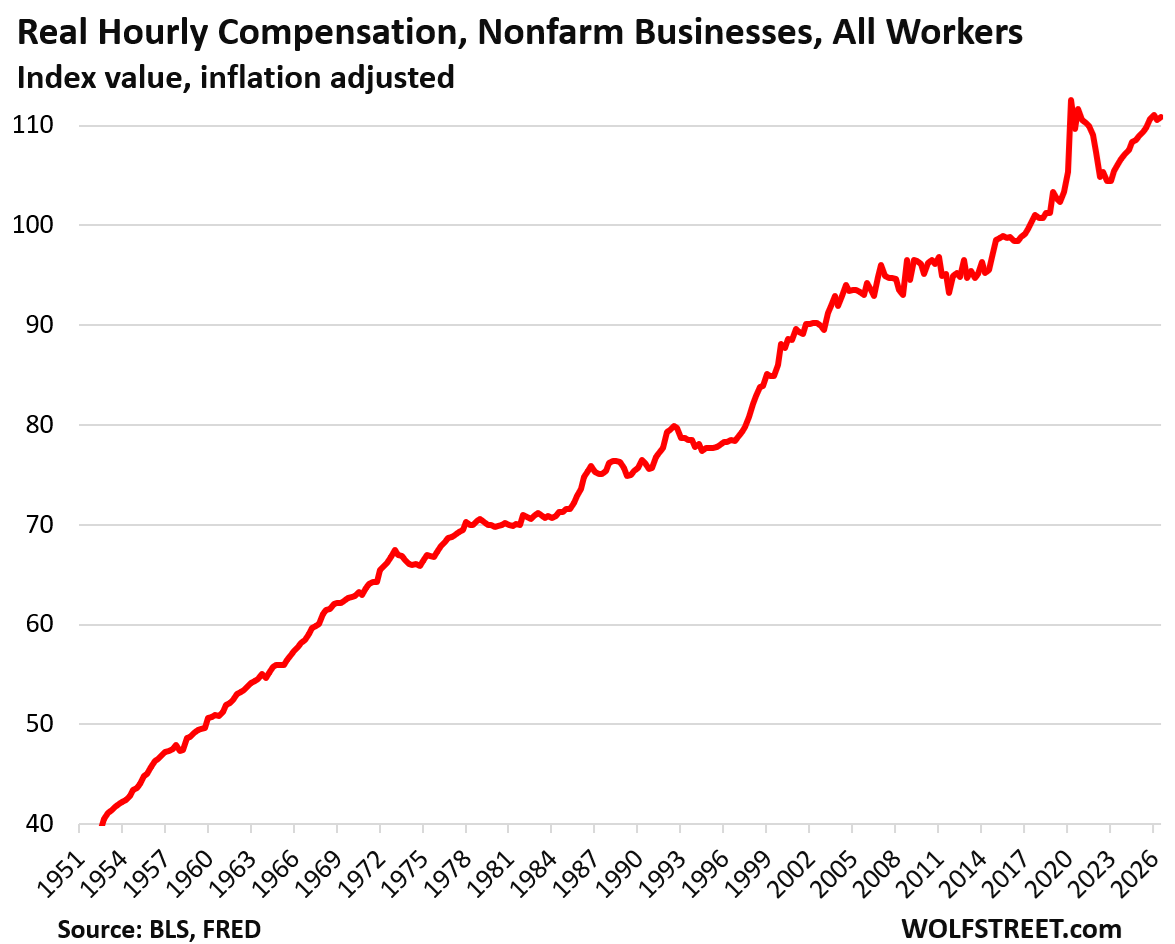
Real hourly compensation – which includes the costs of benefits and is adjusted for inflation – has risen sharply over the decades as labor shifted upscale in terms of skills, while machines did an increasingly large portion of the work.
These figures reflect the cost of labor for the employer, including benefit costs, adjusted for inflation. The spike in inflation in 2021 and 2022, particularly the spike in healthcare costs and other benefit costs, caused the decline of “real” hourly compensation over those two years.
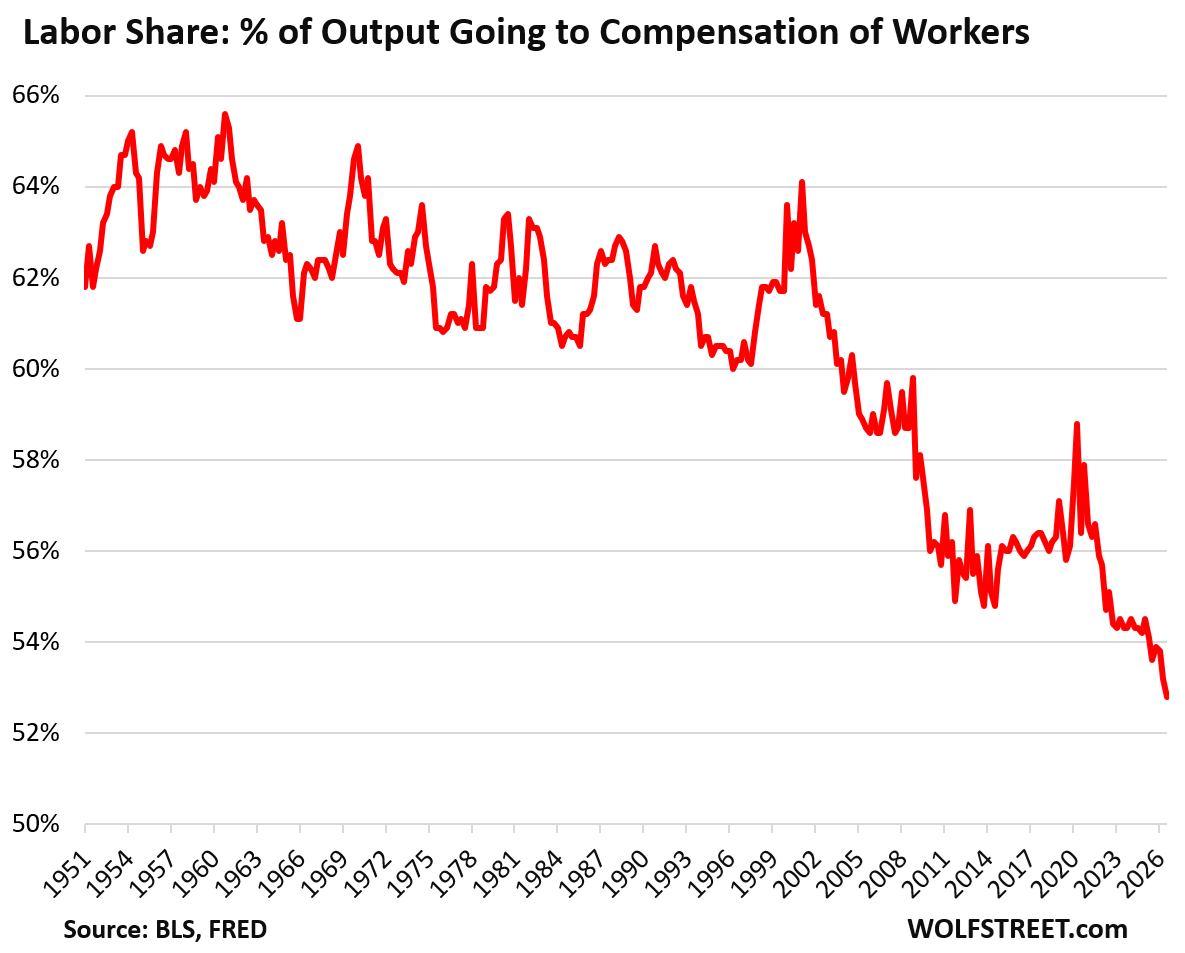
With machines doing an increasingly large portion of the work, a smaller and smaller portion of the output is going to labor as compensation.
In the motor vehicle manufacturing example above, the cost of labor – the share of output that goes to labor as compensation – has declined to 8-12% of the total cost of manufacturing the vehicle.
Production equipment, computers and networks of all types, any machinery and equipment in general are massive investments for businesses. For a chip fab, the total investment can run over $20 billion. Those are also the costs of production, but they’re measured as investments (an asset on the balance sheet) that are depreciated over time (an expense on the income statement).
There are other factors, such as shifting work from labor to customers. The internet and computerization have made that common: Online banking and ATMs – the customer does everything, and the bank provides banking services (output) without labor involved – caused bank labor productivity to soar. Online brokers, self-checkout at grocery stores, self-service gas stations and car washes…
They all create output with little or no labor, and labor productivity in those businesses soars. And the share of the output that goes to labor drops – though each of the remaining employees gets paid more as their productivity has risen (see chart above).
Technological advances cannot be stopped. They all have had the effect of destroying some jobs but creating more jobs than they destroyed, and creating higher-level jobs, where labor ends up doing more challenging work, and makes more money, but the share of output going to labor declines.
And that has benefited labor overall, and the economy overall, though for some individuals whose job was destroyed by automation, moving on to a job requiring higher skill levels can prove to be tough or impossible.
Now there’s this theory or fear that AI may be the first technology that destroys more jobs than it creates. There are lots of arguments on both sides. So far, AI seems to have destroyed some jobs, but also created jobs, such as in the AI development ecosystem (including a gazillion AI startups), in the AI infrastructure buildout, and in cybersecurity to defend websites (such as bank sites) against AI hacking. Overall employment has been rising this year, and the jury is still out on the net effects of AI on labor.
Enjoy reading WOLF STREET and want to support it? You can donate. I appreciate it immensely. Click on the mug to find out how: