
Next week is loaded for the bond market: Two key inflation reports and the 10-year & 30-year Treasury auctions.
By Wolf Richter for WOLF STREET.
On Friday, the day of the strong jobs report, Treasury prices fell, and yields rose. The Treasury market had been rallying for a month through Thursday, and yields fell substantially over that month (when bond prices rise, yields fall).
The recent high in yields occurred around the 10-year and 30-year Treasury auctions in early October. In the secondary market, the 10-year yield had closed at a high of 5.31% on October 5. At the October 7 auction, 10-year Treasury notes were sold at a yield of 5.30%, the highest auction yield since November 2000. The 30-year Treasury yield closed at 5.71% on October 7, and the next day, 30-year Treasury bonds were sold at a yield of 5.618%, the highest auction yield since August 2000, but already down by 10 basis points from the close the day before.
The market breathed a sigh of relief that Treasuries weren’t going to heck in a straight line, or whatever, and that was the beginning of the Treasury rally.
Short-term Treasury yields didn’t budge much over that month. The action was at the longer end of the yield curve.
Declines in yields from October 5 through Friday’s close (yields rose on Friday, so the declines were bigger through Thursday):
- 2-year yield: -33 basis points.
- 3-year yield: -38 basis points.
- 5-year yield: -42 basis points.
- 7-year yield: -45 basis points.
- 10-year yield: -45 basis points.
- 20-year yield: -41 basis points.
- 30-year yield: -40 basis points.
But how much of a rally (decline in yields) is this compared to prior periods?
The 30-year Treasury yield dropped by 40 basis points through Friday, to close at 5.26%.
This has become my favorite 30-year Treasury chart. I’ve shown it for quite a while. Every single rally since 2023 was defeated by the black double-line or before it even got there, and yields then bounced back as prices fell back again. Some day in the future, the yield will break through that line substantially enough. But that hasn’t happened yet. The current rally (yield -40 basis points) would have to push the yield below 5%, so a drop of another 30 basis points or so to get the yield to break through the double-line.
The dotted black line shows the trend, calculated from the yields in the time frame of the chart going back to 2022.
The dotted blue line represents the Effective Federal Funds Rate, which the Fed targets with its short-term policy rates.
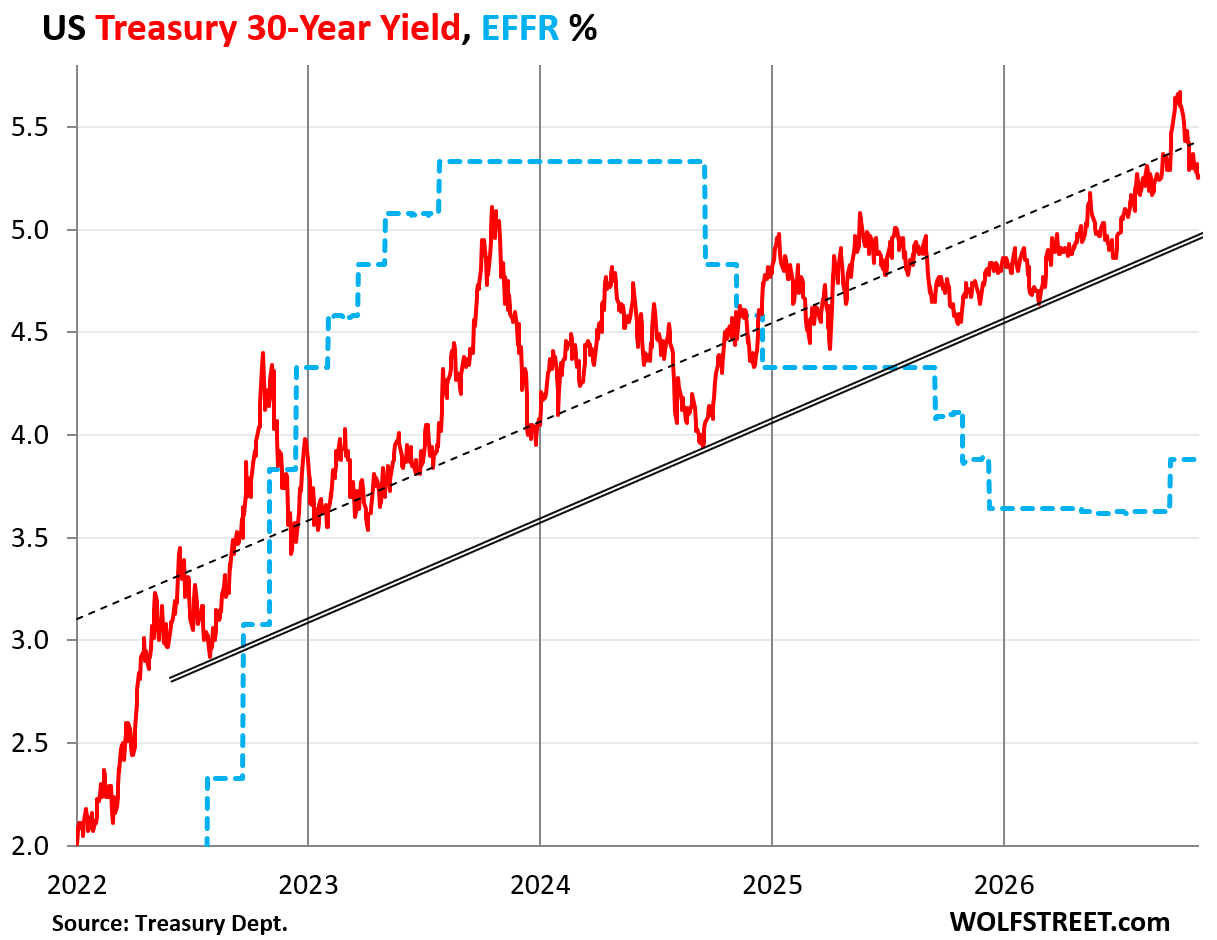
Prior rallies during which yields fell a lot more:
- Late 2022 (-100 basis points)
- Late 2023 (-114 basis points)
- Mid-2024 (-86 basis points)
- Early 2025 (-58 basis points)
- Mid-2025 (-53 basis points).
The market was due for a big rally, and so far, the rally hasn’t been that big.
If the rally ends here with a 40-basis-point drop, and yields turn higher from here, that would be another worrisome sign for the bond market, because it would show that it can’t even get a decent relief rally together.
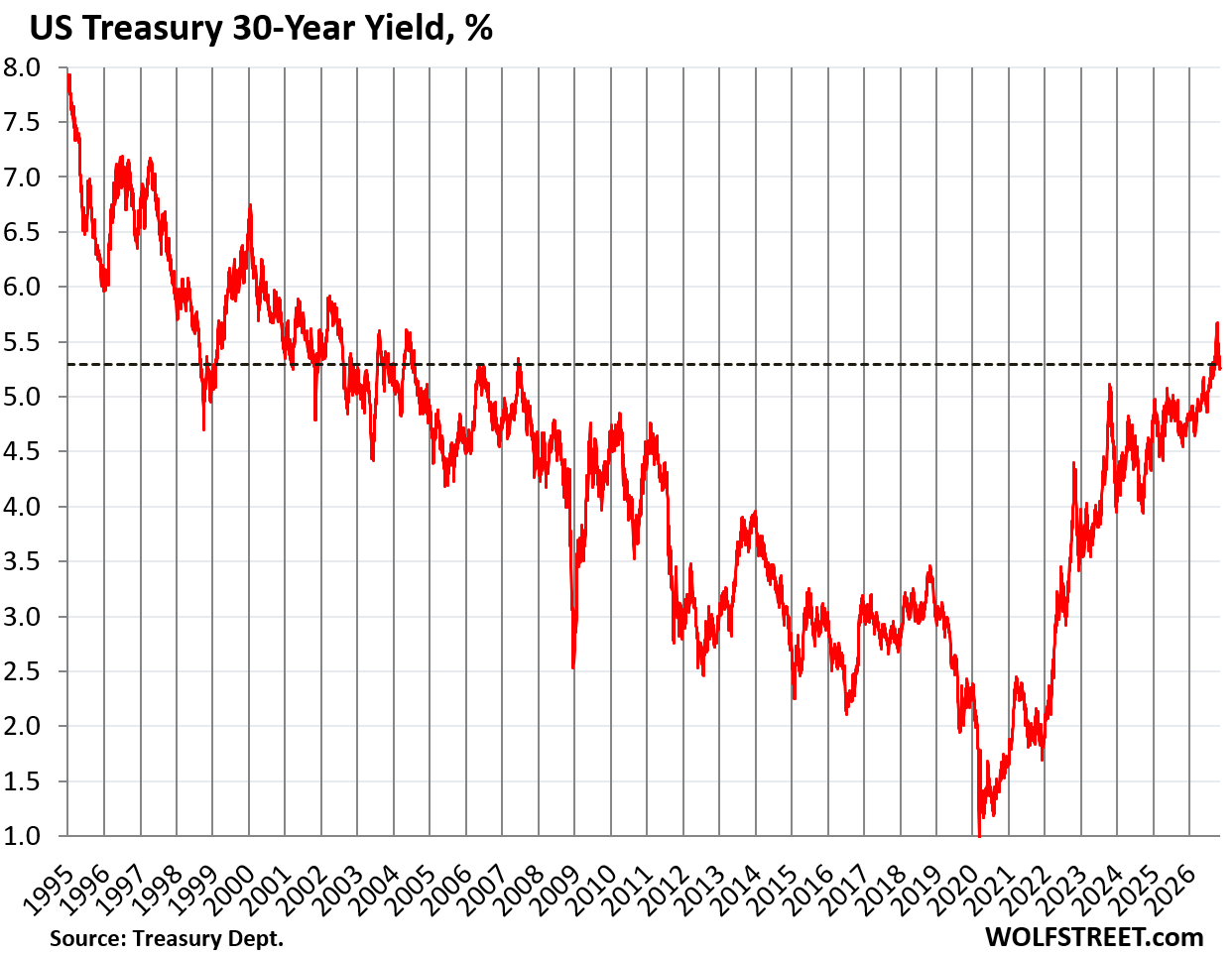
The long-term context shows just how puny that current rally has been so far. The 40-basis-point decline barely registers amid many massive drops. If the rally ends here and yields bounce higher, it would be pointing at the possibility of an additional significant selloff, with yields starting the next leg higher.
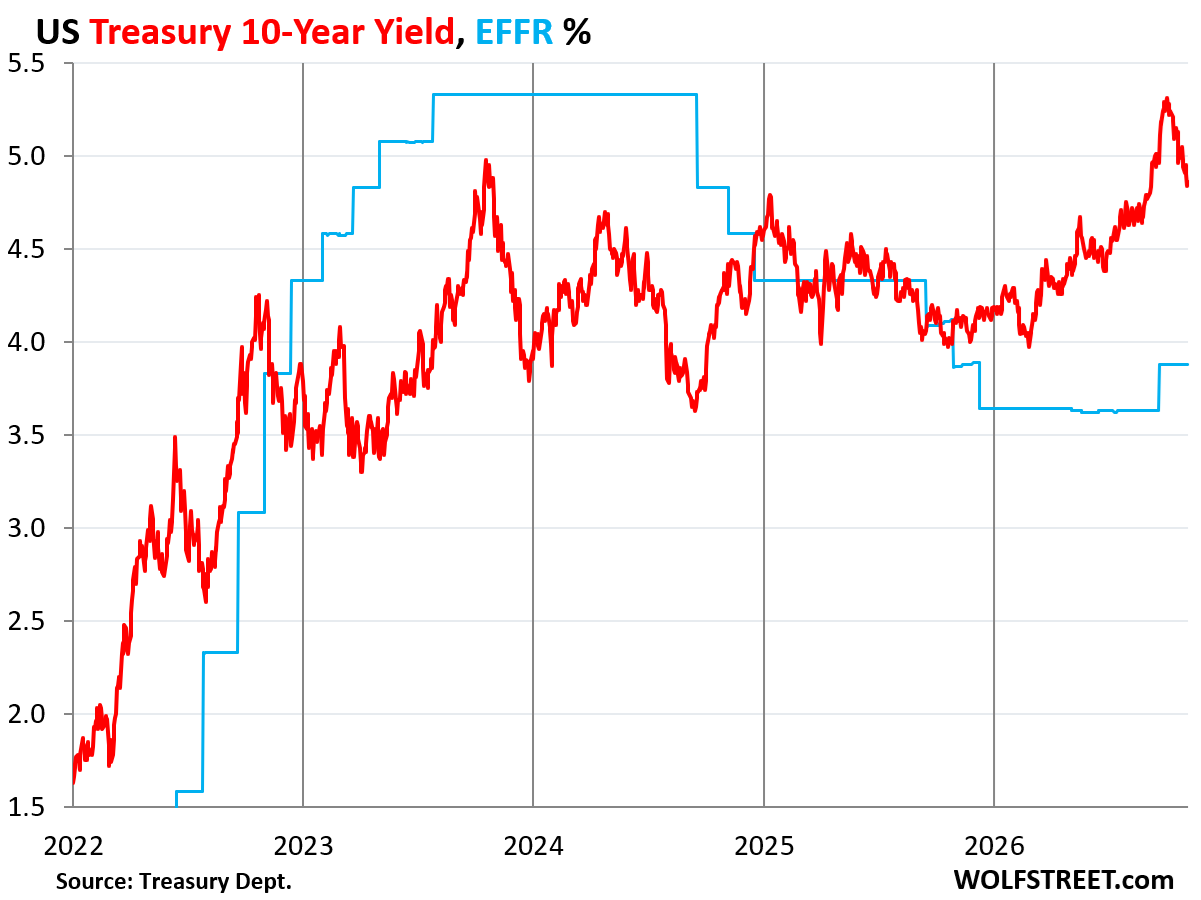
The 10-year Treasury yield shows a similar picture of a relatively small rally, with the yield dropping by 45 basis points through Friday to close at 4.86% – after ticking up 2 basis points on Friday.
Every year from 2022 through 2025 had bigger drops in yields, including a 121-basis-point drop in late 2023 and a 105-basis-point drop in mid-2024. And those yield declines were, with hindsight, just relief rallies in the years-long selloff. The 10-year yield would have to drop by another 60 basis points to be in their category.
It could do that. And theoretically, it should do that, as it had done before, because the drop in yield hasn’t been big enough yet for a proper rally after that kind of yield-surge.
But if it doesn’t, if the 10-year yield heads higher from here, that would be another bad sign for the bond market.
On the long-term chart, the 40-basis-point decline of the yield barely registers amid huge declines.
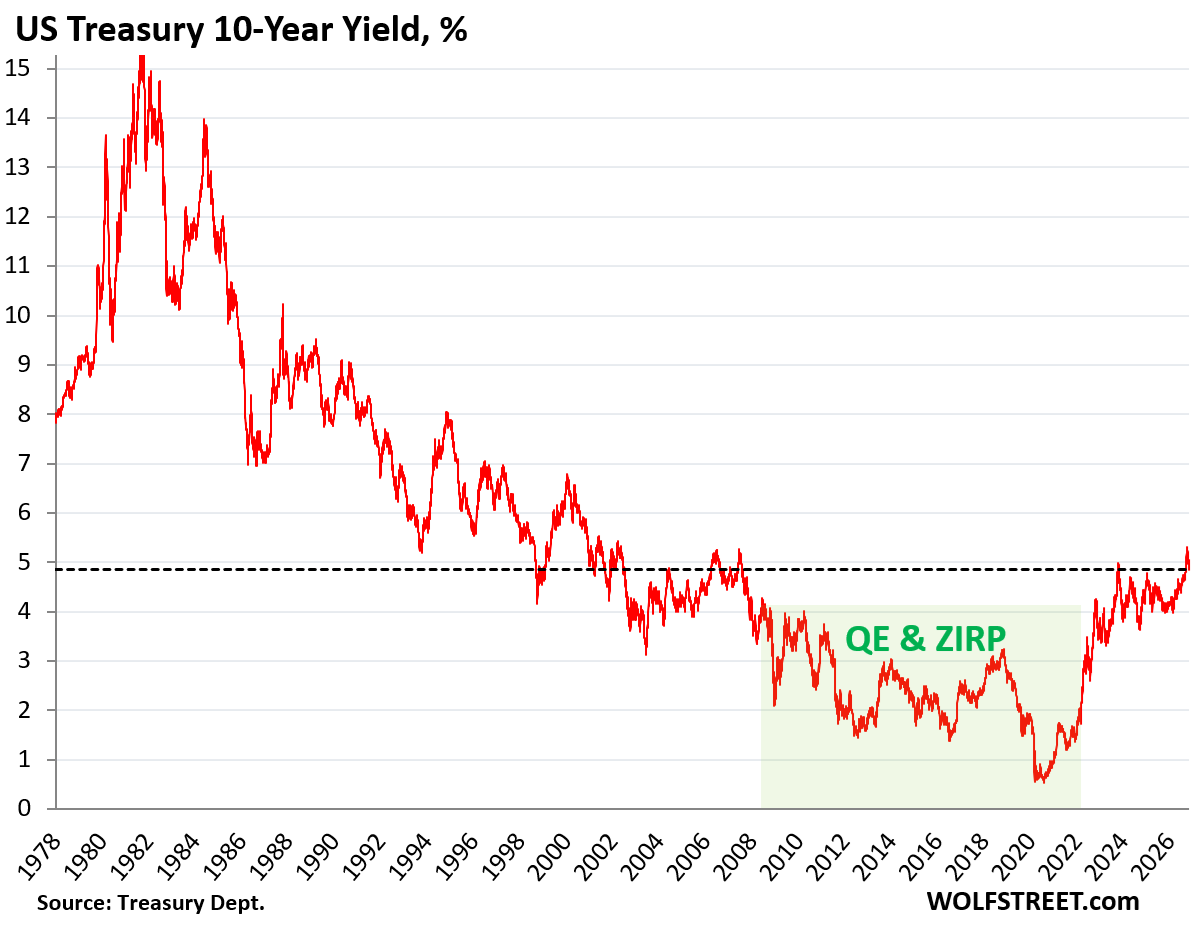
Next week is loaded for the bond market.
Two big inflation reports get thrown into this mix next week: On Tuesday, November 10, the Consumer Price Index for October (consumer-facing inflation), and on Friday, November 13, the Producer Price Index (business-facing inflation). And they could move Treasury yields in either direction.
Higher inflation than expected would add to the stronger-than-expected jobs report that was released on Friday and caused yields to turn around and rise on Friday.
For long-term Treasuries, hot inflation is a scourge because it whittles away at the purchasing power year after year, and yields need to be high enough to compensate for the loss of purchasing power, plus some.
According to FactSet’s average of the economists it polled, the month-to-month inflation readings should be cooler than the hot readings in August and September: +0.24% month-to-month for the all-items CPI and +0.2% for the Core CPI.
But there is a wrinkle. The Bureau of Labor Statistics will not publish a year-over-year increase since there was no CPI reading in October last year due to the government shutdown, and so there will not be a base for the year-over-year calculation. The annual all-items CPI in October rose by 3.7%.
Three longer-term Treasury auctions will also take place next week: The 3-year note auction on Monday, the 10-year note auction on Tuesday a few hours after the CPI release, and the 30-year bond auction on Thursday.
So next week could turn out to be the crucial moment when the bond market decides that this rally was good enough, and the selloff starts all over again; or that the rally would go on for a while longer.
Not appetizing at this yield. Long-term yields have fallen back into the range where this observer (and buyer at the 10-year and 20-year auctions in October) finds them unappetizing and will not be nibbling at the auctions.
Enjoy reading WOLF STREET and want to support it? You can donate. I appreciate it immensely. Click on the mug to find out how:


There are those who do not feel that rising interest rates represent “going to heck” or Hell either.
Prob some are kicking themselves for not buying before this AI rout.
A nice 5.5% prob seems better than -300% the QQQ bonkers etf could see in a severe downturn. But maybe those addicts can’t even feel 5.5% anymore. Who knows
Can you lose 300% in an ETF?
apparently but not normally
Hi Wolf, you might want to fix “poiont”.
Thanks.
Business and personal bankruptcies are up by 11 percent. The personal savings rate is 3.8 percent. Labors share of income is totally skewed.
There is heightened uncertainty.
But Cleveland’s y-o-y inflation forecast is still climbing.
Best to sit this one out.
“Labors share of income is totally skewed.”
Yes, because sweat shops don’t exist anymore in the US, because 3,000 workers and lots of industrial robots can assemble many more cars than 50,000 workers could decades ago, and because pools of secretaries taking dictation in shorthand and typing business correspondence manually on IBM Selectrics don’t exist anymore, having been replaced by computers and email, and because all that silly manual labor in the office (invoicing, payroll, AR, etc.) was computerized and now machines do that that work, and humans are employed in better jobs than mind-numbing data entry, and it’s these machines that produce income.
I’ll have an article on this later today or tomorrow because I’m getting tired of this nonsense getting dragged into here all of a sudden — started about a month ago as someone out there created some clickbait that went viral and is now polluting the internet.
Eagerly awaiting this article Wolf! I have multiple friends who need to hear it
Part-time jobs increased by 339,000 to 4.8 million.
Good lordy, every month people drag this BS into here.
Part time for economic reason is what matters, which is also the figure that you cite without saying so. These are workers who would have preferred full-time employment but were working part time because their hours had been reduced or they were unable to find full-time jobs.
I look for robots to unionize.
AI and all that ya” know.
“Not appetizing at this yield.”
That’s about all the foreshadowing I need to determine that this relief rally (“Dead Bessent Bounce”) is about over with. Our beloved Wolf is a pretty good bellwether.
Well-presented portrayal of the relatively modest directional reprieve on 10 year Treasury yields, Wolf.
Up 400 bp rate rise from 2020 to October 2026 deserves at least a 50 bp “correction” as rates grind higher over the NEXT couple of decades!
Your 48 year long 10 year Treasury chart reveals at least 1/2 dozen similar “corrections” as rates dropped from 15% in 1981 to 1% in 2021. (e.g. 1987 when yields spike from 7 to 10%)
I lost all my money in a card game at Janet Yellen’s Halloween party
Are you David Pumpkins? ?
I certainlly hope we see a backup in yields, I have oodles to buy across the curve.
Perhaps a rise in short term rates from the Fed would ease inflation fears and help stabilize the long term bond market.
This week’s job numbers show that such a move would be unlikely to cause a recession.
Why would higher yields be worrisome?
Why would it worry anyone that investors are (finally) being paid a realistic yield?
It’s ironic that decades ago Bessent worked for Soros when they were betting against the British pound, now he is on our sovereign side playing a serious game of liars poker to keep bond yield down.
Liars poker is game of bluffing on numbers on dollar bills and a great book. I’ve been commenting here 4.85 is the trampoline point for the 10 year, weekly closes are important. 4.859 was the weekly close. Bessent will have his hands full the next 2 years with selling new debt and keeping rates from getting way out of hand. Thanks wolf for the article and format to share. It would be uncomfortable at dinner parties to tell everyone that their stock portfolio is going down 70% and their annuities are loaded with AI bonds that will default, and their long term bond portfolio will get rocked as well. So thanks for allowing me to share here. Futures are not yet open, but tomorrow I expect more selling in equities and maybe some buying in the 10 year before Tuesday. If someone asks me at a dinner party my thought I tell them the truth!!
Cheers
T bill and chill?
If only there was a meme of the bond market grimacing, saying “Go ahead, make my day”
I nibbled on some 3 year notes back when you had the nibble article. Felt like the sweet spot since 4.88 seemed a small enough timeframe with decent enough return above FFR. Plenty rolling in short term still in the event the unpredictable winds change direction but waiting the December FOMC. Seems plausible inflation will come on as high or higher and with solid jobs report and midterms over seems a hike possible.
According to A History of Interest Rates there were two great bond bear markets in the late 19th and 20th century. The first one started in 1899 and ended in 1920. The second great bond bear market started in 1946 and ended in 1881. The were plenty of opportunities within those time frames to get your face ripped off if you found yourself short at the wrong time. Question is do you think any of the market participants knew they were dealing with a long term “great” bear market for fixed income when they were only 5 years into it? Probably not. In fact most everyone likely thought just like everyone does today that rates were about to collapse back to the old lows.
What was the underlying reason for those bond bear markets? 1946. Post WW2 nations had high debts, many exceeding 200% of GDP that had to be inflated away. 1899. The new electrical and industrial chemical technologies were being ramped up. 2026 has both these features, high debts/GDP ratio, AI coming on stream.
John Bridger-
You said “… plenty of opportunities within those time frames to get your face ripped off…”
Yes, and a similar number of opportunities to harvest outsized bond returns for those unafraid to stretch their average portfolio duration BEFORE the numerous and temporary collapses you mention.
Historically it has been good bond portfolio policy to stretch duration as yields climb, and to shorten duration as yields fall. Both directions are eventually temporary. Both directions SEEM permanent when viewed from within…
Thanks for your post.
“… Long-term yields have fallen back into the range where this observer …..finds them unappetizing…” I did not have to decide whether to buy @ those early October levels- had everything tied up in short-term CDs so no money available to buy if I had wanted. But have a jumbo CD maturing later this week, and another in December and another in January, so decision time is coming. I am going to guess that some speculators jumping out of “tech” stocks will not change the situation with the USA debt, and that rates will go higher. Eventually. We’ll see.
For all you nibblers out there, prepare for major losses on your investment. 10yr yields heading for 6%, by which time an over reaction (panic) will probably push them to 6.5% or 7. The nibble that choked.
“Nibbling” is for buy-and-holders. If you want to build a buy-and-hold bond portfolio after 18 years of toxic low yields, you cannot wait until yields hit the maximum high point because you will know only with hindsight when that was, and then you missed it, and you’ll be chasing yields down as they plunge, and you might not catch them because you think they’ll bounce back to new highs and you wait, and they’re gone.
Leveraged Treasury traders, such as hedge funds, have a different game plan. But that’s their job.
1. As I pointed out, I stop nibbling when yields fall below a certain point. I don’t chase yields down.
2. I keep nibbling as yields go up after they are above an acceptable line (for me, 5.30% was the minimum acceptable line for the 10-year, 5.50% for the 20-year… that’s when I started nibbling, when yields fell below, I stopped for those maturities).
3. I’d love to see the 10-year go over 6%. And I’d nibble right through it. But since I’m not certain it will get there and stay above it long enough to actually buy, I have to start buying beforehand to lock in some of those adequate but not exciting yields.
4. But I cannot in advance identify when yields will plunge again because the economy goes into a tail spin because the AI bubble has imploded and taken down stocks with it. That’s what nibbling is all about. You can spread out your nibbling over several years if you want.
A much higher cost of capital is assured. Whether or not that is manifested in higher interest rates is another thing altogether. All one can say, based on the data available is that RISK and TRUST are being repriced.
IMO, it’s the summer of 73′ again, without the cool cars and a mountain of DEBT.
Hedge accordingly.
Just noticing the 40% ish odds of a government shutdown over Christmas. This will also likely be one of those things that seemed obvious in hindsight.
“If the rally ends here with a 40-basis-point drop, and yields turn higher from here, that would be another worrisome sign for the bond market, because it would show that it can’t even get a decent relief rally together.”
Here it is the next week and yields are rising. The CPI report was higher than expectations, a December rate hike is a near certainty, and falling fossil fuel prices after the election are easing recession fears.