
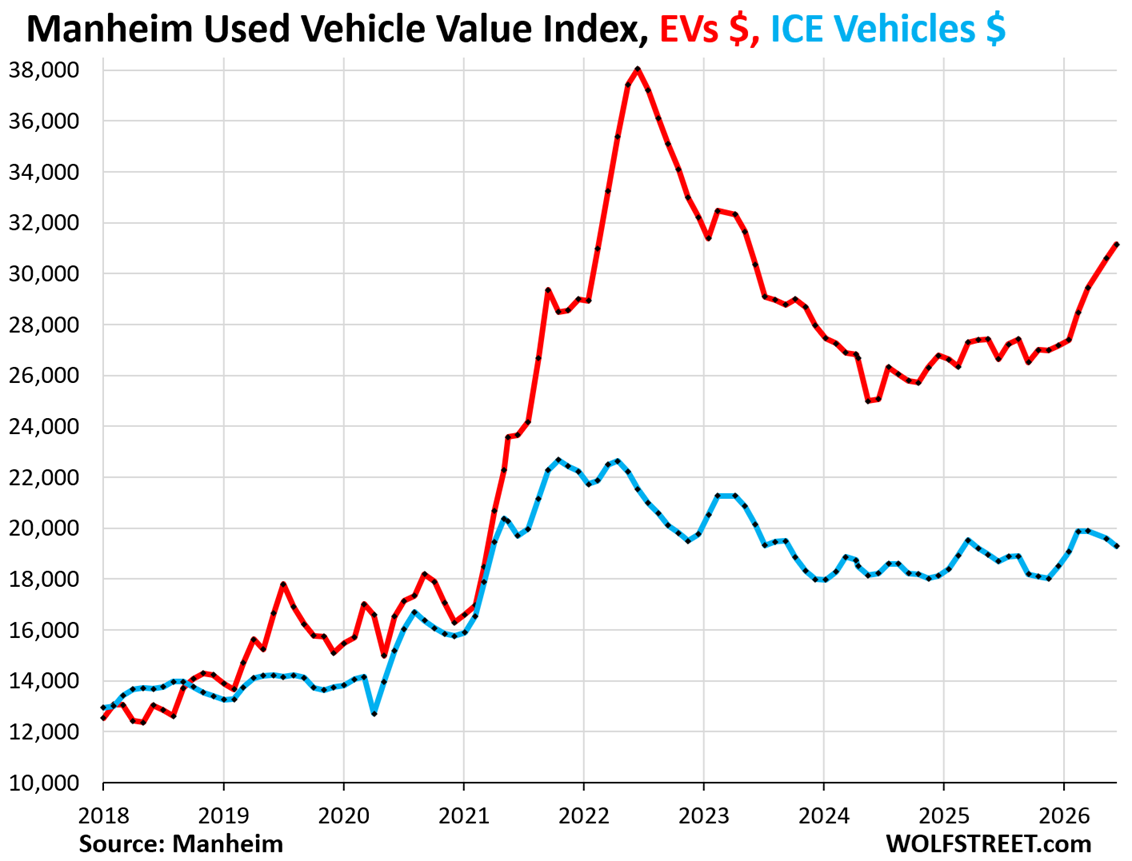
The wholesale price index for used EVs hit $31,156 in June, 61% higher than for used ICE vehicles. Consumers are splurging to buy used EVs.
By Wolf Richter for WOLF STREET.
The spike in gasoline prices that was triggered just about instantly at the beginning of the Iran war had a near real-time impact on the demand for used EVs, or at least the perceived demand for used EVs, as used-vehicle dealers instantly began bidding up prices of EVs at wholesale auctions, in March already. Wholesale EV prices spiked by 3.9% in March from February, and by 3.4% in April from March, and by another 3.9% in May from April, and by 1.8% in June from May, to $31,156, after being relatively flat for all of 2025, according to the Manheim Used Value Index. Manheim, a subsidiary of Cox Automotive, is the largest auto-auction house in the US.
That amounts to a 13.7% four-month price spike through June. It caused the year-over-year measure to spike 13.6%.
ICE vehicle wholesale prices, during those same four months through June, rose by only 1.2%. Year-over-year, they were up by 1.8%. That market has behaved normally.
Supply at these auctions comes from rental fleets that sell vehicles they pulled out of service, from finance companies that sell their off-lease vehicles and repos, from corporate and government fleets, etc. Dealers buy at these auctions to replenish or build their inventories.
Used EVs are still just a small but growing component of the overall used-vehicle market, so the impact of that EV price spike on overall used vehicle price indices was still small.
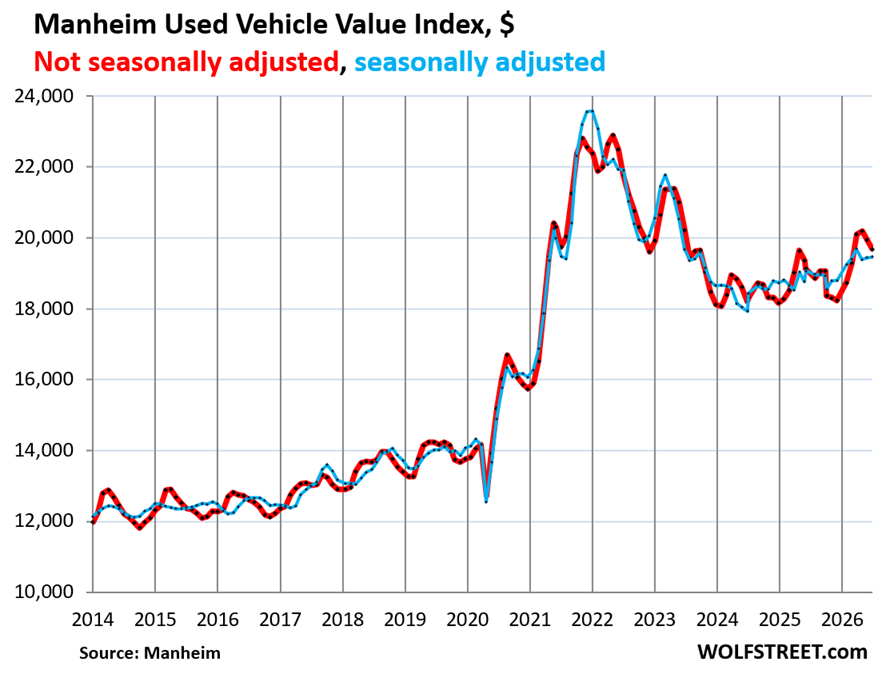
The overall Manheim Used Vehicle Value Index, in which EVs are still a relatively small component, dipped in May and June, not seasonally adjusted (red in the chart below), and seasonally adjusted rose a hair over those two months (blue).
Year-over-year, the index rose by 2.9% not seasonally adjusted, composed of the 13.6% year-over-year increase for EVs and the 1.8% year-over-year increase for ICE vehicles.
But when that relatively small supply of used EVs was met by suddenly increased demand from dealers, these dealers bid up the prices against each other, confident that they can sell those EVs for even more to their retail customers.
Interestingly, the surge of EV wholesale prices is not because consumers cannot afford the gasoline and therefore favor EVs. These used EVs are much more expensive than used ICE vehicles, and consumers are actually splurging to fork over the extra cash to buy them.
The wholesale price index for EVs, at $31,156 in June, was $11,855 higher, or 61% higher, than the index for ICE vehicles, which dipped along seasonal trends to $19,301 in June (not seasonally adjusted).
EV prices had already spiked majestically in 2021 to mid-2022, when gasoline prices more than doubled and stories of “Tesla flipping” broke the internet, where people bought a new Tesla and flipped it as a used vehicle for more money, craziest times in the car business ever.
What is different now is that there are a lot more EV models going through the wholesale auctions, and a lot more volume, than in 2021/2022.
Dealers in aggregate generally have a pretty good sense of where demand and pricing in the retail market are, and when they buy at auction to replenish or build their inventories, they buy to satisfy those conditions that they see. But they can – and do – get caught on the wrong foot occasionally and end up with overpriced inventory.
And if you missed it: My Take on the Zero-Sum New-Vehicle Market: Decades of Stagnation & Decline Interrupted by Steep Plunges. But Not all Automakers Are Losers in this Tough Market
Enjoy reading WOLF STREET and want to support it? You can donate. I appreciate it immensely. Click on the mug to find out how:


Thanks WR for these articles.
I am a 5 EV household and use solar and work lace free charging. My monthly gas bill is almost nil.
I have no ICE vehicle.
I expect most consumers don’t run the numbers on how much gas they actually buy and think an EV’s electricity is free (maybe if you get free workplace charging). It’s certainly cheaper though but payback may be non existent if used EV’s are inflated.
That said, I also think EV’s have some really nice traits that could justify a premium
depending on needs and ability to pay.
Where I live, EV fuel costs less than 5 cents a mile and gas costs over 20 cents per mile. It’s not particularly close. For an average driver that would amount to over $1000/yr.
Maintenance costs are harder to estimate: the EV has fewer routine costs (no oil changes, etc) but potentially more big costs if things go wrong, plus faster tire wear.
My guess is it’s mostly a wash for most people.
Include insurance as well. And cost of capital.
I think a PHEV is great and EV are great too if you need a new car. I balk when people “need to get an EV” when their car is newer and reliable and they like it, but are looking because gas is “expensive”.
At least the used EV market is generally not subsidized, so the market speaks . Let people buy what they want!
EV fuel – that’s a new one! Do you pull up to the EV fuel station? How many gallons of EV fuel does your tank take?
There are so many calculators out there, it’s simple to run the numbers. Usually evs beat ice cars as fast as maintenance, fuel, and insurance, assuming you have home charging or work charging at a normal rate.
Where used EVs were compelling was the insane depreciation rates they got due to FUD re their longevity and range anxiety. That’s going away – in part because the batteries are holding up extremely well on the second gen plus stuff (ie not the first batch of EV Leafs), gas prices, and familiarity.
If I was a used car buyer now I would look harder at hybrids or even ice vehicles. When gas prices return to normal as we’ve probably passed peak oil demand, I would take a stronger look at EVs, depending on circumstances. But the time to buy a used EV was when they had the fed & utility credits, then you could get the massive depreciation hit and around 4-8k off the dealer price.
US Treasury now paying $24 billion a WEEK in interest on its debts…
Yes, but interest payments do not occur in a vacuum. They need to be looked at in terms of the tax receipts that are available to pay for them:
https://wolfstreet.com/2026/06/30/inflation-nominal-economic-growth-to-the-rescue-the-us-governments-ugly-fiscal-mess/
I had to look something up because I didn’t know. This is an average for 3 year old vehicles. I wonder if these EV vehicles are selling well at retail?
Electric cars, like ICE powered cars, have their drawbacks and advantages.
I think huge sources of concern for reservations about buying an electric car for most consumers have involve long range anxiety and extended recharge times, compared to ICE cars.
Toyota has a new battery tech coming out soon that will allow for 650 miles on a charge and a charge time of 10 minutes. Obviously will probably be pricey to start but that tech will be a game changer.
Reviewers constantly talk about range and charging time. Long range requires a massive heavy expensive battery. But a lot of people could use a city car, maybe a second car, that will not break the bank, and will charge easily at home overnight. Think retirees and people who commute 10 or 20 miles.
If you believe that, let me send you an advertisement from the 1960s touting an automobile carburetor that allows your gasoline engine to run on water that gets hundreds of miles to the gallon. 😉
Prices speak loudly. Many dealers are willing to pay a premium for EV’s now, and by the early 2030’s there will be a whole new improved generation of batteries (sodium, solid state, etc), and much more choice in mass market cars (sooner in high performance luxury cars) that will be lighter and more compact. If the grid can stand it, that should be the tipping point.
I believe hybrid vehicles make economic sense. But 100% electric vehicles have been subsidized by the inside the beltway leftist crowd. As usual, they pick the winners and losers. When the “free market” decides that fully electric vehicles make sense, then maybe I’ll buy in. Until then I’m okay with the internal combustion engine or hybrid technology.
Many people think buying an EV is an economic exercise, or a politcal statement. They aren’t- I own two Tesla’s- I own them because they are the best vehicles I have ever driven. I actually have no idea if they are more cost efficient than an ICE vehicle- not everything is a dollar cost benefit analysis – if it were- everyone would own tiny cheap cars and not SUV’s and Pickup trucks.
I also own two Teslas… and my son owns one. I like them for a lot of reasons – their performance, the fact that I can charge at home and never have to go to a gas station, their amazing sound systems and integrated technology, etc. I also own an ICE and have owned ICE vehicles my entire life. There is no such thing as a perfect car, but I find it interesting that almost everyone who owns an EV has previously owned an ICE vehicle… yet most ICE vehicle owners have never owned an EV, and don’t know what the experience is like. However that doesn’t stop them from posting about what they think the experience might be like… cuz they read about it on the ‘net somewhere, LOL!
I can confirm that used and new EVs prices are up. We are in short supply. I was showing a customer a certified EV and they asked “aren’t these supposed to be cheap” I said not any more!
I think people are becoming more familiar with EVs (Including myself). This is raising demand. Also, the generous tax credits for new EVs have gone away so buying a “cheaper than new” used EV would make sense since new EVs are higher in cost without the tax credit. I suspect both new and used EVs are higher in cost.
I also think whenever gas prices go up, there is a herd mentality to try to save money on fuel costs. Personally, I charge at home so save about $1200/year vs a comparable ICE vehicle. Is $1200/year savings (10K miles/year) worth buying a $30K EV? The herd may not have done the math yet. I am a late adopter, but for our needs (driving less than 270 miles per day) and charging at home makes sense. As a bonus, I enjoy the quiet ride and fast acceleration. Saving the environment might be a bonus if my electricity comes from the power company’s solar and wind power and not the predominant coal and LNG power plants.
“Supply at these auctions comes from rental fleets that sell vehicles they pulled out of service, from finance companies that sell their off-lease vehicles and repos, from corporate and government fleets, etc. ”
Before I purchased an EV, I rented one in Las Vegas. I wouldn’t rent one again. The people at the counter had no idea where to charge. The car did not include a charging cable or Tesla adapter. I had no idea that some hotels had free chargers. However, When I visited these hotels, there were long lines to charge. Even the commercial charger we found (after downloading multiple apps on my phone) was more than the cost of gas and we found during peak hours, and the wait line was about 45 minutes. Las Vegas seems to be a a literal charging desert with many CA registered EVs willing to wait.
This may change if car rental companies become more EV-friendly.
Or, I’d be interested to see if rental companies are trying to unload their EV fleet due to poor customer service and lack of demand from vacationing people who don’t want the hassle.
I drive about 5000 miles/year. My Civic gets about 40 MPG. So about 125 gallons of fuel/year. I live in NJ which has a $300/yr EV registration fee. Electricity is 29c/kWh. In no scenario is an EV cost effective for me and I already installed an EV charger in my garage a few years back when I upgraded my electric box.
My son bought an Accord Hybrid and it gets 45 MPG and he drives 10,000 miles/year. I don’t think it makes sense for him either.
Here’s the math: 10,000 miles per year at 45 mpg equates to 250 gallons of gasoline per year. Average gasoline prices are $3.87/gallon. That’s about $1000 per year. EV’s average 3.75 miles per kWh. For 10,000 miles per year, that’s 2,700 KWh per year. Average $/KWh is $0.42/KWh per AAA. That’s $1100 per year.
$.42/kWhr? Who in the world pays that for their home electricity when the break even for solar is about $.20/kWhr?
I currently pay $.12/kWhr, flat rate, for all the electricity I want to use (Charlotte, NC). When I lived in CA, I had solar on my house – which had a cash break-even of five years after which the electricity was literally FREE.
What is the depreciation percentage? Retail is higher. Used should be higher also. Which retains its value better.
Myself, I like to target high-quality vehicles with low resale value. Anomalies exist mainly because of pre-conceived opinions about what people like. Used cars are NOT an efficient market.
The avg, electric rate is up to 18.8 cents/hr., but a vast number of EV owners pay much less, while promoting national security. Of course, many out there will say that 1st sentence is crazy, but it isn’t.
Almost all of TX., and large swaths of the rest of the country have options to get electricity with very low cost, or free nighttime rates. As our grid systems are built for peak generation times, this increases energy security and allows us to export more energy. It also reduces cost for utilities and ultimately, consumers. The very large Commonwealth Edison in Illinois very occasionally has negative rates at night (there have been several minutes where they will pay me to use electricity!) At 5pm on a hot day i could pay more than 50cent/kwh. But why would i get car fuel then?
This speaks to the comments above. I echo the important point that ICE owners have little concept of what it might be like to own a true EV.