
High gasoline prices tilt operating costs in favor of EVs. But soaring electricity prices eat into that math.
By Wolf Richter for WOLF STREET.
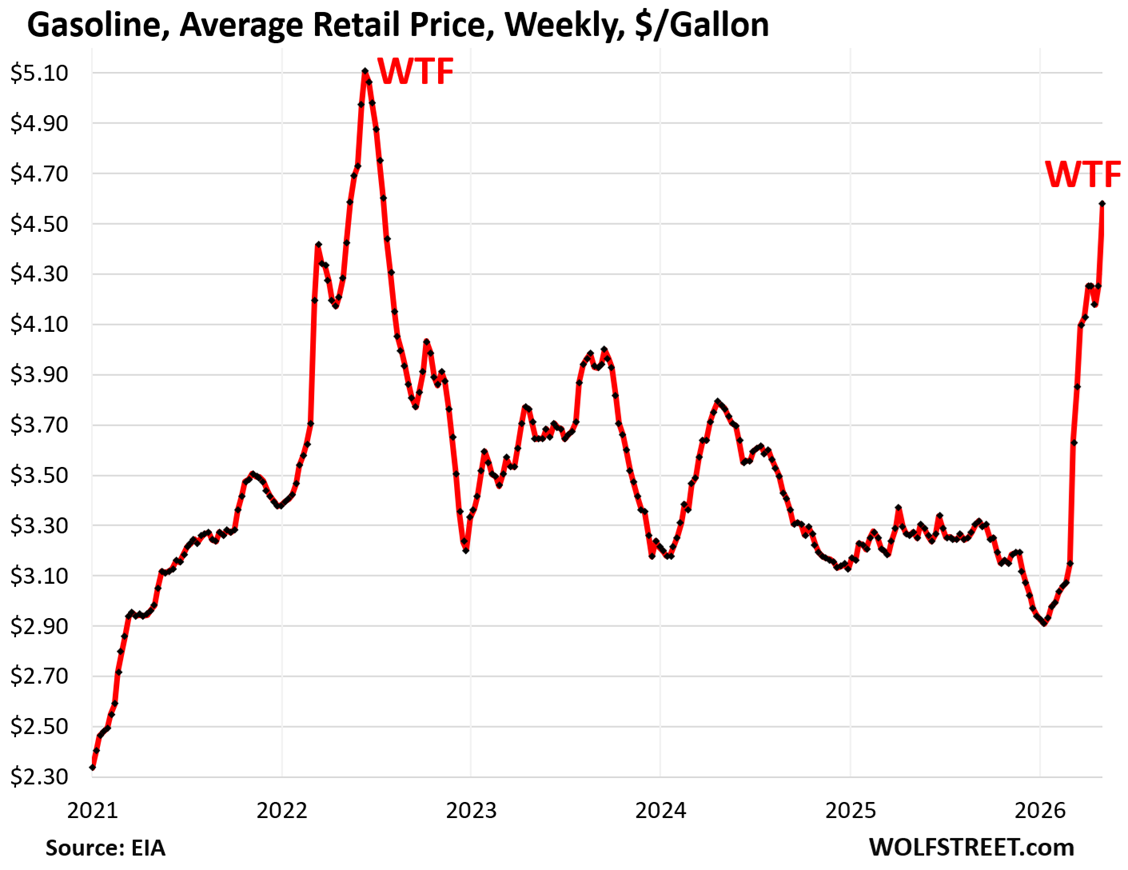
The average price of gasoline in the US has spiked by 57% so far this year, to $4.58 a gallon on Monday, and far higher in some places, such as California, the EV capital of the US, where many gas stations are now hawking their regular for over $6.
And so demand for EVs has taken off in the used vehicle market despite already very high EV prices, and prices jumped for the second month in a row.
Prices of used EVs sold at auctions where dealers buy to replenish their inventories jumped by 3.4% in April, to $29,453, after having already jumped by 3.9% in March. Year-over-year, EV wholesale prices jumped by 7.8%, according to the Manheim Used Value Index.
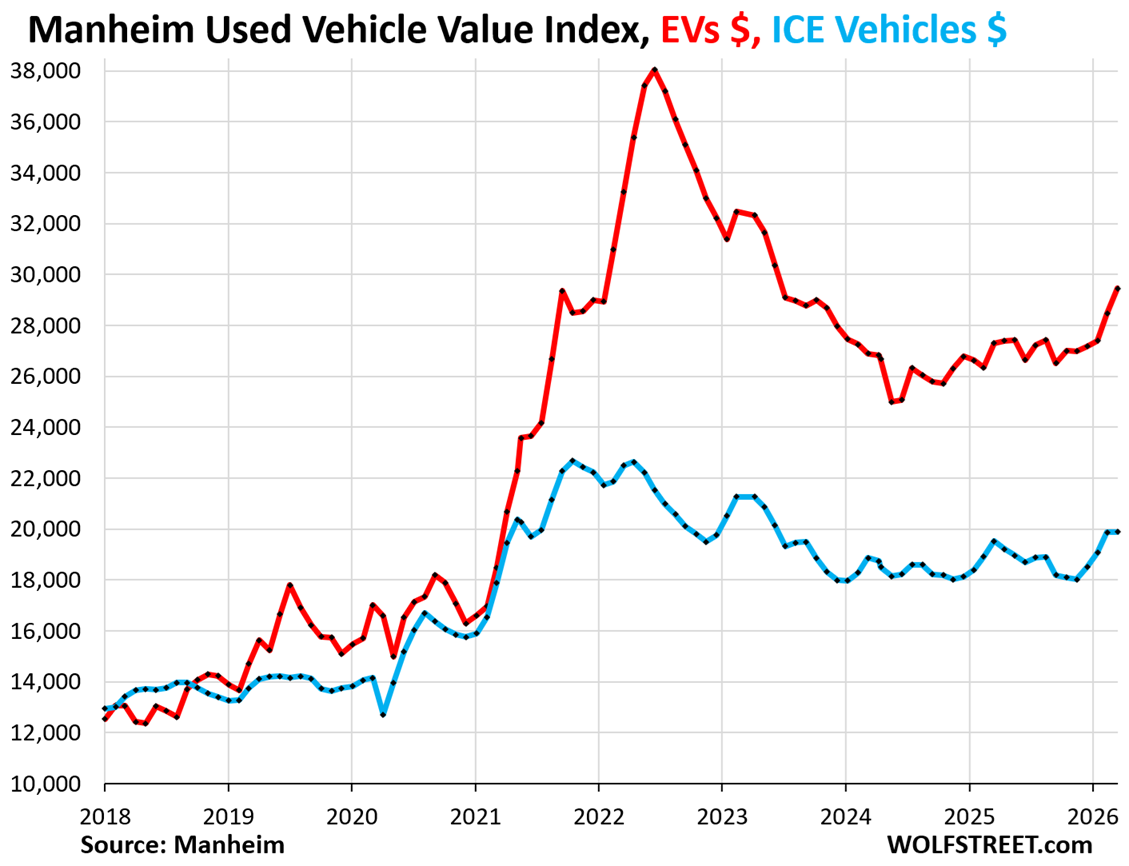
The wholesale price index for EVs is now nearly $10,000 higher than the index for ICE vehicles, which, at $19,897, was nearly flat in April and up 1.9% year-over-year.
Supply at these auctions comes from rental fleets that sell vehicles they pulled out of service, from finance companies that sell their off-lease vehicles and repos, from corporate and government fleets, etc.
EV prices spiked majestically in 2021 to mid-2022, when gasoline prices more than doubled and used-EV prices also more than doubled, amid stories of “Tesla flipping,” where people bought a new Tesla and flipped it as a used vehicle for more money, yup, craziest times in the car business ever.
Those crazy times when overall used vehicle prices had exploded by 50% in two years are gone. And an even bigger gasoline price spike is unlikely to produce a similar EV price spike, now that there are plenty of new EVs on the market. But it does show that triggered consumers can change their buying patterns.
The surge of EV wholesale prices is not because consumers are “squeezed.” Given the high EV prices, it cannot be that these consumers are splurging on used EVs because they’re “squeezed” by high gasoline prices – as the crisis-press likes to say ceaselessly. But can it be that they’re just sick and tired of getting ripped off by the US oil and refining industry and that they’re looking for alternatives?
High gasoline prices tilt operating costs in favor of EVs. But rising electricity prices, driven up by data center demand and other factors, undo some of that math.
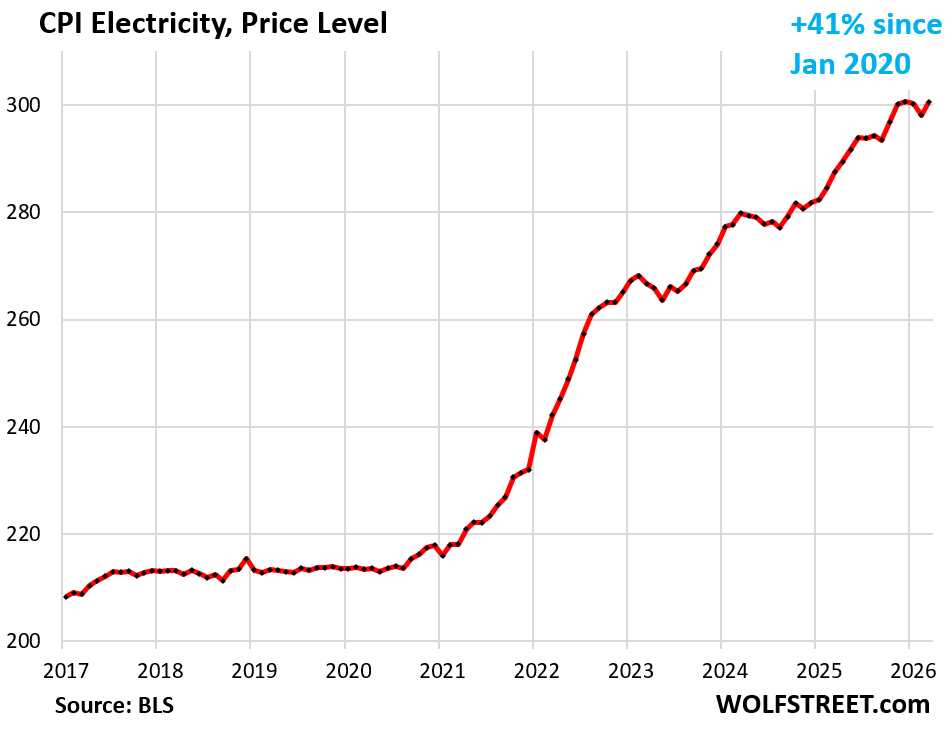
Gasoline prices are very volatile, soaring and falling over the years, while electricity prices are largely regulated and don’t fluctuate up and down that much; and under the impact from demand for power from data centers and other factors, electricity rates that consumers are paying have just rocketed higher.
The Consumer Price Index (CPI) for electricity has soared by 41% since January 2020, compared to the 70% increase for the average price of gasoline since January 2020:
Enjoy reading WOLF STREET and want to support it? You can donate. I appreciate it immensely. Click on the mug to find out how:


Your EV? What’s that? Behind the scenes, utilities and private developers collude on utility scale solar/ battery/ wind projects to circumvent transparency with state regulators. The r’cons grift right out in the open in everything.
Indeed. The best policy is to pay people not to build new electricity generation capacity because it gives some people the ick for no good reason. That’ll definitely make electricity cheaper, and help businesses expand.
It seem fairly likely that gasoline prices will drop back to a more normal level in the next few months. Electricity prices on the other hand may stay high or go higher. It takes years to increase grid capacity, and demand is forecasted to grow. So this sudden interest in EVs could be temporary. I’m still betting on hybrids for the next 5 years.
What are you basing this on? Returning to the prior level of oil production in the Middle East will take months if not well into 2027 (if the war ends soon). Meanwhile, the price of solar panels is falling and can help allay any rise in the price of electricity.
Another consideration: less maintenance. I own a Model Y and have loved the minimal maintenance since getting it in 2024. Only have rotated the tires in 20,000 miles. Arguably, I’ll eat some of the savings in more frequent tire purchases relative to similar-sized ICE vehicle.
However, the convenience factor is a plus, too. Can charge at home and only need to take my car to the shop for tire-related maintenance. $35 rotation at Costco for 20,000 miles.
I always hear the low maintenance argument from EV owners. Buy a Toyota hybrid! In 5 years all I have paid for is a handful of oil changes. No expensive battery, no expensive tires, no charging outlet for the house. Granted, I am a low mileage driver so that helps, but it will take a lot of years of fuel costs and maintenance costs to break even on the premium cost of buying the EV in the first place.
The battery does not need replacement for over a decade or more. Most new studies about modern EV battery life indicate they keeps 80% of the charge after 20 years or 200000 miles. The home charger cost (~$1000) is fairly trivial compared to purchase price and is made up after about 5000 miles of driving (for most people less than a year). And per mile fuel charges are currently about 4 times higher for gas than electric.
Drive what you want; no one cares if you love electric or gas or a unicycle. But let the facts stay the facts.
Tesla has warranty of 8 years/120,000 miles for a guarantee 70% battery capacity retention.
Replacement of batteries will cost you $20,000.
Every time you recharge, your battery loses a wee bit of capacity.
Out of 100k batteries there will be a few that break before their designed lifetime.
But overall Batteries are good for 2000-5000 charging cycles depending on the chemistry. (The cheaper LFP are on the higher end of that spectrum)
2000 * 300 miles = 600 000 miles on the lower end!!
Basically every EV has a battery which is designed to last the lifetime of that car. But as I said there is a risk to have one of the bad ones. As a battery is mostly a chemical product not a mechanicl one it is very difficult to prevent stuff like that. And for the people whose battery dies just outside the warranty it is very frustrating and thats whyt gets circulated as anecdotes but it is not representative.
Plenty of people buy a bulletproof diesel, but still end up having to rebuild the engine. It happens with everyting.
Cost per mile is what should be looked at. If you just want to get from point A to point B with a car, there are cheaper ways.
We buy a car around every 10 years. We have three kids and for us that just means we upgrade our car sooner and they get the old car to use. Back in 2018 I priced electric vs hybrid vs standard ICE and the cost per mile wasn’t even close. Criteria was mid-size sedan that could fit the 3 kids in the back comfortably. At the time two kids were in booster seats, one out of child seats completely. Ended up with a Honda Accord Hybrid which were not loved at the time. Gotba screaming deal on the car which may not be typcial. It’s the best car we have ever owned.
We still have the Accord, getting close to 100,000 miles. Cost per mile driven excluding car insurance is just under $0.38 per mile. That figure will keep dropping as time goes on. My only worry is the battery and the cost to deal with that. We shall see where the experiment ends. Child number 1 is currently driving this one.
In about 4 years, child number two will be driving. I will reprice electric vs hybrid vs standard ICE and see what would be cheaper at that time. When electric shows a clear cost advantage for us, we will pull the trigger. The math is different for each individual depending on where you live and what you pay for electricity.
Good summary of YOUR results N:
We, in this case the family of two now both ”elders” WE, have come to the same conclusion,,, for now…
Continue to hope that the clear challenges of the batteries for the current concept of EVs will continue to improve for both ”range” and durability.
And, to be clear, TOTALLY willing to look closely at all improvements on all relevant fields of cost efficiencies…
It is pretty amazing that even with a full Gulf War, a shut down of the Strait of Hormuz, nearly every Gulf country’s energy infrastructure bombed that the average retail cost of a galllon of gasoline is still below the highs of 2022…and that doesn’t even include inflation.
The highs in 2022 were due to a lack of supply within the US due to the collapse of fracking during COVID. When the economy was reopened, everybody wanted to get out and have fun and the oil companies couldn’t keep up. Once they did catch up, prices started dropping quickly. We have plenty of oil in the US right now, but Asians are seeing majestic price increases. World stocks are depleting quickly, and if US oil companies are allowed to export instead of keeping their oil in the US, we may start feeling those big price increases too.
I seem to remember a “war premium” in 2022? Something about Russia, not really related to fracking?
The EIA data shows US crude production was 11-12MBD during that time and nothing but the headlines changed overnight.
Similarly to today’s war premium: US production and supply is largely undisturbed.
The difference is demand: European demand for US produced LNG in 2022 began to rise (as European energy supplies ARE disrupted by these conflicts).
It boils down to prices being set at the margins, and profits being reaped as available!
So if you can put up with the embarrassment of being seen in a Tesla, you can save something like 10 cents per mile, vs let’s say bmw 3 or even a Camry.
Embarrassed in a Tesla? Yet would drive a Beemer? Not much knowledge about cars and their maintenance. Or you’ve got money to burn.
–Geezer
Something on Reddit was alluding to the fact that (his name shall not be mentioned) is pricing guacamole crock a lot less than the other AI agents. Somehow to get folks to adopt it.
Interesting to peer into the AI nothingness and see what’s happening
Imagine being so slavishly devoted to your political tribe you can’t separate the guy who is the CEO from the most American made car which is also helping to save the planet (according to your doom and gloom political masters) – It’s rather remarkable when I see it.
I own 2 tesla’s (shudder and grasp your pearls) which I purchased after renting one. They are the best cars I have ever owned- I don’t care about the climate to the extent that it changes my purchases, and I have plenty of money so I can buy anything I want. It has super car speed, no maintenance and drives itself. It also employs Americans.
Indeed, and BMW makes a number of electric cars if that’s what you want.
Gas will have to reach 25 before I consider doing something smarter.
Then against electricity might outpace gas at the rate utilities are jacking up prices.
Gasoline, on the left, WTF #1 was a temp spike. Number #2 might be
be a higher new plateau. So far, there is no demand destruction ex
in CA and AZ. Beyond tax refunds, if personal spending will be
higher than income, the stock and the bond markets decline ==> consumption will decline.
Not sure that I agree. The stock market and the real economy are completely disconnected. Likewise, the bond market does not reflect the true risk in the system, especially with the Fed increasing its balance sheet again.
1. In DC area gas is already $4.5 or above per gallon. Even with cash only options, prices are higher. Gas prices increase quicker and comes down slower.
2. If there is a new diseases is going to be spread like 2020, there will be demand reduction and prices will come down.
3. Although there is ceasefire, in the strait of Hormuz, mini-war is going on. Ships wont pass because of insurance payments. Both sides to blame.
4. Stock market did not crumble during the Vietnam war. There may not be a reduction. Stocks are completely a different beast.
5. Please share your thoughts…
Back in 2008, premium hit $5 in NJ. I was driving an Acura which called for premium gas. Company at the time reimbursed our gas expenses and every month I had to send a scanned copy of my owner’s manual showing “91 or higher octane” to the accounting folks.
That was a crazy time. Pickup trucks and V8 cars dropped like a sack of potatoes. Our company swapped out half their fleet for Toyota Prius cars. At the time, the Prius was ugly as sin, but provided us with 50 mpg. New company vehicle policy was rolled out and the list got very small. Lexus was trying out hybrids at the time so they made the list. V6 cars and large SUVs were taken off the approved company vehicle list.
$5 a gallon escalated to today’s dollars from 2008 is about $7.50. Today, I drive yet another car that “requires” premium gas. Where I live now, premium gas is between $4.55 per gallon at Sam’s Club, all the way to $5.35 at Shell. Still needs another $2+ to come close to the inflation adjusted cost of 2008.
Premium at my gas station from hell finally went over $7 the other day, after having been stuck at $6.99 for a while, as regular was encroaching on it from the below.
The last time crude prices dropped in 2022/2023 by $20 my “Gas Station from Hell” kept their prices stuck at the maximum $4.89/gallon for regular. I expect them to keep their price at $6/gallon even if crude drops significantly. Price gauging is alive and well.
We are fortunate to live in a rural township in SW Michigan. Here’s my take on EVs.
I am on good terms with our local Toyota dealer. In addition to the two Toyotas we own, a Rav4 PHEV and an old Tacoma (with 300,000+ miles) we lease a bZ4X EV.
Retail electricity here at the meter costs $.22/kWh. Our garage-mounted Level 2 charger has just over 10% loss which puts our cost to charge either car at $.26/kWh.
My wife’s PHEV gets 40 mpg in the hybrid mode. Depending on the ambient temperature either car in the EV mode gets between 2.0-3.5 miles/kWh. It gets cold here in the winter and cabin heat in an EV eats kWh. In winter my thrifty wife bundles up like an Iñupiat rather than use the heater. I drive the Tacoma. Thanks to the blessing of its combined cycle heater, it’s toasty warm regardless of the outside temperature.
The local EV charging stations charge between $.45-$.85/kWh before the 10% charger loss. Much to my wife who pays the bills annoyance, registration of an EV in the State of Michigan costs an additional $300. In a large, warm weather metropolis like Phoenix, Arizona the economics of an EV are quite different but any real savings between an ICE and an EV for us in the upper midwest is illusionary.
The dealer has let me drive both a Tesla Model Y they took in trade (for a Tundra) and a Kia EV6. EVs are fun to drive and I like driving the bZ4X a lot but I’ll turn it back when the lease expires next year. I will be tempted to buy (not lease) Toyota’s upgraded bZ as a replacement. Not for the extended range or faster charging capability but the visceral appeal of its 4.4 second 0-60 acceleration.
But no matter what, I’m keeping the Taco.
No matter what: I’m keeping the Taco!
We considered a vehicle purchase a couple years back. The outrageous prices all around deterred us.
Our primary vehicle is a 2013 Tacoma with 185k miles. I bought it new (only brand new vehicle I have ever bought!), no regrets. I may NEVER sell it? I have heard many stories of 400k Tacos.
We WILL be faced with buying a vehicle, based on our family’s decision to relocate for a “year (somewhat) abroad” in Puerto Rico.
I am resigning myself to the fact that I will overpay, and sell at whatever price I can get when it’s time to return home.
Articles like this make me sigh, but I will ultimately pay the piper!
In Europe the price of gasoline is 2.3/2.4 euros/liter. That’s
$10.50/gallon. Diesel: sky high. In the US $4.50/gallon. We export oil and LNG to Europe and Asia like never before. It’s all about power. Canada benefits from Iran war. Tesla sold more cars than BYD in Asia and Europe. Tesla has a new Cargo Truck, cyber truck and a super fast sport car. Next week: Trump/ Xi summit. FIFA in June. The US 250Y jubilee and the Nov election. A deal with Iran might not be on Trump mind for a LONG LONG TIME. Inflation will deflate the $40T gov debt. If wrong, the LNG terminals will cannibalize each other.
5-Year Total Cost of Ownership Example (2026):A 2026 Kia Niro EV has an estimated 5-year total cost of ownership of roughly $61,000–$65,000, including depreciation, financing, insurance, charging, and required maintenance (tires). I reckon continuing to drive a 20 year old Toyota Camry or Honda accord ICE vehicle with liability insurance is still cheaper than cost of new EV. Insurance cost alone on a new EV is 20/30% higher. It’s a mind blowing cost to participate in today’s new car environment in America, I rather advise today’s youth to drive a beater and invest after tax disposal income into Roth IRA investments or stock market. The juice for owning depreciating assets just not worth the squeeze.
Tesla is a car co first and a software co second. It’s a modern high tech industry co. In Europe and Asia people bought Tesla to reduce the burden of high gas prices. In the US, where drivers spend many hours per week on hwy and in traffic – for $99/month they get a supervised FSD. With more memory: a full FSD. Lawyers, executives and business people can do work. Their time is more expensive than a blue collar worker in a pickup truck, or moms driving suv, or retired people who need a car to move from point A to B.
Maybe y’all can help with van buying advice. I’ve been thinking about buying a newer van for some time. Top choices are the Sienna and Ford Transit connect. Age about 10 yrs old. Seems like I can get the Toyota with around 100k for upper teens, I’m seeing Transit Connects with 60-80k miles priced towards the lower teens. Longevity isn’t an issue since I’m old. Main thing is I don’t want to get stranded on a road/camping trip. No hassle is a priority – though I can pay for repairs if anticipated. Thoughts?
I have a hybrid for everyday use.
Probably too late to post this but perhaps Wold can keep one of this hundreds of eyes open on this type of catastrophe.
“NV Energy, the Nevada utility that has supplied the bulk of Lake Tahoe’s electricity for decades, told Liberty Utilities—the small California company that services the region—that it will stop providing power after May 2027. The reason? NV Energy needs the capacity for data centers. As in: the energy supplier for the Lake Tahoe region is telling the utility company that it has less than a year to find another power source.”