
Energy that Americans pay for directly: Gasoline, propane, fuel oil, other fuels, utility natural gas, and electricity.
By Wolf Richter for WOLF STREET.
The first wave of energy price spikes that Americans pay for directly washed over the Consumer Price Index for March. But the energy price spikes that Americans pay for indirectly after they filter into non-energy goods and services have not yet shown up broadly, and those waves are still to come.
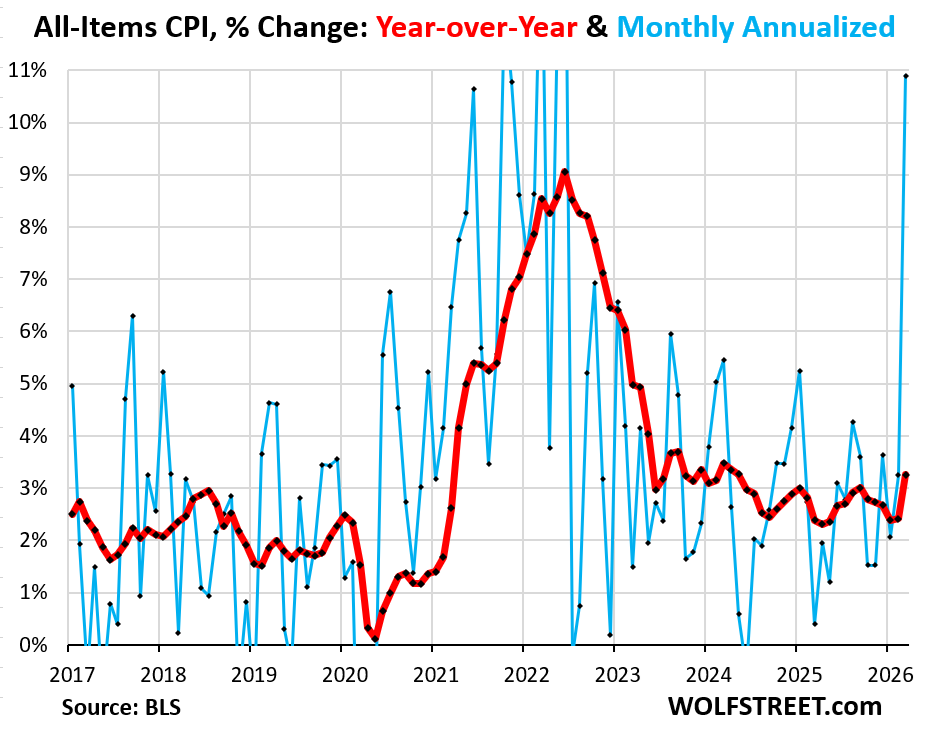
The all-items CPI, which includes food and energy, spiked by 0.87% in March from February, (+10.9% annualized), the biggest such spike since the peak of the prior waves of energy inflation in mid-2022 (blue line in the chart).
The month-to-month spike pushed the year-over-year increase of CPI to +3.26% (red in the chart).
The spike in energy prices that consumers pay for directly.
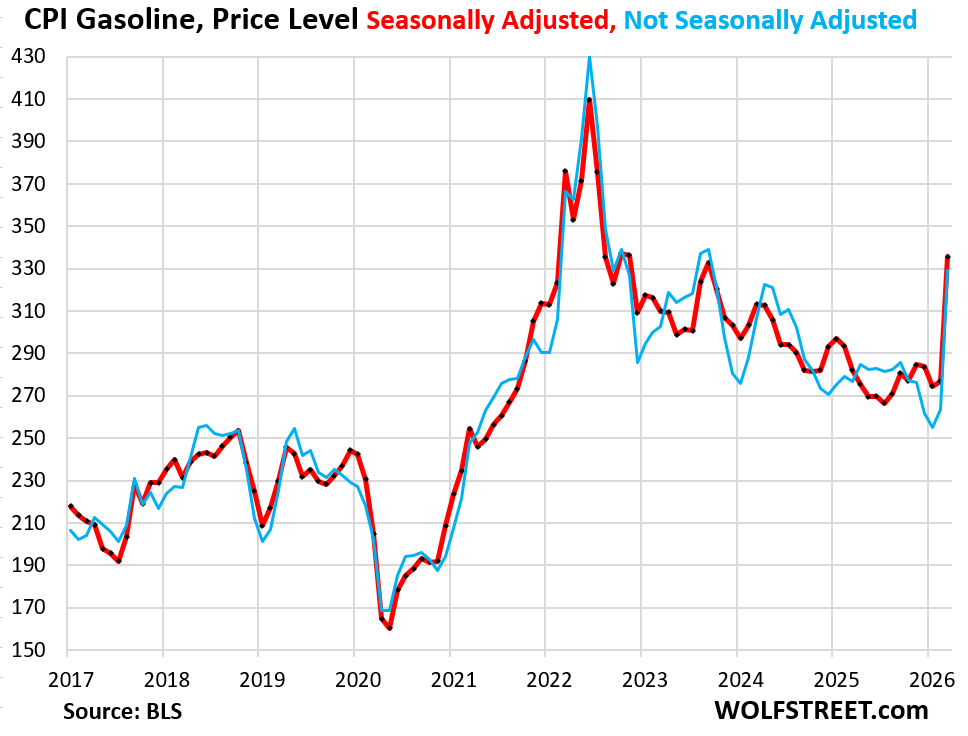
Gasoline prices bottomed out in mid-January after the multi-year decline from the peak in mid-2022. Gasoline prices started rising in late January. For February, the CPI for gasoline already jumped by 0.8% seasonally adjusted. In actual terms, not seasonally adjusted, it jumped by 3.3% in February from January.
Then came the war in Iran, and energy prices spiked in the US, though the US is the biggest energy producer in the world and has a big trade surplus in the energy trade, including in crude oil and petroleum products, and is a big exporter of gasoline, jet fuel, and diesel.
But energy speculation is global and instant, and so prices at the pump spiked even as the gasoline that was in those underground tanks had been refined and purchased well before the war began, and all that happened is that the profit margin of the gasoline retailer spiked.
In March, the CPI for gasoline spiked by another 21% seasonally adjusted and by 25% not seasonally adjusted from February.
Year-over-year, the CPI for gasoline spiked by 18.9%.
The chart shows the index for the price level (not the percentage change), seasonally adjusted price level in red, not seasonally adjusted price level in blue.
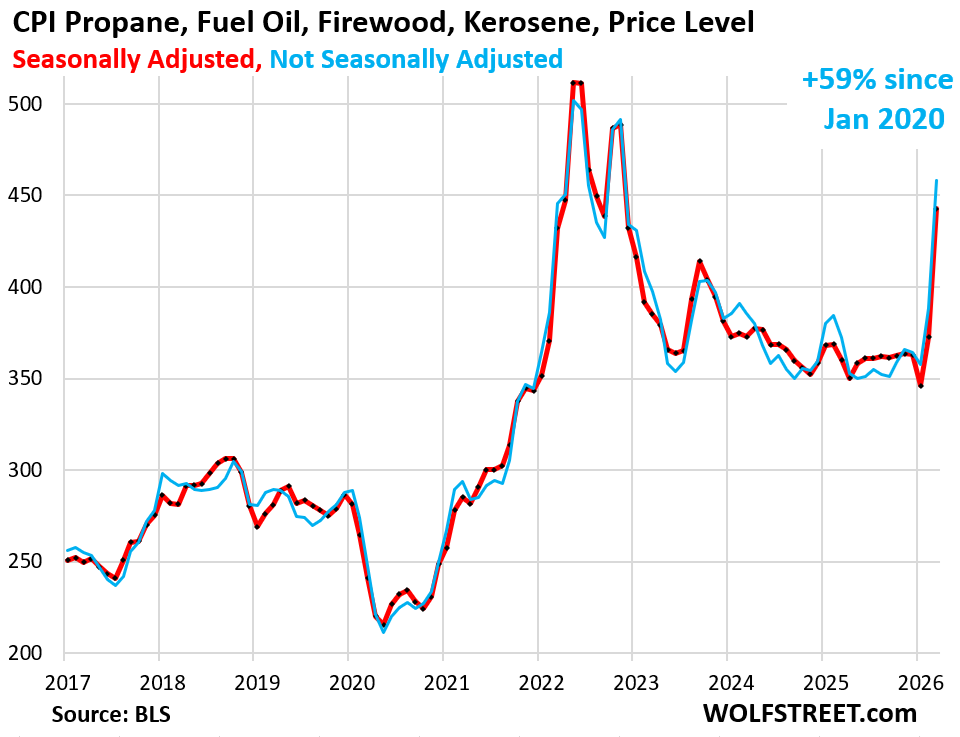
Propane, fuel oil, kerosene, and firewood: The CPI for “Other fuels” spiked by 18.8% in March from February, after having already jumped by 7.7% in February from January, seasonally adjusted. Over those two months combined, the index spike by 27.9%.
Year-over-year, the CPI for other fuels spiked by 22.9%.
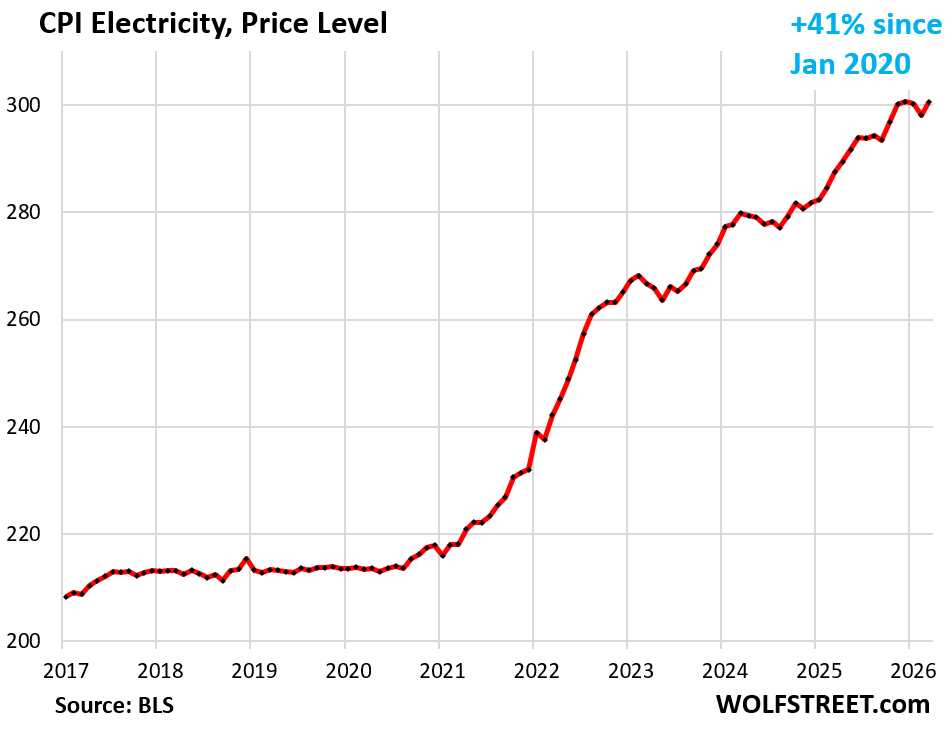
The CPI for electricity jumped by 0.82% in March from February, after two months of declines.
Year-over-year, it rose by 4.6%. Since January 2020, the index soared by 41%.

The price that households pay for electricity on their monthly bills – the fixed fees and charges and the price per kWh used – is largely set by utilities that are monopolies. Some of the utilities are owned by public entities, such as a municipality; some are owned by their ratepayers, such as co-ops; others are investor-owned regulated monopolies, and investors come first. The only competition these electric utilities face is rooftop and plug-in solar.
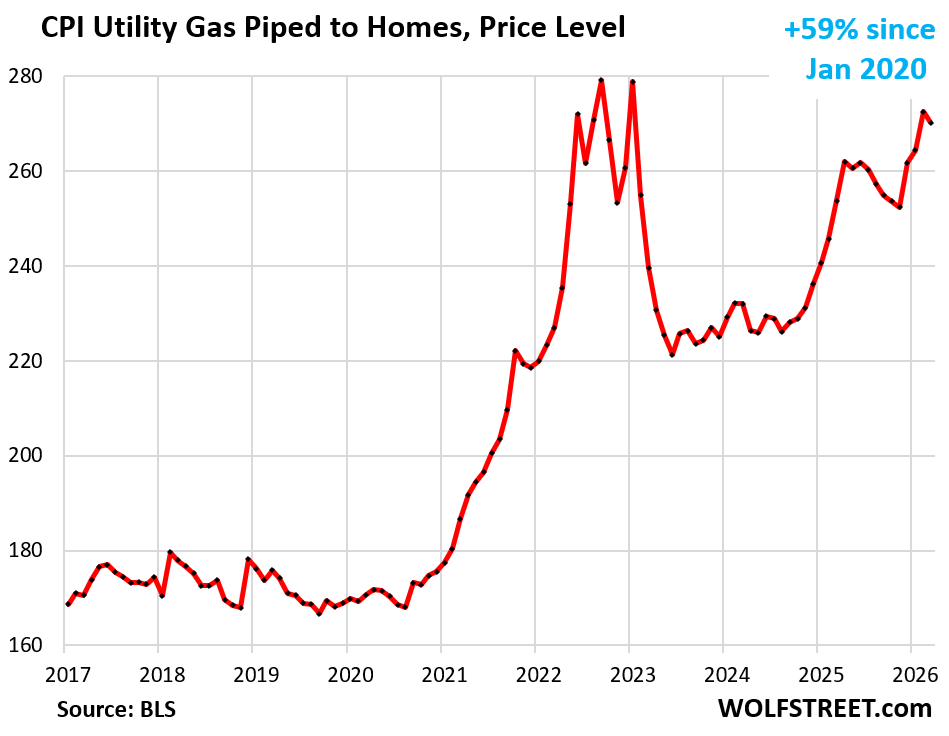
The CPI for utility natural gas (piped to the home) fell by 0.87% in March, after the 3.1% spike in February and the 1.0% jump in January, seasonally adjusted.
Year-over-year it was up by 6.4%. Since January 2020, it has surged by 59%.
The US is the largest producer of natural gas in the world, the largest exporter of LNG in the world, and a substantial exporter of pipeline natural gas. In the biggest oil-producing regions in the US, natural gas is a byproduct of fracking, and part of it used to be flared, and a small part is still being flared, when there is no takeaway infrastructure at the wells. But that’s not what households are experiencing.
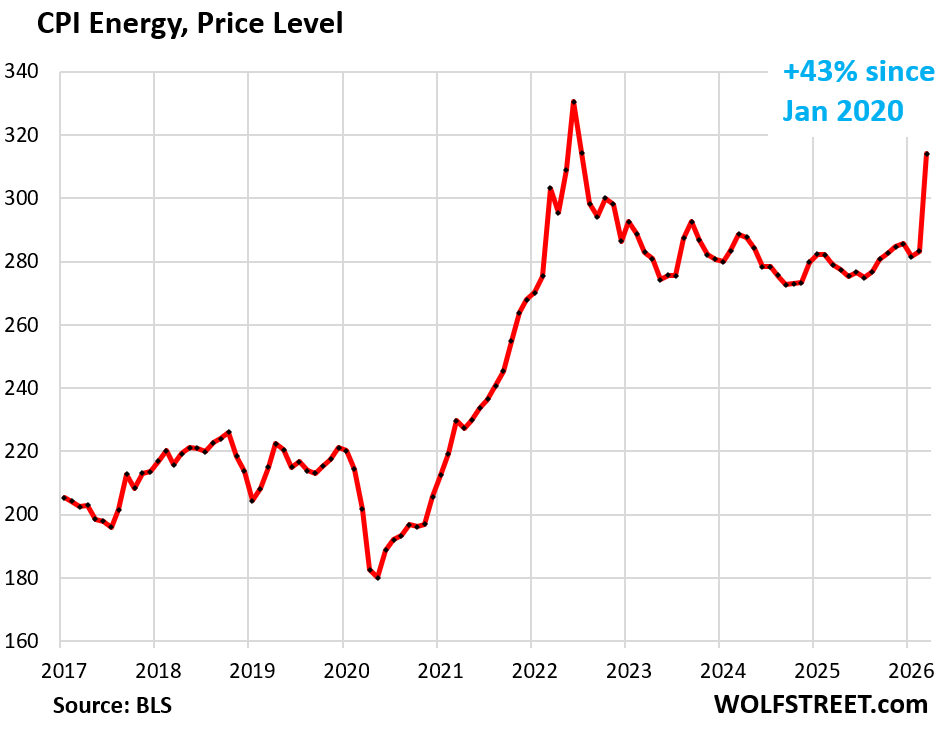
The CPI for the energy costs combined that consumers pay for directly weighs 6.4% of the overall CPI. When it spikes like it did in March, it moves the needle.
The overall energy CPI, which tracks the above categories, spiked by 10.9% in March from February, and by 12.5% year-over-year.
Since January 2020, it has increased by 43%.
Gasoline accounts for about half of the energy CPI.
Energy inflation, like food inflation, hits the lower income households the hardest, as they spend a substantial part of their budget on food and energy. The gasoline price spike hits lower-income households with long commutes particularly hard.
The decline in gasoline prices from mid-2022 through 2025 had been a substantial factor in the cooling of overall inflation. This factor has now brutally flipped into the other direction.
What is still to come to the inflation readings is the influx of energy price spikes into broader goods and services over time. It’s uncertain how much of that can be passed on when demand is not that strong, and how much of it gets absorbed by profit margins.
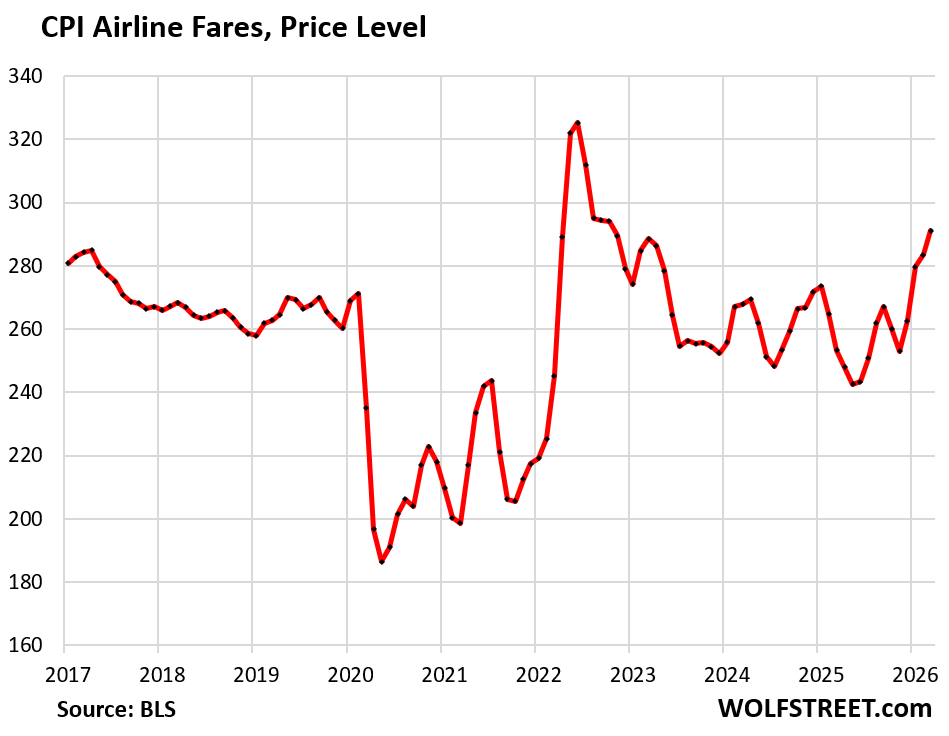
Airline fares is an example. When ticket prices rise, some consumers forgo air travel, and enough seats remain empty. But airlines have huge fixed costs and need to fill their seats, and so they run specials and cut prices to fill those seats. Airline profits can get crushed by rising fuel prices. Delta owns its own refinery. And airlines hedge some of their fuel consumption. So it’s not a straight line.
Airline fares jumped by 2.7% in March from February, but they’d already jumped much more in the prior months. In total, since November, airline fares spiked by 15%, most of that unrelated to fuel costs.
Airline CEOs have been out there trying to manipulate the American public into willingly paying higher prices by announcing that they would raise their prices in various ways to deal with the fuel costs. But consumers could just fly less and create enough empty seats that would force those CEOs to confess during earnings calls that their profits took a hit because they couldn’t raise prices enough without sacrificing revenue passenger miles.
Major non-energy components in CPI:
The CPI for durable goods, many of which are tariffed, was essentially unchanged month-to-month, after three months in a row of negative readings. Year-over-year, it was also roughly unchanged.
The CPI for food at home, after substantial increases in the prior three months, dipped in March from February. Year-over-year, it rose by 1.9%.
The CPI for core services rose by 0.23% (+2.7% annualized) in March from February. Year-over-year, it accelerated slightly to +3.05%. The six-month index accelerated for the second month in a row to +3.3% annualized.
In case you missed it yesterday: Even without the energy price spike, the Fed-favored PCE price index showed alarming trends, and the Fed needs to pay attention: Six-Month Core PCE Inflation (still before Iran War) Jumps by Most since June 2024
Enjoy reading WOLF STREET and want to support it? You can donate. I appreciate it immensely. Click on the mug to find out how:


“The CPI for durable goods, many of which are tariffed, was essentially unchanged month-to-month, after three months in a row of negative readings. Year-over-year, it was also roughly unchanged.”
Are you going to run an over/under on how many commenters blame tariffs? -g-
Interesting to note the spx has been doing the reverse of the tnx of late. Today the tnx was basically flat and tnx yield spiked up, breaking the recent trend.
Howdy Youngins. These are wonderful times for US Squirrels. The ZIRP tool is firmly locked away in the FED toolbox. Will Drill Baby Drill solve our inflation problems??? The guy in the Big House sure thinks so. Going to be a fun ride to November…..
Sober Sailor Saving Spending more everyday…..
though the US is the biggest energy producer in the world and has a big trade surplus in the energy trade,
it allows FOREIGNERS to usurp Merikas surpluses and thereby force HUGE PRICE increases on MERIKANS
Funny how nobody in California cared about higher gasoline prices caused by leftist green policies. The difference in gasoline prices in Texas vs California is ~$2.00 per gallon.
Crazy how gas can spike like that. It’s not like everyone is driving more!
They say price is set at the margin. Kinda like when a dentist from Poughkeepsie pays 7 cents more for one Apple share and Apple’s market cap goes up $1 billion. My girlfriend paid north of $6/gallon in San Francisco, so here we go
I’ve added gas surcharge to all my work now
drove my diesel(about 2 times per week now – gotta keep batteries charged)
also added $40 per week worker credit
talked to couple realtors this week
one said the buyer put in offer – promptly rejected by seller
another who sells 30 homes in BAD year said he can’t even get showing
—–
here’s my take
yes mortgage rates are 7% and NOT going lower
but like 70’s the CONTINUAL DEVALUATION OF FIAT $dollar is making these home prices =
there will always be some distressed low priced buys
but on avg the consumer is going to
1) stay put(we can’t walk our 3.35% – 80% paid off
2) make it rental
in 1970 our current home went for $13,000 in 1980 it was $50k
but but but 10% annual(devaluation) caused fiat $dollar to worthless and therefore prices INCREASED
If the KWH is viewed as the ultimate unit of currency, which some people recognize it to be, then inflation has spiked by 41% in 5 years. That computes to 9% per year. T-bills pay 4%.
It becomes futile to try and save via this means.
That is the way the system works. Which is why over time, your wages don’t keep up and you can afford less and less. Eventually, the average person revolts and votes for regime change, but the regime is helpless to fix the problem. There are a limited number of tools in the box and the political machine has to choose between angry voters and vested business interests/wealthy individuals who have bought the system. Politicians can’t win, so they just game the system for their own benefit. They placate the voters with benefits that become unsustainable over time to keep the game going long enough for everyone to cash out.
Let’s be precise here. If the KWH (or joule) is the ultimate unit of currency, those who own energy stores (at least those who can sell them, which currently excludes parts of the Middle East,) are seeing deflation – the are seeing their purchasing power grow. And all of us are seeing the price of goods decline, in terms of how many KWH you need to trade to buy things
That description does not hold because the joules are needed to produce the goods in the first place. That is like saying that the relative price of jewelry is going down because gold prices are up. It doesn’t work that way.
I should have booked my summer vacation flights earlier. Sorry guys, Looks like I’ll have to contribute to the higher prices.
I love how these comments always read like a bunch of drunken losers after an AA meeting just agreeing with each other hahaha
I’m looking into canning and bulk freezing of protein/fruits/veggies
summer vacay is 5 weeks away
still lot of work to go – very profitable
just like under biden when gas was $5 we still traveled
got in 12 weeks last summer – looking for more same
Exported Crude and Gasoline: As a leading producer, the U.S. exports a massive amount of oil and gasoline. If U.S. gas were significantly cheaper than in other countries, domestic producers would still export it to chase higher international profits, effectively raising domestic prices.
Refining Capacity and Bottlenecks: The U.S. has limited capacity to refine the crude oil it produces. It often exports crude because its refineries are better suited for other types of oil, or because it lacks the capacity to process all of it, creating dependency on international supply for finished gasoline. (Damned If You Do, Damned if you Don’t). I really think the embarrassment will come with fuel lines at gas stations and major cities running out, the airlines is a whole other beast. Basically the entire oil industry supply chain gets to eat off this self inflicted crisis. Wall Street recovers with record profits. Too Big too Fail. 2 types of people in the world the phuckee and the phuckar.
I’m curious on 2 things:
Can prez enact tariffs on outbound energy?
Also for Wolf, what would the economics and scaling look like for the US to become completely self sufficient on energy? Shutting down refineries seems acutely shortsighted in hindsight with these black (gray?) swan events.
so there is law that US cannot export RAW CRUDE
but OBAMA obliterated it and allowed export without penalty
prior crude had to processed into at least 1 alternative(diesel, jet fuel, whatever)
before exporting
if we JUSE ENFORCED current LAWS
—
I advocate to build NEW REFINERY in western Arizona
and taking Commiefornia’s colorado river water for its use
If you do that how will we flush it out to sea?
I advocate restarting the two refineries that California recently forced the oil companies to close.
Green Peace,
California refineries export gasoline, diesel, and jet fuel to Mexico and further south because there is too much capacity in the state, and not enough demand, and it’s a good way for the refinery cartel to keep prices and profits high, despite plunging demand for gasoline in California. They import crude oil, refine it, and export the value-added product. But eventually, refineries that are over 100 years old in a declining business get shut down, rather than invested in. Gulf Coast refineries are also exporting gasoline, diesel, and jet fuel. It’s a HUGE business. Demand for gasoline in California has been plunging for years due to the growing use of EVs (burn no gasoline) and hybrids (burn less gasoline). That overall trend is also present in the rest of the US, and US gasoline consumption is way down — hence gasoline exports by refineries.
There are numerous articles with data and charts about this on this site, including most recently:
https://wolfstreet.com/2026/03/04/u-s-gasoline-demand-fell-further-amid-long-term-structural-shift-plunging-per-capita-consumption/
https://wolfstreet.com/2026/03/03/oil-jumps-but-its-not-the-1970s-anymore-us-crude-oil-production-hits-record-net-exports-soar-imports-decline-further/
Obliterated. Interesting description of legislation. This may help understand the obliteration:
Also, Thomson Reuters Practical Law has an article examining the specifics of the law.
“As part of the 2016 Consolidated Appropriations Act, Congress has removed the 40-year ban on US crude oil exports.”
A tax on “outbound energy” is called an export duty, and no, it’s unconstitutional in the USA.
Article 1, Section 9 states: “No Tax or Duty shall be laid on Articles exported from any State.”
Thanks! That’s good information….
Looks like a problem to me, but I’m commonly wrong…
This is a good time to get behind rooftop solar, at least in the sunny south. In Australia, where Chinese solar equipment is cheap, you can make your own electricty for about 4 cents per kwh. A basic rooftop installation in Sydney starts at $4000 installed. Yeah it’s way more expensive in North America, but Wolf won’t let me mention the T word or he censors me.
We’re still gaining on renewables here in the US despite the president doing everything he can to stop it. Just incredible that we’re paying a billion in taxpayer money to *stop* construction of a 4 GW offshore wind project, while also paying a billion a day to create a totally unnecessary shortage of all of the fossil fuels that he’s trying to force us to use.
A lot of the power here in California now comes from utility-scale solar with batteries, in addition to wind, which should help hold down costs from the oil energy shock. For people who can’t do rooftop solar, there’s finally some momentum to allow plug-in solar in the US as well, which has been illegal because of outdated utility interconnection rules. Utah just legalized it, and CA is in the process under SB-868. Those are panels up to 1200w that you plug into a wall outlet; it basically backfeeds the existing wiring in your house to reduce the amount you pull off the grid (caveat that this system doesn’t work during power outages – you need a battery for that).
It would be fantastic if we had national energy independence through renewables *and* decentralized, democratized energy generation via batteries and millions of individual solar installations. It’s interesting that this is still happening despite oil companies literally buying the entire federal government.
Matt I hope economics triumph over ignorance. Chinese solar and inverters are so cheap here in Australia but there is still major opposition. 3.5 cents AUD per kWh retail prices with falling battery prices, you simply cannot beat it.
Yeah, it’s amazing how cheap you can produce products using slave labor. The socialist workers in Germany perfected this system in the 1930s after seeing how well it worked for the communists in Russia. /sarc
How are oil companies literally buying the entire federal government?
Apparently the main reason solar is so expensive (in the US) i,s that there is no nation wide standard. As in, every state and sometimes every municipality has different standarts/ reglations/ permitting processes making it complicated and raising costs.
I used to love the comments here were mostly apolitical and typically on topic. So much for that! The real threat is the continuing rising price of diesel. The cost of transport for all goods will rise. “First wave” is exactly right. At this point even stabilizing the price will not help, the price needs to fall and in a hurry, otherwise they’ll be wishing for 3%.