
Federal government sheds more jobs, now down to 1966 levels. This labor market isn’t bad, just weird.
By Wolf Richter for WOLF STREET.
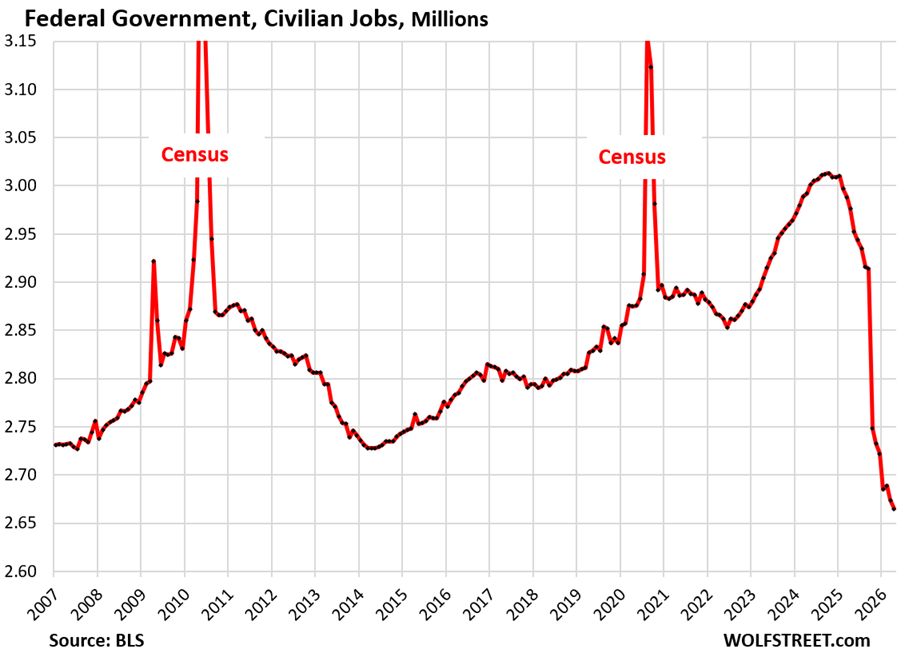
The drumbeat of job reductions at the federal government continued in April, with another 9,000 cuts in its civilian employment, including employees who’d departed earlier but whose severance packages ended in March.
Since January 2025, the federal government has shed 345,000 civilian employees, or nearly 12% of its staff. Federal government employment is now down to 2.66 million, the lowest since 1966, accounting for just 1.7% of total nonfarm payrolls, the lowest in the history of the Bureau of Labor Statistics data going back to 1939.
State government employment edged up in April from March, but is down by 53,000 since January 2025. Combined, federal and state governments have shed nearly 400,000 jobs since January 2025.
Local government employment – largely composed of educators, first responders, and healthcare workers – was unchanged in April, and up by 149,000 since January 2025.
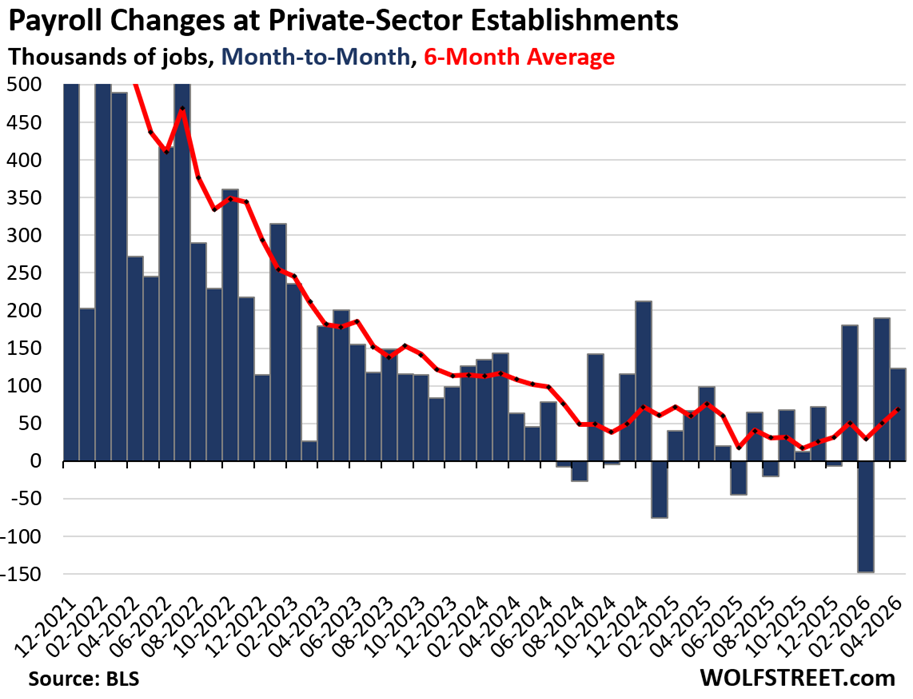
The private sector added 123,000 jobs in April, after an upwardly revised 190,000 additions in March. The month-to-month data yoyo has been quite strong. The huge private sector in the US doesn’t flipflop from month to month on a dime like this – it’s just that the data is yoyoing.
So the six-month average job gain, which flattens out the yoyo and shows the trend better, rose to 68,000 for April, the highest in a year (red in the chart).
Over the past 12 months, private-sector employers added 511,000 nonfarm jobs.
These job gains are low for the US under normal conditions. But now are not normal conditions as the labor force continued to shrink in April amid the crackdown on illegal immigration, tightening up of legal immigration, and the continued wave of boomer retirements.
But the federal government has shed about 12% of its headcount since January 2025, and is down to 2.66 million jobs, the lowest since 1966.
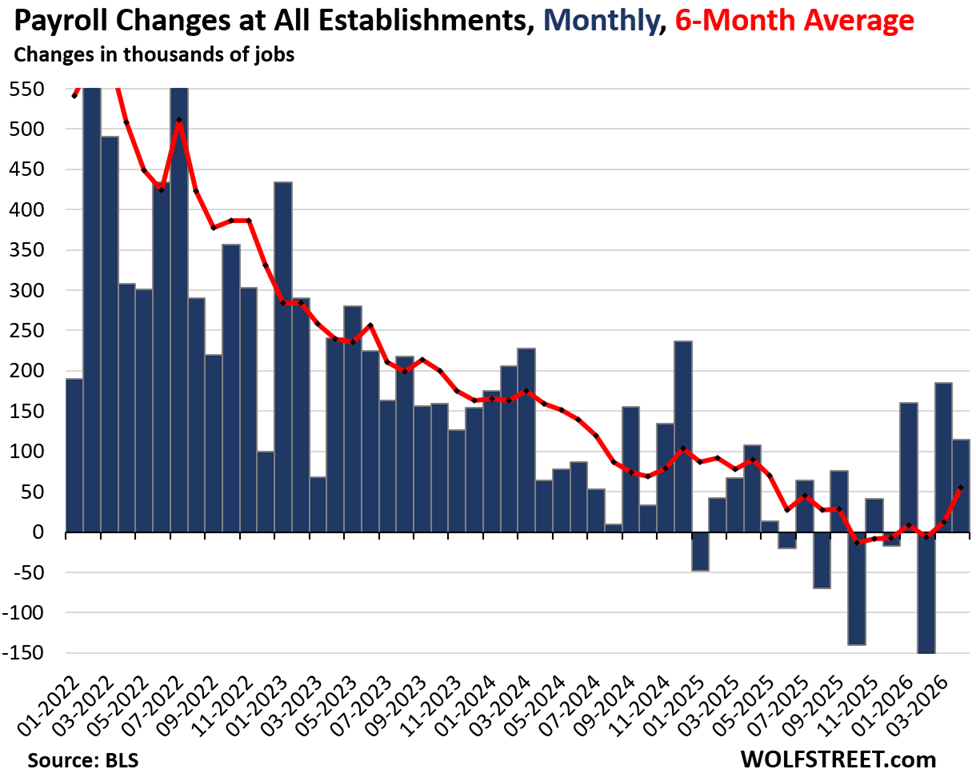
Total nonfarm payrolls, including government, rose by 115,000 in April, and by an upwardly revised 185,000 in March, to a record 158.7 million.
The six-month average rose to a gain of 55,000 in April, the highest in 11 months, despite the job losses at federal and state governments. The low point was in October last year.
Normally, such low job growth would cause the unemployment rate to rise sharply as the labor market would not be able to provide enough jobs for a growing labor force amid the influx of immigrants and young people moving into it at a faster rate than older workers retiring and dying.

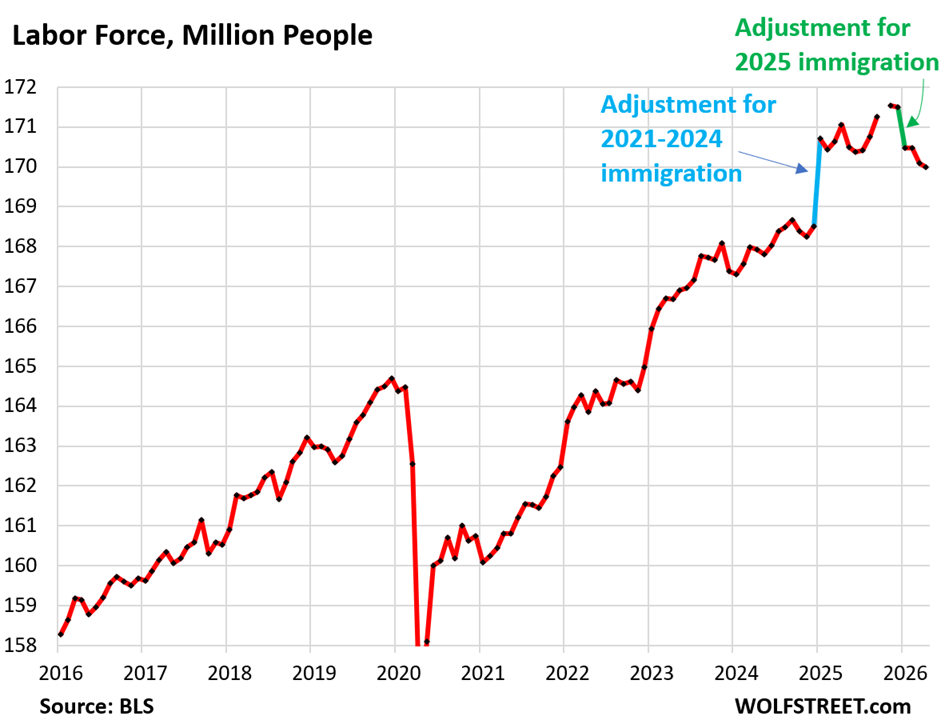
But that’s not happening anymore. The labor force has been dropping since last fall amid the crackdown on illegal immigration, a tightening up of some work-visa programs, and the wave of boomer retirements. In April, it dropped by another 92,000, to 169.99 million. Over the past six months, it has dropped by 1.45 million.
The labor force is the supply of labor, composed of people who are working or actively looking for work. And this supply of labor has shrunk by 1.45 million in six months!
The labor force data is based on household surveys that are adjusted annually at the beginning of the year to the Census Bureau’s revisions of the US population (blue and green segments in the chart).
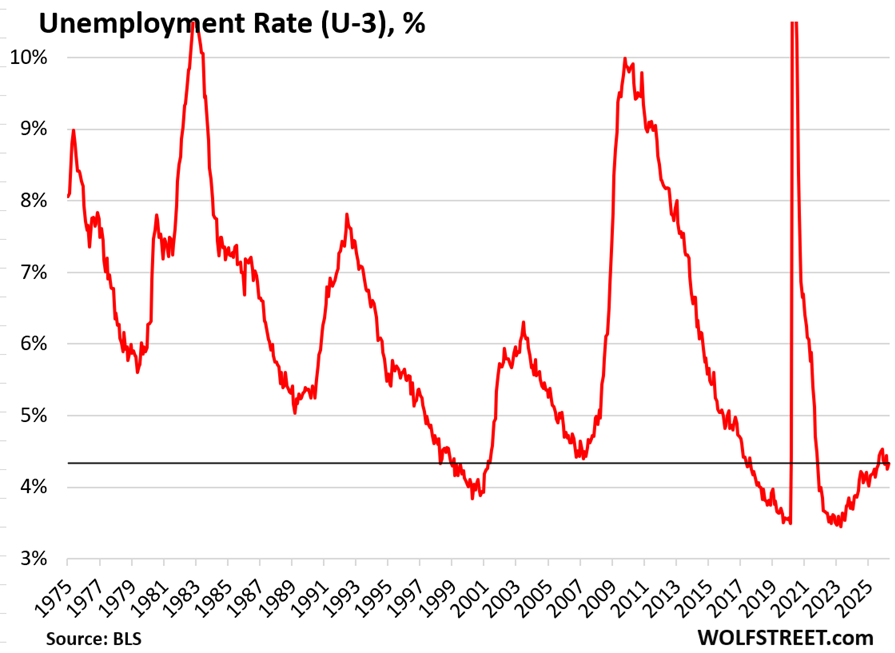
And so the unemployment rate has been roughly stable at a very low rate. In April, it was 4.3%, same as in March, down a hair from 4.5% last fall and up a hair from a year ago.
The unemployment rate reflects the number of unemployed people who are actively looking for a job (7.37 million) divided by the labor force (169.99 million).
From a long-term perspective, this is a tight labor market, but not because there is sharply growing demand for labor – there isn’t – but because of the declining supply of labor.
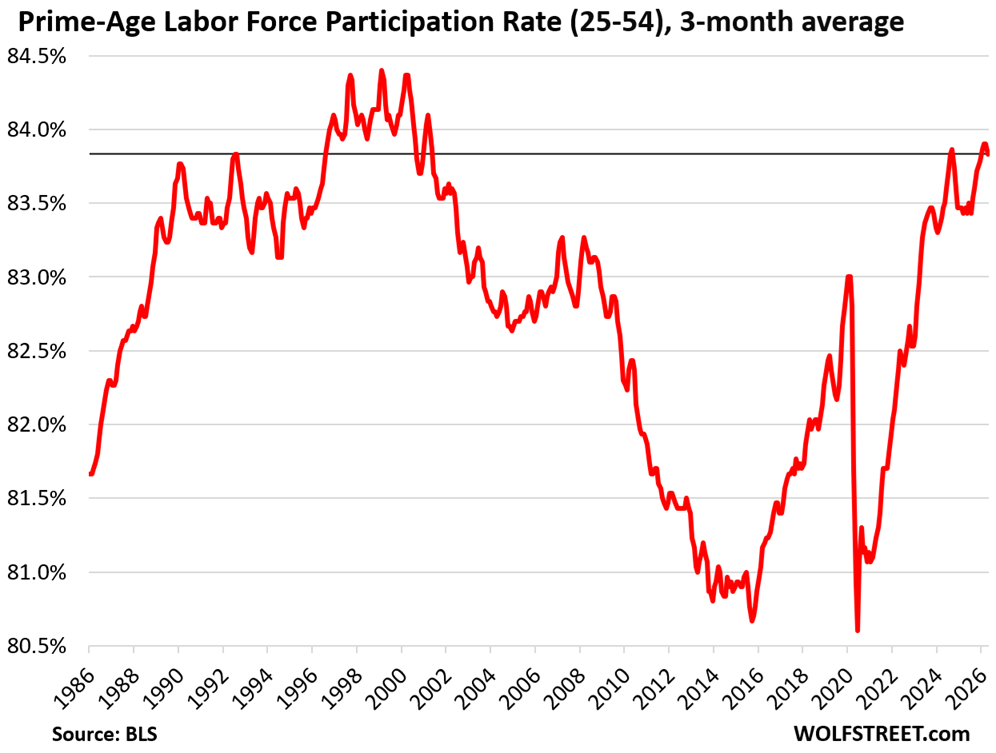
The prime-age labor force participation rate shows this tight labor market. The prime-age labor force consists of people between 25 and 54 years old. It eliminates the issue of the retiring boomers. When people retire and stop looking for a job, they’re no longer “participating” in the labor force but remain in the population until they die. It’s the surge of boomer retirements over the past 15 years that has pushed down the overall labor force participation rate.
In April, the prime-age labor force participation rate remained at 83.8%, and the three-month average was also 83.8%. This range has been the highest since the Dotcom Bubble in the 1990s.
It’s the result of more people getting pulled into the labor force by demand for labor as the supply of labor is constrained due to the crackdown on immigration and boomer retirements.
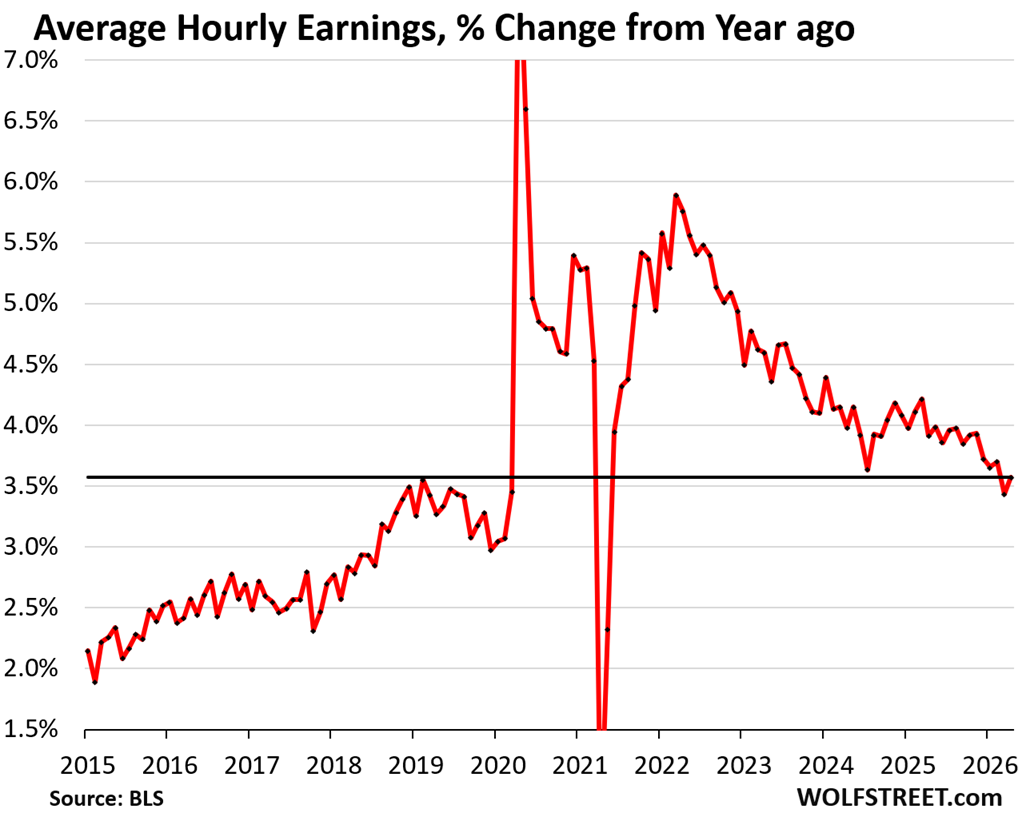
Average hourly earnings rose by 3.6% year-over-year in April.
Clearly, all these global layoff announcements by US companies since 2022, reported breathlessly in the media, and the actual layoffs that occurred in the US, despite continued but slow job growth and falling supply of labor, have the corporate-desired effect that workers have curtailed their demand for higher wages.
But now inflation is accelerating sharply and has about reached this rate of wage growth, putting wage growth at risk of falling below the rate of inflation.
Enjoy reading WOLF STREET and want to support it? You can donate. I appreciate it immensely. Click on the mug to find out how:


Employment to population ratio for 25-54 continues to be flat as a board: 81% of people in prime working years have jobs, also very similar to the dot com years and a close second for highest in US history.
Taylor rule continues to call for Fed Funds Rate about one quarter point higher than it currently is, though interestingly is dropping slightly.
As a miner I learned how to ignore the cruelty a required skill of a miner of like my dad working at the 5600 level of the hot Belmont mine.The only thing he told me about his first day digging piss ditch, pushing the loaded ore cars to the shaft and lifting the ore car up dumping the ore into the tipple.
When it came time to lift the loaded ore car after a while a friend stepped forward and showed him that the the ore car was spring loaded and that all he had to do to was to step on pedal that releases the ore into the tipple
He
It’s ironic that Trump wants lower interest rates, but he keeps doing things that lead to higher rates.
Tariffs, Iran, and the OBBBA are inflationary, and have kept the Fed from being able to lower rates.
His immigration policy tightens the labor market, reducing unemployment, and props up the other side of the Fed’s dual mandate. Again, no reason to cut.
Unless he actually wants higher rates, but is using some kind of reverse psychology when he screams for lower ones?
Howdy Beats Me. Trumpy Tweets are truly something. They seen to even have StockBOYS reading them. ” Making US Kings of Energy solves everything. ” . Pretty sure that is what he is thinking….That s what he always kept saying to Opra anyway.
That’s the case with everything in this administration. Just like when they say “we need to cut waste and lower the debt” and then immediately go and increase spending. Whatever doge has cut will be negated by the new ballroom. All the fed workers salary cut savings will be negated by the 14 billion dollar IRS lawsuit
Don’t forget the coming suspension of the National Gas Tax, which is estimated to cost the Federal Government $500m per week!
Wow, that’ll blow a hole in the budget quicker than snot in a sneeze! I bet Rand Paul will have a field day with THAT one!
When someone floats an idea, it doesn’t mean that it becomes policy. Lots of ideas get floated. That said, Republicans are desperate for the mid-terms, and any short-term vote-buying method is on the table.
Fed overnight rate has little to do with consumer interest rates
I would much rather endure a recession than hyperinflation/Stagflation.
Lowering rates would be an absolute disaster.
Going hungry sucks.
Been there.
With Trump Irony is hardly the cause
it is intentional
So rate cuts? /sarcasm
Dependency ratio going to take a fun ride over the next 20 years.
Monetary policy isn’t the right solution. I’m sure we’ll hear about how young people need cheaper borrowing rates, what they really need is lower asset prices and better policy.
Evan has my vote for Fed President, as i’ve been saying the same thing since 2008.
Younger people need higher salaries.
That sound you hear is CEOs and shareholders everywhere laughing all the way to the bank.
You need to do what all previous generations have done and outsmart those younger than you.
Turn them to the “Dark Side”, Harness them.
🤣 /s
Corporate profits are at an all time high. Younger people need to join together and use their bargaining power.
Exactly ” Monetary policy isn’t the right solution” because of the obvious result that Wolf describes
Wolf, at what point, if any, would the decreasing labor force become an issue from a tax revenue perspective? Treasury.gov has individual income taxes as 50.7% of tax revenue (FY2025). While 1.45 million out of 171.4 million (1.45 + 169.99) is a rather minor decrease (-0.85%) over the past six months, any sustained decrease in potential tax revenue when the deficit continues to balloon seems like it would be concerning.
In terms of tax revenues, what matters is employment and aggregate wages, not the labor force. As long as employment and aggregate wages rise, tax revenues from individual income taxes will rise.
Population declines are quite slow. Bulgaria has one of the largest rates of population loss in the world, having lost 2.5 million people since 1985. Even so, this only corresponds to a loss of 1% per year.
Well it’s 1% compounded, which is significant over long time periods. A 1% reduction that occurs after 20 years of compounding is an 18.2% reduction I’m the base value.
No issues with tax payments.
The U.S. Treasury reports every day how much it has received in payroll tax withholding (federal income, social security and medicare taxes).
The total for the past 365 days is increasing at a 6% annual rate.
The issue the Federal Government has is Too Much Spending.
All of it increasingly popular and useful.
Maybe we should fire some more CDC vessel sanitation workers and save a boatload of money.
/s
I’m all for spreading Hantavirus! That should reduce the working population further! Not like it’s COVID or anything!
The front end of Gen X is 61y. Within two decades they will be 81Y.
Within two decades the boomers and gen X will leave behind many vacant homes. Vancouver taxes vacant homes reduce RE prices. Without immigration the labor force and the US population will shrink. Gen Z and millennials will benefit the most. Their per capita income will rise. The Biden’s era high tech shrinking. Employment in ammunition, drones, missiles, planes, ships, space….is high. Personal spending M/M was higher than wages. Great. There will be a shift from education and healthcare to the high tech industry, where income and productivity are higher. A smaller gov, higher payroll taxes, higher inflation, student loans collection, tariffs and less regulations == > will fill gov coffer.
“Within two decades the boomers and gen X will leave behind many vacant homes.”
Within two decades the US could resemble one giant Thunderdome.
I’m a teacher, and I plan to retire in 4 years. I expect all of the major AI players in the US to announce AGI by the end of 2027. It may slip into 2028, because it’s going to be such a pivotal moment in human history, causing them & Uncle Sam to be quite hesitant about its release.
A non-human entity created by humans that can recursively learn and do any knowledge task orders of magnitude faster, cheaper & better than humans will be more important than early man’s discovery of fire. And robotics ability to mimic human athleticism & dexterity are only modestly behind Grok Expert Mode’s 145 Mensa score.
With all that said, I fully expect AI will begin to have a profound on students’ expectation as it relates to higher education about the time I retire. Within 5 years, there will be a massive shift in how high school grads view the value of a college education. It’s already been but in half over the last 15 years, so I’d expect AI to create a similar chain reaction, causing it to drop from 35% to at most 15-17% in the next 5 years or so.
Declining value of and respect for humanities=declining value of and respect for humanity. A degree used to mean at least some exposure to a philosophy less inclined to self-extinction.
Gen Z scares me in their dependency and anomie. They will relegate their elders needing care to the bots.
The elderly people I know would definitely prefer a competent, polite robot to the dreg-ends of the employability distribution that are currently pulled into elder-care.
AI (Atrocious Idiocy) will be a laughed at and scoffed at irrelevant anachronism within a year or two. What utter stupidity.
I use vendors’ inhouse AI for tech support, and it’s far superior than any tech support I’d ever had to deal with. It’s amazingly good. There is a lot of tech behind Wolf Street, and I’m not a tech guy. So this is hugely beneficial for me. A few days ago, one of them (Cloudflare), after giving me a long list of what to do, even offered to fix the whole issue (this was on their server, not mine), and I said yes, and 1 minute later it was fixed, saving me lots of headaches and an hour or more, and the possibility of me screwing it up and knocking my site offline.
Not hardly. There is quite a rush to market right now due to the mania and frenzy and so we have a lot of grifting and scammers in the midst. I’ve seen what AI can do on the good side and the bad side. The AI systems that are “legacy” and have been around for years now are incredible and lay to waste competing companies without it. The crap AI systems just bleed millions from poorly managed companies. AGI or true AI or strong AI or whatever we are calling it is anyone’s guess. Experts are divided on the topic whether LLM’s can even be a path to true AI. I’m not sure.
What I am sure of is AI is here to stay and it is going to fundamentally reshape society. A lot of the “safe and sound” careers of yesteryear will likely fall first. Data entry/analysis, paralegals, actors, musicians, IT, middle management, accounting, banking, teachers, etc. are in for a rough future.
I used to be pretty skeptical but the past 6 months of really digging into the reality behind the technology has changed my mind. There is a lot of crap out there that makes it easy to lampoon AI and the stock market fever and hype makes it all the more loathsome as well. The good AI systems are breathlessly and ruthlessly efficient. I’ve worked at a place where the forklifts on the dock have odometers integrated with the AI dock controller software. It’s literally measuring in real time how many extra inches you’re driving between trailers and when moving pallets. You have a cross dock excess mileage percentage in the warehouse and have it as one if the dozens of performance metrics every month that the supervisor goes over in meetings with ranking between the other employees. It’s utterly draconian. The insane wages compensated for the misery and cutthroat environment and we were one of the few companies using the system but our quarterly financials were dominating the competition.
AI is mind blowing when properly deployed and well developed. It’s going to be a miserable world to live in though. Within a decade most jobs will be a robotic Orwellian nightmare of micromanagement delivered by a bubbly and chipper chatbot supervisor and we will all be given freedom from freedom with the AI surveillance state.
Call me crazy but I’ve put my money where my mouth is. I’ve sold off nearly every material possession and am dumping the money into paying off the absolutely most modest and cheap house I can afford. 2br/1ba mining flophouse on a postage stamp next to half a dozen superfund sites as far away from town as I can tolerate. The rest into “stonks” or bonds.
If you see black clouds on the horizon it ain’t time to throw on Sunday’s best and go for a stroll with the top down.
FOR the TruckGUY:
Great Post IMVHO, and I hope you will continue to share your experiences and thoughts on Wolf’s Wonder. Just one more reason, of many, that I support WS $$$…
Kudos for having lived through the vast and continuing challenges that SO many folx will have going forward,,,
and, so far,,, it seems that you are doing better than a few years ago, as, perhaps, the trucking industry specifically, and the transportation industries in general go through the transition(s) from the models of years ago to the models of years to come.
SoCalBeachDude,
I wish you’d say why you think so. I’m going to guess you tried to use Copilot to prepare a PowerPoint slide set. If I’d tried that first, I might think the same. It made me the most glorious piece of AI slop. I kept it to show to others so we could laugh at it. But I’ve been pretty impressed with ChatGPT. We’ve been able to write a couple of apps for scientific data processing, among other things. We’d have had to hire a programmer to do that otherwise. It’s a lot better for research than it was 1 – 1.5 years ago too. The one I use doesn’t seem to hallucinate references like it used to.
Almost every actual programmer I know will overtly tell you it’s a when not if scenario. You don’t often find core workers exposed to automation dramatically overstating the technology’s ability to automate their work.
Well, the world needs drones too!
Can I have your drug dealers number? You clearly got ahold of the good stuff!
We regularly see that healthcare is adding jobs. This is fitting given the aging population. However, I do wonder how sustainable this really is in the context of the giant US deficit and coming Medicaid cuts.
Oh it’s big bad. There will be a reckoning for sure. Employment is growing, and they have very effective collective bargaining/cartel status that allows them to set rate for an essential service.
It will be a massive GDP drag. The whole private/public debate doesn’t matter, it’s functionally an unproductive portion of the labor market regardless of where its housed.
The literature is clear on what happens when too much of a societies’ effort goes into a non-productive corners of the economy.
Unproductive? How far does that extend into the sector? Drugmakers, Device manufacturers? I guess its confusing to me; how an entire sector of the labor market can be labeled “unproductive”. Can you explain how you came to this conclusion? Honest question.
For some folks, the only productive job is manual labor to build something physical that they understand and can use, such as a car or a house. Producing software, websites like this, consulting services, medical devices, etc., is then by definition “unproductive” and somehow a waste.
It’s because healthcare (and education) is girly girly girls work and manufacturing is manly man work.
Less productive is probably a more apt definition.
If you spend a million dollars on a tank and it goes to war and gets blown up you moved a million dollars or thereabouts into a defense company. The country you sent the tank to has dirt farmers sell the hull for scrap metal and the money doesn’t produce more money.
If you spend a million dollars on a machine that turns out widgets that can make a million widgets then that turns into profit which feeds a lot of industries and returns a decent amount of capital flow which boosts GDP.
If you spend a million dollars on keeping someone near death in a suspended state then they die anyways a few weeks later you have the same kinda deal as the tank. A bit of money goes to a handful of people but the wealth doesn’t disperse out as greatly or grow exponentially.
It’s rather Kevorkian but a lot of the healthcare system for elder care is just moving money upwards or laterally. Saving a young productive member of society who is creating wealth is more beneficial to the capitalist system than extending the life of a bed ridden senior on welfare or even worse, a pension. For the middle class that spend their retirement funds on healthcare it is beneficial to the upper classes. For the poor on social security it is just a government handout to the healthcare industry. A la upward or lateral movement of capital into healthcare. Strictly speaking, it is better for retirees to die sooner rather than later and have the money move to the inheritors who will blow it on a 150k dollar Ford Raptor Earthquake Tremors XXL Patriot Platinum King Ranch Edition LTD SVT EXEC. Or you know, consume less, invest more…
…And also fir the poor alt people to be turned into soylent green and medicare/SS be dissolved. But let’s not be too eager with the hypercapitalism.
If I were to retire I would buy that Ford Raptor Earthquake Tremors XXL Patriot Platinum King Ranch Edition LTD SVT EXEC pick-em-up truck and put a sticker on it that said socialism is just communism while I drove down to the social security office.
“Productive” in that context doesn’t judge, its discriptive in the financial context.
Manufactoring is “productive” as the productivity rises with investments and one worker can produce more and more over time and earn higher wages.
A nurse takes care of one person at a time a decade ago and in a decade it will still be the same. (there are producitvity gains but lets ignore them for the sake of the argument)
In the context of the economy, rising productivity means rising living standards and rising wages.
If now the so called “non-productive” sector has a bigger and bigger relative share of the economy, that might (will?) lead to inflation. Because all teachers, healthcare workers etc. need rising wages. But they are paid for through the productivity gains in the “productive sector”, and at its core inflation is a supply/ demand inbalance and that is a supply/ demand imbalance in the labour market.
In the past decades that inflation was exported to china as the US (and everyone else) imported more and more goods from there. That kept the supply/ demand balance suppressed even though wages rose in all sectors.
The term “productive/ non-productive” is probably not very good but it does not mean one is worth more than the other or denotes some kind of lazyness. At the end an economist is a non-productive worker, too.
Large chunks of those medical workers are things like home health aides for house-bound seniors. It’s the right thing to do societally, and you could argue that this service allows productive employees to maintain their jobs in the big city vs go home to take care of mom and dad, but expending additional labor resources to care for people who are not earning and are spending the earnings of the young via social security is not efficient in maximizing societal output.
I’m reminded of China, where smoking remains encouraged (subsidized) by the government. The old die earlier and relatively more quickly while it has little impact on the younger productive years.
How on earth is medical care unproductive? Even if you just say “oh the treatments on 90 years don’t add anything to the economy” then that is a dumb argument.
Every single drug, treatment, and medical device eventually helps someone who is in the “productive” age, thereby reducing their downtime, leading to either more production or more leisure.
So in your world there are no elderly without kids? The elder-care worker is more likely enabling the children of elderly people to watch more TikTok than some productive effort, given distributions in productivity throughout society. Otherwise it would be wise for us to find elder-care in other societies as we do infrastructure investment via the world bank.
I tend to agree with Evan.
From a purely macro perspective, with no ethics involved at this stage: the overwhelming majority of “healthcare” spending in the U.S. goes to prolong the end-of-life of elderly people, usually by just a few months. These are treatments which the individuals couldn’t afford on their own, but thanks to Medicare the government will pay. Often the treatments aren’t even necessary, but are done to either pad profits or dodge potential lawsuits. These elderly patients are no longer productive workers and usually only have months left to live (regardless of whether they get the treatment or not).
From a purely macro perspective, again without considering ethics, this is quite wasteful considering the alternative uses of all that labor and money.
Meanwhile, a lot of healthcare for sick babies, children and workers is extremely productive. It gets people back on their feet faster and frequently prevents disabilities. But that’s not where the money goes in the “healthcare” system. (And even for working-age people, a lot of “healthcare” money goes to “treatments” that cost a lot but don’t provide a commensurate benefit.)
This I have little argument with: American views on extending life pay the point where it is enjoyable or useful anymore is really toxic and wasteful. People could use that time and money to have quality experiences and interventions that make life more meaningful, or just take the time to say goodbye and remember the good times. Instead, because of fear of death and the unknown people live out their last days in miserable environments.
To extend this to the rest of healthcare is a big mistake. Health improvements early in life have enormous impact on quality of life. And the advances happening there are really important. And yes, thanks to Baumol’s problem, Anthony that requires lots of human time will get expensive a lot faster than anything that can be automated, but it just means we have to choose carefully what we spend human time on. Baumol’s “disease” is just saying to us, “don’t waste human labor on things that aren’t really important to us”.
You would think that sooner or later the falling supply of labor and accelerating inflation would put pressure for higher wages.
Union contract negotiations will be tougher. Could be a setup for spiraling inflation.
I remember those days back in another oil shock life. Contracts had COLA language as protection for fast rising prices.
My wife just called after leaving UPS in Houston. She had packed 3 small boxes for the grand kids. Total wight maybe 5 lbs. The “big” one was the size of a USPS Express Mail box(about 14″ x 10″ x 3″). The clerk quoted her $480!
He then said he would go $430…needless to say she walked out.
The United States of Corporatocracy.
USPS is much cheaper and easier.
Pirateship yo
Ya, that dude had to be trying to scam her.
I’m curious about how contracting out of labour, and off shoring of goods production and services by the government and by private industry affects the overall long term employment trends. Is there data that consolidates everything?
Will the decrease in total government
employees as a percentage of the workforce make the next downturn
worse ? I would think government
employment acts as a buffer during
a recession in that it helps to keep
money circulating.
The world is watching in read time how deep staffing cuts in the pentagon and other critical areas of the government has weakened the US beyond belief in a short period of time. I am expecting to see the US job market suffer significantly as the energy crisis deepens in the weeks and months to come due to an ill conceived war that has created massive imbalances, especially in global energy production.
And yet the BLS keeps on churning out its data every month. SS keeps paying checks. The USDA keeps ensuring food production is safe. The DoE is fast at work helping start up SMR companies get their initial designs deployed.
So while the war may have been ill conceived, it sure looks like the federal government keeps deporting illegals & doing all the things they’re supposed to do with almost 13 less workforce. And let’s not forget how negative 119 days of government shutdowns have been on the country.
As for the Iran war, it’s still too early to call whether or not it was all worth it. Defanging Iran’s nuclear program & knocking back it’s conventional military are good things for the US & ME.
There are a billion articles talking about how all those things you mention actually aren’t still happening, but actively getting worse, leading to delays and backlogs and missing resources in ways that hurt retirees, farmers, and scientists.
See Baomol Effect.
Economists have been on this for a while. Surprising, I know.
Except its like maintanince. When cut early on it makes the cutter look like a heros. Look what we saved. In the end it creates disasters. guess what phase of the cycle we are in with the cuts….. As far as Iran the jury is out but using your arsenal when you may need it eleswhere also as a deterent may not be the best use. Certainly this admin doesent seem to be playing 4d chess more like checkers.
This administration is trying to play connect 4… But they can only get to one maybe two lol
CDC keeps promptly responding to outbreaks of new respiratory diseases on cruise ships….
/s
Singular: “cruise ship”
If I will get 4 stents, bc I asked for it, and wake up, I add to the GDP. If I will not wake up ==> cardio, anesthesia, radiology, pharma, nurses and the hospitals will lose their compound income. The healthcare sector torture their victims, but keep them alive to enhance returns without efforts
Capex avoidance (reductions) sent mag7 income higher. The high tech co are connect with a feedback loop. They competed with each other. They are sending unrealized promises – which are options – sending SPX vertically up, rising like a missile. A negative signal will send SPX down.
I find this statement mind boggling: “Federal government employment is now down to 2.66 million, the lowest since 1966 … ” With all the explosion of government social programs starting in the 1960’s, federal government employment is still on par with the mid 1960’s !!! I assume this means civilian employment.
Back in 1966 they did not have personal computers or the internet. These two thing surely increased worker efficiency, since in 1966 everything was done on paper.
I can see the AI gains mentioned by Wolf in his work also mitigating a lot of the reductions in total employment at the federal level.
If you look at Wolf’s plot of Federal employment, you will that the level varied between 2.75 million and 2.85 million from 2007 to 2023, a span of 16 years. In the last 2 years of the Biden administration federal employment increased to 3.0 million, about 150K new positions. That is a lot. What happened that we suddenly needed 150K new federal employees?
Don’t forget, this was when there was large increases in government employment with the space program, supersonic passenger airline program, and LBJ’s expansion of the Great Society Programs, the Vietnam War. Also, don’t forget that the federal government now used much more outside contractors. Think of the expansion of NGO funding over the past decades.
There’s a known reduction in head count in higher education because people having less children. Are we seeing the impact of this and deportations working together?
Also, if an individual has two or three jobs, how are those counted?
The issue in higher education is foreign students — they dropped sharply in 2025 and on. Then universities started admitting more local students. But local students pay less, so it’s a huge financial hit to universities, and they have to adjust their budgets. This is something the University of California system has been struggling with.
Local school districts at least trying to reduce at all levels due to decreasing enrollments here in the saintly part of the TPA bay…
Just reporting the fact.
Reading that is going on everywhere our brothers and sister with somewhat darker skin color have been doing most or at least close to most of the actual manual labor to build our houses, etc., etc.
I agree that’s a fact.
Nice to see it starting to turn around.
Part of the story of increasing wages.
What work is not being done following all the federal layoffs? Have functions been replaced with contacted outsourcing? I don’t understand how so many people have left federal jobs in less than an 18 months window without some marked and obvious examples of “things not being done.”
I’ve run into a few things not getting done — various secondary data sets and reports not getting done — and I mentioned a few of them here, and others have chimed in with similar things not getting done. Scientists have a longer list. I read that since the IRS auditing staff was decimated, audits of rich people and companies have gotten further curtailed. Things like that. So there is some effect, but it might not be noticeable by the general public.
Yes, all this and more. The government used to collect data and information about a wide variety of things as a public good: we make better and smarter decisions when we know more things and the federal government has the money, power, scale to be able to do it efficiently. The smash and grabbers do not of course see the value of these things and so they were the first to go.
Many of the government layoffs are only now being realized in the sense of people vacating the role vs having learned the news. It’s almost like this administration is trying every kind of short-term intervention it can vs caring about the long-term health of the country. At least the president has no history of managing organizations in this vein.
Wolf. You touched a great discussion topic. First, contract employees versus direct.
Baumol effect. Can people rationally talk about this?
Unfortunately, a person’s opinion on what economists call unproductive labor depends on if they are the unproductive labor.
These same people will change their position on unproductive labor if you let them stay home and pay them anyway.
Please write article on Baumol effect and unproductive labor
I’m not going to honor stupid insidious BS like the “Baumol effect” with more than one sentence, and this sentence is it.
The labor market is only weird to those who fail to understand free markets and their benefits as pointed out by classical economists who noted for hundreds of years that lower government regulations results in better economic outcomes. Even the Chinese Communist Party finally recognized this in the 1980s. The only people on earth who don’t recognize this run North Korea and the Democrat Party.
RTGDFA
hilarous you can let me know this from your hospital bed when your car has no seatbelt (or the equivalant) or maybe plate glass windows anti lock brake? or how about food saftey? You dont miss your water till your well runs dry……………………………
For a sec there, I thought you were going to accuse the Democratic Party (here in the USA) of being communists, and I was going to be like “whaaaat?”. But then I realized you said “Democrat” party. Well, I’ve not heard of them, and we don’t have them here, so good.
Does the Fed pay attention to birth / death numbers of businesses? Seems like BLS adjusted for 2026 but wasn’t clear how this factors in.
New businesses (births) cannot show up in the surveys because they’re not yet in the database of businesses to get the surveys. Similar with shut-down businesses (deaths); they still get the surveys but don’t respond and say we’re no longer here. So this dynamic introduces errors in the survey results of employees, and the Birth-Death Model estimates, based on past factors, how many employees were working in new businesses that hadn’t been entered into the data base, and how many people got laid off from businesses that shut down but are still in the data base.
For example, in 2025, 5.7 million new businesses were created, and they’re employing lots of people. In March 2026 alone, 534,850 new businesses were created. If each business creates just one employee (the owner), then that’s 534,850 jobs that weren’t included. This business formation data is by EIN with the IRS but it takes a while before these businesses are included in the database of businesses that get the survey.
These estimates are adjusted once a year with the data from the quarterly payroll reports.
The Fed has nothing to do with that.
Thanks!
People are often concerned about “who they are”, because we compare ourselves to other people. In the future with robots around people might think more about “what they are”.
Robots could bring back the concept of slavery. I was looking up different domain names using “bot”. Sure enough, “slavebot.com” has been taken. You will also need a leader robot to control other robots, a “bossbot”, thus bossbot.com. That has also been taken….lol
The question is how much longer can the labor market sputter along?
The days of large labor growth appear to be in the rearview mirror.
Or will somehow the removal of illegal immigrants along with retirees be enough to prop up the labor market for several more years before CEO’s decide when, where, & how deep human jobs are replaced?
At least among my kids’ generation the issue isn’t employment – it’s underemployment. Companies no longer hiring fresh college grads. Corporations cancelling internal development programs. Cancelling internships. Kids are graduating with decent STEM degrees, and find themselves working at Walmart. My daughter graduated with a decent science degree and great GPA – and found herself competing with laid-off government employees with PhD’s for an “entry level” position that “required at least two years of experience”. She is working a job that is paying less than I made when I graduated undergrad in the late 1980’s.