
The share of “full paid days worked from home” has been declining by only about 1 percentage point per year.
By Wolf Richter for WOLF STREET.
To get people to return to the office (RTO), companies have been using all kinds of pressure tactics, reprimands, threats of termination, ultimatums, and actual terminations. And they have been using carrots too, such as fancily remodeled or gorgeous new office palaces. The Trump administration issued a memorandum in January 2025 that required employees to return to the office full-time “as soon as practicable” — those employees that it hasn’t fired yet. And state and local governments have issued similar requirements to get their far-flung people back into office buildings.
But despite all these efforts, progress over the past three years has been minimal. The share of “full paid days worked from home” as a percent of total days worked rose to 26.9% in March, in the range where it had been in 2024, and just a couple of percentage points below March 2023, according to data by Jose Maria Barrero, Nicholas Bloom, Shelby Buckman, and Steven J. Davis, published by WFH Research. A full day is defined as working 6 or more hours that day.
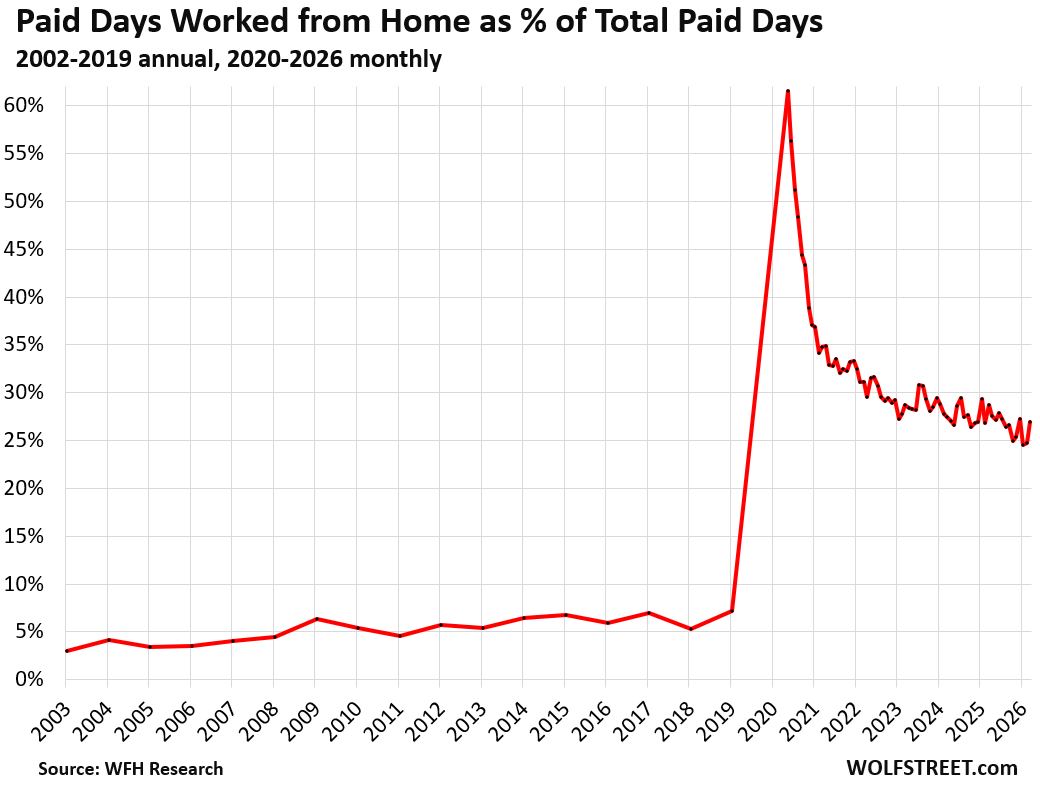
The trend has been down, but very slowly, with the share of Working from Home (WFH) declining at an average rate of only around 1 percentage point per year, despite all the efforts to force it to happen.
And the share of “full paid days worked from home” remains very high, nearly four times the share in 2019 (around 7%). In the 1960s, it was close to 0%.
Clearly, WFH has become entrenched. Hybrid models are now common and functional, companies and workers have figured out how to be productive that way, and RTO languishes.
During the pandemic in May 2020, the share of days worked from home spiked to 62%, in part because office workers switched to WFH, but also because other employment collapsed, such as in accommodation and food services, giving the working-from-home workers a larger share of the collapsed total days worked. As these laid-off workers returned to their jobs, the share of WFH plunged and by early 2023 hit 28%. And that range is where it kind of got hung up and further progress has been minimal since then.
Office attendance also shows RTO is languishing.
Kastle’s “Back-to-Work Barometer” measures office occupancy by how many people enter an office building for which Kastle provides the electronic access system. It measures office occupancy by people entering these office buildings as a percentage of the baseline before Covid. If office occupancy returns to pre-Covid levels, the barometer would return to “100%.”
The barometer’s Top 10 Cities Average was 54.9% in early April (red line in the chart below). Since the start of 2023, it has edged up from 50% range to the 55% range. The plunges are holiday periods. The top gridline (100%) denotes the pre-Covid baseline.
Of those top 10 cities, Austin is an outlier, at around 80%. Philadelphia is at 42%. And the epicenter of WFH, San Francisco, is at around 44%. Chicago and New York City are in the middle at 53% and 56% respectively.
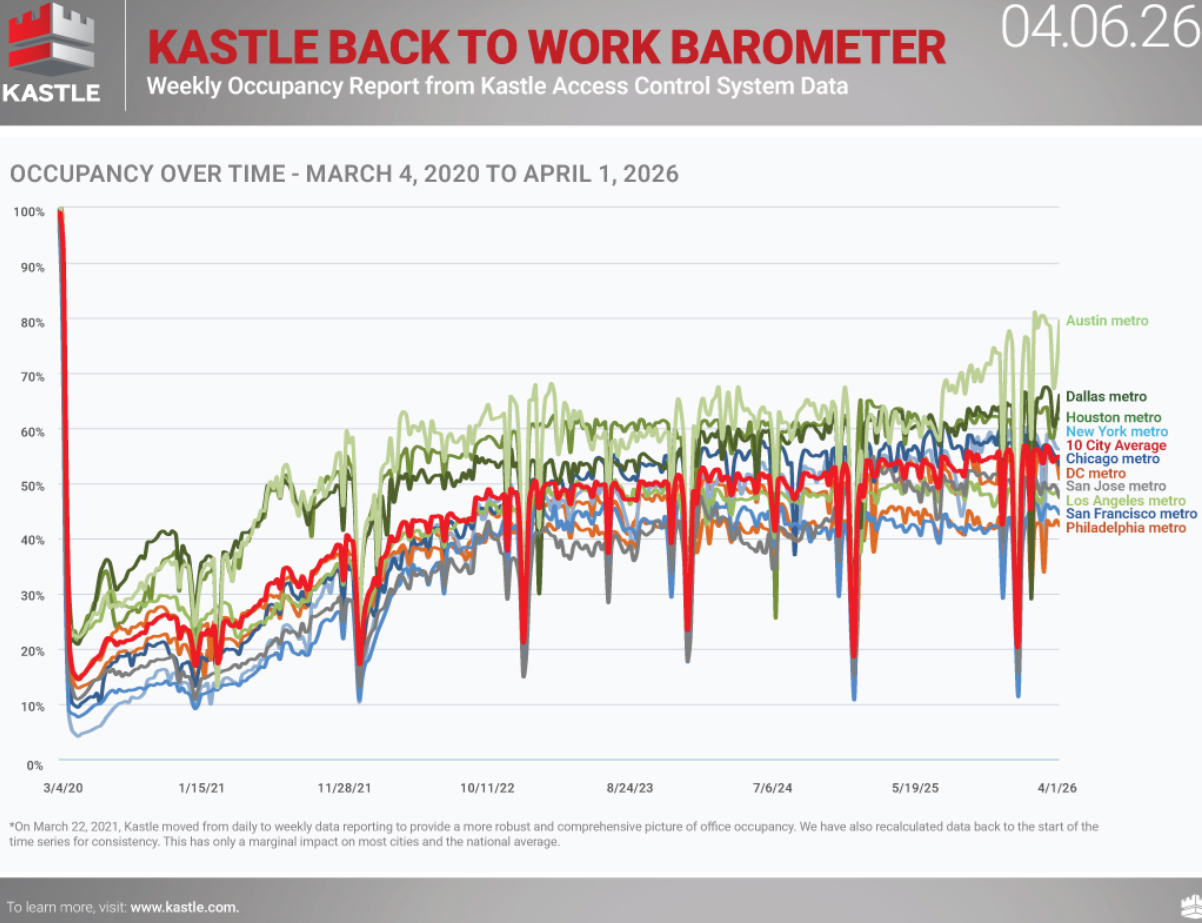
In super-premium class A+ office buildings, representing only 2.3% of the buildings in Kastle’s Barometer, the office occupancy rate is about 20 percentage points higher than the 10-City Average, at 74.5%. Some of the Big Tech and Finance palaces might fall into that category.

How much WFH workers want and how much they get:
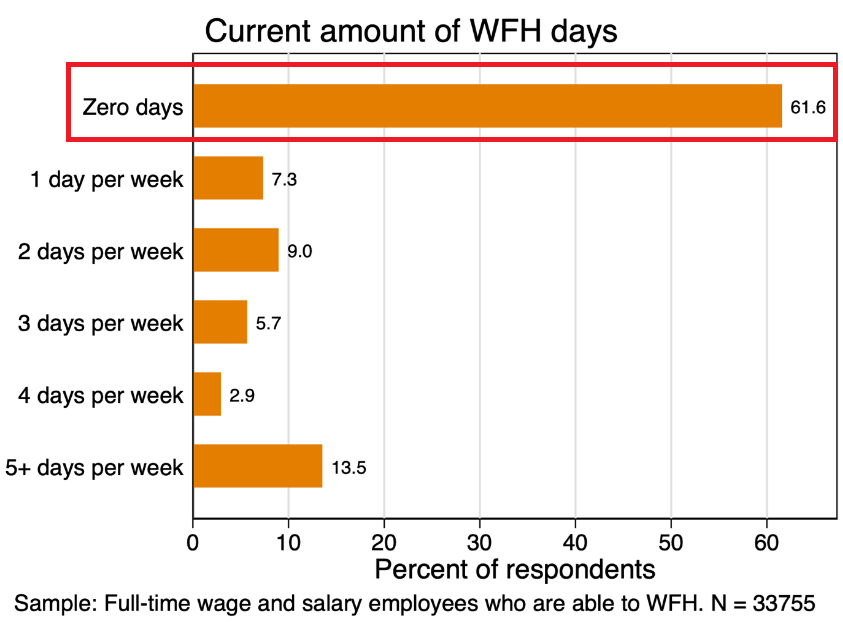
The first chart below shows how many days per week of WFH workers actually have: 61.6% of workers have zero days of WFH, up from 60% last year (brown bars).
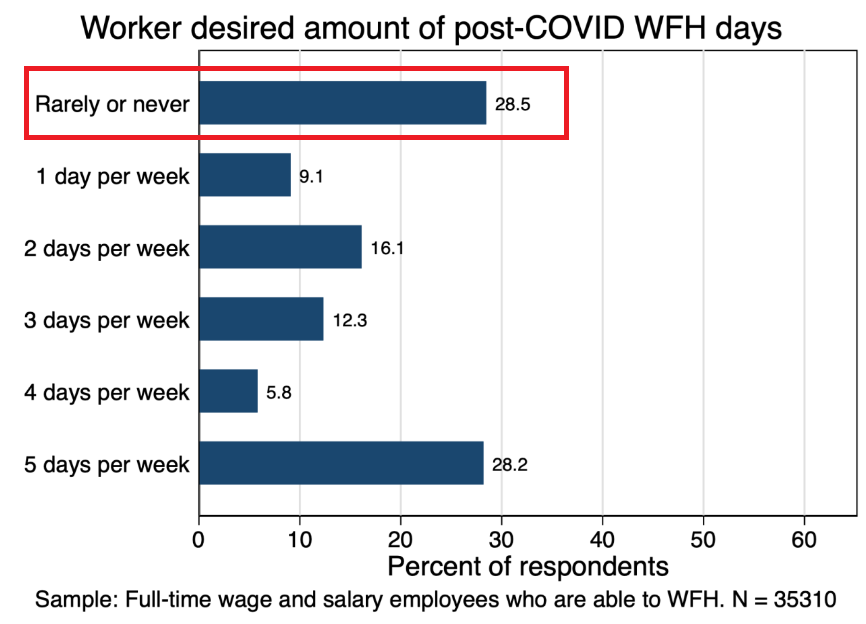
The second chart shows how many days a week workers want to WFH: only 28.5% of workers want to have zero days of WFH (blue bars). Charts via WFH Research.
By industry: These four industries have the smallest fully-on-site working arrangements, with hybrid and full WFH dominating:
- Information: 30% fully on site, 21% full WFH, 49% hybrid.
- Finance & Insurance: 35% fully on site, 24% full WFH, 41% hybrid.
- Real Estate: 42% fully on site, 16% full WFH, 42% hybrid.
- Professional & business services: 44% fully on site, 20% full WFH, 35% hybrid.
In case you missed it: Weak demand for labor and job destruction at federal & state governments should push up unemployment. But the supply of labor has plunged. Read… This is the Weirdest US Labor Market I’ve Ever Seen
Enjoy reading WOLF STREET and want to support it? You can donate. I appreciate it immensely. Click on the mug to find out how:


I work as a software dev in tech startups. Many startups chose to expand employment beyond the city they were founded in and now employ devs from all 4 time zones. Some even gave up their main office completely. This is true of my last 2 jobs. No real issue from 100% remote except it’s terrible for new grads trying to learn and meet people.
We got some Digital Nomads on the Dog Wood Lakes golf course here.in Bonifay Florida. They like it. Maybe it will be the way we work on the future. I know some people work for short periods for many companies. They get sent to many places around the world for sometimes years, and return home when not working.
My hometown of SF has been battling headwinds and much of it has to do with actually having to be downtown, soma or wsoma. Street people have made the quality of life ….to put it bluntly…shit. Why would I want to go to work and have to walk from MUNI Metro to Sansome and deal with it? WSOMA use to be fun/exciting. No more. Sad really and I don’t see it changing anytime soon. The city is not “back” as the local politicians like to say.
What will be more interesting to track in WFH salary vs in-office salary, both within industry and cross-industry.
Will a barista in Aspen make as much as a remote accountant one day?
Absolutely possible, but their earnings wpuld be spent entirely on living there most likely, with roommates.
Aspen where the millionaires feel like the middle class now.
I know of a large bank where they only had enough seats for about 60% of the staff. But the CEO demanded that all workers return to the office full-time, so the department heads spent all their time fighting the other department heads, trying to get a desk and chair for their workers.
“Hoteling” – another ingenious business strategy
Back in the good old days working in a Chicago business sector described in Wolf’s article, “management” would cruise the aisles of the cubical farms early on a Friday afternoon like Dilbert’s boss then rush to the elevators to their cars in the parking garage to high-tail it to their cottages in New Buffalo Michigan or Lake Geneva Wisconsin. I loved stopping them in their tracks to really let them know what I was working on.
I work at at a big Telecom company who forced everyone into the office. They fired a lot of people in RTO as they also forced people to move to a core location. The result was twofold. First, they lost a lot of company knowledge, and now we are less effective and it is starting to show in our results. Ability didn’t factor in, so most good people just quit. Secondly, the morale went to zero. Those left were angry their coworkers got fired and afraid of losing their job. It’s a toxic environment now where it was an environment of people who really cared about the business. We need new leadership, because everyone hates the current leadership, and I see the company declining.
I am one of those fully remote people. I have found zero need to be in the office. The 12 to 13 hour days including commute take a toll on ones health to accomplish literally nothing in addition.
“Remote: Office not Required” was published in 2013. The arguments still hold together pretty well.
I’m in government and while the governor mandated 4 days a week to return it was basically ignored or simply pragmatically possible. You can’t downsize your office footprint by 50% and do that. The assembly is looking to pass a law to legally give departments to choose their policies that make sense for them. I haven’t been in since March of 2020, outside a handful of in person meetings per year. But given Californias budget woes hard to see them picking up new leases and all the money that comes along with it. Plus after 6 years, it would be a huge adjustment for employees lives who have gotten used to the flexibility that comes with working from home.
RTO = Return To an Obsolete way of working
It would be interesting to pick stocks based on the amount of RTO pressure. It’s a sign the company is run by Luddites who care more about office politics than managing.
RTO isn’t actually about RTO; it’s about forcing attrition without layoffs and severance.
Actual WFH isn’t declining because everyone who doesn’t want to RTO ends up with a different job that lets them WFH, which is exactly what the RTO was intended to achieve.
Interesting point.
Bad business strategy, but an interesting point.
You can clearly see in the Kastle data that the RTO stall point happened around Labor Day 2022. Between March 2020 and then office occupancy went from about 14% to 48% of the pre-COVID average. Since then it has only gone from 48% to 55%.
Are you in an office, Wolf? If so, why?
You should work from home 24/7/365. It’s called a home office. Maybe it’s fashionable in S.F.to work in a skyscraper? Status symbol maybe?
I was in Burlingame yesterday (few minutes south of S.F.). Makes S.F. seem like the ghetto.
I’m working in the corner-office on the top-floor of the Wolf Street Media Mogul Empire palace and mug distribution center.
Burlingame is like a cemetery compared to SF with next-to-nothing to do. But if you don’t like people and don’t want to see people and don’t want to do fun things, and prefer looking at cars, malls, rental-car parking lots, the nearby SFO airport and listen to planes landing and taking off, etc., and like driving instead of walking in a small town of 30,000 lost souls that’s spread over a big area, well, then Burlingame may be for you. Everyone likes something different.
SF is one of the most beautiful and charming cities on earth, and millions of people come from all over the plant to see it and enjoy it. One of the safest cities in the US:
Violent Crimes & Property Crimes in San Francisco since 2009.
The viral Youtuber that spread bullshit about San Francisco — by a moron for morons — by pretending that three blocks of the Tenderloin were all of San Francisco got busted for dealing drugs.