
Weak demand for labor and job destruction at federal & state governments should push up unemployment. But the supply of labor has plunged.
By Wolf Richter for WOLF STREET.
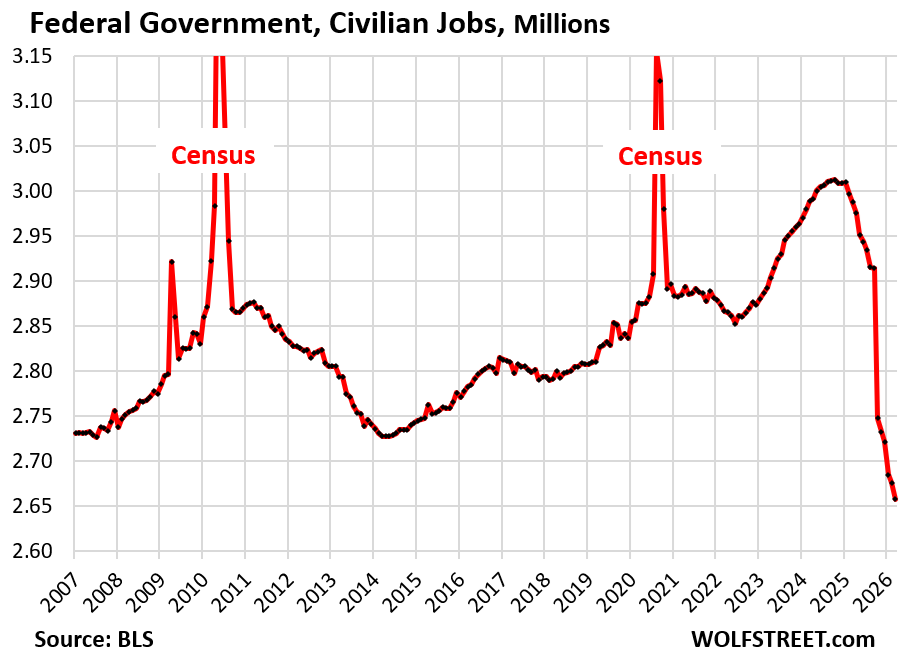
The federal government shed another 18,000 jobs from its payrolls in March, including employees who’d departed earlier but whose severance packages ended in February. Since January 2025, the federal government has shed 352,000 civilian employees, or nearly 12% of its staff. Federal government employment is now down to 2.66 million, the lowest since 1966, when LBJ was President.
State governments shed another 4,000 jobs in March, and since January 2025 have shed 49,000 jobs or about 1% of their payrolls, according to data from the Bureau of Labor Statistics today.
Local governments added 14,000 jobs in March. Local government employment is largely composed of educators, first responders, and healthcare workers. Since January 2025, local governments have added 161,000 workers to their payrolls.
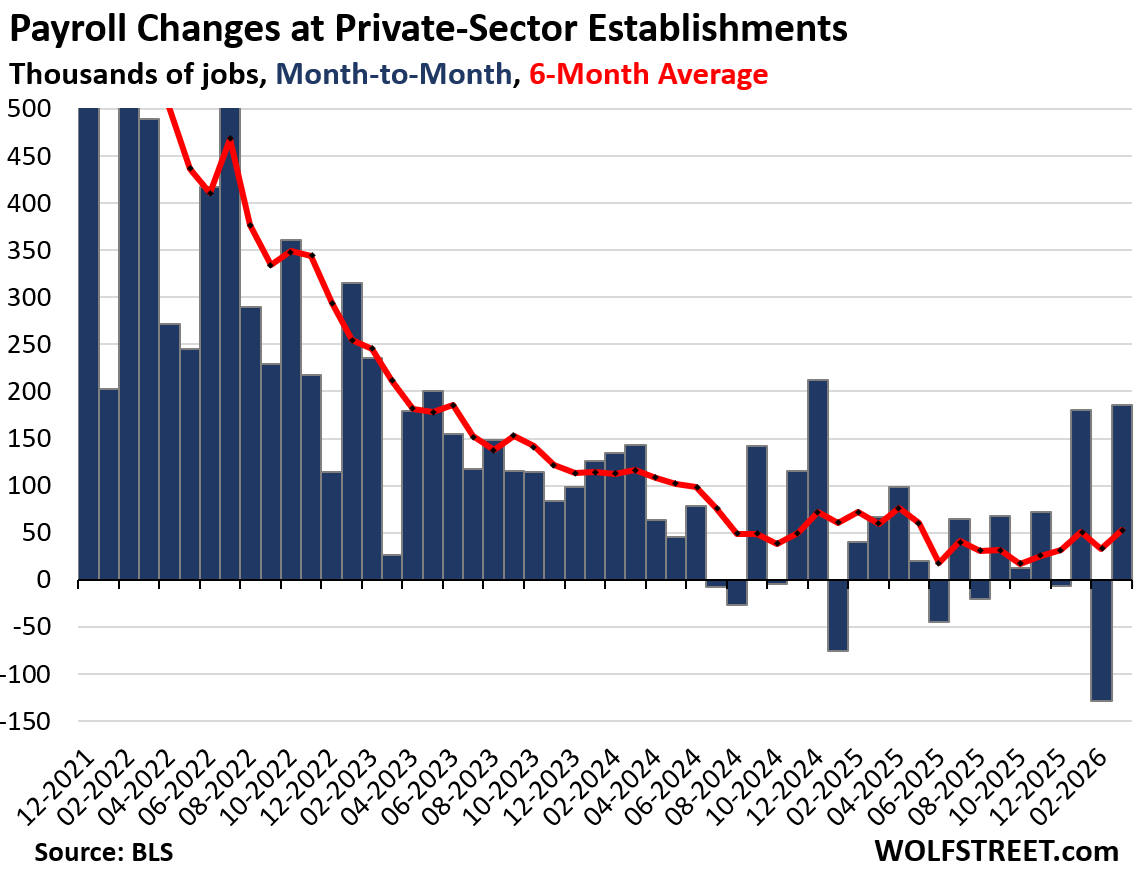
The private sector added 186,000 jobs in March. But the data has been yoyoing, made worse by big revisions in both directions. Today, January was revised up further, February was revised down further. And earlier this year, the BLS adjusted everything to its annual massive benchmark revisions.
So the six-month average, which irons out the silly month-to-month ups and downs – a labor market doesn’t turn on a dime every single month – shows the trend better: The private sector added 53,000 jobs on average per month over the past six months.
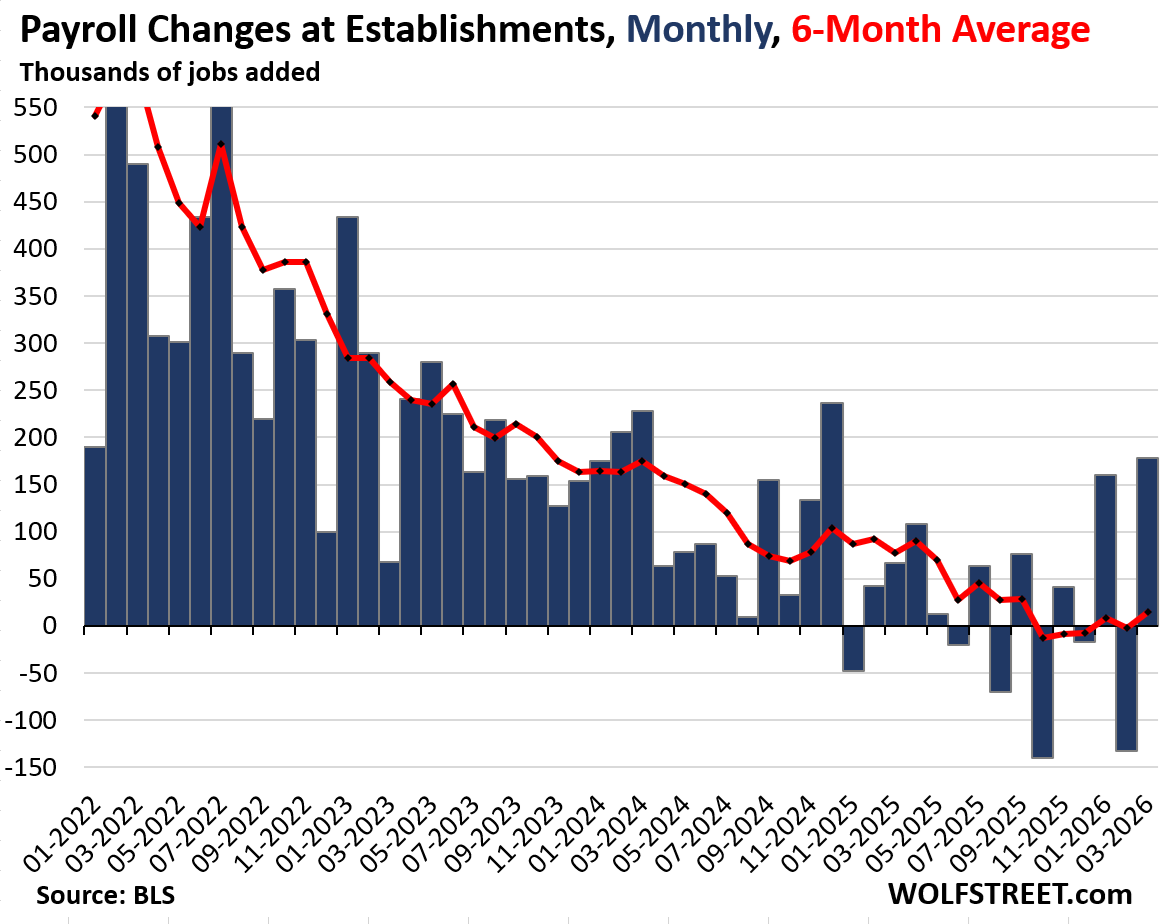
Total payrolls, including government, rose by 178,000 in March. But the six-month average inched up by only 15,000 after having been in the negative in four of the past five months, dragged down by job cuts at federal and state governments.
These kinds of dynamics – negative to low positive growth in nonfarm payrolls – would normally cause the unemployment rate to spike because normally, the US labor force would grow substantially through immigration, legal and illegal, and a slow-growth or no-growth labor market would no longer be able to provide jobs for the growing labor force.
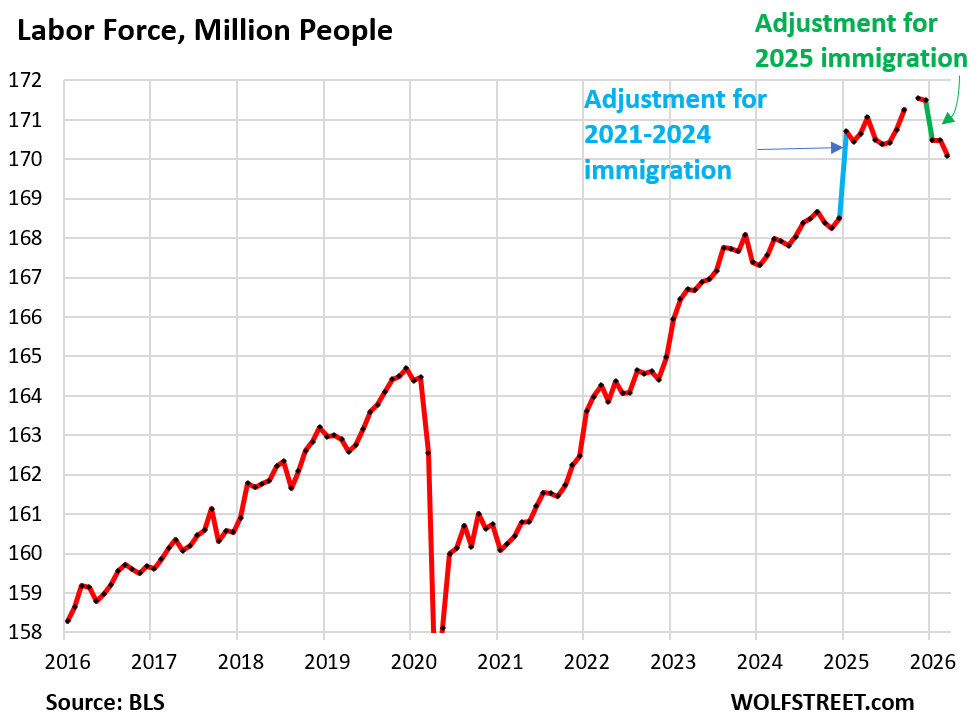
But the labor force continued to shrink in March amid the crackdown on illegal immigration and a tightening up of some work-visa programs. In March, the labor force fell by another 396,000 workers.
Over the past five months, the labor force has plunged by 1.45 million people (six-month data not available because October is missing due to the government shutdown). The labor force is the supply of labor, composed of people who are working or actively looking for work. And this supply of labor has shrunk by 1.45 million in five months! This is huge
As nonfarm payrolls have grown only very slowly over the past six months, while the labor force has been shrinking rapidly, the total number of unemployed people has plunged by 542,000 over the past five months.
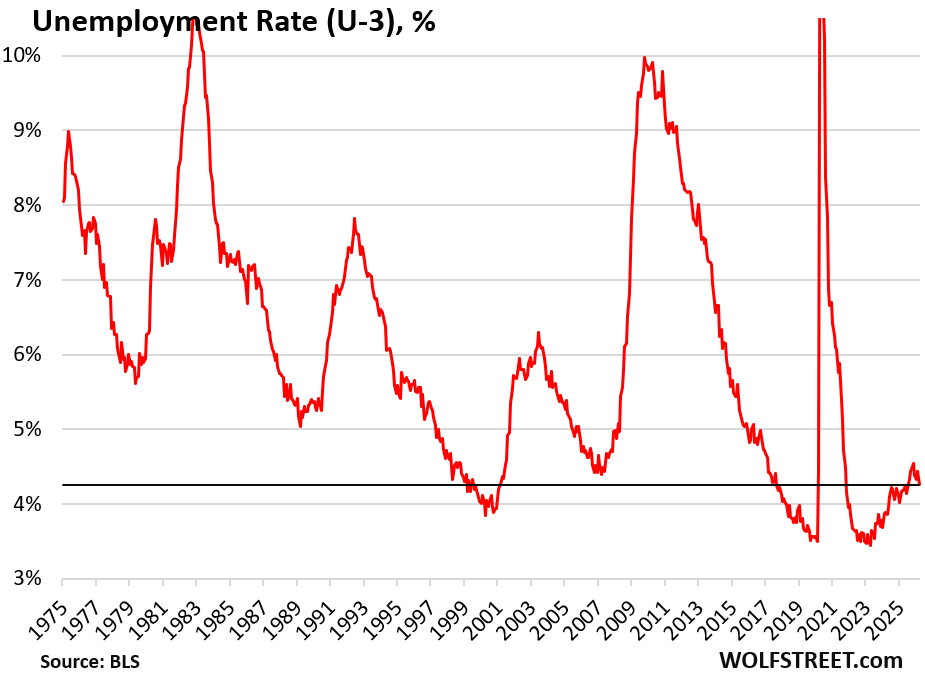
And so the unemployment rate ticked down to 4.26%, the lowest since June 2025 – from a historical perspective a tight labor market, but tight for the reason of a shrinking labor force (supply of labor), not strong job creation (demand for labor).
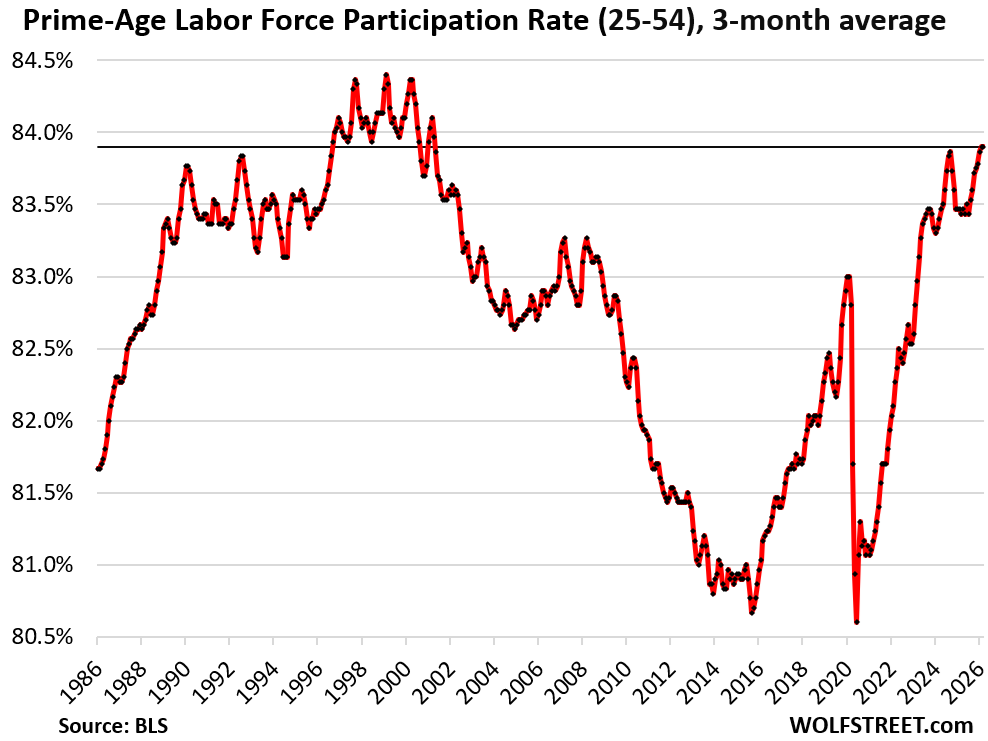
We can see this tight labor market in the prime-age labor force participation rate (25-to-54-year-olds), which has been at 25-year highs, below only the extraordinary period of the Dotcom Bubble. In March, it was 83.8%.
The prime-age labor force participation rate eliminates the issue of the retiring boomers. When people retire and stop looking for a job, they’re no longer “participating” in the labor force but remain in the population until they die. It’s the surge of boomer retirements over the past 15 years that has pushed down the overall labor force participation rate.
The high prime-age labor force participation rate amid glacial job creation further documents the reduced supply of labor due to the crackdown on illegal immigration.
This is the weirdest US labor market I have ever seen. But it isn’t bad. It’s just weird.
The charts…
The private sector added 186,000 jobs in March. Part of that yoyo was a strike in February at Kaiser Permanente in California that had taken over 35,000 healthcare workers off the payrolls in February. In March, after the strike was resolved, they were added back to the payrolls, producing a 70,000-worker month-to-month swing.
The six-month average irons most of that out. Six-month average jobs growth ticked up to 53,000 in March (red line). The low point of the six-month average was in October, with only 17,000 jobs added.
Over the past 12 months, private-sector employers added 502,000 nonfarm jobs, which is low for the US.

Total nonfarm payrolls, including all governments, rose by 178,000 in March. The six-month average job growth turned positive, inching up by 15,000 jobs added on average over the past six months.
Over the past 12 months, total nonfarm payrolls added only 260,000 jobs.
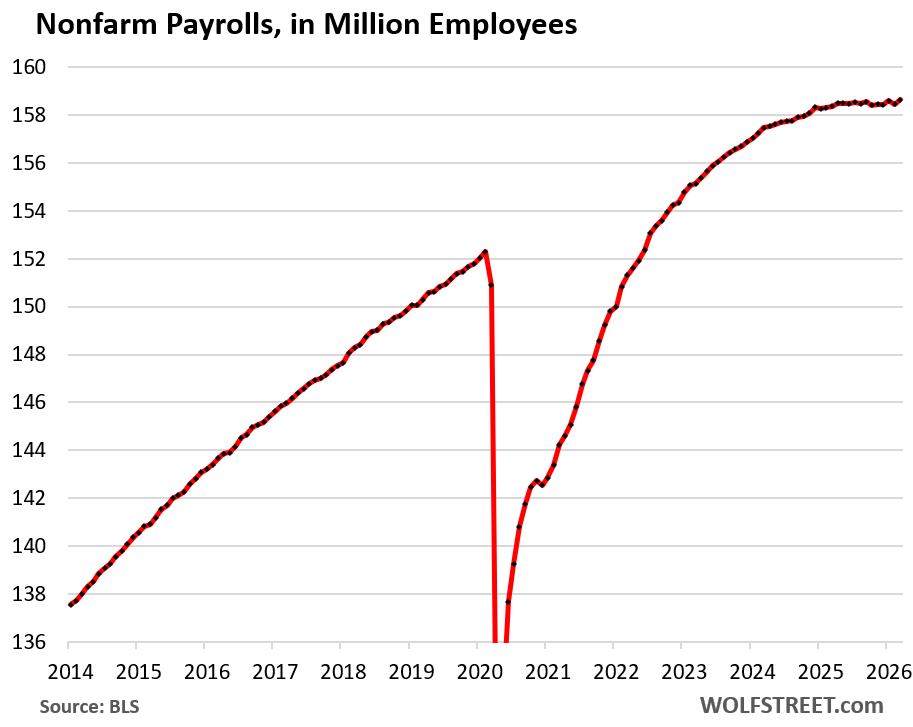
Total nonfarm payrolls ticked up to a record 158.64 million in March, they but that was just invisibly higher than a year earlier. They have essentially flattened out.
The federal government shed another 18,000 civilian jobs in March. Since the beginning of 2025, the federal government has shed 352,000 civilian employees, or nearly 12% of its staff.
Civilian employment at the federal government is now down to 2.66 million, the lowest since 1966, when Lyndon B. Johnson was President, and three years before Nixon took over.
The labor force declined by 396,000 in March to 170.1 million. This is very volatile data based on household surveys that are then adjusted annually at the beginning of the year to the Census Bureau’s revisions of the US population (blue and green segments in the chart below).
Over the past 5 months (no data for October), the labor force has plunged by 1.45 million people.
The labor force is the supply of labor. It consists of people who are either working or are unemployed and are actively looking for a job. People who are retired and not looking for a job are no longer in the labor force. Newly arrived immigrants, regardless of status, who are either working or looking for a job, are in the labor force.
This gives us a rough indication to what extent the supply of labor has shrunk:
The number of unemployment people looking for work fell by 332,000 in March to 7.24 million, the lowest since June – caveated similarly as the labor force data.
Over the past five months, the number of unemployed has plunged by 542,000 people.
The unemployment rate declined to 4.26% in March, the lowest since June last year.
The unemployment rate reflects the number of unemployed people who are actively looking for a job (7.24 million) divided by the labor force (170.1 million):
It shows a tight labor market, with the unemployment rate at the low end of the historical scale.
The prime-age labor force participation rate (25-to-54-year-olds), which eliminates the issue of the retiring boomers, has been at 25-year highs, below only the extraordinary period of the Dotcom Bubble. In March, it was 83.8%, the three-month average was 83.9%.
It shows that the reduced supply of labor due to the crackdown on illegal immigration is pulling more prime-age people into the labor force.
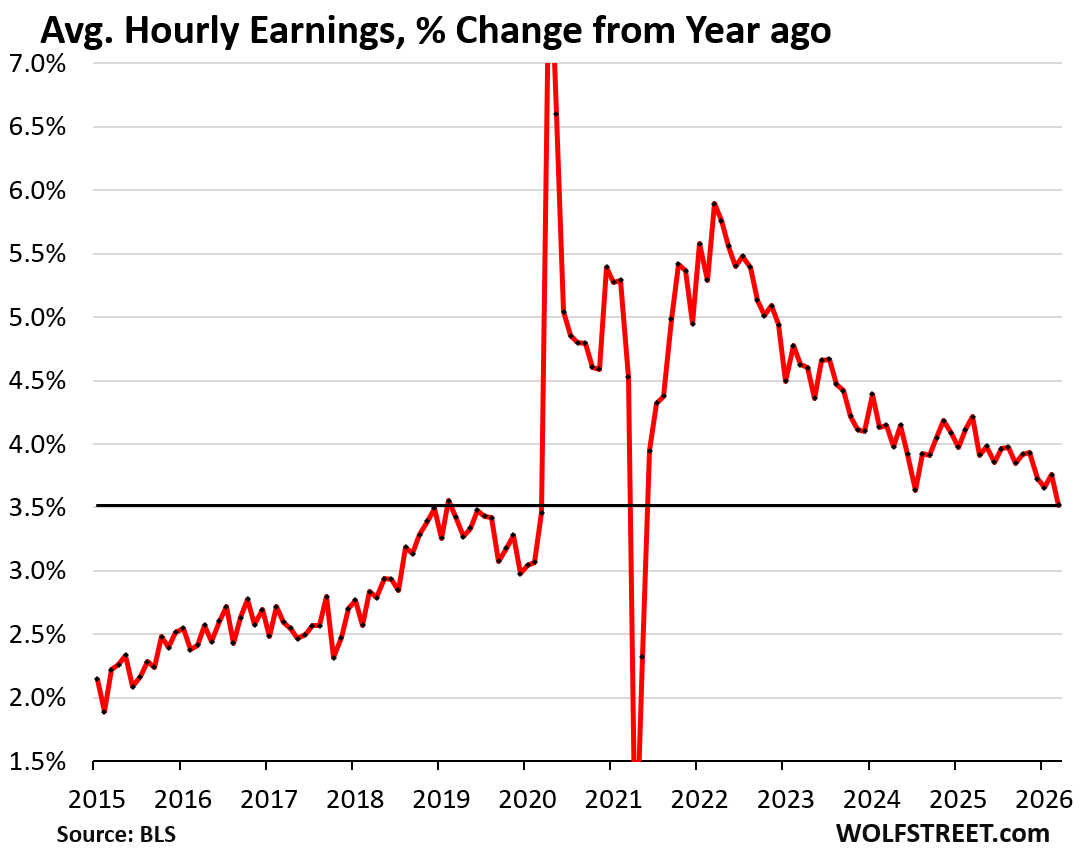
Average hourly earnings rose by 3.5% year-over-year in March, the slowest growth since the distortions of the pandemic. This would still be solid growth, and is at the peak before the pandemic, but inflation is rising, and there is now a risk that wage growth might slow further while inflation accelerates, and workers would then fall behind inflation.
This slowing but still solid wage growth shows the impact of both dynamics that pull in opposite directions: weak demand for labor and falling supply of labor.
And in case you missed it: Stasis in the US Labor Market: a Peculiar Situation
Enjoy reading WOLF STREET and want to support it? You can donate. I appreciate it immensely. Click on the mug to find out how:


Corporate profits are still floating at all time highs.. basically double the
Pre pandemic norm. I imagine the unemployment situation, as reported, wouldn’t move much unless something changes…
State governments shed another 4,000 jobs in March, and since January 2025 have shed 49,000 jobs or about 1% of their payrolls, according to data from the Bureau of Labor Statistics today.
The states are required too balance their budget, eventually.
Unlike the USG that can easily issue currency. In fact the USG has issued 38 trillion dollars of tax payer burden in favor of reducing the pocket change tax on the epitome of the aristocratic cancer that is corrupting the institutions that we built and rely on. Social Security and Medicare as two examples of efficient government programs that should be extended towards a medicare for all system.
There is no heart ache like illness one would think that could befall a US citizen. But often that concern pales in comparison to the cost of palliative care,
unless you are NY, Illionois, California, Massachusetts, NJ
Wolf, Do you think labor force reduction is due to self deportation and deportation or is it due to retirement? Excellent article. Thanks again
Retirements are low as the majority of the boomers has by now retired, though there are obviously still some of us who are clinging by our fingernails to our jobs.
https://wolfstreet.com/2026/03/31/stasis-in-the-us-labor-market-a-peculiar-situation/
well Wolf, I’m 64(65 in december)
working my 3-5 hours per day making bank($50k)
want to say see yah
however the cost of PROPERTY TAXES, INSURANCE and repairs keeps me working
keep getting sucked dry
bluecoats want to TAKE TAKE TAKE
healthcare – only for those who have LARGE assets
and they won’t last
Due to the cost of oil skyrocketing, everything is going to go up. Insurance will go up to pay for pharmaceuticals that require cheap oil for both delivery of products, manufacturing of goods etc. Tires need oil and cars are not going down in pricing especially as most require oil to manufacture. Also the lack of helium for semiconductors will compound with oil to cause prices to go up so insurance will go up. People will need to make more to pay bills, property taxes and repair costs from repair men living in this new expensive world.
You’re right, it won’t last. It’s going to get worse. The US needs to radically change society for a world without cheap oil. We need major work from home initiatives with federal jail time for people who ship jobs overseas. We need to build dense, walkable cities everywhere instead of hoping that cheap oil will allow for everything to be delivered by truck over oil roads built with oil derivatives.
We have 2 almost trillionaires that could easily pay for huge amount of this if their wealth were simply confiscated.
Once beef costs you $10 a pound, you’ll be read to confiscate their wealth too.
Wow that’s so bad. At a time where young people can’t find a job – the fewest people are retiring in decades and instead keeping those seats filled. Rough scene for Gen Z.
Gotta remind ALL of the facts of life for those of us ”coming of age” in the 1950s-60s:
OF COURSE we did NOT immediately find THE job we wanted most of the time; however, there were always jobs.
I, and most of my friends, started digging ditches and washing dishes in high school or earlier.
Many of my friends dropped out of school the day they turned 16, (when it was legal to do so) and went to work full time to help support their family; and to be clear, many of them ended up ”financially secure” by the time they were middle age, but continued to work to help their children and grandchildren acquire college and graduate degrees.
IOW, ”work” is always available, and always available as a ”stepping stone.”
all our kids have good jobs
oldest(31) makes solid living wage(finance manager city)
2nd one is FINISHING building new home(28)
making living wage as contractor lead running 3 crews
3rd just finisher her Masters and now is working at big hospital
all married
they understand LIVING WITHIN ONES MEANS and they hate debt(other than mortgage)
one is following Dave Ramsey program(only has mortgage)
I will be retiring in September.
I keep trying to get fired but seem to fail
but I do take some 12 weeks each summer in mountains
working remotely kind of
Thanks, Wolf! You are one of the few who takes the time to split out private (non-government) employment.
Have you ever looked at the state/local employment by state? It seems as though, over time, government employment is mostly shifting from federal, down to local levels. For example, I just saw a report, with graphs (but no notation as to sources of data), showing that over the last 10 years, California population grew 0.4%, the number of state employees grew 24.5% and the inflation adjusted state spending grew 48%.
(It would also be interesting, but maybe difficult to track, if NGO employment is going up, while government employment is going down, with $$ just allocated into a different employment category.)
State and local jobs are very different from federal government jobs. Laid-off federal workers might find jobs in state and local governments, but these federal JOBS — the work that gets done — are NOT moving down from the federal level to the state level.
In addition, state governments have also shed jobs. Read the article.
People are clueless about state and local government jobs.
State government jobs are dominated by jobs at state universities, which are huge employers. For example, the University of California system employs 267,000 faculty and staff (data via University of California), nearly half of the state government’s total employees of 551,000 (data via BLS).
University of California is a major exporter of services, as foreign students’ spending of foreign-sourced money in the US counts as exports and contributes to GDP as export of services. Universities attracting foreign students is a big important element in CA’s economy. It brings in lots of money and finances lots of economic activity — not just through tuition, but via all the other stuff that these students spend their foreign-sourced money on. And the industry – and that’s what it is – has become huge in CA.
Whoever provided you the manipulative discombobulated BS you cited is a clueless moron.
so I would love another worker
pay $20 an hour – they want $25
talked with HR consultant(from church) and she says that small business is offering $17 an hour
many would RATHER be unemployed earning $0 than working making FEW $$$
just giving current workers MORE HOURS
see they got PAY RAISE
Must be pretty sh*tty jobs they’re offering if (not just one, but *all* potential job applicants) are choosing subsistence food stamps over $17/hr.
Or possibly, this is what employers tell themselves when they realize the free market works both ways and that in a tight labor market, workers have options and all of sudden businesses have to compete for their labor rather than the other way around? Keep blaming those lazy workers (nevermind the rising labor force participation rates). It can never be the uncompetitive job offers…
@Lune, $17/hr is a decent wage in many parts of the country, compared to jobs held by their local working peers. Two people in a household working full time at this wage yields median income in about 20% of the states.
Free market baby. You made an offer, and they decided it wasn’t good enough. Weird how that’s only a problem one direction.
@numbers. You make a bad analogy and call it the free market. On one hand, a person decides not to take a job and the government then funds their decision via taxing the company and people with a job. On the other, a company decides not to hire a person, the government doesn’t then tax the unemployed person and give it to the company. If it were even remotely resembled a free market, companies wouldn’t have to compete with government benefits as the next closest payer. As they say, you get more of whatever you pay for.
@Matt
Those who think that government benefits are competing with good paying jobs have never been on government benefits.
You guys are hysterical. We have one of the highest employment ratios of 25-55 yr olds in history, and you guys bring up the government dole boogeyman. Do you have an evidence that its a huge problem?
$17/hr is… just above minimum wage, and will NOT equal a “living wage” in many parts of the country.
Certainly in some (particularly the south east) regions it’s more livable. Where I am, it’s a starting wage for a high school graduate who has no work experience.
Think Walmart or Wendy’s.
The COL where I live is not conducive to the minimum wage range and the market minimum is at least around $18-$22.
I’m at double the $17 rate and my wife earns close to the same. Skyrocketing home ownership costs (including a prospect of deferred maintenance), the needs to save for retirement and education/ opportunity for the kids (sadly deprioritized) make a mid 6 figure income seem “lower middle class.”
The lower cost areas around us have increased housing costs, and coupled with the lower wages become more tricky to afford too.
“but these federal JOBS — the work that gets done — are NOT moving down from the federal level to the state level.”
But that doesn’t mean that Federally-paid government *contractor* workers aren’t now doing the work.
There are 7-8 million federal contractor employees – in theory (although not in multi-year/decade practice) those contractor slots are more flexible for DC – since the contractor contracts only run on 1-2 year cycles – so DC could (in theory) cut back much faster than on traditional Fed employees (who have civil service protections that impede layoffs after 1-2 years of probationary employment – those are the people – Federal hirees from 2020-3 or so – who got badly nailed by the 2025 Trump buzzsaw).
But in real world practice those Federal contracts (and 7-8 million DC paid contractors) get rolled over year after year and decade after decade. That why Fed employment *outlays* have gone up significantly over the years – the contractor pool has kept expanding even as the Federal “employee” pool has had a soft ceiling of 3 million or so (until the Biden surge pushed the numbers up to 3.3 million or so).
2025 was a definite reversal of DC practice – but only a partial one and not of the net scale you seem to be implying.
You people misunderstand “contractor.” Northrop is a government contractor, as is Boeing, as are many companies that supply the government with goods and services. Someone who is employed by Northrop to work on a drone on a government contract is doing work that the government contracted out. A groundskeeper working for a company that maintains properties and who trims the trees and cuts the laws on government property works on a government contract.
Here is some data from the GAO about which agency buys what types of goods or services from government contractors:
https://files.gao.gov/multimedia/Federal_Government_Contracting/index.html?
> “who have civil service protections that impede layoffs after 1-2 years of probationary employment”
Almost exactly a year ago, I learned that these protections are only theoretical. They can lay off anyone they want, regardless of tenure, and they did.
It is interesting, that UC employees are counted as state employees, even though the majority of UC funding doesn’t come from state tax $$$. (CSU and community colleges are state funded.) Seems like it is a spider’s web of funding and employment, with some people categorized as state employees, yet funded by outside and federal dollars, and then people working for outside employers (contractors, NGOs, etc.) funded by tax dollars. I suppose it’s impossible to even estimate the number of employed people, in each state, whose salaries are mostly funded by tax dollars from any level. Sad that we can’t track where our money goes. (FYI, I pay more SALT than federal tax!)
Big state university systems are complex enterprises that do a lot of stuff, including running big hospitals (teaching hospitals) and healthcare services, medical institutions of all kinds, and research institutions. A lot of those actually PROVIDE funding to the UC system, as you can see:
https://lao.ca.gov/Publications/Report/5143
Slowing wage growth should help with inflation.
Not for working consumers
has nothing to do with consumers
Inflation is PURELY FED/grifters in CONgress issue
have to make your fiat $dollars WORTH LESS every day
please blame
Jerry Powell, Janet Yellen, Bernake for DEVALUATION of fiat $dollar
And don’t forget Trump and Hegseth for starting an unnecessary war in Iran that is causing oil to skyrocket. That will raise prices throughout the economy regardless of whatever beef you have with the fiat currency system.
It doesn’t have to be all one thing or another.
1) America’s never-ending forever wars fuel inflation
2) a) Even as money printing (masquerading as “quantitative easing” and used, but only in part, to pay for said forever wars) by *definition* creates inflation.
2) b) Money printing by the Fed does not immediately (or maybe *ever*) summon real assets into existence – all it does is worsen the ratio between “all US real assets and all US printed money” – the exact definition of inflation.
2) c) But money printing *does* redistribute the buying power of money (who gets enabled to bid highest for that fixed-ish pool of US real assets).
The Fed prints the money and the US *Treasury*/Fiscal spending gets the first and biggest slug of that “new money” – redistributing buying power from private market USD *savers* to DC government *spenders*.
There is more than enough monetary and fiscal stupidity in the US to go around.
AGREE, like totally dude regarding FRB, etc., jd,,,
HOWSOMEVER,,, IF WE the Consumers would just stop buying all of our ”wants” ,,, ALL!!,, and just buy our actual ”needs”, IMVHO inflation of most products would stop and reverse.
Likely that this will NOT happen due to the massive propaganda efforts, AKA advertising, continuing to brainwash most folx…
Leading, apparently inevitably, to more socialism for the poor adding to the ongoing increasing socialism for the rich while the middle continues to deteriorate.
Hedge accordingly as much as you can.
Vet
You must be a student of Edward Bernays?
Nah w, never heard of him.
I am proud to claim an advanced degree from the ”University of Hard Knocks”…
Though I did work my way all the way through college, with no help from anybody but a relative willing to loan me money at 7%, every penny of which I paid back, eventually.
Usually had two part time jobs while carrying a full load, especially the last three years.
Working consumers get screwed either way.
Well that point of view is an example of the obvious discrepancy between a measurement of deflation as a decline in asset prices while inflation is measured as the hypothetical estimate of rent.
My hypothesis is that the increase in asset prices is the true measure of inflation
As a software contractor who has taken hundreds of client and recruiter calls, and done over a hundred interviews, I’ve noticed a shift in attitude from availability to quality. From 2017 to 2023 it was all about having capacity, clients just piled on. Now, for the first time I can remember, new clients are attempting to ask questions about work quality. The conversations are much more interesting.
had conversation with line worker today about
PAYING TOP $$ for those with SKILLS v. those who ‘claim’ to have same
getting work done in 1 hour at $100 v. 3-5 hours at $50
no consideration on why
qx. in future(10 years down road)
are we going to find fixers
Thanks for the article. The problem might be that once labor supply stabilizes, or even starts to increase again, will many employers need more new workers? Or will efficiencies be maintained and new entrants be unable to find work, increasing the unemployment rate that way.
Good question. This comes up at the Fed too. It can go both directions:
1. demand for labor increases, and then there are labor shortages in some areas – there already are labor shortages in the construction industry (electricians, other highly skilled workers), in health care, etc. And those labor shortages may spread to other areas as demand increases, which would push up wages, which would be a good thing for workers and the economy, but another factor in the inflation puzzle.
2. or demand declines, and then unemployment rises very quickly, and we’ll have our recession.
that’s funny Wolf
friend our ours is building MOTHER-IN-LAW suite on property
he’s license REALTOR
went to get business cards for sub-contractors -NONE SPOKE ENGLISH
oops – all were LEGAL aliens with green cards
so NEW HOMES getting built with IMMIGRANT labor
I’m sure they all spoke English, Joe. You see, a lot of general contractors make their subs sign an agreement not to solicit work from the general’s job site. That means they aren’t supposed to hand out their business cards, regardless of why your friend was asking. Hence the no English. It’s easier for the general to enforce with an immigrant workforce.
Tell your friend this is America bro – learn to speak Spanish!!!
Hat tip to Paul Rodriguez
The inflation puzzle indeed……
@Wolf, my main concern is that the jobs displaced (white collar) pay much higher wages than the jobs created (blue collar), resulting in lower overall wages and a lot of potential demand destruction from less circulating money. White collar can easily afford 401K contributions, and blue collar … not so much. Since the stock market is the economy now, it will hurt if the new money inflows into the stock market slow significantly. I think the Fed has no clue what’s coming, and they prefer not to think about it.
Not sure where you’re located JD, but friends in some areas getting $200/hour these days for remodel and rehab work,,, Portal to Portal!
True that they don’t work full year, but that’s their choice, so far.
Skilled manual labor guys here in the saintly part of the TPA bay area getting $75+ and also working as much as they want, etc.
@Drewman Group, concensus is that the speed of the transition provides the answer to your question. If AI is very rapidly adopted, it will crush the economy. If the uptake is slow, no problems. I personally think three years from now, AI adoption will be similar to the adoption rate of the iPhone, which was blazingly fast. It was just in Feb 2026 that the first “real” breakthrough took place in AI capability, and it will be a while before that breakthrough gets transformed into a repeatable process across an array of job categories. My guess is three years, but I am an old guy who may not appreciate how technology time frames get accelerated now.
Then I guess in three years we will have our recession, for at least the industries most impacted by AI adoption, and millions of workers will unable to find work until they are retrained in trades.
What “real breakthrough” occurred in AI two months ago please? Anyone?
So we have increasing inflation and oil shocks galore and the labor market is fine…
One wonders how the FED can sit on its hands and NOT raise.
shhh, locals don’t want to
TELL TRUTH
any qx
Exactly the dilemma that the Fed board of governors I think are acutely aware.
I think they should sell the government debt at as low an interest rate that is justified.
Personally I consider the chronic inflation documented by Wolf as a fact that the Fed interest rate structure is insufficient too neutralize let alone reverse the type of financial disease that breeds corruption
When in doubt, blame (or praise) AI.
Which may actually be a legitimate assertion.
Every day, in every way AI will get smarter and smarter.
Howdy Folks. Great article. What I keep thinking about after reading it is?
What were all these federal workers doing while at work? Maybe had another job somewhere and why some of the numbers don t make sense.
Howdy Bubba. At my agency we lost two groups of people. A bunch that were within 5 years of retirement, and a bunch within their first 5 years of service. The first group took the early retirement option, and are now having the time of their lives. The majority of people in the second group were our most promising up and coming employees. They weren’t working second jobs, but are now employed with various local, state, and private entities. We are leaning into our “partners” now to pick up the slack. However we’re just paying them a lot of money and doing most of the work in house with less. They have been cutting some red tape though, so that’s helped take some pressure off.
one of our sons is senior finance manager at city(age 31 – very smart and good manager)
has couple workers – one who is older – needing insurance but has ok skills
other younger – not worthy but need work done for now
son was offered city manager job but said NO WAY
political and against his CHRISTIAN views
he gets living wage as accountant and good benefits(why he is there)
loves time he has raising young son
and watching college sports(bear down Arizona – 2017 grad)
What on earth are you on about ?
Your comments about real estate are usually spot on, but that’s the most nonsensical thing I have read that you have written here. How does a city manager job conflict with Christian values? Does the budget allot for quarterly chicken sacrifices? But go big footballs!!!! Good grief.
Perhaps the work has been shifted
to outside contractors ? The work gets done but not by government employees. It’s always easier to loot
when not constrained by the GS scale.
Howdy Sporkfed. Did you know Govern ment ( Till DOGE ) would store a retires information on paper down in a mine shaft? They just recently went to digital…. True Story
Now it’s stored on some ex-DOGE kid’s thumb drive. Along with everyone’s tax and social security records.
I always pay attention to average hourly wage. I think it’s big factor in future inflation. Speaking of future inflation; my most repetitive comment on wolf’s site. “The unemployment rate will invert below the inflation rate” creating a perfect storm for asset wealth destruction and bursting of the biggest bubble ever. It’s trending to become reality.
cheers
Could someone smarter than me please help me understand that statement. If the rate of unemployment goes below the rate of inflation, how does that lower asset prices?
so SMALL business is offering sub $20 an hour wages
with few takers
most want $25 – and remain UNEMPLOYED by choice
I had discussion today with worker(55) who want $800 week
but I don’t pay that($600)
he’s like I need more-but I can’t given high priced materials
he’ll remain for now since I actually PAY$$$$
he got robbed recently for work that didn’t get paid
You CAN, but WONT. yes your costs may be high, perhaps you take less margin to remain competitive. That’s not the only option. I personally was paying 800 to 1000 week to work in a chocolate shop in Boston. It can be done. You command quality work for those prices. You need to have an honest discussion between you and employee. Its not a one-sided deal.
Well let me take an attempt to decipher a message hidden within the confines of a code. Since I grew up blue collar, my dad
drove truck I propose that makes me valid as a judge of such things.
Well the whole thing is obvious to the clueless AI that hallucinated the spit ball that you referenced.
It would be interesting to get the change in the numbers of contractors and the related employees. My limited experience with medicare deals mostly with contractors.
MEDICARE – ie 65+
issue is we can’t get down on knees and kiss your butt
we have exceptional skills but refuse to bend to YOUR(corporate)
demands
have a good day
now let me go play some pickle ball
And the consumer still remains strong which is a surprise to me . Apartment vacancies I think are rising Wolf supplied that data a few weeks ago . So eventually the consumer spend will start to have an impact on economic activity . I’m sure when that happens Wolf will know first
so here’s scuttle butt on vacancies
1. ILLEGALS and sanctuary cities paid for some 7-10% of rentals
2. President Trump stopped it in tracks=0
suddenly we had 7% more rental available at MARKET rates
took time to consolidate
here in Tucson our mayor – Regina Romero – took in over 1,000 illegals PER WEEK and worked to send them to INTERIOR states/cities
suddenly it stopped under President Trump(yours to)
I am also in Tucson.
Noticing many vacant rentals around town, including several in my neighborhood.
Methinks that some of them used to be occupied by illegals who were deported or self-deported.
Illegals weren’t renting 1500 dollar flats. Your arg is min wage like your portfolio
Sure they are. They just tend to house several people per bedroom. Sometimes a few more in the living room etc.
Anybody noticed any changes in the level of service they get from the federal government, even though they have shed all those workers?
I sure haven’t noticed a change.
In terms of me being the public, I have not noticed anything. My Social Security started without any hiccup at all. Medicare has been rolling along on auto pilot, no problem. My tax returns got accepted, etc.
But from my point of view as an analyst, I now run into data that the government no longer produces. This was secondary stuff, so maybe I was the only one that looked at it and reported on it, but it was interesting and important, and it’s either gone or partially gone. This includes the data for the EPA’s annual Automotive Trends Report. They still posted the report, but not the data. “The data on this page has not yet been updated…” it says still today. This should have been done last fall. So I couldn’t do my annual article about it. Bummer.
But they’re still responding to my emails. So there’s someone left in there.
The whole thing does remind me of Twitter when it got gutted and over half of the workers and apparently most of the contractors were fired, and Twitter users didn’t really notice much difference. There were maybe some minor hiccups, but nothing existential, from the users’ point of view. Advertisers left, but that may have had other reasons.
It does make you wonder about these big overstaffed companies where apparently no one knows what all these people are doing, and if it even needs to get done. And when you fire half of them, the company is still OK. That points at really shitty management before.
In terms of government, the jury is still out. We don’t really know all the stuff that doesn’t get done anymore that might turn out to be crucial somewhere. I’m watching this with some sort of morbid amazement.
it’s BUSINESS like USPS
3 weeks for 1st class mail
now I get late fees and cancellation notices for insurance/utilities
again WHY DID I PAY $1 per envelope to mail
march 9 to march 31 for LOCAL
oops electric goes to LA, gas to RENO, WATER to IOWA
for TUCSON
All of those things can very easily be paid for electronically which results in instant verified and confirmed payment. Try that.
Many businesses(like insurance companies) will pass on the 3% fee if one were to pay with CC. Of course, if you feel very trustworthy of your local government/utility, you can provide your routing/bank info. Later, no need to lien your account, just siphon it out and you can fight to get it back. Needless to say, there is also the ever increasing likelihood of a breach and everybody gets your info.
Wolf, I have the same experience in the ag space of less data produced by USDA over the last 5-10 years. It makes it harder to put together analysis when the gov’t stops gathering and releasing certain information because of downsizing its staff. I end up cobbling it together from different agencies. I used to say I could tell my small company that I could get them to 2nd base on my analysis, but now I might only get them into the ball park….
Many of these items have historical context when digging in further. Why did the government produce this data? Because it was needed and didn’t make economic sense in the private market, or the private market didn’t have the visibility to produce it. Why was it needed? Usually, local disaster xyz could have been prevented with better information.
Now, there’s certainly an argument for cutting some of these things, since they may be redundant or usurped by technology. I don’t think what has happened recently can fall within the confines of smart cutting, only hasty cutting to justify OBBBA. I’m not a fan, and I suspect we will suffer ramifications over the next two decades when gaps are found again as disaster xyz relapses, costing more than the preventive measure that was cut. It’s just like big corp outsourcing everything and losing all institutional knowledge and their competitive advantage, then wondering why they went to shit over a decade.
“Those who do not learn from history are doomed to repeat it”
I always thought one on the great strengths of the USA financial system was the high quality, factual data provided by the government that was trusted worldwide.
It’s way too early to assess the fallout of federal government cuts. Many federal workers contribute in complex areas that have LONG TERM impact on our health, environment, taxes, and so forth.
Firing 20-40% of a federal agency is the easy part. The hard part is dealing with the fallout for years to come and the change in incentives and behaviors that result. Reminds me of when Bush II did the easy part, then raised his “mission accomplished” sign.
Having worked in four different GUV MINT operations, the problem is WHICH employees get fired, especially with a ham handed approach as appears to be the case recently:
The general rule of those operations followed the ”20% of the people did 80% of the work, etc., and that 20% are the ones who will either go elsewhere quickly due to their competence, or take the ”early retirement” offer and then go elsewhere, start their own gig, etc.
Seen it several times, exactly, and the incompetence level goes up, sometimes waaayyy up.
The Federal Government increasingly relies on contractors rather than “Feds” to do its work. The government isn’t smaller just because it has fewer direct employees.
Contracting increases the government’s flexibility – it’s really hard to fire Feds – but it also reduces transparency and enables corruption at all levels – all those lucrative contracts must be renegotiated.
This also means that a substantial fraction of “private” employment is actually “government contractor” employment, which really isn’t the same thing.
It seems a lot of the contracts and contractors got axed too.
“Professional and business services” – an industry where a lot of government contractors would be situated, has taken a big hit.
> “it’s really hard to fire Feds”
Before April 2025, I thought so too. Turns out, it’s quite easy. Civil service laws are just a suggestion.
I’ll throw in the “AI Anecdote” to the conversation: we yanked three entry level ($50-$60k) positions from our recruiter in the last three months as we’ve slowly rolled out a number of AI solutions in our business.
1. Eliminated the need for an additional client account manager as the new tools allow our existing team to collect and chew on big data sets with a lot less manual labor. Net result is that our client account staff are able to handle about 30% more than before.
2. Eliminated two entry level help desk support positions. Similar to #1 above – we’ve rolled out a number of tools that have helped us to reduce noise, automate a lot of lower level work (user setup and user firings, as examples)
Moving forward, we think that a handful of new tools we’re working to rollout are going to add at least 30-50% overall efficiency to the technical delivery team.
We’re also holding off on another project manager as our new AI solutions for scoping, quoting, and project follow-up are eliminating a LOT of administrative overhead (and, greatly improving accuracy and reducing errors).
TL;DR – we’ve grown at a steady 20% average clip the last 6 years. If that trend stays this year, combined with our new efficiencies, the ~8 new hires we anticipated for this year will be 4 or less.
When will AI eliminate your position?
It is already AI. No human writes like this. You can tell by the blandness and lack of soul. Well, could be a Harvard business school graduate.
🤣 good catch
Good question actually.
Is your business going to lower prices
to pass along the savings ? Is AI going to increase demand for your services .
Would immigrants fill out an employment survey truthfully without fear? They are communicating with the federal government.
They’re going to revise these jobs down by -200,000 in 3 months after the media has moved on.
They revised January up today.
It’s my understanding that Obama didn’t deport all that many undocumented aliens from the interior of the US during his 8 years. The vast majority of these deportations were from illegals crossing over, spending days in the in the US receiving aid of some sort before being deported.
Nowadays, between illegals self-deporting & actual hundreds of deportations, both of which from the interior, means we’ve never seen anything like this before.
Now, if we can get Trump to take a real stand against H1-B visas. I would love to see him go all out putting corporations on notice that this program will be sunsetting over a fairly short period of time.
H1B isn’t the worst of it and at least benefits the US by bringing a consumer and likely their family here for the term of employment. Ending it would simply accelerate off/near-shoring.
The reality is, companies like mine, a micro cap software company, have hired hundreds in our new Indian office while hiring zero domestically and allowing attrition to shrink the US workforce. We also maintain, for teams with timezone sensitivities, South American teams. I’d venture more than a quarter of our tech workforce is off-shore in some capacity.
But it’s crickets from everyone (except labor-centric pols like Bernie) on this. It’s been going on for decades, just with goods before services.
I meant to say hundreds of thousands of deportations. My bad.
Maybe the weirdness is this: we’re used to blue collar jobs being slowly ground down, and talk about rust belt cities, etc, while white collar jobs were always growing. So aside from recessions and normal economic cycles, the secular trend was for blue collar workers to slowly see their employment options dwindle and paychecks stagnate while white collar jobs slowly improved. The overall unemployment rate hid this churn of rust belt cities struggling and service sector industries exploding.
Could we be seeing a reversal of this? That maybe the unemployment rate is low, but now it’s made up of a higher percentage of white collar workers being displaced by AI, while reshoring is making anyone with blue collar skills a hot commodity?
Even the shrinking labor force, if it’s truly from decreased illegal immigration, would improve labor conditions for blue collar industries. Meanwhile legal immigration via h1b and such continue to bring new white collar workers in.
Lots of white collar workers are talking about how difficult it is to find a job, and maybe some of that is the usual complaining, but it feels like something has turned, despite the stats not showing it. And it feels a lot like factory workers stagnating while the economy boomed in the past few decades. The gains were mainly in the white collar world. Perhaps automation is coming for the white collar world now in the form of AI, and the overall stats are masking it?
I know you look at sectors too, but even that may be too broad. For example, I’m assuming a nurse and a mid-level administrator in a hospital are both counted as healthcare workers, but only the latter is currently facing possible job loss from AI (at least for now…). Is there a way to generally divide the AI and non-AI worlds and see employment trends? Probably a hard thing to do, but maybe that’s where the weirdness is.
I dont think so. Labor skills are not that transferable. And also there has been a deficit of qualified labor for a long time in the US….. Interesting to see but mild incrases in wages are not going to move people Large increases in wages are going to stoke inflation………I got my popcorn out.
This all sounds wonderful to me, on net. It’s starting to sound like the very early preconditions for Japanification to me, which should push down housing prices.
Are there any measures of worker utilization (efficiency) relative to the work that needs to be done at the macroeconomic scale? Say I have a ditch that needs to be dug. I know how deep and how wide, type of soil, etc. The average ditch digger can shovel known about of dirt per day. I need the job done in 5 days. So I do the math, and hire a bunch of people. The job ends up taking 10 days, and so the utilization was 50%, because I managed it poorly.
In other words, how many workers are working compared to how many workers we actually need? Or how well are we managing the workforce relative to the work getting done?
There are measures of “productivity,” which is what you’re referring to. The most common measures of productivity are figured by comparing some output expressed in dollars (such as revenues or value added) with the labor costs or hours worked to produce that output. The BEA does that for each industry, and you can look at it. the overall productivity figures that it releases quarterly gets some coverage.
It’s very challenging to measure productivity at the macro level, and the BEA concedes that and struggles with it the best it can.
At the confined micro level, a company can measure productivity more easily, such as you mentioned, or in sales, or in a factory. By using equipment, productivity goes up. For example, it might take 5 guys with shovels and pickaxes 10 days (about 400 manhours) to dig this big ditch you referenced. But with a backhoe, one good operator might do it in a couple of hours (2 manhours, huge gain in productivity). Same in manufacturing and elsewhere. Productivity rises with training, equipment, and automation.
But it’s very tough to measure productivity in administrative jobs, professional services, etc., such as architecture, law, engineering, etc. because there are quality aspects to those jobs that are hard to measure.
You might say that AI is techs new backhoe?
yes, that’s sort of a good comparison.
The world needs ditch diggers TOO, Danny!
-Caddyshack
The Federal gov’t is still cutting jobs. You’re going to see another big tranche of cuts when the results for March – June get published. DoW is cutting all “term” positions, and a large number of contractors. The intention is to only have the “permanent” employees in the job force and then look at what can be done to cut those.
The problem with this is most “term” positions are for jobs where the gov’t has determined they need an employee, but haven’t finalized what agency is going to pay for the position, or they’re in a place (like overseas) where many positions don’t allow the employee to stay past a certain time limit (3-5 years normally).
One thing I see becoming an unintended consequence of this is that the military is going to have to stop moving people in and out of various job specialties and actually have to get Soldiers (at all levels) who are actually subject matter experts. This is hard to do when you PCS them every 2-3 years.
Commands rotate at same rate or faster. It will always be a problem. You get a bad command team and morale (one way to measure military productivity) tanks and cohesion falls apart. When we went to 5 year BCT consolidation in the early 2000s, it helped. But even then, some units were awesome and some terrible, so the constant rotation is a feature, not a bug.
Totally different issue, and part of the problem. Look around the military and the real subject matter experts are the civilian workforce. Because the military rotates so often most Soldiers never really learn their jobs; they’re always training. It takes years to learn how to run an airfield, how to load a seagoing vessel, how to properly run a rail terminal. And those are all jobs done by civilians. Yes, they have troops who man those units, but they are the small portion of the workforce, and the least experienced.
It’s a weird time in the labor market. I hire a lot of people and a reasonable feel for most parts of the market and there are all these new pressures pushing the market in different directions and its hard to see which one will prevail. You have the AI effect which is holding down entry level college hiring and also mid career white collar since most CEOs are waiting to see what the final state of AI is, but you also have the restriction on immigration and an actual decline in population- which pushes down labor supply on the front line hiring and pushes up wages, but you also have companies uncertain about the future economy and therefore more conservative with hiring, but then you have this massive AI boom where a trillion dollars is going to spent in the next YEAR !! On Capex which drives hiring, but then you have technology layoffs because of AI and the need to pay for the Capex. It’s hard to really know what is happening other than to say- the times are interesting.
In August 2025, a significant leadership change occurred at the Bureau of Labor Statistics (BLS) when President Donald Trump fired Commissioner Erika McEntarfer. This decision followed the release of a disappointing jobs report that indicated a slowdown in job growth, which Trump attributed to manipulated data. The numbers are suspect no?
There was a huge NEGATIVE read for January. It’s just erratic ups and downs.
It really helps to read the article BEFORE you comment, or at least look at the pictures, good lordy.
Wife’s company just laid off a whole bunch of people. Luckily, not her (for the moment), but she’s middle-high management, so who knows what the future holds.
These were non-tech jobs in a VERY specific market segment and generally AI-proof (onsite, client-facing), in which none of the competition is hiring and indeed could be doing their own layoffs. These people’s jobs are literally wiped out at the moment, everywhere, and will not be replaced. So all these white-collar individuals will need to pivot to something else.
I’m not exactly sure what the “something else” is in this market, and I’m confident that there are plenty of other white-collar individuals going through the same thing, with a heap more coming down the pike.
Suffice it to say, we’re scaling back and preparing our own potential pivots. It’s the new midlife crisis.
People might start hanging onto their jobs longer as a result of geopolitical events and likely higher inflation for some time. Before the Middle East started I was looking at retiring in the 18 month window but at this point I will just hang on. The current conflict may end soon, which I think unlikely, or persist much longer, but even when it does it things don’t just naturally go back to normal. Seems to be this weird idea that because the US is largest exporter we won’t be hit hard. I guess everything is relative but that’s not how a global commodity and global market works.
Wolf – you being on the Fed payroll – I’m assuming you are not considered a Federal
G-mint employee. Need clarification.
You’re an idiot, that’s the best clarification I can come up with.
The goal was to relever the labor market. That’s what the White House wizardary cast upon the country. You were supposed to make more than you did at some other means of producing. This is after the nation despised producing in favor of assets. And wow oh how did this nation hate all of us.
Maybe that revlering will come to pass. Could also wind up that what this did was “levered” everyone down. Buy most likely either way is that the days of the what’s become known as the 1% are numbered. These White House folks aren’t dumb as the play so time will tell.