
When this inflationary mindset takes off, inflation becomes like a runaway train.
By Wolf Richter for WOLF STREET.
The problem is that even before fuel prices began to spike, inflation had already been accelerating and running hot, and the current fuel price spikes will add to it, just when the economy has become more forgiving of price increases. That’s very bad timing:
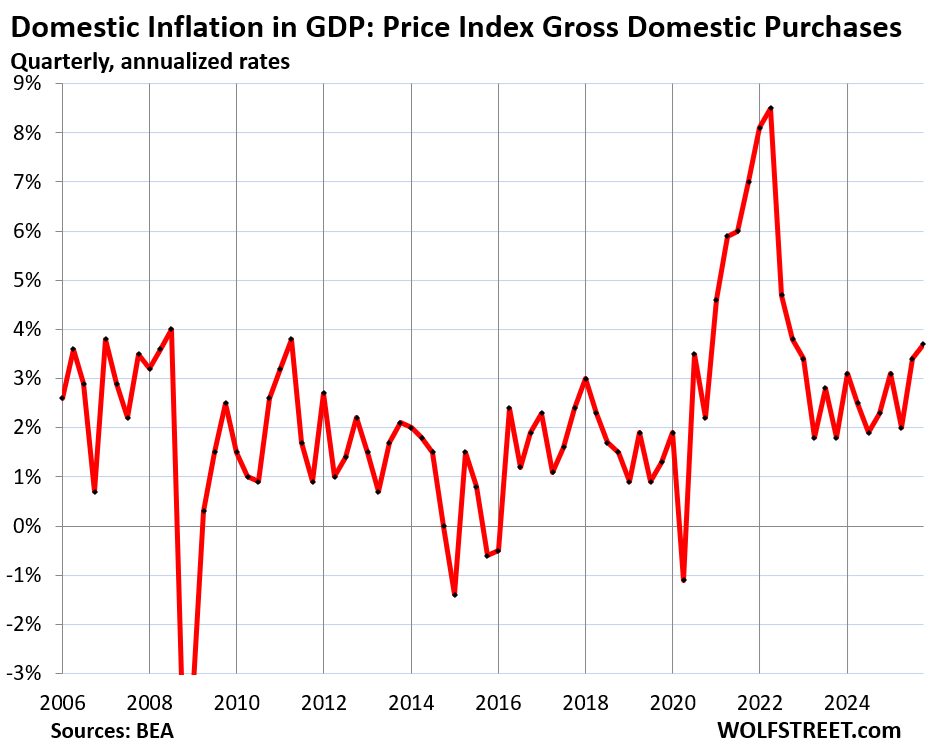
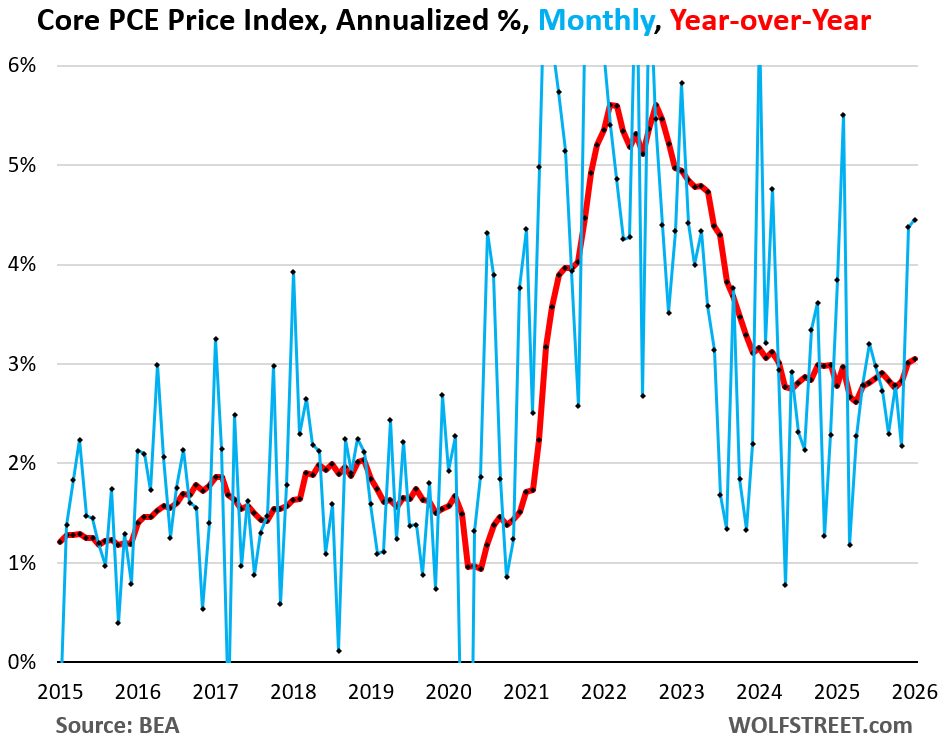
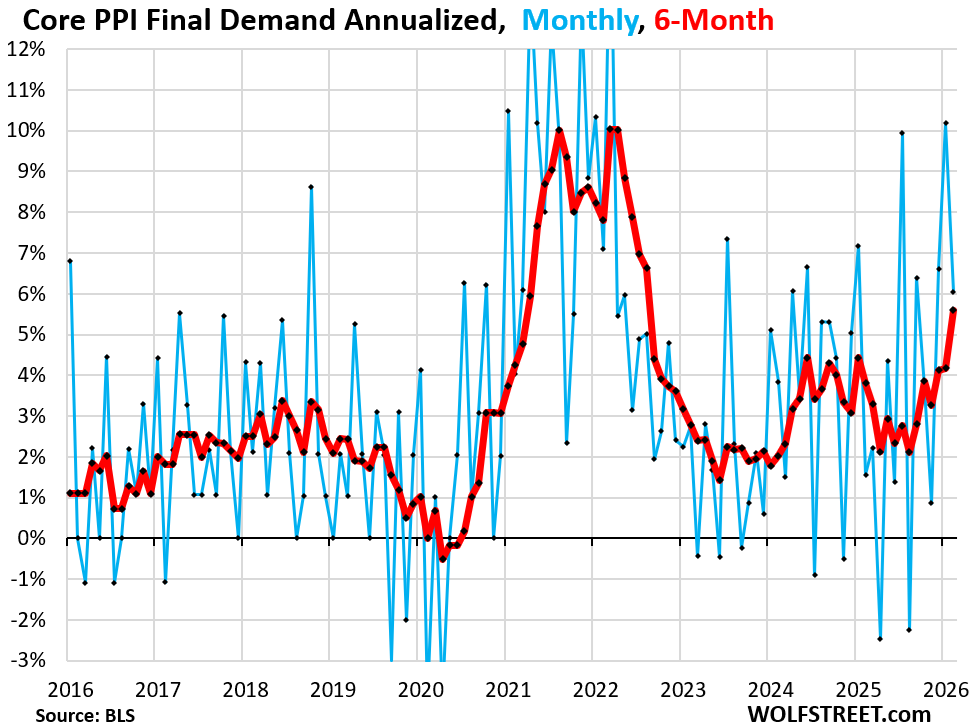
The broadest inflation gauge, which tracks inflation across GDP and not just consumer-facing inflation, rose by 3.7% in Q4. The price index in GDP that excludes imports rose by 3.8% in Q4, the worst since 2022. The core PCE Price Index, the Fed-preferred inflation index for consumer price inflation, rose by 3.1% in January, the worst in nearly two years. The core Producer Price Index, which tracks inflation that companies face, jumped by 5.6%, the worst since August 2022 (see charts at the bottom of the article).
The average retail price of gasoline, all grades combined, at gas stations on Monday spiked by another $0.24 from the prior week, and by $1.17 or by 40% since the beginning of the year, to $4.10 per gallon, the highest since August 2022, according to EIA data released this morning, based on a survey of gas stations on Monday.
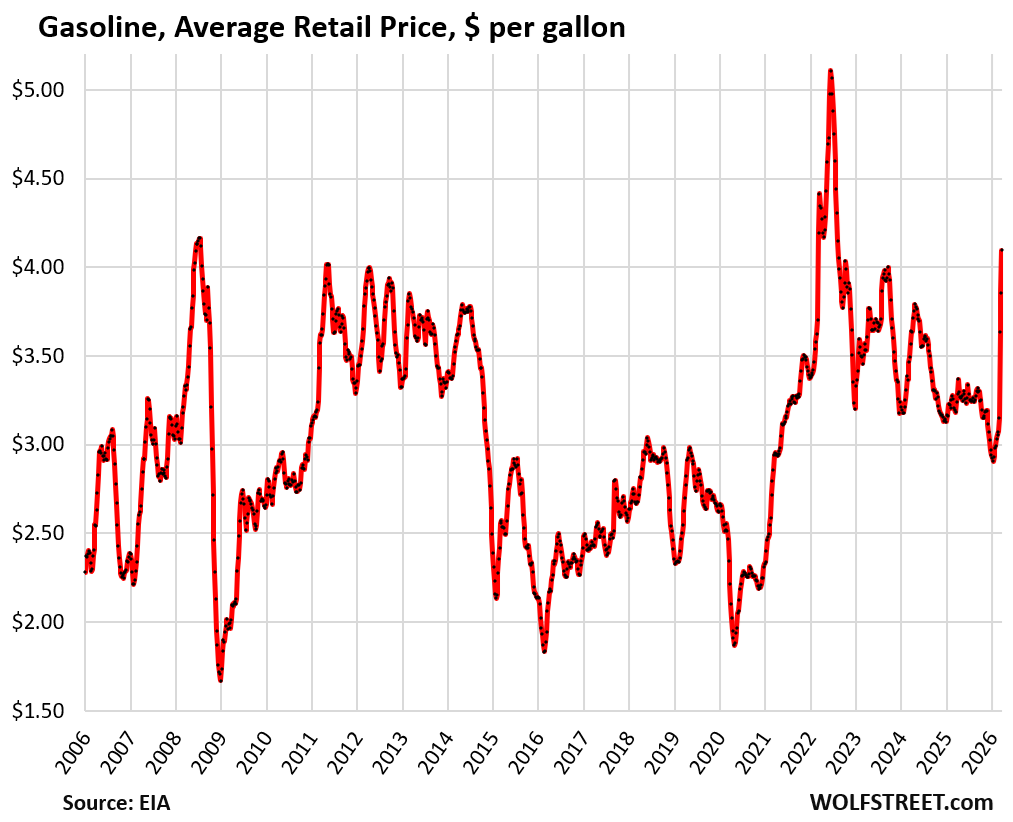
These price increases of gasoline will enter into the inflation calculations for the Consumer Price Index (CPI) and the Fed-preferred PCE price index for March, to be released in April; and they will push up the broad GDP inflation measures for Q1.
The three-and-a-half-year long decline in gasoline prices from over $5 in mid-2022 to $2.91 in early January was a substantial contributor to the cooling of overall consumer price inflation rates. And that impetus has done a U-turn. Overall inflation measures for March will show that U-turn, and will be hot.
But gasoline price spikes unwind: In early January 2026, gasoline cost the same as during some periods in 2007 and 2008, and a lot less than during part of the time in between.
When gasoline prices fall back to earth, they push down inflation, which is why the Fed could be tempted to “look through” (meaning, ignore) the spike of gasoline prices.
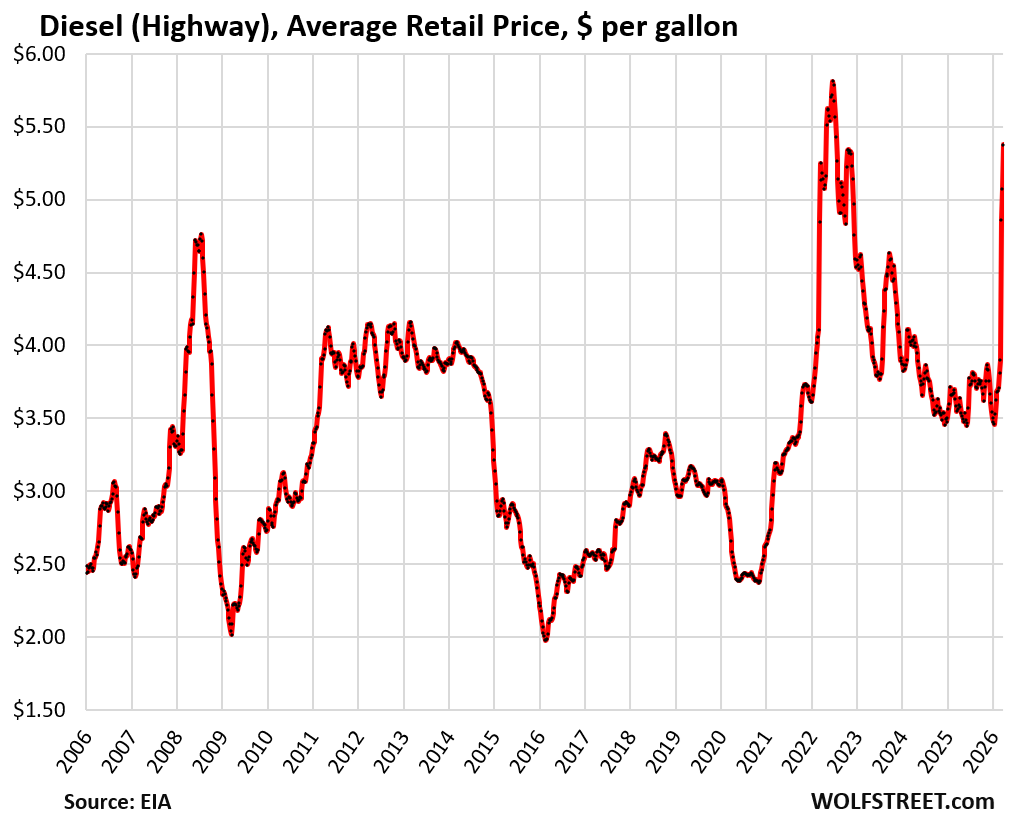
But diesel is a serious problem for core inflation. The price of highway diesel on Monday spiked by another $0.30 from the prior week, and by $1.90 or 55% from the beginning of the year, to $5.37 per gallon. Year-over-year, the price of diesel jumped by 51%!
Only a small portion of consumers drive vehicles with diesel engines – some pickups and SUVs, and some older European imports.
But diesel prices feed into transportation costs, and they feed into costs of goods and transportation services that companies pay for, and they will try to pass those costs on via higher prices of goods and services that eventually filter through to the end-users, including consumers. And those prices of goods and services are part of core inflation measures.
The daily spot price of jet fuel has doubled since early January. Airlines are aggressively trying to pass those cost increases – a substantial part of their overall costs – on to their ticket prices, and if people continue flying, rather than forgoing trips that are suddenly a lot more expensive, those price increases could stick.
Many airlines hedge part of their fuel purchases, so their cost increases don’t exactly track the spike of the spot price of jet fuel.
Airline fares are part of services inflation and are part of the core inflation measures. Thankfully for consumers, airlines have a history of being forced to eat higher fuel prices and book losses as they could not raise fares without losing a lot of business. But they’re trying.
Air freight also faces higher fuel costs, and that impacts all kinds of transportation costs that could filter into prices of goods and services.
Ocean shipping and transportation by rail also face higher fuel prices. And carriers will also try to pass on those costs, and all this is additive.

Fuel price spikes could trigger the inflationary mindset, when consumers are willing to pay those higher prices, and demand higher wages, and companies are willing to pay those higher wages to their workers and higher prices for goods and services they need, knowing that they can pass on those costs plus some to the next entity, and ultimately plus-some to consumers, which is what happened in 2021 and 2022, amid a historic spike in profits, and in the 1970s. When this inflationary mindset takes off, inflation becomes like a runaway train.
The Fed can deal with this by hiking its short-term policy rates to whack the inflationary mindset out of the minds of businesses and consumers. It doesn’t always work and it can get messy, but that’s the main tool the Fed has when the inflationary mindset takes off. Alternatively, it could try to prevent the inflationary mindset from even taking off by responding quickly with rate hikes – something it failed to do when that inflationary mindset began taking off at the end of 2020, and the Fed didn’t initiate the first feeble rate hike until March 2022.
Current inflation gauges, which still predate Iran war, were already hot:
Inflation as tracked across the economy in GDP, except imports, in Q4: +3.8% annual rate.
Core inflation that consumers face, which excludes energy and food, as tracked by the Fed-favored Core PCE price index: +3.1% year-over-year (red), worst in nearly two years. The Fed’s target for this measure is 2.0%.
Core inflation that businesses face, as tracked by the Core PPI Final Demand: +5.6% six-month average annualized (red), the worst since August 2022.
Enjoy reading WOLF STREET and want to support it? You can donate. I appreciate it immensely. Click on the mug to find out how:


Well, the Fed continues to look through inflation just like they look through main street.
Yes and the refinery companies are profit taking feels like a set up by the current Admin to catch them they are paying far less for oil from Canada and Venezuela contracts and shipping the excess we are excess producers now. We get into 4 months of elevated prices then their next price adjustment would be different for Canada but Venezuela is locked in for the year at far lower price.
Insane. According to our AI Friends, “Diesel is generally cheaper to produce than gasoline because it requires less refining. However, various factors such as taxes, demand, and environmental regulations can lead to diesel being more expensive at the pump.”
I can think of two of those that can be solved rather easily. I have now cured this round of inflation and nominate Wolf as next Fed Chair and all the commenters as Board Members.
My first Executive Action as a Board Member is mandating that hotdog buns and hot dog packs are sold in the same quantity.
Thank you for your attention to this matter.
INsiderFIDELS! I am forming the break-away Miserlamist Republic of Sallah Mander. Free beenies will be provided to all who have excess weenies. Bring your spare pups down to the nearest missile crater where we will put out a community pot. Any boiled off excess oils will be sold on the open market to fund the new state. Buns are for non-believers. All heads must be covered with a CAT Diesel hat. Sallah be praised!
I really love that scene in father of the Bride 😅!. “Remove the superfluous buns!”lol
“Maybe the children will have two hotdogs instead of 30 hotdogs”. “They don’t need to have 30 hot dogs—they can have three,”
Hear! Hear!
Damn,we are again reaching 4 chan business levels of insanity…..,keep it up!
That’s somewhat nonsensical AI slop. A refinery gets fewer gallons of diesel out of a barrel of oil than gasoline, and diesel is a denser fuel, containing more energy per gallon than gasoline. Gasoline blended with alcohol is even less dense.
A refiner can get only about 12 gallons of diesel (ultra-low sulfur distillate) out of a barrel of WTI; or it can get about 20 gallons of gasoline out of a barrel of WTI. And they get all kinds of other products out of a barrel of oil along the way, from gases to bitumen.
In other words, to produce 100,000 gallons of diesel, a refinery needs a lot more crude oil than it needs to produce 100,000 gallons of gasoline. Refiners juggle this around, along with all the other products they produce from a barrel of crude oil, to maximize their profits.
(just in case: 1 barrel = 42 gallons)
See, that’s why you’re our new Chair! Thanks for the extra information.
I second the motion to make Wolf the next Fed Chair.
Now for all who approve say “I”
So the move to ULSD is the reason it flipped to more expensive than gas?
How do people twist everything into BS? That takes some real talent.
I think it does cost significant money to get the sulfur out, and I do think I’ve read that the ultra low sulfur requirements upped the cost of diesel (that had always been known as the ‘less refined’ fuel) when they went into effect and added processes needed to occur, making that whole less refined statement no longer so applicable. But I’m also not an oil guy. I do remember when diesel was consistently cheaper than gasoline back in the 90s/00s
From Bloomberg cited on Adam Tooze’s blog today:
“Oil refineries are complex machines capable of processing multiple streams of crude into dozens of petroleum products. For simplicity’s sake, the industry measures refining margins using a rough calculation called the “3-2-1 crack spread”: For every three barrels of WTI crude the refinery processes, it makes two barrels of gasoline and one barrel of distillate fuel such as diesel or jet fuel.”
321 crack spread
3 bbl crude yields 2bbl gas 1 bbl diesel
uukj and bbj,
Your comments are kind of funny. I gave you some pretty exact figures of reality, and you google it and what you come up with is the industry’s method to estimate a refinery’s gross profit. To figure the “crack spread,” they add the price of 2 barrels of gasoline and 1 barrel of diesel, and subtract the price of 3 barrels of crude oil, and that difference is the “crack spread” or theoretical gross profit of the refinery.
In reality, no way in hell will a refiner get 2 barrels of gasoline and 1 barrel of diesel out of 3 barrels of crude oil 🤣
Why didn’t we just make things simple and bottle beer in oil barrels?
Tap a barrel!! 🍻
Yes that is true and why gasoline demand does effect prices it is only what 12 gallons of gas from a 49 gallon I believe from a barrel of oil. AI helps a lot I remember hearing that the gas companies are crooks and they get 3 gallons of gas from one gallon of oil AI is making is smarter in a lot of ways instantly we just have to choose to ask correctly and yes and do not forget the USA refineries are paying far less then spot price with our own ramped up production and convenience intake to referinies from Canada and Venezuela allowing USA companies to export more and profit think the Admin is setting them up for a revealing of how they gouged during this.
It’s not that simple: a refinery uses distillation columns to refine petroleum products. A refiner gets a myriad of different distillates from that process. Furthermore, Diesel has 15% more energy content than gasoline by volume. Thus under similar market conditions, diesel prices will be higher than gasoline prices.
On a related topic, how do people graduate from high school without knowing basic technologies that everyone depends on?
ok mr. smarty pants. let’s see how well you paid attention in high school.
without google or ai please answer the following:
1. what are the three ingredients required to manufacture elemental phosphorus?
2. what are the four basic steps required to manufacture elemental phosphorus?
you have 15 minutes to answer. no credit will be given for partial answers.
just one of 10,000 basic technologies that everyone depends on.
Elemental phosphorus is not man made. Most likely it’s made through either the late-stage fusion activity of a star or super nova event in combination with neutron decay.
Agreed, JDR. While my classmates were trying to hook up with chicks I was staying up late studying petroleum distillation processes
But that could generate some good pickup lines, no?
…Who says they graduated?
IF, by “basic technologies” you mean the laundry machine, oven/range, dishwasher and checking: people SHOULDNT be graduating high school without that knowledge (but there’s nothing in the curriculum that would inform these skills. That’s why: Parents).
If you mean the process of refining crude oil and the production processes of the petrochemical industries… then most people are in the dark (because I don’t need to be an electrician to operate the light switch).
Oil refining is a fairly complex process and the inputs matter to the output (light sweet WTI, Canadian oil sands or whatever). I don’t know a ton about it, and I drive AND use energy, often!
Liquid fuels are not priced on energy density. Heavy fuel oil has higher energy density that diesel, by about the same margin over gasoline. It’s pretty cheap because its use case (demand side) is much more limited.
I literally live between two refineries! My husband worked in one of the labs for a short time until realizing the incompetence of the employees might kill him. Those places are so dangerous – they should pay me to live here. One mistake in releasing some tiny bit of hydrogen shook my entire house and broke some neighbors windows. The process hasn’t evolved or progressed towards efficiency in decades.
Wrong!!! There are slightly more than 100 refineries operating in the U.S. today, a 65% drop from the 1950s. Also it takes significantly fewer workers per production unit. The process is significantly more efficient and productive today.
Wow, the Dunning-Kruger effect is certainly on full display in these posts.
MW: Dow, S&P and Nasdaq end lower, oil prices and Treasury yields climb as worries over Iran war persist
DJIA -0.18% SPX -0.37% COMP -0.84% CL.1 +4.28%
In Newport Beach, CA this morning saw a gallon of diesel at $7.57. Seems sustainable, right?
Only in newport beach do they shrug their $houlders and whip out the plastic. Everything there is perpetually price bloated. I get your point though. Moving inland, those prices began to shut people out of the food market.
In Brookings Oregon it’s now 5.89 a day after I filled up for 5.45.
CA diesel has officially hit $7 according to GasBuddy.
I saw diesel at 7.99 in San Diego yesterday. Premium was 6.99. This was hardly the nice area too
The price elasticity of demand will offset an increase in the inelastic demand for fuel. There’s an absolute historic rise in the demand for money, decreasing the velocity of circulation.
My ability to understand this comment decreased as the increase of my ignorance decreased my desire for knowledge on the increased assumption that this information would becoming decreasingly valuable to me
I think your elasticity needs to increase then so inelasticity can decrease so that you can reach an equilibrium of being both flexible and inflexible to deal with the modern paradigm of paradox that seem to exist in the ethereal ethos of our world.
Absolutely needs to decrease the absolute desire for knowledge until his ignorance is as valuable as his intelligence so he resides in a state of bliss.
Reply to Rico
Absolutely
🤣
It’s simply a double whammy. How else do you get an economic depression?
Gonna run right out and get me a Ram 1500 TRX (super charged V8)
Seems like a reasonable response to higher fuel costs.
Ironically may be a good time to buy. If you could save $10k off the price it’ll pay the fuel cost differential of the recent rise for 100k miles. That is if you were gonna buy one at gas prices 3months ago
I paid 4.99 a gallon for diesel and few days days later on the way home it went up to 5.49. Sprinter nation got more expensive
My “Gas Station from hell” just posted $5.05/gallon for regular, topping their last $4.89 price that lasted over a year.
My nearest gas station (near San Francisco) is charging over $6 for regular today and over $7 for diesel.
I’m in rural Western Washington State and my “Gas Station from hell” is giving yours a run for our money. They posted $5.69/gal last week. Scared to see what it is today.
I’m sure we will all be hearing the victory crowing from this administration any day now. Sounds just like the last administration…
On Kudlow today some dude on the panel said oil will go back down to $50/barrel once a peace agreement with Iran is signed. He said all the inflation due to the War is transitory.
Did he happen to mention how far up his ass the stick was? What part of “worst energy crisis” did he overlook? The”gutted” Iran nation is landing cluster bombs and never before seen heavier payload munitions on its missiles in central Tel Aviv..
Airline ticket(exact same flight)
Mid March HI to Houston R/T $1,600
3 days ago $2,600 but included flight credits
“Transitory” haha! I didn’t know they brought comedians on his show.
So all the facilities in the Middle East that have already been blown up will be magically repaired and back in operation? I think not.
Sure, with inflatables they just patch and blow up, again. Basic physics
Good post, thank you.
When grabbing a bite and filling up with gas at Casey’s gets too expensive, folks will drive to WalMart.
I am guessing that those WalMart digital price tags will pay for themselves in short order.
(Walmart’s diesel and fuel purchasing team meetings must be pretty interesting right now. I wonder what it costs to keep their fleet on the road for a day?)
Of course, “kids my age” know there’s always Rice a Roni, Hamburger Helper, Tuna Fish, Baloney, Spam, Canned Peas and Corn, or my childhood favorite, Dry Milk (served as cold as possible.)
We are about three generations from the widespread knowledge that if you never eat another chip from a bag in your life, that you will not perish due to starvation.
Digital price tags with facial recognition for customer specific prices.
Digital price tags are kinda a dumb fear. You can drive to a competitor to save , which I would do, if worth it.
And Amazon already does this, they track you and thru diff links can avoid showing you their sales.
Sometimes I see coffee for $12. Then I get an email, on price tracker website, it goes to below $10, I click link in email, boom it’s under $10 now. Like magic
Was Amazon gonna show me that sale? Nope
PMI’s didn’t look good today either
They were all in growth mode.
$5 diesel ❓❓❓ We may see $10 – 15 diesel.
Just drove by Chevron is a little CA town yesterday. Their premium gas was $6.69/gallon.
1970’s 2.0?
Oh, and don’t forget about that explosion at the Valero refinery in Texas. An internet search says
“Yes, the massive explosion and fire at the Valero Port Arthur refinery in Texas on March 23, 2026, is expected to significantly affect its refining capacity.”
New York Post reports that some California gas stations are charging over $8.00/gallon.
We all know inflation is transitory. All of it. 1 time shock, that keeps on shocking.
Maybe they could change their metric to a “Petrol Equivalent” number and base the cost of fuel on “estimates”. That works really well for keeping the numbers low.
Until lower inflation and recessions bring prices down due to slower business activity.
Hell the boomers may all be gone by the time that happens.
This inflation since the pandemic has been a real red hot poker up the A** for retirees, I’d think.
I really hate politics entering economics discussions, but every time WTI jumps above $100, Trump makes a statement claiming the war along the lines the war is over. The markets react quickly bringing it back down regardless of validity. Maybe if this time is true, oil prices will retreat in a few months when Gulf production is fully online, but the damage to the Qatar gas production facilities will take five years to restore. This is bad news for everyone as data centers are consuming more and more energy.
This tells you that the price of oil has been pure speculation, driven by maniacs. There hasn’t been any supply issue at all. In the 1970s, when there were supply issues, with people having trouble finding enough gasoline in big parts of the country, it didn’t matter what anyone said.
Supply issues perhaps,but at least we had Chevelle SS’s/Ford Shelby Cobras/real 4×4 trucks/jeeps etc.!
Now,,all we have is unibody death traps and lousy music,give me back the 70’s(minus asian war).
A lot fewer people dying in the “unibody death traps”. I helped someone out of a wrecked car recently, she had T-boned someone at an intersection. She was pretty shook up, but physically just fine, basically wrapped in airbag pillows on multiple sides. Not to mention the crumple zone ate up most of the impact.
Meanwhile my old nc miata in stock trim would blow the doors off any craptastic 1970s jalopy on any road that had more than a 2 degree turn. My 40 year old pick em up truck would be needing a half dozen small fixes and would have a new layer of rust on the floor where it was parked. And the “real 4×4” it had would be open diffs except the gov bomb in the rear which would be a 2-3 year swap at the junk yard. Don’t forget to throw in a new junkyard “vee aight modurr” every other rear end. And tranny too if it was auto. Don’t slide off the road in your bias ply tires either, the car will be fine; you’ll be broken in half though.
The cars from the 50’s 60’s 70’s are all garbage. Some looked nice. That’s about it. Giant engines in rust bucket land barges that made an impressive lack of power in straight lines only. I always laugh when someone yammers on about how they don’t make cars like they used to. One word to that: GOOD!
1911….
New cars are not death traps.
I love those older vehicles from the 70’s and before also. But they were actually the true death traps.
Even the cheapest quality vehicles built in the last 10-15 years are astronomically safer than cars from early 1990’s and before.
Which is exactly why the Fed has incentive to raise rates during a supply shock — to drive out the speculators. Lots of “commentators” on mainstream media “play dumb” and act like it doesn’t make any sense.
The only reason there were supply issues in the 1970s is that the price of gasoline was controlled. If they had been able to raise the price until supply equaled demand, there would have been no gas lines.
The reason there were supply issues in part of the US was because of the Arab boycott of the US, whereby they stopped selling oil to the US, and there wasn’t enough production in the US to make up for it.
I was living in Oklahoma at the time, in the US Oil Patch, and there were no supply issues there because oil was produced and refined locally, nor were there supply issues in Texas, where I started living in 1976, because oil was produced and refined locally. The price of gasoline still shot up though, but there were never any lines at gas stations.
At the time, the US oil producing areas were not sufficiently connected via pipeline to some of the consuming markets. This has improved over time, but there is still no oil pipeline across the Rocky Mountains in the US (Canada has one, but not the US), and the West Coast cannot be supply by pipeline from the big producing regions, such as the Permian. Oil trains work though, but that’s more expensive.
There was a Country music song back in the 70’s called “The gas line blues” . It was a hit at the time. If I remember the words, it described a motorist who was desperate for gas to fill his near empty tank. He got up at 3AM and got in line. He waited for 4 hours for the station to open then another hour in the line. By the time he got up to the pump they ran out of gas at the pump and he was left stranded with enough gas to make it home 1 mile away.
Wolf do you still have your Hybrid Fusion? Still driving my 2013 Fusion bought in the fall of 2012 in the flats. Life time MPG 42.4. Gas prices according to your chart look the same.
Could you comment not on the oil per barrel problem but on the refining of light American Crude problem associated with fracking.
According to this article the US has not built a new refinery since 1977. But I guess??? America First refining will give it the 50 year it’s a chime old school try. Thank you for your educated experienced thoughts.
1. We still have our Fusion Hybrid (#2, 2020 model year, last one before the geniuses at Ford killed it, and now regret it as they watch helplessly how the Camry hybrid has become a hot product. Our #1 was totaled when my wife got rear-ended). When I drive, it gets 40-50 mpg, my wife gets less; hybrids are really sensitive to how you take advantage of the electric motors/generators (easy does it).
2. I’m not going to click on the BS article, that kind of stupid clickbait keeps circulating, and I deleted the link so that no one else gets lured by this stupid clickbait. But keep in mind: one, refineries have invested many billions of dollars to upgrade their equipment and to expand to allow them to maximize their profits, and they use US-produced crude oil just fine. Two, gasoline demand in the US has been dropping, especially in California, where it’s in freefall due to EVs and hybrids; and three, US refineries are huge exporters of gasoline, diesel, jet fuel and other refined petroleum products. There’s a big-fat article about this on this site just a couple of weeks ago lol
Yeah, I have thought about that: haven’t built a “new refinery” since Adam.
Look at the next plane you get on: there’s some gear floating around that’s decades old, BUT it’s also regularly gutted and rebuilt.
The “refinery” is “old” because the dirt is all paid for and permitted/ contaminated.
The gear/ guts are (as Wolf states) upgraded as needed/ and available because the oil companies are interested in keeping their profits and efficiencies intact!
And that everyone is the true story. Market traders speculating. At some point real world experience will translate into price action but by then the speculators and politicians will have done their damage and moved on to the next opportunity. This “could” be all over by May but according to the news today, the global economy is in imminent danger of falling into the abyss at any moment.
Wolf hasn’t posted the prices on his “Gas Station from heck” in a long time. Why not?
I just need to take a picture of it in the morning so that I don’t take the picture into the sun. I’m just too busy in the morning to do that.
Doesn’t it have prices posted on both sides?
Well, this is the second most densely populated city in the US. The gas station is not a free-standing place with nothing around it. There is a big hotel across the narrow street, and a big tree at the corner of the street, and you cannot get far enough away from the sign to take a good picture of it, or to not have the tree block the view of the sign.
You can see both of them in the background in the photos I took of it from the other side.
One predictor of inflation is the US bond market. Inflation = nominal yield – TIPS yield. Currently, the 5 year predicts 2.61% inflation and the 10 year predicts 2.34% inflation. What is the bond market missing? Is it seeing a recession sometime out there in those timeframes?
Unlike during Covid, current job market will stifle “inflationary mindset”. No helicopter money either.
People more likely to “hunker down”. Get ready for recession.
Filled the work truck @ 4.59gal ( diesel ).
Still, below 08 & 22 high for my area.
Increased our rates.
Can’t wait for nearly 100% of these comments to be wrong
You’re the only ‘know-it-all’ (genius) in the bunch?
Ok, tell us more…
Nice of you to include yourself.
To the owl the wolf is wrong.
To the wolf the owl is wrong.
Yet the dragonfly soars.
🤷🏻♂️
That final chart, the core PPI final demand. Next month will be interesting to see the 6 month figure, after the -2% gets replaced.
There were two rather important items not mentioned in the essay:
1. This inflation is caused by a war of choice by Trump.
2. The conflict continues, looking more dire with each passing day, so we may be facing fuel costs going through the f-ing roof, and inflation doing the same.
We’re going through a repeat of the 1970’s decade with the added War and a completely disfunctional government in DC. + massive federal debt and deficits with no end in sight. Jimmy Carter (once removed) is starting to look pretty good.
The expectation that the Fed is dedicated and determined to “do the right thing” is a fairy tale, IMO.
5 years, 55 consecutive months over the 2% target, a target that was once the ceiling…and people still discuss cuts and soft landings.
The damage from QE extends.
Banking regulations eased so as to meet the private lending/credit industry as that industry begins to “gate” investors and implode…will the Fed run to aid or stand aside and let chips fall?
Depends on who is getting hurt, and that shines the light into that which the Fed has morphed
I am going to strongly disagree on “looking through” inflation this time around, because there is a geopolitical shock that still has no sign of abatement. We have no idea when the situation concerning energy will turn around, and until that changes, the Fed would be extremely reckless to discount the risks. Not that they haven’t done so before – the period around 2022-2023 was the only time they showed anything like restraint and responsibility (apart from the “totally not QE” bank bailout) in recent memory. Otherwise they have been far too accommodating to Wall Street and whatever administration is in power.
Yep, and this energy shock is just getting started. Let’s see, the last time the ten year yield was about 5% it was 2007. Something happened shortly after…
The devolution of humanity continues unabated. Scientists at the University of Kentucky are turning bourbon waste into supercapacitors (seriously, google it) but the average Joe/Jane keep voting for red team/blue team billioniares that want to kill them.
Interesting times Wolf.
“The last time the ten year yield was about 5% it was 2007.”
1. The last time was actually Oct 23, 2023, if briefly:
https://wolfstreet.com/2023/10/23/spectacle-ensues-after-10-year-treasury-yield-pierces-5-huge-demand-piles-in-yield-plunges-19-basis-points-in-hours/
2. in the 4+ decades before QE started in 2008, a 5% 10-year yield was actually low. Most of the time over those 4 decades, the 10-year yield was higher and a lot higher than 5%.
So what the yield limit before the financial plumbing breaks? Your data support my hypothesis that it is somewhere between 4.5-5.0.
No, what there is at 5% is a HUGE flood of demand, including from lots of people here that will pounce on the 10-year with that kind of yield and drive the yield back down. Maybe someday this huge flood of demand shifts to 6%, but for now, it’s triggered by 5%.
“HUGE flood of demand”
So you believe that debts and deficits don’t matter. Okay, fair enough, but feeding that family of four might require significantly more income then.
You’re perverting what I said to suit your narrative, and it’s a waste of my time to play this game.
It doesn’t matter what I think about the deficits because I’m not the global investors that are buying the 10-year, even at today’s lower yields. There is huge demand even at those lower yields today. Or else the yields would be much higher. I don’t know why this is so hard to understand. Maybe you cannot understand it because it contradicts your narrative?
One thought: the government loves inflation, the money they borrow is paid back in worth less dollars. The 30 year Treasury notes, for instance, will basically pay you back your entire investment plus 5 percentage interest in 30 years. But at 3+ percent inflation a year the paid back money will be worthless. Of course you still got the 3 percent interest a year, and had to pay taxes on that. Besides, inflation will probably run much higher than 3 percent; it is so “profitable” for the government
Honestly, I don’t think the inflation mindset has subsided much.
When my car, home & healthcare insurance stop going up by double digits, then I’ll jump on the inflation is “maybe” tamed bandwagon.
Not a single hurricane hit the continental US last year. That’s tens of billions of dollars in insurers pockets. This year is predicted to have a major El Nino by the time the active part of the hurricane seasons arrives, which usually means fewer hurricanes.
And let’s see how OER & healthcare inflation look now that we’re getting past the fall 2025 distortions. It’s just stunning that the BLS sits on its hands, choosing not to correct these grossly inaccurate means of capturing these major components of inflation.
Ha, weather is somewhat of a hobby of mine. Funny that you bring up hurricanes and El Nino, there are talks amongst people in the weather circle saying that if the ocean subsurface temperatures continue their upward trajectory this year, there’s a real chance that a cyclone could hit California/West Coast. Can you imagine the implications of this?
We already have cyclones here in California, including a bomb cyclone every now and then, which beat up the coastal regions, destroy docks and homes along the coast, wash out bridges on Hwy 1, etc. But they have so far lacked the destructive power of a big hurricane. And we have frequent Atmospheric Rivers that flood the interior. But California’s coast is hilly to mountainous in most areas, and there are not many big coastal flood zones that extend far inland, as there are along the Gulf Coast and the Atlantic Coast.
The real risk in California isn’t a cyclone but a big atmospheric river event that floods the interior. The USGS did a study on it in 2010 and named it the ARkStorm scenario (a thousand-year-return atmospheric river, although more recent estimates have said they are 200-year storms), and estimated potential damage at over a trillion dollars (in current dollars).
Under an updated ArkStorm 2.0 project from 2022 which hasn’t been finished, a couple of authors (including Daniel Swain from YouTube’s Weather West) estimated we’d see up to three of these storms by the end of this century under a high emissions scenario, and that these future storms could be several times more severe than even the 1862 flood because of a number of converging factors from climate change: basically, warmer airs holds more moisture, so more intense rain; warmer air means a higher freezing level so less of it falls as snow, and, potentially, a higher freezing height over an existing snowpack means “rain on snow” flash flooding. Peak runoff in future storms was double, and in some cases 4x, the peak runoff estimated from historic storms. They also noted that nearly all of the storms that occurred in the models were during El Nino years.
The 1862 flood turned the entire Central valley into an inland sea, from Sacramento to the Tehachapis.
Turned the bay into fresh water.
It would be pretty catastrophic if it happened again.
Oh… then drought the following year.
California has always been boom and bust weather.
Am I still going to get my tariff dividend check ?
If he cuts a deal with Iran for their oil like Venezuela we can get a petro dividend!
Eat, drink, and spend money, for tomorrow will be more expensive.
Welp, back to the 70s show. I can only imagine what will happen when inflation really gets going, and the Fed has to Volcker the economy. By then this regime will be gone, and we will be into what I shall name the “National Emergency Government” phase.
YMMV, but it is sure that the next mile is going to cost bigly.
And the irony of ironies, AI will not help with this.
So, buy a house now with cheap funds, or buy a house for less with super expensive funds. Choices, a la Hobson.
If I can add to that. Buy a stone one, note too close to the coast, in an area with woods, hills and preferably natural water somewhat closeby. Your grandkids will thank you for having the foresight to get that into the family when it was still affordable.
I can add to that: Don’t buy a “stone one” in an earthquake-prone area, such as California. Buy a house whose structural parts are made of wood or steel (including concrete with lots of steel in it), if you want the house to survive the next big one. But a stone facade is very good, as long as the structural parts are wood or steel.
Jorg, if you buy a house in the woods in California, you have a fair chance of getting burned out. An entire town, curiously named Paradise, burned to the ground in 2018. 85 people killed, 18,000 structures destroyed. It was located in the woods in the foothills.
Waiting for the next “Wolf” print to show on inflation numbers bleeding into the economy this week. Been overshadowed yet these things are still progressing.
I topped off my Mitzubushi Mirage the other day and it cost $18 for 1/2 a tank ($4.10/gallon). Frankly, I don’t give a flyin f$ck if gas goes up to $10/gallon. It will not affect my lifestyle one bit. In fact, I am hoping it does. Get rid of some of this traffic that is getting worse here every day.
I have a C-max which is a wagon version of the fusion. Same drive train but not as aerodynamic. Dealer sent a love letter yesterday imploring me to sell it or trade it in.
Very practical car, I can haul a stove in it easy peasy if I have someone to help hoist it in. Seat back folds perfectly flat.
The C-Mac is actually based on the Ford Focus (which Ford also killed), not the Ford Fusion. The Fusion is a much longer vehicle with a bigger powertrain than the Focus. As long as the C-Max still runs well, it’s a keeper.
In Norway, the largest political party today suggested direct transfers to people to help with the high diesel/gasolin prices.
It’s a very popular suggestion by all means, and the people also expect interest rate cuts.
We get the politicians we deserve, and rate hikes will be next.
“We get the politicians we deserve”
Yes.
“…and rate hikes will be next.”
Nope. The central bank of Norway (Norges Bank) just signaled a rate HIKE as the next move. The ECB folks have also been talking in the rate hike direction. The central bank of Iceland already hiked.
War is inflationary. Period.