
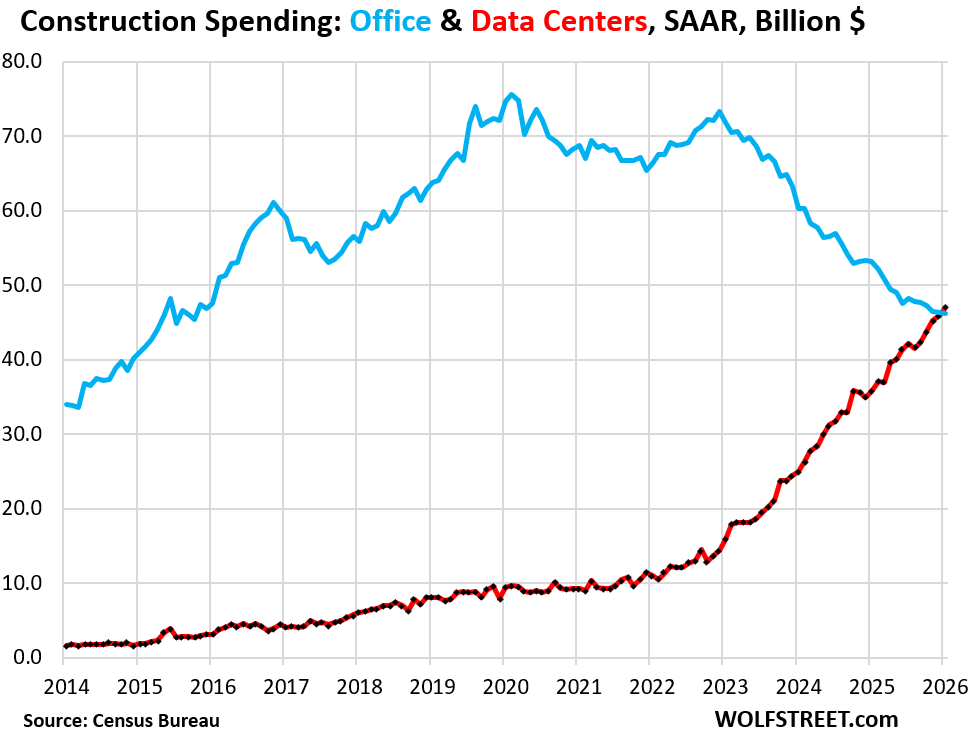
Explosive spending on data-centers exceeded plunging spending on office buildings for the first time ever.
By Wolf Richter for WOLF STREET.
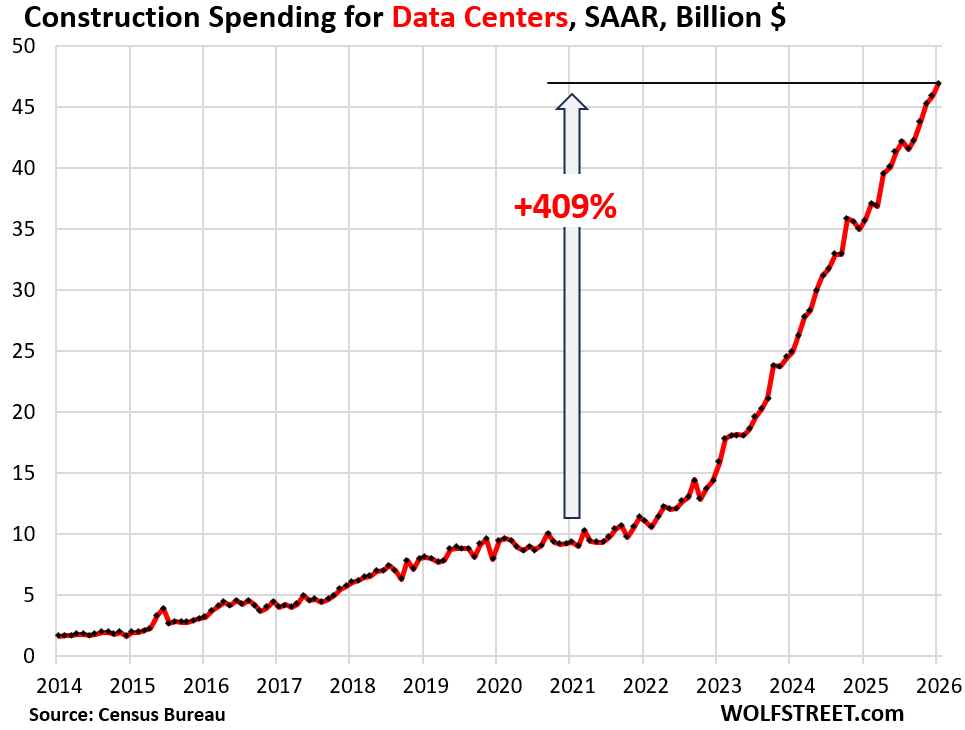
Construction spending on data centers soared by 31% in January from the already spiking levels a year ago to a seasonally adjusted annual rate (SAAR) of $47 billion, up by 409% since the beginning of 2021 – it more than quintupled! – and up by 670% since the beginning of 2018, according to data from the Census Bureau today.
Spending on the construction of data centers is reportedly limited by various supply constraints and bottlenecks, ranging from labor, especially electricians, to electrical equipment and of course power – grid power and on-site power generation equipment when grid power is not available. No one was ready for this sudden boom.
This construction spending on data centers does not include the amounts spent on the immensely expensive AI-specialized servers, networking equipment, etc. inside those facilities, which have reached astronomical levels.
Five companies alone announced $700 billion in capital expenditures in 2026, the bulk of which are related to AI with a focus on AI infrastructure – data centers and everything in them and around them, from AI servers to onsite power-generation equipment if the utility cannot supply the juice.
- Amazon: $200 billion
- Alphabet: $175-185 billion
- Meta: $135 billion
- Microsoft: $145-150 billion
- Oracle: $42 billion
Other companies also boosted their capital expenditures, and the overall capex figures are much larger. But only a small portion of it will go into actual construction costs of data centers (Here’s where they get the money to do all this).
Office construction spending fell by 13% year-over-year in January, to a seasonally adjusted annual rate of $46 billion, the lowest since 2015, and has plunged by 37% since the beginning of 2023, as the commercial real estate sector of office began to spiral into a depression.
Spending on data center construction (red line) exceeded spending on office construction (blue line) for the first time ever in January. Boom and bust in one chart:
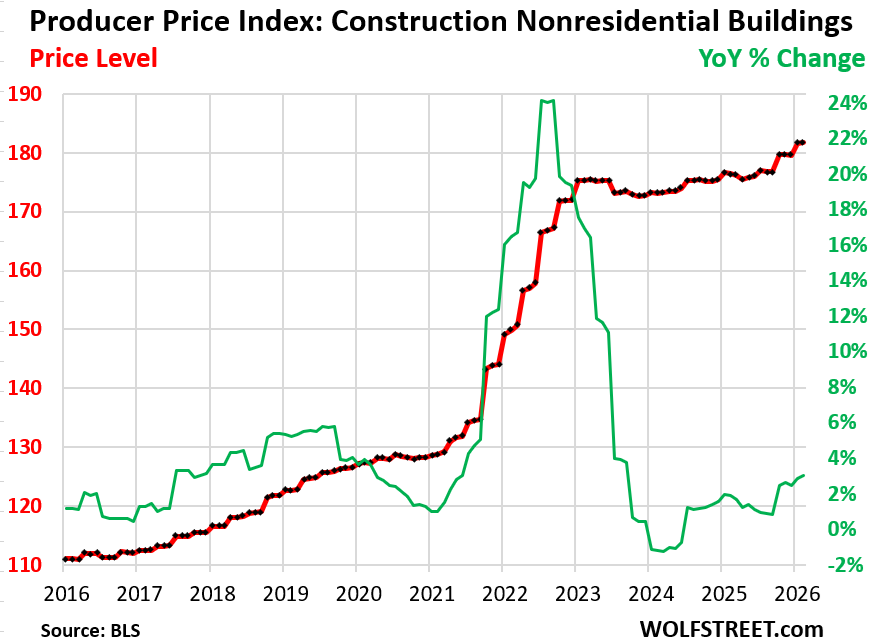
Construction cost inflation: The Producer Price Index for Construction of Nonresidential Buildings, which was part of the hot PPI data released last week, edged up by 0.1% in January from December, and on a year-over-year basis accelerated to +3.1%.
Construction costs had been relatively stable in 2023 through mid-2025, after the huge two-year 36% spike in 2021 and 2022. In October 2025, the PPI for nonresidential construction started to accelerate again.
The chart shows the PPI for the price level (red line, left scale) and the year-over-year percentage change of that price level (green line, right scale).
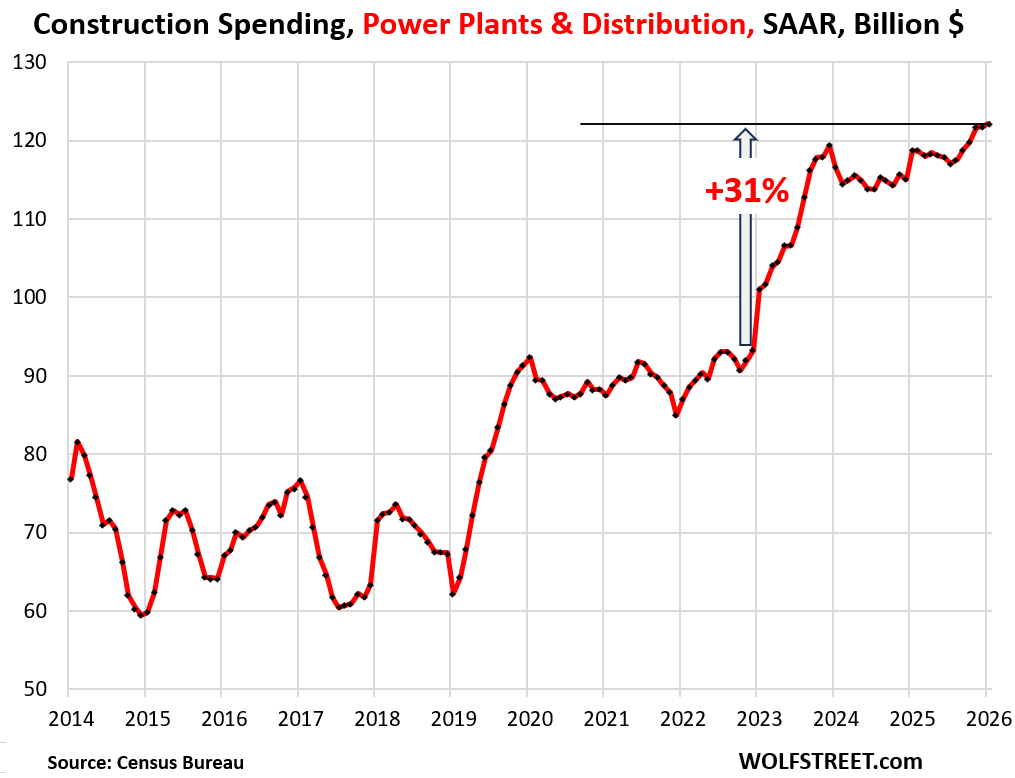
Spending on Power Plants & Distribution rose by 2.9% year-over-year to a seasonally adjusted annual rate of $122 billion, up by 31% since the beginning of 2023. This includes construction spending on power plants and transmission infrastructure.

Data centers require prodigious amounts of power, and utilities or the data center providers themselves have to invest in new generating capacity and in transmission infrastructure to get the power to the data centers. But the process of planning and getting permits for a power plant or a transmission line takes a long time, and the construction spending won’t show up here until construction actually starts.
And utilities, before spending billions of dollars to provide 500 megawatts of power to a cornfield owned by a fly-by-night hedge fund, want to make sure the infrastructure will not become a stranded asset when the AI bubble implodes. They’re proceeding with some prudence because they have to live with the consequences.
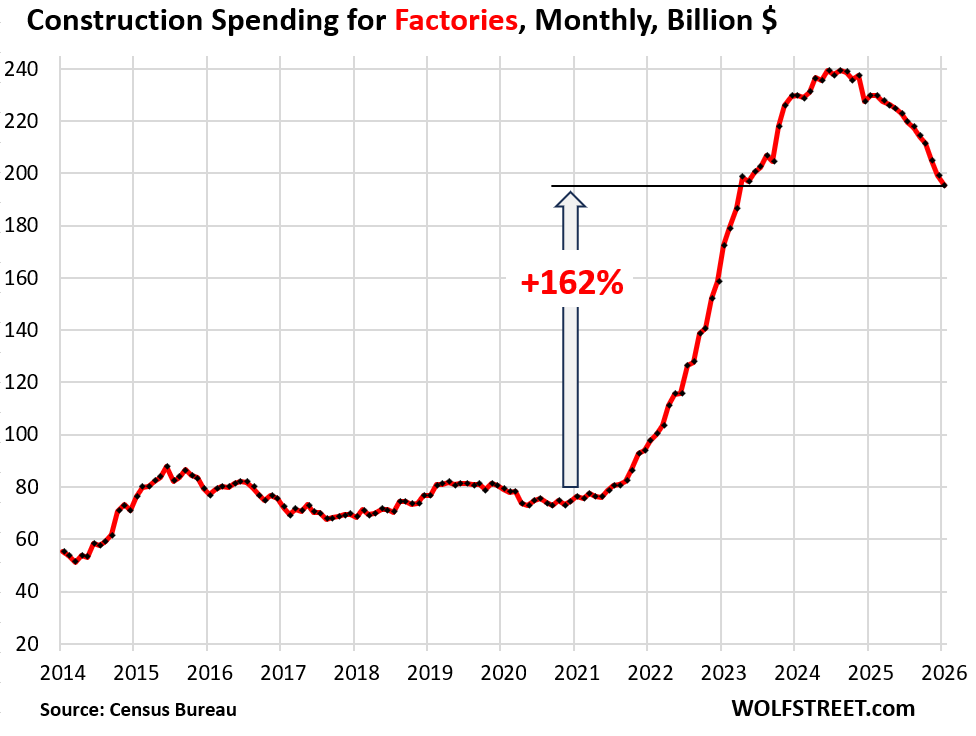
Construction spending on factories declined further from the huge boom, as spending on the construction of semiconductor plants and battery plants has slowed sharply.
Spending on factory construction fell 15% year-over-year to a seasonally adjusted annual rate of $195 billion, still up by 162% from the beginning of 2021, and over four times as much as spending on data centers or offices.
The largest two components of factory construction are factories for Computer, Electronic, and Electrical Equipment (39% of total factory construction in January) and factories for the Chemical industry (23% of total factory construction spending), and we’ll look at them separately below.
These are just the construction costs of the buildings and do not include the cost of the production equipment in the building that dwarf the costs of the building.
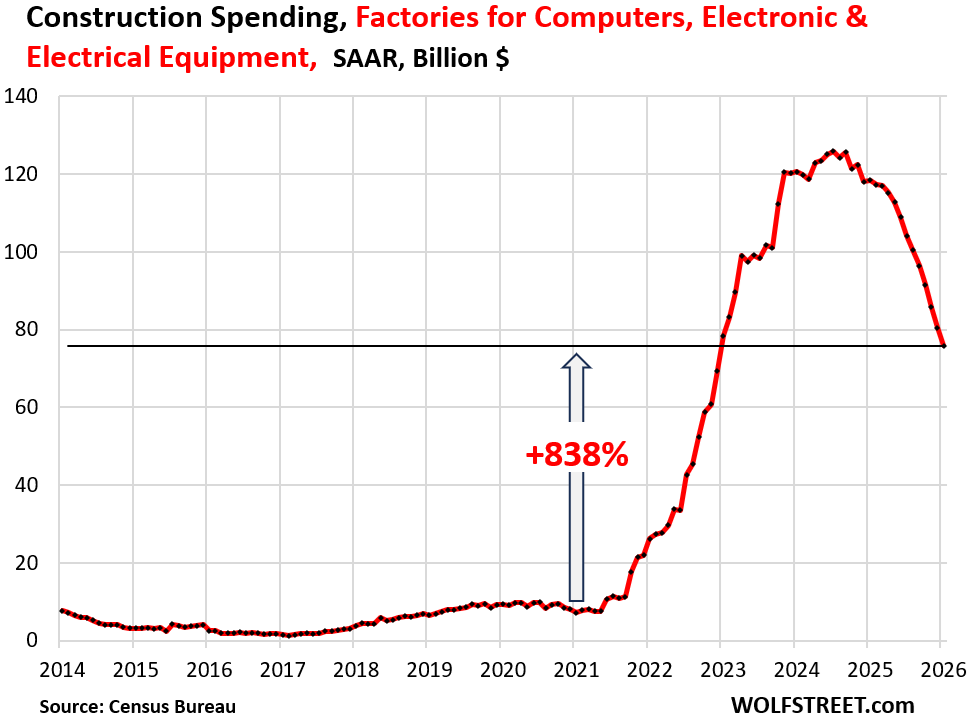
Factories for Computer, Electronic, and Electrical equipment, which include semiconductor plants and battery plants, were the driver of the boom in factory construction and now are the driver behind the partial unwinding of the boom.
While spending has dropped sharply from the peak in mid-2024, and by 36% year-over-year, to a seasonally adjusted annual rate of $76 billion, that is still up by 838% from the beginning of 2021 and by 1,871% from the beginning of 2018. These are still huge numbers.
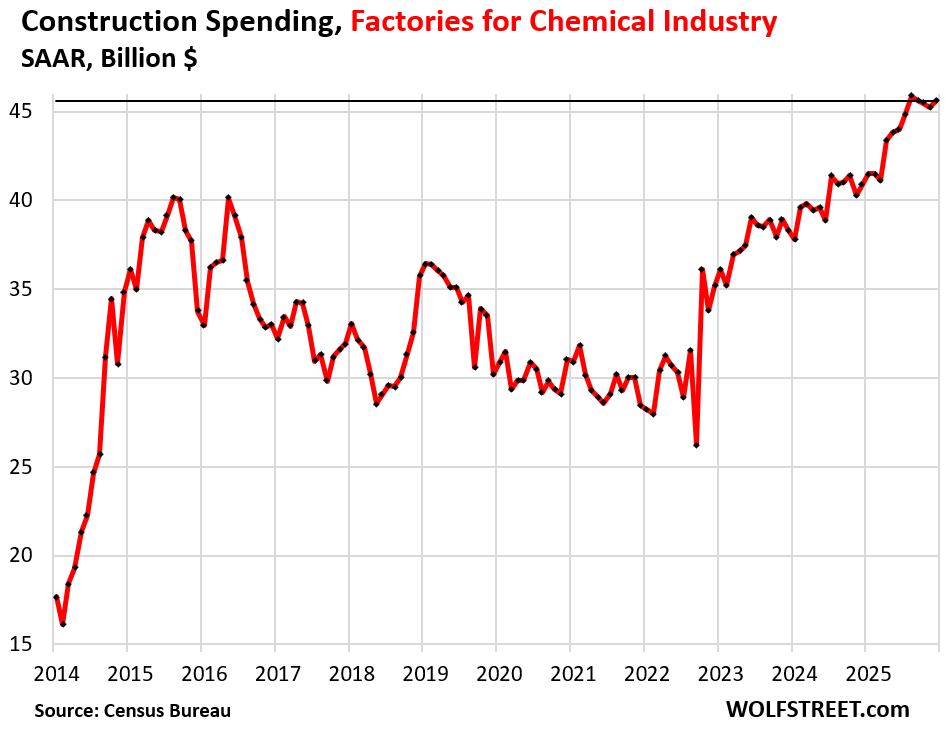
Construction spending on factories for chemical products jumped by 12% year-over-year to a seasonally adjusted annual rate of $46 billion in January, up by 57% from the beginning of 2021.
Factories built in the US will all be highly automated plants with relatively little or no low-skilled manual labor. No one is building a sweatshop factory in the US as labor is too expensive. But automated production equipment costs the same anywhere in the world; it’s the great equalizer.
Enjoy reading WOLF STREET and want to support it? You can donate. I appreciate it immensely. Click on the mug to find out how:


I remember when I was a kid in the 60s. I would hear that a structure, such as a stadium or factory, costs $50M to build, and I couldn’t believe anyone could get that much money.
When I became an adult in the late 70s, early 80s, the construction of commercial and public entities cost several hundred million dollars. Oh my!
Today, we use billions of dollars as a starting point, especially for fabs, stadiums, and data centers!
I guess I now understand how my parents felt when they bought their first home for $10K and were blown away when they saw their kids buy homes costing hundreds of thousands of dollars.
It’s called corruption.
Watch the sopranos, you gotta grease so many palms and give no show jobs.
I mean that’s what corporations are and how they exist, the agreed upon corruption.
Now I dunno how deep it goes but obviously it’s better than inferior countries. And better than the past, or maybe the recent past was best and we are descending back into our heritage of massive corruption?
Everyone wants something for nothing or not to work hard for the money. There are also always perceptions that one “deserves” something. Or if only one could “pry” something from someone else’s fingers, then their cunning gave it to them.
It’s a crazy world.
Hell my fav sport on earth is totally rigged. Figured that out while standing there befuddled that one and one didn’t make 2. It made 7.
I still watch the sport. Lol
Geeze seems office buildings are becoming a stranded asset. Difficult to repurpose to residential, but can be done at cost. What else can they be used for?
meant to say, at “a” cost….
Nothing, and therein lies the big transition that needs to occur. With more Americans choosing not to have kids, 1-2 bedroom homes would be in higher demand, if affordable supply were to hit the market. The most suitable office buildings need to be converted into affordable housing. However, developers & builders may need tax incentives to do so at these lower prices.
Trump is making a MASSIVE mistake by not creating a national / will / campaign to get more Americans into residential construction. Replacing illegals with Americans who build homes is the BIGGEST job growth opportunity we have in the next 10-15 years.
And let’s figure out a way to get all of that new home buyer “incentive monies” going into bank’s pockets to go towards paying Americans a good wage to build homes.
I follow the building industry & framers / plumbers / electricians / HVAC are making good money nowadays. And in many cases, they’re using illegal labor to do so. Which means these illegals in many cases are NOT working for peanuts. They’re already making wages that many Americans would work for, IFFFFF the right policies forced builders / contractors to hire Amercan. The whole residential construction industry has a very strong bias towards hiring illegals. That’s a FACT.
Your comments have an air of reason, until one uses critical analysis. Perhaps you just didn’t complete your scenario. First, there is no housing crisis. You would know by reading Wolf Street. second, converting office to residential is not fully addressing the needs to do so. Obviously it is a huge expense, but who are you renting too? Demographics needs to be addressed for success. Third. You really do need a set of services for the folks. Food store, dentist, doctors,etc. I know some of these exist in cities, but where I had my shop in business district in Boston, a dearth of services. Incentives need to be in place to get entrepreneurs to open while residence s are leased. Planning boards need to have a plan for success for a community. This is a SLOW process, and most likely will not outrun the decline of offices.
The real solution is not to throw more labor at using 19th century technology to build homes. The real solution is to apply modern manufacturing and automation that has been adopted by Every Other Industry to REDUCE the labor needed and bring housing manufacturing into the current century.
You posted this under the wrong article. This article is about construction of data centers and factories, not housing. Repost this under the correct housing article, and then I’ll delete this. But hurry.
Do we have any sense of how dependent blue collar work has become on the data center expansion?
If there’s a bubble implosion, will it hit blue collar really hard, like an oil bust situation?
Most concern about the bubble burst seems to be about a white collar recession from the high-flying firms having to fire lots of people. But it seems there could be a blue collar problem lurking there, too.
Not really. We’re already extremely understaffed on construction labor due to boomer retirements. Deportations and data centers are just salt in the wound.
Investment that doesn’t produce a high number of job openings. We will have stagflation.
These data centers will go the way of the malls after the AI implodes as I expect. They’ll have to find some other uses for the properties out in the middle on nowhere. Maybe ICE detention centers?
I think you may be correct
AI is a dud
AI is a DUD because it just outputs whatever the model determines. It has no human reasoning or ability to think to QA the result to see if it makes sense.
We will never be able to pull the human mind out of the loop on life or death situations. The people who say otherwise are trying to profit.
Planes can fly themselves at this point. Do you want to ride in a plane without a pilot monitoring what is happening?
“Do you want to ride in a plane without a pilot monitoring what is happening?”
Have you ever taken a Waymo? They’re everywhere now, and they’re dealing with “life and death” situations every second of every day. Human drivers are responsible for about 35,000 traffic fatalities a year in the US. So why would I entrust my life to these human drivers? Waymos have not been involved in a single fatality (oh, one of them ran over a cat that darted out in front of it, and it made the global news!).
@Wolf,
Riding in a Waymo on city streets is not the same thing as getting into an Aircraft. There are 1000s of more calculations and inputs happening in flight. And yes, I’ve ridden in a Waymo. Cool tech and fine for what it does.
AI is good for certain things like a taxi. It isn’t fine for things like aircraft, surgery, medical diagnosis, or any other number of things where an error is certain death.
AI Problems
LOL. Automatic pilots have been landing planes for years. Long before there were Waymos. Turns out, landing a plane is pretty easy for a computer. It’s just hard for a human.
My parents died in a Boeing in 1976 because the idiot human pilots of Turkish Airlines had turned off the automatic pilot and attempted a manual night landing and slammed into a mountain, they weren’t even going in the right direction, despite long warnings from the air traffic control.
https://en.wikipedia.org/wiki/Turkish_Airlines_Flight_452
You humans have no idea just how stupid humans are. Which is why you humans are so easy to replace with AI and with even just basic automation.
@wolf,
So would you get in a plane with no one in the pilot seat?
Absolutely. As long as it’s not Southwest.
AI is not a dud. It’s a looming job killer, as is robotics.
Go search “Chinese new year robot dance” on youtube.
It’s insane how athletic / dexterity robots have nowadays.
Now granted, there’s an equilibrium that has to be found. Killing too many jobs destroys consumers, and I’m not all that convinced that people will be happy with a Universal BASIC Income.
I’ve capitalized the part that’s the issue. Basic doesn’t sound like a very good standard of living.
agreed, but just one quibble: Those dancing humanoid robots are not AI. They’re not operated by AI at all. They’re a piece of equipment that runs on regular software that was pre-programmed. Lots of times, these kinds of robots are in part remote-controlled (by humans in body suits). It’s not AI that is the marvel here, but the mechanical engineering of making a humanoid robot function like this.
dang,
AI will be fairly ubitiquous at some point. Remember when an expect believed only 5 computers would satisfy all the US computing needs. As will any new technology and suite of tools there will be an adjustment period, which will likely be acute in some sectors in the US.
There will be a shake-out and some heavily debt-fueled construction will lead to bankruptcies.
But AI is NOT a “dud” and will NOT be going away. It will only improve and be used for more things.
Companies like Google can make good use of their AI infrastructure even if nobody ever generated another “slop” video. So some will win and some will lose.
AI has also done wonders to shake up entire industries allowing newcomers to challenge established brands and force them to innovate (ChatGPT vs Google, for example; not the Google has ever been particularly lax when it came to innovation).
My pov as well.
Saw AI entering DoD (as it was called in those years) R&D initiatives 10 -15 years ago. Some being fielded now. AI languages have been “played” with since at the least 1960s. The “intellectual” impulse has been there for decades – maybe all the way back to Turing.
Corporate/Gov’t financial management/innovation is a different matter from technology development. That’s a business savvy aspect. As you note, when entering the ramp up phase of traditional technology dominant curves there are plenty losers and some winners.
The data centers are the new home of our incoming AI overlords.
We hope and pray that they will “come up with” clean unlimited energy, a cure for cancer and the solution for world peace.
We actually have most of these things available, but would rather see our neighbors die than to miss out on the Big Payday.
We have stopped teaching critical thinking in our country, and the “relief” of not having to do… anything, EVER will be the terminal velocity of the brainrot already underway.
Just consider the Matrix as a documentary, before it’s time.
So agreed!
In a recent YouTube video, musician Rick Beato showed how he downloaded an LLM to one of his computers. Instead of running his AI queries through something like Chat GPT, he just fires up his computer app.
Takeaway: All of those data centers will soon become as obsolete as the recording studios that bands used to need to record anything.
I don’t know if I can post the YouTube link here, so I’ll just say that the video title is “How AI Will Fail Like The Music Industry.”
I can run Excel on my computer. But increasingly, computer users run Office 365 or Google Sheets, powered by datacenters in some other part of the US.
Datacenters were a growth business before LLMs came on the scene. Even if roll-your-own AI becomes trendy, the majority of Americans will use the datacenter-based version.
My Office 365 is “powered” by my laptops, a huge piece of software on my SS hard drives, and works offline just fine all day long without internet connection, and I won’t know the difference. It doesn’t need data centers. I turned off backup to the cloud, because I don’t want my stuff on a MS server. When online, I can read my Outlook emails no matter which laptop I’m using, but that’s just email, which is cloud-based. But I cannot share files between laptops because I have no files in the cloud.
The only major difference between now and when I used to buy the software from MS is that I pay an annual subscription fee which gives me a license to put the software on five devices. I always have two active laptops and the most recently retired spare, and my wife has one laptop, so that’s four laptops on one annual fee. Financially, it works for us since I go through laptops pretty quickly and I used to buy the software each time for each new laptop, and that adds up.
And the updates are automatic, and largely unnoticeable (unlike Windows updates).
But if you’re into document sharing with a scattered team, you can have all your huge corporate files in the MS cloud, but the software is still on your device, and your device still powers all the processing of the data.
But I think that the AI processing you do largely takes place in a data center.
Google Sheets is different; it does run on a server.
Good call Wolf, I have invested in SSD Drives and stopped using the cloud a couple of years ago. Who would have known that these $79.00 drives a few years back, would be going for $189.00 today! It seems that Moores Law is not working anymore?
The only thing I won’t do is my finances. They are all still fragmented in their respected company apps.
I painstakingly combine them.
Sucks but I don’t want some butterfly company having the data blended.
I never even caught on to 1998-2008 tech more than I had to know. Got it, understood it easily, just didn’t feel like messing with software too much.
So really doubt I’ll ever use AI much.
I think my washer and dryer can connect to wifi. But never interested me either. 🥱
Philip they will go back down at some point.
However when they are $99 again, buy 2! Haha
I took Office 365 off my machines so I don’t have to waste money and time updating my licenses. I installed Office 2003 on my Win 7 machine. I own the CD and the software. It does everything I need done. No more hassles from Microsoft.
the data centers are likely to be a yoke rather than the obvious devious nature for which the AI has no control like the pit bull drama
Local AI computations are feasible but limited, though they will improve especially as dedicated AI hardware becomes a standard component, much like on-board video has become.
The capability of such is tiny compared to a datacenter pod, though. So while you will likely get an AI assistant on your phone to manage meetings and find flights, big-data analysis and generation of useful work (and un-useful slop) will continue to need the bigger models.
Back in the 1960’s, all processing was done on IBM ( or other companies ) mainframe computers.
The phone in your pocket has more processing power and more disk storage than those mainframe computers.
This will happen with AI as well.
Exactly. I’m not going to dare defend the ai bubble or suggest anyone should be gambling their hard earned money on it..HOWEVER- there are many smart people who comment on this site and I cannot comprehend how so many of them doubt the technology will continue to evolve and become more advanced than we could ever imagine. Just imagine the computing power at our disposal if even 25% of these things actually get built and are up and running in five years.
And yet, even with many orders of magnitude more power now in your pocket, still more processing is done “in the cloud”.
I worked as a laborer on the Anheuser-Busch brewery in Fairfield in 1975-76 and as a laborer and carpenter on the Kaiser-Permanente cement plan near Cupertino in 1979. Both have now closed. I have to wonder how long all of these data center locations are going to be able to maintain viability in the face of rapid change and competition.
I’d imagine over the last 50 years those places have more than paid for themselves..
I expect that they did reasonably well although it wasn’t quite to plan for the cement plant. A coal burning facility was added in 1979 as a move toward a cheaper more reliable fuel, largely inspired by the early 70s oil volatility. I was told that the oil-fired equipment was being shipped to Venezuela. In the ensuing years opposition to coal increased considerably and was probably the driving force behind the shift from coal to coke in 2007.
Think NASA Mission Control and you have the idea.
Remember that big room from the Mercury, Gemini, and Apollo missions? The one that was shown on teevee?
Your cell phone has more computing power than that room.
The recent data from Wolf Street reveals more than just a market shift; it’s a physical eviction of the human worker. For the first time ever, spending on the “digital brains” of our economy has overtaken the space once reserved for human bodies, as office construction has plunged 37% while data center spending has quintupled. We are stoping building for people who need desks and coffee breaks, and instead pouring hundreds of billions into silicon “residents” that require prodigious amounts of power but no physical supervision. As highly automated factories replace manual labor and server racks take over the landscape, the message is clear: the economy is moving out of the office and into the machine, leaving the traditional workspace as a hollow relic of a carbon-based past – written with AI.
Today I was talking to some good ‘ol boys in the oil biz from Louisiana. Their take take is all wars are energy wars and oil is good for one thing, power(in all shapes and forms) until something better comes along. Oil is strictly transitional and finite. Well, maybe AI can figure it(cheap energy) out before fracking goes the way of it’s predecessor dinosaurs.
Some were predicting last year that the VZ move was a backstop for the Iran invasion. Now it appears so. Put one deer in the locker before starting the next war.
However, cheap drones have clearly shown that ingenuity can beat the big boys. AI seems more like digital bitcoin to me.
Meanwhile, the bond market seems to have called the TACO bluff.
To this point, if all AI bets pay off and the concentration of wealth accelerates with jobless thought mining centers…at what point does the trickling velocity of money stop the day to day economy? We are already feeling the effects in food prices and energy costs. They are biting further and further the hand that serves them. They would be wise to head that warning.
Or people are just working from home? I read that’s a thing now. So less need for office building space (but larger homes with home offices).
I think there will still be space for humans…
People just need to find it.
Then again…. Maybe all just computers and robots… we will see
Amazon: $200 billion
Alphabet: $175-185 billion
Meta: $135 billion
Microsoft: $145-150 billion
Oracle: $42 billion
These companies are going to need an army of H1Bs every year for doing “AI”. American college kids can’t do these jobs; it requires a degree from Kolkata, and a cousin/uncle who already works for Amazon IT dept.
“500 megawatts of power to a cornfield owned by a fly-by-night hedge fund, want to make sure the infrastructure will not become a stranded asset when the AI bubble implodes.”
Thanks for the much needed laugh. You can feed a lot cows with chips…
I love going into the office so my corporate overlords can monitor what I do
Too late. everyone is already monitoring what you do away from the office via your smartphone and other devices that you might have, such as laptops, Alexa, etc.
Yeah but like 90% of the dudes who run these offices have no clue how to use that stuff nor do they trust technology which is why they think you need to be in your seat to type on a computer.
I heard an inside rumor that some city with the initials S.F. was going to be completely razed/bulldozed and replaced with one gigantic
data center. The data center committee did say something about leaving a certain bridge intact. It’s new name will be ‘D.C. (data center) West’.