
The hocus-pocus show falls flat. Well, OK, then.
By Wolf Richter for WOLF STREET.
The Treasury Department announced this morning that it would buy back a “maximum par amount” (face value) of $6 billion in Treasury bonds at the buyback auction tomorrow, tripling the amount of the bond buyback auctions that Yellen had started in April 2024.
Bessent had announced on August 19 – as part of this hocus-pocus shows to push down long-term Treasury yields despite the tough issues the bond market faces – that the buybacks for 10-year notes and 20-year and 30-year bonds would be at least doubled from the $2 billion per auction that had begun under Yellen’s Treasury, to at least $4 billion. Tomorrow will be the first buyback auction under the new regime.
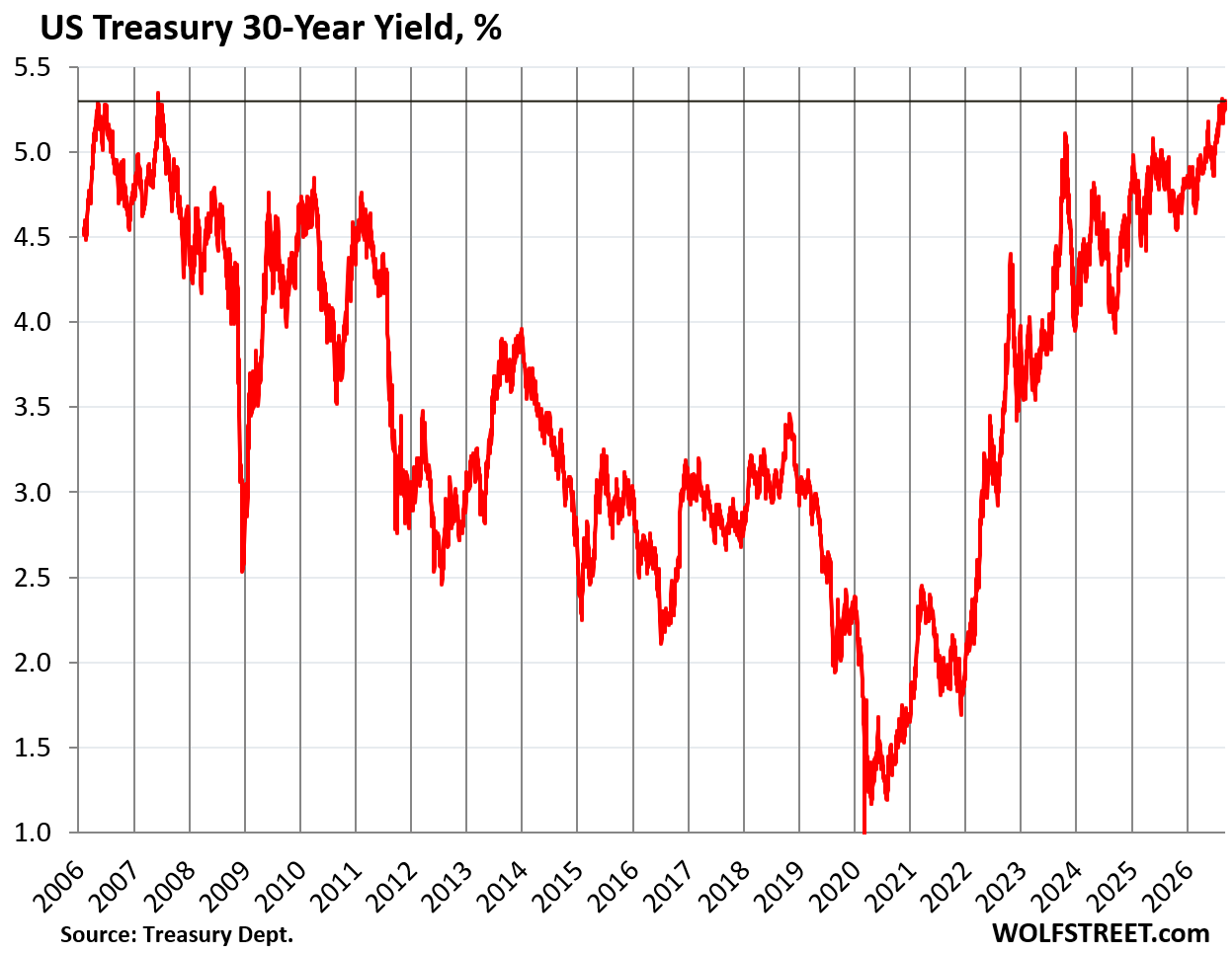
Treasury yields spiked initially upon the announcement, with the 30-year Treasury yield spiking by 5 basis points to 5.31% briefly (matching the prior multi-decade high) and currently trades at 5.30%. The market had hoped for some kind of big-kahuna figure, far bigger than $6 billion, and some had hoped for open-ended buybacks without set limits, etc., and so this was another disappointment for traders in a Treasury market that is troubled by the deep long-term fiscal problems of the US government.
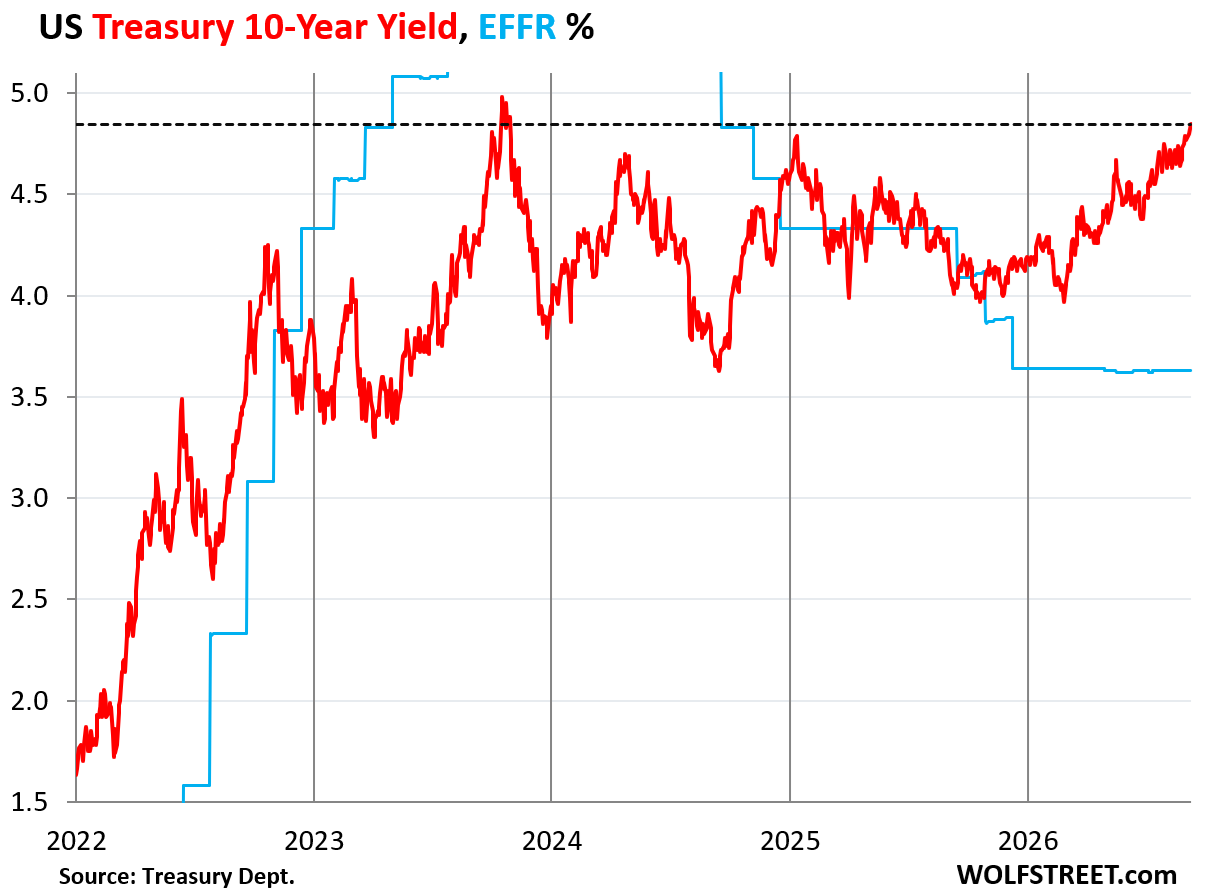
The 10-year yield spiked to 4.85% currently, the highest since that brief period in October 2023 when it kissed the 5% mark.
This announcement came just hours before the 10-year Treasury auction today, and a day before the 30-year auction tomorrow.
The buybacks will likely occur at a substantial discount, as has been the case in the prior auctions of this type of debt, given the lower yields when those bonds were issued.
The Treasury Department has been buying back 30-year bonds that were issued in the second half of 2020 at discounts of over 50%, in effect paying less than half of the face value for those bonds. It also bought back 30-year bonds that were issued in January and February 2021 at discounts of about 47%.
During those buyback auctions, the “par value” of those bonds was $2 billion, but the actual amounts paid for those $2 billion in par value was a lot less.
Same with today’s announcement: The par value of those buybacks is capped at $6 billion at tomorrow’s auction, but the actual amounts paid will be substantially less than $6 billion.

The announcement today lists 40 bond issues, all 20-year and 30-year bonds, maturing between May 2040 and August 2046.
For example, at the top of the list is a 20-year bond, maturing in May 2040 (CUSIP 912810SR0). So this bond has about 14 more years to run and therefore trades like a 14-year bond. The government issued the bond in May 2020 with a coupon interest of 1.125%.
The yield of this bond, trading like a 14-year bond, spiked today by 5 basis points to 5.12% currently from 5.07% just before the announcement, meaning that the price fell further, and that the government might buy it back at an even bigger discount.
It already bought back $1.95 billion of par value of this same 20-year bond at the buyback auction on February 10, when yields were a lot lower than today, paying 64 cents on the dollar. So for the $1.95 billion par-value, which covered nearly all of the $2 billion buyback limit that day, it actually paid $1.248 billion.
Given the 5.12% yield now, Treasury may buy back this bond at an even bigger discount at the auction tomorrow.
In terms of the debt: Since Treasury cannot “print money,” eventually every buyback is funded by new issuance of debt. So Treasury is buying back at a massive discount some low-interest-rate debt and replaces it with smaller par amounts of debt with much higher interest rates. This lowers by a tiny bit the total debt outstanding, but the interest payments may end up being a little higher than before.
Treasury is shifting more of its debt to short-term T-bills, and T-bill interest rates, which are unstable long term – they change with the Fed’s policy rates and get high when inflation is high – will replace the fixed interest rates of this cheap long-term debt that it buys back. Just how smart that is long term, who knows. But long-term doesn’t matter at the moment. This is before the mid-terms, and that’s what matters to Bessent perhaps.
But spiking bond yields was not the goal of Bessent’s hocus-pocus show. The goal was to drive down bond yields, and to drive up bond prices. Well, OK then.
Enjoy reading WOLF STREET and want to support it? You can donate. I appreciate it immensely. Click on the mug to find out how:


Bessent’s Bezzle.
We now live in a world that is coming apart at the seams. Oil is going to end both big wars going, because the world wants oil, and cheap.
Our bond market is just another casualty of our deteriorating fiscal and trade situation.
Geopolitics is crushing domestic concerns.
Rearranging the deck chairs on the USS Titanic. The Uniparty is going to solve this by a new/bigger war, or another army of H1B talent. Probably both.
Bezzle-cents blunder!
Bessent’s bezzled bond beating
Where was this outrage when the G was *actually printing money* (under the eminently fraudulent title of “Quantitative Easing”) transferring hundreds of billions/trillions in spending power from everyone on Earth who had hard-earned savings in USD to the US G (who hasn’t balanced a budget in over 50 years).
Again, I’m no fan of the Trump crew but the mind-wiped hypocrisy about the decades of fiscal cancer accumulation that got us to this bleak moment is hard to stomach.
Cas127…agree totally this is a condition created by a chain of bad decisions that reaches all the way back (at least) to August 1971; probably even further.
hAve YoU eVeN SAid THaNk yOu oNCe?
You did notice the huge run-up in interest rates from 2020-2024 on that graph?
Trump strategy is to grow the country out of self-inflicted Congressional irresponsibility over the last 50 years or more. Doubtful it has much impact. 5-6% rate on 30 year bonds is nothing compared to historical peaks. It’s the size of the debt relative to GDP and circling threats to the dollar that are center-of-gravity.
Fiscal irresponsibility by Congress lies at the heart of this. And the ideology that drove much of it – stepping into a divisive area.
When the feces hits the fan, my bet is the anger hits home in very visceral ways at the front doors all these politicians/ideologues.
Here come the smoke and mirrors.
You cannot have a buyback by issuing new debt. This ain’t the Fed.
Just more eyewash that may help his buddies on the Yen carry trade.
Does nothing but spook bond vigilantes.
Time to take the keys away from this group.
Got a currency and real estate speculator running the economy. What could go wrong?
You forgot CryptoCON.
It’s really sad that Bessent is taking Yellen’s bad idea and making it even bigger. It’s looking pretty lame that the Treasury didn’t refinance all their debt when rates were low like practically every homeowner and business owner did a few years ago (me included). Just incompetent and irresponsible. Not to mention both parties spending up our deficit.
But now I have a sneaking suspicion that SNL is going to do a skit with Bessent speaking at a news conference and rapping out “I AM the House” to the music of LL Cool Jay…
The government is essentially refinancing the national mortgage at a HIGHER rate, in order to obtain a short term political objective.
This is like a homeowner refi’ing a circa 2021 mortgage so they could extract equity to pay off the credit card. It does nothing to solve the Amazon shopping addiction or the pay cut they took to work part-time. And once that trick has been played, the US loses the option of playing it again.
It looks very, very desperate. Bessent’s “I am the house” comment reflects an observation I made here several days ago: The objective is to deter traders from shorting treasuries or the USD by throwing a random new risk into the calculation. By causing pain to traders, Bessent interrupts the compounding growth of their bets against treasury duration.
I would not say the swap in a “14 year bond” bought at a big discount is swapping cheap debt for more expensive dept just a trade in the future bet on the direction of short term rates for those 14 years
No. It is trading cheap debt for more expensive debt. The 1.12% that was bought back is going to be financed with short term rates currently at least 3.50% (over 3 times the rate) for the next few months. After just a short while it will be mathematically impossible for the U.S. to somehow pay a less in interest over the next 14 uears unless there are somehow negative interst rates in those 14 years.
Pretzel twisting to try and justify dumb behavior.
How would that even work in reality?
The Fed was about to raise rates.
I’m sure the debt flows in and out over time. Doubtful old Uncle Sam could time the lows with his trusty checkbook in hand!
“So the Treasury department is buying back at a massive discount low-interest-rate debt and replaces it with smaller amounts of debt with much higher interest rates.” …now I get it. Thx!
soon to be known as Bessent’s Fizzle
The words “I am the house now” will come back to haunt him. You can’t display that level of hubris and not have it come back to bite you. Of course, he’ll be fine either way
The 10-year Treasury auction results are in: the government sold $39 billion of 10-year notes at a yield of 4.834%, the highest auction yield since August 2007.
5% here we come?
https://wolfstreet.com/2026/09/05/the-10-year-treasury-yield-over-5-my-thoughts/
Do you think there is any chance that Congress and the President will ever capitulate and propose an actual budget that grows more slowly than actual growth ?
That would be awesome. But right now, the White House is talking in the opposite direction: more tax cuts for asset holders. Maybe some day, the midterms will be over, God willing, and reason can prevail, but I doubt it.
Making the Don a lame duck who’s lost the Senate is going to be bad. He’ll do maximum damage just to prove a point.
“But right now, the White House is talking in the opposite direction: more tax cuts for asset holders.”
The greed knows no bounds. It’s just so gross at this point. As if they haven’t gotten wealthy enough already….
I just saw this. Trump in his speech today, made two promises (whatever that’s wroth, LOL) that would make the deficit much worse, both of them blatant vote-buying schemes:
— $5,000 for each American adult if Republicans remain in control of Congress. That’s like all three Covid stimulus checks packed into one, just to get people to vote for Republicans.
— making the temporary Trump tax cuts permanent.
This comes on top of the earlier idea of indexing capital gains from stocks to inflation (if your stocks rise at the same rate as inflation, there is no capital gain), which is a braindead vote-buying scheme, when you think about it long enough. And auto-seeding the Trump accounts.
Meanwhile, the budget deficit is 6% of GDP, Bessent is trying to sell $1 trillion in new debt every three to five months to fund that deficit, and is going nuts doing that. To calm the market, he already promised “fiscal consolidation” for after the midterms, which runs smack head-on into Trump’s promises.
Wait till the bond market gets wind of Trump’s promises 🤣🎇🎉✨
Buying at 50-60 cents on the dollar and refinancing short term at 4% waiting for inflation to subside? Looking at the debt short term hoping interest rates decline? That seems to be their plan right now.
Wes,
I agree. It’s their plan. I hope they understand why we don’t approve of it.
Not a word spoken about the people/banks forced to sell their bonds at a 50% discount.
I would be upset if it was me.
This not a comment – just wondering where the Treasury gets the money to buy bonds.
By eventually selling more new debt. I explained that in the article in detail.
I just imagined a stoned-out-of-his-mind Spiccoli asking Mr. Hand a question he had just answered a moment before.
Yes 5 percent here we come is my bet !
I have a piddly short term CD locked in until February. Hoping for a much better rate by the maturity date so I can continue saving and gaining interest risk free. My odds are looking pretty good 😊. Time to rachet down the 401k contributions and keep a bit more on the liquid side of the investment equation.
I guess if you are laddering into the 10 year then current yields make some level of sense but to me, wait and see makes a lot more sense. This a new territory for me as an investor.
Yea, and as more treasury buyers get this sense, more and more of them may decide to hold out for 6% instead of 5%, and then 7% instead of 6%.
If the government is not serious about confronting inflation, why would anyone buy a long-duration treasury at any price today?
Bessent can make temporary chart zig zags, but the desperation of him being in this position tells traders higher yields are on the way. It’s running off treasury buyers.
Does anyone else feel like we’re all trapped in a giant, cursed circus tent and being forced to watch this show every day? Currently, in the left ring, we have (or had) the Incredible Disappearing Congress, who went behind a curtain and vanished to the shock and delight of 51% of the audience a couple years ago. In the right ring we have five contortionists, who’s grotesque manipulations of judicial precedent challenge the stomachs of even the most hardened originalists among us. In the center of the center ring, on a podium, with all of the spotlights, poses our ringleader – although today he’s shared one spotlight with the Treasury secretary. Which character do we all think the secretary will be? Maybe the sword-swallower?
“Which character do we all think the secretary will be? Maybe the sword-swallower?”
He is the carnival barker, yelling “get your US treasury bonds and get them now before I crush the yields!”
It’s KevWar I can’t find a role for at the circus. Perhaps he is outside selling tickets, and announcing how great the circus is going to be and how committed the circus is to its 2% goal, and he’s been talking like this for months now, and nobody is impressed. Some wonder if the point of the circus is to pay your money (negative real yields) to hear KevWar talk with confidence.
LOL!!! Love it. Exactly what lever is he going to pull that are going to “crush yields”?
I’ll will gladly take the other side of that trade. There so many rocks and hard places now I’ve lost count.
Where the f&%k is CONgress? Ultimately the “disappearing congress” may have lead to the judicial knee-jerking. I hope people remember it’s really congress that has enabled all this.
Where is congress? We’ll they took an early recess to avoid voting on the Epstein transparency act 2.
Are the dealer/seller identities for the trades at these auctions publicly known? I used a search engine query to poke around the Treasury website but didn’t stumble onto a list. If one exists I’d be curious to browse. Surely realizing a 50% loss on a trade has to pinch somebody’s bonus. Maybe they’ll make it up in volume.
“Surely realizing a 50% loss on a trade has to pinch somebody’s bonus. Maybe they’ll make it up in volume.”
It’s called churning the IRAs of the sheeple. I’d like to know the relationship between Insurance companies buying up long term bonds at 1% or less then seeing the same industry skyrocket their premiums under the cloud of AGW the very next year. Is regulating Insurance companies any part of the FED mandate?
Thats a great question. Most have to be very big players, like nations, so I can’t imagine anonymity is protected here. You can see break downs of which nations own how much, but I dunno about the other players.
Not necessarily. For the seller the question is: do you want 50% of your money back now, or do you want 100% of your money to remain locked in for another 14 years at a 1.5% yield while inflation is 7+% per year?
The sellers see the yields rising further, making today a better day to sell than tomorrow. They see inflation and think: hm that doesn’t look transitory to me, and they cover their losses while they can.
If you think corporations are going to hold people accountable that bought bonds years and years ago, I have bad news for you.
All well put. I get it.
But now you’re going to tell me there’s no Santa Claus or Easter Bunny after stealing the last of my delusions that there’s a universe where incentives can be properly aligned with outcomes.
Hahaha, sorry for stating the obvious. I’d like to make a joke now about how we never tried real capitalism but I’m too afraid a lot of folks will take it serious.
The M2 money supply was 300 billion in 1960 the M2 in 26 trillion today. This really says it all. Inflation, inflation, ad nauseum.
This says nearly nothing and is a perfect example of how you can mislead just by using big numbers.
You say that M2 is about 90 times bigger today than in 1960. The economy is about 64 times as big as it was in 1960. To put it a different way, in 1960 M2 was about 56% of GDP. Today it is 70%.
There’s no obvious correlation between M2/GDP and inflation; M2/GDP stayed within a narrow range of 50-60% of GDP during the high inflation 1975-1985 period. Then it rose from 50% in 2006 to 70% in 2017, during a very low inflation period. It spiked at 85% in 2021 and has been dropping ever since.
I know, I’m wasting my breath. No amount of telling people that monetarism and M2 supply have nothing to do with inflation will ever convince them. But I try.
There is no correlation between M2 (the stock of aggregate outstanding legal tender) and inflation (the rate of change of the price level) – but there is a 100% correlation between M2 and the price level. M2 drives the price level with long and variable lags because employment contracts and purchase agreements take time to reprice. The fact that the ratio of M2 to GDP changes little and stays within a narrow range is proof of the correlation between M2 and the price level (AKA the GDP deflator). The idea that the stock of outstanding legal tender (M2) could double, triple, or increase tenfold, and the price level could remain unchanged is a mistake – an illusion caused by the difference in timeframes between how little time it takes for liquidity to be injected into the economy, and how very long it takes for nominal GDP, the GDP deflator, and the rice level to adjust accordingly.
5% ten year seems like a return to normalcy.
Nothing to see here folks!
The hubris is simply staggering. The bond “market” is going to take the poofter to the woodshed, but hey, maybe that’s his thing.
Regardless, the fact that he failed as a hedge fund manager should tell you everything you need to know. This administration is destroying the American economy and insider trading on their own incompetence. As the saying goes;”Full Faith and confidence…”
No rule of law and no trust means yields are going higher, inflation is going much, much higher.
Hedge Accordingly.
Hedging is the problem when events are manipulated by dishonest powerful entities.
Not really. If you don’t like a particular set of people, then do not play the game they are playing. Make your own way with your own people. Nothing in this life of real value comes without hard work and risk. No one is getting out alive so make hay while the sun is shining.
Maybe hedge against a fall in the US dollar then?
Ray Dalio is looking more correct by the moment.
Wealth flees corruption. Always has.
Yes, capital and talent ALWAYS go where they are respected. Same as it ever was…
I have been doing well with some Brazilian and South Korean companies lately, will take profits and add to dry powder until I see what the Fed does. May start adding to the commodity positions, we’ll see.
The fundamental problem is this no longer “investing” in the traditional sense, and that is the problem.
Regardless. Place you bets!
Excited to see the ratio of sellers to the Fed buying that slug of 6B. Over subscribed in a big way is my guess with dealers trying to sell UST bonds.
Interventionists never learn.
Interventionists have no skin in the game. Taxpayers do.
Interesting concept of taxpayers and skin in the game. Honestly, it could be said; taxpayers have been on a tax holiday for a long time. We overspend and underpay, the outcome is high equity prices high wealth and raging deficits blowing out yields and a debt hangover . Growth hasn’t been able to catch up to lower the budget deficit since before the dot com bubble bursted, even than it was only a year or two that it lasted. Not many people talk about a solution instead we focus on kicking the can down the road. They tell us we will grow our way out of the problem, as a nation our kids are not interested in having kids, it’s going to be a challenge for them.
Can you save a falling-down condemned building with silly putty patches? Scotty is trying.
Scripted Reality institutionally designed…debt conundrums and mathematical limits in a debt based system…no feedback correction loop for bad behavior by the Plutocracy…it turns out the design could always be gamed, just needed the right pirates to do it…250 not bad, 300, that’s funny 🤣…
“It’s an eminence front, it’s a put on
It’s a put on, it’s a put on, it’s a put on”
Band: “The Who;” Song: “Eminence Front,” 1982.
Most people, the herd tribe never had an original thought their entire lives
..the church did it with a monopoly on language and entertainment on sundays…they just copied their operating system with a new product verses salvation and only they had the key with the monarchs hammers…tc.
“Come and join the party dressed to kill….”
Wow, that dusted off some cobwebs. Nicely played.
With Warsh not providing forward guidance, hopefully the risk premium will widen bond yield spreads. The best thing that could ever happen to the housing market right now is for mortgage rates to go over 8%, and stay there for at least several years.
I mean that’s the whole point right? The era of jawboning is over, so the bond market is free to do as it wishes.
Not unrealistic since neither the Fed nor Congress are taking inflation seriously.
Interest rates respond to influences other than inflation rates, either current or expected (there is a demand side factor (government deficit financing) operating in the loan funds market as well as a supply side factor — inflation expectations).
Inflation causes lenders as a group, to reduce the volume of loan funds offered in the markets and refuse to loan any particular volume of funds (except at higher rates that will compensate for the expected rates of inflation).
The inflationary impact on the supply side is the most important, since it literally establishes the minimum for long-term rates.
At the same time the supply of loan-funds is decreasing, the demand for loan funds is expected to rise as a consequence of the expected massive increases in federal deficits (for savings), (the larger the deficit, the greater the demand).
The deficit financing impacts on the supply side (as well as the demand side) are pushing interest rates up. With supply decreasing and demand increasing (in the schedule sense), there is only one way for interest rates to go – up.
Can you say, “crowding out”?
I think most concerning thing to me is the govt spending is going on with full employment and a strong-is economy. If we get a recession and they need to stimulate the economy what rate will that debt be at?
Lets take away the deficit spending and see how strong the economy is.
The answer is, not very.
Take away the deficit spending at 6% of GDP and +2% GDP growth goes away quickly.
MW: The bull market’s biggest enemy right now could be Bessent’s interventions
Wolf – seriously question – First it was $2 Billion, then $4 Billion and now $6 Billion. At what point might it be $100+ Billion? Any time soon?
Also, – you mention tomorrow’s buyback auction. Is it a buy/sell auction, or just a buyback auction?
I thought a traditional auction was to go somewhere and buy something, not to sell something unwanted. 🤔 🫤
1. There are a lot of mechanical limits in the system, and it’s easy to get something wrong and send the $32 trillion bond market into chaos.
2. If they want to buy back $100 billion theoretically, they have to sell $100 billion in new securities to fund the buybacks, plus the $1 trillion in new securities every 3-5 months to fund the deficits. This is getting very risky here.
3. There are two types of auctions: sales auctions, like today’s 10-year note auction; and separate buyback auctions, like tomorrow’s buyback auction. For these buyback auctions, Treasury lists the issues it is willing to buy back by CUSIP number (40 were listed today). Holders of these securities then offer them for sale at the auction at a specific percentage of par that they’re willing to accept, such as at 60% of par for the 20-year bond that I discussed. The government can then buy the securities offered with the biggest discounts, up to $6 billion at par.
MW: Treasury will buy more government bonds than previously announced. The market remains ‘underwhelmed.’
Bessent is striking me as the kind of guy in high school that would ask a girl out, she would laugh at him and he would show up with a box of chocolates the next day to give her as a gift. Then ask if she would go out with him now. Then she would say no, he would come back the next day with a cheap faux gold necklace. Same deal, then the next day beg her again while offering her a 50 dollar kohls giftcard. Repeat ad naseum with random tchotchke crap while half of the school looked onward with pity and the other half laughed.
Hmm. You know he’s gay, right?! But point well taken.
I always thought that suit was a bit expertly tailored.
It seems this administration has one singular goal – to juice already grotesquely inflated and obscene asset prices to levels that would make even the most greedy blush with embarrassment, while talking out of the other side of their mouth about how they are for Main St.
Arguably Main Street (which voted to be in this position over the past 40 years) will be better off with a decade of 4-5% inflation than they would be with a debt crisis and interest rate spiral. You just can’t tell them that upfront because they won’t understand any connection between their voting actions and having to pay the consequences.
Did anybody else notice that the yield curve just re-inverted? It’s an almost invisible move: 3.95/4.06/4.01 at the 3-month/4-month/6-month T-bills. But I’m wondering if it’s just enough to get the perma-bears all triggered to predict the sixth or seventh recession of the last four years.
I’m not seeing that. I’m seeing:
3-MO: 3.92%
4-MO: 4.00%
6-MO: 4.05%
1-YR: 4.18%
Nicely upright and orderly, but higher.
Hmm. Tiny differences, but interesting. I pull mine daily from the Treasury website:
https://home.treasury.gov/resource-center/data-chart-center/interest-rates/TextView?type=daily_treasury_yield_curve&field_tdr_date_value=202609
This what they posted across the maturities for today:
09/09/2026 3.81 3.88 3.93 3.95 4.06 4.01 4.17 4.43 4.49 4.61 4.71 4.83 5.28 5.28
There are a lot of notes at the bottom of the page about curve fitting that I’ve only skimmed so maybe these aren’t sampled from actual trades.
Yes, those are the figures I generally use for my charts. But, but, but…
All bond yield indexes are calculated, and there are different ways of calculating them, producing different results with yields of 1-year and shorter. The issue is the interest payment. T-bills don’t make interest payments; you buy them at a discount and get paid face value, the difference being the interest. Bonds and notes pay interest every six months, with the last payment made simultaneously with the redemption amount. In addition, there are differences in bond land related to using the 360-day year for some things and the 365-day year for other things. So how do you calculate an annual yield out of all this? There are several common methods.
This issue also crops up in the auction results of T-bills where the auction results report gives you two rates at which the T-bills were sold (“high rate” and “investment rate”), and I cite both in the tables in my articles about T-bills.
Publications such as CNBC, MarketWatch, etc. use one method. These are the figures I cited in my comment.
The Treasury Department switched its yield indexes to another method in 2021. The page you linked explains this in the footnotes:
“*Series Break – Treasury updated its methodology for deriving yield curves. On 12/6/2021, Treasury began using a monotone convex spline (MC) method for deriving its official par yield curves and discontinued the use of the quasi-cubic Hermite spline (HS) methodology. All Treasury yield curve rates derived from yield curves that used the HS methodology – prior to implementation of the MC method – remain official. See the Yield Curve Methodology Change Information Sheet for more details.”
And it linked this page with a detailed explanation (fun read, NOT):
https://home.treasury.gov/policy-issues/financing-the-government/yield-curve-methodology-change-information-sheet
In addition, the Treasury Department cuts off sometime in the afternoon (maybe around 3 pm ET), while bonds continue to trade, while CNBC and other publications show the results of continued trading, and there is not cutoff. So there can also be a time difference
At any rate, I would not get distracted by minor differences like that.
Sidebar to Wolf…..I used a generative AI model (ChatGPT) to probe some interest rate matters of interest to me the other day. The response had many graphs – some from FRED and a sizable percentage from your articles!
MW: Dow, S&P 500, Nasdaq trade lower as U.S. oil prices surge to $100 a barrel; Treasury yields climb
Breakfast table at the Warsh’s. “Kevin 4.8% is not enough. OK honey.” Greed is spreading from the stock market to the bond market. Greedy Billionaire.