
Americans hate, hate, hate high gas prices, but they’re less sensitive to them than auto dealers ironically expected.
By Wolf Richter for WOLF STREET.
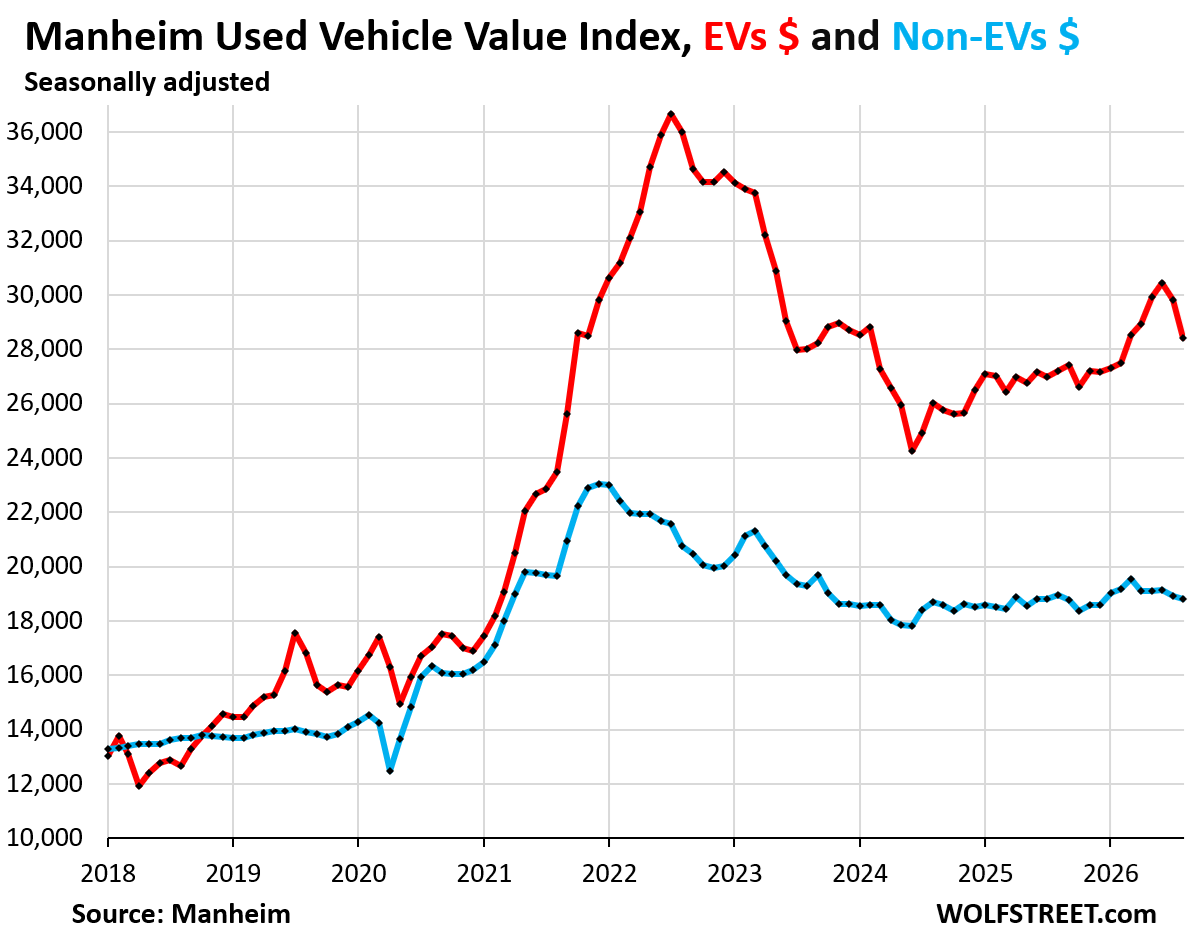
The spike in gasoline prices from February through mid-May did a job on auto dealers, and they piled into wholesale auctions and bid up prices of used EVs, expecting huge retail demand from consumers trying to dodge those high gas prices that were apparently ruining their lives. And prices of used EVs at wholesale auctions spiked by 11.5% seasonally adjusted in February through June, the biggest such spike since the craziness in 2021 and 2022, while prices of non-EVs dipped by 0.3%. EVs are battery-electric vehicles and do not include hybrids (hybrids are in the category of non-EVs along with all other ICE vehicles).
But then in July and August combined, prices of used EVs at wholesale auctions plunged by 6.6% seasonally adjusted, giving up all but the February portion of the five-month spike, as dealers got cold feet (red line in the chart), while prices of non-EVs fell by only 1.7% over those two months (blue line), according to the Manheim Used Value Index today. Manheim, a subsidiary of Cox Automotive, is the largest auto-auction house in the US where dealers go to replenish their inventories of used vehicles.
This is pretty crazy behavior by dealers buying used EVs, while pricing of non-EVs was boringly below normal. It seems dealers were misled by all the moaning and groaning about high gas prices.
Supply at these auctions comes from rental fleets that sell vehicles they pulled out of service, from finance companies that sell their off-lease vehicles and repos, from corporate and government fleets, etc. Dealers buy at these auctions to replenish their inventories.
Beyond the moaning & groaning about gas prices.
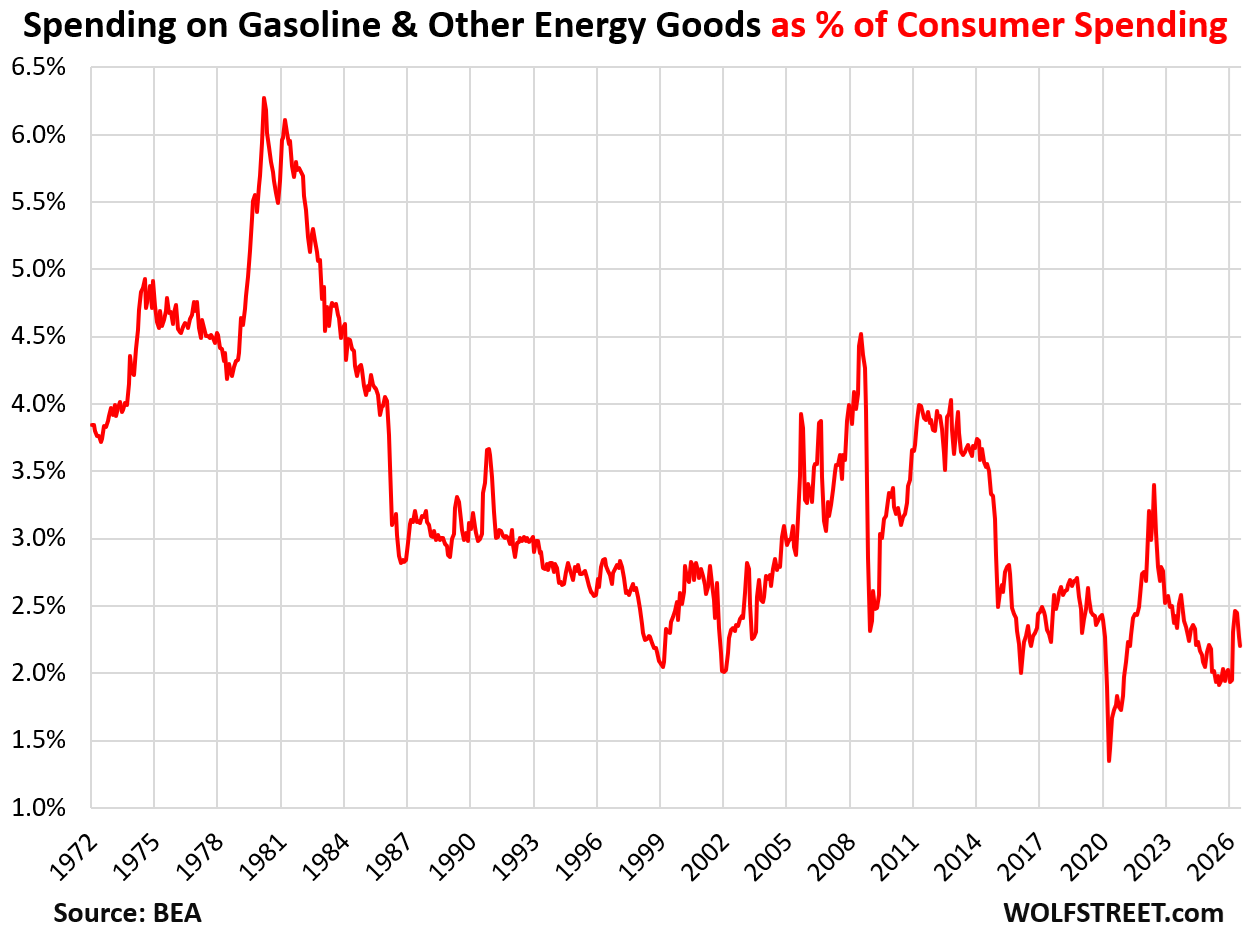
In 1972, just before the 1974 Oil Crisis, about 4% of total consumer spending went to gasoline and other energy goods (utility natural gas, heating oil, etc.). By 1980, spending on gasoline and other energy goods ate up over 6% of total consumer spending.
A lot of things happened since then that reduced the importance of gasoline in the consumer spending basket, including more fuel-efficient vehicles and fewer miles driven per capita, which combined into plunging gasoline consumption per capita, from a high of 42 gallons per month in 1978 to 33 gallons per month in 2025. At the same time, spending on other categories, particularly housing, healthcare, and other services have soared.
And so in the six-month period through January 2026, before the price spike, only 2% of total consumer spending went to gasoline and other energy goods.
Then gasoline prices spiked, and in April 2026 absorbed nearly 2.5% of total consumer spending, before the share began to drop again, and in July was down to 2.2%.
Americans hate, hate, hate higher prices. And higher gasoline prices hit us in the face every time we get gas, and every time we drive by a gas station. It’s just relentless.
But spending on gasoline and other energy goods just doesn’t measure up compared to the soaring amounts we spend on housing, health insurance, other insurance, other services, food, and durable goods.
Gasoline price spikes hurt, they’re in your face every time you drive by a gas station. But economically, they just aren’t what they used to be, so to speak. They weigh much less in the overall spending basket, and so consumers aren’t that much influenced by gas prices when they make long-term spending decisions, such as what vehicle to buy.
Big powerful pickups with lousy fuel economy still rule, regardless of the price of gasoline. And auto dealers, who sit in the middle of selling big powerful pickups with lousy fuel economy that they make lots of money on, thought ironically that Americans would switch in large numbers to used EVs because gasoline prices rose? Overall demand for EVs, just like overall demand for pickups, isn’t driven by gasoline prices, but by Americans wanting to buy what they want to drive.
Enjoy reading WOLF STREET and want to support it? You can donate. I appreciate it immensely. Click on the mug to find out how:


Wolf is right. Oil price increases are not a big deal.
Since ACA, it’s been the medical insurance costs that have made the difference.
I tanked up in Appleton in early Feb 2026 for $2.37 Gal. Today if I wanted to top off the tank it is $3.89.
Retired people on fixed incomes have long memories come November.
In my San Francisco suburb, diesel has recently been retailing for about $8.59 a gallon.
maybe you all living on JUST SSI
who didn’t save and live within ones means
our RV place is made up of 1,000 retirees
who still drive 10mpg diesel trucks
and spend spend spend
many taking cruises and trips to europe and elsewhere
Joedidee.
You cant take with you, do you may as well spend every dime you’ve got, and then some!!!
The trick is to die so deep in debt, the banks will run the day they loaned you money!!!
YMMV….
just don’t tell your spouse, right? 💔
I wouldn’t be caught dead on a cruise.
Exactly how will voting in November lower gas prices?
A new Congress can stop the pointless war in the middle east.
Ending Republican control of Congress and then ending the war in Iran and getting the Strait of Hormuz open would go a long way to lowering prices.
Iran’s nuclear program was supposedly utterly destroyed in 2025 when the US and Israel bombed them, so there should be no concern about a nuclear weapon. Trump is a very trustworthy person, after all, and you can count on him to not lie about important stuff like that, right?
Regardless, the US has 5000 nukes, North Korea has had them for 20 years and its never been a problem for the US, so honestly why does it matter if Iran gets one?
Thats Israel’s problem, not ours. If Trump allegedly cares about America First, then we should not be sacrificing our best weapons, lives of our servicemembers and stoking the fires of inflation at home to fight somebody else’s war.
The problem is that Trump and Hegseth are too arrogant to back down, too incompetent to win against Iran, and don’t actually care about the American people more than their own selfish needs to project strength.
Republicans deserve to lose control of Congress. They have been absolutely derelict in their duties and their failure to check the President on the Iran debacle is just one example.
They are a big deal to shipping fuel costs though (particularly diesel). We’ve started to see some of that show up but it seems like there’s potentially much more to come.
Yes. I wondered about the lack of commentary about the “cascade effect” particularly as diesel seems to be soaring. Perhaps the major trucking and shipping lines hedged their supplies at much lower cost? Wonder what that average would be. Like to see a chart.
They aren’t a big deal to those who are well off. $40-$80 a month is a lot to people living check to check. The people hurting are the poor, the rural working class, and the lower middle class urban commuter. That’s a lot of Americans having to cut back, and they aren’t buying cars that often. It’s not all just whining.
Poor people are always in trouble. It’s tough to be poor, I will never forget it. But the idea is to get out of it, and then you’re not poor anymore.
The median-married couple household income in the US = $120,000. Median means 50% of married couples make more than $120,000 and 50% make less than $120,000.
I may never be rich…
But the goal is to not be dirt poor
Poverty is like a disease that spreads through family generations… until someone breaks the chain.
Agreed… I will never forget.
maybe they ought to try to
LIVE WITHIN THEIR MEANS
get rid of car/truck payments and drive junker
did you really need to go on vacay and rent AIRBNB for $1,000 nite
Money is not important. Only the lack of it.
this seems like a worthless stat without measuring it against the local cost of living dollar amount, i.e. 25% below the poverty line, etc.
So the figure I cited is national median income of a married couple household, so compare that against the national “cost of living dollar amount.”
You can compare the local median income of married couple households to the local “cost of living dollar amount.” You can dig out the figures for each region that you want to look at yourself.
Here is California median income of married couple households: $138,170
It would be nice if they went back to $2.
We could all save more money than paying whomever our extra savings.
So that some oil exec can have a bigger yacht.
It’s actually kind of Moronic to say you’re ok with these higher gas prices. Just saying 🤷🏻♂️
It will never be $2 again, nor should it be. There’s only like 6 countries on earth with gas that cheap and I promise you we don’t want to be one of them
Wolf is right. See the pundits:
Princeton economist Dr. Alan Blinder says that “food shocks and OPEC ii (supply shocks) deserve much more blame for the alarming rise in inflation in 1979-1980.”
WSJ: “When It Comes to Inflation, I’m Still on Team Transitory,” op-ed, Dec. 30, 2021).”
“Alan Blinder wrote that inflation “still looks transitory” but admits “that doesn’t mean it will be over in a month or two”
Who would you rather read?
LOL! If diesel is part of your input costs, it most certainly is a big deal and it is being past on to the consumer. Wolf’s point is that the customer is paying the higher price.
Wolf’s point is that the consumer may or may not pay the higher cost of diesel, even if they’re paying it, the higher diesel costs will only be a minuscule part of the price that consumers are paying. For example:
If there is a $4,000 fuel surcharge for hauling 40,000 pounds of beef in a refrigerated trailer from point A to point B, that’s $0.10 per pound. So for ground beef, which is already $6.99 a pound, the retailer isn’t to tack on the $0.10 to make that price $7.09. Same with steak, which might be $17.99 per pound now, and hitting a ceiling at that price, so the retailer could add $0.10 to it, and get $18.09, and sales will fall further. That’s how it works in real life. Higher costs are hard to pass on for many competitive businesses.
For many expensive items, such as consumer electronics ($800 smartphone, $1,200 laptop, etc.), the fuel surcharge per item just isn’t even a factor, and businesses are just eating that little extra. Their pricing is set by other priorities, such as how to maximize sales without giving up too much gross margin.
This is why inflation that businesses are paying for has been far higher than inflation for consumers, because businesses CANNOT always pass on the higher costs without losing sales, which shows up in PPI, and the inflation rate for the overall economy. The inflation rate for the overall economy (consumers, businesses, and governments), which is part of the quarterly GDP figures, was 6.4% in Q2 annualized and 4.4% in Q2 year-over-year, spiking straight to hell, far higher than the consumer inflation rates:
Yes, inflation can, and will go much higher. Consumer have been paying some of the cost, they will pay more, a lot more.
Gas prices are amazing that way: it’s clear, and your chart proves, that people can easily afford gas prices of double what they are today. But at the same time, no other aspect of inflation pisses people off more than paying an extra $10 at the pump.
It’s Schrodinger’s inflation: it’s trivial in most people’s budgets and it’s the most important thing in their heads.
Not really.
People are plenty pissed off about housing costs (largest expenditure).
But the G has long cultivated the black magic trick of convincing enough naive housing/interest rate speculators (basically anybody with a mortgage but especially those whose rate might reset at some point) that they their interest rate speculation/home price froth works to *their* advantage.
Since about 60%-65% of the US “owns” (an interesting word for a mortgage debtor) and 35%-40% rents, the “democratic math” (so far) is enough to prop up Congress’ long-standing 9% approval rate…
Not sure how that contradicts what I said, but that’s all true.
we now live in rentier economy
I have FIRED so many mils who are LAZY LAZY LAZY
don’t show up, make excuse after excuse
and then expect to get raise next week
and skills – hired 20 year old this week who IS EAGER TO LEARN
and SHOWS UP ON TIME EVERY DAY
It’s called the availability heuristic: the factor that is most visible is judged to be most important, even if it is objectively not. For gas prices, it is not only when you buy, but every time you drive by the big red numbers $5.55/gal (at least as of 10 min ago).
It’s also not surprising when you look at averages: the average person drives 10,000 miles a year in a vehicle that gets 25 mpg, which comes to 400 gallons of gas per year. An increase of $1/gallon, which gets people screaming their heads off, comes to $400/year, or $30/month. The average adult spends $500/month on going out to eat/drink.
Yes, it’s the perception that matters.
As a diesel owner who goes on long trips, this basically sums up my emotions this summer.
Angry? Yes. Politically motivating? A good deal
Actually making me want to change my habits? Eh, a bit tighter eating out budget aint so bad and I already take extra shifts for surprise costs like kiddo #2 on the way.
Life goes on. To much red blood to actually drive an EV ig.
As an American I hope that everyone votes. It is the only demand of democracy, even when you lose.
oh, coming pain is just around corner
please vote for your giver(ie takers vote)
instead of seeing how vibrant our economy is for those willing to W O R K
I’m ready to buy when you lose your home in coming years
called cash
Who are you angry at and what are you politically motivated to do?
I would suggest that your anger should be directed at Iran for their unprovoked attacks on neutral shipping.
As for politics, if you dont like higher gas prices, why would you vote for a party that favors high gas prices as a matter of policy?
My anger is at the Trump administration for starting a pointless war with constantly shifting goals, no plan on how to actually win other than to attempt a decapitation strike(that failed), and then no ability to defend the Strait of Hormuz or negotiate a ceasefire or surrender under favorable terms.
Everyone knew that Iran would close the Strait if attacked. Its their strongest bargaining chip and why every other President was smart enough to not get us into this debacle.
The Strait would be open if Trump didn’t have us attack Iran again, after their nuclear program was allegedly totally destroyed during our attacks last year.
He deserves the blame and Republicans in Congress deserve the blame for doing nothing to check him and stop this pointless war.
I drive a sprinter on road trips. Diesel is now $6.30 in Michigan, 150 bucks to fill up. Contractors, farmers and shippers have to pass that pain on to their clients soon. Diesel is 50% more expensive than unleaded now. I would feel like a victim except I choose a Diesel rig instead of an unleaded rig.
The people who can afford a Mercedes Sprinter van can afford to fill the tank.
I see many $50k vehicles circling food give aways today
lined was out to street with people waving NORMAL traffic by
You’re only poor if you look poor.
Although there are some of us that might look poor that are far from it.
Quite the conundrum.
Bought an EV in March of this year. Didn’t need to, but the local air quality district offered me $10K for my 2004 Acura TL. Since I don’t need to commute (retired), I bought a 2027 Chevy Bolt. It was the cheapest new EV I could find. Used cars make me nervous, but that is my irrational fear. Being in northern CA, electricity prices are exorbitant, so I switched to time-of-use rates and only charge during the lowest rate period at home (midnight to 3PM). The software has frequent updates, but otherwise works reasonably well and there are buttons for most important things rather than putting everything on the touch screen. One luxury I like is that I can pre-cool the cars interior up to an hour before I want to use the car.
Wow, Freddy. You aided a govt agency to take one of the most-reliable, best-built cars in the world off the road forever. Smooth move.
Hope your Bolt serves you as well.
–Geezer
I took a 2004 reliable car out forever too, not without regrets for the sheer waste, for similar incentives. And now the maintenance will be far less on a very, very quiet AWD that accelerates smoothly and doesn’t pump nearly as many fumes into the cabin.
EV batteries are not a perfect solution, but the ride is smooth. Some people prefer noisy diesel trains too, and old-fashioned wood stoves that tank interior air quality.
And non-electric manual toilet seats that don’t do anything but go up and down…
make sure your insurance covers fires from lithium batteries
Make sure your insurance covers fires from gasoline, wiring problems, etc.
There are lots of “park outside” fire recalls active currently for vehicles with internal combustion engines, including for 2021-2025 Jeep Wrangler, Wrangler 4xe, and Gladiator due to power-steering-pump wiring overheating, with fires having occurred even when vehicle is parked and turned off.
Recession is primarily caused by high energy costs on consumers. This moment may or may not end, either way it won’t end well.
It’s been a Loooooong time since a recession was caused by high energy prices.
The 2001 recession was caused by the Dotcom Bust during which stocks plunged (S&P 500 -50%, Nasdaq -78%), companies shut down left and right, and others tightened their belts, and massive layoffs spread across tech.
The Dec 2007 to Jun 2009 recession was caused by the collapse of the housing market that triggered the mortgage crisis which triggered the financial crisis and massive layoffs.
The Feb-Apr 2020 recession was caused by the lockdown in response to covid (energy prices collapsed, WTI futures went below zero famously).
I work in commodities. It’s the pits. You get screamed at when prices move 1%, but no one bats an eye at a $1200 new iPhone, or us spending 18% of GDP on health care.
Oh well. Thems the brakes.
Evan…
I agree…
I have had people complain to me that they would not buy certain things like beef, eggs or milk because the price went up…. While the are holding a $1200 iphone and driving the newest escalade. Peoples priorities definitely perplex me.
The brakes can be described more correctly as ” the breaks” I think.
The catosttrophic failure of a mechanical contraption as opposed to the frailty of human failure
And “catosttrophic” more correctly “catastrophic”? 😉
Diesel fuel is now over $8 per gallon in Southern California this week.
Diesel is a consumer problem in Europe where in many countries most ICE passenger vehicles are diesels.
In terms of cargo in the US, spreading the extra cost of diesel across a 40,000-pound load of groceries makes less of a difference when you’re already paying $6 a pound for ground beef or $17 per pound for steak, of $5 for 48 oz of OJ with pulp.
I secretly would love a 6 month stretch of 20 plus a gallon.
Would be nice to drive on semi empty streets.
Do you mean semi-empty (like COVID) or empty of semis?
As usual, after the numbers/data surface the real thing making most people angry is the NOISE about the issue more than the issue itself and that noise is political and coming mostly from the media carrying the water for Democrats leading into the midterms. If you hear their noise – most Americans are starving – standing in bread lines to eat and waiting in gas lines like its the 1970s… Few dig into the facts of the matter, any matter – Just hearing the drip drip drip of the doomers-loop every day.
Carry On…
Cultists have a long history of projection.
What were your thoughts back in 2021 when Fox News had all of its viewers putting “I did that” Biden stickers on gas pumps? I would bet a lot of money you were singing a different tune.
Carry on….
Too true
I gauge the tourism by the local monthly First Friday here in my little Hawaiian village. Last Friday was ridiculous. Like a FF pre Covid. Mobs of tourists. Tourists are blowing wads of digital dollars…trying to melt plastic.
The funny money gets funnier by the day… Why not spend now because it’s only going to get more costly for everything?
I’m doing a town run tomorrow, 50 miles each way. Have to, dentist, notary etc etc blah blah. 8 programmed stops. With high gas prices we never just do one or two stops in our house. And with the latest strikes going on just now, more missiles fired and sunk tankers this aft, good time to fill up, too. Brent will be over $100 tomorrow and climbing. It won’t get any better with the election looming, either. Oil and products are a global commodity and will be shipped/sold to the highest paying market possible. That price will be reflected everywhere and is why the majors are making obscene profits. Furthermore, while it might not be too bad in NA for now, in Asia prices and availability is a crisis. It will affect many markets in this connected world.
If people drive as usual that bodes well for increasing gas taxes to save the highway trust fund.
Something has changed in the past 4 weeks. I have noticed a distinct chill settling in over the local economy, at least in my haunts. This is not the normal back to school, summer’s over thing. I remember the last housing bust, how suddenly things started drying up. I’m starting to get that vibe again.
The Apple event was packed to the gills, and many people I know are fully expecting to fork over $2k Scrooges for the new foldable iPhone. Your anecdotes differ from mine.
Not to mention the jobs report indicating the economy is firing on all turbocharged cylinders.
I’ve noticed the same thing.
I live in SOCAL which is normally the land of excess and lots of money. The housing market seems completely dead with homes just sitting. Lots of people aren’t doing what they normally do which is spend obscene amounts of money and brag about it all over social media.
We’ll see how this turns out. I expect people to start complaining more if rates get hiked at the next fed meeting.
You know the war will be getting close to resolved if the US bans the export of diesel. fwih the US diesel exports are desperately needed/used by Europe.
Economy functioning fine for the asset holders but the non-asset holders are probably fed up living like slaves.
Unlike the situation in the 1970s, the US is now a net exporter of petroleum. Thus a rise in oil prices today does not cause a flood of petrodollars leaving the country as in the 1970s. This is why there has not been and will not be a recession due to Iranian threats to mideast oil supplies.
I wouldbe curious to see an analysis of why we are having record high diesel prices at a time when oil prices are nowhere near a record high…
Mainly bc the medium sour and other heavier grades that the middle east produces are not getting out and to refineries.
+China banned diesel exports along with Russia.
US SPR only has about 20M barrels left of medium sour. US is still exporting diesel. That could change soon.
Canadian crude is what the US refiners are setup for now. 25% of CAD oil produces about 25-30% of US diesel. Technically refiners can pivot to using Venezuela crude with some tweaks as well but the VZ crude is mainly going to India to be refined.
Major issue is refiners are running at 100% almost everywhere and NOW is the time for maintenance.
Everything is being run very tight.
Hurricanes could really F* things up.
Last time I ran the numbers, gasoline accounted for less than 1.5% of my annual spending. Prices could triple or quadruple and not really affect my behavior.
I’m curious to know other people’s percentages. Surely we aren’t talking about the financial burden of motor fuel if we don’t even know how much we are spending.
I’ll play, but my data should be thrown out as an outlier.
$4/gallon gasoline works out to about 20% of my annual fixed expenses. Small denominator so large percentage. I drive less than the average American by a good margin too.
High prices do get me on the bike and motorbike more which is good for the mental and physical health.
20%!!! Do you drive for a living?
Fixed expenses are only about $5000 annually. 7500 miles a year at 28 mpg @ $4.00 a gallon is $1071 a year/5000 = 21.42%.
Yes, I am an outlier, haha.
If Slate proves to be a viable option when my Tacoma rusts out completely in another 5 years I could see going that direction.
0% because I drive an EV. Including EV charging costs, it’s 0.4%.
Gen Z Overtakes the MarketYounger demographics now dominate online gambling apps and prediction markets:The Largest Share: Gen Z has officially overtaken Millennials as the largest age bracket in online betting, accounting for 48% of all online wagering activity. Combined, Gen Z and Millennials make up 88% of the entire market volume. A pack of cigarettes cost $10.50 in Colorado. Vape pens run $15-$70. Americans always figure out a way to shit money down the drain where bad habits or to much automobile credit/debt. The EV is just buying Tesla solar panel for your home, how long before break even on the ROI. Mud tires and 6 inch lift kits, $70-$120K picks up the driveway says I made in America.
Part of the issue is that the oil market was talked down, and we opted to drain the reserves for a self-own foreign policy decision. It is not surprising that consumers would not change behavior based on the fuel source on a long term purchase, when if “things went back to normal” the world would likely have an oil glut.
Ironically, Biden was the biggest benefactor the gas industry in the USA by taking Russia’s market share in Europe, while Trump was the biggest benefactor to the Chinese EV and solar companies through their respective foreign policies.
It makes no sense to pay the EV premium when you won’t recoup the premium over an ICE vehicle during the lifetime of your ownership. Especially for those who can’t charge at home
Electric motors are far superior to internal combustion engines (nearly flat torque curve, quiet, instant power without revving up, regenerative braking, etc.). Drive an EV you’ll see the difference. That’s why people buy EVs, not the gas savings, though the gas savings can be significant where and when gas prices are high.
Historical psychiatrists and psychologist will have a field day analyzing the comments section of Wolf’s blogs. This should be a new source for the consumer sentiment statistic, lol.