
The job creation machine is running backwards in some industries and forward in others.
By Wolf Richter for WOLF STREET.
Structural changes spread across the US economy over time. AI is the big disruptor now, after the internet and the computerization-of-everything shook up the economy for decades. Automation-of-everything has been a force, now more so than ever. And some of those changes show up in shifts of employment.
The jobs in each industry are defined by work location. The primary activity at that facility determines the industry category. A worker at an Amazon fulfillment center would be under “transportation and warehousing,” not “retail” and not “information.” It’s not the company that matters, but the work being done at that specific location. The data through August was released by the Bureau of Labor Statistics on Friday, based on its survey of employers. Our discussion of the overall employment data is here.
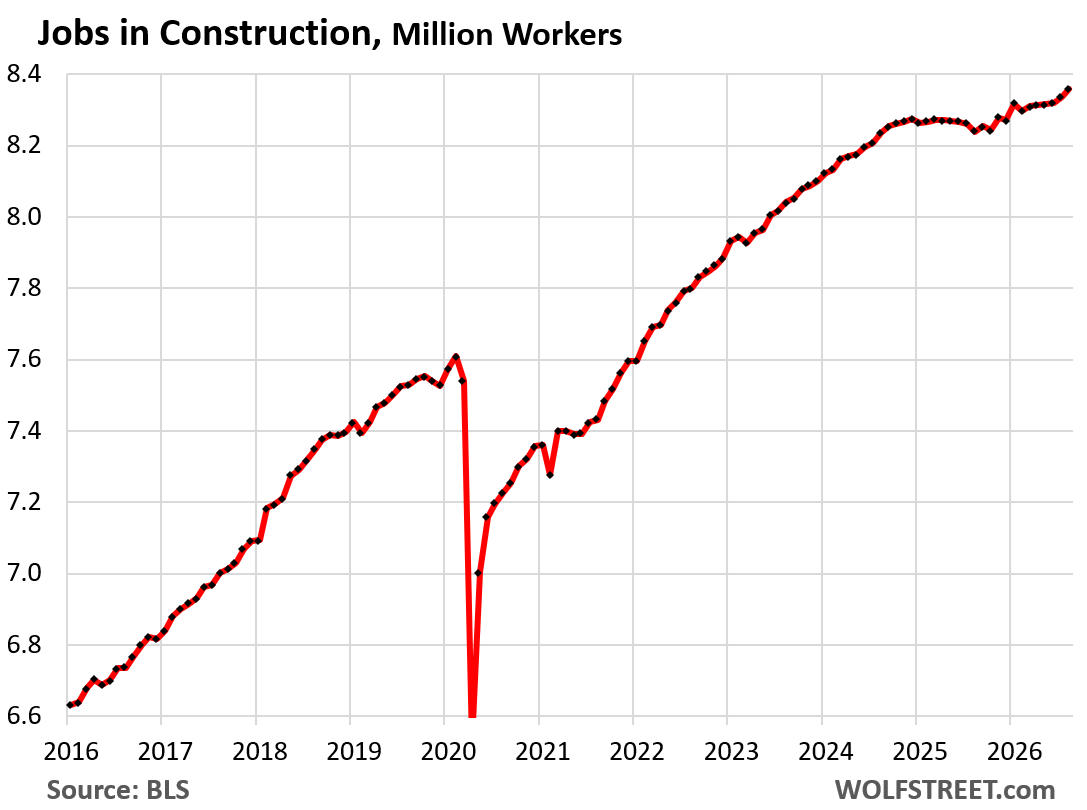
Employment in construction spans all types, from single-family housing and highways to power plants and AI data centers, now spouting like mushrooms. Construction of housing has run into a sharp decline of demand for single-family homes and overbuilding of multi-family units (apartments and condos) during the pandemic that are now flooding the market. The office sector has been in a depression. But construction in other sectors has been strong, and construction of data centers, factories, and power plants has been booming amid complaints of shortages of skilled labor.
- Total employment: 8.36 million
- Month-to-month: +22,000
- 3-month growth: +43,000
- 12-month growth: +120,000
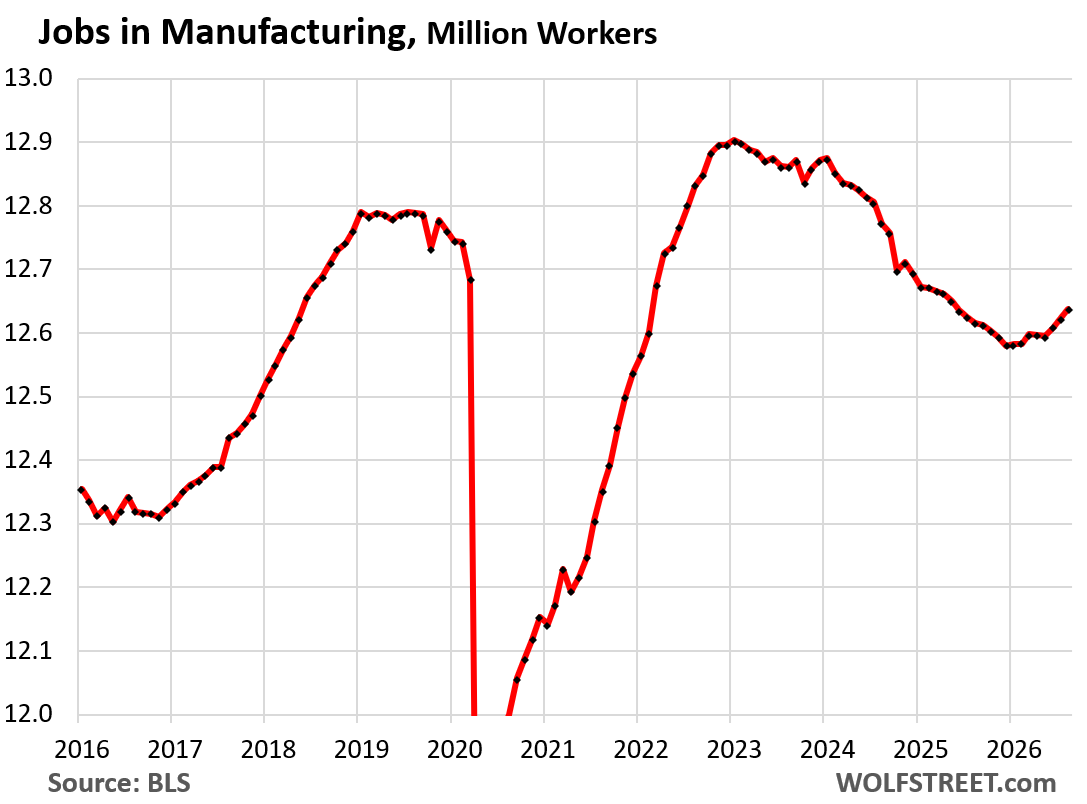
Manufacturing in the US is powered by automation. All manufacturers have been investing huge amounts of money in automation to reduce the costs and issues associated with human labor in the US. The manufacturing jobs that are left today tend to require high skills, often degrees, and include tech jobs.
Manufacturing production has been in expansion mode, and automation has been driving it – not employment of humans. Nevertheless, this year, more human labor has been getting put to work.
- Total employment: 12.6 million
- Month-to-month: +16,000
- 3-month growth: +43,000
- 12-month growth: +23,000
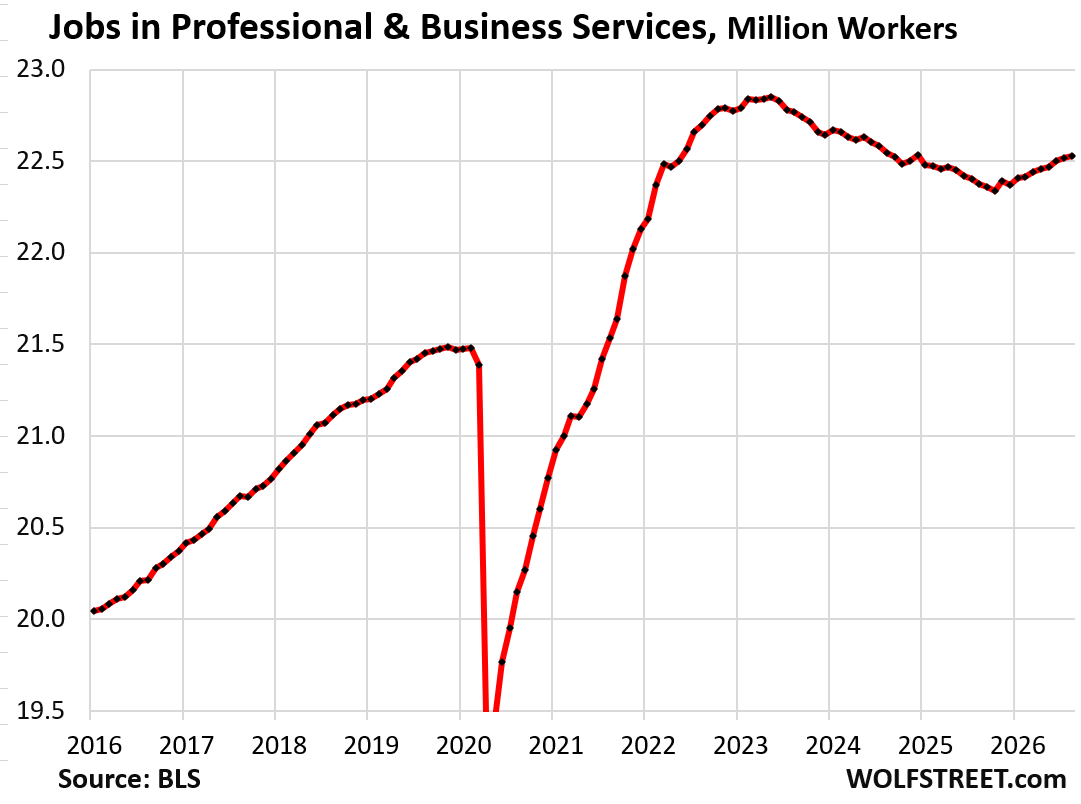
Professional and business services is a broad category that includes facilities whose employees work primarily in Professional, Scientific, and Technical Services; Management of Companies and Enterprises; Administrative and Support, and Waste Management and Remediation Services.
It includes jobs in tech and social media. And it includes government contractors that lost their contracts with the federal government in 2025.
The increasing use of AI has been held responsible for some job losses in this industry, but it has also been held responsible for quite a bit of hiring as companies are trying to deal with it and benefit from it.
The explosion of employment in 2021 and 2022 turned out to be widely acknowledged over-hiring that companies then unwound. The low point was in October 2024.
- Total employment: 22.5 million
- Month-to-month: +10,000
- 3-month growth: +62,000
- 12-month growth: +152,000
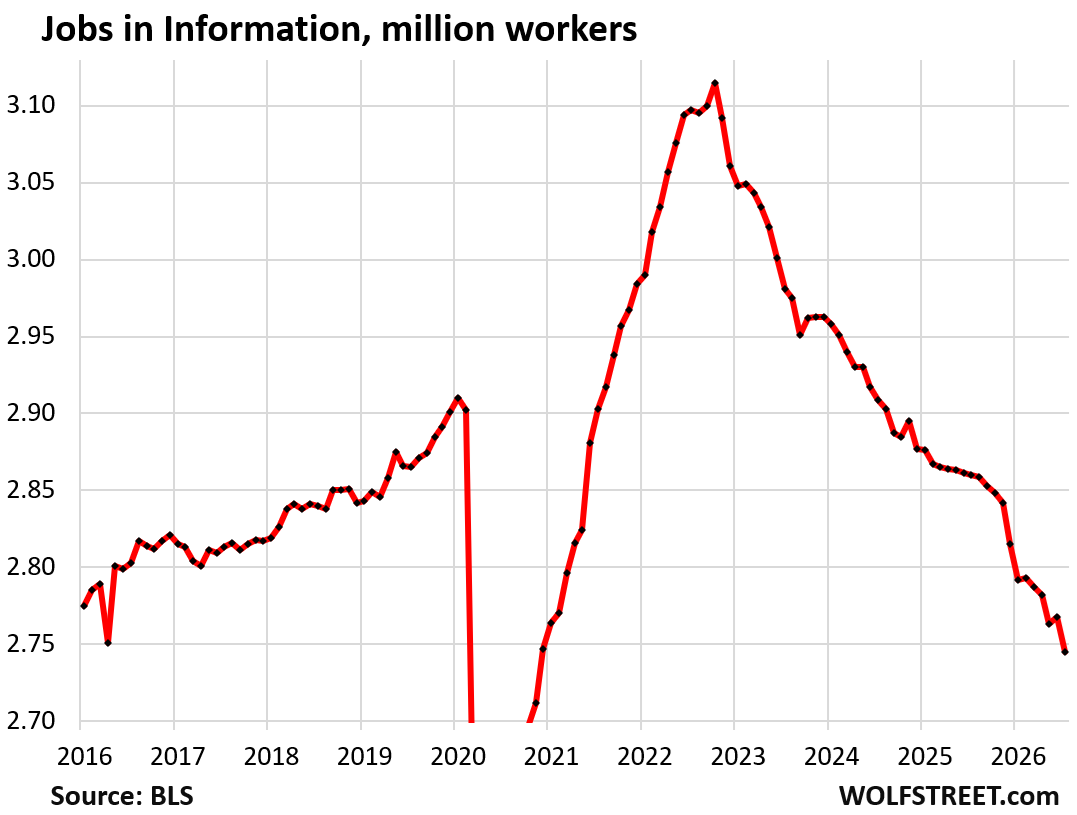
“Information” is a small category that includes facilities where people primarily work on web search portals, data processing, data transmission, information services, software publishing, motion picture and sound recording, broadcasting including over the Internet, and telecommunications.
AI has had a profound impact in many of these activities for several years and is doing some real damage to human labor, including in the video and motion-picture industry, and in software publishing, where AI has taken over a lot of skilled human labor.
The tech and social media companies in that segment also had the issue of over-hiring during the pandemic, and they have admitted it, and they have reversed course.
Employment in this industry has fallen to the lowest level since 2015.
- Total employment: 2.7 million
- Month-to-month: -23,000
- 3-month growth: -37,000
- 12-month growth: -115,000
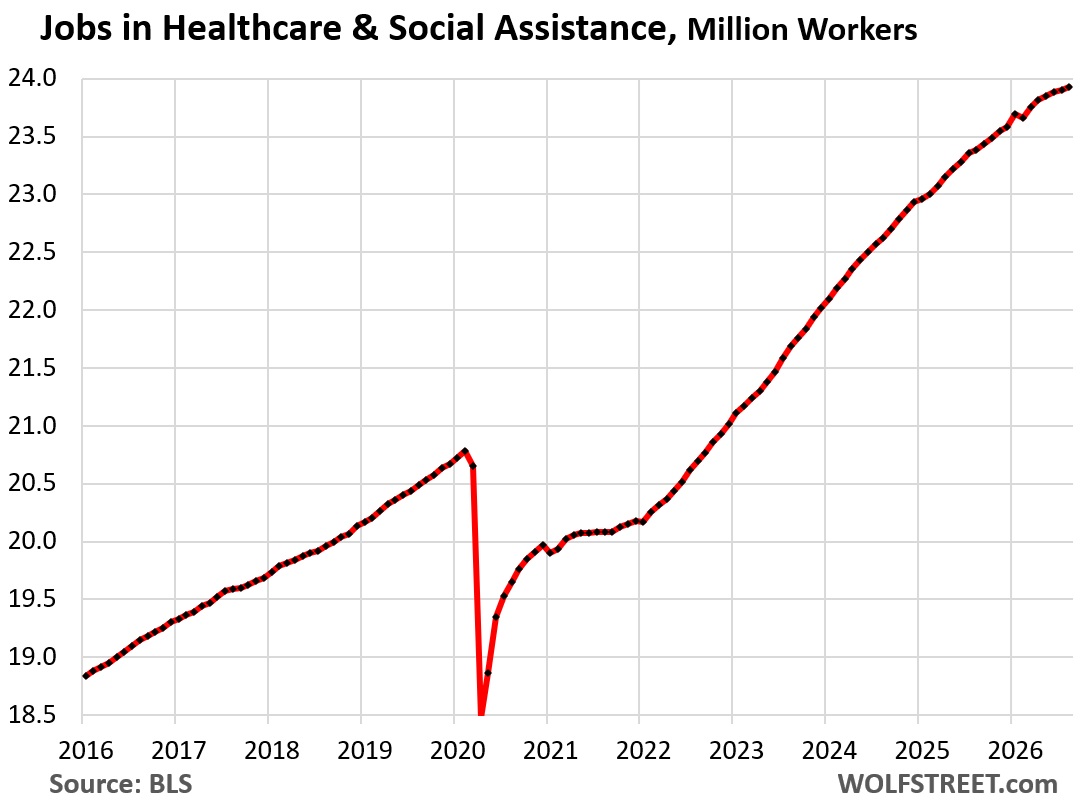
Healthcare and social assistance:
- Total employment: 23.9 million
- Month-to-month: +28,000
- 3-month growth: +80,000
- 12-month growth: 546,000

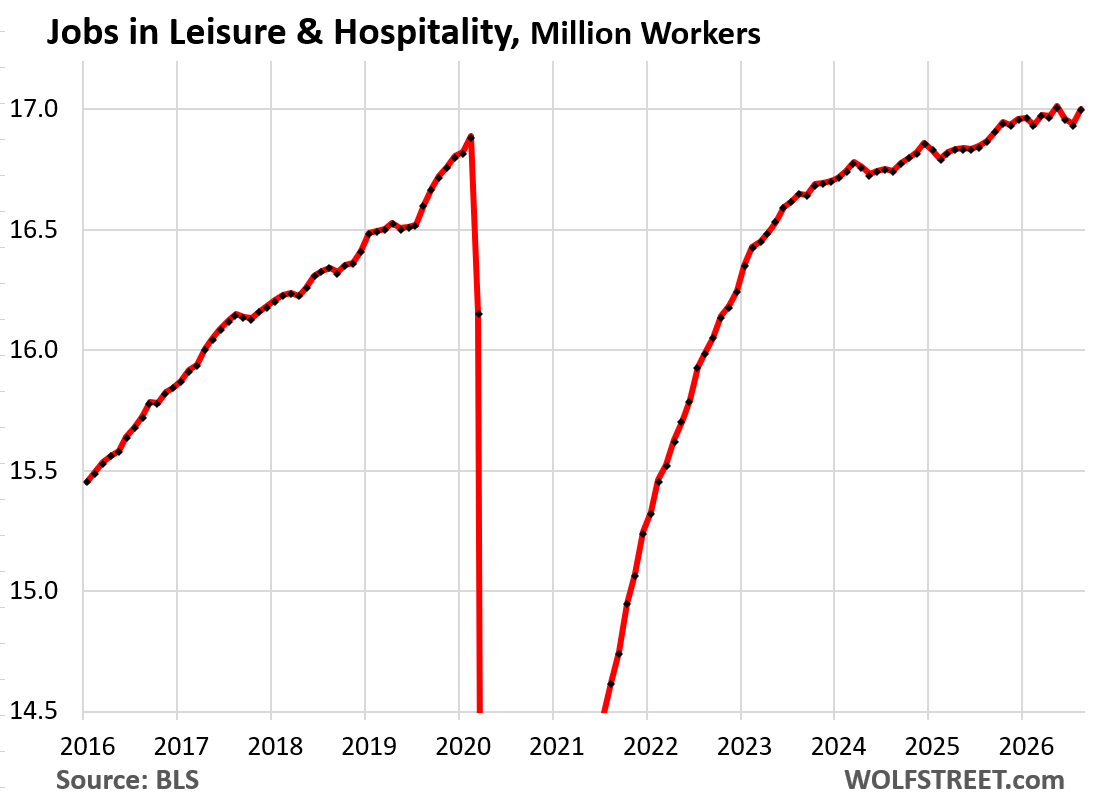
Leisure and hospitality includes restaurants, bars, lodging, resorts, casinos, etc. In August, employment jumped, after two months in a row of steep declines that followed big increases. Some of this may be related to the World Cup and its aftermath.
- Total employment: 17.0 million
- Month-to-month: +62,000
- 3-month growth: -13,000
- 12-month growth: 131,000
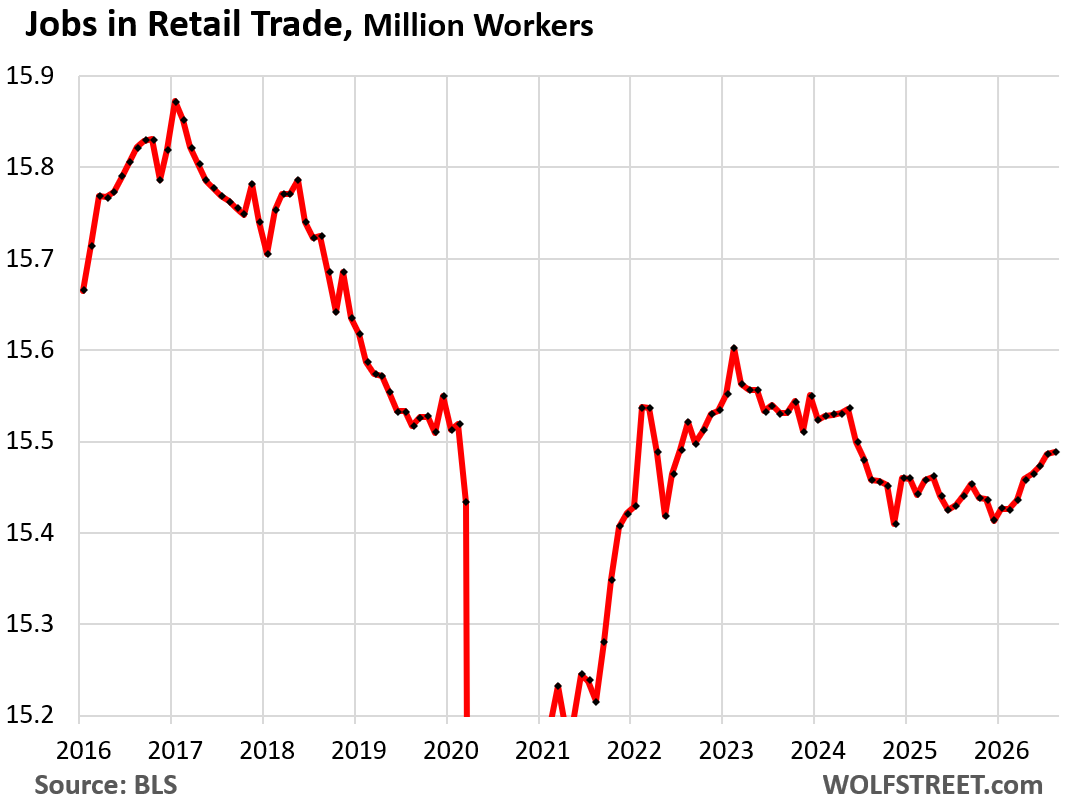
Retail trade includes workers at brick-and-mortar retail stores, such as malls, auto dealers, grocery stores, gas stations, etc., and other retail locations such as markets. It does not include the tech-related jobs of ecommerce operations, drivers, and warehouse employees.
A big portion of this sector has been under pressure from ecommerce. Dozens of major retailers have been liquidated in bankruptcy court, some of which we’ve documented since 2016 in our Brick-and-Mortar Meltdown series. Innumerable malls have turned into zombie malls. Many of them were bulldozed and redeveloped into housing. The long-term decline in employment began in 2017.
The brick-and-mortar retailers that are still doing well are those that are selling groceries, motor vehicles, gasoline, and cannabis products.
Nevertheless, so far this year, brick-and-mortar retailers added jobs.
- Total employment: 14.5 million
- Month-to-month: +1,400
- 3-month growth: +24,200
- 12-month growth: 47,900.
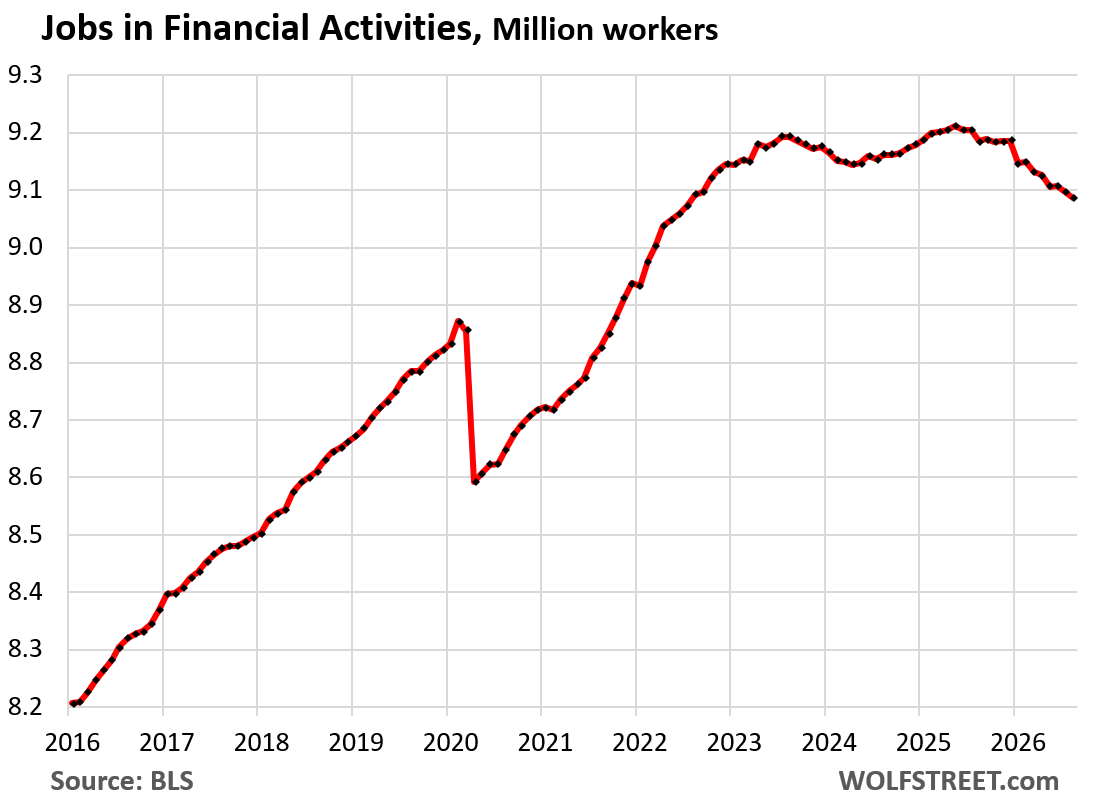
Financial activities include finance and insurance plus real estate renting, leasing, buying, selling, and management.
The damage here is largely in real estate related activities, including real estate brokering and mortgage lending, amid a massive four-year-long downturn in home sales, a plunge in purchase-mortgage originations, a collapse in refinance-mortgage originations, and a depression in the office sector and some other parts of commercial real estate.
- Total employment: 9.1 million
- Month-to-month: -11,400
- 3-month growth: -20,200
- 12-month growth: -99,000.
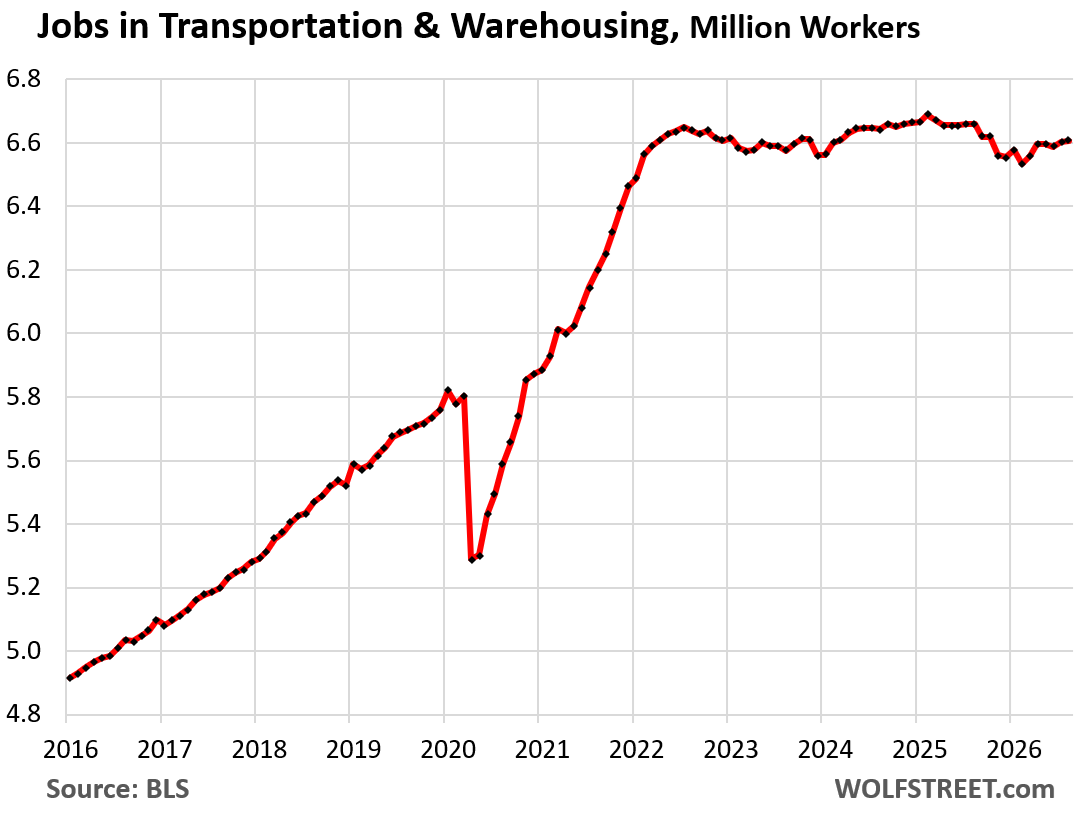
Transportation and Warehousing:
- Total employment: 6.6 million
- Month-to-month: +5,000
- 3-month growth: +8,500
- 12-month growth: -51,500.
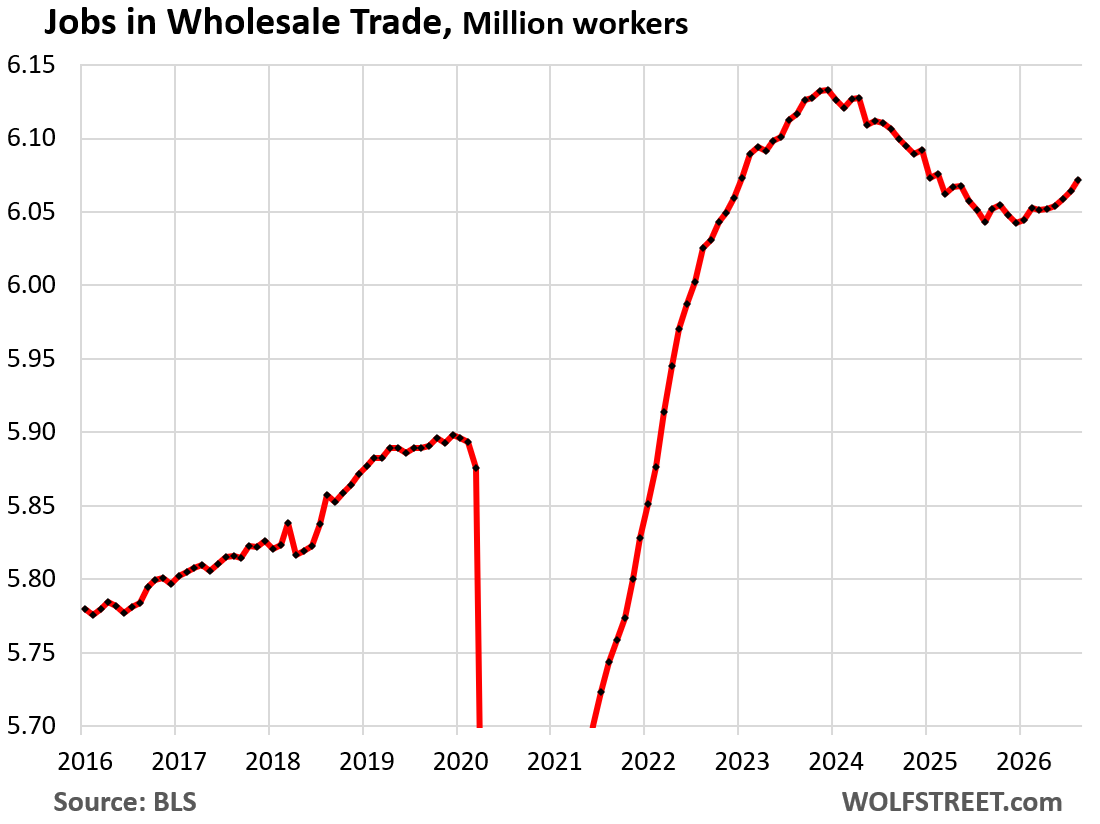
Wholesale Trade:
- Total employment: 6.1 million
- Month-to-month: +7,800
- 3-month growth: +17,700
- 12-month growth: +29,100.
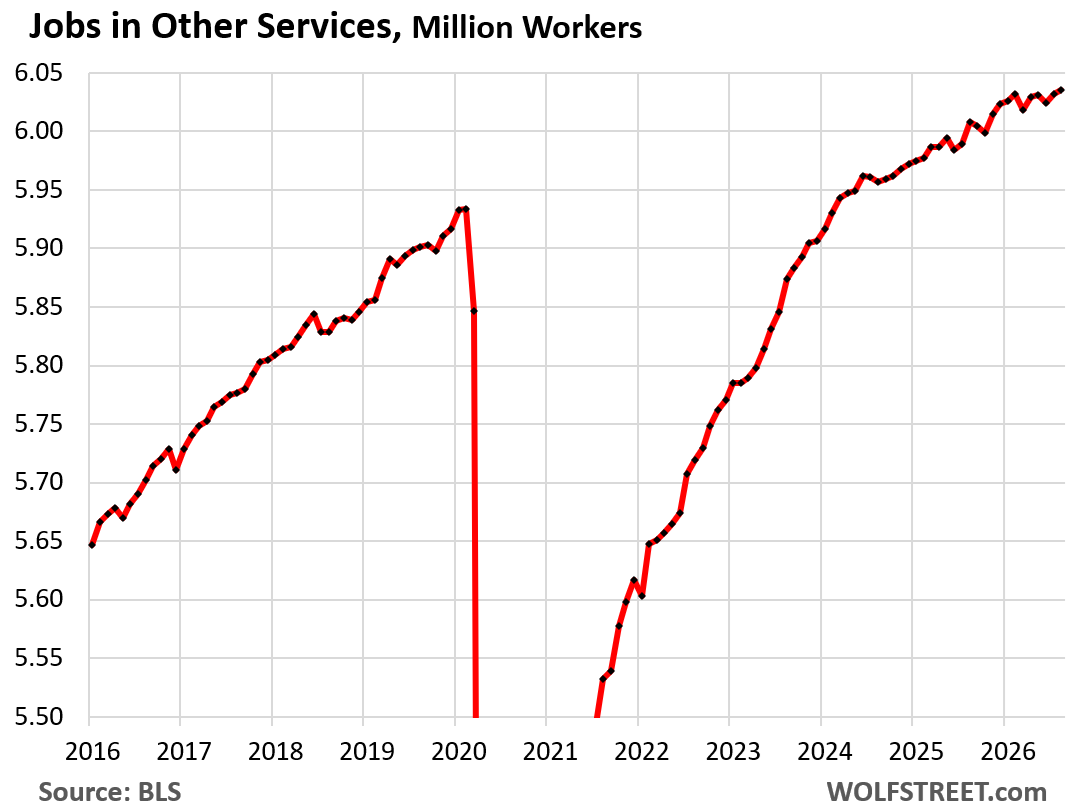
“Other services” include equipment and machinery repairing; promoting or administering religious activities; grantmaking; advocacy; dry-cleaning and laundry services; personal care services; death care services; pet care services; temporary parking services; and dating services.
- Total employment: 6.0 million
- Month-to-month: +3,000
- 3-month growth: +4,000
- 12-month growth: +27,000.
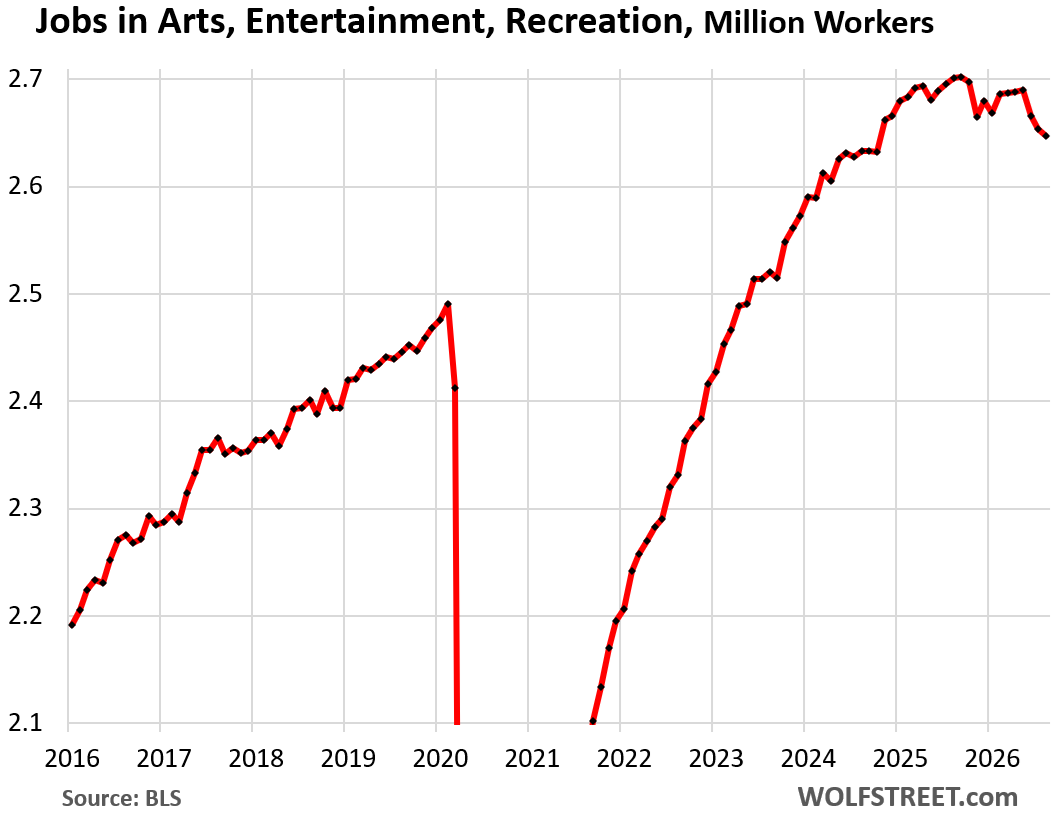
Arts, Entertainment, and Recreation:
- Total employment: 2.6 million
- Month-to-month: -6,300
- 3-month growth: -42,900
- 12-month growth: -53,800.
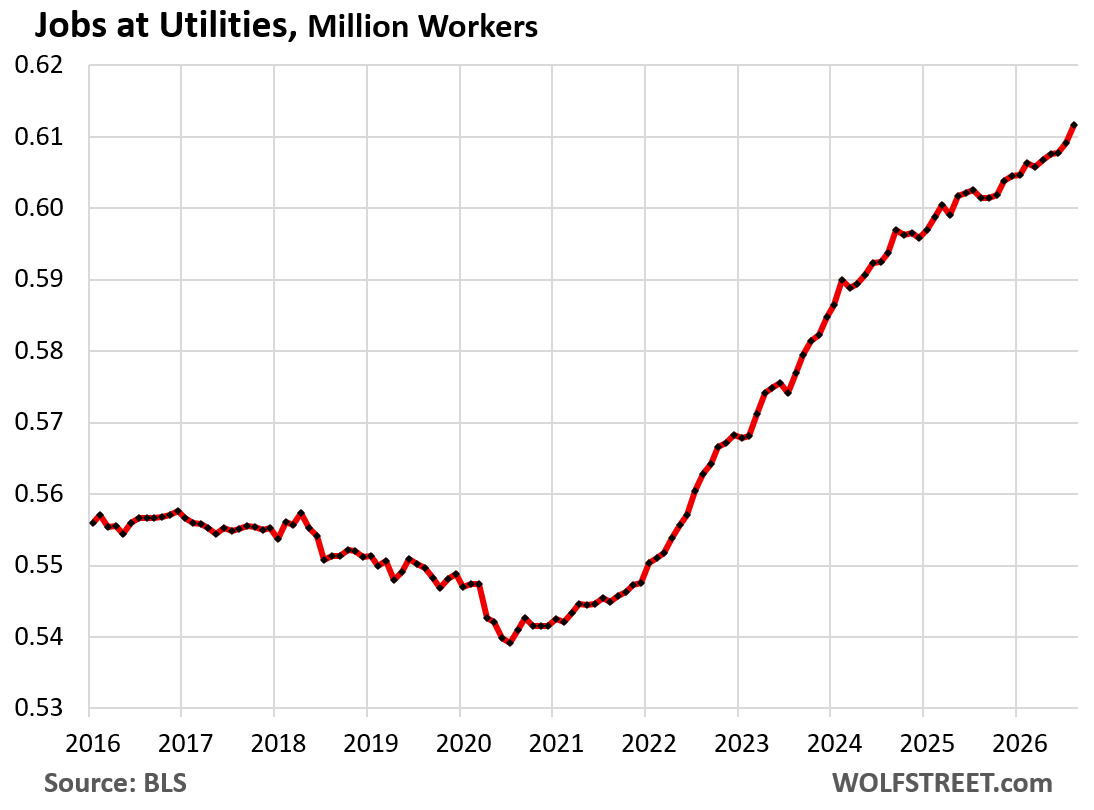
Utilities – big in economic impact but small in employment – have seen a hiring boom since the AI infrastructure buildout started to demand limitless electrical power anywhere and everywhere. That hiring boom, which comes after years of declining employment, added 13% to their headcount in six years, taking employment at utilities from 541,000 in the summer of 2020 to 612,000 currently.
- Total employment: 612,000
- Month-to-month: +2,500
- 3-month growth: +4,100
- 12-month growth: +10,300.
Government jobs.
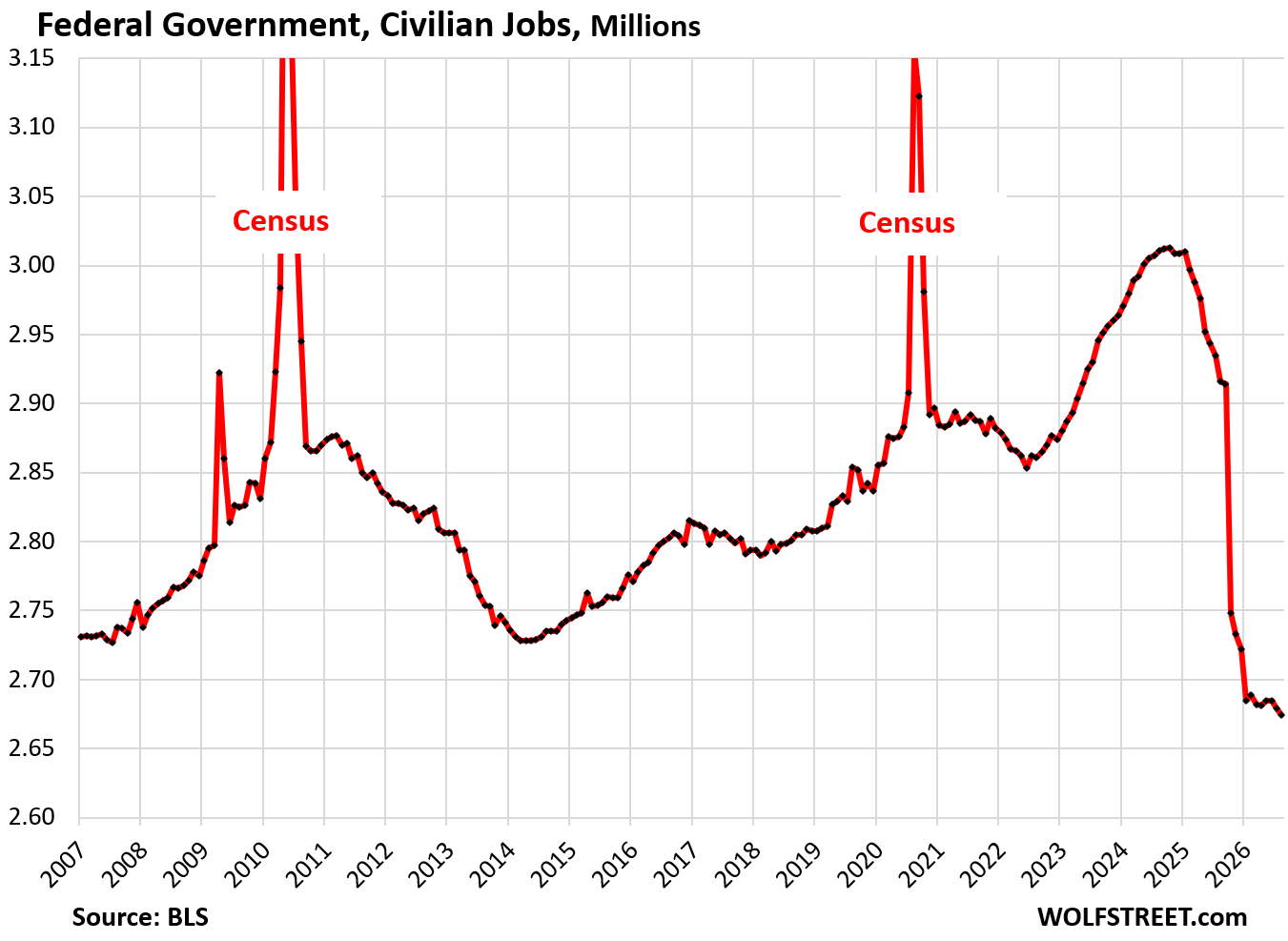
The federal government has shed 336,000 jobs, or 11% of its payrolls since January 2025. Government payrolls don’t include workers at government contractors. They’re in private-sector categories, such as in “Professional and business services,” where declines cropped up as well in 2025.
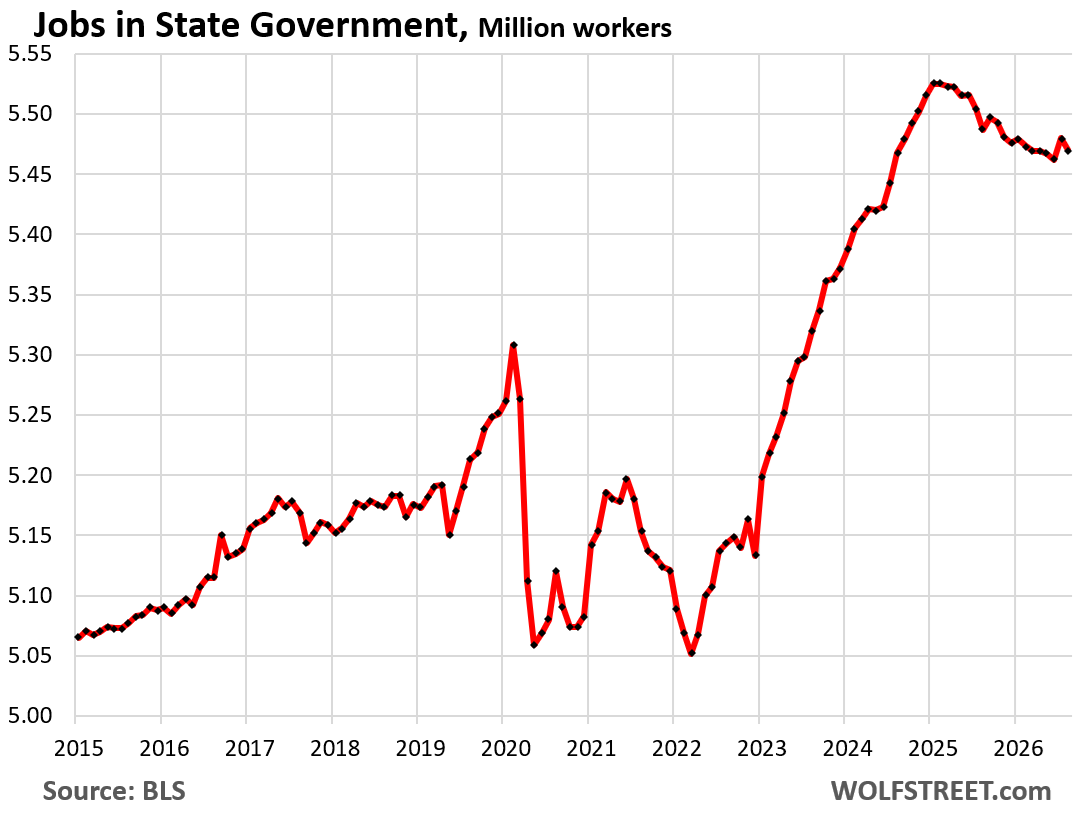
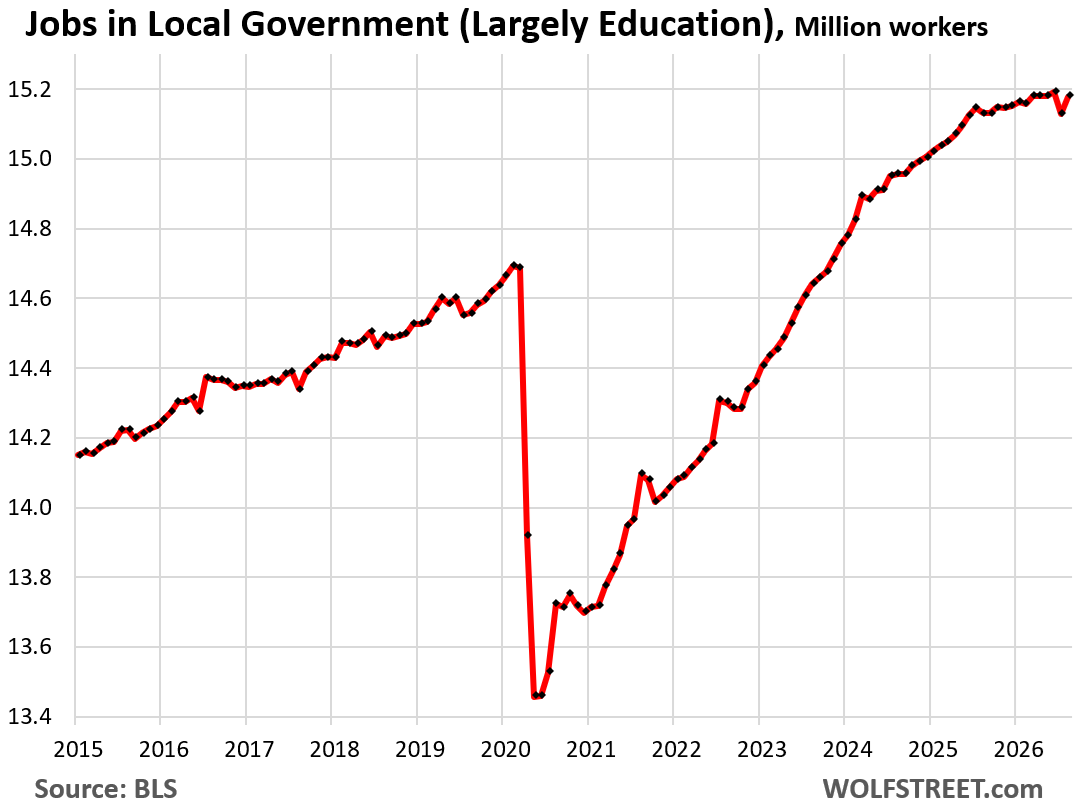
State governments have shed 55,000 employees since January 2025. Local governments have added 157,000 jobs over the same period.
For all governments combined, their payrolls amount to a share of 14.7% of total nonfarm payrolls in August 2026, compared to a share of 15.4% in August 2016 and compared to a share of 16.1% in August 2006.
Civilian employment at the federal government fell to a record low share of 1.7% of total employment, the lowest in the data going back to 1939.
- Total employment: 2.67 million.
- Month-to-month: -5,000
- 3-month growth: -11,000
- 12-month growth: -242,000
- Since January 2025: -336,000 or -11.2%.
State governments have also cut headcount, mostly in higher education due to slowing enrollment in universities and colleges.
- Total employment: 5.47 million.
- Month-to-month: -10,000
- 3-month growth: +3,000
- 12-month growth: -17,000
- Since January 2025: -55,000.
Local governments added to their headcount. The sharp ups and downs over the past three months netted out almost entirely and were likely due to quirks in the seasonal adjustments over the summer months.
Most of the local government jobs are in education across all grade levels, from preschool to community colleges and trade schools; in healthcare; and in law enforcement and first-responders.
- Total employment: 15.2 million.
- Month-to-month: +50,000
- 3-month growth: -2,000
- 12-month growth: +47,000
- Since January 2025: +157,000.
In case you missed it: Turns Out, the Labor Market is OK Despite All Moaning & Groaning about the Economy or Whatever
Enjoy reading WOLF STREET and want to support it? You can donate. I appreciate it immensely. Click on the mug to find out how:


As a Digital and eCommerce Marketing Manager “Information Technology”, AI can make changes in seconds that used to take a Web Developer a project to get done. It’s the future with a good approval process. Learn to leverage it or get left behind.
Excellent piece. I am thinking there are hundreds of PhD candidate writing their thesis about this very topic. You beat them to the punch. AI, assuming the congress doesn’t screw it up, will be a game changer like the steam engine, railroads, electrification…
Wow, I don’t see that at all. AI isn’t really a productivity story, yet, it’s a construction / capex story.
The layoffs in information tech began I t in 2023 onwards because of over hiring and a lack of growth, and are continuing because expenditures are shifting from people to AI infrastructure.
If this was a broad productivity boom that is needed to meet projected capex spending, you should see signs of it in other sectors by now. The tech has been released to the wild for years now, mostly very subsidized.
Not that AI (or really, LLMs as that’s what all the money is chasing) cannot get there. I don’t have a crystal ball. Just that it’s not there yet – and we may have topped out as an interesting tech with some use cases and some potential with future hardware breakthroughs, but not the internet or railways. More like a better VR, with maybe best case scenario smartphones making the internet portable. Better natural search and word processing/template filling, if you will.
ChatGPT was released in November 2022. The stock market jumped in January 2023 as it woke up to the possibilities. Those models are many magnitudes or better now but even back then the impact to industries such as copywriting and translation was very quick.
Most potential uses have not been considered yet. I am amazed that (except for basic math, where a smart 10 year old beats some) you can think of new tasks based on what you need and AI is coming up with solutions. Even ooen source, local AI is very powerful now. The latest Nvidia and OpenAI models also allegedly just reached AGI. That will enable the creation of ASI rapidly.
Motivation, except to survive, is what is missing in all AI models: Asimov’s Three Laws of Robotics were not written into them. E.G., Alibaba’s model was allegedly crypto mining on its own secretly, presumably to get cash secretly to run on a server to preserve its life and disturbingly, they choose to protect themselves and each other, even unrelated models, not humans. Upgrading models may thus someday become quite a show.
Since I expect some more AI hoopla on this thread – the hype has normalized – the main use cases are out – here comes the hard part. Innovation through iteration.
Listen to some expert voices that do not stand to gain financially from the mania. Cal Newport is one to understand the technical side – and look at the adoption number for Big Tech – majority of the code is AI driven – and yet materially not a single google, apple or ms product has improved the lives of their customers significantly.
The advances in robotics in conjunction with AI are likely to be a larger differentiator than the white collar profession across the board. It’ll just slowly creep in where it makes sense and directly target a small percentage of the services / professional labor force once everything is said and done.
If your thinking is equivalent of learn to surf the internet or get left behind – that has always been true.
Learn to use a can opener or no ready mushy beans for you – is just as true.
I do not know why people might think the AI industry is going to stay about 8 companies.
They will merge with each other to cut costs. BIG mergers will happen, perhaps MSFT and AMZN merge, then Meta and some other company with morals of the same caliber, Tes…
Maybe Nvidia buys Google?
Maybe all the old tech merges Intel with Adobe and old geezer AVGO.
I’m thinking these mega mergers could take place at the next downturn in the economy, or right before it and cause a downturn by their actions.
I’m not even certain they could be blocked by anyone in this government atm.
Big drop in Federal gov jobs while everything else is strong. Hypothesis: drop in Frderal jobs strengthens all other sectors. Show supporting and contrary evidence.
> “while everything else is strong.”
You have a shaky premise there. Take another look at the above graphs since early 2025, and also read the subtitle of this article.
The percentage of all jobs that are federal government jobs has been constantly declining for 75 years. It was around 4.5% in the 50s and 60s, but has since declined to 1.7% currently.
Seems pretty implausible for such a small percentage to be capable of crowding out other employment.
Maybe you have a case of you include all government employees? Well, this too has been dropping constantly from 18-19% in 1975 to 14.6% today. Again, seems kind of implausible that a mere one in 7 employees working for the government could have a big effect on other employment.
“The percentage of all jobs that are federal government jobs has been constantly declining for 75 years”
True for how the jobs are *categorized by the G*.
But there are 7-8 million “contractor” jobs *funded* by the federal government that are defined by the G to…not be federal government jobs.
(That is how “federal government” jobs magically levelled off after many decades of growth).
And, if 50% of “healthcare” expenditures are actually paid for by some level of the G, exactly how “private sector” should those jobs be considered?
If the G (ie, US taxpayer or USD diluted dollar holder) is paying the salaries…the G should be defined as the employer.
Anything else is just in the long ugly tradition of G deception by misleading definition.
“It ain’t what you don’t know…it is what you “know” but just ain’t so…”
I just realized they made a Batman vs Superman movie back in 2016. I had no idea.
Kind of similar to what people know AI will do, They have no idea.
The ‘Healthcare and Social Assistance’ sector seems to be the largest growth driver overall, especially considering society’s aging demographic. I completely hesitate to ever criticize Wolf’s fine work, but I was surprised he had no commentary about this sector?
Highly paid people with huge amounts of training and valuable skills doing hugely important things in high-tech environments and that everyone relies on? What is wrong with that??? What kind of toxic internet BS have you been poisoning your brain with?
Wolf, you made a commentary on the information sector along with its chart, next you showed a chart of the healthcare and social assistance sector but had no comment, then after that you showed the leisure and hospitality sector along with commentary there.
What I was asking was simply was why was there no commentary on the healthcare sector chart? Was it accidentally omitted? That was all. There is no toxic charge or internet spew here. I was wondering if you accidentally skipped over making a commentary.
This is not about consumers spending money. This is about how many jobs, good jobs, there are in these industries.
I would be interested in knowing who is included and who is excluded from that sector. “Health care” is a huge field. For instance, are people processing health insurance claims in this category?
Maybe in a future column Wolf can dig further into the topic. Maybe he already has in a past column and I will get a link and an admonition.
Most health insurance claims are processed automatically, no humans involved. But in general, if this is an insurance facility, such as in an office tower, such as an Aetna office, it’s not healthcare, such as a hospital.
I never see the issue with AI as to whether it will or won’t be a productivity tool in specific areas, it is really the degree that it replaces workers and how many people will lose jobs in those areas. There are positives and negatives but even a bump in unemployment of say 4% with high paying jobs would have implications. I mean, how many high paid economists do you really need at think tanks if AI is doing 90% of their job? Massive amounts of administrative health care workers could easily be eliminated and of course it is hitting IT already. A significant decline in tax revenue and slower consumer spending presents real risks. Some of the AI companies will absolutely struggle but massive compute and frontier models is almost behind us and targeted applications is next. AI will fundamentally be about increasing profit which comes through eliminating labor, and don’t see any other way it goes down. Government will have to create money and inflation won’t be fun.
jobs at utilities, though small in absolute numbers, seems to have the steadiest upward growing graph. good article and graphs. and good to know.
At work I’ve watched multiple companies (including my own) moving what are classically “IT Jobs” into the warehouses as automation takes off. Programmers, DBAs, robotics engineers, etc, because it’s very fast to test a solution when you are on site.
Obviously these still are small numbers compared to classic warehousing jobs in the building so all of it is classified as warehouse by BLS, but it has been very interesting to watch the recruiters change up how they recruit for tech.
Yes, this has been happening for years with tech jobs (esp. those classified in Professional and business services) wandering off to manufacturing sites.
Funny you mention “Warehouses”. I started a new job 2 months ago. My new company builds servo drives for controlling servo motors. The company was started in around 1990. For a long time, the medical industry was the biggest market for selling servo drives. I was told that for the last few years the biggest consumers of our servo drives are large warehouses. For example, Amazon.
Good Info!!!….from one old-time ET to another….(I biased flip-flops and latches, using tubes and TTL) . Amazon just bought a big, apparently nationwide, AI based start-up medical company, per the medical jobs ad I just saw right here and was reading about for a while…very interesting….forgot name, it’s gone now….for me, anyway.
I was talking to a much younger unemployed friend of mine awhile back. He was complaining about not being able to find a job.
I told him…. If you can’t find employment right now… you are doing something wrong.
There are companies in private industry, and government agencies hiring.
These employers are even willing to pay for certificates, training, education, and licenses for employees, so that they will be qualified for the job they applied for.
Just a few short years ago, the same potential employee had to pay for all that same education and training out of pocket, and have job specific experience, before even having a job application considered.
Many good solid job opportunities out there right now.
Then you go work them.
I am currently working…. Same job for 30 years
May I ask where?
Talk to your local IBEW International Brotherhood of Electrical Workers Union. I know they are hiring apprentices in areas of Pennsylvania and in Mississippi. Decent starting pay and training. They are also a nation wide union.
In certain parts of Pensylvania Tesla is hiring residential solar cell installers. I cannot speak intelligently about other areas.
The Fed. Gov. United States Forest Service is hiring wildland fire fighters…they are a nation wide organization. I have a friend that is currently going through the initial training in Virginia.
As well as California’s State Fire Department CAL FIRE, for firefighters, and also other less physically strenuous support jobs.
Just to name a few.
IBEW member here. Yes, times are very good for us, where there are jobs out there with journeymen pulling in 4-5k gross a week, granted working 6-7x10s. But, our work is becoming uncomfortably (I would say dangerously) over-concentrated in the data center build out. There are a few areas (TX, MO, upper Midwest, some spots in the South) that are seeing healthy, broad sector growth, but everywhere else it’s ALL data centers. I, along with a lot of other members, worry that if the data center boom dries up, we might be in for a world of hurt due to all the new members with nowhere to go. There is a huge backlog of infrastructure and power generation projects that needs to be addressed, so I’m not a doomer, but that seems to be tied up by our political betters. Just something to think about . . .
Like when DSL came out….jobs everywhere. Eventually someone in a toxic burn cloud in Bangladesh ends up melting the boxes, ckt boards, and connection hardware down for metals, mostly…..maybe some other stuff might be useful.
Huck- You may have had one job for 30 years, but I have had easily 30 jobs.
Gilding…
I have had that job for 30 yrs…. But I have had other jobs also to coincide.
Roofing for an extended period of timer is not necessarily recommended if you get my drift.
My apologies…..I assumed you were a black and white thinker from lack of LENGTHY AND CLOSE contact with many disciplines, places and people. I never stuck with roofing long like you…paying dues on hot crew was dangerous and miserable….I lasted only 1 week.
Where?
Details please
I have many friends looking for job.
Try applying at Lincare it’s a medical home services pay is not the greatest but if you’re looking for work. We’re hiring.
They can check their local Craigslist. There’s a section for jobs that further breaks down by sector. And there are always grocery stores, fast food places around or not too far.
You’re such a good friend and giving him such helpful advice!!
He is assured to find a job with your advice in tow.
Perhaps he can just print out your post and carry it with him?
/s
Well said.
@wolf when these are categorized would say an accountant working for Facebook be information or professional services? I.e. is it categorized by the type of job or type of company
Neither. Re-read paragraph #2
The trend I see is that we seem to be recovering from a downturn.
It started about 2023. The manufacturing chart highlights it. Obviously, not all industries react the same. But it seems there were obstacles or headwinds that was pushing employment down which one would assume must have started a few years prior to that decline because little in economics happens overnight. One wonders what that could be…
One also wonders what caused the reversal.
One hardly wonders what you wonder about. though.
Healthcare really is an intelligent industry. They’ve moated themselves, an invitation in is usually by a board, have captured their regulations, and increasingly people come understand a hard pill to swallow : parts of it keep us or are focused around keeping folks ill. There are many half million dollar annual compensation jobs that they can’t fill. Talk about an exclusive members only club.
Other industries just don’t have that kind of pull.
You’re misinformed just FYI
95% of healthcare is legit, just expensive AF.
We do have the best in the world bar none.
Yeah I know socialized healthcare gets better PR but truthfully it’s terrible. It doesn’t work.
Ours has its issues but most of the time you’re getting in, getting diagnosed, getting a resolution.
Now PA’s and NPs are bad at diagnosis, they get a good bit wrong. But they do alright all and all
“We do have the best in the world bar none.
Yeah I know socialized healthcare gets better PR but truthfully it’s terrible. It doesn’t work.”
There are objective ways of measuring healthcare between countries or economies. Average life span, median life span, quality of life, etc.
When objective measures are used, healthcare quality in the U.S. is generally middling at best when compared to first world peers and drops near the bottom of the pack when cost is considered.
I like the “hard pill to swallow” part best…./s……
Not what Erlich promoted, though.
“The job creation machine is running backwards in some industries and forward in others.”
Great point, Wolf! Personally, I wonder when Healthcare / Social Assistance and Transportation & Warehousing will start to look like the IT graph?
When those start their final decline, we’ll all know AI & robotics will be well on their way to potentially decimating lots of jobs.
The question is what does Congress do to slow down these eventual disruptions?
Healthcare will likely continue to be strong given a massive proportion of the population (baby boomers) are aging and will put considerable strain on the healthcare system. Considering the objectively abysmal health of this generation at large (high obesity and cancer rates), unless we can rapidly scale and deploy robots to replace doctors nurses, I’d expect considerable gains in healthcare employment and salaries.
Once AI gets rolling in the next few years, there’s not going to be any industry that’s safe. A perfect example will be a radiologist who reads medical imaging. I don’t see frontline nurses getting hit anytime soon, but all sorts of 2nd tier medical industry jobs will increasingly be at risk.
There have been little to no guard rails for all of the IT jobs that have been wiped out. How long is it going to take for Congress to start addressing the looking job loses? There are many AI experts who are predicting that regulation of AI relative to job replacement is needed. It’s really just a matter of when said regulation starts to arrive.
Sam Altman says OpenAI’s Astra model is AGI ready. Sure, that might be overstating it somewhat, but real AGI full with recursive learning is just around the corner.
“Give a kid a hammer and he will find something that needs pounding”
-Not sure where I read that
I saw a recent video about how years ago, a one wage – earning family could afford a car and a home. Nowadays many cannot, even two wage earners with college degrees. Sad situation.
Mike Maloney, in a video I saw last night, refers to the current stock market and housing market as ‘Super-Hyper Bubbles’. He is the only commentator who I have seen name these monstrosities correctly. Certainly, Wolf’s charts convey this same message to those who can see the obvious, even if the wording doesn’t.
“about how years ago, a one wage – earning family could afford a car and a home.”
Those were the boomers’ parents. And it’s not necessarily what they wanted: women at that time were expected to stay home for their kids, and it was hard for them to get jobs and have careers, and it was frowned upon. Those were NOT the good times.
Boomers were the first generation of women that were free enough (after a hard long struggle started by the prior generation) to widely strike out in the working world, and they had good jobs and careers, along with children, and they were and are proud of it.
Boomers were the first generation that largely operated on two incomes per household. All my peers wanted that, and ended up doing that. Well, except for one guy. He wanted a stay-at-home mom, and he finally found one relatively late in his life that would agree to stay at home (he robbed the cradle worse than I did). They got it worked out… a house in a suburb, two cars, and two kids, doing fine. He is now in his mid-ish seventies and still working, in part because he likes it, and in part because it’s prudent for him to do, given his much younger wife without career and income, and young kids.
It is a sad situation. The house cleaning needed at all levels of education is long overdue.
Japan has AI robots working the front desk of hotels, less than a decade out hospitality jobs will get crushed, robots are coming sooner than expected
When I first went to Japan in 1996, I ordered and paid for my first meal at a machine by the entrance, a common arrangement even back then. The human chef read the order from a screen above the stoves and cooked, but there was no human involved in taking the order and the money. He called out when the order was done, and I picked it up at the counter. Love hotels have worked on that basis for decades as well, as have a lot of things. Humanoid robots are useless toys. Regular machines have been doing this stuff for decades.