
Even without gas stations, retail sales jumped, powered by ecommerce, auto dealers, general merchandise stores, and other retailers.
By Wolf Richter for WOLF STREET.
Retail sales soared in March by 1.7% from February, seasonally adjusted. Compared to March last year, sales jumped by 4.5%, not seasonally adjusted.
But there was this spike in the price of gasoline, which caused sales at gas stations to spike. So the question arises: Did Americans cut spending on other stuff that they buy at retailers in order to buy gasoline? Nope, not Americans. Born to splurge.
Retail sales without gas stations jumped by 0.61% in March from February, after having already jumped by 0.67% in February, seasonally adjusted (red line in the chart). Year-over-year, retail sales without gas stations rose by 3.5% not seasonally adjusted (blue).
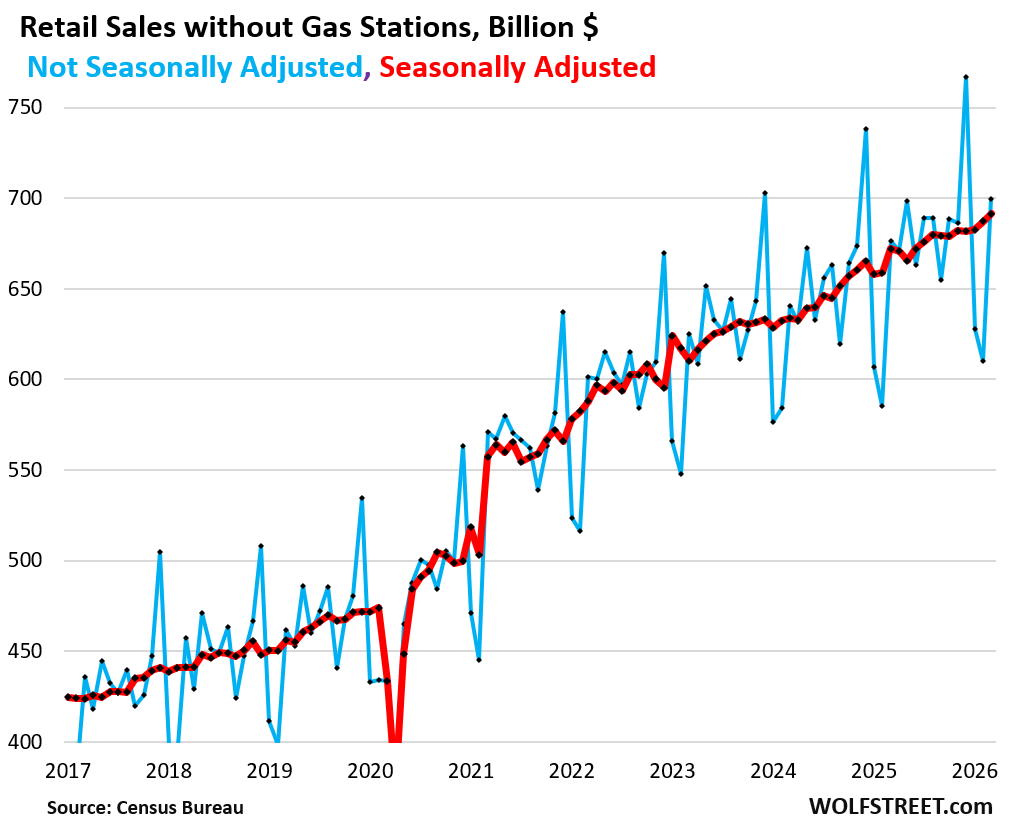
Avid inflation-adjusters, note: Most inflation is in services, and retailers don’t sell services, they sell goods. CPI inflation in durable goods was close to 0% in March both month-to-month and year-over-year. And CPI inflation in food bought at grocers was 0% in March and less than 2% year-over-year. The CPI for gasoline spiked, and that explains the spike in gasoline sales, see chart further below.
Inflation in services, which is where Americans do two-thirds of their spending, was over 3%. But you cannot adjust retail sales to inflation in services that retailers don’t sell. You have to adjust retail sales to inflation in the goods that retailers sell. And outside of gasoline, there wasn’t much.
The largest categories of retailers.
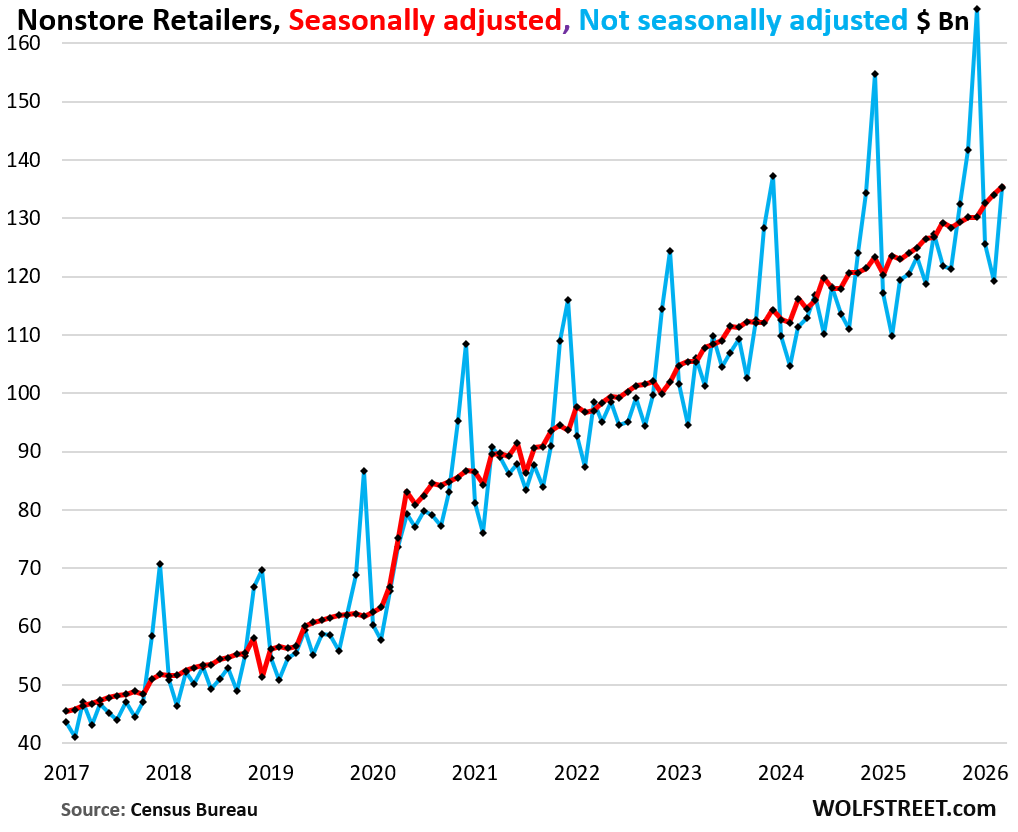
Ecommerce sales (18% of total retail sales) have been soaring relentlessly, gobbling up market share from brick-and-mortar retailers, growing year-over-year at over twice the rate of overall retail sales.
This includes ecommerce sales by retailers with brick-and-mortar stores, such as Walmart, Macy’s, Costco, etc. Their online sales count here, and their brick-and-mortar sales count in their brick-and-mortar category.
In March, sales at these nonstore retailers jumped by 1.0% from February, seasonally adjusted, to a record $135 billion, making it the #1 largest category of retailers in March.
Year-over-year, sales jumped by 13% not seasonally adjusted and by 10% seasonally adjusted.
There is no sign that consumers cut their online spending because they spent more on gasoline. These are big sales increases, even for ecommerce:
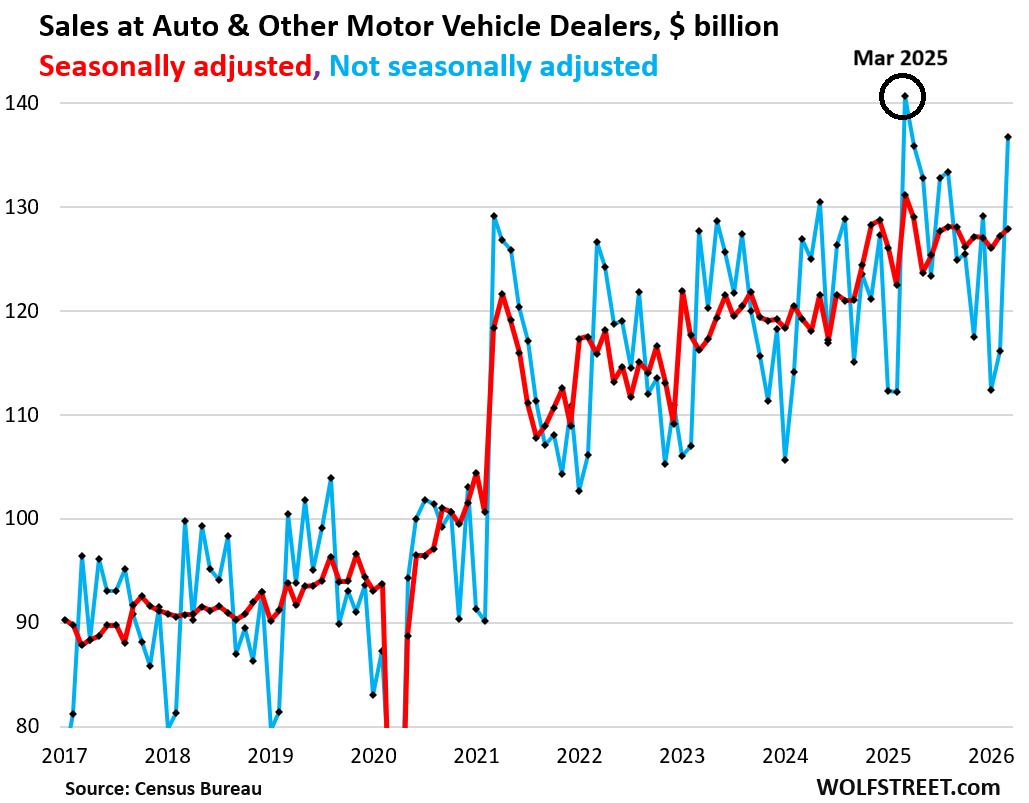
Sales at Auto & other motor vehicle dealers (17% of total retail sales) rose by 0.6% in March from February, seasonally adjusted.
Year-over-year, sales fell by 2.8% not seasonally adjusted (blue line). But that was compared to March 2025, when tariff-fearmongering clickbait in the mainstream media, financial media, and social media about exploding auto prices caused a massive wave of frontrunning and a huge spike in sales. Those prices ended up barely budging, as automakers had to eat all of the tariffs to not lose sales and market share. Beyond that front-running-distorted comparison, sales in March this year were pretty good, the second-highest ever, up by 18% month-to-month not seasonally adjusted, and by 0.6% seasonally adjusted.
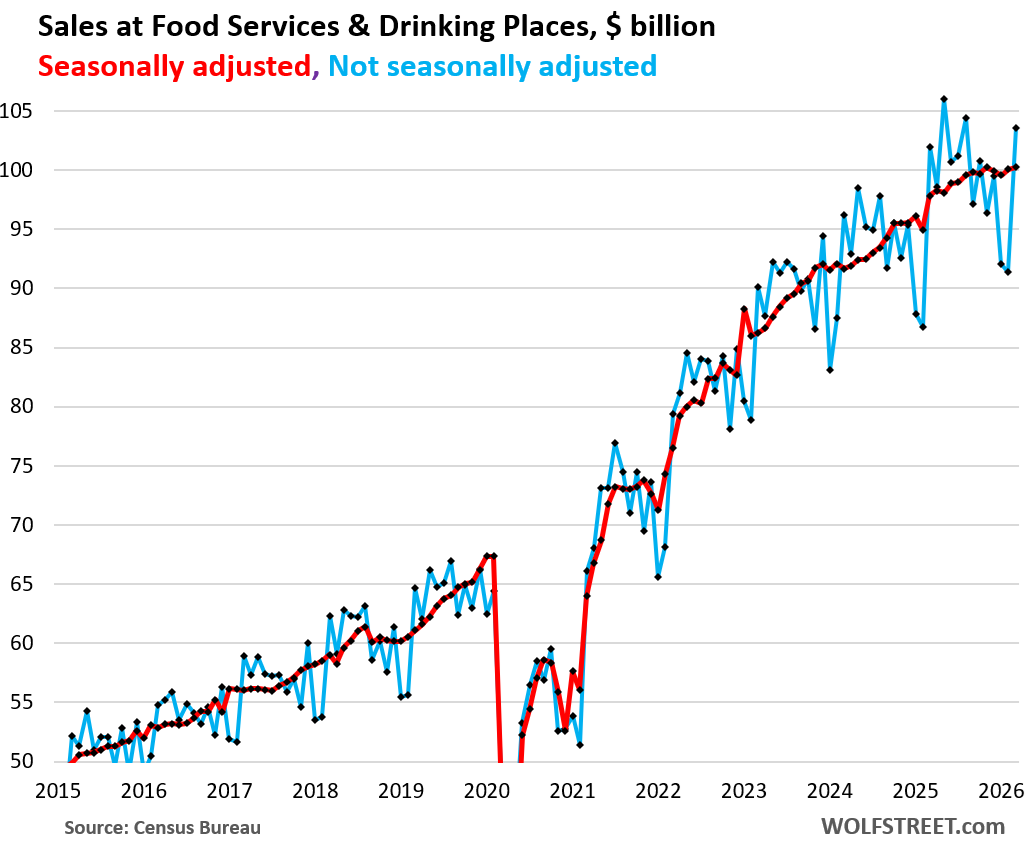
Sales at Food services & drinking places, such as restaurants and bars (12% of total retail sales), rose by 0.1% in March from February, seasonally adjusted.
Year-over-year, sales rose by 2.4% seasonally adjusted and by 1.6% not seasonally adjusted.
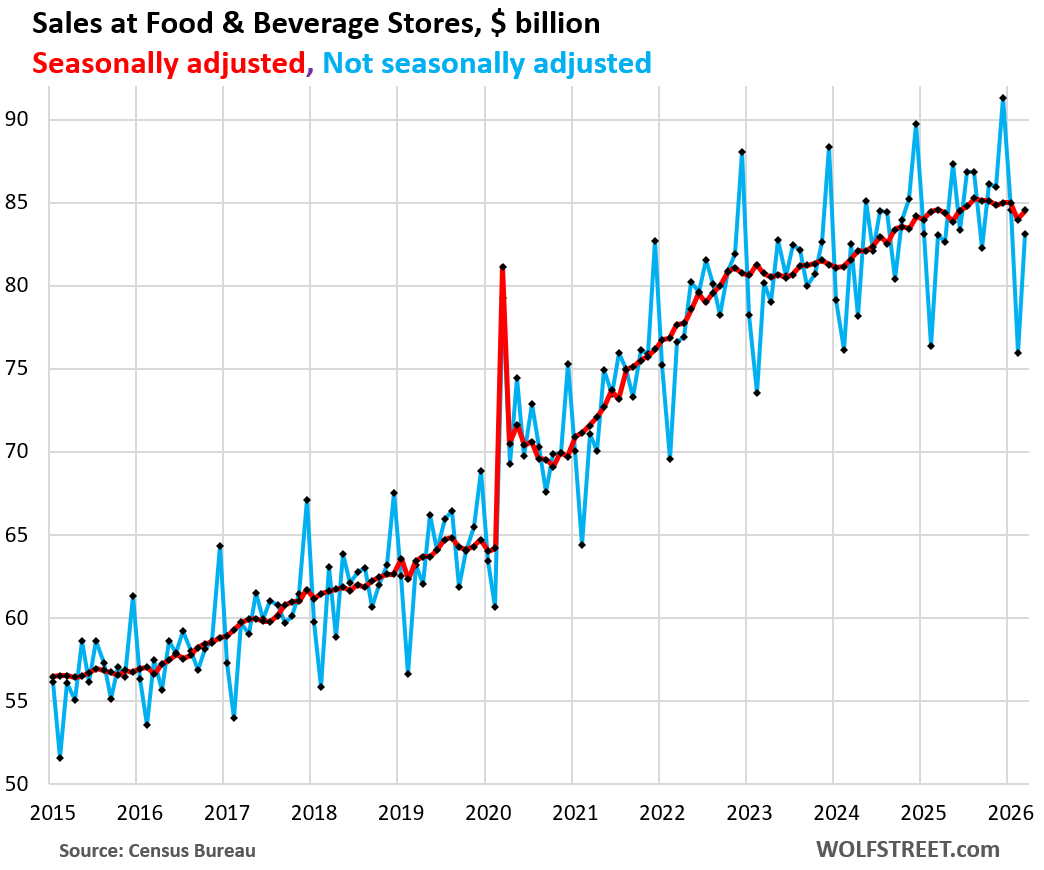
Food & Beverage stores, such as brick-and-mortar supermarkets, grocery stores, and specialized beverage stores (12% of total retail sales) have long been losing market share to online grocery retailers, including their own online operations, to “general merchandise stores,” such as Walmart and Costco that do a booming business in groceries, and to restaurants (see chart above).
So when “sales at food & beverage stores” languish, it’s not because Americans went on a diet, but because sales shifted to other types of retailers, including ecommerce, general merchandise stores, and restaurants. This has been going on for many years.
Walmart, the largest grocer in the US, has been aggressively going after the grocery business, including the ecommerce grocery business, none of which count here in this category. Amazon has been selling groceries online in various iterations. There is now a huge choice of online food retailers – both online-only retailers and the online operations of brick-and-mortar retailers. And these sales don’t count in this category of “Food & beverage stores”; the count in ecommerce, regardless of how the food got into the house, whether delivered by the company, or a carrier, or picked up by the customer.
And we can see this change show up here in the numbers.
Sales at food & beverage stores (brick-and-mortar) jumped 0.7% in March from February, but was unchanged year-over-year, at $84 billion
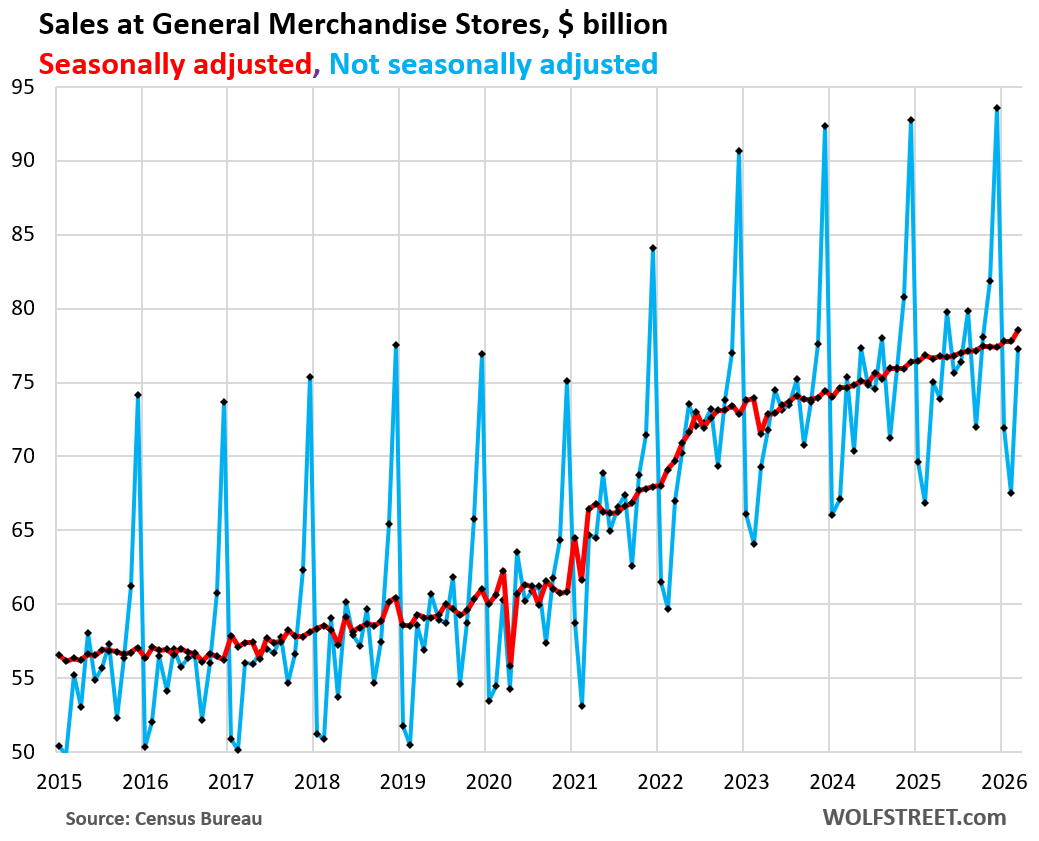
Sales at General merchandise stores (11% of total retail sales) jumped by 1.0% in March from February to $79 billion. Year-over-year, sales were up by 3.0% not seasonally adjusted and by 2.5% seasonally adjusted.
This category includes Walmart, Costco, Target, and many others. Many of them also sell groceries, with Walmart being the #1 grocer in the US, and their grocery sales are here in this category, not in the category of food & beverage stores.
But sales of their ecommerce operations are included under the ecommerce retailers above.
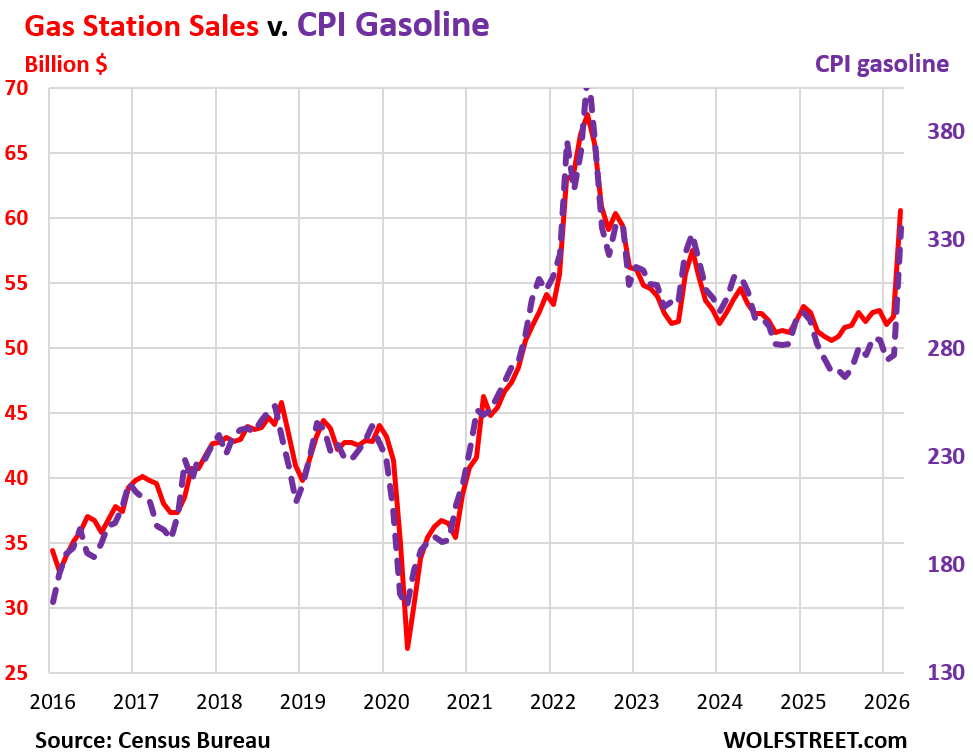
Sales at gas stations (7% of total retail sales) move in lockstep with the price of gasoline. Gasoline prices spiked in March, so sales at gas stations spiked in March.
Sales at gas stations spiked by 15.4% in March from February, and by 18% year-over-year to $61 billion (red in the chart below, left scale).
The purple dotted line (right scale) shows the CPI for gasoline, which also spiked.
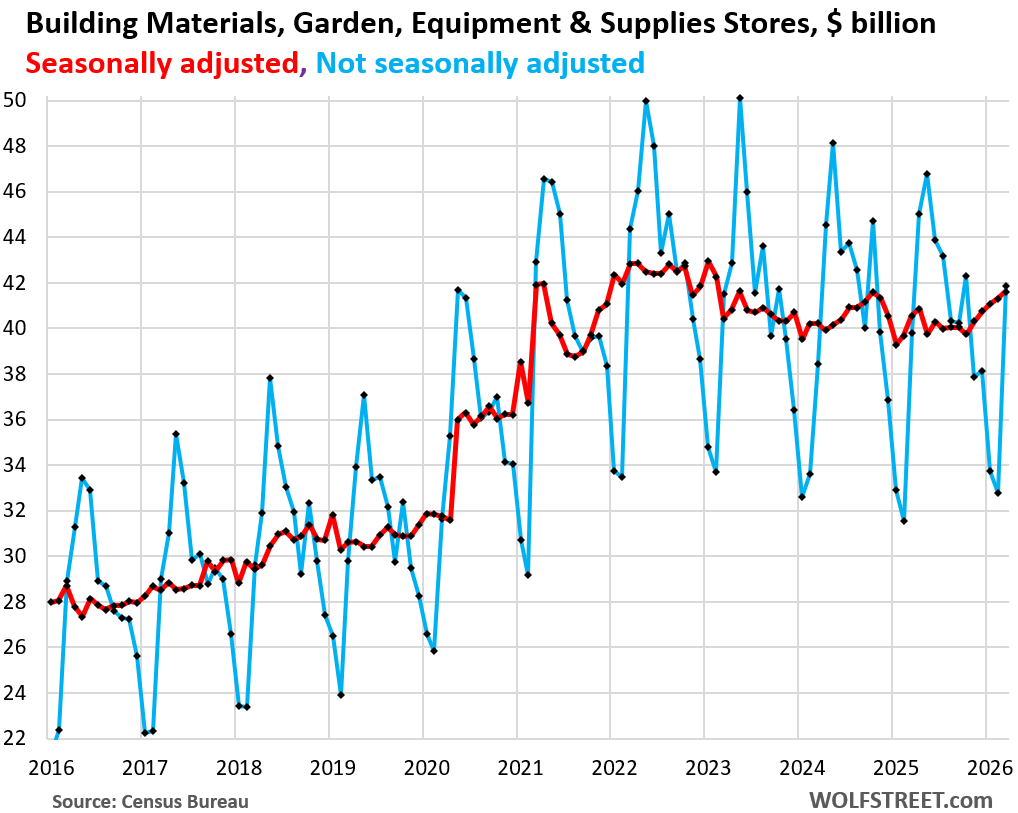
Sales at Building materials, garden supply and equipment stores (6% of total retail sales) jumped by 0.7% in March from February, seasonally adjusted, to $42 billion. Year-over-year sales were up by 2.6% seasonally adjusted and by 5.3% not seasonally adjusted.
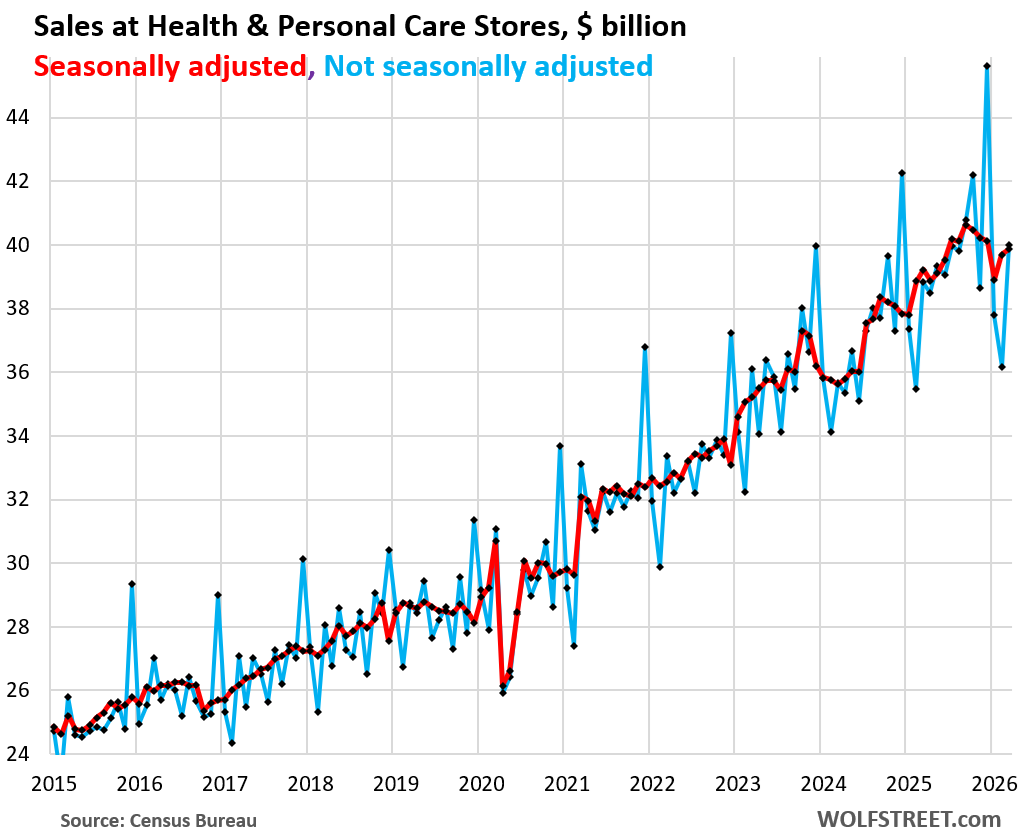
Sales at Health and personal care stores (5% of total retail sales) rose by 0.5% in March from February seasonally adjusted, to $40 billion.
Year-over-year, sales rose by 3.0% not seasonally adjusted and by 1.6% seasonally adjusted.
In case you missed it: Where Americans Spend their Trillions on Goods and How that Changed since 2015
Enjoy reading WOLF STREET and want to support it? You can donate. I appreciate it immensely. Click on the mug to find out how:


Howdy Lone Wolf. A Sober Sailor Guilty as charged. US old squirrels learned a long time ago, always save some of your $$$ and you will live your life your way. No matter what comes. Currently received my best discount ever on a new car and thought, what the hell buy it even though I could have kept my old one. Cant take it with you …..
A senior sober sailor sailing till I can t sail no more…..
What new car did you get?
Bought an a6 12 k discount. Last year love my sedan.
It’s not the tax refunds that are doing it. Just found out the IRS is 2 months behind processing paper tax returns due to the shutdown. I will not get mine before mid June at the earliest even though they received it on March 6th. They haven’t even entered mine into their system. It was sitting for 2 months collecting dust.
You are assuming your situation applies to others. Did you know that 94% of federal tax returns are filed electronically with refunds issued quickly?
Rather than complain, why not file electronically?
Why didn’t you file the federal tax return electronically? When you do that it gets entered and processed immediately.
Swamp Creature
That’s nonsense. The IRS is not behind, and the IRS doesn’t “enter” paper returns. They’re scanned by machines.
Through April 10:
https://www.irs.gov/newsroom/filing-season-statistics-for-week-ending-april-10-2026
Yep, the IRS is the last agency to be “behind” and they have a huge incentive to not be behind. Per your data, millions (36ish million) owe taxes after filing.
It’d be something to look into: BNPL and how it’s changed since first coming about. I know some of us remember layaway, but this is different. Prolonging the next downturn.
BNPL is MINUSCULE.
And it’s very short term, most plans have four fixed payments stretched over 6 weeks to pay off the entire purchase, interest-free to the consumer.
Americans clearly have a lot more money, collectively, than people realize
Howdy TSonder. I thought I was the only one that paid off credit cards every single month, saved $$$$ all the time, always lived within my means. After seeing the Lone Wolfs articles, I realized how wrong I was… There are millions and millions just like me…. Thought I was special but am not. Oh Well…..
Strange. Being on fixed incomes we haven’t bought anything out of our usual items necessary for maintaining our property and vehicles. No luxury items and actually cut back on vacation. Our insurance, electricity and taxes have all increased along with cost to eat out. Luckily our cars are hybrids so the gas prices don’t affect us much. We don’t do much driving anyway.
Yes, many retirees are in that situation. But not everyone is a retiree.
I am reading more and more about Buy Now Pay Later and how many young people are using this method of payment.
I am wondering how much of these sales are deferred consumer debt?
Interesting article, thanks!
BNPL is MINUSCULE.
And it’s very short term, most plans have four fixed payments stretched over 6 weeks to pay off the entire purchase, interest-free to the consumer.
Bernie Sanders projects every day that Americans are struggling to pay for food and clothing. His famous statement that an average bank balance is $400 has been refuted by federal reserve which reports that the median balance is $8000 in the bank balance. I have been hearing this paycheck to paycheck living since 1990
If you want to make everyone poorer via policy, best to make them think they are poor first.
Just one moron’s take: Are we actually struggling?
The media loves to act like we’re all huddled over coupon books and canning pears to survive, but I’m just not seeing it. Maybe I’m in a bubble, but nobody I know is ready to “chamber up the old Colt” over this economy.
Sure, some people have it rough—that’s always true—but a whole lot of people are doing just fine. Every time I look around, the planes are full, the stadiums are packed, and restaurants are slammed. People are shopping and vacationing everywhere.
Obviously, between the Biden-era inflation and flat wages, and then Trump tariffs, we all felt a crunch. But the real ‘crisis’ is half media rhetoric and half foolish spenders who never dropped their COVID habits. They’re burning $300 a week on ten-dollar delivery fees for a twelve-dollar burger, or grabbing a Lyft two blocks to pick up some weed. I’m sure credit card balances are up, and yeah, some people are close to tipping over—some from a run of hard luck, but plenty more from just refusing to live within their means.
There is no free lunch so the reset button is coming for some.
I just paid $104 for a tank of gas. Never paid that much before in my life. Whether my income is six figures or zero, that’s something I notice and have strong feelings about. Just because there are plenty of rich people across the world clamoring to spend their cash doesn’t mean everything is a-ok. Far from it
Seems trivially true that overall sales go up year over due to inflation even if durable goods inflation is zero. What portion of overall retail sales is non durable goods? What’s the CPI for these?
nearly 70% of the money consumers spend go to services, and it’s in services where inflation is high – that’s always the case and is the case now. Services inflation does not apply to retail sales.
In terms of nondurable goods:
Gasoline had negative inflation for three years in a row (prices dropped), which pushed down retail sales.
Food had a huge inflation spike in 2021-2022, but food inflation has leveled off at relatively low levels now, though prices remain very high. Some prices have been falling (eggs, avocadoes, olive oil, even some coffee has seen some price cuts recently after the huge spike); and other prices are still rising (such as beef).
Those two are the big nondurable goods categories. Smaller nondurable goods categories are clothing, shoes, accessories, household supplies, etc. They’re pretty small part of the consumer spending basket.
I had been planning an EV purchase for a while and finally bought in March. A month later that base model is in very short supply with smaller incentives.
I’m not saying it makes a difference, but EV sales were up in March. Certain states still have incentives.
I am also buying more groceries at a time, partly fearing very specific food item oil shocks. My chocolate consumption is down.
Wall Street on red alert as Buffett’s favorite stock market gauge hits worst reading EVER…
GOLDMAN Says Recession Risk ‘One Tweet Away’…
Wall Street is not on any kind of alert, red or otherwise. They’re in full-blown booze-a-palooza.
I wouldn’t count on this lasting too much longer if gas prices stay high. I was speaking with the owner of a nail salon about a week ago and she told me her business is starting to lose customers… not lose-lose… they just aren’t coming in as often.
Amazon just delivered their latest load to our house in a Rivian EV cargo van. They have seen no change yet in cost for local delivery. I’m sure long distance transport to distribution centers still use diesel trucks.
Many people I know have an EV or hybrid now. They are using these vehicles more than their gas guzzling ICE SUVs and trucks. In my area, driving an EV charged at home is unchanged at about $1.00 per gallon equivalent(compared to an equivalent 25 mpg car. ie it costs about $1.00 in electricity to drive 25 miles in an EV). Electric rates are not as volatile as the local gas station prices but I suspect since natural gas powers our electric plants, price increases will eventually propagate to higher electric rates.
Wolf has shown EV sales grew last year to catch the tax incentives.
How many EVs are now registered compared to ICE cars?
I read that EVs made up almost 30% of new registrations in Colorado in 2025.
We were one of them with a Chevy Blazer EV.
I see almost every third car on the road is now an EV. Mostly Teslas.
These drivers are not seeing the gas pump pain yet.