
The government is already busy fighting over what to do with the $31 billion in profits on its foreign exchange interventions last fiscal year.
By Wolf Richter for WOLF STREET.
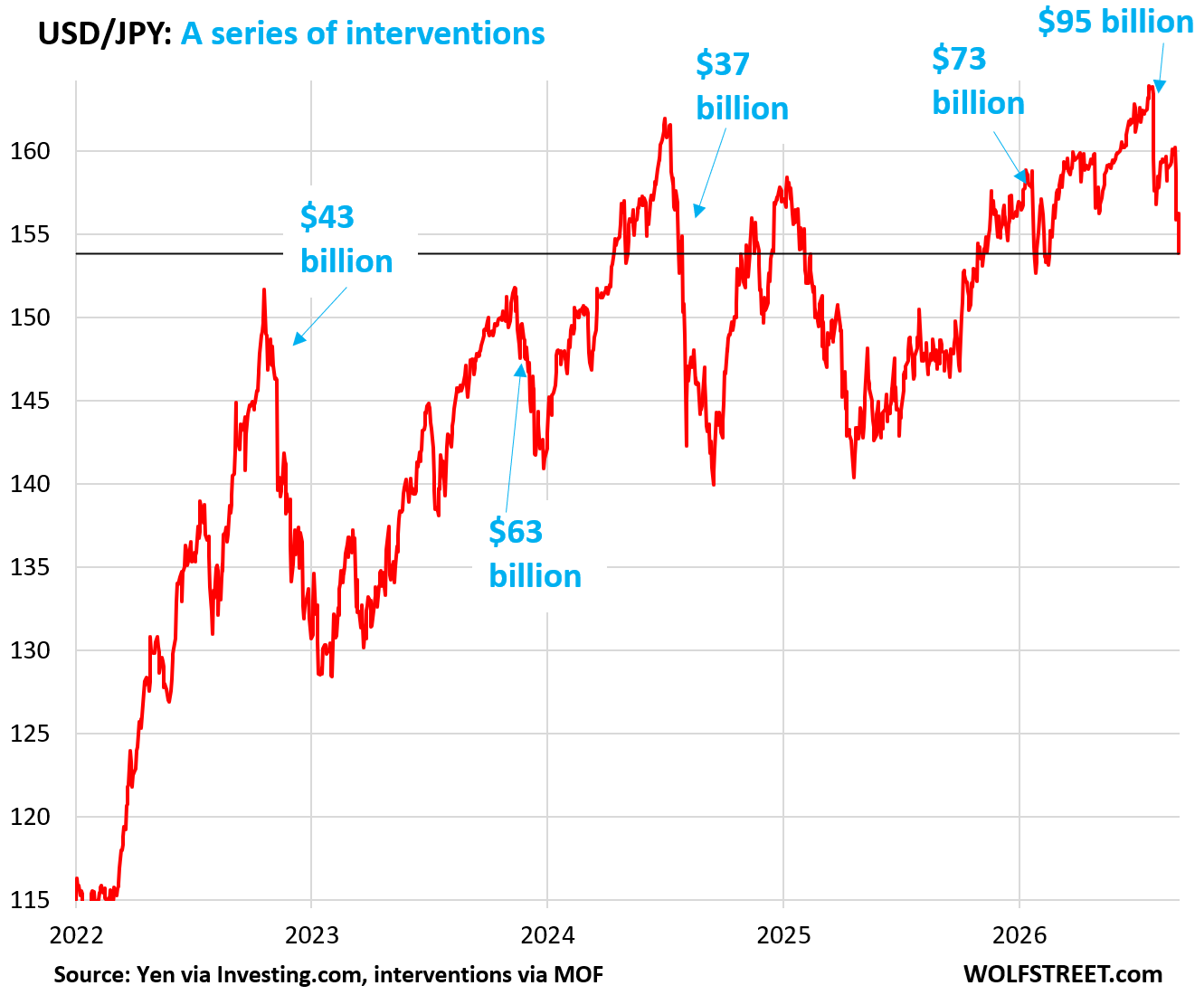
Japan’s Ministry of Finance disclosed on Monday that its foreign currency reserves plunged by a record $94.6 billion in August, or by 8.7%, to $995 billion at the end of August, from $1.09 trillion at the end of July, showing the effects of the big kahuna joint Japan-US intervention in the foreign exchange markets to put a floor under the plunging yen (red in the chart below).
Over the four-month period of May through August, which includes the yen interventions in May and on July 31, foreign currency reserves plunged by $174 billion, or by 14.9%!
These foreign currency reserves consist mostly of securities, mostly US Treasury securities. Securities plunged by $87.8 billion in August from July, to $840 billion (double-yellow line in the chart).
The remainder of the foreign currency reserves consist of foreign currency deposits at other central banks, such as the MOF’s USD deposits at the Fed’s Reverse Repo facility for Foreign Official and International Accounts (a liability for the Fed). Deposits dropped by $6.9 billion in August, to $155 billion (blue in the chart).
Today’s release shows the effects of the interventions on its foreign currency reserves and provides some details. On August 28, the MOF had already disclosed that it had bought back ¥15.4 trillion of yen-cash in the foreign exchange markets during the July 31 intervention, and sold foreign currency to do so.
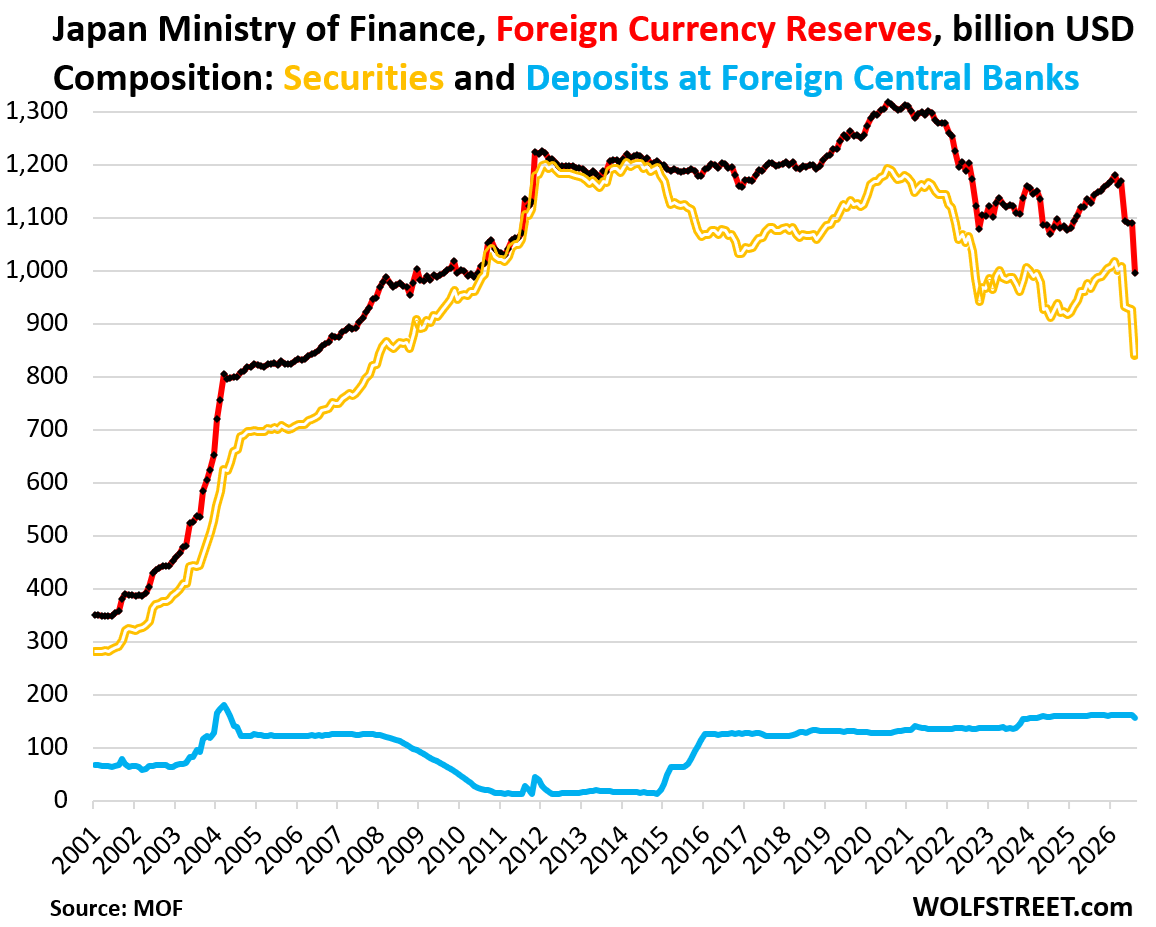
But don’t cry for Japan: As the yellow double-line in the chart above shows, the MOF bought most of these securities, mostly Treasuries, in 2001 through 2011, when the yen was much stronger against the USD than now – in other words, when it could purchase more US Treasuries with fewer yen. In February 2012, foreign currency securities reached $1.20 trillion – which was roughly the peak of the MOF’s foreign securities holdings.
At that time in 2012, Abenomics took off. The BOJ started doing massive amounts of QE and pushed interest rates to zero, and then below zero, while the government generated massive amounts of deficits, and over the years, the yen collapsed by 48%, despite the recent rally.
Now the MOF is selling those US Treasuries and buying yen with the USD proceeds, thereby getting many more yen for those securities than it had paid for them, realizing huge cash profits in yen terms.
Each intervention has generated massive profits, but none more than this one since it was the biggest intervention so far.

A slush fund forms from those profits. All cash proceeds in yen of these currency interventions, plus all cash proceeds from the yields paid in foreign currency, go to the Foreign Exchange Fund Special Account (FEFSA), which is legally separate from the government’s General Account so that politicians cannot create some sort of slush fund from the proceeds of those interventions.
The collapsed yen has massively amplified these returns as interventions continued over the past few years, while yields in USD on Treasury securities have surged since 2021. For example, for Japan’s fiscal year through March 2026, the FEFSA booked profits of ¥5.06 trillion, according to the MOF ($31 billion at the time). This does not include the profits from the interventions in May and on July 31.
The law governing the FEFSA specifies that 30% of the cash proceeds from those interventions and yields have to be retained in the FEFSA as buffer for future losses and to be reinvested in foreign exchange reserves.
The remaining 70% are then moved into the government’s General Account, where it’s political slush-fund time.
The government is now busy arguing over what to do with the ¥3.54 trillion in foreign exchange profits (70% of ¥5.06 trillion) that were transferred to the General Account – part of it for the fiscal year 2025, part of it for the fiscal year 2026.
Takaichi already stated when she became Prime Minister that the slush fund from the foreign exchange profits should be used to pay for her policy initiative of cutting the consumption tax on food from 8% to 0%. In August, a compromise was approved that reduces the consumption tax on food to 1% for two years, with special benefits for low-and middle-income people that effectively reduce that tax to 0%.
The stated goal is to not issue new bonds for funding the tax cut, and the government is now debating which slush fund to use for funding the tax cut, with all eyes on the profits from the foreign currency interventions.
Enjoy reading WOLF STREET and want to support it? You can donate. I appreciate it immensely. Click on the mug to find out how:


Paying down food consumption taxes for Japanese citizens…popular with the young generation, not so much with the pensioners. Good article.
I don’t think that the few Japanese pensioners I know would complain about food getting a little less expensive after that tax on food gets cut to 1% or to 0%.
And do not try and tell us weepies that our Fed wasnt a leader in this manipulation since 2012 which was a blueprint created for every central bank. Yet where are any profits made on these deals by our Fed which came back to our general fund?
The banksters at the FED made hay PRIVATELY, and so did all their wealthy buddies.
Thank you.
As always, the intervention tactics are interesting…but the baseline trends seem to me to much, much important (in other words, in the long term, even governments find it very, very difficult – and not rarely, terminally difficult – to offset/”control” negative long term trends in their mismanaged macro-economies).
So the bigger questions are *why* the Yen has been significantly falling against the USD (not exactly a truly healthy currency itself…) and why *now*.
1) The intermediate range answer is likely the one that Wolf mentioned – the interest rate differential between the US and Japan. Savings are (usually) going to flow to the highest yielding nations (well, just those nations that can sorta be trusted to not inflate/devalue their own currencies in short/medium term. Leastist dirty shirt America mostly qualifies).
2) But…longer term…Japan is in bad, bad shape macro-economically. 90’s vast overvaluation bust…followed by China absolutely gobbling up its export markets…followed by long-forseen demographic decline.
And with vast gvt-debt-to-GDP ratios, the Japanese G’s bag of temporizing tricks is likely played out.
Such factors make the Yen a riskier/less desirable place to hold one’s trans-national savings (thus Yen steadily falls).
In the end, holding one’s savings in a particular currency is a reflection of the growth rate/attractiveness/safety of real assets within the ambit of that particular currency.
Japan has always been at a disadvantage in terms of natural endowment of real assets – but monumental human efforts in Japan in the 50’s thru 80’s overcame this.
But political hubris/delusions/more-or-less corruptions damaged the Japanese Miracle and the follow-on China Miracle (with its own massive human efforts) quite possibly means the sunsetting of Japan.
We buy bonds in other currency as a hedge against USD. Some years big losers and some years big smiles. When hedging it’s for safety not so much greed.
Interesting article, Wolf.
I find the treatment of realized and unrealized gains and losses at the reserve bank level very confusing.
How do the “realized” profits (and the disposition of them that you describe) affect the BOJ balance sheet?
Also, is the accounting procedure similar to that followed by the Fed if/when it sells appreciated assets?
Thanks.
The BOJ has nothing to do with this topic here.
Those realized cash profits were generated by the Ministry of Finance (MOF), which held the Treasuries and sold them, and then sold the USD proceeds for yen, pocketing huge cash profits. I described in the article what happens to those profits.
in 2021, 10 year Note interest rates were 1.5%. So selling those notes now with 5 year yields at 3-4% would have involved capital loss which was more than covered by the gain on the exchange rate. But that exchange rate gain is a nominal gain right because YEN has declined in purchasing power by the same 48%. it seems a bit illusory.
Interestingly Abe (of Abenomics s) was assassinated with what seemed to me to be very little fanfare at the time.
Do you think it would be in Japans best interest to continue selling off it’s Treasuries, assuming it could do so without making the US angry ?
“In 2021, 10 year Note interest rates were 1.5%. So selling those notes now with 5 year yields at 3-4% would have involved capital loss.”
When did nearly all of this Treasury buying occur???? I told you just below the chart:
“As the yellow double-line in the chart above shows, the MOF bought most of these securities, mostly Treasuries, in 2001 through 2011…”
If i remember correctly the tax on food was not lowered to 0% because POS manufacturers could not implement it in time. So they lowered to 1%. As that could be implemented faster. :)
I don’t worry about the Japanese. They are a disciplined people that have survived much worse.
All the while the world ignores the supply side of the equation, just like the early 70’s…
…this time with the world awash in debt.
Interesting times Wolf. The only thing I feel comfortable predicting is that CONgress will continue to act irresponsibly.
Hedge accordingly.
“They are a disciplined people that have survived much worse.”
True.
But.
Failure to effectively respond/reform for 30+ years (see, also, US for 50+ years but much luckier in natural endowment of real assets) is a very, very, very strong indicator that Japan has lost the “magic”.
LOL! Again, I don’t worry about Japan. Watch what happens in L.A. county when those EBT cards stop working.
Failure to value intelligence and rewarding bad behavior for 50+ years will have much more serious consequences.
Hedge accordingly.
Seems like food on Japan must be as expensive as food has become in USA. Anything we can learn from this.
MW: Why the yen’s rise to a six-month high could go further
MW: Dow closes over 600 points lower as oil prices climb on escalating U.S.-Iran tensions
I’m stupid, obviously. I never considered BTC “safe” since it is basically just ether digits.
“A $320 Million Hack Exposes the Cracks in Crypto’s Plumbing”
Wolf, I have questions about the following sentence:
“The law governing the FEFSA specifies that 30% of the cash proceeds from those interventions and yields have to be retained in the FEFSA as buffer for future losses and to be reinvested in foreign exchange reserves.”
So is this saying there’s a good chance much of the 30% eventually gets put right back into US treasuries?
Or, if it stays in yen, are the yen deposited in Japanese banks (which would be stimulative)?
Or is it better to think of these funds as having been effectively deleted from the economy, like when the US Fed trades assets for US dollars, thereby removing those dollars from the economy and making them essentially fictitious.
Just guessing here. But I don’t think they will keep it in yen cash. Much of it will get re-invested in new Treasuries.