
Even without gas stations, retail sales jumped, powered by ecommerce, auto dealers, general merchandise stores, and other retailers.
By Wolf Richter for WOLF STREET.
Retail sales soared in March by 1.7% from February, seasonally adjusted. Compared to March last year, sales jumped by 4.5%, not seasonally adjusted.
But there was this spike in the price of gasoline, which caused sales at gas stations to spike. So the question arises: Did Americans cut spending on other stuff that they buy at retailers in order to buy gasoline? Nope, not Americans. Born to splurge.
Retail sales without gas stations jumped by 0.61% in March from February, after having already jumped by 0.67% in February, seasonally adjusted (red line in the chart). Year-over-year, retail sales without gas stations rose by 3.5% not seasonally adjusted (blue).
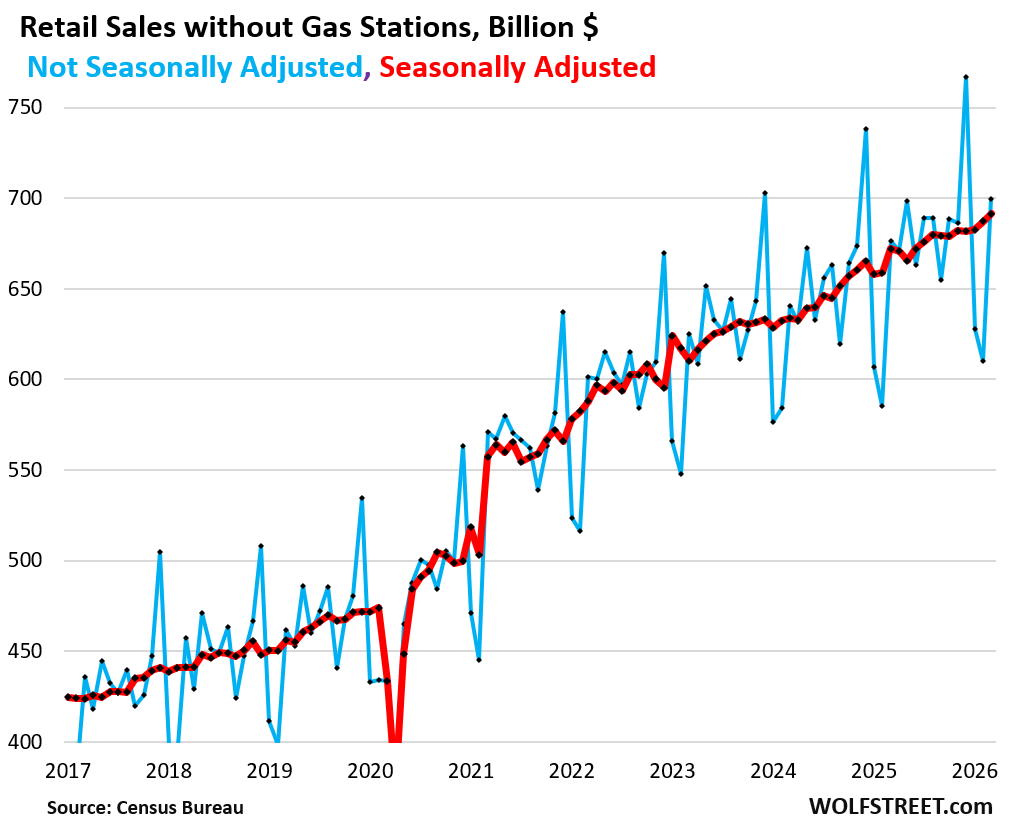
Avid inflation-adjusters, note: Most inflation is in services, and retailers don’t sell services, they sell goods. CPI inflation in durable goods was close to 0% in March both month-to-month and year-over-year. And CPI inflation in food bought at grocers was 0% in March and less than 2% year-over-year. The CPI for gasoline spiked, and that explains the spike in gasoline sales, see chart further below.
Inflation in services, which is where Americans do two-thirds of their spending, was over 3%. But you cannot adjust retail sales to inflation in services that retailers don’t sell. You have to adjust retail sales to inflation in the goods that retailers sell. And outside of gasoline, there wasn’t much.
The largest categories of retailers.
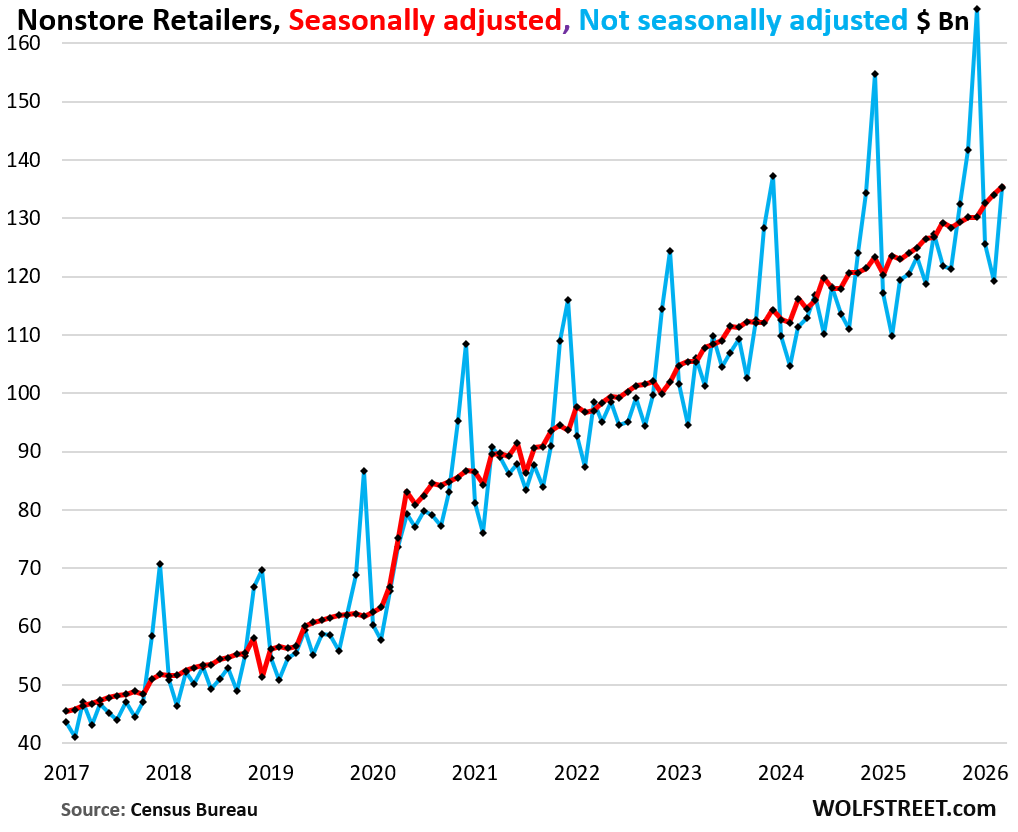
Ecommerce sales (18% of total retail sales) have been soaring relentlessly, gobbling up market share from brick-and-mortar retailers, growing year-over-year at over twice the rate of overall retail sales.
This includes ecommerce sales by retailers with brick-and-mortar stores, such as Walmart, Macy’s, Costco, etc. Their online sales count here, and their brick-and-mortar sales count in their brick-and-mortar category.
In March, sales at these nonstore retailers jumped by 1.0% from February, seasonally adjusted, to a record $135 billion, making it the #1 largest category of retailers in March.
Year-over-year, sales jumped by 13% not seasonally adjusted and by 10% seasonally adjusted.
There is no sign that consumers cut their online spending because they spent more on gasoline. These are big sales increases, even for ecommerce:
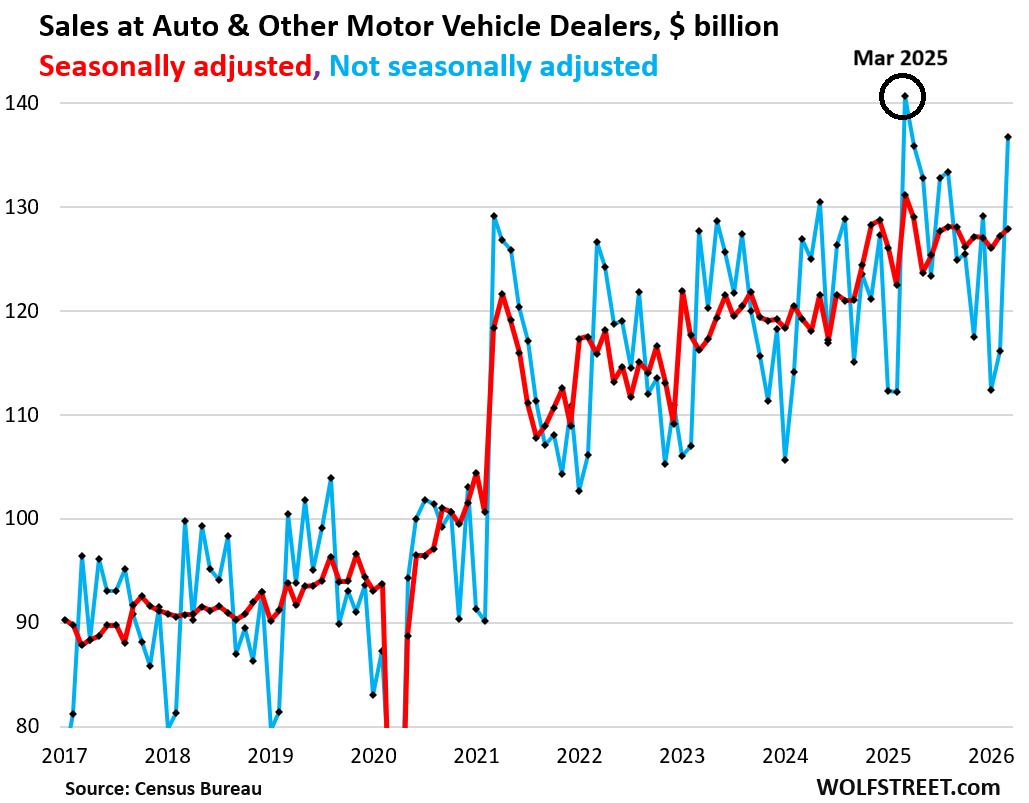
Sales at Auto & other motor vehicle dealers (17% of total retail sales) rose by 0.6% in March from February, seasonally adjusted.
Year-over-year, sales fell by 2.8% not seasonally adjusted (blue line). But that was compared to March 2025, when tariff-fearmongering clickbait in the mainstream media, financial media, and social media about exploding auto prices caused a massive wave of frontrunning and a huge spike in sales. Those prices ended up barely budging, as automakers had to eat all of the tariffs to not lose sales and market share. Beyond that front-running-distorted comparison, sales in March this year were pretty good, the second-highest ever, up by 18% month-to-month not seasonally adjusted, and by 0.6% seasonally adjusted.
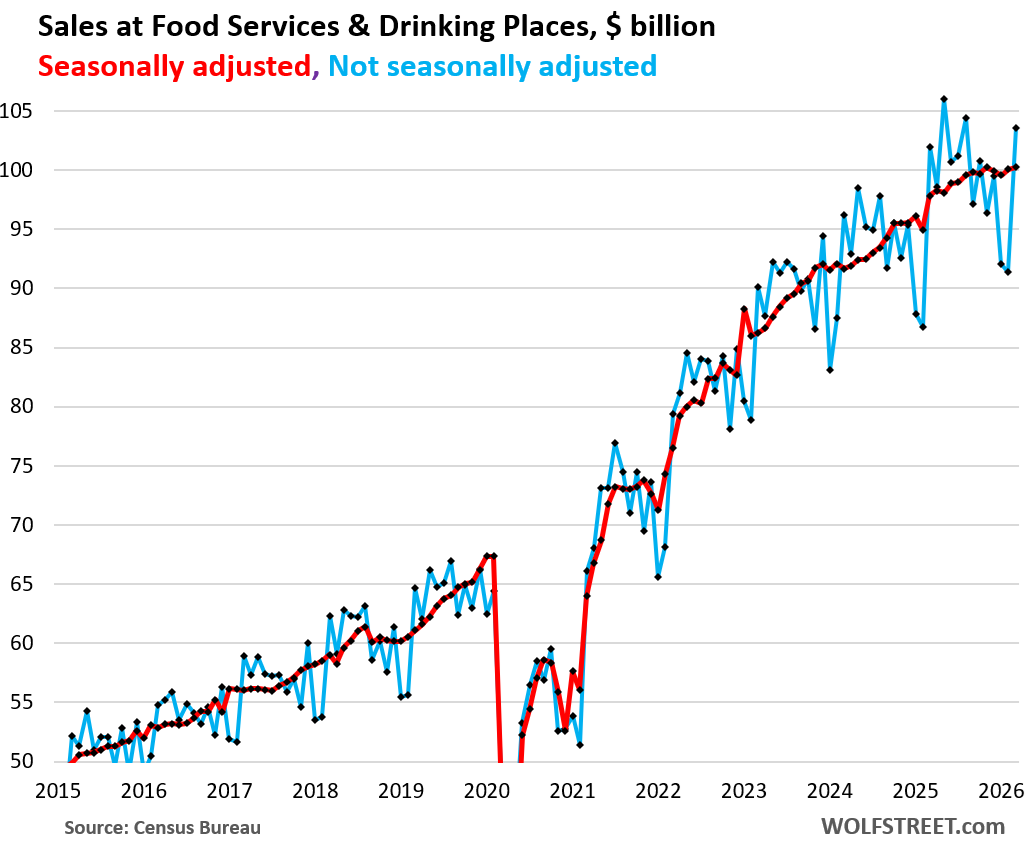
Sales at Food services & drinking places, such as restaurants and bars (12% of total retail sales), rose by 0.1% in March from February, seasonally adjusted.
Year-over-year, sales rose by 2.4% seasonally adjusted and by 1.6% not seasonally adjusted.
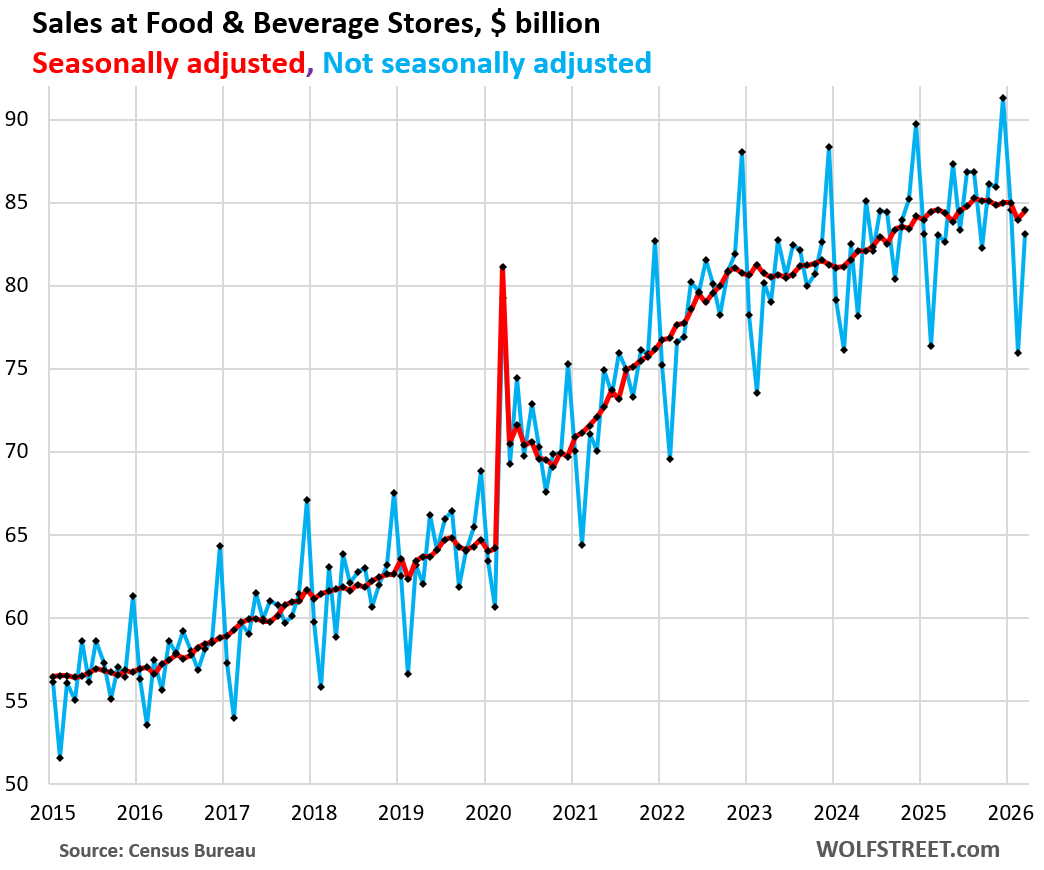
Food & Beverage stores, such as brick-and-mortar supermarkets, grocery stores, and specialized beverage stores (12% of total retail sales) have long been losing market share to online grocery retailers, including their own online operations, to “general merchandise stores,” such as Walmart and Costco that do a booming business in groceries, and to restaurants (see chart above).
So when “sales at food & beverage stores” languish, it’s not because Americans went on a diet, but because sales shifted to other types of retailers, including ecommerce, general merchandise stores, and restaurants. This has been going on for many years.
Walmart, the largest grocer in the US, has been aggressively going after the grocery business, including the ecommerce grocery business, none of which count here in this category. Amazon has been selling groceries online in various iterations. There is now a huge choice of online food retailers – both online-only retailers and the online operations of brick-and-mortar retailers. And these sales don’t count in this category of “Food & beverage stores”; the count in ecommerce, regardless of how the food got into the house, whether delivered by the company, or a carrier, or picked up by the customer.
And we can see this change show up here in the numbers.
Sales at food & beverage stores (brick-and-mortar) jumped 0.7% in March from February, but was unchanged year-over-year, at $84 billion
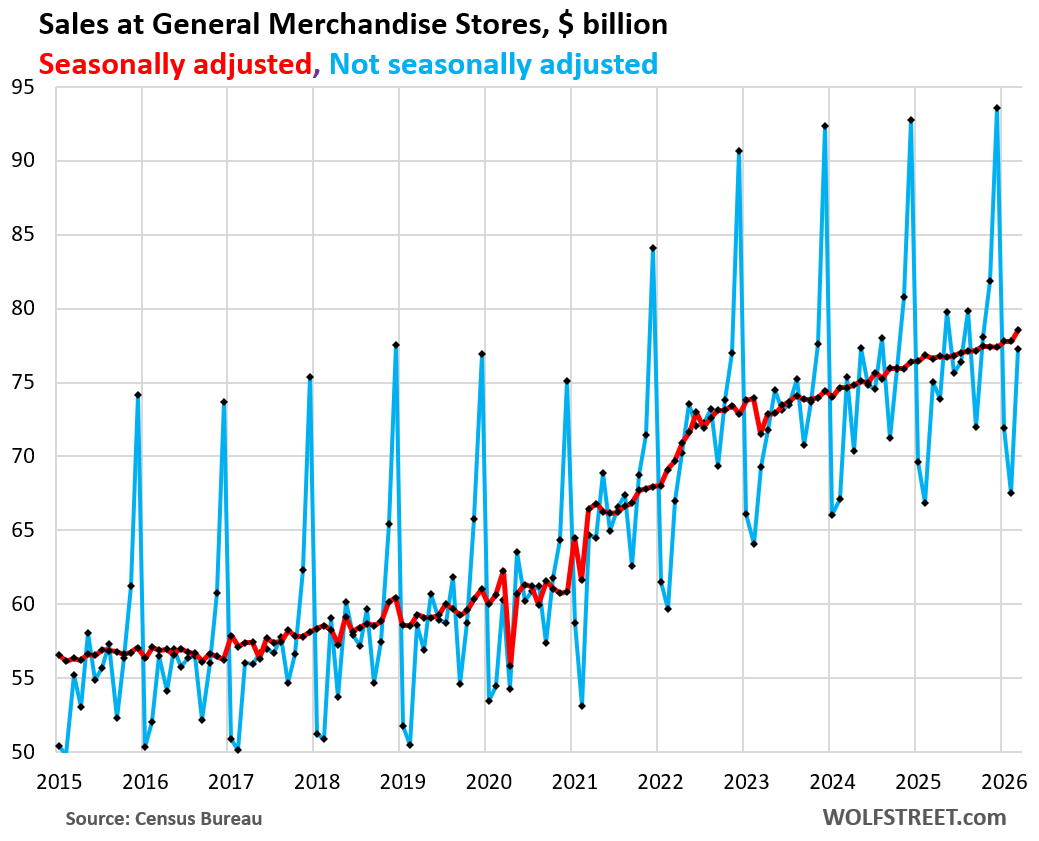
Sales at General merchandise stores (11% of total retail sales) jumped by 1.0% in March from February to $79 billion. Year-over-year, sales were up by 3.0% not seasonally adjusted and by 2.5% seasonally adjusted.
This category includes Walmart, Costco, Target, and many others. Many of them also sell groceries, with Walmart being the #1 grocer in the US, and their grocery sales are here in this category, not in the category of food & beverage stores.
But sales of their ecommerce operations are included under the ecommerce retailers above.
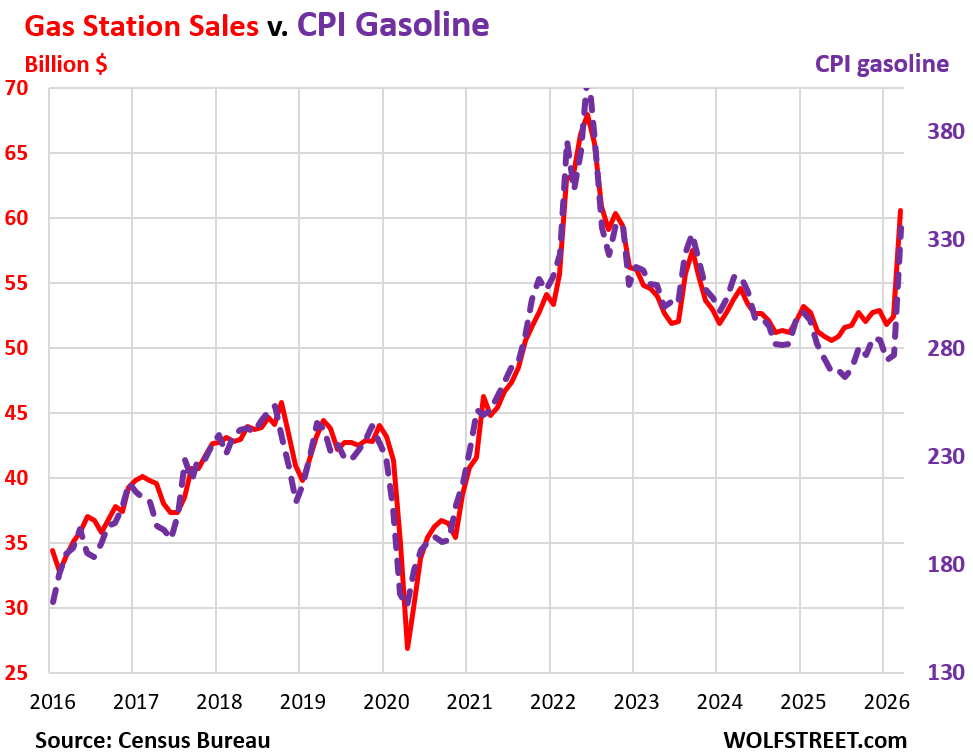
Sales at gas stations (7% of total retail sales) move in lockstep with the price of gasoline. Gasoline prices spiked in March, so sales at gas stations spiked in March.
Sales at gas stations spiked by 15.4% in March from February, and by 18% year-over-year to $61 billion (red in the chart below, left scale).
The purple dotted line (right scale) shows the CPI for gasoline, which also spiked.
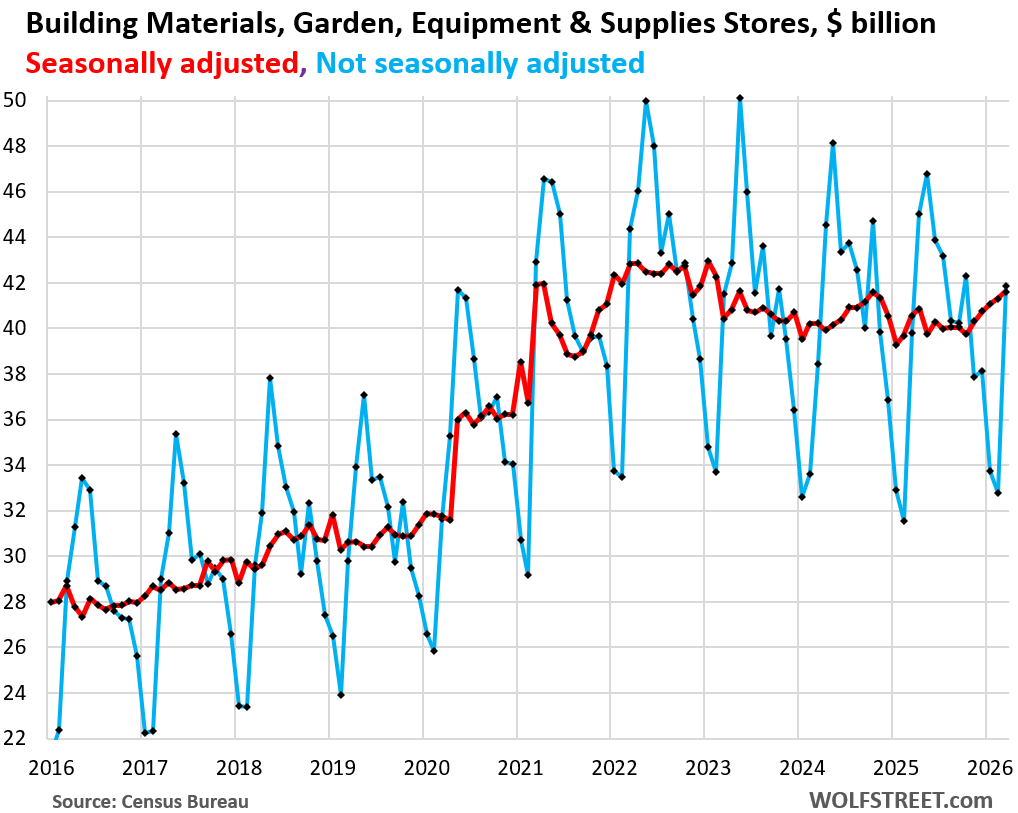
Sales at Building materials, garden supply and equipment stores (6% of total retail sales) jumped by 0.7% in March from February, seasonally adjusted, to $42 billion. Year-over-year sales were up by 2.6% seasonally adjusted and by 5.3% not seasonally adjusted.
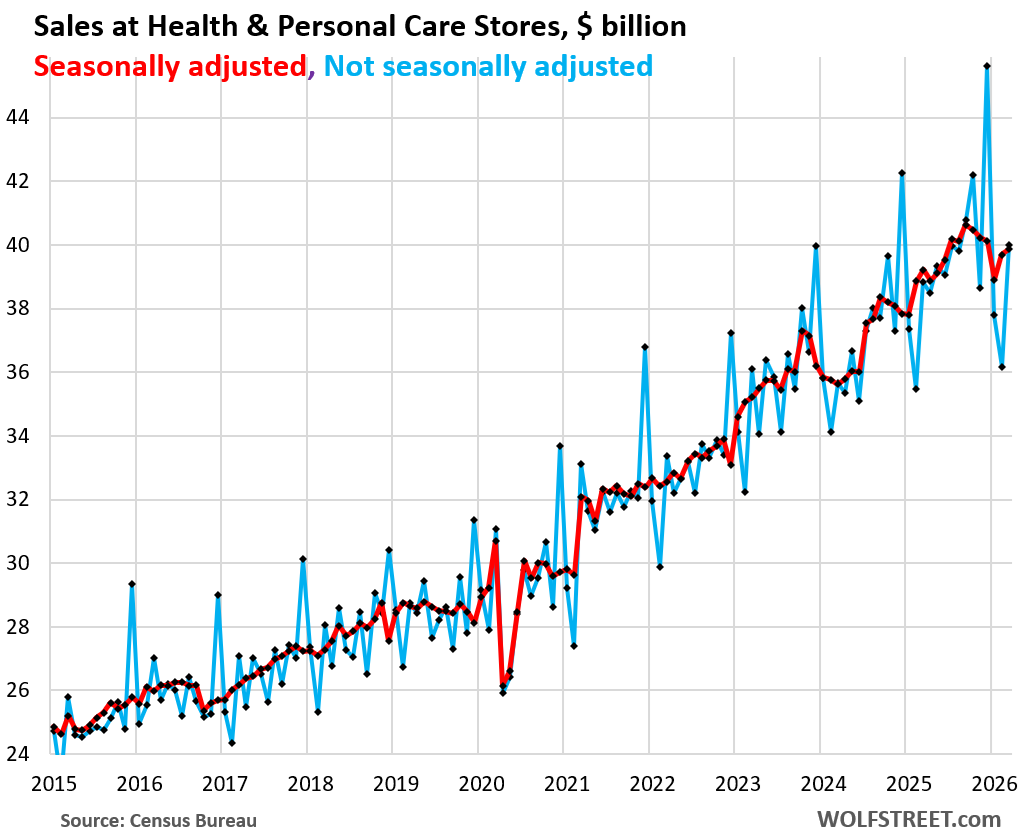
Sales at Health and personal care stores (5% of total retail sales) rose by 0.5% in March from February seasonally adjusted, to $40 billion.
Year-over-year, sales rose by 3.0% not seasonally adjusted and by 1.6% seasonally adjusted.
In case you missed it: Where Americans Spend their Trillions on Goods and How that Changed since 2015
Enjoy reading WOLF STREET and want to support it? You can donate. I appreciate it immensely. Click on the mug to find out how:


Howdy Lone Wolf. A Sober Sailor Guilty as charged. US old squirrels learned a long time ago, always save some of your $$$ and you will live your life your way. No matter what comes. Currently received my best discount ever on a new car and thought, what the hell buy it even though I could have kept my old one. Cant take it with you …..
A senior sober sailor sailing till I can t sail no more…..
It’s not the tax refunds that are doing it. Just found out the IRS is 2 months behind processing paper tax returns due to the shutdown. I will not get mine before mid June at the earliest even though they received it on March 6th. They haven’t even entered mine into their system. It was sitting for 2 months collecting dust.
You are assuming your situation applies to others. Did you know that 94% of federal tax returns are filed electronically with refunds issued quickly?
Rather than complain, why not file electronically?
Americans clearly have a lot more money, collectively, than people realize
Howdy TSonder. I thought I was the only one that paid off credit cards every single month, saved $$$$ all the time, always lived within my means. After seeing the Lone Wolfs articles, I realized how wrong I was… There are millions and millions just like me…. Thought I was special but am not. Oh Well…..
Strange. Being on fixed incomes we haven’t bought anything out of our usual items necessary for maintaining our property and vehicles. No luxury items and actually cut back on vacation. Our insurance, electricity and taxes have all increased along with cost to eat out. Luckily our cars are hybrids so the gas prices don’t affect us much. We don’t do much driving anyway.