
Despite only tepid job creation by the private sector, unemployment remains historically low.
By Wolf Richter for WOLF STREET.
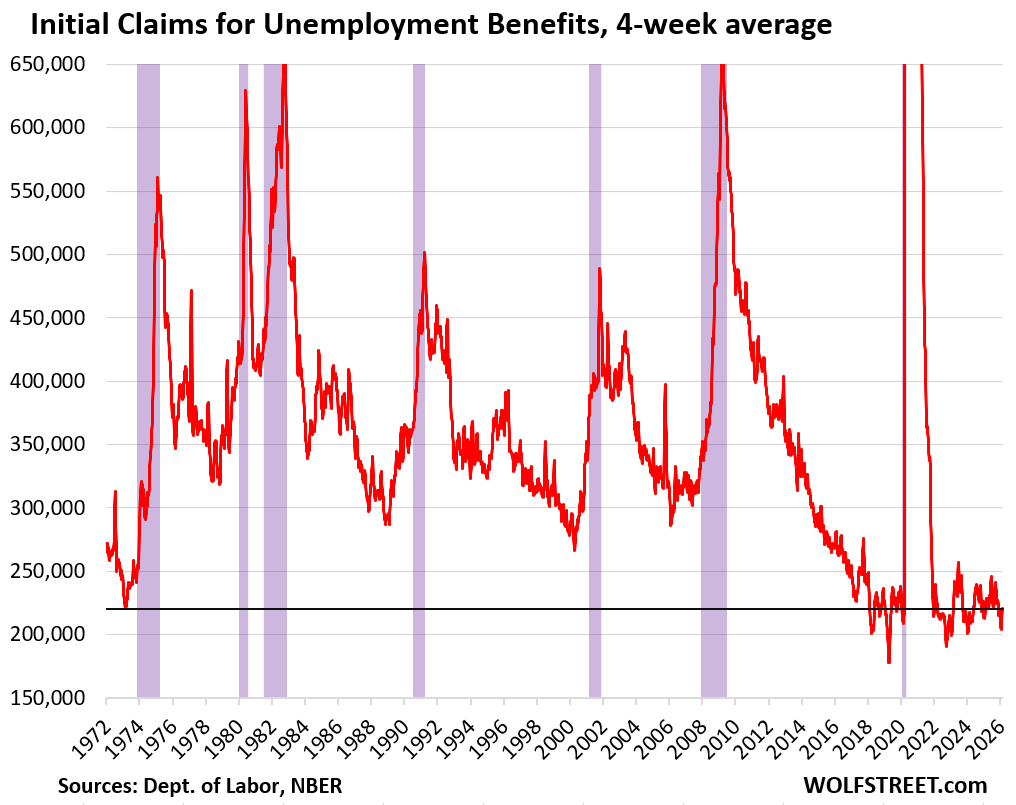
So another piece of the puzzle today: Initial applications for unemployment insurance benefits in the week through Saturday, at 212,000, were historically low. The four-week average, which largely irons out the week-to-week squiggles, at 220,250 and roughly unchanged for three weeks, was also historically low. There were only a few weeks in the decades from the 1970s till the pandemic when the four-week average was even lower.
Freshly discharged people filed these unemployment insurance claims at their state unemployment agencies, which then report them to the US Department of Labor by the weekly deadline, which then publishes it. This is not survey-based.
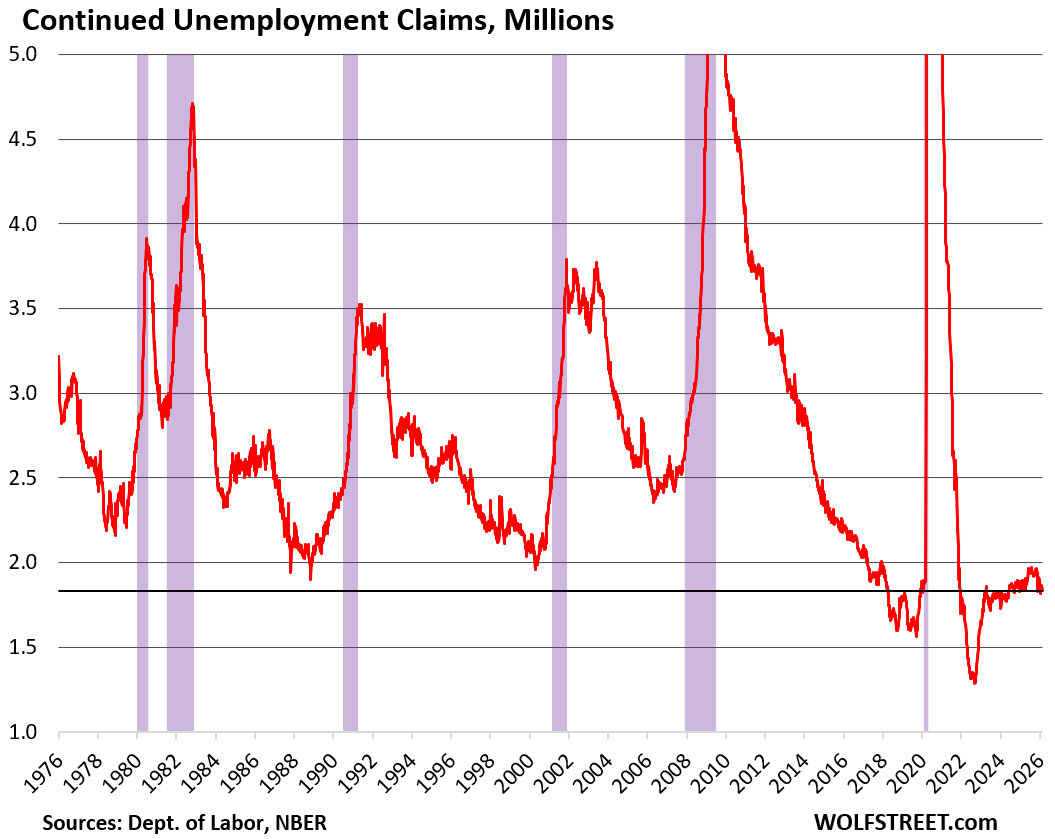
Continued weekly claims for unemployment insurance benefits fell to 1.833 million. Since their recent high in July 2025 (1.968 million), they have dropped by 135,000.
This reflects the total number of people who’d initially applied for unemployment insurance at least a week earlier and are still claiming unemployment insurance because they still haven’t found a job.
Over the past five decades, it’s only during the tight labor market in 2018 and 2019 and in the years of the labor shortages in 2022 through early 2023, that the level was ever lower.
It indicates that people remain on unemployment insurance rolls a little longer than in 2022 through early 2023 during the labor shortages, and in 2018-2019 during the tight labor market, but less long than in the prior decades.
This is one more indication that overall, employers are hanging on to their workers despite some global layoff announcements by some big companies.
These announced layoffs don’t all happen in the US. And some of these announced layoffs don’t lead to actual layoffs, but to workers finding different jobs in the same company. And some of these layoffs hit remote jobs as companies are cracking down on workers resisting RTO policies, while workers for in-office jobs are getting hired.
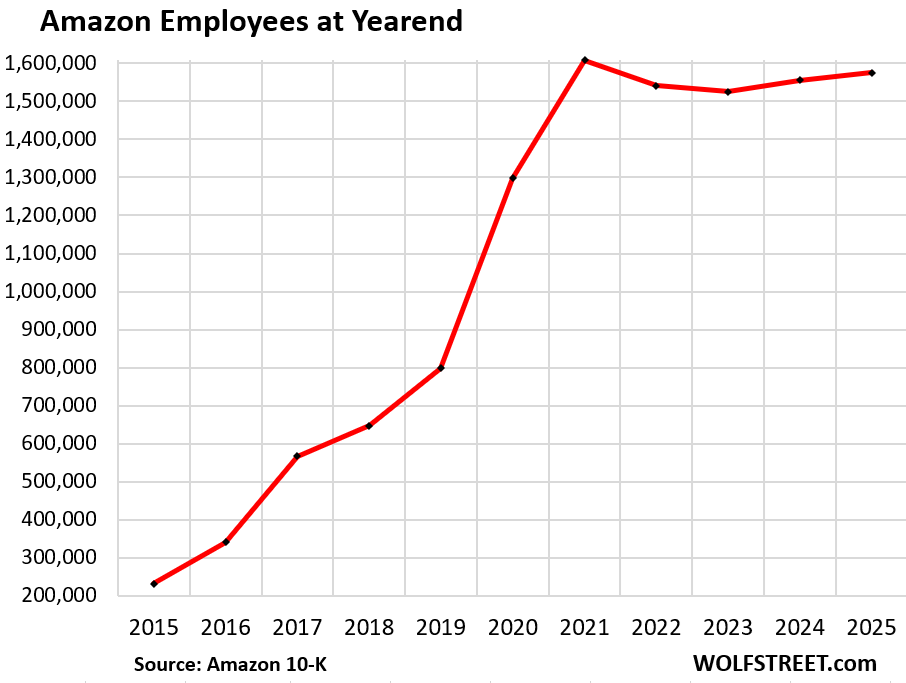
Amazon is the biggest example. It has announced shockingly huge waves of layoffs starting in 2022. But it also hired during that time, and its gigantic headcount – a mix of fulfillment center & distribution workers and tech workers around the globe – has barely changed, and at 1.576 million at the end of 2025, was down by only 2.0%, or by 32,000, from the peak year 2021.
But in 2020 and 2021, in one of the most astounding binges ever of helter-skelter overhiring, Amazon added over 800,000 workers, and its headcount had more than doubled. In the seven years 2015 to 2021, its headcount had multiplied by 7.
And since 2022, it has been trying to clean up the effects of this overhiring. Automation has also increased.
Alphabet is another big example. It also announced big waves of layoffs starting at the beginning of 2023, but its headcount actually still rose that year. It showed a lot of people out of one door, including 35% of its managers that had been overseeing small teams, while it hired a lot of people through the other door. And at the end of 2025, its headcount was just a hair below the 2023 peak. But in 2020 and 2021, its headcount had exploded by 60%.
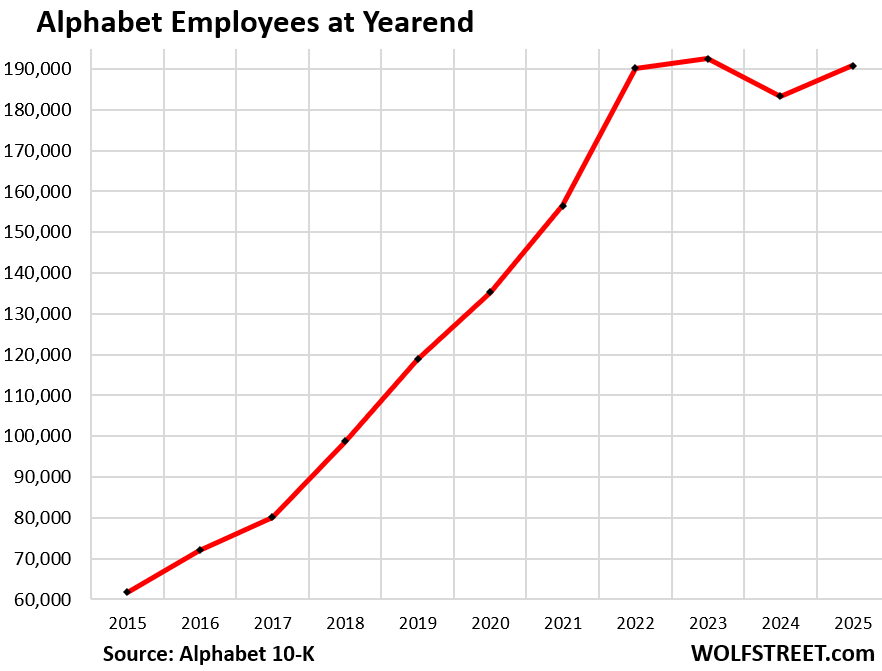
What these two examples, Amazon and Alphabet, show is that job creation has stalled at these two companies, after exploding in 2020 and 2021.
And they’re not alone. In the private sector, job creation was tepid in 2025, while the federal government and state governments have shed nearly 400,000 jobs combined.

Tech workers, white-collar workers, and recent college graduates looking for work in tech and other white-collar jobs are getting tripped up by corporate decisions to deploy AI to do more and more things, adding to the productivity of the existing workers and thereby requiring fewer new workers. This is now playing out everywhere.
Maybe it will trigger a day of reckoning at these companies, just like the overhiring had triggered a day of reckoning in the other direction, but for now, it has become corporate dogma.
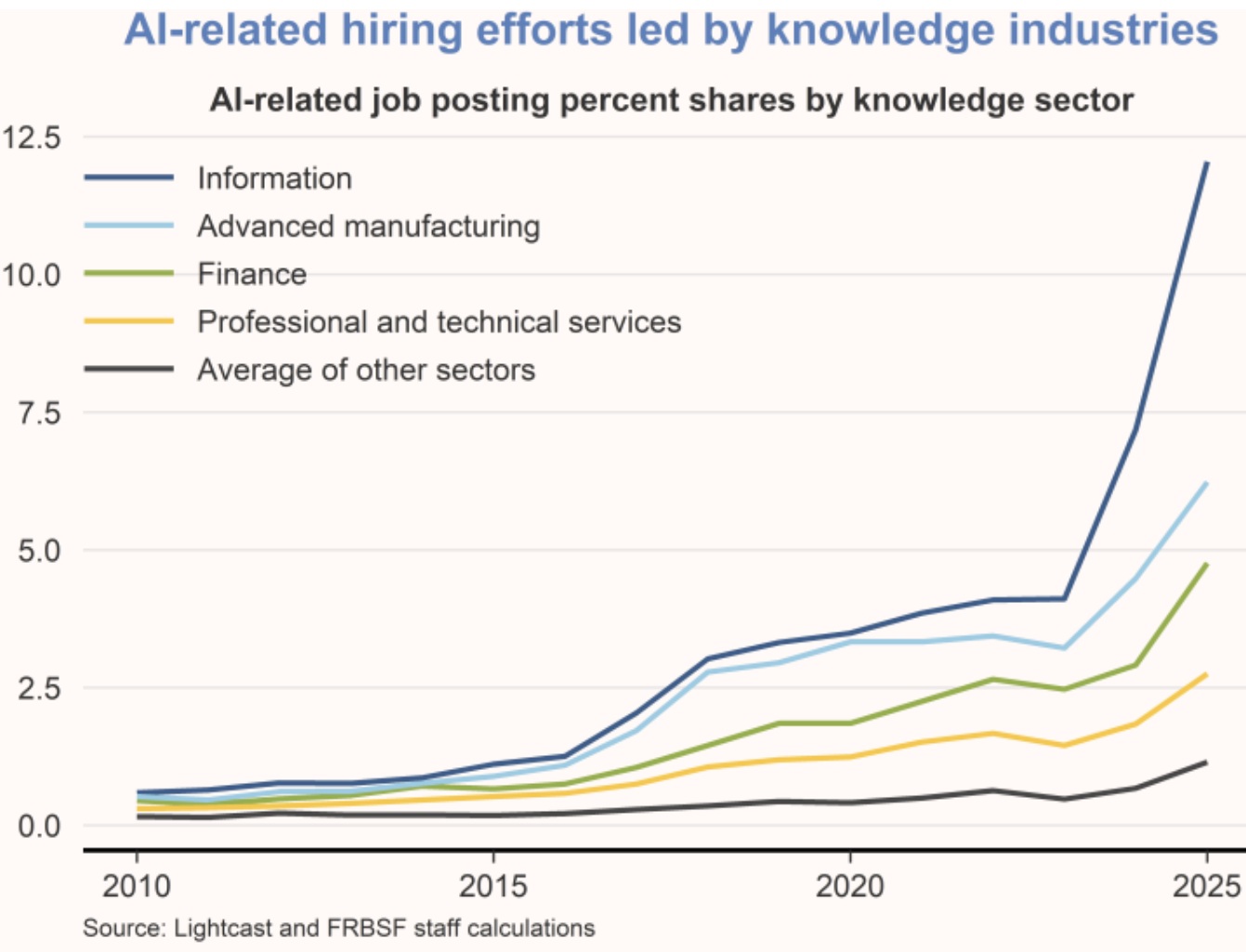
At the same time, they’re scrambling to fill AI-related jobs. Companies in all kinds of industries are scrambling to hire AI workers: In information, advanced manufacturing, finance, and professional and technical services, and AI-related job postings over the past two years have tripled in those sectors, according to data from Lightcast and San Francisco Fed calculations. And some companies are trying to attract them with mind-blowing compensation packages. There are also labor shortages in other parts of the economy, particularly in the trades.
At the same time, the supply of labor is being throttled back. Net migration to the US – immigration minus emigration – has slowed to a crawl and may turn negative in a year or two, according to Census Bureau estimates: The crackdown on illegal immigration, the tightening up of legal immigration, the substantial outflow of immigrants (self-deporting, getting deported, and legal immigrants leaving), and Americans moving to foreign countries in record numbers – that confluence of factors has changed the dynamics of labor supply, resulting in low unemployment despite slow job growth.
Enjoy reading WOLF STREET and want to support it? You can donate. I appreciate it immensely. Click on the mug to find out how:


I see a lot of folks looking for help in the trades,well…..,take on apprentices!
I as a builder see the need for skilled trades but also see less folks taking on apprentices/willing to train folks and keep em trained with the trades and codes changing.
I hope more hire from the tech high schools whether young grads or as many offering adult programs with grants(yep,tax monies but actually feel this is a good investment/return).
I have mentioned before had a friend who was a squirrel(arborist)who at 50 just needs to stop or get long term injured.He is taking the basic HVAC course and upon completion will have some basic skills and also at graduation they get a gift certificate of 600 towards tools,these are folks who have invested their own time and feel would make great apprentices/assets to companies.
Skilled help is great,you have folks with good skills,try and keep them with rewards and making sure their skill sets are up to date,this is true with any business.
Look at construction jobs in Texas, good luck getting one if you don’t speak Spanish.
I know people with over 20 years experience in the “trades” that can’t get a job, even at the much lower wages now being offered.
I have no experience working in the Texas region but at the moment in New England things chugging right along and pay rates pretty damn good.
As more deportation continues feel will be even a better market for trades until economic reality sets in,then,we may all be looking for a job!
Petunia: In spite of my vast regard for your many comments, IMVHO, in this case I suggest major concerns.
When I started back into the SWFL construction industry in ”early ’90s” it was still as I had known back in the ’60s and earlier, but the Spanish speaking folx were minor…
20 years later, the very good workers, mostly very clearly bilingual, were good and better crew leaders and even overall job site superintendents.
To be clear, I too was challenged due to age,,,
And then was able to make the transition to the office.
Good Luck and God Bless ALL the brothers and sisters who WANT to make similar transitions from doing real hands on stuff to the ”office”’…
VV,
I never said Spanish speaking construction workers were not good workers and most work for lesser salaries. What I said is that employers, in TX and elsewhere in the South, demand construction workers speak Spanish as a condition for employment to weed out native workers who are just as good or better, so they can pay less. Since you hired them, you know the drill.
NVDA, the king of AI jungle flopped. If WTI rises to $100/ $125 and
SPX drops 1,000 pt, the banks can cut rates – including C/C rates – still
above Fed rates and inflation rates. The banks will make money charging fees and interest, C/C debt can rise to $2T/ $2.5T. The rest suffer, including RE owners.
Wolf I am curious about your term over hiring. In a time of loose money these companies grew rapidly. As did their products and services, and hopefully revenues. Perhaps it was appropriate hiring for the time, as is their levelling off of hiring in the present.
That’s not my term. That’s the term the CEOs used when communicating the layoffs to their employees, thereby taking the blame for the layoffs. In the sense of: it’s our fault, not yours, we overhired, now we have to fix it.
Just now, Jack Dorsey used that term — “Yes we over-hired during covid,” he said on X — when explaining why he was laying off 40% of Block’s staff, which had more than tripled in three years, from about 4,000 to 12,000 now.
They’re all using that term.
This situation reminds me of the phenomenon you have written about regarding companies that leased tons of office space they didn’t need, but figured they MIGHT need later, and now are hastily trying to get rid of it.
It makes me wonder why these brilliant business leaders seem to be so myopic and unable to think more than 3 chess moves ahead. I understand forecasting staffing needs or office space needs is difficult, but they were so egregiously wrong it makes you wonder.
Absolutely I mean what is the status of the CRE, the commercial real estate market.
From what I hear, it looks like the financial decision is most likely to be based on minimizing the loss rather than the insanity of holding out for the price that was payed for the asset in the previous decades.
The $40T gov debt will flop.
Do you have a time range for this prediction?
Wolf!! A lot of these hirings happened in India and outside. Most layoffs happened here. The total employment is for the entire world. US composition has changed a lot in the last 3 years. If you take into account only American employment these companies the graph will be different.
Those were global layoff announcements, as I said. And some of them didn’t happen in the US, as I said. And some of them didn’t happen at all, as I said. At the same time, the companies were hiring through the other door, as I said.
As someone who works in Tech, it is true lay offs were global phenomena.
But the most of the brunt of lay offs were borne by the higher cost center/geography than cheaper cost center/geography.
So, both Ram and WR are correct in their statement.
Bottom-line: Companies are laying off to save $$. It does not make sense to lay off cheaper workers.
I worked in the mines, harvesting the minerals that eventually will be refined to the elements;
including Cu, Ni, Co, U, Ra, Gd, Ag, Mo, Tantalum, Neodymium and the lanthanide series, natural carbon minerals and biological precursors, iron ore processing for both hematite ferric oxide, fe302 and ferrous oxide, magnetite Fe2O4 which is the magnetic common iron oxide minerals.
I know IBMers in Austin who lost their job 2 years ago and are still unemployed. They are not being counted as unemployed anymore, that’s why unemployment is not that bad.
Petunia, you’re spreading ignorant BS on my site because you never read anything here. they are counted as “unemployed” and figure in the “unemployment rate” which are part of the jobs report, to be released next Friday. They dropped off the “nonfarm payrolls” when they lost their jobs and they pushed down “nonfarm payrolls” and counted in a negative way. But they don’t count here as “unemployment insurance claims.” But that’s always the case, people always drop off the uninsurance rolls, that’s a constant, and nothing new.
Wolf does a lot of articles on unemployment, and knows how all the data series work. But many of the readers don’t.
Might be worth doing a “big picture” post that walks through how all the employment/unemployment metrics relate to one another.
Each of the metrics gives a part of a bigger picture, but they all have constraints & limitations. For instance, the weekly “Initial Claims” and “Continued Claims” series only cover people who were recently laid off (last 2 weeks, last few months) and haven’t found a new job yet. But they don’t measure people who couldn’t find a decent job within a few months of being laid off, and are either working unhappily in some other way, or still unemployed.
Right now the weekly “Initial Claims” and “Continued Claims” data are showing steady labor market turnover. But the monthly data for longer-term unemployment (“Number Unemployed for 27 weeks and over” in FRED) is elevated. There are just under 2 million would-be-workers in that group, up about 0.7 million from the pre- and post-pandemic lows.
So there are in fact more people struggling to find work than “usual” in a healthy economy. And if you know one of them, that will resonate with you.
On the other hand, total unemployed and labor force participation rate are steady.
Seems like the economy as a whole is doing okay, but there is a lot of change going on, and that has displaced a couple million people who are struggling to find their “next thing”.
1. ” longer-term unemployment (“Number Unemployed for 27 weeks and over” in FRED) is elevated”
That’s an absolute number. over the years and decades, employment and the labor force have grown sharply, along with the population including a huge spike in 2021-2024. So you need to express this in terms of total employment or in terms of the labor force or in terms of nonfarm payrolls, and come up with a ratio… If you express it in terms of the labor force, it will be similar to the unemployment rate.
And that demolishes your whole theory.
2. “labor force participation rate are steady.”
It reflects the largest generation ever (boomers) retiring, starting about 15 years ago. Why don’t you read my articles here?
Look at the prime-age participation rate, which excludes the issue of boomers retiring:
https://wolfstreet.com/2026/02/11/private-sector-ramps-up-hiring-job-losses-mount-at-federal-state-governments/
From my article:
“The prime-age labor force participation rate (25-to-54-year-olds) rose to a multi-decade high of 84.1%.
“The prime-age labor force participation rate eliminates the issue of the retiring boomers. The overall labor force participation rate shows the percentage of the population that either has a job or is looking for a job. When people retire and stop looking for a job, they exit the labor force but remain in the population until they die. The surge of boomer retirements, which started about 15 years ago, has pushed down the overall labor force participation rate, as these retired boomers are still in the population but no longer in the labor force.
“The prime-age labor force participation rate is a cleaner depiction of participation in the labor market, than the overall participation rate, and speaks of a lot of strength in the labor market that has been changing dramatically since early 2025 due to the crackdown on illegal immigration, which has slowed the growth of supply of labor.”
“as I said”.
You don’t say? (an old phrase from the 1950s, indicating curiosity or sarcasm).
If the Fed lowers rates from here, it won’t “save jobs” or “increase hiring”. It will provide the capital to companies that they need to make the investments into AI, effectively accelerating the pace of job losses. The Fed would do better to focus exclusively on inflation. If the Fed truly wants ”maximum employment”, then they will hold rates exactly where they are, or even hike one or two times, over the next three years, to dampen the AI job loss transition.
“corporate decisions to deploy AI to do more and more things, adding to the productivity of the existing workers and thereby requiring fewer new workers”
We’ll see if “AI” shows up in the productivity statistics. So far, it really hasn’t, despite the grand proclamations of the LLM vendors, and certainly not at the scale promised (remember devs talking about “sipping rocket fuel”?) Funny enough, in my day job, my co-workers who use “AI” for programming tasks spend a lot of time futzing with the chatbot, and complaining about how the “AI” tools are obviously “vibe coded”. No discernible increase in the rate of new feature releases or bug fixes. In fact, from what I can tell, the bugs are proliferating faster than before. Probably in the warehouses, automated sorting and such enabled by better machine learning applications will make a bit of difference, and some fraction of workers who previously packed boxes and moved them around might get to supervise and repair the machines, move up the value chain a bit. Not so sure in white collar land.
Corporate dogma is right though. Eventually the C-suites will have to realize they’ve been lied to. It’ll take a while to get there. In the meantime, companies that lay off workers in favor of chatbots are going to face a rude awakening.
AI is a nuscence that must be tolerated for the next several years.
That is an estimate of the amount of time that AI bots convince each other of a common solution.
Probably eliminate the humans
Well it does improve spelling.
😉
That all changed when Antropic demonstrated the CCC software project on Feb 5, 2026. That project is similar to the Wright brothers 120 foot flight at Kitty Hawk in 1903. By 1905, the Wright brothers flew 24 miles, nonstop. While the CCC project has many bugs and deficiencies, it was completed in two weeks. Had a team of the best domain specific software experts/engineers in the world tried to create the same project in two weeks, the bugs and deficiencies would have been much greater, if they could even get their project to work at all in that time frame. I have personaally written a compiler alone, similar to the CCC project, so I am not blowing smoke here. While I may not be the best engineer in the world, I have a deep understanding of all the features that must be co-ordinated among team members and implemented to get CCC to function at the level of feature support that it includes.
Just so people can understand what an enormous impact this AI milestone will have for all AI projects, going forward, I’m including a link to an article written by the original principal architect of the LLVM sotware project, the “gold standard” for projects similar to Anthropic’s CCC project:
https://www.modular.com/blog/the-claude-c-compiler-what-it-reveals-about-the-future-of-software
Intellectual property is a big focus of the article, and it has been my focus, too, when I have discussed this topic on other forums.
What the linked article does not mention is that there is a type of software called a “decompiler” that can pick up any executable ever written in the history of programming, and convert it back into source code, which is human readable IP. If you want to crate a word processor with AI, your could first decompile every word processor ever written, then have AI generate a word processor by taking the “best pieces” of software procedures out of each of those projects, and amalgamating them into a “new” word processor. The intellectual property violations here could be very hard to prove. This is why many “software” stocks have been tanking lately. I’ve oversimplified here, but more or less this is what AI will be doing, with the help of human beings for a few years, until the human direction gets analyzed and codified into higher level, automatable processes. My two cents.
Yeah but humans don’t want to create our own software.
We want it ready to go with no bugs.
We want to all go to the store and buy the 1 that works and all our friends and relatives use.
Remember the alternative word processors? I can’t even remember their names. But there were some. Everyone just used word from Microsoft.
AI could build a flaming car that shoots hoola hoops out, but I don’t want one of those.
Let me extrapolate the current AI situation a decade into the future with an analogous human intelligence quip:
Magnus Carlsen (born 1990) is a Norwegian chess grandmaster, widely considered the greatest player in history. “I have no chance against my phone,” Carlsen admitted. Carlsen explains not playing against engines: ‘They make me feel stupid’
So analog wins?
Yup
AI (actually LLMs) are a game changer anywhere knowledge is codified: software, medical, translation, lawyers etc. IMO software became a commodity at this point.
It’s of little use where process is stochastic like investing or complex systems.
On the medical front, a recent study found that when you don’t already have the answer to feed into a model, models are worse at diagnosis and determining courses of action than just using a search engine: https://www.nature.com/articles/s41591-025-04074-y (Of course if you already know the answer to feed it into the machine, what do you need the machine for?)
As for legal, don’t get me started. Legal work depends on understanding. LLMs don’t understand. LLMs hallucinate citations, misinterpret legal docs, and have gotten numerous lawyers in hot water. I have strong doubts that this is something that can be fixed, to the extent that robo-lawyers replace people. Hallucinations are inevitable, even in summaries.
AI Jobs Scare: Block Axes 40% Of Staff, Says Most Firms Will Follow Suit. The tsunami is coming!
I don’t even know what Block did or does?
So who cares.
There will always be greedy morons.
Block is the new name of the company that was called Square, and that operates payment services Square and Cash App, BNPL lender Afterpay, plus some other stuff. Annual revenues of about $25 billion.
Ahh thanks,
I was once in the market for a manual processor.
I learned the squares had horrible security on the back end with customer card numbers and such. But this was years and years ago.
As I said all through 2025, the last thing Congress needs to do is create amnesty for all these illegal immigrants. Over the next 10 years, there will be significant upheaval in almost every sector of the US labor market.
From workers picking crops, to factory workers, to knowledge workers, the labor supply will shift towards too many workers competing for fewer jobs. The shift will begin in earnest in the next 3-5 years with it accelerating towards the mid 30’s.
The percent of Americans who view a college education in a positive light has dropped by 50% in the last 15 years down to about 35%. By 2032’ish, that figure will be headed towards single digits.
My 25 YO son just got hired by Snowflake. I sincerely hope he can make a go of it, but I really wish he would do a 180 and go work in the residential building industry with a goal of being a builder / developer sooner rather than later. Time will tell.
I’m four hears from retiring as a teacher, and while I’m very excited, I’m just as apprehensive about our economy / political / social cohesion.
Labor Force Participation Rate
https://fred.stlouisfed.org/series/CIVPART
It reflects the largest generation ever (boomers) retiring, starting about 15 years ago. Why don’t you read my articles here?
Look at the prime-age participation rate, which excludes the issue of boomers retiring:
https://wolfstreet.com/2026/02/11/private-sector-ramps-up-hiring-job-losses-mount-at-federal-state-governments/
From my article:
“The prime-age labor force participation rate (25-to-54-year-olds) rose to a multi-decade high of 84.1%.
“The prime-age labor force participation rate eliminates the issue of the retiring boomers. The overall labor force participation rate shows the percentage of the population that either has a job or is looking for a job. When people retire and stop looking for a job, they exit the labor force but remain in the population until they die. The surge of boomer retirements, which started about 15 years ago, has pushed down the overall labor force participation rate, as these retired boomers are still in the population but no longer in the labor force.
“The prime-age labor force participation rate is a cleaner depiction of participation in the labor market, than the overall participation rate, and speaks of a lot of strength in the labor market that has been changing dramatically since early 2025 due to the crackdown on illegal immigration, which has slowed the growth of supply of labor.”
Many boomers retire at age 65Y, collect SS, but cont to work.
You can be taxed on your SS earnings if the “work” makes you too much.
That would suck to sit down in feb-mar and realize you just worked a whole month to pay the IRS, when you could have just stayed home.
Oh also,
You prob want to max out your full retirement age, especially if you have other sources of retirement to draw upon. Like a 401k or taxable brokerage account.
The full retirement age , say 67-68, that $ amount per month is a good bit more than say the 65 years old number , most of the time.
Most people pull that SS rip cord a bit too soon, IMO.
Michael, you can actually begin collecting SS at 62 (but you get less, so it depends on how long you expect to live). But in any case, it makes sense that many boomers continue to work.
This isn’t the past where most people worked with their hands. A lot of people have jobs where they only need their minds, not their bodies. So if people’s minds are sharp and they like their jobs, why wouldn’t they continue to work?
sufferin, you can be taxed on your social security benefit whether you work or not. It does not take much income (from any source) to put you where 85% of your social security benefit is taxed by the IRS . It happens to me every year, and I don’t have any income from a job. FYI, don’t count on social security to be a major source of retirement income.
Thanks thurd,
I’m not counting on it much.
Living thru these high inflation times is really intense.
SPX flopped. Demand for highly skilled and skilled workers is rising.
Tariffs, a smaller gov, lower rates, realized gains, payroll taxes
and student loans will fill the gov coffer.
If in the next ten years the spread between gov rates and inflation
will be (-)2%: 10Y X $40T X (-)002= (-)$8T.
Just rewired an old 4′ fluorescent light chassis with a couple of led bulbs I already had using AI. The moat protecting the trades is becoming more of a puddle. Value of human labor even there is resolving towards someone with high conscientiousness and ability to follow direction augmented by ai and the ability to ask the right questions. Not saying there’s no value. Just saying the delta between bottom ai led facilitation and top end is evaporating significantly. I think this calls into question the value of trade school proposition over the medium to long term.
I’ve been a DIY’er much of my life. Both because I’m cheap and because I like to learn how things work and how to fix them. Of course that means I rarely run across the same issue more than a couple of times. The upside of that is I now have a great appreciation for the experience that comes from years of working in one trade. AI is great at telling you how to do something. Experienced tradesmen are great when the standard fix isn’t going to work because of outliers that you didn’t know could exist or little tweaks that have to be made to make something look perfect.
Doug as a contractor have seen some home owners do incredible work on their place,you have the time and tools feel that is great.
With that said,there have been how to videos out for years that the good ones folks learn skills from,that said,the trades then/now are still making money and feel is a good long term opportunity.
@Doug Coleman things are going well for the trades and I have never paid more to hire people since the number of people that 1. Have the tools to rewire a light and 2. Even think about doing it keeps dropping every year. My college age son just hard wired a radar detector in a new (used) car and I asked him if he knew a single person that would have any idea how to do it and he said no.
I’ve sung the praises of AI on here for research and coding / scripting, but on repairs I have to sing a different tune. I’m zero for three at repairing broken scientific equipment using AI. But the AI is very confident, and makes you feel good about what you are doing, so there’s that.
For home repairs, I believe you. For some equipment, it would save time for the AI to say “I have no idea how to fix that”.
UK Graduate Statistics & Employment Rates | 2026 Analysis
This year’s UK’s standout-cv.com report referenced above is very interesting and in my opinion worth consideration. 900K graduates per year, around 530K of these are undergrads (the number of postgrads is astonishingly high). 204K business and management graduates (over 25% of the total of all graduates). 98K social sciences (over 12%). 62K engineering and technology, 18K physical sciences (physics, chemistry), 15K maths. 43K psychology. 67K design/creative/performing arts. 19K media/journalism/communications. “Subjects allied to medicine” (unclear exactly what that means) 110K, of which nursing 18K and apparently only 10K medical (doctor) training places each year.
There is no attempt whatever to match what students are studying to what employers actually need. 204K business and management graduates – yet again are producing generalists with no grounding in any particular industry, even though we should know very well from the US, Germany and Japan that the best managers have deep industry experience and are not generalists.
I say good on all accounts.
Especially Americans leaving to live abroad, though I question the numbers the wsj put out. Although it is funny to make all of your money here and then leave.
Hopefully this helps housing come down in the short and long run.
“Although it is funny to make all of your money here and then leave.”
People do that in California all the time. They become billionaires thanks in part to the funding and investment environment and the brains in California, and then they leave to not pay taxes to the state that helped them become what they are. This is human nature.
The numbers probably don’t exist, but I’d like to see how many people are making their money in California and then moving abroad. Or how many are retirees that have already made their money
“how many people are making their money in California and then moving abroad.”
I know a woman (and WOLF STREET commenter) who did just that. She and her son moved to France; he’s studying there (in Paris?), and she lives in a small coastal town in the south somewhere. And I have a friend in the Bay Area who’s seriously thinking about moving to Europe (though her husband is not totally sold on it). She has her own legal practice and doesn’t need an office in the US. So that’s a thing somehow.
As far as I know, and from my own experience in Belgium, taxing authorities in Europe don’t tax your global income, unlike the IRS. They only tax your income that you make in their jurisdiction. But you still have to pay US income taxes on your global income to the IRS.
Wolf Richter
Feb 27, 2026 at 11:44 am
It makes sense when you think about it. Earn as much as possible in the Bay Area and then move somewhere with more livability and in many cases cheaper.
I think that WSJ article missed the point. They had one guy who had a family that moved, but I still think the vast majority of people are upper income earners who live in high tax cities/states.
Eric86
California — especially the big coastal cities and Silicon Valley — has always been a “gateway” state: People from overseas arrive, and people who’ve made California incomes for decades leave. In addition, there has been the impact of young Americans moving to California to have California opportunities and make California incomes, and then years later, decades later, they move to another state with their California money. This is classic, and has been that way for a very long time.
What is newer maybe is that more Californians, instead of moving to Texas, are moving to France or Thailand or Italy or Mexico or wherever.
I’m not sure Europeans even like us anymore, if they ever did very much.
Very irrational lately. Mildly schizophrenic
To much production to little consumption equals deflation. If you do not hire people for the job how are you going to keep them consuming? Perhaps you will need a guaranteed income. Rocky road ahead. Be a farmer, so you can eat.
Or…
You could get a job shoveling snow in NYC for between 30 and 45 dollars per hour.
Just a joke, so no one go crazy.
MW: Amazon, Nvidia and SoftBank pour $110 billion into OpenAI — raising the stakes for AI monetization
NVDA -1.58% SFTBY -1.29% AMZN +0.40%
OpenAI’s new $730 billion valuation is more than double what it was a year ago.
MW: Stocks take a turn for the worse after PPI points to persistent inflation at the factory level
MW: Jack Dorsey’s Block plans to lay off nearly half its staff in ‘deliberate and bold’ embrace of AI
XYZ +16.42%
Due to “over-hiring.”
That’s the term CEOs now use when justifying the layoffs, thereby taking the blame for the layoffs. In the sense of: it’s our fault, not yours, we over-hired, now we have to fix it.
Just now, Jack Dorsey used that term — “Yes we over-hired during covid,” he said on X — after Block’s staff had more than tripled in three years, from about 4,000 to 12,000 now.
They’re all using that term.
The United States might finally be at the point where a decreasing but also richer and more educated population will be an advantage. The Japan model maybe. AI and automation are going to replace a lot of jobs, just like diesel powered farm equipment, automated phone switches and online shopping did. Maybe it makes sense for there to be 8 people replacing every 10 that leave the workforce, but somehow the same or more amount of money circulating so that the debt can be serviced. It’s a complex problem but “cut rates and import workers” doesn’t seem to be the answer anymore.
Well under that scenario, isn’t the US bound to be a loser, given our population is declining much slower than comparable nations? We would have too many potential workers while China, EU are “right-sized”?
MW: Dow down 650 points, 10-year Treasury yield slips below 4% as stocks close out volatile February
SPX -0.84% DJIA -1.34% COMP -1.29%
Amazon needs to hire, and I suspect is hiring, more humans to staff its Amazon Fresh warehouses, and build more such warehouses. Amazon Fresh started new plans a few months ago which will eventually put Instacart out of business. Amazon is finally getting serious about the grocery business (buying Whole Foods was stupid BTW). Amazon Fresh prices are the same or less than Walmart, and if you are a Prime member, you have no fees (delivery, service, weight, time-of-day, and other such crap) if you buy $100 worth of groceries, which is pretty easy to do nowadays. Don’t tip unless the deliverer does something wonderful, which never happens. Wolf’s specialty delivery company (is it Whee?) will still be around, but Instacart will go belly-up.
They use those Roomba shelf movers a lot.
Cool concept. The shelves come to you.