
Homebuilders are doing their job creating new housing stock even as they’ve had trouble selling these homes.
By Wolf Richter for WOLF STREET.
Since mid-2024, inventory for sale of new single-family homes at all stages of construction has been about 45% to 55% higher than in 2019, and has been at the highest level since the peak in 2005-2007, at the beginning of the Housing Bust, even as sales have been hobbling along at so-so levels despite large-scale incentives and mortgage-rate buydowns and even price cuts.
In September, inventory for sale of new single-family homes at all stages of construction dipped a hair to 480,000 homes, not seasonally adjusted.
That was up by 49% from September 2019 and up by 68% from September 2020, according to the Census Bureau today. In September, homebuilders sat on 8.6 months of supply at the current rate of sales.
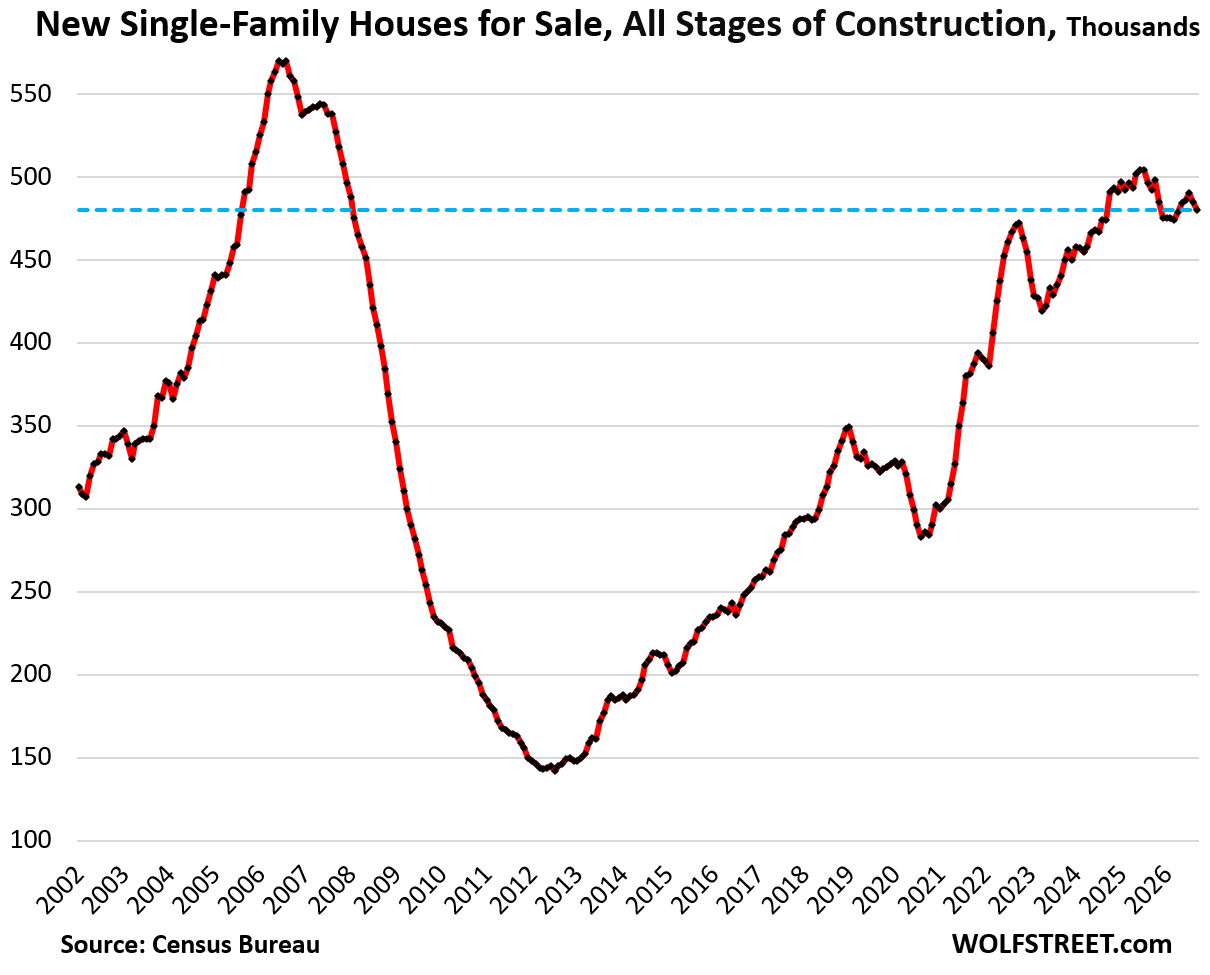
This is the “Housing Shortage” that the housing industry ceaselessly promotes to create a fake sense of scarcity to manipulate up prices.
Big homebuilders have to build homes because that’s their business, they cannot just pack up and leave when the market turns against them, they have to keep their businesses intact, they have stockholders and bondholders they need to make happy, they have to protect their credit ratings, and they have to work with prices and incentives to keep their sales volume up. And they’ve been doing that, even as sales of existing homes have collapsed.
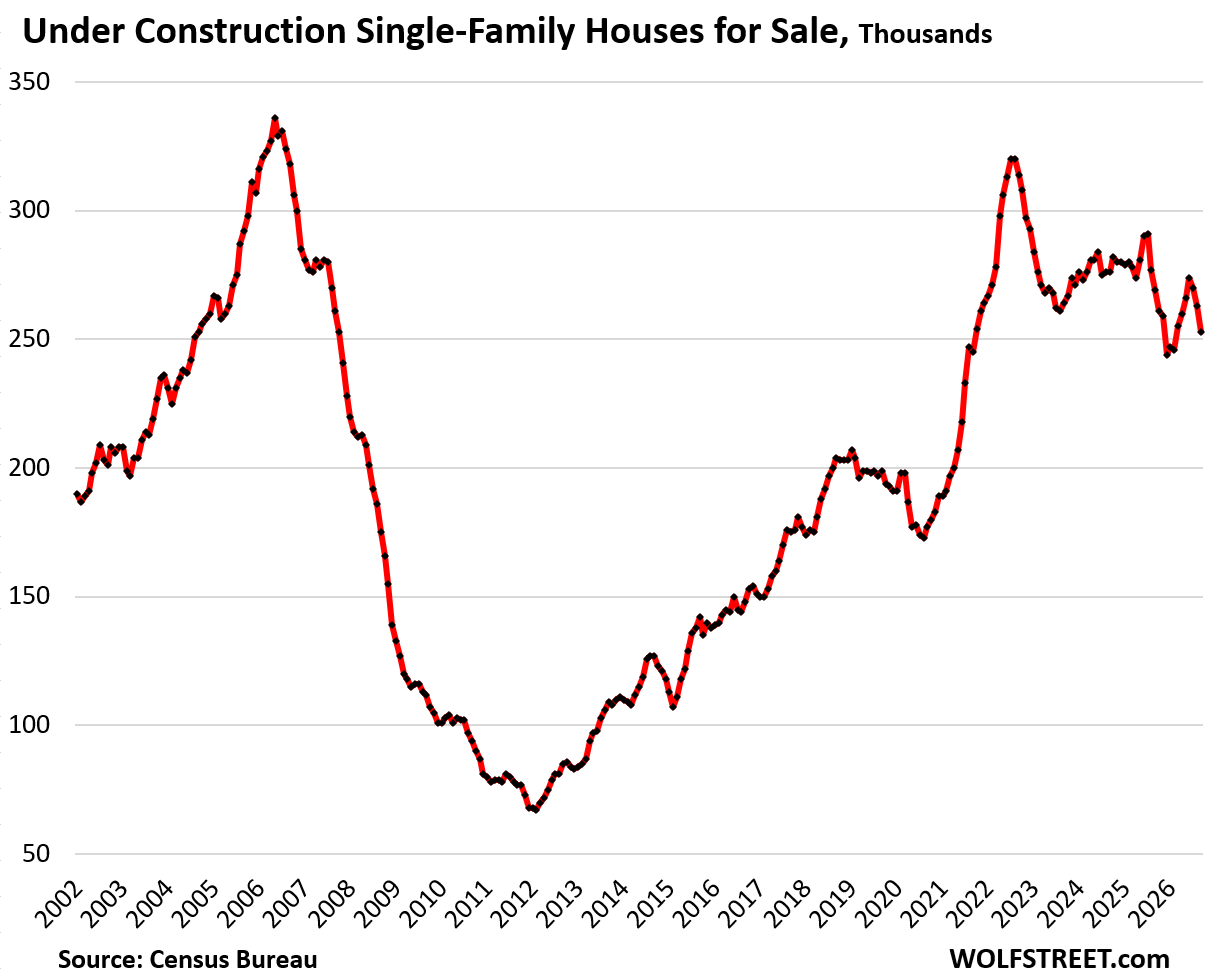
Inventory of under-construction homes declined by 5.9% year-over-year to 253,000 homes in September. The decline is a result partly of under-construction-homes being sold, and partly of homes being completed without being sold and moved into the category, “completed homes for sale.” And homes where construction had just started moved into this category.
Compared to July 2019, under-construction inventory was up by 27%, and compared to September 2020 by 41%.
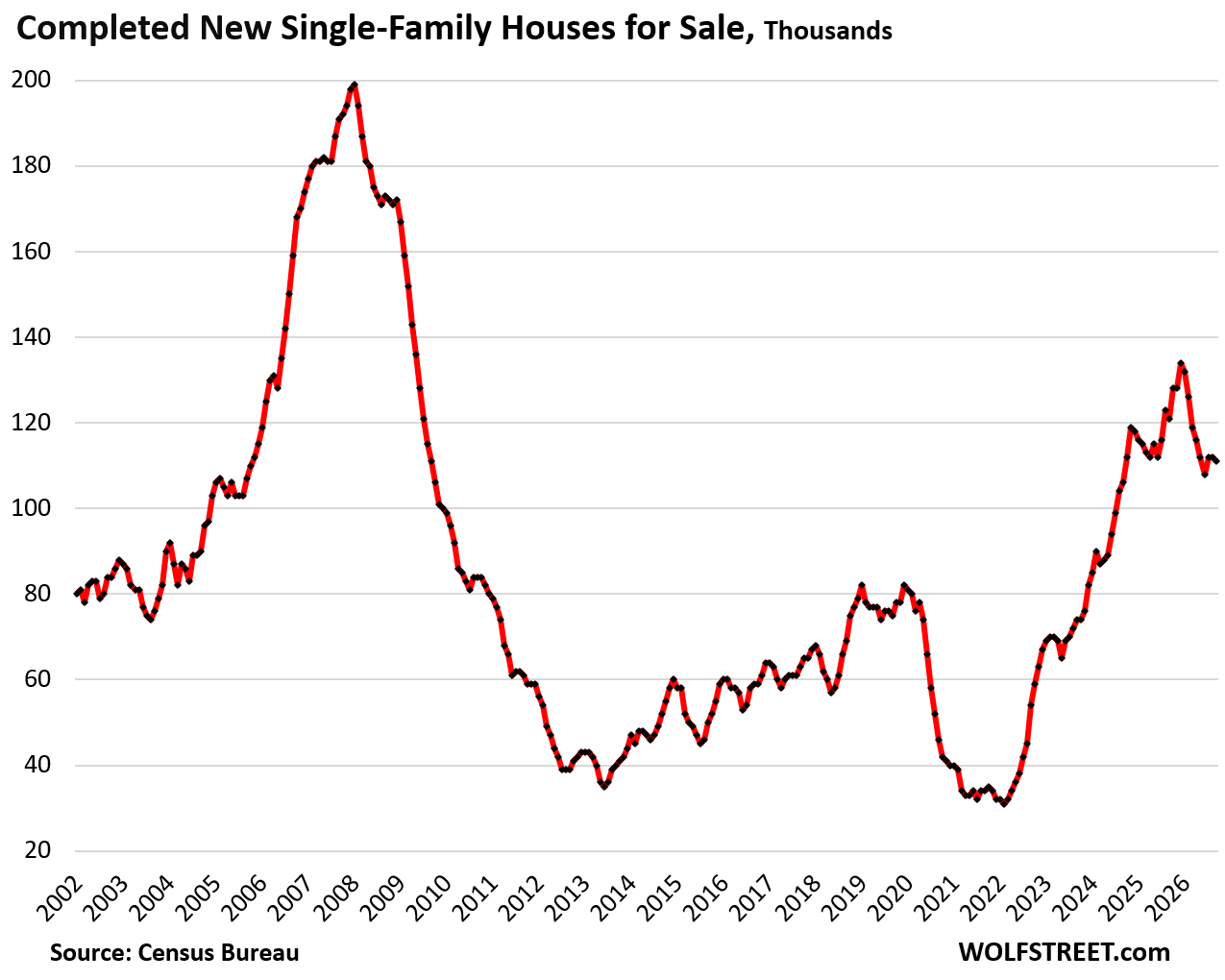
Inventory of completed homes for sale edged down to 111,000. Homebuilders have made some progress selling down their completed inventory from very high levels last year.
Compared to September 2019, inventory of completed homes was up by 48%. Compared to September 2021, inventory was up by 227%. Back in 2021 and 2022, there was a shortage of completed homes, as buyers, motivated by below-3% mortgages and FOMO, were swarming across the country, willing and eager to pay whatever price for homes that were move-in ready, and homebuilders accommodated them, thereby creating historically fat profit margins.
Now there’s lots of supply, and prices are down. Homebuilders have a lot of capital tied up in completed homes and are very motivated to sell them.
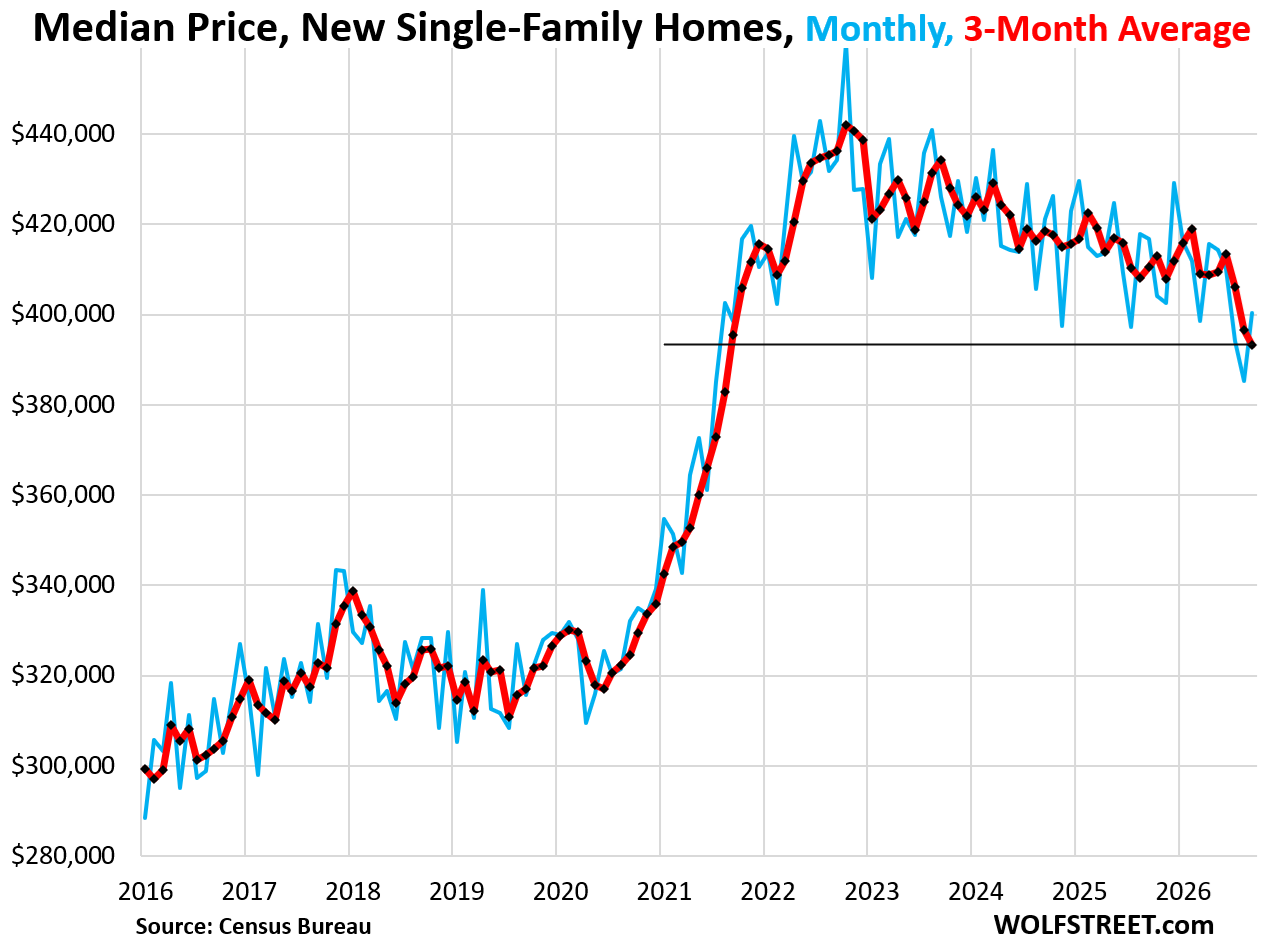
The national median price of new single-family homes sold does not reflect the incentives and mortgage-rate buydowns. It only reflects prices written into sales contracts. So it doesn’t show the full pricing dynamics.
But it does show the trend of how homebuilders are adjusting to reality. Homebuilder gross margins have plunged, net profits have plunged, shares have plunged, but they are building and selling homes and are adding new housing stock.
The median price – not including incentives and mortgage-rate buydowns – has been on a downward trajectory since the peak in late 2022. The 3-month average, which irons out the month-to-month squiggles, has declined by 11% from the peak in late 2022, and by 4.6% year-over-year to $393,300, the lowest since August 2021 (red in the chart).

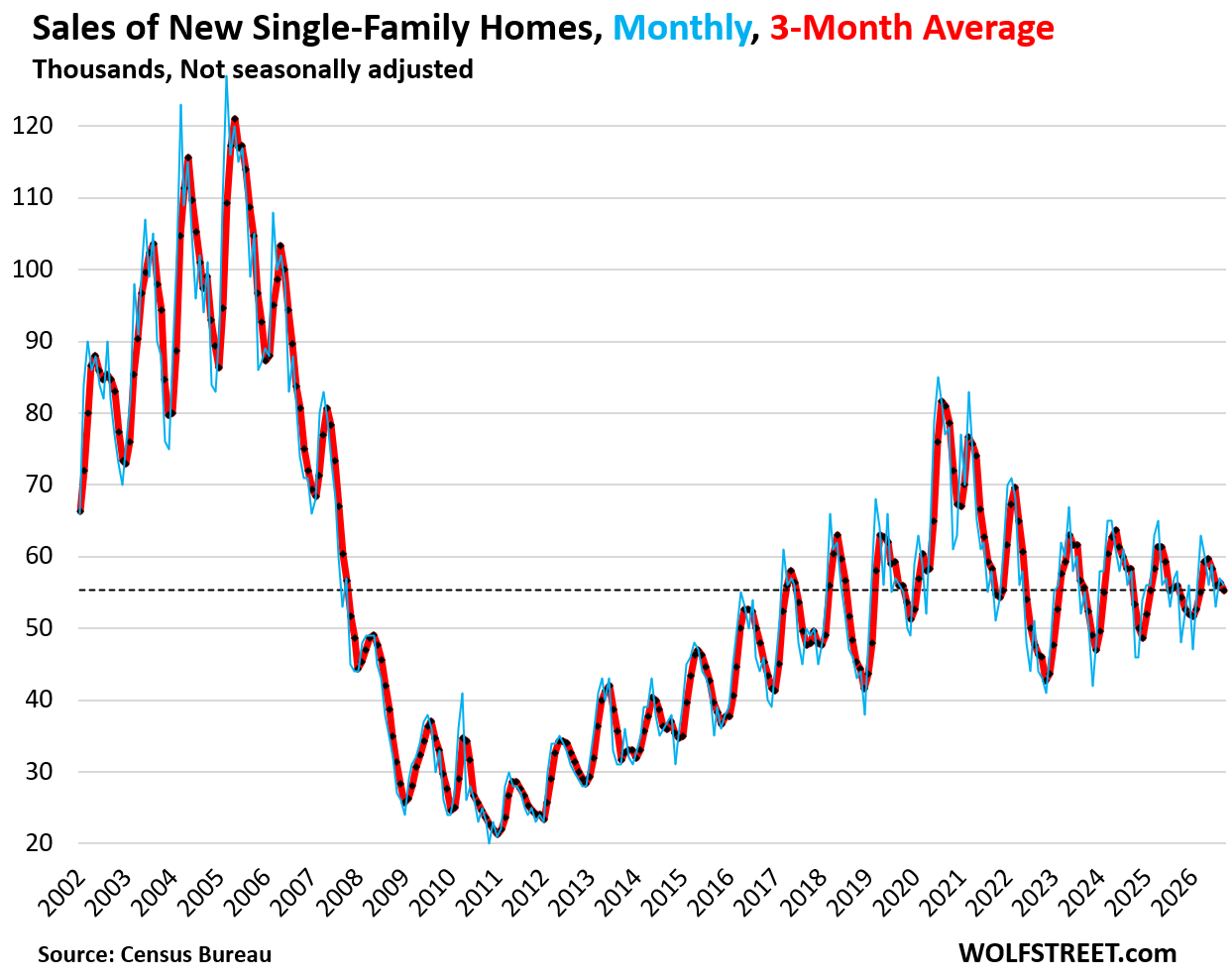
Sales of new single-family homes at all stages of construction fell by 3.4% year-over-year to 56,000 homes in September, not seasonally adjusted.
September sales of new homes were on the same level as in September 2019, even as sales of existing homes have collapsed by 40% over the same period. This shows that homebuilders have figured out this market – stimulating sales with incentives, mortgage-rate buydowns, and price cuts – and that homeowners wishing to sell have not figured it out. Homebuilders are running circles around them.
But compared to the Housing Bubble sales in the Septembers 2005-2008, sales have plunged by over 40%.
These are middling sales on very high inventories. But sales haven’t collapsed as they have for existing homes.
By region:
A map of the four Census regions is posted in the comments below.
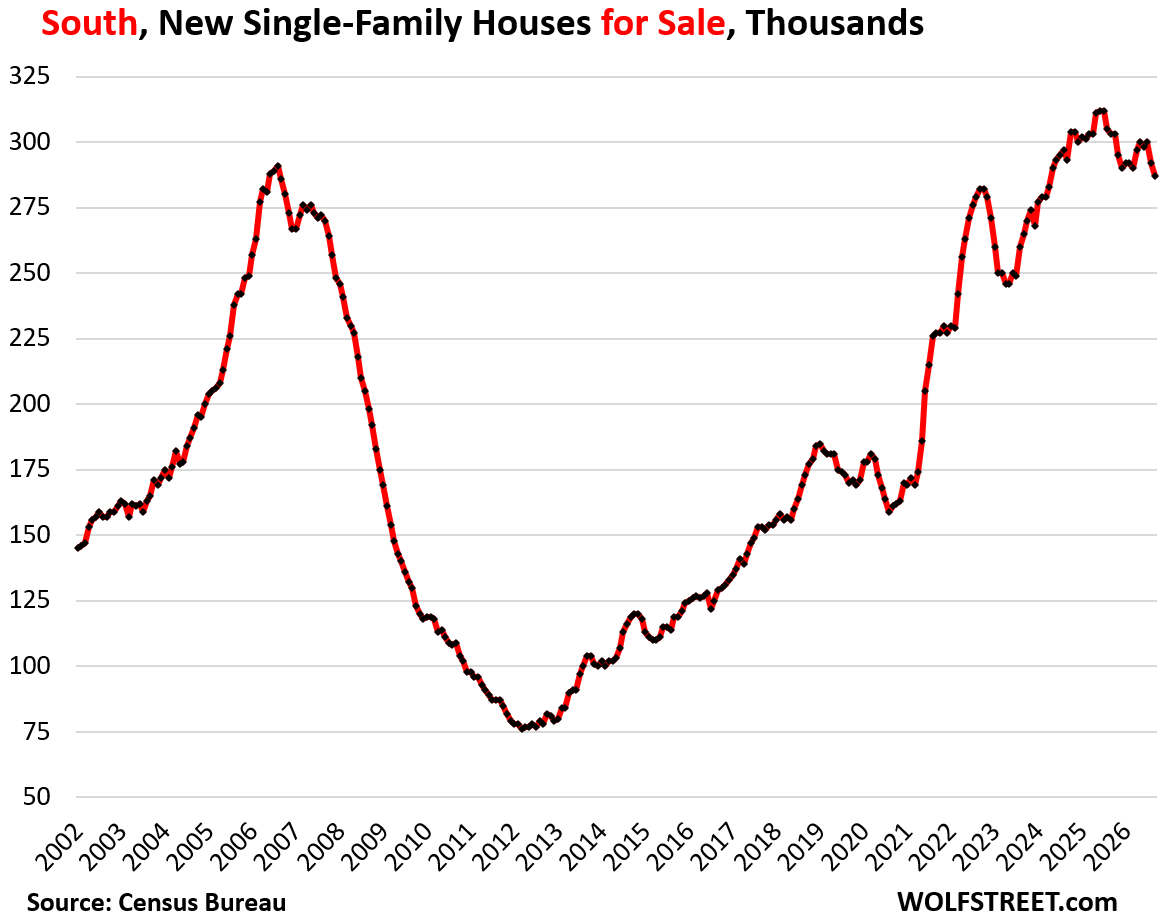
In the South, inventory for sale declined year-over-year by 5.3% to 287,000 new single-family homes at all stages of construction, not seasonally adjusted. Homebuilders are all talking about their issues in the South, and they’re making some headway addressing them.
But compared to September 2019, that inventory was up by nearly 70%, even as sales were roughly the same, making for 8.4 months’ supply!
These are huge inventory levels, matching roughly those at the peak during the Housing Bust, even as sales were down by 33% over the same period.
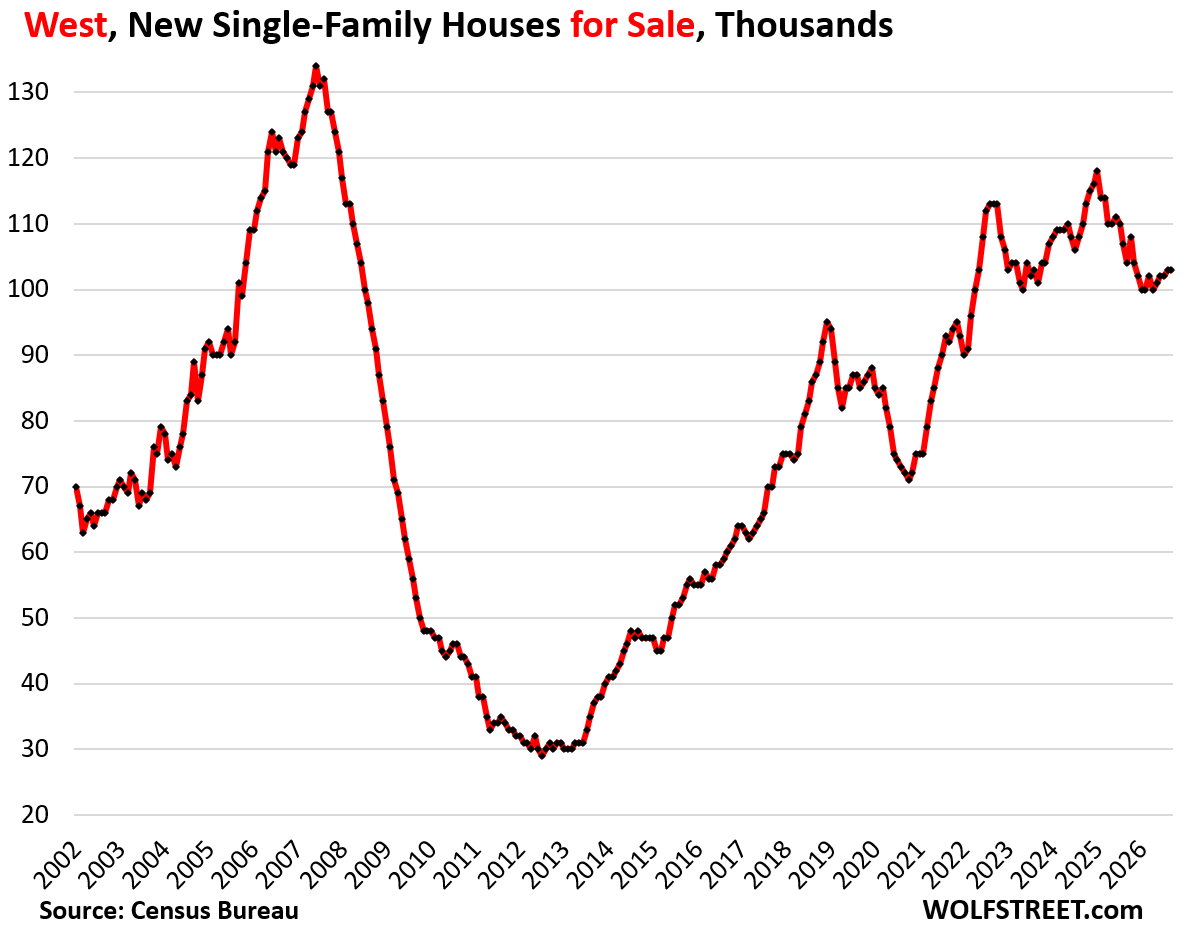
In the West, inventory for sale declined by 14% year-over-year to 103,000 new single-family homes, but were still 21% higher than in September 2019.
But sales dropped by 14% year-over-year, and by 8% from September 2019, leaving builders with 8.6 months’ supply.
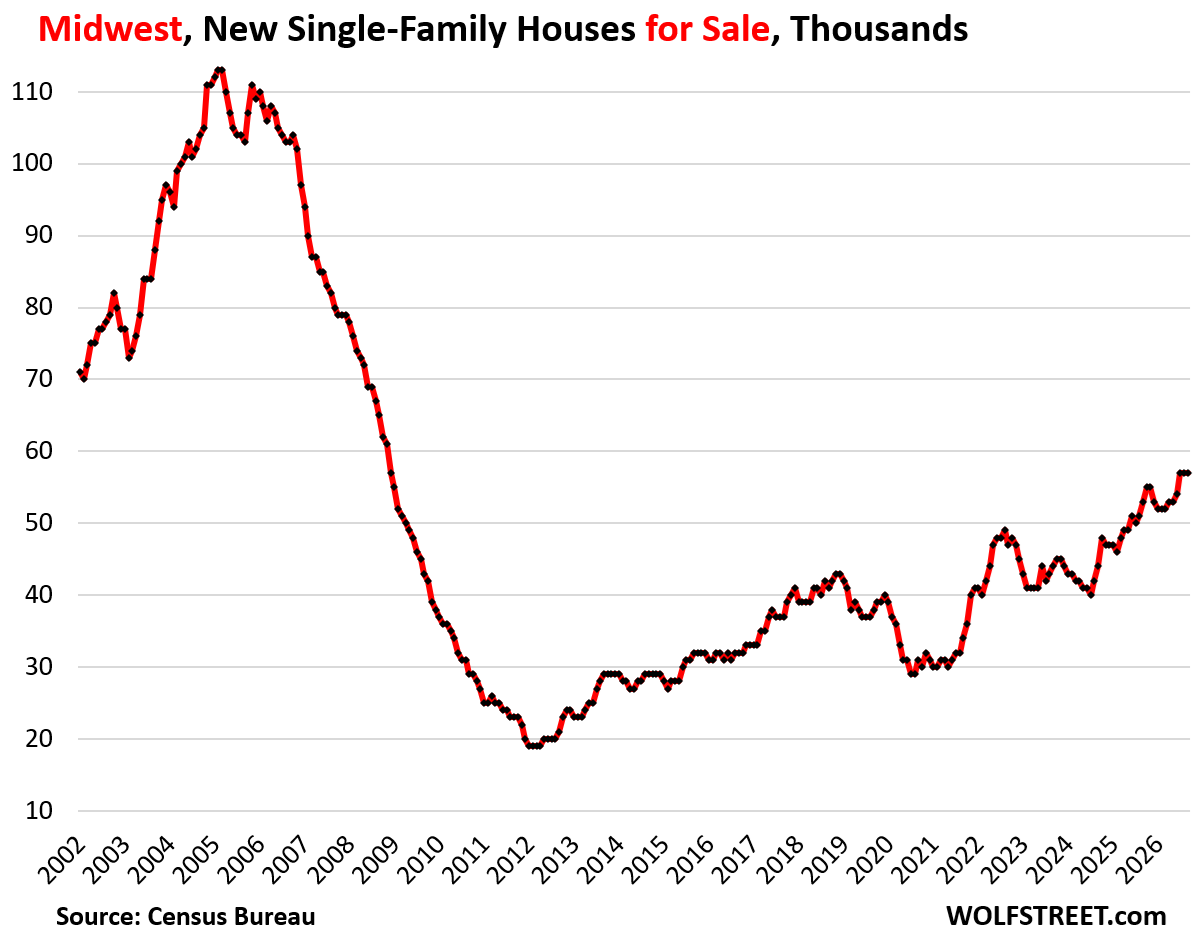
In the Midwest, inventory for sale rose by 7.5% year-over-year to 57,000 new homes, same as in August, and both were the highest since 2008.
Compared to September 2019, inventory was up by 50%!
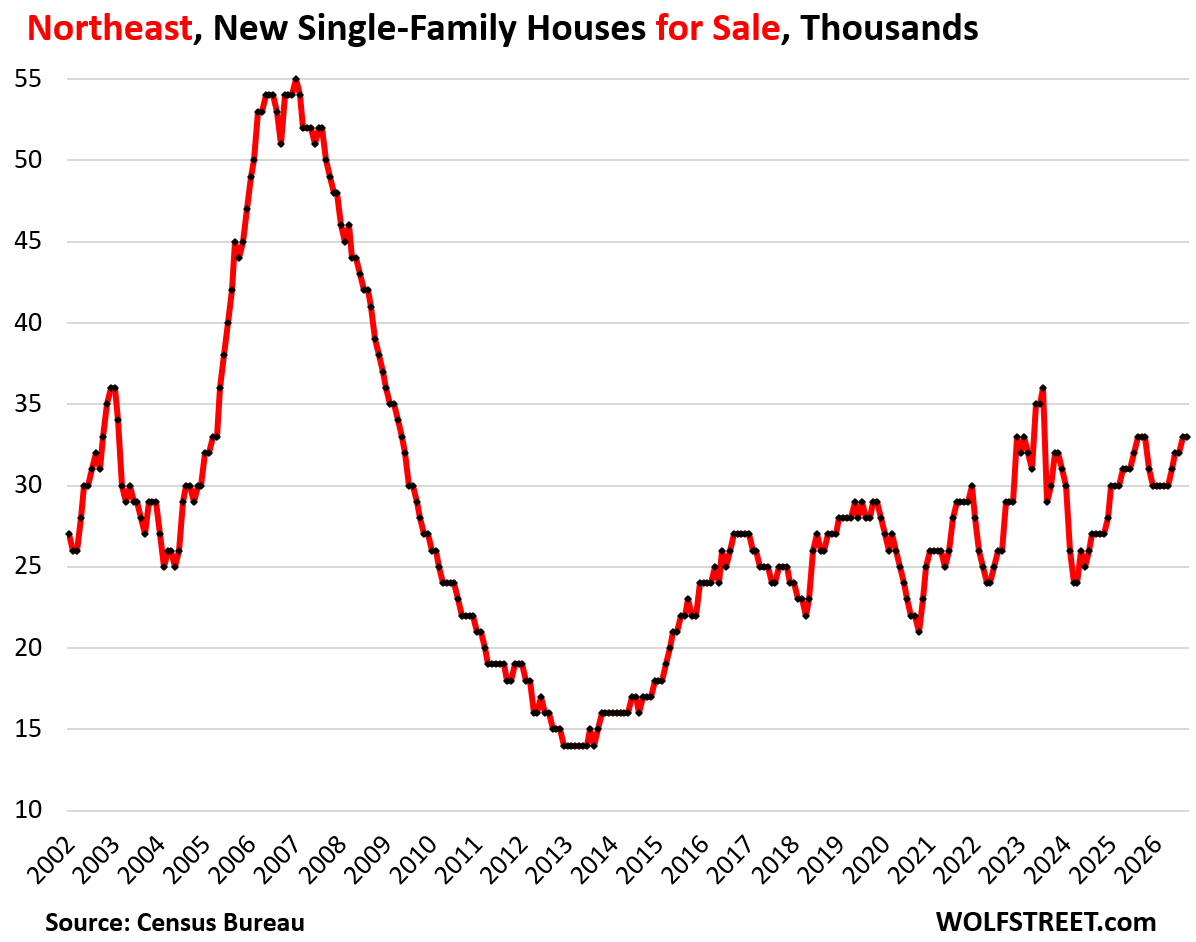
In the Northeast, inventory remained at 33,000 new single-family homes, up by 18% from September 2019.
The densely populated Northeast is a small market for new single-family homes, as most new construction is multifamily (apartments and condos).
In case you missed it: Mega and Large Investors Pull Back from Housing Market, Become Net Sellers, Small Investors Continue to Pile In
Enjoy reading WOLF STREET and want to support it? You can donate. I appreciate it immensely. Click on the mug to find out how:


The map of the four Census regions of the US. Click on the chart to enlarge it:
These graphs would make for a nice supplement to a law of supply and demand lecture.
good stuff. keep it coming. hopes and prayers we have another panic like 2008. i love buying high cap rate properties after debacles. phoenix AZ was especially sweet. my hood went down 70% top to bottom 2006 to 2012
Funny how our society can seem to run off some BS narrative forever and people will fall for it over and over again…Housing shortage, Mortgage rate will be coming down in no time and back to 2%, home price will go up and any pause or small adjustment is only a gully, trickle down economy is good for all of us….despite so many already been debunked with plenty of supporting evidence.
Think the Fed is like:
“dude do you know how many of these people will refi if we drop rates?”
Heck even McDonald’s might start doing refis for people if rates drop. 🍔
“re-fries”?
The old among us can remember a time before internet-spread BS fads dominated the investing landscape. Back when people analyzed fundamentals and to some extent thought for themselves a lot more.
1995-2000 Dot com stocks
2001-2007 Oil stocks
Pre-2008 housing
2009-2012 gold
2012-2020 big tech giants
2016-2020 weed stocks
2018-2024 Crypto FOMO
2021-2023 Meme stonk mania
2022-present AI mania
Now there’s a cottage industry of influencers who pull the gullible money one way or another. It’s a pump and dump game played by hundreds of players each trying to influence someone else into bidding up something they want to sell, if they can get out before the music stops.
TL;DR – Never take on a concentrated investment position in anything that the social media influencers are pumping.
@wolf – Thanks. I figured out how to get such charts from Census bureau thanks to you. How do we have confidence in these government numbers ? Are there any reliable private market (non-govt) alternatives to this?
Btw, please consider adding a list of books or courses on all this economic and finance stuff that can be read by beginners and more advanced people.
The Census Bureau is now using satellite imagery, in addition to their classic field work of field staff physically going to construction sites and getting the info, inspecting permits, looking at contracts, etc., all around the country. They lay it out in the methodology. It’s impressive how they do that.
Collecting this data is expensive and complicated and no one does that in any depth. John Burns does a survey of a limited set of homebuilders – but that’s just a survey that homebuilders answer, and it doesn’t provide this level of deal, not anywhere near. That survey has some homebuilder sentiment questions, and commentary, so it’s interesting, but it doesn’t give the info that the Census Bureau’s data provides.
As with a lot of data, it’s not perfect at all, especially the preliminary data (today for September), which is very rough, but each monthly revision, as more data is collected, refine the results. We may be unhappy with it, but it’s the best we have.
I always recommend taking Accounting 101 at some local junior college. It’s hugely important… debits, credits, assets, liabilities, capital, revenues, costs, cash flow, and what all that looks like on an income statement and balance sheet. It’s a real eye-opener. I think that would be the first step.
It’s like unlimited fries at Red Robin.
Where’s the bottom?!
😆 🥁
When heart disease sets in…that is the bottom.
If you draw a support line from 2016 on the median price plot one sees that 360 is the equilibrium price where most buyers would probably be at (at least in the current conditions). Thus median prices are still too high. What do you think?
Agreed. Pricing has been very sticky.
But effective prices are a lot lower and have fallen a lot more because of the incentives and the mortgage-rate buydowns that are not included in the median price, as explained in the article.
Also, every year that there are small price declines, alongside wage increases, the affordability gap narrows, but it would take many years… we’re already completing the fourth year of that process.
Also, Lennar is now building starter homes once again, under $200k in the Dallas area, 1,600 sf, small lots, but it’s a starter home, the kind of home this country needs the most. That’s affordable.
1600sf used to be fairly normal even for a family house. The house where I spent my early years was probably 1800sf and much in that area was in the same range.
Yea, what we need is a return to the 2BR / 1BA homes of the era before the 1950s.
The problem is that people in the US are so dysfunctional that we’re afraid of investing in a property in a neighborhood that can be afforded by a drug addict.
Thus the “housing shortage” is driven by a desire for economic segregation and living at distance from one another. It is a consequence of not effectively dealing with problems.
But if the first line leading to bubble 1, then how can the price increases 2014-early 2020 be justified? They are too steep.
They were just reinflating the bubble. It was unsustainable, Then it got straight mad after the pandemic.
It’s like piling food on a tray a waiter is holding (what’s with me and food today? Geez). You put too much on there and all the food falls off (lower housing rates, market correction).
Then that food on the floor goes on sale (depressed housing). People with means or just with good timing dive in.
Agreed… and now that we are in the era of RTO, I suspect most home-building — which seems to generally be powered by farther- and farther-flung exurban subdivisions — is still relatively high-priced for prospective commuters. Prices are definitely coming down in both real and absolute terms, but all the data I’ve seen suggests they’re still expensive on an income-to-monthly burden basis. And come to think of it, the cost of commuting now likely takes a much bigger bite than it used to. (Add to that more expensive home insurance and energy costs, as well as higher interest rates, and we likely need a *discount* to the mean — not merely a reversion to it — to get back to historical absorption levels).
There is, of course, no housing shortage of any kind anywhere in the US at this stage with houses readily available to those willing to pay the highest prices ever seen on housing in the US. If folks meet those criteria there are some superb properties available to choose from in every locale.
Also LOTS OF GOLD up for offer, if you have the money to buy it.
😂
Houses are unique, but gold is just another fungible commodity.
Interest rates back to normal and deporting/self deporting millions has consequences?
There’s only a shortage of affordable homes.
Yes. The combination of falling prices and rising incomes solves that issue over time.
Here in Georgia, this September closed with the lowest number of sales for as far as my database allows me to pull data for (10y). Also, the highest number of active listings for the same period. October looks even worse than Sept. Yep, it’s pretty much frozen, like 0 Kelvin.
Morning about Lennar using its own subsidiary Millrose Properties to buy completed homes off of it, resulting in reduced inventory through circular financing?
*Morning –> Nothing
Only thing I’ve seen them doing is developing land under Millrose and transferring ownership to Lennar once construction starts like True Homes does with Dependable Development. At least here in NC.
You can Google the keywords I gave and find information about how the “land bank” Millerose is now also operating as a revenue generator, washing the land holding fees right back to Lennar.
I’m thinking it’s a workaround to get CPI lower, can’t get most other components of core to ever go back down. Housing and rents are known for cratering every so often, and like magic CPI is lower. But not if you own your house, just smoke and mirrors for you
1) “a fake sense of scarcity to manipulate up prices.”
Extremely important concept in *all* markets – and continually pushed by sellers/potential sellers in order to talk their book.
And “pseudo scarcity” is another important concept – by which I mean the use of various supply-denying/supply-delaying tactics (zoning, permit hurdles/delays, excessive code requirements, etc.) that all *sorts* of parties (incumbent builders/incumbent sellers/property tax yield optimizing municipalities/etc) use to deny/slow the addition of supply.
One look at a US map shows how scarce *true land scarcity* really is (and it is usually limited to hyper-water-confined locales of self-selection – Manhattan/SF/Miami etc).
So if housing prices somehow have gone ballistically upward – without summoning a pretty quick, pretty thorough new supply response – it is a very, very good question to ask exactly how/who/why is supply response being throttled.
(One instance along these lines – that I have basically never seen addressed…why exactly do municipalities require potential builders to disclose planned selling price before the munis will “allow” a permit to be issued.
Are lower priced builders being blocked/delayed by the munis? With the “justification” that pre-determined incremental property taxes *have to* hit some continually elevated number in order for new supply permits to be “allowed”? I’ve never seen this potentiality even be discussed – despite periods of extremely low/slow new home supply)
2) “Big homebuilders have to build homes because that’s their business, they cannot just pack up and leave when the market turns against them.”
I entirely agree with the point/concept…but then the supply collapse from 2007 to 2013/15 has to be explained.
Builders “have to build”…but new homes weren’t being built then.
The answer is likely…well, the builders collapsed/went out of business.
But usually desperate businesses will slash prices as bankruptcy threatens (better some revenue/profit vs. none) but I don’t know that *new-build* prices ever really saw a truly dramatic decline during the 2007-2014.
(Existing home prices *did* collapse)
Why would builders simply, meekly prefer to walk into BK then?
Or now?
There have been some new build price reductions post 2022 unZIRP (frequently in the form of some tortured, obscuring mtg rate buydowns) but we’re maybe talking 10-15% cuts off of truly insane highs (from $450k to maybe $385k-$405k, not $250k or $300k…more of a reset than a true retreat from Bubble 2.0)
3) For many, many decades housing supply/demand worked much, much more smoothly in the US.
But the last 25 years have seen the US housing market turn into a hyper-volatile, schizophrenic interest-rate-speculation casino.
Being successful and being seen as successful are two different things.
Housing being affordable and housing being seen as affordable are two different things.
“ The ARM share of applications increased to 11.3% last week, the highest level in more than a year”~ risk is being added up, $tnx right now has 5.041 as resistance, when that falls, up up and away higher yield marches The algo loves to pivot at the triple 6s, semiconductor bounce at 10666 4 days ago, it was slightly under its 200 S DMA for less than seconds the next day, you have to go back to May of 2025 before $sox were under their 200 simple DMA. Hot inflation tomorrow hotter wage growth on Friday and a very important Fed speech in couple of hours. Maybe the data will postpone the carnage or maybe the earth($tnx yield) will jump up and kiss the risk rocket ship soon. Next few days are huge.
“The ARM share of applications increased to 11.3% last week, the highest level in more than a year”
This constant manipulation in the media… From VERY low levels to VERY low levels:
https://wolfstreet.com/2026/10/02/homeowners-are-clinging-to-their-below-4-mortgages-for-dear-life-as-mortgage-rates-went-over-7/
Rate of change and velocity is always important. All bottoms and tops “build a base” for change in direction. I swore off shorting but spxs looks base ready for a move higher, my brain wants to rationalize buying it, it’s not really shorting it’s just a liquidity direction move, Ha 5.32% for 3 days will create panic. Everything is interconnected even the way we all think. We are not driving the bus we are riding a tram to a destination, like to get yummy waffles in our bellies at the top of Jackson Hole. it’s the journey that makes it’s fun. It’s getting interesting:) :):)
SPXS was base ready! Leverage invert etfs are the best for charting and looking for base formation. It makes timing easier. Favorite to draw charts!
Like my salary
/s
I concur 100%. New home construction, which have been in the pipeline during the crazed pandemic buying spree, are not completing and adding to bloated inventories. Home builders need to build in order to stay in business, pay their employees, pay their investors and so on and so on. They are not a charity.
Here in SW Florida new homes, with their upgrade incentives, mortgage rate buy-downs and other financial freebies, have devasted the existing home market. The house next to me sold for 10K less than the market value assessed by the county property appraiser. Several homes are for sale in my immediate neighborhood, but they are all priced above their fair market value. They are not moving. Of course, 2 of these are owned by out-of-town LLCs that purchase distressed properties, fix and than flip. I know, because I did the research on them.
The median home price in SW Florida, new or existing, is just under 400K. Rule of thumb would indicate a combined income of 130K for a couple looking to buy would easily cover monthly mortgage payments on a 400K home. However, 130K is not the median income here in SW Florida – it is much lower. If you own a a new car and your car payments are around 1000K a month then the bank automatically disqualifies you from a mortgage. This is not the only issue.
Here in SW Florida 3 hurricanes over 9.5 years, since I moved here, have launched insurance rates into the stratosphere. I am paying over 5400 a in insurance for my teeny, tiny 1300sf, retirement bungalow. As for the couple that buys that 400K home, which will probably be around 1800 sf., their insurance is going to run anywhere from 6000 to 10,000 a year depending on the area they live in an their proximity to water. If one lives or intends to buy in a Zone A flood zone, one must carry mandatory FEMA flood insurance for a home loan.
A recent article, in the past few days, came out with a list of 25 cities in the US with the highest property taxes. Florida had 11 cities on that list. Here in SW Florida, where I live, we made an ignominious appearance somewhere in the middle of those 11.
This is why we Floridians get to vote on amendment 3 this mid-term election. It needs 60% of the vote to go into law next year. It provides for 150K in homestead (a Florida thing) tax exemption for 2027 and 250K in 2028. The caveat is that you must have been a Florida resident for 5 years. I’ve been here 30.
On Tuesday, November 3rd, I will be glued to the local news awaiting the outcome of amendment 3. I pay a ridiculous amount of taxes on my teeny, tiny retirement bungalow and I am nowhere near the water. For millions of retired, senior citizens who own property, the passage of this amendment would be life-changing. We wouldn’t need to sell our homes and move to Arizona or South Carolina.
Remember, this article states the collapse of the existing home market. If amendment 3 fails, then a lot of existing homes are going to come on the market. I think I’ll do okay either way, but millions of others may have to make some difficult choices. Cheers.
Florida has 0% personal state income tax for 2026.
That is why property taxes are high.
One or the other to pay for services and no one ever wants to cut those.
Fantastically clear-eyed post. It’s not often someone in a different demographic segment is willing to accurately represent the forces facing another one.
Hope you get your exemption!
Tax exemptions always sound great on paper but the costs those tax dollars covered don’t go away. Who pays or how just adjusts. See all these states trying to can or heavily limit property tax now since it became a hot button topic and they want to buy those votes but it’ll just cause another pain down the road without a proper plan.
Anyone with the goal of but having difficulty affording a new home shouldnt be driving a $1,000 per month vehicle. Gotta be frugal, drive something a lot cheaper and used.
I’ve been building on and off for over 50 years. As a carpenter I renovated my once affordable fixer uppers into economic security. Sweat equity. Started at age 24 with the first home. 71 now and live in a beautiful home….but only because I built it.
But here’s the thing. I still hit my fav lumberyard every week or two. I never buy from Home Depot type stores for serious supplies. Never ever, their lumber is dry (being inside), but of low quality. Portland cement and quik crete are reasonable and always available in these stores, maybe occasional plumbing stuff. But the costs are the costs to build…for materials, labour, and all the permits crap. If Govt, any level of Govt seriously wants to foster affordable housing they can offer to homeowners, (NOT to corporation political donating builders), free land. They can offer lower interest rate subsidies, they can reduce the permitting nonsense. Duplication. But this will never be done as it will reduce home values for everyone else already in the game. They are constituents, too. Local Govt will not relinquish their empires, either.
A verse to share…. written about the Bay Area tract homes back in the 60s.
Little boxes on the hillside,
Little boxes made of ticky tacky,
Little boxes on the hillside,
Little boxes all the same.
There’s a green one and a pink one
And a blue one and a yellow one,
And they’re all made out of ticky tacky
And they all look just the same.
This is what is offered by the big guys, just like the in the 60s when this was written. When all the VA loans got veterans into housing. And people still cannot afford them. Why? Wages have not kept up to costs. Inflation hides this. Local Govt is too rigid with bylaws. And buyers watch too much HGTV nonsense and think housing is about expensive furnishings….bling. Buyer expectations are stupid and in fantasy land. You don’t need granite countertops. 1 bathroom works fine to get started.
The big boys can build an affordable starter home, or folks can buy a fixer upper. The rest is budgeting with a plan.
Some of this is population change. Many people don’t want a 10k sqft home these days. Turns out having 8 bedrooms didn’t make folks happy. Add on that many young people won’t ever get married per the talking heads.
That works in the favor of these once build bigger builders at lower price points.