
Another sign of underlying strength in the labor market.
By Wolf Richter for WOLF STREET.
The trends in the number of job openings, in the number of quits, and in the number of hires — trends of labor market “turnover” — bottomed out in late 2025 and then wobbled higher, another sign of underlying strength in the labor market.
The Job Openings and Labor Turnover Survey (JOLTS) data today by the Labor Department tracks this “turnover” in the labor market in June. It doesn’t track employment growth, unemployment, etc.; the jobs report for June (released July 2) did that.
Labor market turnover is a function of slots left behind by people who quit their jobs; by people who were laid off or fired; and by people who retired or separated for other reasons, such as died while employed. Those left-behind slots become “job openings” when employers try to fill them. Growing job openings mean mostly growing turnover in the labor market.
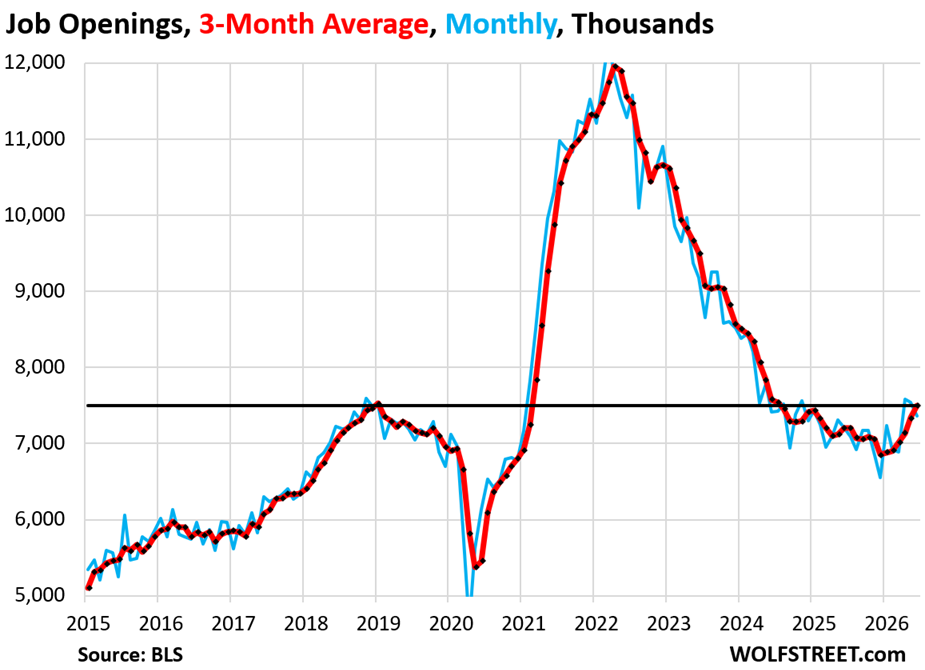
Job openings in June dipped a little from the spikes in April and May, to 7.36 million, still the third-highest since January 2024, behind only April and May (blue line in the chart).
The three-month average, which irons out the month-to-month squiggles and includes the revisions, rose by 157,000 in June to 7.49 million, the highest since July 2024, matching the prepandemic record in 2019, having now increased month-to-month every month this year – a meaningful improvement of the trend (red line in the chart).
Year-over-year, the three-month average is up by 4.0%.
The data is based on a survey of the HR departments of 21,000 business locations, not online job postings. A job is “open” only if it meets all three conditions:
- A specific position exists, and there is work available for that position.
- The job could start within 30 days.
- The employer is actively recruiting workers from outside the establishment to fill the position.
Excluded are positions open only to internal transfers, promotions, demotions, or recall from layoffs; positions for which employees have been hired but have not yet started; and positions to be filled by employees of temporary help agencies, employee leasing companies, outside contractors, or consultants.
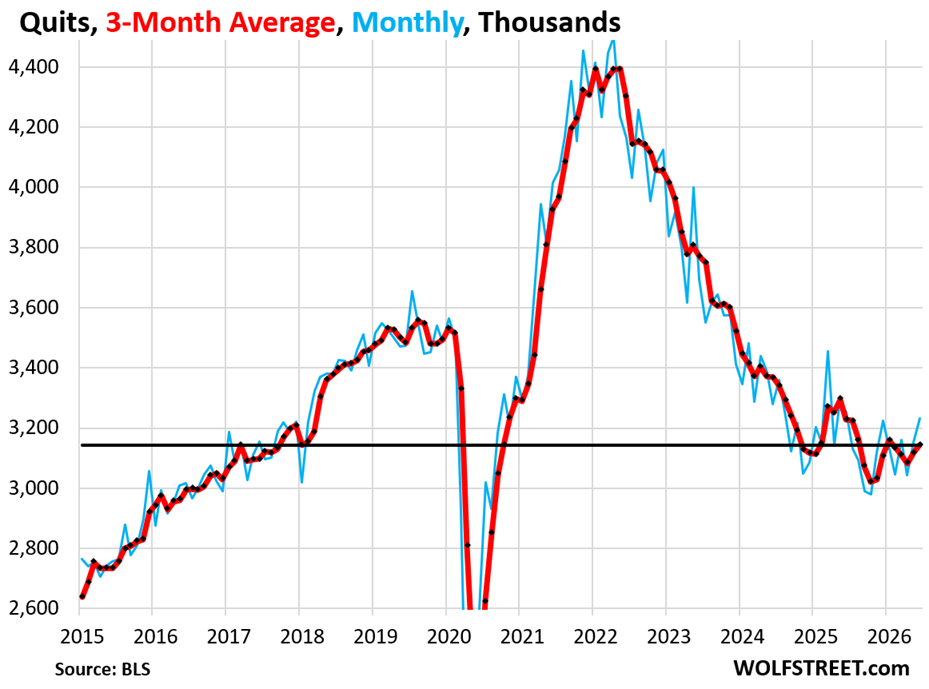
Voluntary quits rose in June by 79,000 to 3.23 million, the highest in a year (blue in the chart below). These people quit their jobs voluntarily, such as to take a better job somewhere else, but do not include people who retired, died, etc., who are tracked separately.
The three-month average rose to 3.14 million, the highest since January, and both were the highest since July 2025 (red).
Higher quits indicate that workers are more confident they can find a better job, or that they already lined up a better job.
Quits are the biggest source of the labor market turnover and account for 60% of total separations.
More quits mean more job openings left behind, and therefore eventually more hires to fill those newly vacated jobs, and more turnover.

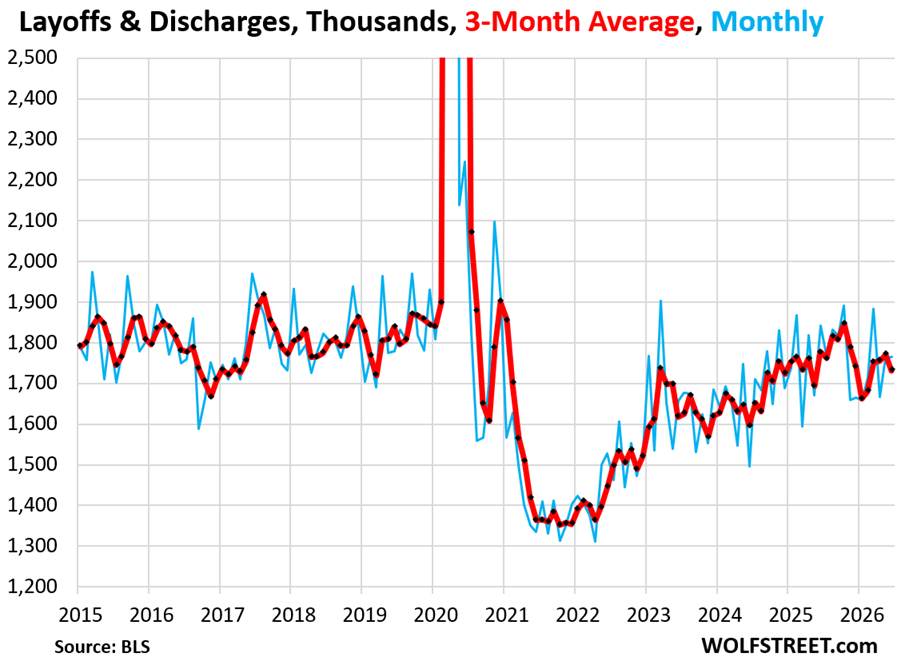
Layoffs & discharges remained roughly at 1.77 million in June, down year-over-year by 77,000. Getting fired for a variety of reasons, or for no reason, is a standard feature of the US labor market.
The three-month average declined by 39,000 from the prior month to 1.73 million. These levels are at the lower end of the range of the prepandemic years. Layoffs and discharges accounted for 34% of all separations.
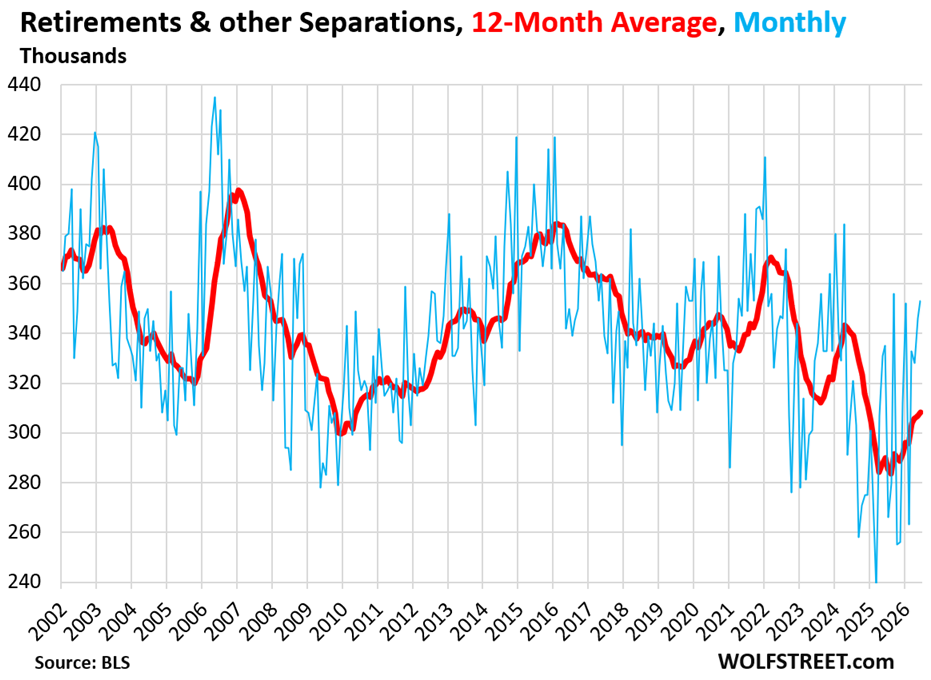
Retirements and other separations (including deaths while employed, etc.) rose to 353,000 in June. The 12-month average, which irons out the huge month-to-month spikes and plunges, rose to 308,000 in June. It has been coming up from the 25-year low in 2025.
Retirements from federal government jobs play a role here. Since January 2025, the federal government has shed 324,000 workers, or nearly 11% of its workforce, and quite a few of them eventually switched to retirement. When people were still on severance pay, they did not count as retired, but as employed. When they come off severance and retired, that’s when they count as “retired.”
Retirements and other separations account for about 6% of total separations.
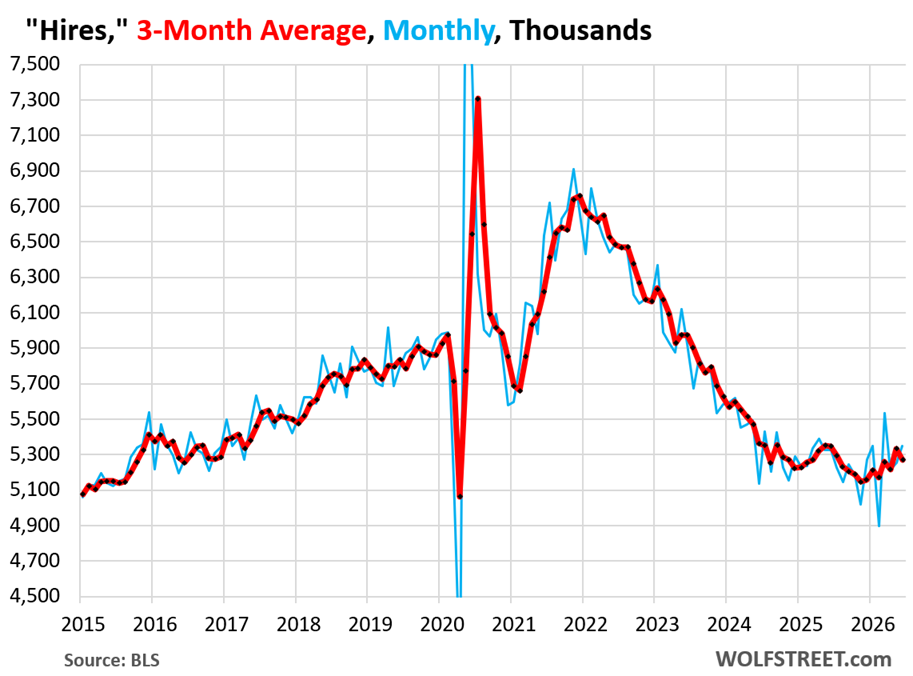
The number of hires rose by 96,000 in June to 5.35 million. The three-month average dipped a hair to 5.27 million.
But this is not a measure of changes in payrolls (such as job creation), but mostly of “labor turnover,” and the number of hires is mostly a function of slots left behind by separations (quits, layoffs and discharges, and other separations). Nearly all of these 5.35 million hires filled slots left behind by separations.
Enjoy reading WOLF STREET and want to support it? You can donate. I appreciate it immensely. Click on the mug to find out how:


Trying to donate to your firm but it keeps telling me to use PayPal I don’t use PayPal
Sorry for your troubles. PayPal set this up to be confusing, and you ended up clicking on the wrong button.
Please follow these instructions:
1. go to my donate page either by clicking on the picture of the wall or on this link directly: https://wolfstreet.com/how-to-donate-to-wolf-street/
2. on my donate page, click on the yellow “Donate” button, which takes you to my PayPal page
3. On the PayPal page, FIRST, enter the amount where you see “$0” at the top; SECOND, click on the WHITE button (“Donate with Debt/Credit Card”). Do NOT click on the yellow button. This WHITE button takes you to the PayPal page where you enter your credit card info and make the payment. No PayPal account needed.
Donated.. worth every penny!
Thank you!
What’s the labor effect of the estimated 700,000 people taken into ice custody since Trump took office in 2025. Is it to small of a number to show up anywhere or are they working under the radar.
I talked to a recently deported about 25 years old who said he was doing landscaping, installing sprinkling systems, and he could frame a house and he was a good welder who could weld anything.
Those deported and the ~2 million people who “self-deported.” Back in July, I already reported that the labor force declined for those reasons:
https://wolfstreet.com/2026/07/02/labor-market-tightens-despite-tepid-job-growth-as-labor-force-declines-further-amid-crackdown-on-illegal-immigration/
“Over 4.7 million students graduate from U.S. colleges and universities each year, including roughly 2.17 million who earn bachelor’s degrees”. These represent people with formal education.” “…data shows roughly 1.5 million students enrolled in formal trade schools and an additional 2.5 million students participating in broader technical or vocational education programs. Because most trade programs last between 6 months and 2 years, hundreds of thousands of certificates and credentials are completed each year across the country’s roughly 7,600 technical and trade institutions.” I suspect there is plenty of worker supply (both formal education and trade educated) to pick up the slack. Now, service workers and people doing the “dirty work” that most people refuse to do….thats a different story. I spent a summer from college working in a institutional kitchen washing dishes using the large machines. It was hot, humid, sickening work. I swore I would never do it again. That type of work will go hurting for labor.
I work in a company that hires these kinds of roles. Dishwasher is relatively easy to hire for as there is little demand for interaction and no need for literacy. Plenty of ex-cons who just want to keep their head down and not talk to anyone. Now cooks who have to read recipes and coordinate with the other cooks, and the people to manage those cooks–constant churn.
If an uncomfortable job paid more than a comfortable one, more people would be interested in doing it. Illegal workers are just as uncomfortable as you, but they are willing to do it for less, because … they are illegal and are in no position to demand better pay Resulting in pushing legal workers others out of a decent paying job. Ending illegal jobs (or slavery in a dark past) doesn’t make the work disappear. Pay a competitive wage and the job will be done.
Cool. He shouldn’t have a problem getting a job back in his home country
This year, many of my friends, family, and coworkers have started doing landscaping and handyman work on the side. These are people with high-paying jobs (one individual even has a $150k salary) just looking for extra cash.
They work Friday-Sunday. Some work 5 8s and take Friday here and there off. Others work 4 10s.
They use the extra cash for luxuries. New toys like side-by-sides, extra vacations, sports betting, etc.
No doubt this wouldn’t be possible if immigrants still had a monopoly on this sort of work.
Anybody worried about the Labor Force Particpate Rate continuing to plunge? Asking for a friend
Amongst 25-64 it is stable and still above pre-covid levels
Hi Ryan,
I was 15 when I got my first real job in 1961 washing dishes at Arthur’s Big Bend Drive-In. Arthur’s starting wage was sixty-five cents per hour and he had two ironclad rules. If you’re late to work you’re fired and if you’re at work and take a break you’re fired.
I worked there for two years. I only left because I got a better paying job teaching swimming and lifeguarding at the YWCA.
My point being that if you’re motivated and hungry enough and there aren’t any other immediately available options those conditions you describe don’t seem that onerous.
And for the record, after VN, I finished school at MSU and paid for it by working at the University Club’s kitchen doing exactly the job you describe supplemented by the GI Bill’s $200/month.
Lastly, Drewman I don’t worry about the participation rate. Why should I? I guess if I saw green tracers snapping again my head again I might be worried but otherwise, I’ll leave the worrying to my wife. She’s really good at it.
I am curious however. If you worry about the participation rate, why?
Best regards to all.
PS- Wolf I’ve got the tracking number. If the two dollars I sent don’t should up in a week or so, drop me a line.
Gone are the days when you can pay for your life’s essentials with low paying jobs.
Have you looked at the wage hike vs cost of living esp education in the last few decades.
That American dream for masses died long time back due to financialization of all things forced by financial repression of FED and Gov’s policies.
Jon,
Ever lived in your car? I did for eighteen months (December 5, 1985-April 17, 1987), for personal reasons, in Alaska, no less. Granted I did have a week-on/week-off job on the Slope. The folks I worked with claimed I was the world’s highest paid homeless person (in Portland it’s called houseless not homeless). Over that period my expenses were roughly five-bucks-per-day. In was a solitary and lonely period for me but also strangely liberating. We own our stuff, but it owns us. Kristofferson had it right we he wrote “freedom is another word for nothing left to lose”.
I truly believe, knowing what I know now about investing and 401Ks I could have done the same if I’d started with a “would you like fries with that Big Mac” job. Note I wrote started, not forever.
In my experience it’s the individual’s values; intelligence, discipline, patience, determination and focus on the long term that matter. Those values are instilled by one’s parents. Good parents, regardless of their wealth, ethnicity or social status, who assume responsibility for their progeny are the ultimate privilege.
@OBC
I agree with you generally and your pearls of wisdom you shared here.
Yes, the question: Do I own the things or things own me ?
In the end, we all have nothing to lose as we can’t take any. Let’s realize and enjoy this freedom!!
Thank you!!
jon….
I think that the point that OBC was making, was that if you have a crummy low paying job that you don’t like…..
Then you hit the grindstone and do what it takes to get a better paying job, maybe even a better paying job that you like.
It may take work, and it might not happen overnight but I know plenty of people (including myself) that made this happen. If not, I suppose you are not hungry enough.
And I am not speaking of elderly or infirmed, I am speaking of able bodied workers.
There are an enormous amount of opportunities to get a solid job with a decent paying, living wage right now as we speak.
People with crummy, low paying crap jobs have always struggled with basic necessities.
“In my experience it’s the individual’s values; intelligence, discipline, patience, determination and focus on the long term that matter.”
Well most of those are heritable traits or things instilled by upbringing with little ability for an individual to change. The evidence is very clear that the most important determinant of success is who you were born to in what county and at what time in history.
Drewman Group
The overall Labor Force Participation Rate rate has been dropping for 15 years because BOOMERS, that huge generation, have been retiring out of the labor force. I re-explain this every month when the jobs report comes out.
The Prime Age Labor Force Participation rate, 25-54 year olds, which exclude said boomers, has been at multi-decade highs for years. A tight labor market.
All you have to do is read at least one of my jobs report articles, rather than dragging internet BS into here:
https://wolfstreet.com/2026/07/02/labor-market-tightens-despite-tepid-job-growth-as-labor-force-declines-further-amid-crackdown-on-illegal-immigration/
Okay– but it did plunge 0.6% m/m which is the biggest one month drop since April 2020. It could be a blip, but besides March 2025 we now have the lowest Prime Age Labor Participate Rate since December 2023. We’ll have to see if this is a trend or not.
Month-to-month squiggles, as I call them. Which is why I look at three-month averages. The next data point, to be released this Friday, will bounce back. That’s just how that stuff works. The gigantic US labor market doesn’t turn around from one month to the next, unless something huge happens like Lehman imploding or covid lockdowns.
Wolf, where are the data that show hires due to the expansion of jobs? Or is that in these hires, but so minimal it can’t really be seen?
The jobs report (last one Jul 2, next one on Friday) shows net increase in nonfarm payrolls. That net increase in payrolls is the number of jobs created and filled. That’s the data that answers your question:
https://wolfstreet.com/2026/07/02/labor-market-tightens-despite-tepid-job-growth-as-labor-force-declines-further-amid-crackdown-on-illegal-immigration/
This data here today is about labor market turnover.
If I click through the ad to support Wolf Street, is it possible to set up a recurring monthly tip to keep the paywall away? Thanks HMFIC
Yes. If you click through the ad, you get to my donations page, where you can see the different options of how to donate.
You can set up a recurring payment on PayPal using your credit/debit card (no PayPal account needed). Many people do that. If you use Zelle, you may also be able to set up a recurring payment (depends on your bank).
Off topic but is the latest Japan “not a rescue” perceived as another “risk on” signal?
Infation trade?
Haha!. Wolf, there is an ad on your main page for running shoes – the brand is ‘Cloudmonster’. They are probably the ugliest running shoes that I have seen. Maybe they are comfortable.
❤️🤣
Wolf I’m curious if you have insight on why retirements and separations hit a 25-year low in 2025? Many of these charts follow recessions/expansions but with that one it’s hard to understand the peaks and troughs.
Boomer retirements are ebbing as fewer and fewer boomers are left in the workforce. Mid-boomers are now 70, the youngest ones are 60. But as I pointed out, the increase in retirements in 2025 was likely due to the job shedding at the federal government. There should be gradually fewer retirements going forward.
Rico, About that deported 25-year-old migrant you mentioned who could frame a house, weld and landscape.
Are you sure?
Does he own a welder? Does he have a framing crew and fork lift? Or a zero-turn, truck and trailer?
My wife doesn’t know how to weld, pour concrete, frame a wall, let alone wire, plumb, hand sheetrock, or insulate or roof a house, but even so during the worst of the government’s Covid restrictions she did all of that and more because unlike the deported illegal immigrant you mentioned, she had capital.
What is it that makes our country great, anyway? Our system of government? Our military? Our schools? Maybe, maybe not.
Because without the capital stock our forbearers accumulated over the centuries the possibility for any US citizen to enjoy a comfortable existence would be lessened, wouldn’t it?
It seems like our leaders are doing all they can to squander that “capital stock.”
Immigrants made this country great. Started at Plymouth Rock and continued for 250 years. Racism was our original sin which continues today.
To your question about what he owned. He was a worker. An employee.
Two Tramps in Mud Time By Robert Frost
Out of the mud two strangers came
And caught me splitting wood in the yard,
And one of them put me off my aim
By hailing cheerily “Hit them hard!”
I knew pretty well why he had dropped behind
And let the other go on a way.
I knew pretty well what he had in mind:
He wanted to take my job for pay. …
Nothing on either side was said.
They knew they had but to stay their stay
And all their logic would fill my head:
As that I had no right to play
With what was another man’s work for gain.
My right might be love but theirs was need.
And where the two exist in twain
Theirs was the better right–agreed.
It is NOT “racism” to deport illegal immigrants. I’m sick of seeing this insidious bullshit. No ifs, whens, and buts.
“What is it that makes our country great, anyway? Our system of government? Our military? Our schools?”
Tremendous natural resource wealth and unbelievably favorable geography. Rival powers concurrently destroying themselves and enriching us in the world wars. Rival powers spinning their wheels with Marxism. Luck.
Going out on a limb here, but America must reevaluate the concept of education.
Education, which I define as learning and holding new knowledge and skills, is essential for both human and societal happiness.
However, today education must be in tune with its ROI, including opportunity costs.
Education also must have an awareness of market forces such that it provides a means to help support oneself.
Gone are the days of getting a non-marketable degree costing 5-years and $300K.
Hi A Guy, About education. Student loans. Herein lies a cautionary tale about government subsidies and the of law of supply and demand.
Student loans were marketed as making attending college more affordable. They did the exact opposite.
Student loans made attending college more accessible but that’s not affordable, is it? Loans, in actuality made attending college more expensive while simultaneously decreasing the value of a degree.
How is a loan a subsidy?
An alternative explanation for the rise of loans is that loan-based education financing was a replacement for subsidized education. That subidy was in the form of tax dollars collected from everyone and used to keep tuition low for the subset of taxpayers who attended colleges.
In that version of the story, the rise of loans was the end of a subsidy, not the creation of one. A private market mechanism (loans) was used to replace subsidized higher education.
In that story, the rise in the cost of college was not an actual increase in the cost of producing education, but instead a shift of that cost from all taxpayers onto the subset of taxpayers who attend college.
Institutional spending per student went up, rather than simply a shift in the source of that spending (though that also shifted).
The real question is this, how many available professions are there that can support a family at a middle class lifestyle? The whole “Get a STEM degree” shtick was laid bare the last few year.The CS jobs were cut as soon as they could. And the days of the US being the premiere R&D society are gone. All of that moved to the East.
And the dramatic reversal in the market outcomes for these degrees should give people a lot of caution against arguing that colleges should only provide degrees with high labor market returns.
What is a high earning degree with good job prospects in one year can be a low earning degree with poor prospects after just one turn of the US private sector innovation machine.
Hi commenter,
Are Federal Student Loans subsidized? Here’s Google’s AI answer, not mine:
“Federal student loans usually have lower interest rates than private loans for the average undergraduate borrower. Federal undergraduate rates are fixed at 6.52%, whereas private loans can range from roughly 3% to over 13% (or higher for variable rates), meaning borrowers with poor or no credit will pay much more with a private lender.”
As AI mentions, the interest rates on Federal Student loans are fixed at 6.52% while private sector loan interest rates are written in across a broader range depending on the borrower’s credit score and/or secured by either a cosigner or pledged assets.
Any Federal Loan written to a borrower who is unable to secure a private sector loan at a rate below the Fed’s 6.52% therefore is ‘subsidized’.
There may be other factors at play here as the rules apparently have evolved’ since my youngest graduated. Loan forgiveness or interest-free deferred payments for instance at the taxpayers expense can reasonably be considered subsidized, can’t they?
Anyway, thanks for providing the motivation to re-examine the current state of student loans. I learned something from answering it. I hope my answer addressed your question.
It’s not 1960 with IBM recruiting graduates for a 40 year “profession”, but there are plenty of highly paid jobs out there, as borne out by income data.
2010 called. Many of those degrees are already gone due to lack of student demand. College students (and their parents) have known about barista PhDs for a long time.
The bigger issue is that now even “real” degrees have little practical value in the face of AI. We’ll go back to universities bring primarily the realm of researchers rather than something half the population did and branded, paid education replaced by online, unaffiliated, often free suppliers. It will be interesting if credentialization will continue. I’ve myself thought of investing in forms that run standardized testing centers.
The AI machines are slapping each other on the back, “Plenty of jobs for us out there”