
These dynamics are now moving in the right direction.
By Wolf Richter for WOLF STREET.
Over the past 12 months through Q1, the total US housing stock grew by 1.41 million housing units – new construction minus demolitions – according to the Census Bureau today. With an average household size in the US of 2.3 people per housing unit, this addition over those 12 months provided homes for 3.2 million people.
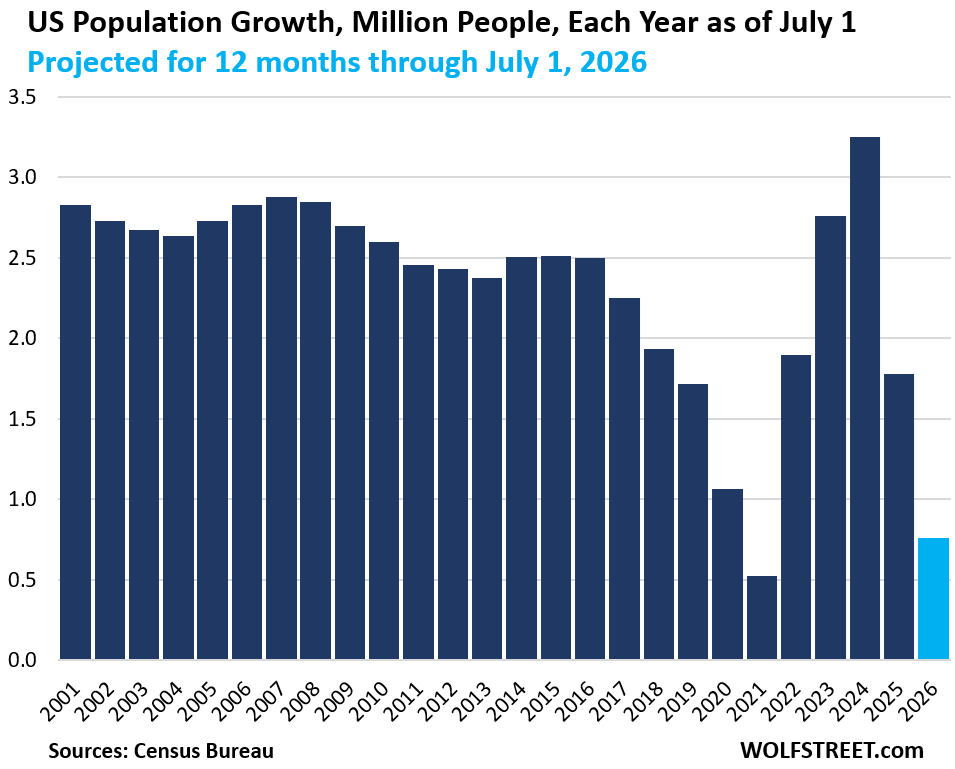
But in 2025, population growth faded amid a crackdown on illegal immigration. According to separate data from the Census Bureau, for the 12-month period through July 2026, the US population is expected to increase by only 757,000 people.
The total housing stock reached 149.0 million housing unit. These are single-family homes, townhomes, duplexes, ADUs, etc., and multifamily homes (condos and apartments).
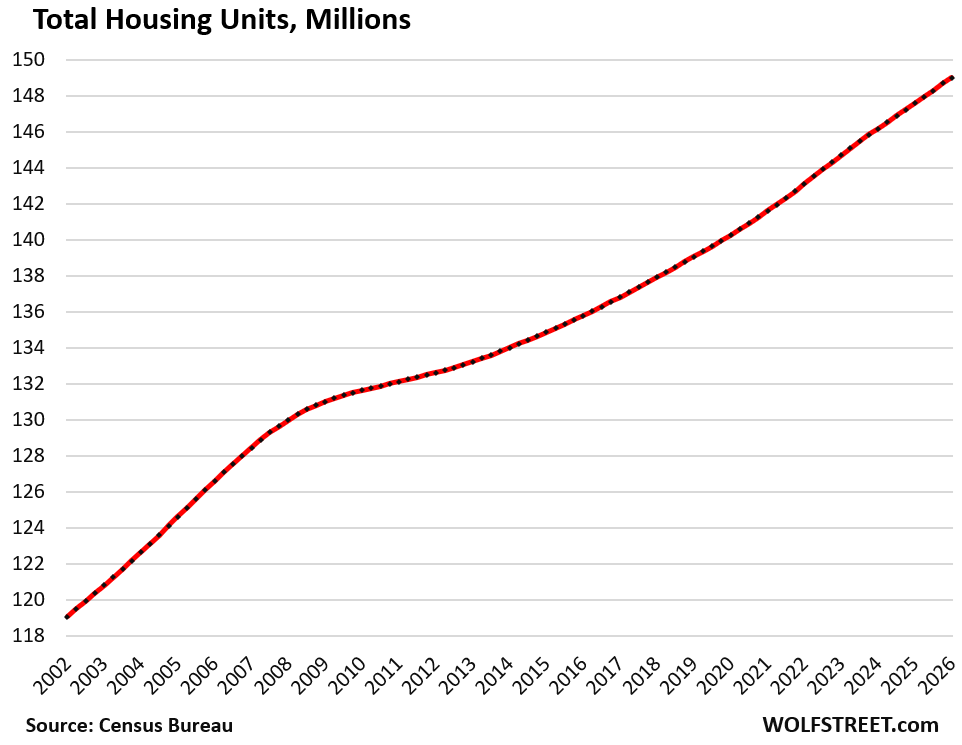
Over the past five years, the total US housing stock grew by 7.4 million housing units – new construction minus demolitions. At average household size, this addition accommodates 17 million more people.
But over the 5-year period through July 2026, the US population grew by 10.4 million people, including the two-decade-record surge in 2023 and 2024 (my analysis).
Over the past five years, the housing stock has grown steadily and substantially faster than the population.
The vacant housing stock.
There were 11.9 million “year-round vacant” housing units in the US, or 8.0% of the total housing stock.
The vacant shadow inventory: Of those 11.9 million year-round vacant units, 6.4 million vacant housing units were held off the market for a variety of reasons, a portion of which constitutes the vacant shadow-inventory that will show up on the for-sale or for-rent market at some point.
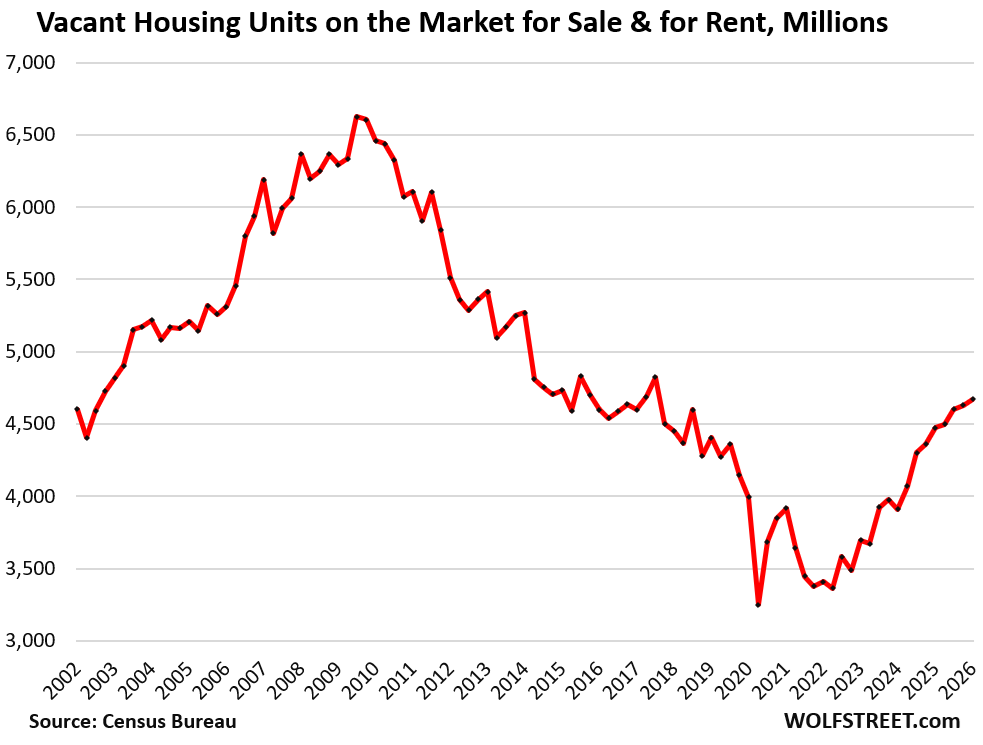
Vacant housing units on the market for rent or for sale rose by 4.4% over the 12 months through Q1, to 4.7 million vacant housing units on the market, the most since two quarters in mid-2017, and before then the most since 2014, coming out of the housing bust.
Over the two-year period, they surged by 19.4%! But this time, population growth has slowed to a crawl.
With the for-sale market frozen and 2025 sales of existing homes down by about 25% from before the pandemic, and by 43% from the record in 2005, many wishful sellers of single-family homes and condos, after failing to sell their units at wishful prices, put their units on the rental market, hoping that this too shall pass.
The number of these “accidental landlords” has surged, Zillow found by the for-sale listings that didn’t sell, were pulled, and were then re-listed for-rent. For an overview of this situation, looking at for-rent and for-sale units combined eliminates this issue of vacant housing units shifting between categories:
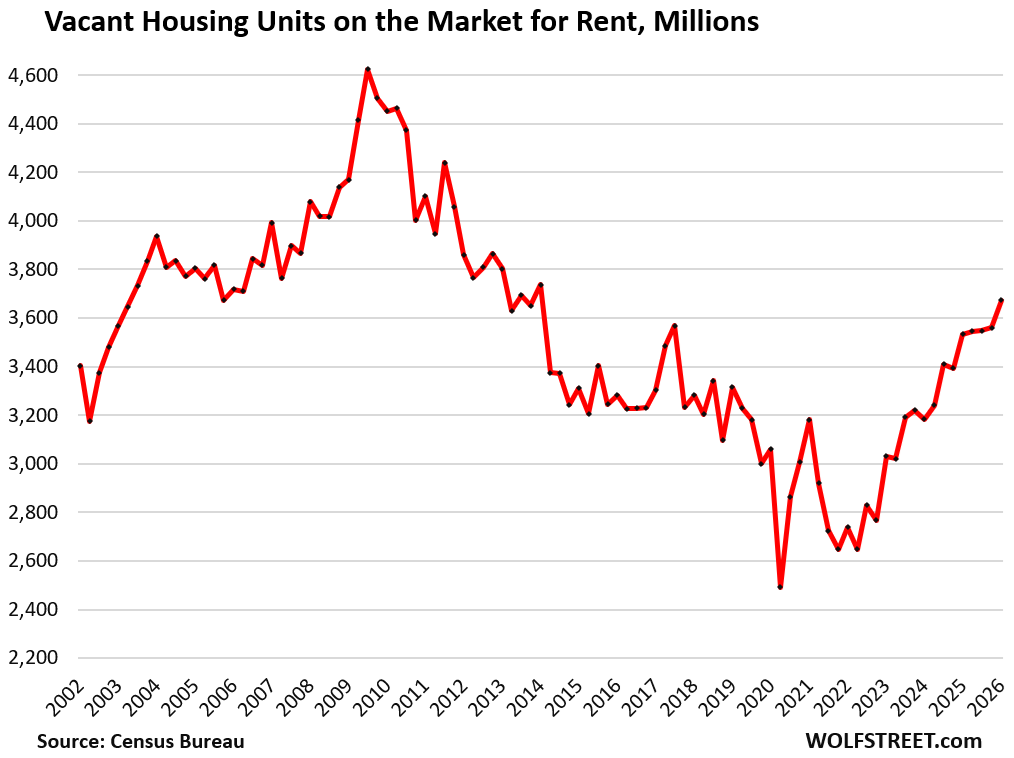
Vacant housing units on the market for rent – including by “accidental landlords” – rose by 6.1% year-over-year to 3.67 million in Q1, not seasonally adjusted, the most since 2014.
Over the two-year period, for-rent units surged by 15.4%!
Vacant housing units on the market for sale jumped by 6.1% year-over-year to 1.0 million housing units, not seasonally adjusted. A sharp quarter-to-quarter decline in Q1 from Q4 is typical in these not-seasonally adjusted figures.
Over the two-year period, for-sale units surged by 37%!
And remember: a portion of what used to be vacant for-sale homes are now vacant for-rent homes that these “accidental landlords” shifted into the chart above:
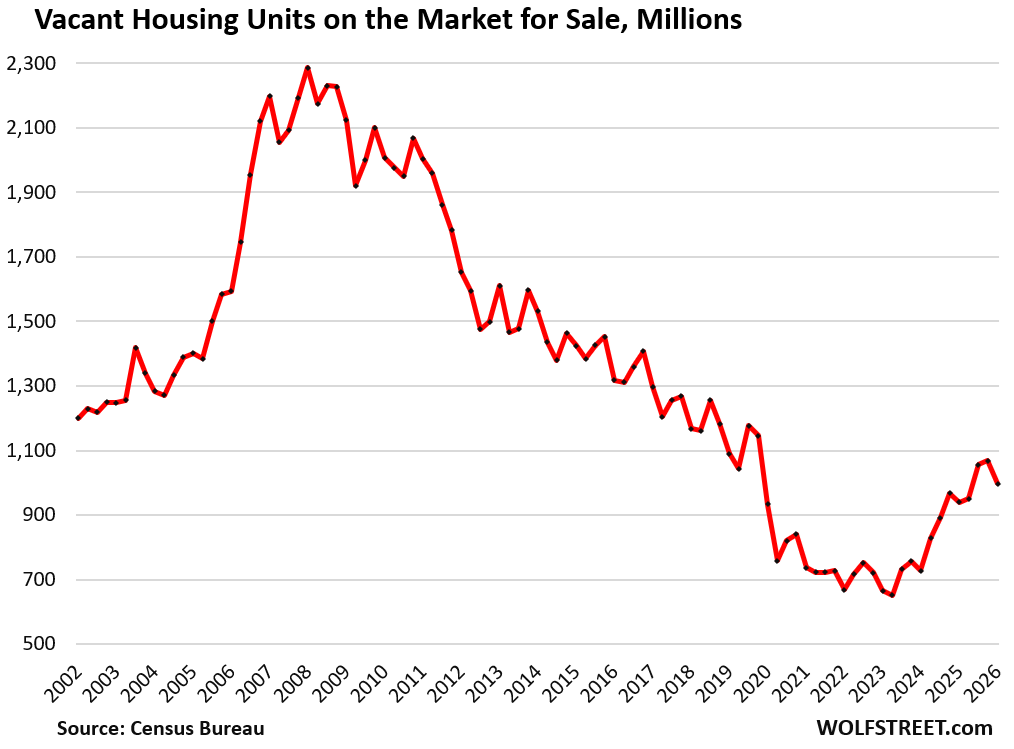
What the US housing market needs more than anything is lots of new housing units, more supply, and even more supply, of all kinds, amid slowing population growth. And these dynamics are now moving in the right direction.
Enjoy reading WOLF STREET and want to support it? You can donate. I appreciate it immensely. Click on the mug to find out how:


Be careful what you wish for!! Slowing housing demand created by lower population growth creating lots of vacancies will lower house prices and rents. Most rental houses are owned by Mom and Pop landlords. Vacancies that are long-lasting will lower rents and start causing foreclosures and in general lower income of lots of landlords. We could end up with a 2008 housing bust that would contribute to a recession right when the average American is suffering from inflation. Worse case scenario is that states with lots of outmigration could start looking like some Italian towns with permanently vacant homes.
“…will lower house prices and rents.”
That is exactly what is needed. Rents soared during the pandemic, and home prices exploded. It was completely crazy. High housing costs take a huge bite out of the rest of the economy. But there won’t be a mortgage crisis; most mortgages are in the hands of the government, not banks, and the taxpayer doesn’t care. The taxpayer is watching Netflix videos.
A real housing bust could contribute to a recession, but not as much as the stock market can when the bubble implodes. But then maybe we’ll finally get inflation under control.
https://wolfstreet.com/2026/04/16/the-most-splendid-housing-bubbles-in-america-price-drops-gains-in-33-big-expensive-cities-march-2026/
Haha…….
the taxpayer doesn’t care. The taxpayer is watching Netflix videos.
Sad but most likely accurate.
(1)
“…most mortgages are in the hands of the government, not banks”
Wasn’t this also the case in ’07, if we think about the GSEs as essentially arms of the government even back then? They certainly proved to be arms of the government in the end, when they required bailouts. There’s nothing stopping that from happening again.
(2)
But so far so good. Housing Bubble #2 is deflating slowly enough, in a job-abundant environment over the past 3-4 years, that the people sitting in negative equity have just enough incentive to stick it out, rather than letting foreclosure happen.
But your charts foretell falling rents. As increasingly negative cash flow makes the bleeding more severe for landlords, we should expect to see units appearing for sale at desperation prices, or just abandoned by landlords when the rent isn’t sustainable and there’s not enough equity to sell.
(3)
I appreciate your astute observation that housing units are increasing faster than population. However, if population growth is heading toward negative numbers (see recent fertility stats!) while we’re piling on additional housing units, it seems to set the stage for Housing Bubble #2 to exceed the magnitude and consequences of Housing Bubble #1.
The accidental landlords who overpaid cannot escape their mistake by renting into a falling rental market, in a country with soon-to-be negative population growth. Japanification, here we come!
1. The GSEs are now government entities. They are the government. Maybe someday, they’ll privatize them, and they’ve been talking about it, but even if they privatize them, the guarantee on the mortgages will still the government, it won’t be privatized. They want to privatize the revenues and profits, not the risks.
2. Commercial real estate already went through all that. Lots of big landlords went bankrupt or let the lenders take over their apartment buildings. The process works fine. Investors are going to lose some money, so what. And that already started several years ago.
For the sake of the younger generations, we need lower house prices and rents. Many of my friends can’t afford houses that just 6 years ago were perfectly reasonably priced.
Home prices have been detached from the wages because of financial regression policies of FED.
Home prices need to fall by 50% or so to make any sense.
A 50% decline would be a repeat of the 2008 crisis.
It would not because this time, banks are not on the hook. The government and investors are. So it won’t lead to a Financial Crisis.
Re: “Worse case scenario is that states with lots of outmigration could start looking like some Italian towns..”
The elites can easily fix that. Case in point: there are so many North Africans in Berlin that it no longer even remotely looks like Istanbul.
If mom and pop landlords bought before 2020 they should have plenty of equity.
If they bought recently that’s kind of on them for buying into a bubble or trying to get rich by buying sfh for airbnb. We should be able to correct 20% or so without a major crisis… things typically revert to the mean.
Up near me in Sacramento they are trying to get approved a 9,400 home build out. Looks like it will not pass but would be an extra small city right on the middle of an already packed area as well as wipe out massive green areas. Can’t even imagine prices being affordable given cost to build, new roads, schools, parks and so on not to mention impacts on existing infrastructure. 25K more people just dropped into an area is noticable. Better to let Arizona and Nevada expand where plenty of land and water.
Plenty of water in Arizona and Nevada!?!?!? That’s a good one.
Yeah, i guess. Who would have guessed. Learn something new every day !
They grow lots of cotton in Arizona.
Wolf,
I can’t tell if you’re being sarcastic with your closing comments. I don’t get it from a development standpoint. Why would builders want to put more houses on the ground if there’s a glut of vacant houses to compete against? This sounds like a game of musical chairs (again and again) with the housing industry. Would you invest in speculative home building right now? It seems like there is going to be a real reckoning next year with prices continuing to drop – regardless of new builds. Thanks.
Builders have to build. That’s their business. They cannot just shut down. They’re going to build and sell what they build. That’s what they’re doing right now, and they’re doing a pretty job at it. Their sales have held up. They’ve cut their prices — and some by a lot — and their profits have plunged. They’re competing against homeowners, and they’re gaining market share against homeowners. Homeowners just haven’t figured out yet.
Lennar’s home sales are rising from record to record, and it’s very aggressive in its pricing strategy. Homeowners have no idea what they’re up against. What it takes to sell homes in this market:
Profits may be declining at Homebuilders, but as long as they’re still making profits, they’ll build. Bring it on and saturate the market to get rent and home prices in better equilibrium with income levels which continue to rise, albeit slower than RE prices. It may pay to sit on the sidleines another year or 2.
Profits may be declining at Homebuilders, but as long as they’re still making profits, they’ll build. Bring it on and saturate the market to get rent and home prices in better equilibrium with income levels which continue to rise, albeit slower than RE prices. It may pay to sit on the sidleines another year or 2.
Your charts are valid where there is open land available. UP here in the central Colorado mountains, there is almost no open land, so to build a new house, you have to tear down an old one. Then you have $800,000 invested in your lot. Small builders do just that and sell the new house for $3M-$5M.
Plenty of land every where in USA. A lot of land can be opened looser zoning.
Only people with vested interest in RE says, you can’t create land.
You can’t create PRIME land (e.g., easily commutable to SF, NY, and other “everyone wants to live there” places).
But yeah, there’s plenty of land everywhere else, outside of protected lands.
That’s not correct. There is lots of prime land in urban cores being redeveloped into housing, happening all the time, such as old industrial, malls (they’re huge pieces of land, mostly parking, and the buildings are easy to bulldoze), old powerplants, warehouses, rail yards, ports, etc. There are 74,000 housing units in various stages in the pipeline in San Francisco right now, in all those kinds of spaces, some of them with nuclear contamination (being remediated) from the Cold War.
@Wolf when you write “The vacant shadow inventory: Of those 11.9 million year-round vacant units, 6.4 million vacant housing units were held off the market for a variety of reasons”
Does this mean that your data says 6.4 millions homes have been sitting vacant and off the market “and” 5.5 million homes have been sitting vacant and for sale or for rent for over a year?
Does your data list the number of “occupied” housing units listed for sale or rent. A large percentage of sellers never move out of a home for sale and I list all my rental units “for rent” as soon as I find out someone is not renewing their lease (and I lease almost all of them before the current resident moves out).
Had to read your question a couple of times to figure out what the question was. So I hope I got it. I had to delete my first answer.
There are two categories of vacant units: “Year-round” and “seasonal.”
So year-round does not mean they were already vacant for 365 days. It means they’re permanently vacant and are NOT used for seasonal stuff. The another category is seasonally vacant, such as vacation homes. I didn’t discuss that category.
This is not an “inventory for sale” data set. It’s a vacant housing units data set. The title of the data set is: “Quarterly Residential Vacancies and Homeownership.” If a unit is occupied, it’s just “occupied” either by the owner (85,963) or by a renter (46,084).
Suppose my question would be how many of those ‘vacant’ homes are actually livable as they sit or are so with minimal costs. Where I am there is a glut of vacant homes just outside of downtown, but most aren’t livable and they don’t turn. There was an attempt to get a program going in which the city would take vacant, dilapidated buildings and sale them to investors with strings attached (buyers meeting low income numbers/rental reqs, that kind of thing) but it died on the vine.
Amazing ramifications of an actual functioning border.
Don’t want to be political and I dislike Trump in general.
But thanks to him, border is closed/secured and lot of companies thinking outside the chine/other countries for manufacturing.
50% would make housing cheaper than 05. Housing has been in a decline in my area for 4 years. Wages haven’t kept up.
Hi Jon – I saw that article too, about people buying house kits from China. Makes sense.
Perhaps all of these white collar people who will get laid off from AI will take whatever money they have and start building houses from cheap materials from China.
Nice to see someone admit that despite their personal dislike, his policies are achieving much good. What most haters don’t get is the fact that many people like myself would prefer these policies in a nicer package but the gold is worth the grime.
First comment seemed to come from someone who overpaid for rental property, perhaps multiples. Old landlords like me may not owe much or anything on the house. I prefer balanced supply of houses to look for good renters who like what I have on offer. Too much of a housing shortage and you see desperate people emailing about places they can’t afford.
Builders have to build. That’s their business. They cannot just shut down. … their profits have plunged …
Hmm … why not? What makes builders increase inventory into a falling-price market especially when there is a significant lag time between the investment decision and committment, and the sale transaction.
“The price of doughnuts is falling, we’ll make more today at today’s cost and sell them next year. We don’t know how much we’ll get, but it’s likely less than we would get today.”
We may be underwater after we have paid off our construction loan (if we can get one).
I get, up to a point, that the pipeline must not freeze … but … adding to excess inventory with new spending … when the old stock with old sunk costs can just be repriced downward against me does not seem sensible to me.
If “new” is a selling point, renovation “just like new” can undercut it.
What am I missing?
“What am I missing?”
Everything. And you cherrypicked some phases out of context to suit your narrative.
Here is my entire paragraph, verbatim:
“Builders have to build. That’s their business. They cannot just shut down. They’re going to build and sell what they build. That’s what they’re doing right now, and they’re doing a pretty job at it. Their sales have held up. They’ve cut their prices — and some by a lot — and their profits have plunged. They’re competing against homeowners, and they’re gaining market share against homeowners. Homeowners just haven’t figured out yet.”
Doesn’t economic growth depend on population growth? Just like the economy grew after the population boom following WW2 doesn’t it contract if population levels decline? Seems like basic supply and demand. Hope it all works out for the best.
No, it depends on rising productivity and/or population growth, one or the other or both. Rising productivity is the good part about economic growth. Rising productivity creates wealth. Rising population makes the slices of that wealth smaller.
Thank you Wolf. Population growth by itself is irrelevant if all of the dynamics are not taken into account. If population growth were all that mattered then Mexico City should be the economic envy of the world.
Reading this from Australia where every government policy is designed to increase the price of the existing stock of housing and inflate the cost of new housing. It’s actually quite depressing to witness the decline in almost every other part of the economy because of this
The downtick in houses for sale and the uptick in houses for rent made me chuckle. Homeowners will do anything except simply lower the damned price, won’t they?
Where do environmental carrying capacity limits (or lack thereof) enter into this discussion. The Western states are currently facing potentially ongoing severe drought conditions with water rationing now kicking in in those areas with the least secure water supply situations (e.g., in Colorado those municipalities with the most junior water rights, most costly wastewater treatment, etc.). The endless pro-growth economic development (e.g., high-end real estate developers and increasingly-desperate fiscally-challenged states and municipalities incentivizers) keep turning blind eyes to these realities. At their cost. Wolf’s earlier post about the precipitously-tanking real estate brokerage stocks, including amalgamating in desperation recent IPOs like Compass are red flags.
I should add: Take a look at the cities in Arizona where new building permits have had to be terminated due to insufficient present and forecasted future water supply. Buckeye is one. There are others. The Colorado River is warning in its own way.
Buckeye never owned the water rights to allow those houses, and told those land speculation fools to go buy the water rights necessary. Instead they just found the next suckers. Scam has been going for a half century. Arizona has plenty of water, it’s only cheap for vested first owners and those sucking down aquifers (essentially water strip mining) in unregulated areas. Stop growing cotton and alfalfa and there’s plenty of water.
Is this mostly urban areas? In the small town area I live in (Pa.) when a house goes on the market it sells the same day a lot of times for more than the list price. There are very few that have been on the market for weeks but they are odd balls as they are way over priced or in need of repair. I have been paying very close attention as my son has been looking for a three or four bedroom house for months.
Scott,seeing homes move quickly in Boston burbs and in N.H.,at least semi-reasonably priced homes.
I have not seen the pricing on a lot of the homes so do not know how if by any the pricing dropped ,just see for sale signs and then a lot of pending within a week or two.
Where I live in coastal, suburban Florida, houses sit and languish on the market. 5% of the houses in my neighborhood are for sale and have been for months.
I think there are three factors: demographics, labor supply, and local policy. Immigration restrictions certainly cut into the first of the two. Builders in Sunbelt are having to contend with lower aggregate demand. Immigration restrictions alone are expected to cut down home formation by 20% over the next decade. In large metros that’s going to translate into modest dip of around 3% (magnified further in inflationary environment). Homes are no longer going to be stores of value but it’s going to take a while for people to realize this. In areas with smaller more moribund markets and lots of paid off homes it may be impossible to sell at any price, kind of like rural Japan. It may eventually come for markets in midwest and northeast too but right now it’s a tale of 3 markets.
The comment about a Colorado mountain town with 800k lots is likely a ski town where the wealthy gather to show off their wealth. It has as much relevance to the middle class as the huge yachts have to a modest cabin cruiser (used).
If you want a mountain town look at Maggie Valley NC. It’s a little scruffy but the elevation on the outskirts is high enough you don’t need AC. Plus there’s water, some times too much water but that’s better than none. High elevation lots won’t get flooded.
Ssshhhh don’t tell the internet about Maggie valley :) I want at least one good place on earth left when I retire