
These dynamics are now moving in the right direction.
By Wolf Richter for WOLF STREET.
Over the past 12 months through Q1, the total US housing stock grew by 1.41 million housing units – new construction minus demolitions – according to the Census Bureau today. With an average household size in the US of 2.3 people per housing unit, this addition over those 12 months provided homes for 3.2 million people.
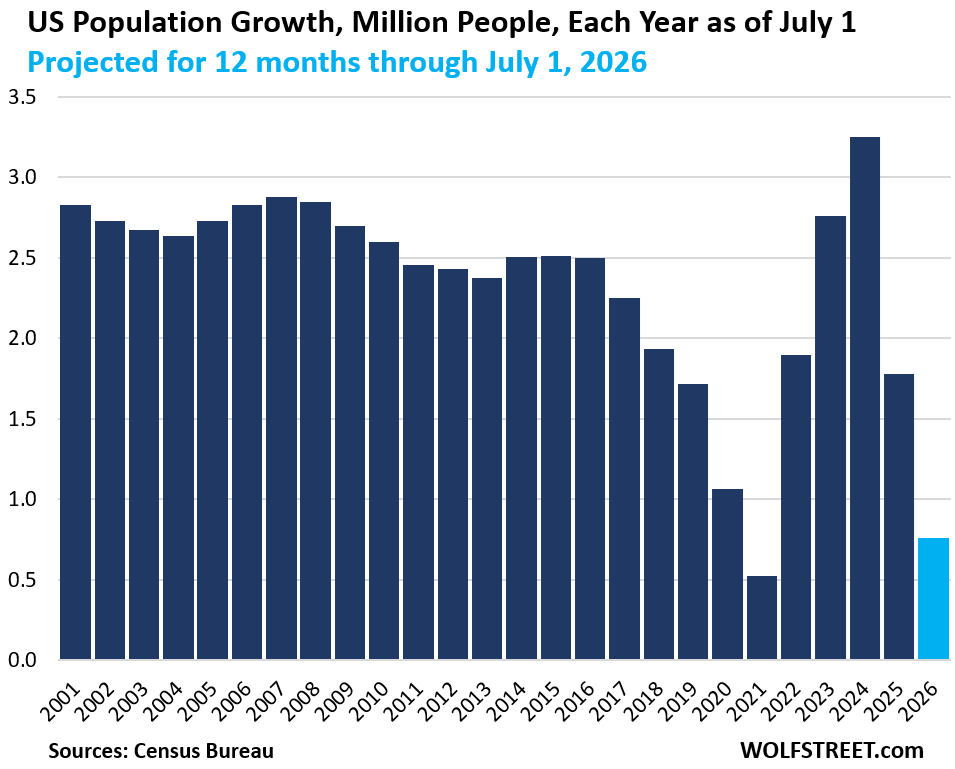
But in 2025, population growth faded amid a crackdown on illegal immigration. According to separate data from the Census Bureau, for the 12-month period through July 2026, the US population is expected to increase by only 757,000 people.
The total housing stock reached 149.0 million housing unit. These are single-family homes, townhomes, duplexes, ADUs, etc., and multifamily homes (condos and apartments).
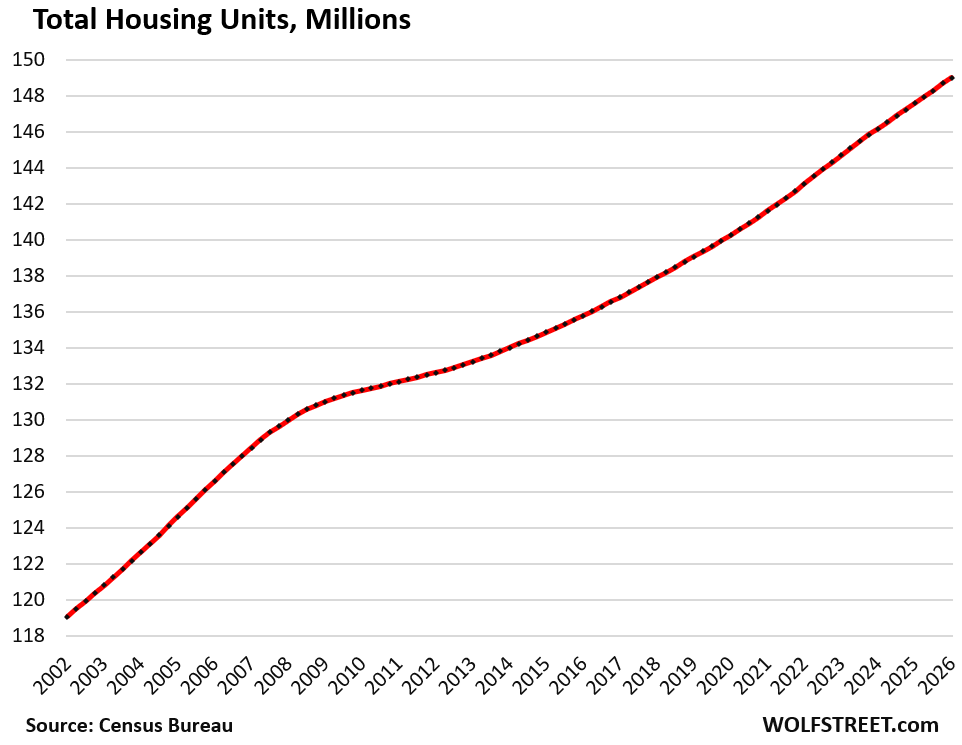
Over the past five years, the total US housing stock grew by 7.4 million housing units – new construction minus demolitions. At average household size, this addition accommodates 17 million more people.
But over the 5-year period through July 2026, the US population grew by 10.4 million people, including the two-decade-record surge in 2023 and 2024 (my analysis).
Over the past five years, the housing stock has grown steadily and substantially faster than the population.
The vacant housing stock.
There were 11.9 million “year-round vacant” housing units in the US, or 8.0% of the total housing stock.
The vacant shadow inventory: Of those 11.9 million year-round vacant units, 6.4 million vacant housing units were held off the market for a variety of reasons, a portion of which constitutes the vacant shadow-inventory that will show up on the for-sale or for-rent market at some point.
Vacant housing units on the market for rent or for sale rose by 4.4% over the 12 months through Q1, to 4.7 million vacant housing units on the market, the most since two quarters in mid-2017, and before then the most since 2014, coming out of the housing bust.
Over the two-year period, they surged by 19.4%! But this time, population growth has slowed to a crawl.
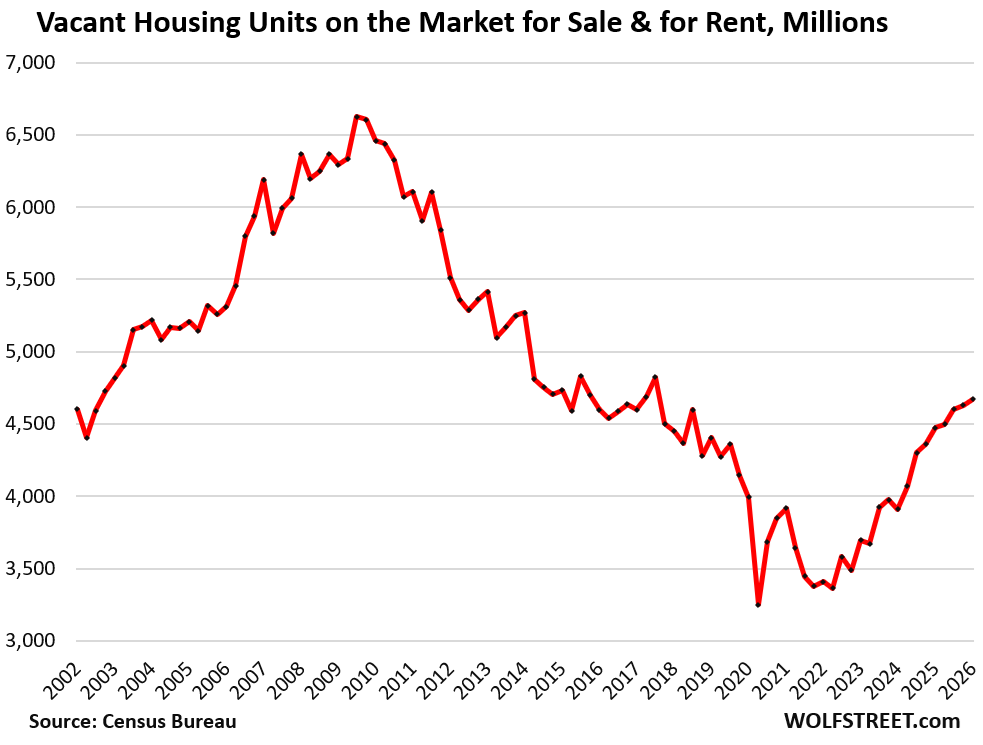
With the for-sale market frozen and 2025 sales of existing homes down by about 25% from before the pandemic, and by 43% from the record in 2005, many wishful sellers of single-family homes and condos, after failing to sell their units at wishful prices, put their units on the rental market, hoping that this too shall pass.
The number of these “accidental landlords” has surged, Zillow found by the for-sale listings that didn’t sell, were pulled, and were then re-listed for-rent. For an overview of this situation, looking at for-rent and for-sale units combined eliminates this issue of vacant housing units shifting between categories:
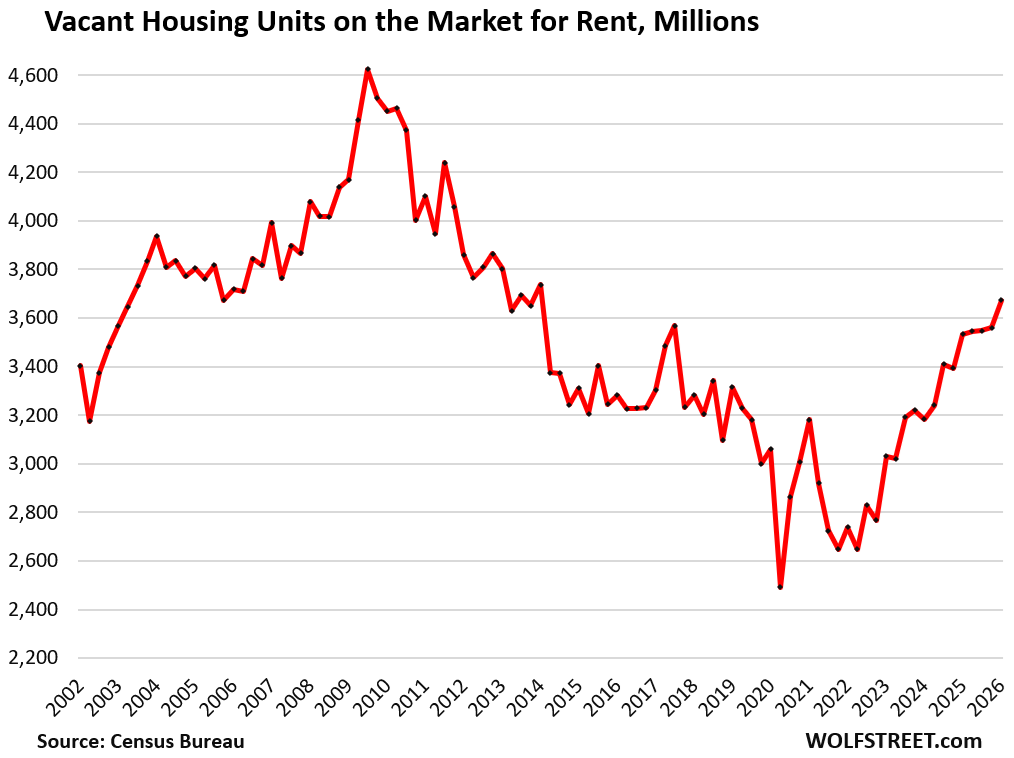
Vacant housing units on the market for rent – including by “accidental landlords” – rose by 6.1% year-over-year to 3.67 million in Q1, not seasonally adjusted, the most since 2014.
Over the two-year period, for-rent units surged by 15.4%!
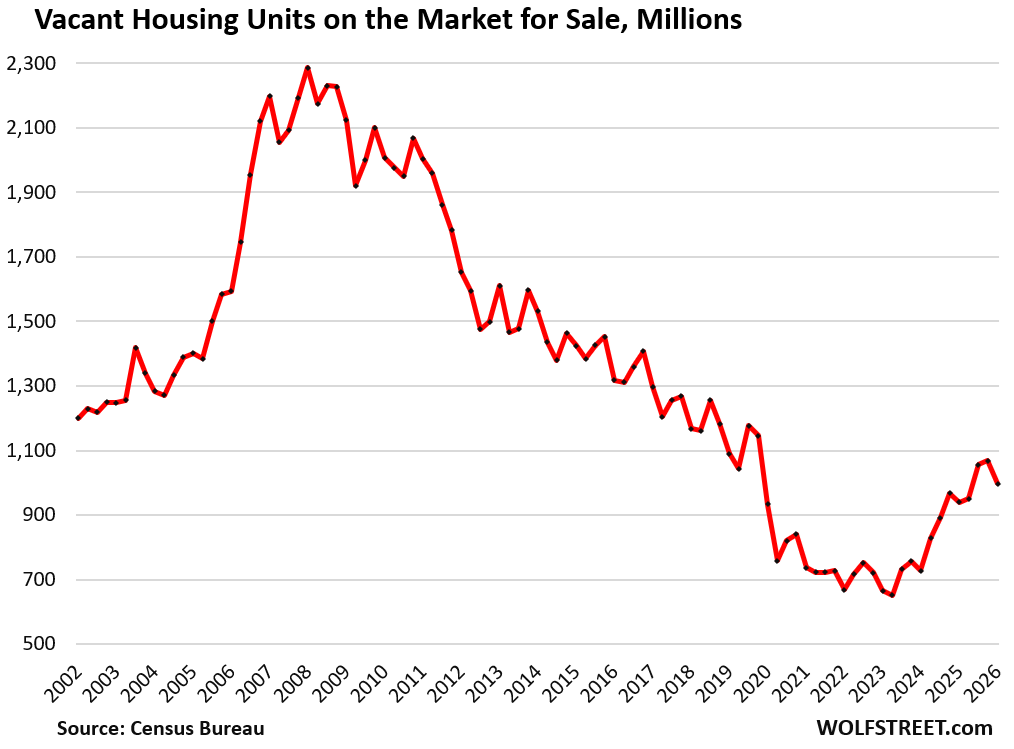
Vacant housing units on the market for sale jumped by 6.1% year-over-year to 1.0 million housing units, not seasonally adjusted. A sharp quarter-to-quarter decline in Q1 from Q4 is typical in these not-seasonally adjusted figures.
Over the two-year period, for-sale units surged by 37%!
And remember: a portion of what used to be vacant for-sale homes are now vacant for-rent homes that these “accidental landlords” shifted into the chart above:
What the US housing market needs more than anything is lots of new housing units, more supply, and even more supply, of all kinds, amid slowing population growth. And these dynamics are now moving in the right direction.
Enjoy reading WOLF STREET and want to support it? You can donate. I appreciate it immensely. Click on the mug to find out how:


Be careful what you wish for!! Slowing housing demand created by lower population growth creating lots of vacancies will lower house prices and rents. Most rental houses are owned by Mom and Pop landlords. Vacancies that are long-lasting will lower rents and start causing foreclosures and in general lower income of lots of landlords. We could end up with a 2008 housing bust that would contribute to a recession right when the average American is suffering from inflation. Worse case scenario is that states with lots of outmigration could start looking like some Italian towns with permanently vacant homes.
“…will lower house prices and rents.”
That is exactly what is needed. Rents soared during the pandemic, and home prices exploded. It was completely crazy. High housing costs take a huge bite out of the rest of the economy. But there won’t be a mortgage crisis; most mortgages are in the hands of the government, not banks, and the taxpayer doesn’t care. The taxpayer is watching Netflix videos.
A real housing bust could contribute to a recession, but not as much as the stock market can when the bubble implodes. But then maybe we’ll finally get inflation under control.
https://wolfstreet.com/2026/04/16/the-most-splendid-housing-bubbles-in-america-price-drops-gains-in-33-big-expensive-cities-march-2026/
For the sake of the younger generations, we need lower house prices and rents. Many of my friends can’t afford houses that just 6 years ago were perfectly reasonably priced.
Home prices have been detached from the wages because of financial regression policies of FED.
Home prices need to fall by 50% or so to make any sense.
Re: “Worse case scenario is that states with lots of outmigration could start looking like some Italian towns..”
The elites can easily fix that. Case in point: there are so many North Africans in Berlin that it no longer even remotely looks like Istanbul.
Up near me in Sacramento they are trying to get approved a 9,400 home build out. Looks like it will not pass but would be an extra small city right on the middle of an already packed area as well as wipe out massive green areas. Can’t even imagine prices being affordable given cost to build, new roads, schools, parks and so on not to mention impacts on existing infrastructure. 25K more people just dropped into an area is noticable. Better to let Arizona and Nevada expand where plenty of land and water.
Plenty of water in Arizona and Nevada!?!?!? That’s a good one.
Yeah, i guess. Who would have guessed. Learn something new every day !
Wolf,
I can’t tell if you’re being sarcastic with your closing comments. I don’t get it from a development standpoint. Why would builders want to put more houses on the ground if there’s a glut of vacant houses to compete against? This sounds like a game of musical chairs (again and again) with the housing industry. Would you invest in speculative home building right now? It seems like there is going to be a real reckoning next year with prices continuing to drop – regardless of new builds. Thanks.
Builders have to build. That’s their business. They cannot just shut down. They’re going to build and sell what they build. That’s what they’re doing right now, and they’re doing a pretty job at it. Their sales have held up. They’ve cut their prices — and some by a lot — and their profits have plunged. They’re competing against homeowners, and they’re gaining market share against homeowners. Homeowners just haven’t figured out yet.
Lennar’s home sales are rising from record to record, and it’s very aggressive in its pricing strategy. Homeowners have no idea what they’re up against. What it takes to sell homes in this market:
Your charts are valid where there is open land available. UP here in the central Colorado mountains, there is almost no open land, so to build a new house, you have to tear down an old one. Then you have $800,000 invested in your lot. Small builders do just that and sell the new house for $3M-$5M.
Plenty of land every where in USA. A lot of land can be opened looser zoning.
Only people with vested interest in RE says, you can’t create land.
@Wolf when you write “The vacant shadow inventory: Of those 11.9 million year-round vacant units, 6.4 million vacant housing units were held off the market for a variety of reasons”
Does this mean that your data says 6.4 millions homes have been sitting vacant and off the market “and” 5.5 million homes have been sitting vacant and for sale or for rent for over a year?
Does your data list the number of “occupied” housing units listed for sale or rent. A large percentage of sellers never move out of a home for sale and I list all my rental units “for rent” as soon as I find out someone is not renewing their lease (and I lease almost all of them before the current resident moves out).
Had to read your question a couple of times to figure out what the question was.
There are two categories of vacant units: “Year-round” and “seasonal.”
So year-round does not mean they were already vacant for 365 days. It means they’re permanently vacant and are NOT used for seasonal stuff. The another category is seasonally vacant, such as vacation homes. I didn’t discuss that category.
Amazing ramifications of an actual functioning border.
Don’t want to be political and I dislike Trump in general.
But thanks to him, border is closed/secured and lot of companies thinking outside the chine/other countries for manufacturing.
First comment seemed to come from someone who overpaid for rental property, perhaps multiples. Old landlords like me may not owe much or anything on the house. I prefer balanced supply of houses to look for good renters who like what I have on offer. Too much of a housing shortage and you see desperate people emailing about places they can’t afford.