
Down by 35% from 2021, by 30% from 2019, and by 31% from 2018. The housing market is in the 4th year of this relentless mess.
By Wolf Richter for WOLF STREET.
Pending home sales in the US overall ticked up in March from February, seasonally adjusted, but were down 1.1% year-over-year, and were down by 35% from 2021, by 30% from 2019, and by 31% from 2018. Compared to March 2011, during the Housing Bust and the first March in the data series, pending sales were down by 18%. The housing market is now in the fourth year of this situation.
Regionally, pending sales ticked up from near record lows in the South and the Northeast and fell in the West and Midwest.
In January, national pending sales had dropped to a record low in the data (which goes back to mid-2010) by the National Association of Realtors, and the upticks in February and March are from that record low (historic data via YCharts):
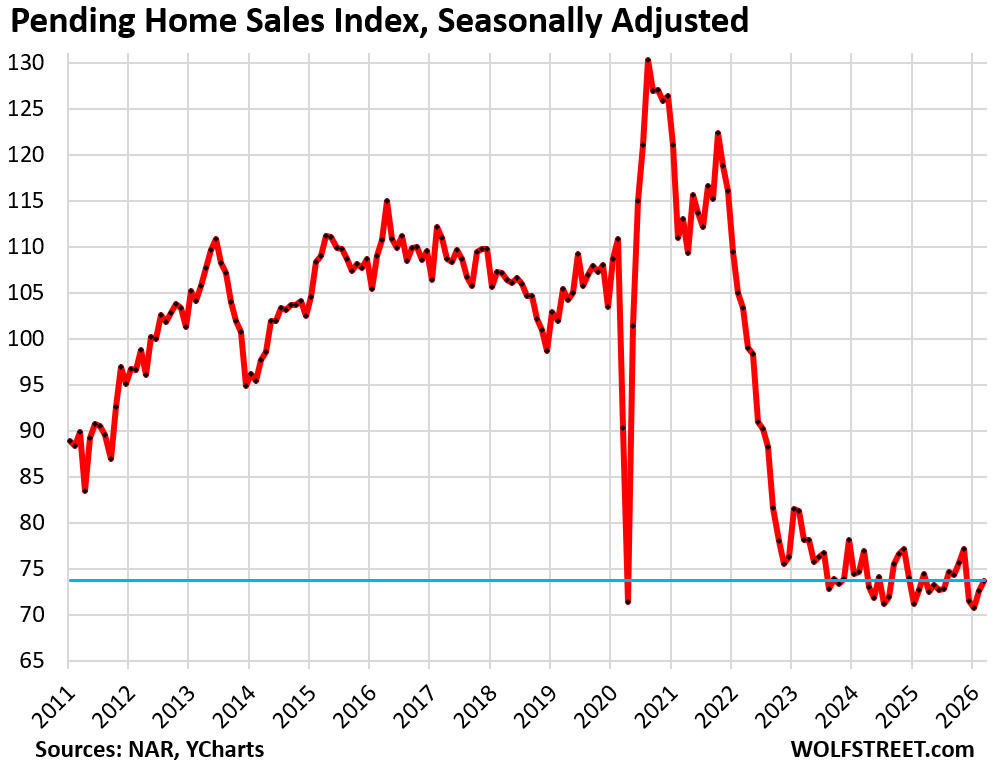
The metric of pending home sales tracks contracts that were signed in March but that haven’t closed yet and could still get canceled because buyers cannot afford homeowner’s insurance, or cannot sell their own home, or for other reasons. The rate of cancellations has been running high.
Pending home sales by region.
A map of the four Census Regions is posted in the comments below.
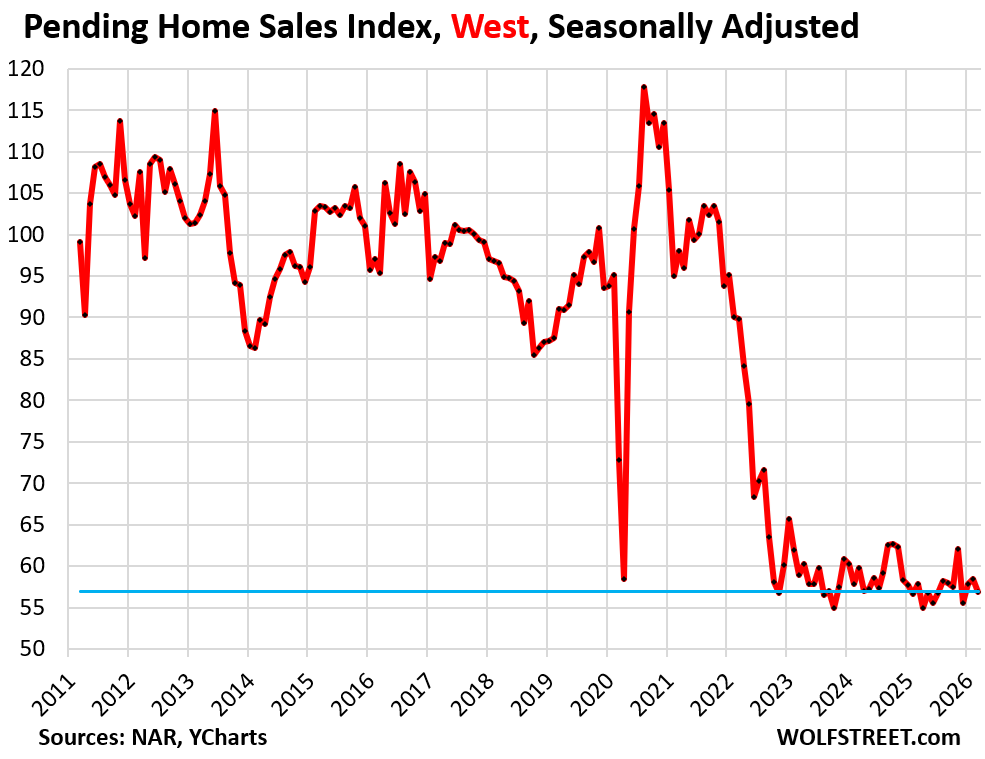
In the West, pending sales fell by 2.6% in March from February, seasonally adjusted, and were just a hair above record lows.
Compared to March in prior years:
- 2025: -1.7% (year-over-year)
- 2024: -4.8%
- 2023: -3.4%
- 2022: -36.6%
- 2021: -41.9%
- 2019: -37.5%.
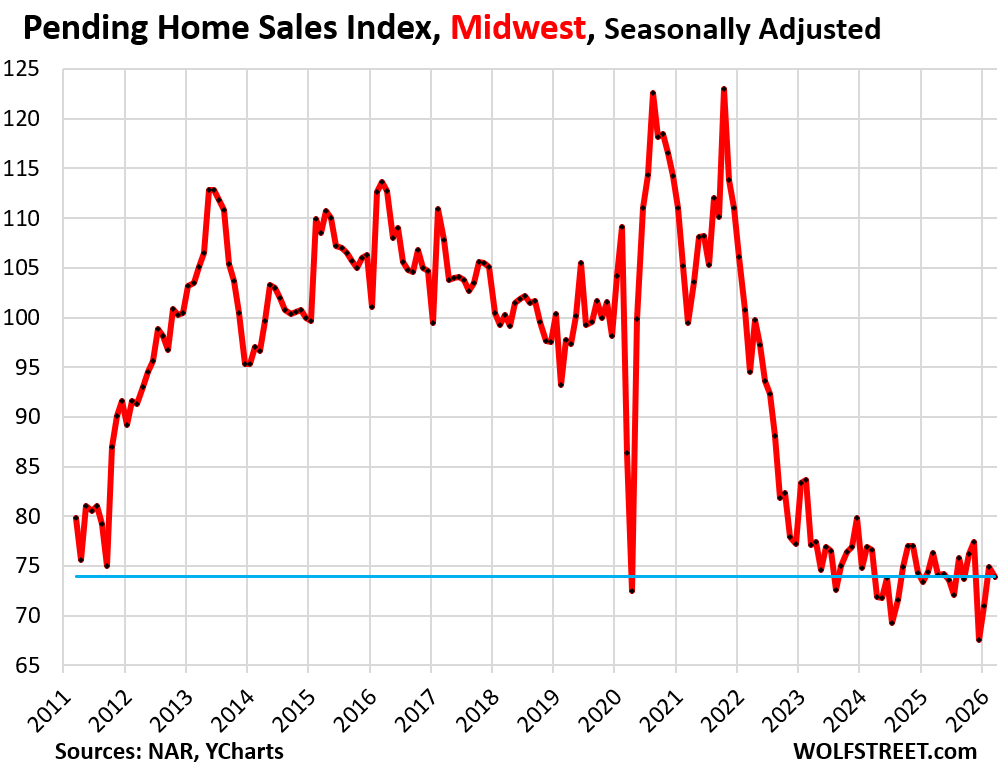
In the Midwest, pending sales fell by 1.3% in March from February, seasonally adjusted, and were down 3.1% year-over-year.
December had been the record low in the data going back to mid-2010.
Compared to March in prior years:
- 2025: -3.1% (year-over-year)
- 2024: -3.5%
- 2023: -4.2%
- 2022: -21.8%
- 2021: -25.7%
- 2019: -24.4%.
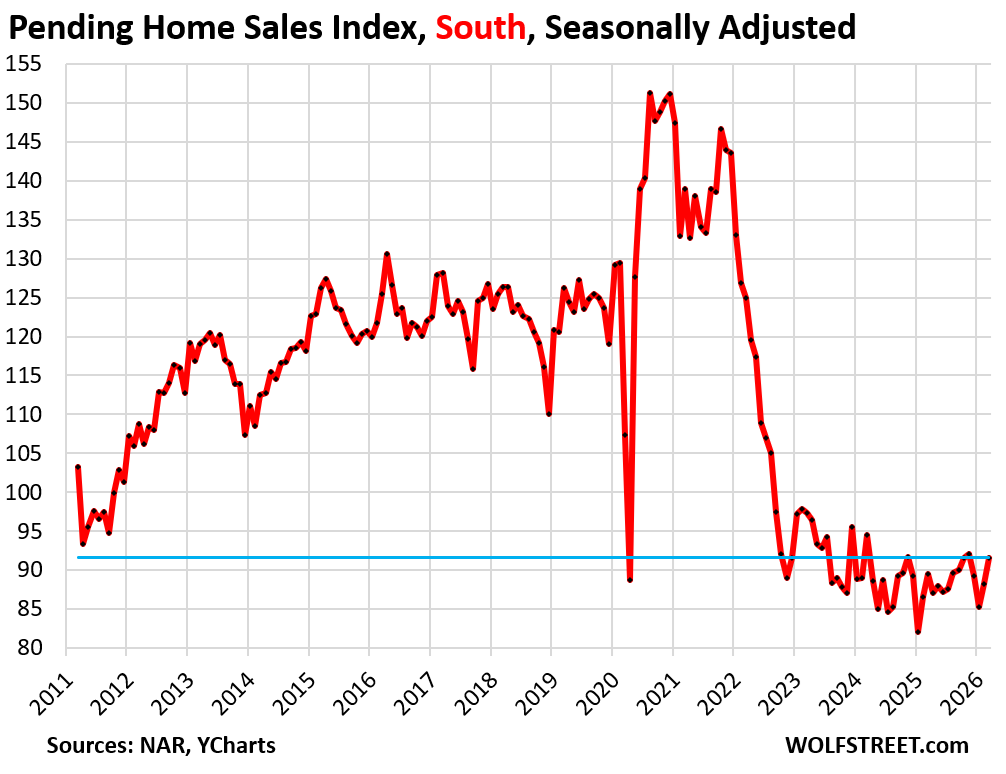
In the South, pending sales rose by 3.9% in March from February, seasonally adjusted, with the increases in February and March having not quite reversed the declines in December and January.
Compared to March in prior years:
- 2025: +2.3% (year-over-year)
- 2024: -3.1%
- 2023: -5.9%
- 2022: -26.7%
- 2021: -34.1%
- 2019: -27.4%.
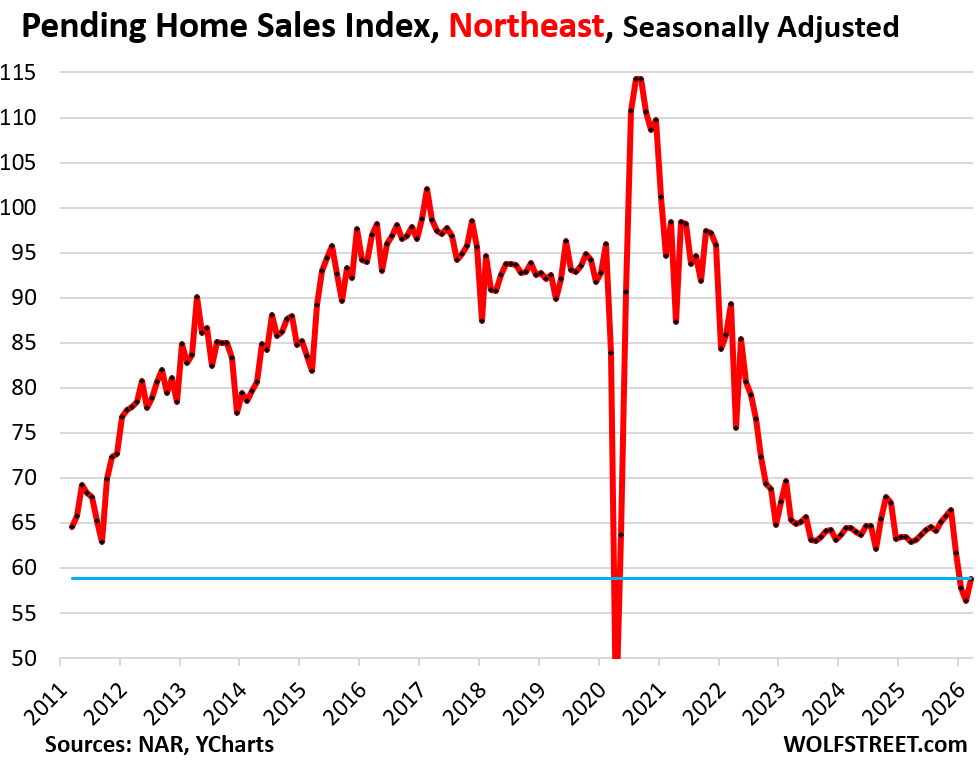
In the Northeast, pending sales rose by 4.4% in March from February, which had been the second-worst sales on record, behind only lockdown-March 2020. The uptick in March barely made a dent into the prior three months of steep declines. Year-over-year, sales were down 6.6%.
Compared to March in prior years:
- 2025: -6.6% (year-over-year)
- 2024: -8.7%
- 2023: -10.0%
- 2022: -34.2%
- 2021: -40.2%
- 2019: -36.4%.
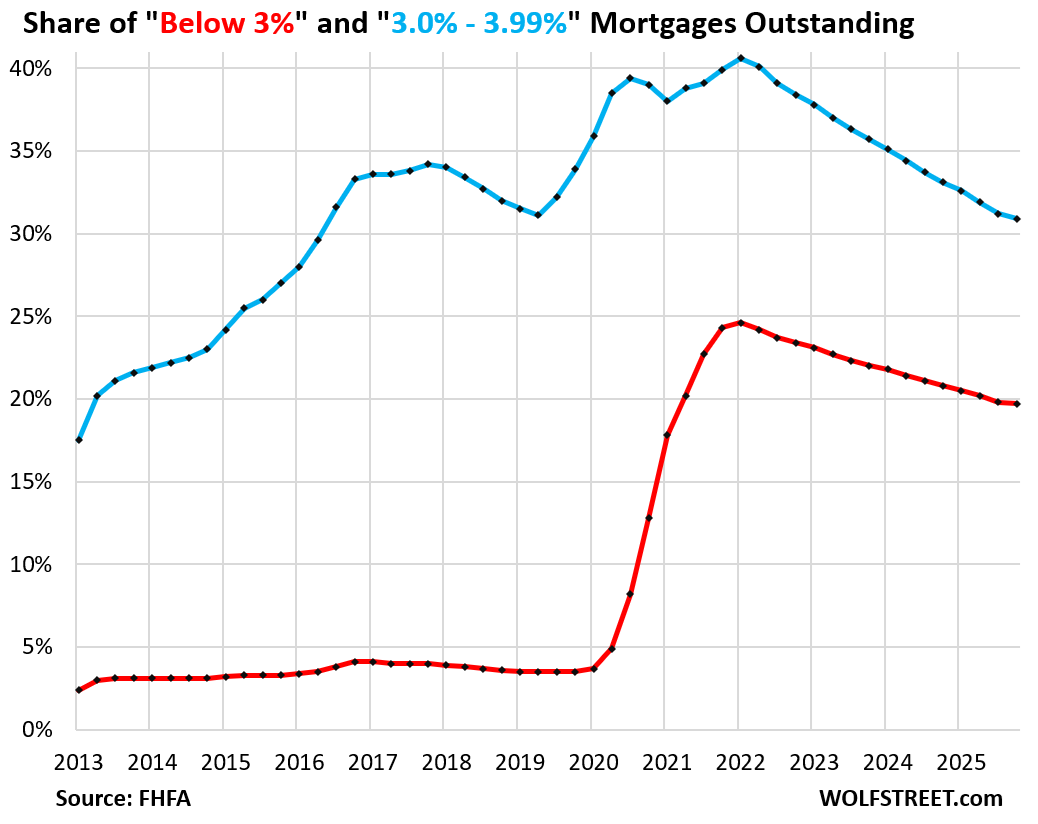
So in March, the housing resale market remained in the deepfreeze. Sales volume continues to get crushed by too-high home prices that had soared during the years of ultra-low mortgage rates thanks to the Fed’s reckless monetary policies. And it is further hampered by the super-low mortgages still out there that prevent many homeowners from moving into a new home because they cannot afford to, or don’t want to, pay the too-high-price to be financed with a regular mortgage rate of around 6%, when their current home carries a 3% mortgage.
These too-high home prices and 3% mortgages still out there are depressing home sales, and this as secondary effects on economic activity that home sales generate, such as moving expenses and buying new stuff for the new home, landscaping, remodeling, etc., and these effects can include not taking a new job because it would require a move. This is the so-called “lock-in effect.”
But gradually, life happens, and the lock-in effect loosens just a little every quarter as homeowners pay off their super-low-interest rate mortgages anyway:
In case you missed it yesterday: Condo Prices Dropped by 12% to 31% in 31 Bigger Markets. Some Are where They’d Been 20 Years ago, such as Oakland
Enjoy reading WOLF STREET and want to support it? You can donate. I appreciate it immensely. Click on the mug to find out how:


The four Census Regions of the US:
Pending home sales are in the toilet and this is before the largest and most economically devastating energy crises in my lifetime takes control of the american and global economies.
Buckle up folks!
Take jet fuel, for example.
It is widely reported that jet fuel is produced and refined in the middle east and is essentially off line. The last time I checked, e-commerce was heavily reliant upon jet fuel.
Airlines beginning to cancel flights en masse is the first glimpse into what is coming.
Who is going to load up on realestate when the energy crisis in the US unfolds in the weeks and months to come? We are entering the shock and awe phase which is when the denialists are faced with the facts.
The US isn’t going to run out of jet fuel. It refines more jet fuel than it can sell domestically, so it has become a big exporter of jet fuel. Saying that the US will run out of jet fuel is fearmongering BS.
But what could happen in the future is that in some FOREIGN destinations, there might not be enough jet fuel to cover demand, and so US airlines might have trouble filling up in some spots in Asia or Europe for their return-trip, in which case they’d cancel the entire out-and-back flight. Local flights in those foreign countries might also get cancelled. But that’s not happening yet. They’re just talking about it, and stupid headlines are circulating in the media.
What is happening is that they’re adding hefty fuel surcharges or other surcharges to cover the higher costs of jet fuel.
“The last time I checked, e-commerce was heavily reliant upon jet fuel.“
I’m curious what sources you checked. Neither the Amazon semi tractors I see on the interstates nor the train engines pulling the mile-long strings of double stack containers I see on the freight railroads nor the last-mile UPS and FedEx trucks I see in the neighborhood are burning jet fuel. In fact, a lot of the Amazon last-mile trucks I see aren’t burning any fuel at all these days.
If you absolutely, positively must have that pair of socks by tomorrow at the latest, then yes, they might have burned some jet fuel getting them to you. But if you can wait just a few days, then no, they aren’t burning jet fuel. The e-commerce apocalypse might still be a little ways off.
Ehhh you say they aren’t burning jet fuel but they kinda sorta are. Or at least not far off. I bet if you asked a refiner they might tell you these distillates you mention are quite similar at the base level before you throw in the additives . I don’t agree with the fear stoking though, nobody is running out, the newly adjusted pricing is making sure of that
Blake: truth heard. The energy densities are very close. Point humbly taken.
Merely observing that the U.S. e-commerce machine isn’t going to grind to a halt just because a fuel blend it doesn’t use in quantity might be bottle-necked in a region we don’t get it from anyway. (Points of view may vary in Europe and Asia).
IMO there are bigger energy-related issues to be discussed than the effects of oil prices on U.S. e-commerce. But a thread on pending home sales probably isn’t the right forum for that.
Haha you are right. The article is about home sales after all . I’m with you
It’s more self-cancellation of travel plans like self-deportation.
If you are willing to pay the increased costs, you will get there and back. But be prepared to pay!
Idiot Alert …
That is a no. Europe has gotten what they deserve on jet fuel and much more with the Strait of Hormuz as a bunch of self-righteous freeloaders that can’t be bothered to help protect international commerce. As far as Asia goes, China was only going to get so far before America economically slapped them down, just like Japan in the 90’s. Furthermore, there is nothing wrong with America running out of good will concerning both enemies and frenemies.
Who will win this game of attrition,
The seller or the buyer ?
In My area 80 miles east of San Francisco I believe the buyer will come out on top.
Lots of bay area high paying tech layoffs Oracle for one.
I am seeing more high end homes hitting the market.
Have a fantastic day ! 🍻
Your in CA of course you are screwed the only region doing well is the one with the most red zones … blue zones are leading the economic issues for the last 3 years for so many reasons besides business and people just leaving followed by citizen blindness and lack of accountability and leaders more focused on optics and tik tok
Anecdotally speaking, OC/LA seems to not feel like the number represent in West graph…..Still seeing home being snatch up for ridiculous price and demand maybe wane a little bit but not by much unfortunately. Sadly, this also means, many sellers are still asking for hopium pricing….Guess we’re special out here…at least that’s how it feels, I am sure and hoping Wolf will post some graphs specific to OC and LA to illustrate I am wrong :)
I’m tired of seeing you whining repeatedly about the same issue. Get a clue. You’re not the only one who is hoping for price drops so I can relate but JFC man get a grip.
Phoenix_Ikki,
The reason I post data is so that I don’t have to read this goofball “observation” nonsense with verbs such as “being snatched up.”
What will be interesting is the April and May numbers. If we get some downward momentum for Spring selling season I think that would help. What we need is a sentiment change. Most markets now operate on psychology, not fundamental
In my local development in a lower scale area of Southern California there were normally four sales per year at a peak of 550 per sf for a five years. In the last year there have been zero sales and nothing on the horizon. A 200 dollar a square foot drop to 350 would not be surprising. Given the tax and associated costs no one is going to move unless divorce or death or prison.
Unfortunately sections of the market run on psychopathy. Ran across a listing for a crappy little house in a crappy neighborhood in a crappy industrial area some late-night infomercial watcher bought, painted and put in granite countertops. And now 2 months later think it should sell for 2.5 times what they paid. Now it’s a crappy house in a crappy neighborhood in a crappy industrial area, with granite!
To be fair, they may not be psychopaths. Maybe they just spent too much time at the marijuana store next door.
I’ve got a bestie with two mortgages right now trying to offload 35 acres w/house that’s in the mountians of SW Colorado. Property backs up to huge BLM. Praying his market is still atypical.
It’s not going to change until those 3% mortgages roll over in 2050
Who in their right mind would give up a 3% rate for a 6% rate and a much crappier house by comparison?
This is the elephant in the room. Yes, people are forced to sell, but the rest…hard sell, pun intended.
But most of those people who got 3% mortgages also bought when home prices were at/near their peak. They are in a double bind. They have non-transferable 3% mortgages and they overpaid for their home. If they are in an area of decreasing home prices, at some point the negative equity will be larger than the savings of a 3% mortgage.
If you are one of the lucky few who bought at 3% before the price explosion, then damn right, you would be insane to sell.
BruceP, a huge portion of those with 3-handle mortgages *refinanced* their houses, with cost bases way below <2021 prices. So it's not about "a lucky few" it's more like millions.
A counterpoint here to "Who in their right mind would give up a 3% rate for a 6% rate and a much crappier house by comparison?" How about those getting jackhammered by rising prop taxes?
I fall into the 3-3.99% bracket, which was the case for a decade+.
The sub 3% folks may have “overpaid” OR may have refinanced.
There was a huge refinance boom along with the plunging rates. Many of the price- boom buyers were cash buyers (0% mortgages), although I don’t have a percentage.
This happens when one can sell a house, then buy in a completely different market (which there was also a lot of… with no numbers from me).
It’d take a lot of price drop for people to realize that 3% rate is not that great.
Many once hot markets like Austin have fallen more than 25% from their peaks. Other markets would follow them in due time.
I wonder is the employment levels of real estate agents and mortgage brokers for residential has also take a similar descent?
Not updated for about 10 months, but I don’t think it changed much:
https://wolfstreet.com/2025/05/12/housing-bubble-bust-1-and-2-as-seen-through-employment-at-mortgage-lenders-they-shed-jobs-again-38-gone/
It is really hard to identify the employment level of Real Estate agents because so many are part time or just dabble in it while doing other things. In many states (varies by licensing requirements) the 80/20 rule is in effect. 20% of licensed agents will do 80% of the transactions. In some states (especially ones with low license costs) a surprisingly large percentage of licensed agents do zero transactions in a given year.
These are employees, not independent contractors. This metric here is from nonfarm employment; it doesn’t count brokerage licenses, but actual employees for which companies file quarterly employment tax reports.
When I asked Gemini what percentage of licensed real estate agents in Nevada had a transaction last year this is what it returned:
“Based on national data for 2024–2025, approximately 29% to 30% of active licensed real estate agents sold a home, meaning over 70% did not close a transaction. Due to high inventory of new agents in Nevada and a 16.2% drop in monthly sales, Nevada often reflects this low-productivity trend.
Zero Sales: Roughly 71% of active Realtors sold zero homes in the previous year.
Low Productivity: A small percentage of top-producing agents (roughly 30%) are handling the majority of transactions, while nearly half of agents sold only one or no homes.
Context: While overall sales numbers have dropped, the number of licensed agents remains high, creating intense competition.”
Some mildly conflicting information there, but the point is, there are still a ton of licensed real estate agents, but many are not actually doing transactions.
Lots of Realtors have full-time jobs doing something else. They just keep their license active, just like people who don’t have a car renew their driver’s license when it expires.
But the data that my charts are based on aren’t about licenses. These are employees, not independent contractors. This metric here is from nonfarm employment; it doesn’t count brokerage licenses, but actual employees for which companies file quarterly employment tax reports.
That’s “efficiently proportional.” Salesforce explode, Salesforce implode.
Home sales might continue their increase in the northeast as NJ’s towns begin approving housing projects after this latest round of fair housing mandates hits it’s deadline. NJ really hadn’t built any new homes since the mid 2010s. Sadly it looks like it’s mostly just rentals or 55 and up housing.o wonder what the percent of new builds that are 55 and up is.
The portion of sub 4% mortgages are indeed falling. My question is this, what proportion of that loss is due to sold housing vs people paying off their note? People praying that the graph comes back down to normal levels might face a harsh reality where “pre covid rate” homes never actually end up hitting the market, and we are stuck with a perpetual supply deficiency.
This is all speculation though, just like our market.
Interesting, my browser hid the “lock-in loosening” link that would have answered my question. I’ll have to revisit my privacy settings.
Given that on average the 30yr fixed went below 4% in late 2011 for the first time, now marking about 15 years into the first sub-4% loans. The chance that fully paid off mortgages are a significant portion is close to zero. They are dropping because 1) Average tenure is 12 years and folks are moving on to the next phase of their lives, 2) Mortgages were set for 5 or 10 years and now need to be refinanced.
There is no supply deficiency at all, sales have collapsed, but there’s plenty of vacant homes, both listed and unlisted. Homeowners with pre-covid rates may be ‘stuck’ in their homes, but that’s not necessarily a housing market issue other than reducing what we’ve come to see as a natural flow of buying & selling. If they don’t sell their house, they’re also not in the market for a new home, so they don’t contribute to heated market conditions.
Seeing the for sale mushrooms out here in work region(20-35 miles from Boston)and things seem to for most part move to sale pending within 3 weeks,these are either lower priced or middle priced homes(250-700 range)and yes,for what some are the pricing is silly high.
Tis beginning of “traditional sales season these parts,watching with interest
Every time these charts hit fresh lows “the rent is too darn high” meme guy pops into my head. I know we’re talking about buying and selling here, but it’s still related, imo. I used to keep up on the weekly housing numbers with the Altos research guy, but he gave up about a year ago. It must’ve been too depressing to do 52 weekly “signs of life in the housing market” videos a year.