
The hit from energy in March was softened by food and services, which briefly backed off. In prior months, services were the driver.
By Wolf Richter for WOLF STREET.
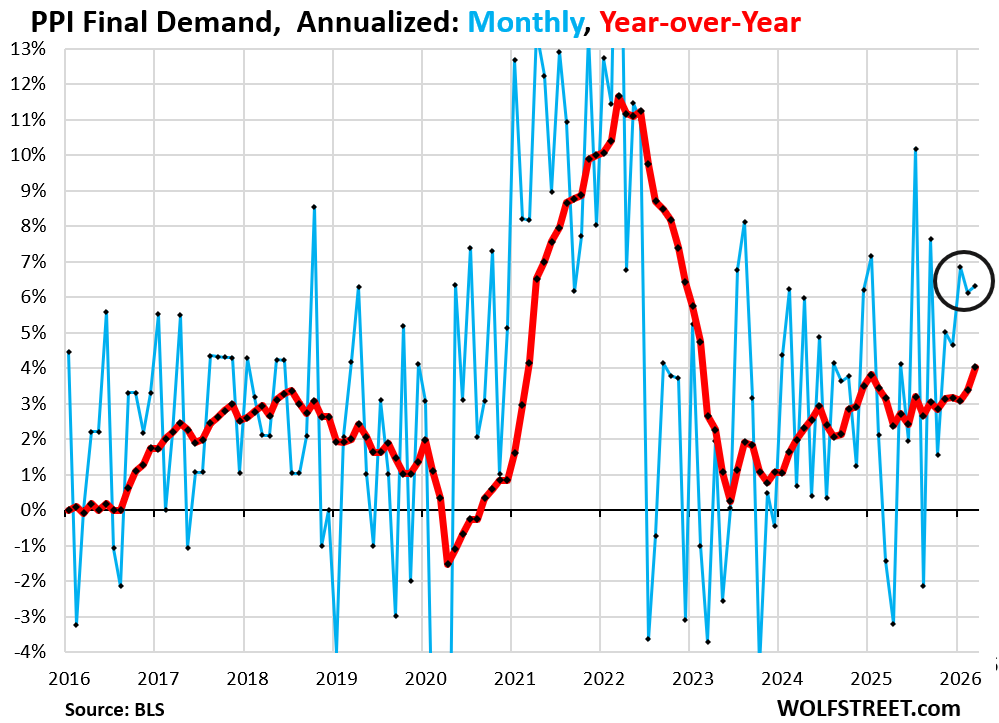
The energy price spike hit inflation at the producer level in March: The overall Producer Price Index final demand (PPI) accelerated sharply to 4.0% compared to a year ago, the worst since February 2023 (red in the chart).
Month-to-month, the overall PPI jumped by 0.51% (+6.3% annualized), seasonally adjusted. But it had already jumped by 6.1% and 6.8% annualized in February and January before the energy price spike hit (blue in the chart), according to data from the Bureau of Labor Statistics today.
What’s surprising is that it didn’t jump more. Turns out, there were several factors that kept the March month-to-month increase from blowing out: While energy prices spiked in March from February, prices of food that manufacturers buy fell, and the PPI for services that producers buy, the biggie – 68% of overall PPI – was nearly unchanged month-to-month after three big increases in a row because its component “trade services” (accounts for 19% of overall PPI) fell in March from February, the second month of declines, after the two huge spikes in January and December.
Energy prices are always volatile with big jumps and plunges. The 8.5% spike in March (165% annualized) came on top of the jump in February.
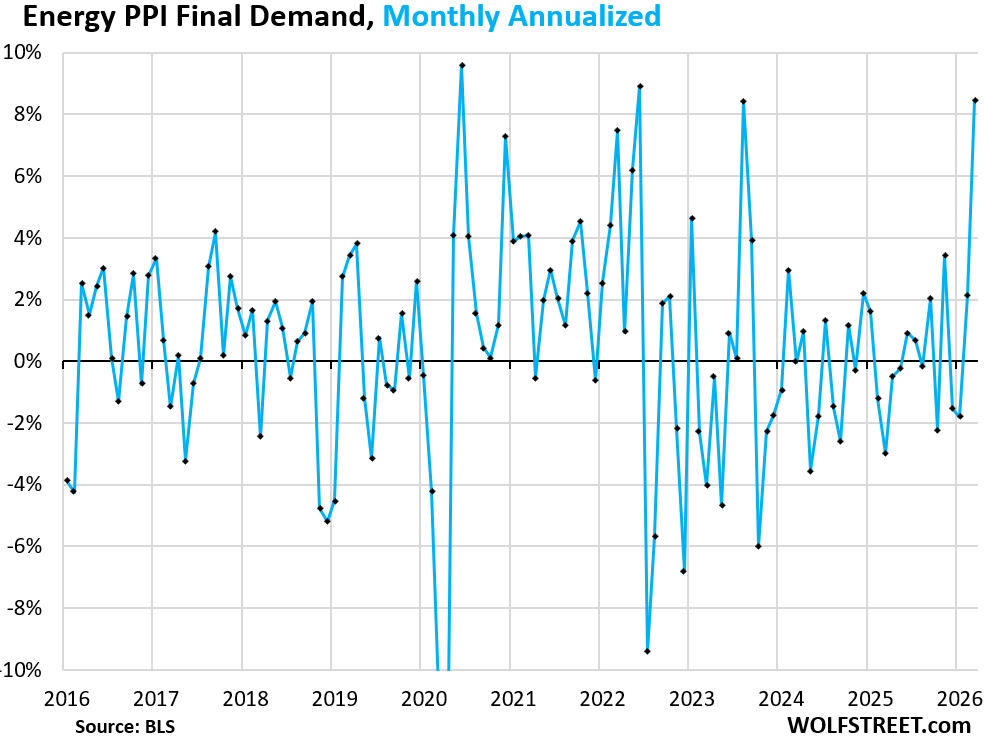
This pushed the year-over-year increase to 11.2%, from a decline in the prior month.
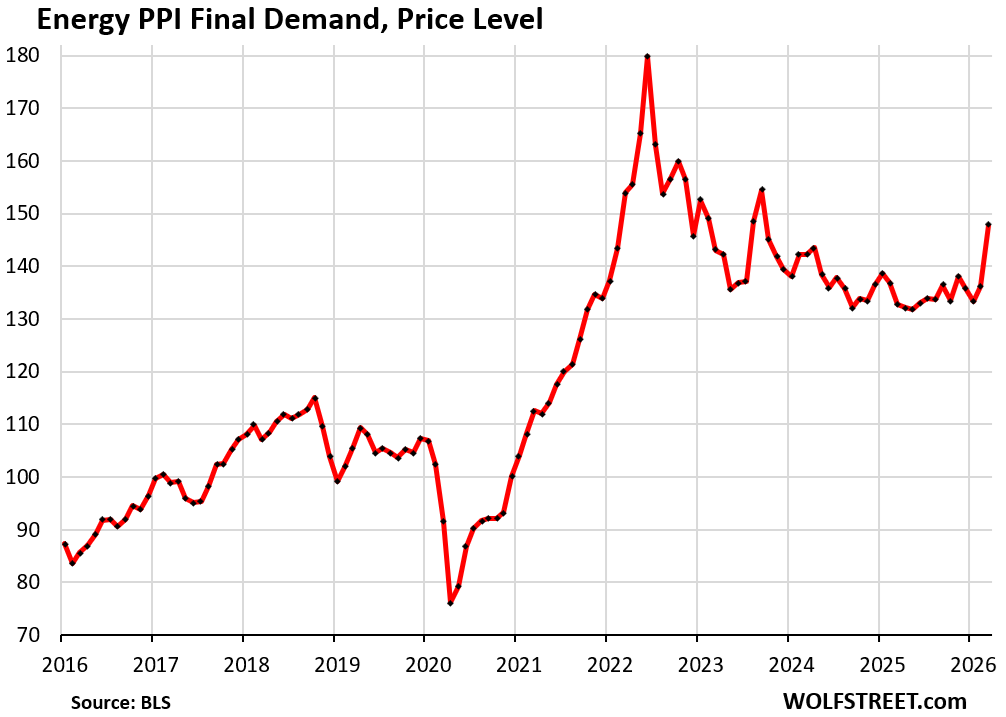
The energy PPI is so volatile with such huge spikes and plunges that it’s helpful to look at the price level to gain some perspective (the year-over-year percentage changes just cause uninsured whiplash).
The chart shows the price level of the energy PPI. The big spike in March pushed the price level to the highest since the September 2023 spike.
From the peak in mid-2022 through 2025, energy prices plunged but remained far higher than before covid, driven by the soaring costs of electricity.
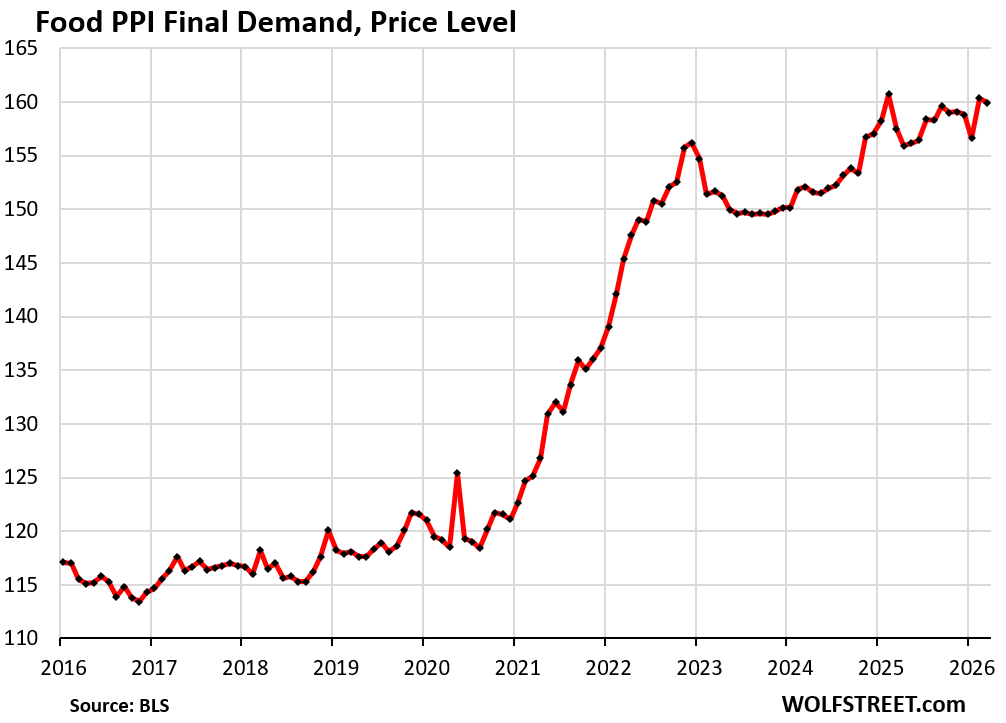
The PPI for food that producers buy held down the overall PPI: It fell on a month-to-month basis by 0.27%, after the gigantic spike in February of 2.39%, and the plunge in January.
On a year-over-year basis, the food PPI accelerated to 1.5%.
Food prices are also hugely volatile, so it helps to look at the price level. The PPI for food is up by 33% from mid-2020, prices are very high, but they’ve been bumping into a ceiling at these levels, it seems.
The services PPI barely ticked up 0.05% (+0.6% annualized) in March from February, seasonally adjusted, after the big increases in the prior three months.
It caused the six-month services PPI to back off to +4.6%, from 5.8% in February, which had been the worst increase since August 2022.

The services PPI weighs 68% of the overall PPI, and the nearly flat month-to-month reading in March kept the overall PPI from blowing out.
Within the services PPI:
- Trade services (weigh 19% in overall PPI): -0.3% month-to-month not annualized, second month in a row of declines, after big spikes of +2.0% each in January and December.
- Transportation & warehousing services (weigh 4.9% in overall PPI) spiked by 1.3% not annualized in March from January, the biggest spike since July.
- Other services (weighs 38% in overall PPI): +0.1%, after the 0.6% jump in the prior month.
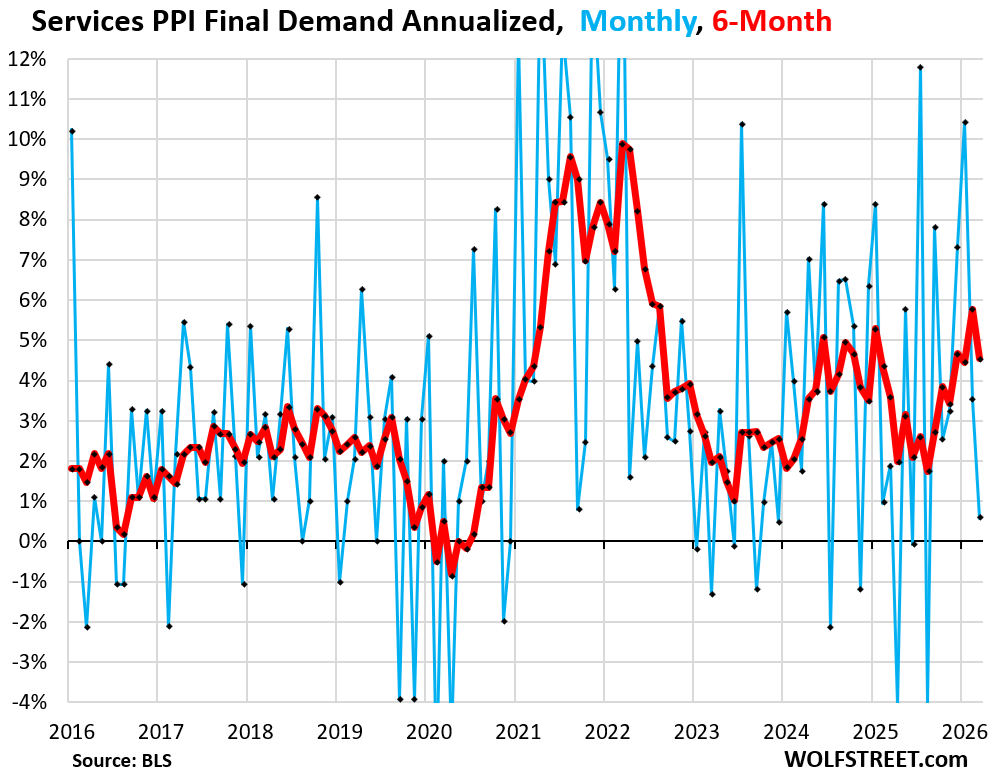
Year-over-year, the services PPI decelerated a hair to +3.7%, after four months in a row of acceleration.
The low point, the point of the coolest recent services PPI inflation, was in December 2023 at 1.8%. The inflation rate has more than doubled since then.
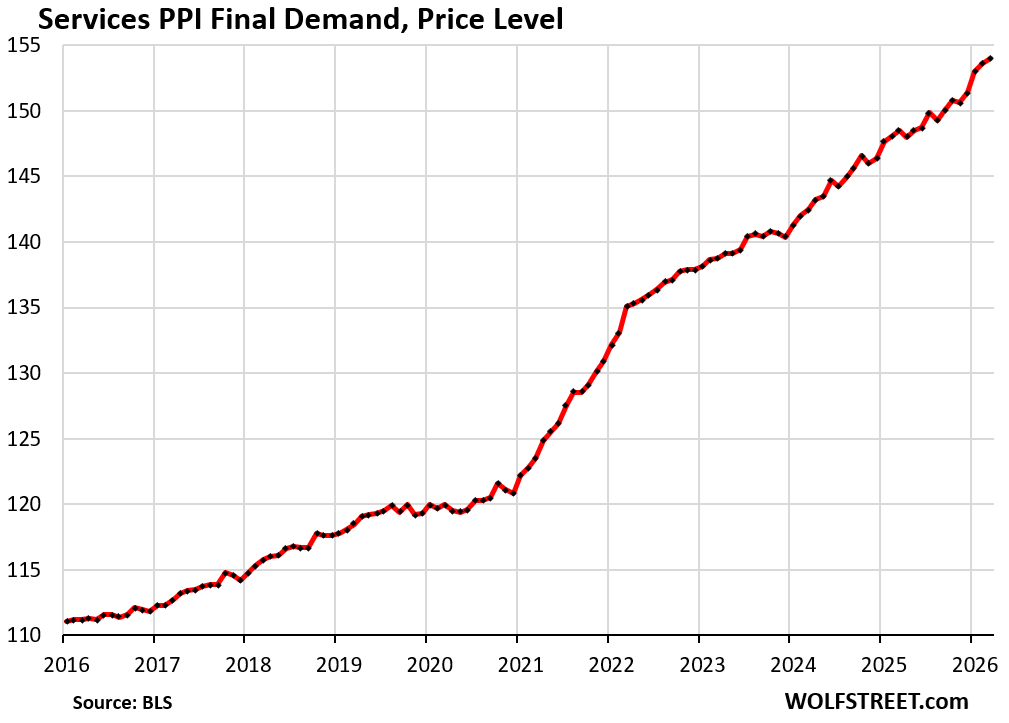
Despite the month-to-month squiggles, services prices have been marching relentlessly higher. Since mid-2020, the services PPI has risen by 28%. The chart shows the price level, and its steep trajectory. This is 68% of the overall PPI:
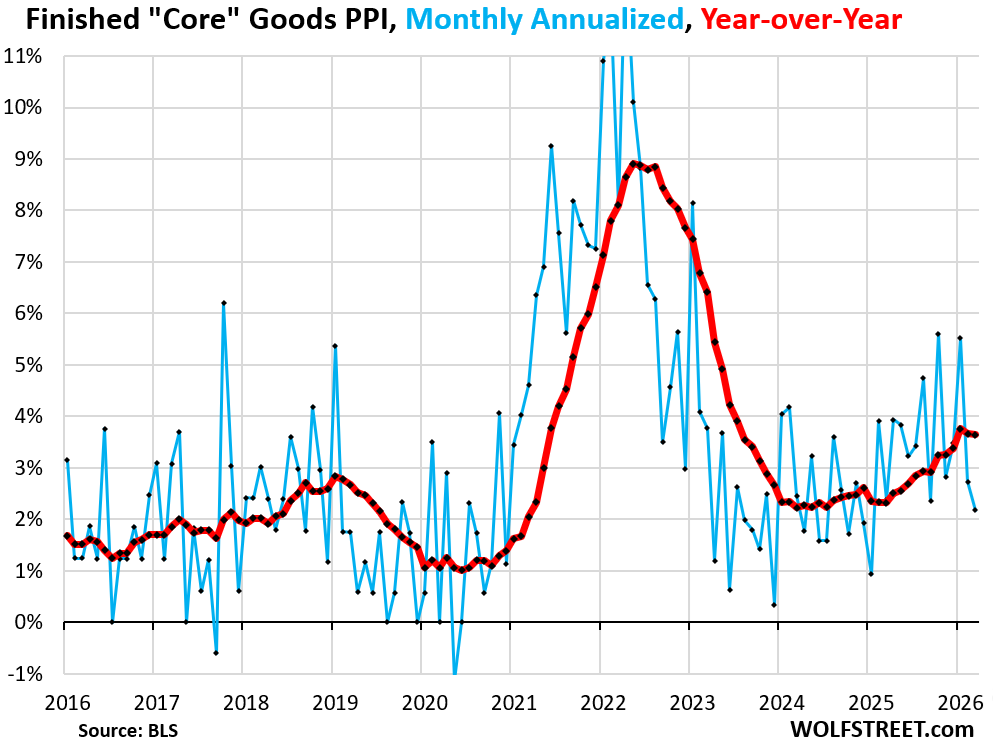
The PPI for finished core goods (goods without food and energy) rose 0.18% (+2.2% annualized), the slowest increase in a year.
Year-over-year, the PPI for finished core goods rose by 3.6%, a slight deceleration from the prior two months.
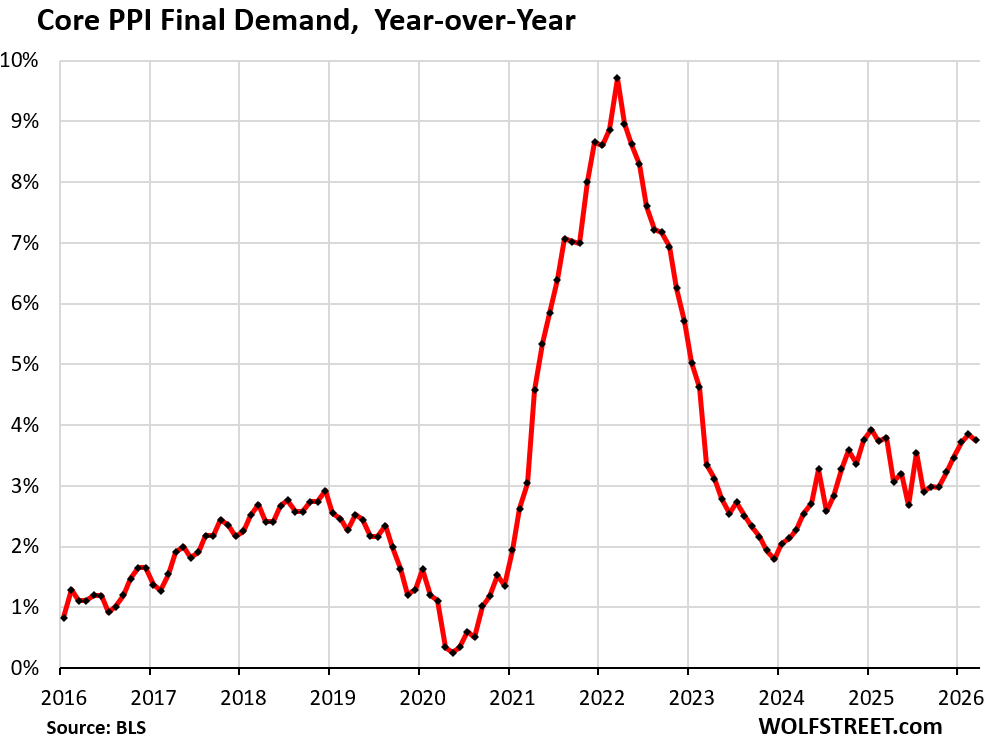
Core PPI Final Demand, which excludes energy and food components, rose by only 0.09% (1.1% annualized) in March from February, seasonally adjusted, held down by the services PPI.
This small month-to-month increase caused the six-month core PPI to back off a notch to +4.7%, the second worst since August 2022, behind only the +5.5% in February.
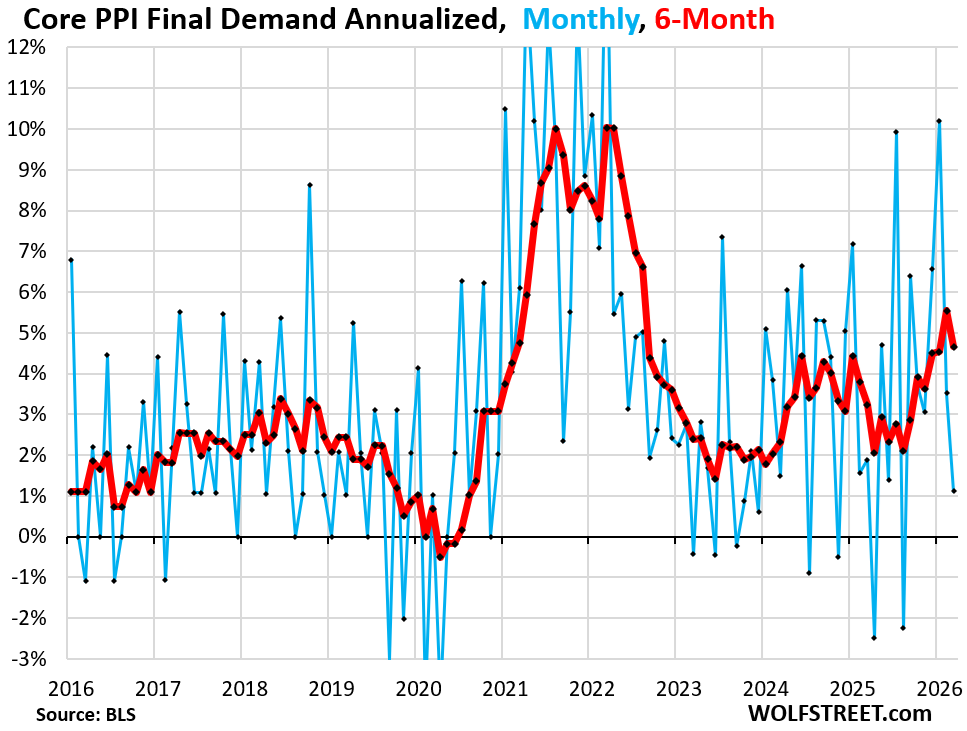
Year-over-year, core PPI decelerated a hair to 3.75%.
Enjoy reading WOLF STREET and want to support it? You can donate. I appreciate it immensely. Click on the mug to find out how:


Darn inflation. It’s getting harder and harder to live beyond one’s means and adding to the credit cards’ ever increasing balances. There should be a law!
Well I think you have imagined, correctly, the dilemma
Thanks wolf
Regarding energy, my understanding is that oil output from Iraq alone has dropped by 60% due to the war and unlike fracking, it cannot be turned back on quickly. It will take at least two years to restart.
Russian oil output is down by 40% and the Ukrainian’s will take much of that offline within 2-3 months at the rate they are currently blowing up refineries.
The Chinese economy is totally dependent upon imported oil.
I cannot image a scenario where the PPI doesn’t spike dramatically in the months to come!
This is the most precarious and frightening setup in my lifetime…
Will China start escorting their tankers? Then you’ll see volatility.
In my neck of the woods I am seeing a lot of people scoot scoot with electric scooters. See more young people walking as well.
Maybe the lack of data of global, small replacement of oil with electrification solutions is making the oil consumption vs price fuzzy?
Electric prices are also moving to the new City on the Moon aptly named Wazoo. See recent Wolf blog re: electric prices.
104. Seen and read Wolf’s most excellent articles about inflation.
It may be important to understand that althout switching to an EV still consumes a fuel source (electricity), the EV itself is much more efficient on a MPG basis than a traditional ICE. Maybe that negates paying the astronomical prices toward the City on the Moon?
Apparently during the Iran-Iraq war there has been quite a bit of destruction to the oil fields. Back then the output recovered much faster then forecast. If there is a real NEED, stuff can suddenly move fast. Remember how germany build some LNG import terminals in 3 month. That would normaly take 20 years.
I would be careful, I think there are a few different factors at play here:
– a lot of gulf states had excess capacity. I suspect that while some capacity has been degraded, they propably can offset some of that. (after the war)
– Other nations had excess capacity, too and they can offset some of that production shortfall.
– There are a few bottlenecks. Tankers is one, 800 takers are trapped in the gulf and their capacity is missing for distribution right now.
– Various countries have quite a bit of reserves. They might not be where we see constrains in the real world.
– reserves have a maximum output. I doubt that is a real problem but some claim it is.
– A 90 day reserve can be enough for multiple years, we are not at a point where those reserves need to offset 100% of a nations need. They might need to offest 5% fewer imports. (Or higher exports in the case of the US)
– Poor nations suffer the most, as always, because they get priced out. That means demand destruction. And suffering. And economic destruction leading to more unnessecary suffering.
– right now Ukrain is focusing on russian export capacity, not necessary the refineries. The export terminals are much fewer and more vulnerable.
Transient God damnit, transient.
Young people rightly say they wish they could have bought a house in the 1970s. Well we had oil embargos in the 1970s that wrecked havoc on the economy and must have given us that housing market, so hopefully history can repeat itself. This time the battle is over the actual Straight of Homuz, so it may be treacherous for a long, long time.
History repeating itself will mean that the price level charts of housing prices will keep going up with every spike in inflation. It’s why we keep reading here about the need for home builders to keep adding to the supply
The “Buy Now, Pay Later” crisis:
47% of Buy Now, Pay Later (BNPL) users were late in paying their BNPL loans over the last year.
This percentage has risen +6 points from 2025 levels and +13 points over the last 2 years.
High-income borrowers, young adults, men, and parents of young kids are among the most likely to miss payments.
This comes as 25% of borrowers now hold three or more active BNPL loans at once, driven by Gen Z and Millennials.
Furthermore, 29% of users are now turning to these loans for groceries, and 20% for restaurant delivery or takeout.
Transactions using BNPL loans are expected to surge to a record $687 billion in volume by 2028, from $334 billion in 2024.
U Have No Clue what has been going On.!
1. What does “late” mean? Most of them are bi-weekly payments. they pay every two weeks. What does late mean? They forget to make a bi-weekly payment and then make it 5 days late?
2. Tears are gushing out of my eyes. You people!!! BNPL balances and spending are MINUSCULE compared to credit card balances and spending. These are young companies that are doing it, they’re using instant AI-powered credit approvals, and they’re taking risks because the merchant pays them and subsidizes them. Affirm, one of the largest standalone BNPL lenders, lost $2.5 billion over the past five years, despite a small profit, its first, last year. PayPal, which has gotten into it belatedly, is now the top dog, but it’s just a tiny part of its overall payments business.
3. It’s like subprime auto loans and subprime credit cards: specialized lenders take huge risks because the gains can be big, but then these lenders blow up, and it doesn’t make any difference because the balances are so MINUSCULE. Lots of articles about them here.
4. Except BNPL is much much smaller than subprime auto loans and subprime credit cards.
5. BNPL is interest free for the customers, unless they fall behind.
6. You cannot buy anything on Amazon without Amazon trying to shove BNPL down your throat.
Young people are facing the same future that I am
They however do not have the perspective that last 70 years has cursed me with
My “gas station from Hell” just posted a new high price of $5.49/gallon. I’m still waiting for a picture of Wolf’s “Gas station from hell”.
My neighborhood gas was at 5.85 while Costco was at 3’90
Wall Street is completely delusional at this point. They’ll shrug off anything and everything as long as some politicians keep saying all is okay. At some point data needs to start to matter again.
CNBC:
“Treasury yields move lower after light producer price reading”
Delusional
It’s almost ridiculous, really.
Make Data Great Again!
It’s almost like billionaire politicians told billionaire investors that they should stay long. No more recessionary asset deflation will happen: “We got this, and we’re going to get more”
Wall St.is not buy ‘n hold. It is front run the TACO and make $60B in oil profits that the SEC and FED never investigate.
I think that is a valid observation. What does it mean when the stock market is valued like never before in history including 1929
Seems expensive
Dont worry! At FED, we are going to see through those useless inflation readings. All is Well.. I am keeping Ample Reserves on FED balance sheet. Some idiots think that we have Excess and need to reduce the size. What they know? Your enjoy sky high asset prices.
– Jay Powell