
Prices of new & used vehicles, insurance, gasoline, maintenance & repairs, parts & accessories, and fees.
By Wolf Richter for WOLF STREET.
Americans spend a lot of money on the ownership costs of motor vehicles, and inflation has hit them over the head in recent years. These costs of vehicle ownership weigh nearly 15% in the Consumer Price Index. They include the purchase price of new and used vehicles, the price of motor fuel, auto insurance, maintenance and repairs, auto parts and equipment (parts, tires, accessories, oil, coolant, and fluids), and motor vehicle fees (state registration and license fees, parking fees, tolls, and other fees).
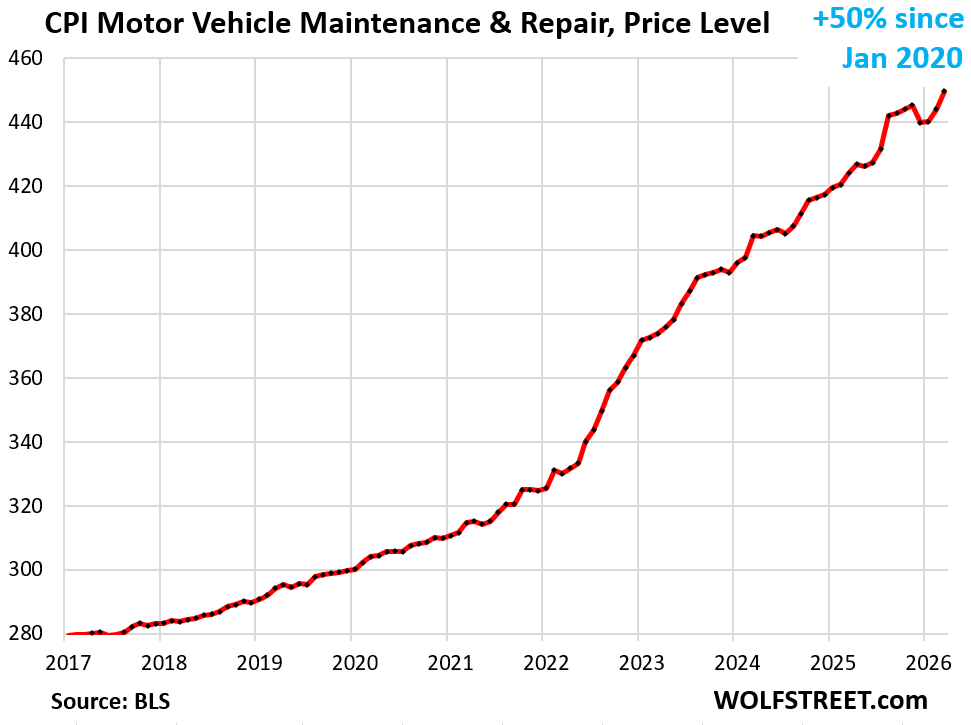
Each category of costs experienced its own inflation spike. They didn’t happen in lockstep. The first out the gate were new and used vehicle prices; they exploded between mid-2020 and mid-2022 and then hit a ceiling. Vehicle maintenance and repair services rose steadily through 2021 and then exploded, and they continue to surge. Auto insurance exploded from 2022 through 2024 but then hit a ceiling and stalled. Motor vehicle fees rose steadily but then suddenly spiked late last year. And motor fuel prices spiked from late 2020 through mid-2022, then plunged, and now there’s the brutal re-spike. We’ll look at each one of them.
The CPI for motor vehicle maintenance and repairs jumped by 1.25% in March from February and by 6.1% year-over-year, according to data from the Bureau of Labor Statistics. Since January 2020, those prices exploded by 50%. These are services – parts and equipment are in a separate category, see further below – and these services are driven by the cost of labor (which surged) and profits (which also surged). The chart shows the index for the price level (not the percentage change), seasonally adjusted.
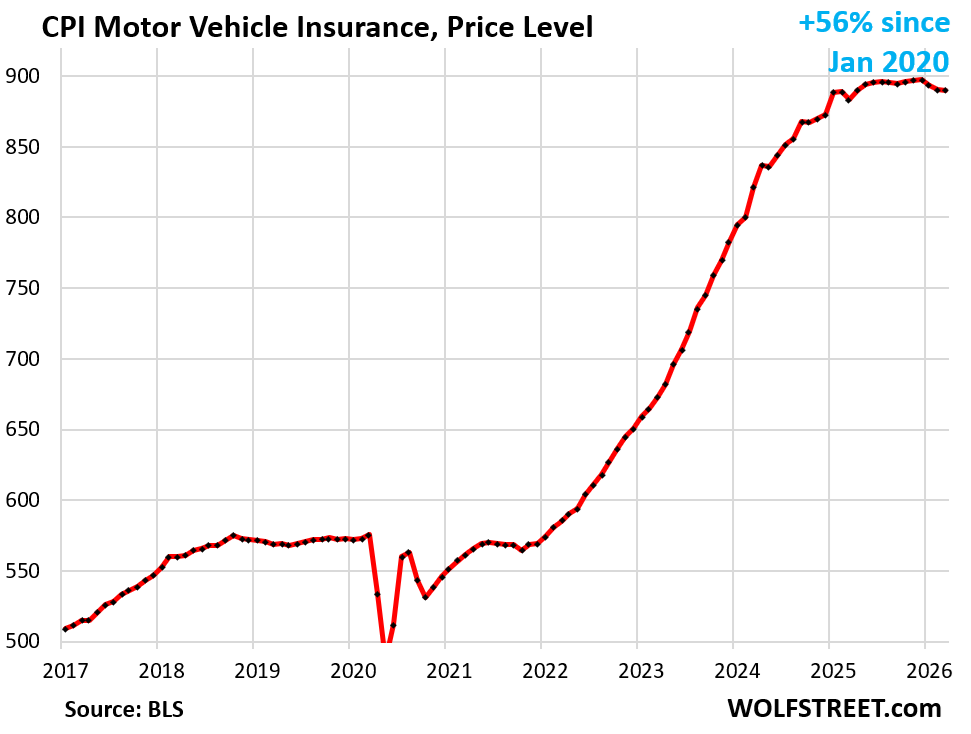
The CPI for motor vehicle insurance has been flat to down since the peak in mid-2025. In March it was essentially unchanged from February, and up only 0.8% from a year ago.
But since January 2020, the index has spiked by 56%. Insurers, which got hit by spiking repair costs and exploding used-vehicle prices (replacement costs) in 2020-2022, raised their premiums to keep up with cost increases, plus some. But recently, those increases stalled.
So there is little inflation – the rate of change of prices – in auto insurance currently. But due to the inflation in prior years, auto insurance has become hugely expensive and continues to be hugely expensive.
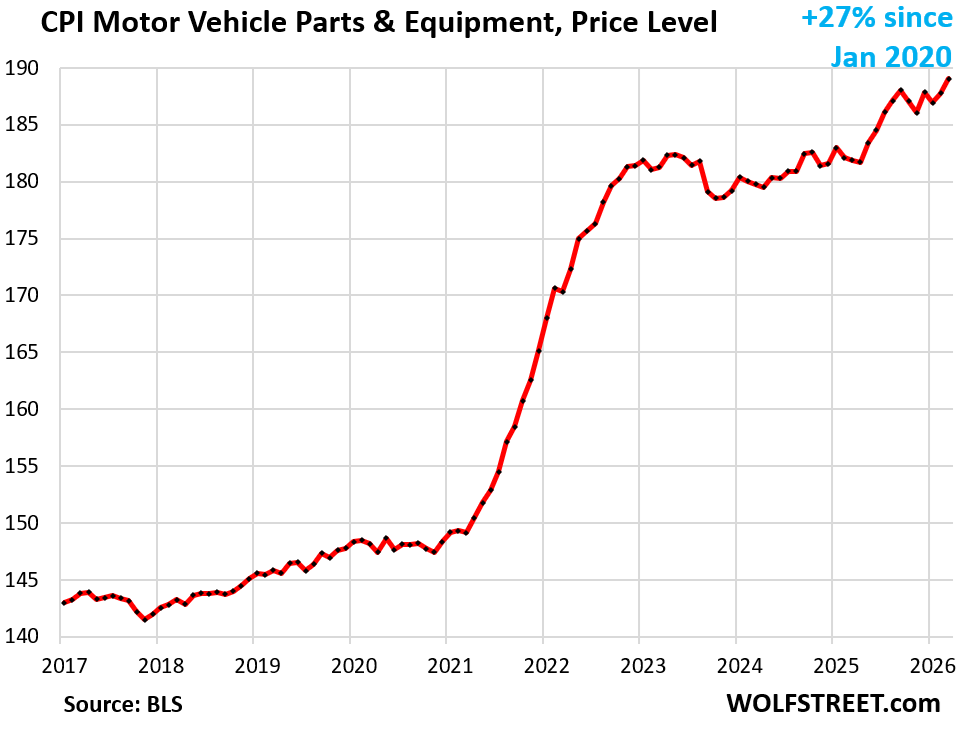
The CPI for motor vehicle parts and equipment jumped by 0.7% in March from February. Year-over-year, and from three years ago (March 2023), it was up by 3.9%.
But since January 2020, the index has soared by 27%, most of it in 2021 and 2022.
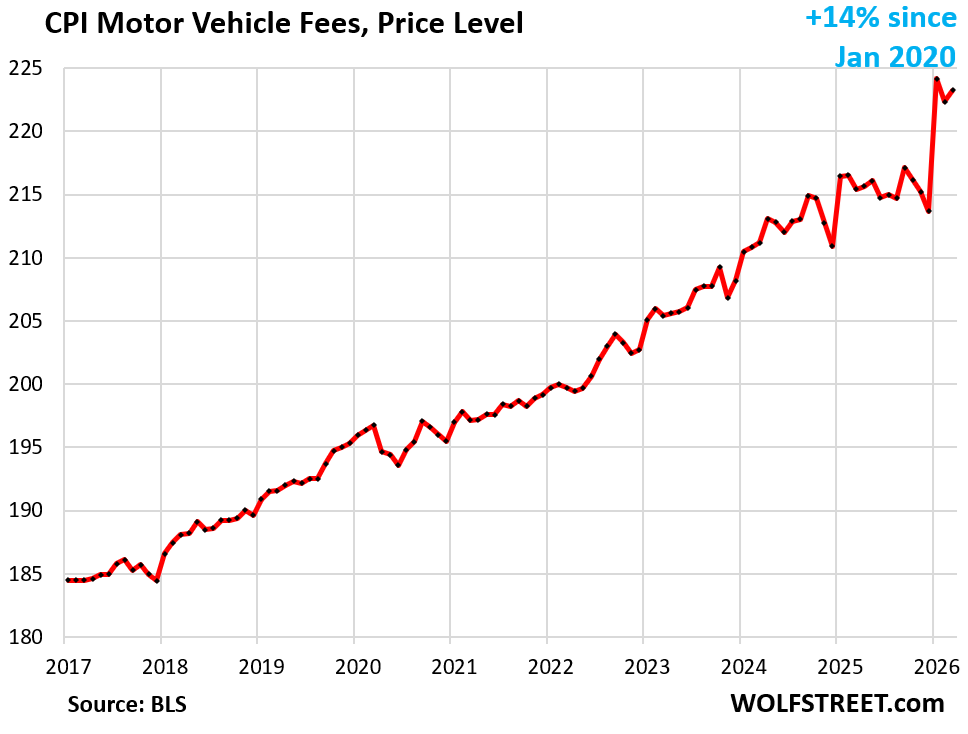
The CPI for motor vehicle fees rose by 0.42% in March and by 3.6% year-over-year, including the freak spike in January.
Since 2020, the cost of fees has risen by 14%, relatively tame, compared to the other costs here.
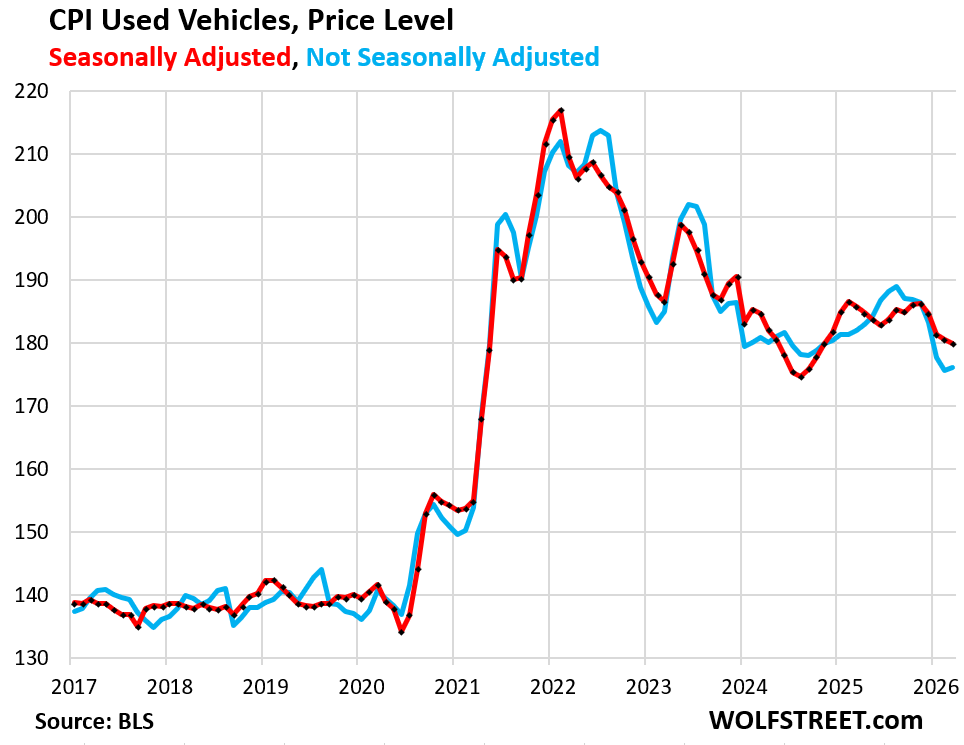
The CPI for used vehicles had exploded by 54% from mid-2020 through early 2022, and then plunged through mid-2024 when it bottomed out.
Not seasonally adjusted, it ticked up in March but was down 3.2% year-over-year (blue line). Seasonally adjusted, it dipped further in May and was down 3.2% year-over-year (red).

Since mid-2020, the used vehicle CPI is still up by 29%, despite the plunge since mid-2022. Used vehicles remain very expensive, and the industry has had a very hard time making price increases stick. So maybe this spring they get their chance when consumers come in with their big tax refunds.
In preparation for this hoped-for onslaught of down-payment-wielding customers, dealers have already started bidding up prices at wholesale auctions where they buy their inventory.
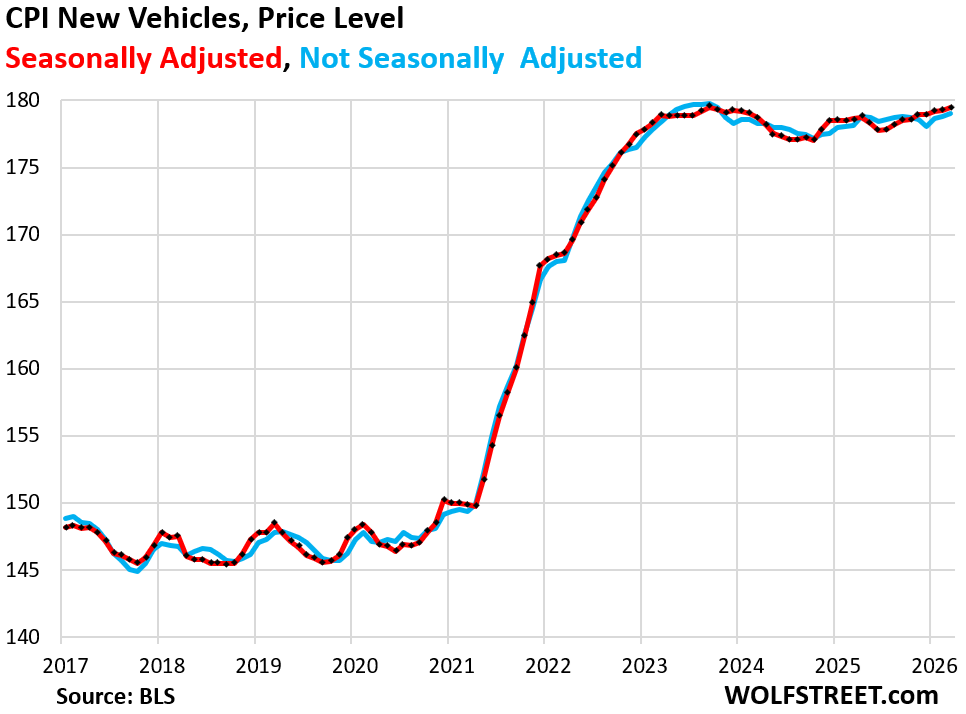
The CPI for new vehicles inched up 0.1% in March from April, and by 0.47% year-over-year, and is below where it had been at the peak in mid-2023.
After the 21% price surge from mid-2020 through mid-2023, new vehicle prices hit a ceiling, they’re too expensive, and demand is not strong at those prices, and any price increases keep getting replaced with discounts and incentives to make sales happen.
New vehicle sales remain well below their pre-pandemic levels and in 2025 were just a hair higher than they’d been 40 years ago, in 1986 (my ugly charts by automaker, but there were some winners too):
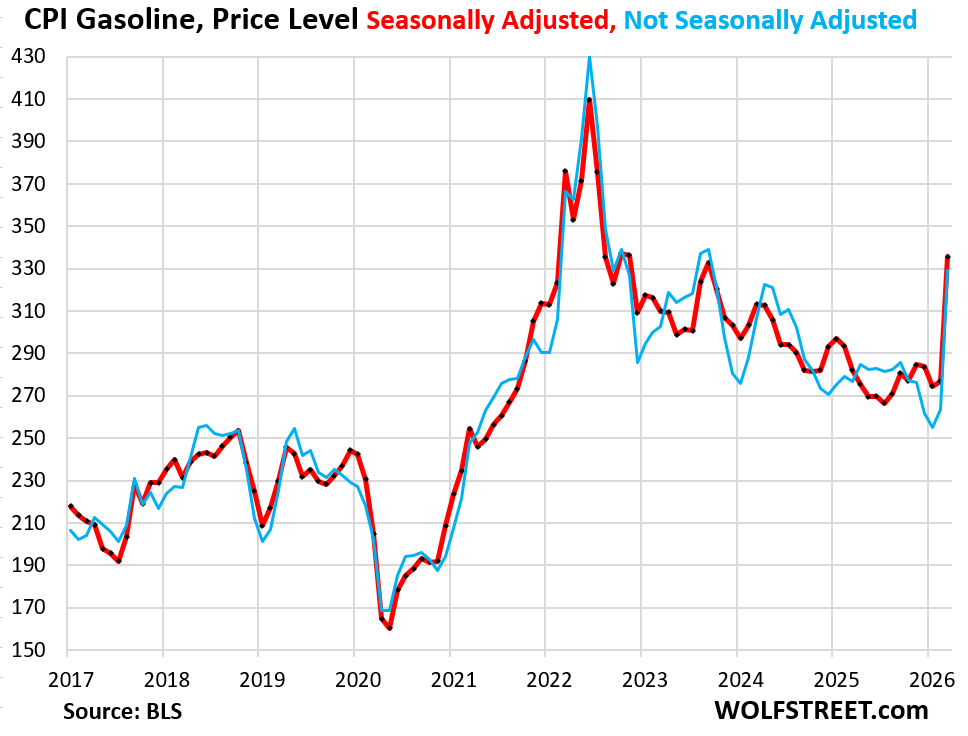
The CPI for gasoline spiked by 21% seasonally adjusted and by 25% not seasonally adjusted in March from February.
The US is a big exporter of gasoline, and has a big trade surplus in petroleum products, including gasoline, and its supply is not dependent on the Strait of Hormuz. Gasoline prices at the pump spiked because energy speculation is global and instant, though the gasoline was already in underground tanks or had been refined and purchased well before the war in Iran began. And what consumers paid for was a huge spike in profit margins of the gasoline retailers and refiners (and the crack spread surged in the first half of March).
Year-over-year, the CPI for gasoline spiked by 18.9%.
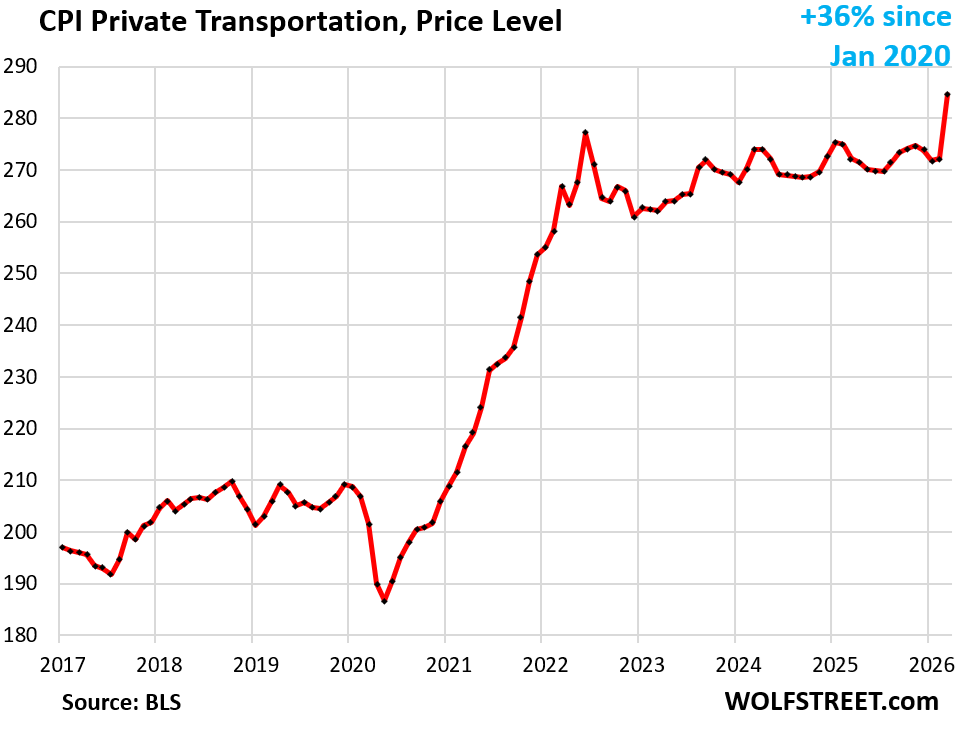
The CPI for “private transportation,” which combines the above categories into one index, spiked by 4.6% in March from February, to a new record, surpassing for the first time June 2022, driven by the spike in gasoline prices in March.
Year-over-year, it was also up by 4.6% thanks to the spike in March. In February, it had still been down from a year ago, due to the year-over-year declines of used-vehicle and gasoline prices.
Since January 2020, it has spiked by 36%, that’s about the increase of the overall cost of ownership of a motor vehicle in the car and truck culture of America.
Enjoy reading WOLF STREET and want to support it? You can donate. I appreciate it immensely. Click on the mug to find out how:


Unreal.
IRS vehicle allowance for business miles in 2020 was 57.5 cents a mile. In 2025 it was 70 cents and a slight increase for 2026 to 72.5 cents a mile. My CPA recommended taking the allowance per mile. I told him I was going to deduct actual costs as they are much higher when running a diesel truck. I tend to keep my vehicles a long time, but the cost of a new F250 shocked my CPA when he saw the invoice.
Those F250s are expensive all right, but you can’t put a snow plow on an F150 – it voids the warranty.
Really makes Wolf’s Toyota Camry vs. F150 XLT price chart that much worse when you find out you can’t even use the F-150 to do basic stuff you’d expect from a truck without voiding the warranty.
Fuck Ford.
Insurance is the one I feel the most. I used to be able to insurance a liability only policy on a jalopy back in 2020 for roughly $20/mo. It’s closer to $40-50 now. My full coverage for the nicer car that was $60 is well over $100 now.
Insurance, oh boy. Even with all the discounts, zero accidents, zero tickets of any kind, raised deductables and 14yr old standard volkswagen sedan low annual mileage <5k, bundled insurance policies, still annual significant increases. I mean this isn't like home insurance rates in wildfire areas….tell me again, why? PS this is rhetorical…no answer needed.
My thoughts, too. Insurance in Georgia is crazy after living in Iowa
All Property & Casualty insurance rates are approved on a state basis by each state’s insurance commission and very very widely.
We have 5 vehicles and 3 drivers. We are paying $712 per month. Three years ago, the bill was about $400/month. We don’t have anything newer than a 2017 model
Insurance is nuts. When I divorced back in 2019, I owned three vehicle for a short period of time, and my insurance back then was $300-400 for 6 months for all three vehicles (!!!) – two with comprehensive coverage, one with liability only.
I have a similar set of 3 vehicles now and I pay almost $2000 for 6 months. Yes, there is a second driver now and I moved states, but 5-6x increase still feels insane.
I guess consumer preference will eventually shift towards budget economy vehicles if price levels keep ticking up. I cannot really decide whether this is a “shock” or more like a “boiling the frog slowly” scenario. Very few seem willing to reduce their vehicular living standards, even though that would be the top decision in the current market.
Fewer and fewer budget options depending on what you vehicle needs are. Not everything can be handled by a Kia. Wolf’s yearly F150/Camry price index is proof of that.
China is waiting…
Sorry, but WRONG!!!!
The same type of people who shipped all the other factory work overseas are WAITING for the OK in “law”……and quite busy lobbying both gov’ts for it.
Good old “classic arbitrage” profits ya know?
I was (he is dead, but I still have them…but now it’s offspring of his, and other relatives and friends of his MANY contacts, all in same MIC/M Intel (hell, ANY intel) crowd)……related to a guy who was a VERY VERY FN AHole big time DC swamp critter lobbyist who got VERY rich off Vietnam dead kids…among many other war projects like most aircraft, missiles,etc, used by military and even the X-15 and the space shuttle. Real flag waver.Had big ones at Hilton head Beach house and other homes…..
TRUMP IS JUST A FLAILING USEFUL TOOL….TO MANY>>>>
I dot believe the price transparency of China (and its hidden subsidies/market manipulation) and think anyone doing business with them is selling away their future means as has been shown over and over.
It’s silly we don’t let the Chinese in, at least for the econoboxes.
American manufacturers don’t want to make them anymore because the margins suck. Fine. Let the Japanese, Koreans, and chinese fight it out at the low end.
We used to believe in capitalism. Now it’s whomever is most politically connected in this unaffordable economy.
Nate
This is just so naive. Your “capitalism” is precisely what sold out US manufacturing to China and destroyed it in the US. The Chinese knew exactly how to play the capitalist CEOs and politicians whose fault this is.
Nate – Are you inferring that not allowing a communist country to flood your country with goods is against capitalism? Communism is the antithesis of capitalism. This is the most ironic comment I may have ever read.
It is a terrible situation (overpriced/overskewed American made autos vs. unbelievably competitive Chinese ones) that has gotten to this point because for 20-25 years the warning signs of excessive off-shoring were ignored, the warning signs of excessive financialization of US manufacturing output (ZIRP “subsidies”) were ignored, and the Fed expropriated a generation of US dollar savers (via ZIRP) to keep the whole morass from blowing up – until now.
It is a terrible, ugly problem with likely only terrible, ugly solutions (US consumers continue to take it in the neck to preserve the residue of US manufacturing capability or US consumers are offered reasonably priced foreign alternatives without doomed ZIRP/financialization games…but at the cost of perhaps terminally exposing US manufacturing to straightforward worldwide competition.).
Either choice threatens further national decline for the US.
The only model that continues to make sense is to buy a new or slightly used vehicle with and drive it as long as possible (whist contributing to a personal car fund for maintenance, repairs and future vehicles). The cost of repairs is annoyingly high, but its still better to delay a future purchase as long as possible. The good news is that most modern cars can easily last 200k miles, and even in the snowy north, they don’t rust out like they used to.
With the Federal reserve’s balance sheet expanding again (now back over 6.6 trillion) I don’t expect inflation in any sector to ease anytime soon. All those bears warning of demand destruction that doesn’t appear to materialize…
Body Man
To repair the car body is somewhat of a scam. Many body shops colude with appraisers to do addons thereby raising the cost of the repair that results in insurance rates increase and the insured gets stuck with higher insurance costs. Also i would like to see some estimate as to what body parts really cost.
What do you mean when you say body shops collude with appraisers to do ‘addons?’
Does the CPI-new vehicle chart reflect MSRP, or the actual price paid after the incentives that you cite?
Actual transaction prices. Same with used vehicles. The BLS purchases this data from JD Power, which gets this data electronically from dealers every time they sell a car. JD Power is the industry data gatherer that everyone relies on, including the dealers. A few years ago, BLS switched to JD Power data from its own dealer surveys. I covered that switch at the time. The BLS figures on new and used vehicle prices have totally nailed the price spike and drop since then. That was a very good move.
But my own “WOLF STREET Ford F-150 XLT & Toyota Camry LE Price Index” uses MSRPs
https://wolfstreet.com/2025/11/28/new-vehicle-inflation-the-wolf-street-ford-f-150-xlt-toyota-camry-le-price-index-going-back-to-1990-v-cpi/
Thanks!
I was offered a 15K cash offer for my used 2020 Mitzibushi Mirage which I purchased in Nov 2023 for $11,700K. Mileage is under 70K. I’m getting 35 – 40 MPG. American car manufacturers missed the boat when they discontinued building sub-compact cars in favor of big gas gussling SUV’s and trucks. Even Nissan discontinued its Versa sub compact. Ford & GM will be filing for bankruptcy in the near future as gas prices approach $7 to $8 a gallon nationwide. I won’t shed a single tear for them when this happens.
We’ll all likely shed tears because if Ford or GM go bankrupt, there is a 90% chance our broke Government will print tens of billions more (= more inflation) to bail them out.
The USG views automakers as a more or less indispensable part of the weapons making/”national security” complex (smarter governance is a helluva lot cheaper for “national security” than direct/indirect perpetual industrial subsidies though…).
Think armored tanks (increasingly obsolete but so is a lot of G thinking…), infantry fighting vehicles, etc. You pretty much need to have a domestic, consumer auto manufacturing industry (even a pretty crappily run one) to have much of a hope of fielding large numbers of land war vehicles.
(Exact same argument for Boeing and aerospace weapons – even if Boeing continues to screw up for *decades* on the consumer side, 95-99% chance that the G would *never* allow Boeing to be liquidated. That makes for a horrible incentive structure and a pathological military vendor mindset. See, also, 70 yrs of US defense contracting…)
(Sweden might be an interesting case study on how a country 1/33rd the size of the US manages to have a domestic weapons making industry that doesn’t bankrupt the home country).
To a certain, ltd degree I agree with the tariff subsidy/national security argument – the big problem is that a lot of defense and defense adjacent manufacturers are the most internally dysfunctional and desperately addicted to government over-spending.
Indispensable and dysfunctional is a terrible, terrible combination.
GM has multiple fuel-efficient vehicles, they’re just all crossovers outside of Cadillac. I sure wouldn’t ever buy one though as I have an inherent distrust of 3-cylinder engines.
That will change in 2027/2028 as they are bringing back multiple sedans, including a newly announced RWD Buick. They should be (re)launching hybrids around that time as well. GM had some of the best hybrid tech with the Volt-tech, but sadly decided to kill it — now they’re regretting that decision. Their hybrids should be on offer shortly.
Ford is in serious trouble though…
Meh sedans…why Americans choose a significantly less useful shape on the same footprint is beyond me.
Hopefully that changes and we get more wagons and hatchbacks (not CUV’s)
Many of us would NEVER even considering purchasing a truck based vehicle such as a SUV.
I am glad do most of me auto work/repairs meself and that I found a great deal last year on a daily driver.
Canada agreed to:
• Slash tariffs on Chinese EVs from ~100% → about 6.1%
• Allow up to 49,000 Chinese-made EVs per year into the country
Typical price range (Canada, 2026)
🚗 Entry-level (small cars)
• Around $22,000 – $25,000 CAD (~$16K–$18K USD) 
• Example: BYD Seagull–type models (basic city EVs)
👉 With incentives in some provinces, people estimate it could drop to:
• $10K–$17K CAD (~$7K–$12K USD)
🚗 Mid-range (most buyers)
• About $35,000 – $45,000 CAD (~$26K–$33K USD) 
Examples:
• Compact hatchbacks and sedans (like BYD Dolphin, Seal)
• Small SUVs
🚙 Higher-end models
• Around $45,000 – $55,000+ CAD (~$33K–$40K USD) 
Examples:
• Larger SUVs, longer-range models, or performance trims
People are so naive about what China has been trying to do for the past many decades: Destroy manufacturing in the West and dominate manufacturing globally. It did so successfully. Corporate America was a big driver because over the short term, they could fatten up their profit margins and revenues. And idiot politicians in the US and elsewhere encouraged it including through tax policies — as does Carney now. Consumers are all for it because these morons will gladly sell their future in exchange for cheaper junk they can buy. People are just benighted about this issue.
Ford, GM, Stellantis, Honda, and Toyota should just continue to pull their manufacturing of US-bound models out of Canada, and shift it back to the US, and they’re already doing it. Then the imports into Canada from China will cause those automakers to stop producing even Canada-targeted vehicles, and Canada won’t have any manufacturing of cars and trucks anymore. Bye-bye. The largest manufacturing industry in Canada is food. Just hand that to Chinese companies too, while you’re at it. Maybe you can get cheaper 3-D printed broccoli from China, wouldn’t that be great 🤣
The biggest industry by far in Canada is real estate: build and sell housing to Chinese investors and immigrants at inflated prices that then sell it to each other at even more inflated prices. That is the #1 industry in Canada by far. The Canadian economy is hugely dependent on real estate. And that is now falling off a cliff and there are bailouts underway.
So kill off your manufacturing. Who needs that kind of nonsense anyway. Just switch those resources to selling real estate to each other. And China won again.
I watch a lot of “how things are made” videos. The specialized machinery is amazing, but once manufacturing is lost, the eco system to create this specialized machinery is lost and very difficult/expensive to get back. Any competitor who already has this equipment has a huge advantage over anyone who wants to bring back manufacturing.
Yes, and that’s part of the problem, which is why it takes many years to re-build a manufacturing industry because you have to rebuild the knowhow, suppliers, and the infrastructure along with it. The US is still the second largest manufacturer in the world, larger than the next three combined (Japan, Germany, and either South Korea or India, which are neck to neck), so not all hope is lost; there are still a lot of knowhow, suppliers, and infrastructure in the US, but a lot has already been lost and needs to be created from scratch.
Yes: see semiconductor manufacturing.
So specialized, it’s mainly concentrated on one small island.
Odd thing is, Canada should/could be a very wealthy country. It has huge natural resources (much of which they are purposefully not taking advantage of), immigration (many of the more talented end up leaving for better opportunity in the US), good education (again, many go to the US). But seem bent on self flagellation.
Interesting take. I would leave for Canada yesterday if my responsibilities with family were ignored.
Did you see this article in Moneywise.
From MONEYWISE
“ ‘We will not survive’ “
https://moneywise.com/investing/stocks/toyota-honda-ford-ceos-warning-china-portfolio
Honda President and CEO Toshihiro Mibe.
“We have no chance against this,” Mibe said (9) upon a visit to a Shanghai parts factory, commenting on its seamless automation across all levels of production. Logistics, procurement and all aspects of the process were so automated, in fact, that he did not spot a single human worker on the supplier’s floor.
Rico
Yes, China is in the process of winning this commercial war because US CEOs and politicians were so effing greedy and stupid that they sold the future of US manufacturing to China in order to maximize their bonuses, stock-prices, and campaign contributions.
But it’s not too late. The US too has super-highly automated modern plants — and robots cost the same anywhere. China has no inherent advantage when it comes to automation. It’s with automation that the US can fight back successfully, not with sweatshop labor. And it is happening; there are lots of new auto plants in the US, and new ones are getting built, and existing once are getting expanded. The biggest drivers are ironically the foreign brands, while US brands had specialized in offshoring production.
Thank you Wolf!
People need to wise up that lunch with China isn’t free, or even cheap.
YEP!
And don’t forget the engineer’s freedom flexibility and creative talents and even industrial shitworker similar talents also long gone.
I am long time industrial shitworker….by choice……and poor…..so FN what? Had plenty relative’s back-up to do it, so why not REALLY enjoy my youth and knowledge for it’s own sake……not for a high pay job?…pay later…..knew I wouldn’t starve…..was homeless or living in bread van though, and eating extremely cheaply while most teeth rotted away…….good training…..along with Mekong Delta…..even if having had some shitty times.
FOR WOLF ONLY….Thanks for deletes, man….and sorry I lost it. Probably safer for ya…(am wild card here now…or now even worse one)….on permanent moderation…..your biz…your agenda…your call…..in my head…..and for real, obviously….ALWAYS!
And WHY don’t WE build those “basic city EVs” ? CHEAP start-up and talent is HERE. And don’t give me that “people don’t want them car company PR horseshit!
I have seen many small companies try and probably ALL got crushed by car company lobbyist laws. CA did.
40mph and 40-50 mile range would work FINE for my city….and not just for me…….beats driving cars so old that front end collapses on freeway like girl commuting to PT jobs and college I knew in 2014-21 at LAST owner owned and run coffee shop in area….or poor people with EVERY warning light flashing…..I/they can dodge Hummers and trucks well enough to risk it….and WILL….(had Honda 600 for 4-5 years…gave it to 100% disabled Vet Bro who trashed motor in year or so…was a mechanical zero……I even had 17 mi freeway commute to work every day, and worked all Sat/Sun I could……….sure I pissed people off…..even in slow lane at 55mph…slower on “Cotati Alps”……forgot speed there.
City is flat and just big enough….rent a vacation/longer drives car…so what?
Rural is different game….Lived and traveled a lot there/then when gas was cheap and cars cheap and fixable by most everyone.
Example of car company lobbyists at work;
In 1980-81 I built and licensed and drove for 2 yrs (also had self restored/upgraded distributer and fuel pump, carb work I did, 67 PU, too….then ran out of $3K in savings and 1 yr UN ins + 6mo extension, and sold tools, welder, drill press, guns, clothes, books, etc,etc) completely enclosed 2 door 3 wheel car with plenty grocery storage and even hit 55mph flat out on freeway with 16hp Tecumseh engine with a Salisbury CV drive….had to put in jackshaft to regear for some small common Toyota car axle….flipped upside down…..so what?….if you know cars well….
Even rolled it and hit fireplug showing off on hot pavement day and tighter turn than expected and with passenger. Had seat belts….super strong exterior frame. Hardly dented…just safety glass window shattered…later made off grid ranch tractor out of it….VW front end….side hill without fear….rear would slide downhill and I could slowly climb to top…..Plenty pulling power with huge rears w/chains….added gas tank and friend gave me Bobcat seats…very cool rig.
Try to do that NOW!!!!! Only 500/yr incl M/C by “lotto…HAHAHA” (last I heard in CA) for homebuilts and NO small or cheap enclosed (read; weather proof) 3 wheelers even by big outfits.
You weren’t on “permanent moderation,” which is why your stuff got posted for all to see, and then, in the middle of the night when I was asleep, you asked me to delete it, and when I didn’t because I was asleep, you cussed me out in a series of comments for not deleting that comment. It wasn’t until the morning when I saw the mess you made and sent in my cleaning squad with mops and buckets to clean it up.
Detroit is toast if BYD is ever allowed to sell vehicles in the US.
Have you been to Detroit in the past 50-60 years? That ship has sailed
Downtown Detroit has been revitalized, with these old commercial buildings and warehouses converted to lofts and apartments. That started over 20 years ago. Pretty cool place now. But there are lots of blighted single-family neighborhoods in Detroit, where they scraped off the houses and planted community gardens or whatever.
“But there are lots of blighted single-family neighborhoods in Detroit, where they scraped off the houses and planted community gardens or whatever.”
There are people like myself who would happily relocate to an older Detroit neighborhood with blighted houses with great bones and architecture, to purchase a row of 3 or 4 of them to renovate, but for the dangerous criminal element which makes that a HARD PASS.
Get rid of the crime and incorporate a tough police presence and I am there yesterday. I have zero interest in risking my life simply by enjoying my own house I am working on. But then again, the Detroit Land Bank Authority wouldn’t have $1,000 houses without the crime.
I was in Colombia recently and the BYD cars look sharp! Certainly nicer than those dated-looking Teslas. I would totally buy one
I hate putting chinese parts in my car. But sometimes that’s the only option nowadays. Cheaply made garbage. Their cars are probably the same. The have no track record of building anything that lasts. Wolf is right though, people will sell their soul and their country to buy cheaply made trash.
For anyone that works on their own vehicles it is best to avoid Chinese knock off parts (that are usually the cheapest parts on eBay and Amazon) and pay for the OEM parts whenever buying a “leave you walking” part. A friend had a 1995 Land Rover Defender that he bougth used (for $75K) a few years back “left him walking” last month when the Chinese rotor in the distributor failed.
I’m trying to wrap my head around 1995, $75K, and distributor all in the same sentence. Electronic ignition ranks up there with sliced bread and indoor plumbing on the plus side of my technological advancement ledger but it feels like it’s been around longer than 30 years.
Lots of German OE parts manufacturers have moved their factories from Europe to China in the last 10 years. Better than knock off but still not as good as the original. Some genuine parts I am still able to get at good prices. Others are increasingly expensive or unavailable. eBay is always good for used stuff.
Idontneedmuch
I bought a Krups electric kettle about a year ago. Krups is a respected 100-plus year-old German consumer brand specializing in smaller appliances. The thing was made in China. It’s a piece of shit. It leaked from day one through the seam where the stainless-steel spout is attached to the stainless-steel liner. The water runs down between the liner and the plastic shell and ends up on the base plate. My wife’s retirement plan is that I’m going to get electrocuted by this thing, and then she can sue Krups and Amazon for millions of dollars. Then after a few months, the hinge on the lid broke, and the lid is no longer attached to the kettle, causing all kinds of problems. I have bought some pieces of brand-name China-made shit before, but this takes the cake. German companies have ruined in a short period of time the trust and respect they earned over the past 100 years. Happens to US brands too. Ask me about my Honeywell made-in-China HEPA air purifier piece of shit … Honeywell doesn’t even own the brand anymore 🤣 China is killing these brands by using their CEO’s relentless greed against them.
R/H/A – That ’95 Defender sets the bar for long range off road capability, hence the price point. The one A/I referenced was very likely right hand drive and definitely had a manual transmission.
Re: Electric ignition – when you’re in the bush you need to be able to work on your rig with the tools and parts you brung. There ain’t no OBD IIs on the Skeleton Coast
Anything that lasts,eh…..the great wall/Ming vases/they at least used to make great swords(Damascus steel the best though/well made Japanese katana second).
I believe they could make quality products,but,they will cost you.
I would much rather pay a higher price once than pay for something twice or three times. But as Wolf points out, its the greed of the CEO’s and stock holders that have been allowing China to steal the manufacturing and then extract whatever value is left of the brand. Eventually if not already, many brands have already lost their reputation of being high quality.
I remember being a kid and listening to people say the same things about “Jap Cars” and VW peanut cars.
The difference is that those countries have a largely capitalistic economics system. China does not. Its apples to oranges.
I feel like I’m in some twilight zone.
I blame British Hong Kong. It allowed people to use China’s cheap labor without dealing directly with a communist regime (imagine people supporting USSR economy in the late 80’s). Then they handed it over and everyone still wanted their cheap goods, so we looked the other way.
China may also throw in a free organ of your choice. Of course the donor is hoping you chose to buy elsewhere.
Always get a laugh from insurance costs as years ago when all states passed insurance required laws. My agent said it would increase cost. He was correct. Which reminds me of a young man in my youth who always received a safe driver even though totaling several cars a year.
Would you rather have no means of collecting anything? If at all, the minimum policy limits are way too low
The mileage deduction of .70/mile for self employed use of auto in business is a joke. I calculated the cost of using my Subaru 2003 clunker and came up with a cost of $3,500 for the year to operate the vehicle for about 4000 business mileage. You do the math. The mileage deduction should be much higher than .70/mile.
What went into that $3,500? Do you use the car for personal use besides the 4,000 miles a year of business use?
People bitch and moan about the mileage deduction. Working class folks don’t get the mileage deduction from commuting to and from an office or factory. Stay at home parents don’t get mileage from driving kids to and from parks or the zoo.
Mileage driven is a cost of doing business. It’s a cost of mobility. It’s a fundamental law of nature. You want to walk a mile? That’ll cost you energy.
There shouldn’t be any tax break for it whatsoever. Doesn’t matter whether it’s for business, charity, place of worship/religious, or personal use.
The US without that tax break would allow the market to lean into more efficient (cost/energy) modes of transportation for people, goods, and services. Let’s do away with it. It’s so ripe with fraud as the cherry on top.
That’s the whole point of the tax code: stimulate the capitalistic economy!
If I incentivize “business use,” then it incentivizes the tax revenue generating businesses activity.
Subsidies and every other form of manipulation are all there “for a reason.” Even if it never accomplished that reason, and it was all bought and paid in advance (see offshoring in various forms: “incentives” backfired)
$3,500 includes gas, parking, tolls, insurance, repairs, depreciation etc
Parking and tolls are not appropriately counted into the figure. The IRS estimate is not intended to account for those.
Must have had to put a new engine in it during that timeframe at that kind of math. 😆
Personal Injury Lawyers should be removed from the Auto Insurance system to lower premiums.
New Zealand’s auto injury system operates under a unique, 24/7 no-fault scheme managed by the Accident Compensation Corporation (ACC). Anyone injured in a car accident—residents, workers, or visitors—receives coverage for medical costs, rehabilitation, and partial lost earnings. In exchange, you cannot sue at-fault drivers for personal injuries.
Fortunately the attorneys are not the ones deciding how much to award to the parties injured in auto accidents – it is your peers (the jurors) who make that decision.
Perhaps the US could adopt New Zealand’s liability system right after it implements universal healthcare, flat taxes and universal income!
@Swamp Creature did you include depreciation in your “cost”. For expensive new cars just the depreciation is over $1/mile (e.g. the guy who sells his $90K Ford truck after three years with 30K miles for $60K). Very few people that pay for others to maintain and repair their cars get their actual cost per mile under $0.70/mile when adding in ALL costs including parking, tolls and depreciation). More and more of my tenants are getting rid of cars due to the increasing cost (and using UBER/Lyft and other car share services)
Today Trump threatened to fire Powell (again). I’m sure his replacement will cut rates because what we need is free money to buy these expensive cars. Have I got that right?
When Powell leaves, the Fed’s “ample reserves regime” leaves. The “ample reserves regime” means a big fat balance sheet. That’s his baby, and it goes with him. Warsh, the nominated replacement, is all for a much smaller balance sheet – as is Bessent. Several Fed heads have already come out in support of a smaller balance sheet, starting before Warsh was even on the horizon. But Powell squashed that. We might eventually get a rate cut and a smaller balance sheet. I could live with that. It would likely push up long-term rates and widen spreads, and higher long-term rates and wider spreads are a good way to put a lid on inflation.
There appears to be confusion on the part of Trump as to what positions are held by Jerome Powell. Mr. Powell’s term as Chairman of the Federal Reserve and FOMC does indeed expire as of 05/15/2026 but his term as a Federal Reserve Board of Governors member does not expire until 2028 and he may very well decide to continue in his term as a member of the Federal Reserve Board of Governors and as a functioning member of the FOMC until that term expires in 2028.
No confusion here, on the set of The Apprentice: You’re Fired!
It’s a planned distraction to bump other stuff off the top of the news feeds.
Autozone Inc, O’Reilly Automotive Inc, and Advance Auto Parts Inc have all had good stock runs.
Two nice recent model year Ferraris were up at auction this morning at BAT (Bring A Trailer) but didn’t meet reserves with the first being a 2024 Ferrari SF90 Spider Assetto Fiorano which reached $622,000 and the second being a 56-Mile Grigio Scuro 2022 Ferrari 812 GTS which made it up to $630,000 but the reserve was not met. This may indicate some softening in prices in the quality used car market.
The $500K + market for late model cars is not the “quality used car market” it is the “nut job show off rich guy market”. The “quality used car market” is doing fine. P.S. Porsche just announced that they are making a Cabrio version of the GT3 next year since most cars hit the bottom of the depreciation curve at 15 years I might be able to get one for myself as an 80th birthday present in 15 years.
Good luck, that car is awesome. One catch: it won’t depreciate, at least not much, because they won’t make many.
Porsche’s are just souped up Volkswagens and really nothing else.
Ferraris are REAL CARS and are not ‘nut job show off’ cars at all.
I love all the Colombo V12 Ferraris and also have a soft spot for the 288 GTO (that looks like the 308 Magnum PI drove but costs over $5mm). It was a sad day for me when I heard Ferrari made the last car with a manual transmission in 2012.
3 years ago, my Allstate car insurance renewal went up 25% in one 6-month renewal. Here in GA they exploited a never used loophole after a hurricane. Obviously, I switched.
In 2025, not a single hurricane hit the US southeastern coastline. Would love for that to happen again now that there’s supposed to be a build E-Nino later this summer. My guess is the car insurers will continue to just raise prices.
Congress / Fed / Treasury / WH will all do everything they can to keep us out of recession. Everyone here realizes this means inflation will continue to build until something exceptional happens.
The AMOC (Atlantic Meridional Overturning Circulation) is slowing down which correlates with Southeast drought patterns (with short periods of extreme rainfall).
“The Atlantic Meridional Overturning Circulation (AMOC) is showing signs of slowing down, with estimates suggesting a reduction in strength by as much as 15% since the 1950s.”
In addition, other studies should it may not be slowing down.
Not sure what this has to do with the price of tea in China. I thought that I was talking about diminished hurricanes which are much more destructive.
I was in Toyota dealer the other day servicing our hybrid crown — every vehicle on the lot is a tundra or sequoia or 4runner or Land Cruiser. I be the average MSRP is $65k. I live in a small, western town where the average income certainly is not $200k and yet everyone has a more expensive car than our household. People just love their big trucks/suvs and seem not to care what it costs including the rolled negative equity. Sugar high will continue seemingly forever. No risk in the economy.
Every year there’s a ton of the $87T in boomer assets passed down to kids.
This wealth transfer is on the biggest reasons asset prices are staying so high. There’s a lot of money trickling down.
I have no doubt that it’s a top contributor to keeping the housing market afloat since rates shot up in 2022.
I just got my insurance renewal bill and it is up 10% from last year.
Mine actually went down a bit. Renewed around February I think. Maybe my next one will be more.
Someone should do a comparison of buying and maintaining a car thru for instance 2015-2025 and show the costs.
Then say project a car purchase in 2025-2035
And see the differences.
Maybe a little AI web tool or something. Would be kind of cool.
Mid-size sedan (Camry/Accord)
2015: $25k (purchase) + $9k (maintenance) + $12k (Insurance) + $1.5k (fuel) + $20k (Depreciation)
2025: $33k (purchase) + $11.5k (maintenance) + $16 (Insurance) + $ 1.5k (better fuel efficiency) + $23.5k (depreciation)
Roughly $18k (Used car $20+k)
S&P at record high!!!
BooYow!
🎉
The greatest legal casino in the world.
Fuck S&P and CNBC, too….Bloomberg too…not quite as bad, but bad enuf.
Solidly confirmed that here….thanks again……
Nothing seems to be able to bring the economy or the market down, not even inflation, a war or oil shock. I have to stop over thinking all the noise and just buy the dip, because it’s never going to go down a lot.
Just a handful more people needed to give into that same mindset and then things can finally change!
Stock market bubble update after 11 straight up days:
S&P 500 market cap now $63.769 Trillion. This is just the S&P 500 (!!!)
The top eight stocks, all tech stocks (the “Mag 7” plus Broadcom which has surpassed Tesla) have a combined market cap of $23.56 Trillion, and now account for 36.95% of the S&P 500.
I hate Trump, but I don’t dislike his idea of letting the Chinese manufacturers like BYD build some factories here and make some cheap cars. My Alabama-made Hyundai drives great, for example. Force the US manufacturers to compete with Chinese manufacturers. Give consumers the choice to buy a cheaper, smaller, car. Force the big 3 to build less expensive models with fewer frills. Let me buy a god damn kei truck and drive it on the highway! I don’t need a jacked up, four-door cab, lifted, $65,000 pick-up. I need a $10,000 two-door cab kei truck with a six foot truck bed and a hitch.
I want a kei truck. Someone in town imports the older trucks but I want a steering wheel on the left.
Actually, what I really want is the tiny Subaru vans I saw in Europe in the 90s. It looked like my old Toyota hippie van (pre Sienna) had been shrunk in the dryer.
Any idea how to go about importing one?
They’re not highway legal, not even in Japan. They don’t have enough power to drive at highway speeds, not even in Japan.
I think they are limited to 45 mph. So not on the interstate but I see them on the street around town. This is TN so lower regulations.
GOOD SHOW TN!!!!!!
I like the FWD races with a trashed rear end and rails…..am part good old boy, just from different very rural logging CA coast area……was TRUE “coastal elite” for a while…….
No hitch is going on a kei truck, when the trailer has more weight and power than the truck pulling it you are just asking to die in a ditch. The 6 foot bed is more than enough space for those trucks to do what they need to do.
Speed limits would have to come down for all these small jap spec cars, no one wants to make that sacrifice before even shrinking vehicles.
R&T: Rolls-Royce’s New EV Droptop Reportedly Carries a Starting Price Close to $10 Million
There is no such thing as a new Rolls-Royce for the people. Every single vehicle to ever wear the Spirit of Ecstasy on its nose is made for the very few. There are still levels to things in the world of the ultra-wealthy, however. For those who require the very finest and most exclusive machines, and who have the unending cash reserves to pay for it, Rolls-Royce has just dropped what may be the ultimate motorcar: the limited-production Project Nightingale.
Project Nightingale is not your typical special edition Roller. This particular model belongs to the new Coachbuild Collection, which itself slots somewhere in amongst the brand’s one-offs and few-off lineups, which include models like the $6 million Phantom Goldfinger and the $28 million Boat Tail. According to Autocar, this particular machine is expected to carry a price tag right around $9.5 million to start. Given how much customization Rolls has offered with these special machines in the past, expect those figures to skyrocket.
If I ever get a place in Palm Springs I want to buy a (white with white leather) ~$50K Rolls Royce Corniche from the 80’s and drop in a LS engine in front of a Tremec 6-speed. P.S. With the top NBA players making over $20 million/year I bet we will see a lof of the $6-$28mm RRs in the NBA players lots…
Sacrilege.
Worse, SCBD, burn at the stake level Car Modification Blasphemy!
And what do NBA players have to do with a car article, anyway?
10+ year old Bentley GT W12s are still lots of fun, and they’re practically giving them away at this point