
Who is the smart money, after the home-price explosion?
By Wolf Richter for WOLF STREET.
Mega-investors have been retreating from buying existing homes scattered all over the place, and have become net sellers, selling more than they’re buying, thereby locking in massive gains on their scatter-site homes that they’d purchased after the Housing Bust.
The publicly traded single-family landlords have been talking about this turn of events for the past couple of years in their earnings announcements. They’re still adding to their rental inventory, but by either building that inventory themselves through their own homebuilder divisions, such as American Homes 4 Rent, one of the largest single-family landlords in the US – entire developments of build-to-rent single-family homes – or by contracting with homebuilders to build those rental developments for them. Build-to-rent (BTR) adds new sorely needed rental inventory to the US housing stock, funded by corporate money.
But they have pulled back from buying scatter-site homes and have become net sellers of them. Realtor.com Economics has now put some data together for the first half of 2026 and released it today, tracking to what extent the mega investors have pulled back from buying existing homes (single-family, townhouses, and condos), and to what extent small investors have continued to pile in. Mega investors were never a big force in the overall US housing market, though once upon a time, especially after the Housing Bust, they were a substantial force in a few specific housing markets. Here’s the big picture of who is still buying; the nitty-gritty and definitions are below.
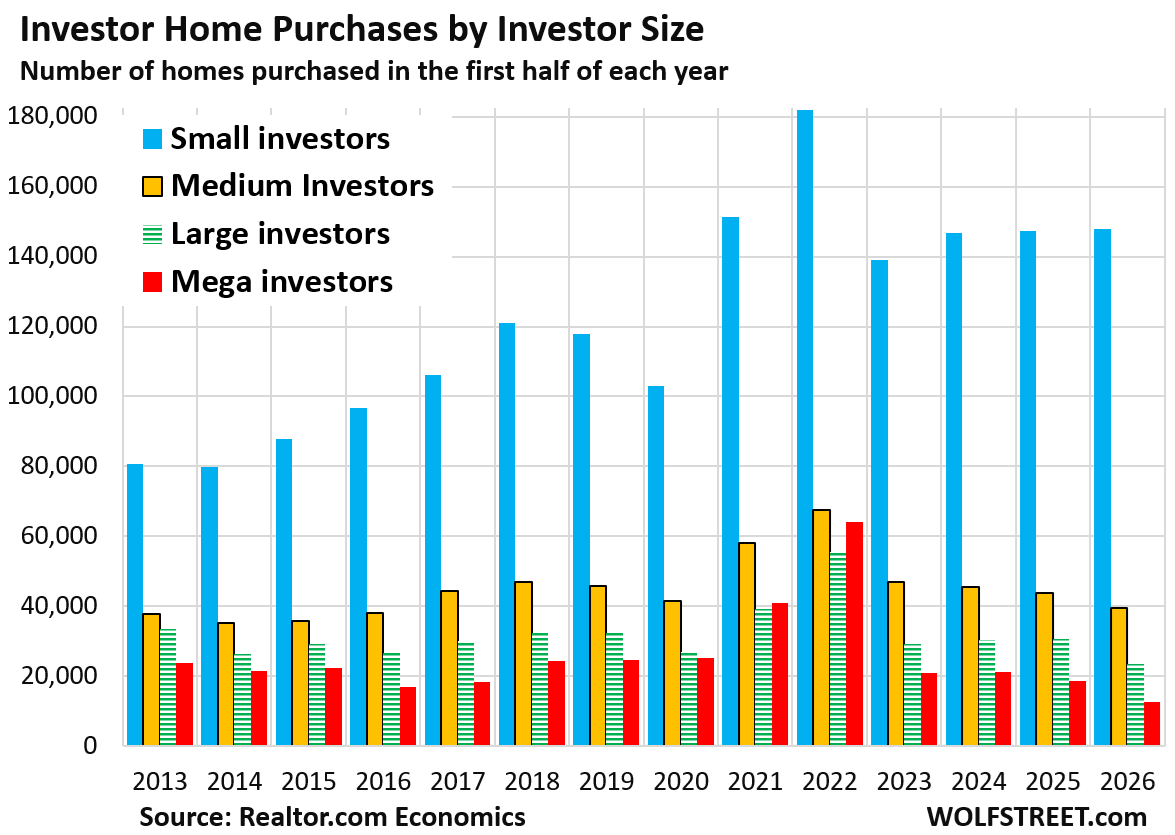
Not all mom-and-pop investors are included. The data tracks investors by corporate entity, and purchases by mom-and-pop investors that do not use a corporate entity are not included. So if the purchases by mom-and-pop investors without corporate entity were included, the blue columns in the chart above would be even taller.
These purchases reflect purchases only, and do not include sales. As purchases by large and mega-investors have collapsed, while their sales have risen, they have become net sellers, selling more than they purchased, thereby adding more inventory to the for-sale market over those years than they took off the for-sale market.
Investors were big sellers. All combined, they sold 196,000 homes (single-family, townhouses, and condos) in the first half of 2026, down by 5.5% year-over-year. Excluded are sales of new construction and foreclosed properties.
The sales accounted for 9.4% of total home sales, a slight decline in share from a year ago (9.5%). The share of investor sales has been running in this range for the past several years.
Mega & large investors pulled back, small investors piled in. All combined, investors purchased 224,000 homes (single-family, townhouses, and condos) in H1 2026, down by 7.0% year-over-year. Included in these investor purchases are new-construction and foreclosed properties.
So all combined, investors purchased 28,000 more homes than they sold. This was driven by an army of small investors (with 1-10 all-time property purchases), even as mega investors and large investors pulled back.
Mega investors (over 350 all-time purchases) and large investors (51-350 all-time purchases) were again net sellers – selling more than they purchased in H1. They have been active sellers for years; and their purchases plunged.
Purchases by mega investors (red columns in the chart above) collapsed by 80% from the peak in H1 2022, to about 12,700 properties.
Purchases by large investor (striped green columns in the chart above) plunged by 58% over the same period to about 23,300 properties.
Purchases by medium investors (11-50 all-time purchases, black-trimmed gold columns in the chart above) plunged by 41% from H1 2022, to 39,500 properties.
But purchases by small investors dropped by “only” 19% from the record in H1 2022, to about 148,000 properties (blue columns in the chart above), thereby dramatically increasing their share of all investor purchases.
Non-investor purchases plunged by 31% since H1 2022. So mega-investors with an 80% plunge, large investors with a 58% plunge, and medium investors with a 41% plunge have dramatically stepped back from the already declining market.
But small investors have gained share as their purchases dropped by only 19%. Small investors have been and remain a force in the overall housing market.

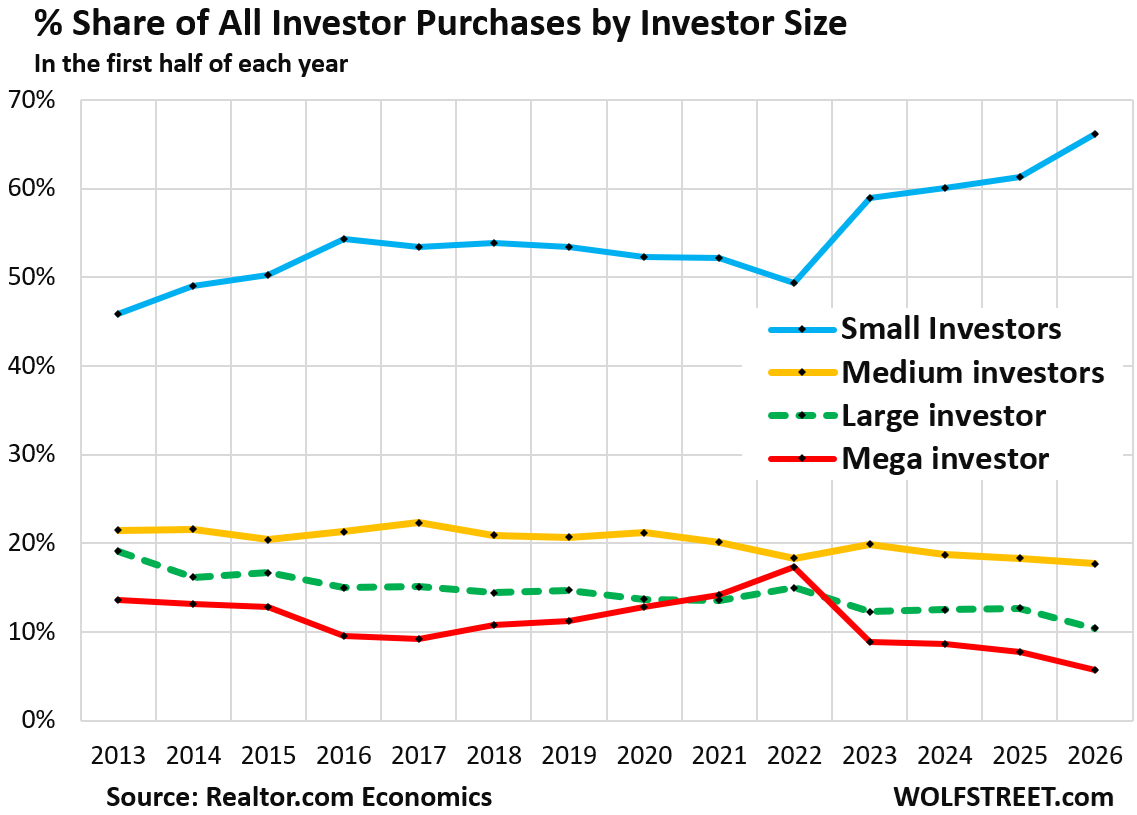
Small investors’ share of all investor purchases rose to 66.2% in the first half of 2026, a record in the data, up from 45.9% in the first half of 2013 (blue line in the chart below).
The share of all other investors declined, with the share of mega-investors dropping to a record low of 5.7% (red line), and the share of large investors dropping to a record low of 10.4% (dotted green line).
Small investors have been, and continued to be, the driving force. There are millions of them, each buying a home every now and then, but together buying up large numbers of homes and putting them on the rental market. But the figures here exclude small investors that do not use a corporate entity for their purchases, such as many mom-and-pop investors.
Clearly, small investors still think that buying rental properties after the home-price explosion from mid-2020 to mid-2022 is the eldorado, while the smart money has stepped back?
Enjoy reading WOLF STREET and want to support it? You can donate. I appreciate it immensely. Click on the mug to find out how:


Does this include buy-to-STR? It will be interesting to see how the new changes to AirBNB rules (which mega-hosts who manage tens of properties are very pissed about) will affect those net purchases.
There is no distinction as to what types of rentals these properties are used for. And the type of rental could change, such as a property gets purchased for long-term rental, but then the investor cannot get the rent needed to cover the monthly nut, and loses too much cash flow, and decides to put it on the short-term rental (STR) market.
Oof – another very very bad sign. So basically, the people with the market intelligence to know are getting out, handing future losses to optimistic up and comers trying yet another way to make it…
Anyone else feel like we’re about to go off the cliff?
Brazil equity market had circuit breaker go off this morning after 10% drop, Indonesian Stock Market Crash 12% last week in a day, also Kospi got close to triggering circuit breakers recently, it’s not isolated, it’s dominos moving from one piece to the next piece. Buckle up! It’s coming here soon IMO.. Get prepared, for whatever you decide to do. Preparation and plan is always good. Or just do nothing that’s the reality we live in. It’s your call to make.
But today’s 17% plunge of the Brazilian stock index only wiped out a couple of months of gains. It used to be that a 17% one-day crash would wipe out a couple of years of gains. So if people were gone on an extended vacation, and didn’t look at their portfolio, and came back today and saw that their portfolio was unchanged from when they left, they’d just shrug. The Kospi is even worse.
Kospi has been sheer madness this year! According to a sunbiz article, that exchange has seen four 14%+ weekly drawdowns since June.
I am not sure Korea knows what it’s doing in the market – we are probably not far off…
Depends on how many people are overleveraged. I’d like to see the stats on what percent of people were overleveraged during the last few crashes compared to total market value.
Well the prices will go up again right after they deflate some.
Maybe a turnaround of 8 years?
Not too bad
I got a kid up in the Seattle area. The “Bank of Dad” was going to help fund 25% of a home, he another 25%, and his payment would STILL have been 150% of his rent.
The one he offered on he didn’t get, losing out to a “all cash” investor. Right about that time a post came up on Twitter when a guy described the advances in AI. Told son “You’re out of the housing market now for the next two years at least. You don’t NEED, a house, you just want a house. When AI job dislocation hits your market prices will correct by 25% or more. No reason to lose a quarter mil to impatience.”
Per ZeroHedge today, $MSFT looking to buyout up to ONE THIRD of total workforce. That’s gonna ripple thru Redmond and surrounding areas big time. $AMZN can’t be far behind.
I texted an agent in Reno (a city I like for some reason) about buying a condo. Summer place. Told the agent if they dropped the price 15% (and why) I’d come look at it. After seeing the $MSFT news today, that might not be enough.
I simply cannot see AI NOT being a giant job destruction engine. Nor can I see eventual Fed policy being anything but an inflationary direction.
It’s all going to come down to timing and markets, both Real Estate and stock/bond.
They just want to fire their employees to prop their stocks up. They don’t need to fire them.
Meta wants to raise 95b from stock sale, when companies go public and raise 95b on over a trillion in valuation, in my theory meta stock could go down 1 T after they sell 95b in new stocks. Debt market isn’t cooperating for the hyperscalers anymore or debt covenant are stopping them. I think meta had Debt covenant to avoid, that’s why they are doing equity instead of new debt! Just a theory or gut intuition. Will see what happens after they creat 95b in cash from issuing shares, it’s not going to be pretty. 20% drop only hurts if you bought on the top or used margin at the top to buy more equities. Instead of Marsha Marsha Marsha we got Margin Margin Margin!!! Ha
Be careful here. Companies often use job cut announcements before earnings release to soften the blow of an earnings miss.
I have been in single family rental market since 1985. By your category I am on a medium investor who set up a small management company. Since single family homes are not cookie cutter like apartments (which have same floorplans, baths, kitchens, heating etc) and take alot more knowledge about each property to manage than apartments. Hence their management can not be automated as easily and therefore large firm’s have more difficulty and expense in managing them. Therefore its not surprising that larger firms are getting out of this market.
The article says the mega, and I assume large, landlords are building SFH to rent. They’re not pulling out of the market. It looks like they’re streamlining their operations.
The article says purchases by all investors are slowing down SFH purchases: mega (-80pct), large (-58pct), medium (-41pct), small (-19pct) for a total reduction of 7 percent. Mega and large: streamlining and building, but still purchasing; medium, small, still purchasing but less fast.
Instead of smart vs dumb money, it might be big money vs small money. Is buy to let suddenly going to become unprofitable while build to let stays profitable?
If you can buy without a mortgage, and you’re competing with mortgages, that competition shouldn’t be too hard to be beat.
The Federal Reserve recently put out a study saying it’s not 66 percent of American adults that own a home, but rather 52 percent. So that indicates an even larger population of renters.
When the government overtly declares an asset to be an asset for which they’re going to make every effort to keep the price increasing (the Federal Reserve stated one of its goals post 2008 was to put a floor under home prices; the FHFA REO-to-Rent program created the first big injection of cash into encouraging large companies to purchase homes and rent them out, in order to keep prices from slipping; and today, Trump reiterates he wants to keep home prices rising), it’s going to cause to cause that asset to increase in value and even bubble (but is it a bubble if the actual (not index or inflation adjusted) price never comes down significantly? Perhaps UofC economist Eugene Fama was right about bubbles).
2 family to 5 family depending on jurisdiction investor since the 1980s. sold off all but one property 3 years ago. just sold off the last one this past summer. only have my home. i suspect i’ll get back in another 5 to 10 years when this bubble bursts and bottoms in cities i like to invest. if rates keep rising for a decade or more, it might get really juicy for decent cap rates again. i like buyng with cash. much better deals. financing is always available after if one wants. hopes and prayers we have a huge bubble bursting in stocks and r/e. trading stock bubbles is easy peasy. part time work.
One interesting point from the Realtor.com source:
“Investors comprised 10.7% of home purchases in the first half of 2026”
whereas
“Investor sales comprised 9.4% of total home sales in the first half of 2026” (as Wolf also noted above)
so overall, it’s a net increase (10.7% – 9.4% = +1.3% of transactions) of houses owned by investors.
That’s a demand imbalance that would tend to prop up prices.
But it’s less than last year, when the equivalent numbers were 11% and 9.49% so the net was +1.51%.
The small time investors are probably or might be a little foolish or naive, we’ll see. But we know who gives money big time to both major parties which ran up 40 trillion in debt, and appointed the fed that did the bad QE, thats the mega and large investors, so they are more foolish.
Many smart people kept saying that a home is for living, not an investment. And for sure not a passive one. The message has not been going through.
There were many small investors who got wiped out in 2008-2009 because they overpaid 2004-2007. There were abandoned 2-4 family houses scattered all over Boston, Worcester and Manchester (the areas I’ve been involved in.
Will that happen again this time is the big question.