
Conniptions in the Treasury Market calm down. Nothing Goes to Heck in a Straight Line, says the WOLF STREET dictum, not even the Treasury Market.
By Wolf Richter for WOLF STREET.
Companies duking it out in the AI infrastructure race have been frantically front-loading their capital raises, trying to squeeze as much and as quickly as possible out of the markets, to get in front of other companies, to get in front of the mega IPOs of Anthropic and Open AI, and to get in front of the US government that has been squeezing the bond market for what it’s worth.
At some point, the debt and equity markets would have conniptions that would impose a pause on the capital raises until tempers settled down. And the companies wanted to get in front of that and load up on cash before that happens.
Markets are now having these conniptions, but these companies are chockful with cash that they have raised this year and last year and haven’t spent yet. And they can let the dust settle in the markets without new capital raises, and start spending this money on AI infrastructure. And after the market tempers settle down, they can dip in for more.
On top of this pile is Alphabet, which, after huge capital rases earlier this year and last year, had $242 billion in cash and marketable securities on its balance sheet as of June 30. In August, it raised another $29 billion in cash through bond sales in the US and Australia. On top of that comes the operating cash flow in Q3 (in Q2 = $39 billion). This would bring its cash hoard to about $300 billion, out of which it would be making its capital expenditures ($44 billion in Q2).
So even if the markets were to lock up, Alphabet could still spend enormous amounts in capital expenditures on AI infrastructure.
In other words, Alphabet far outraised its current capital requirements by front-loading capital raises, and it now sits on a huge pile of unspent cash that’s going to get spent.
Amazon is #2 with $123 billion in cash and marketable securities on its balance sheet as of June 30. In addition, it raised another $31 billion in July in the US and the UK. Plus the operating cash flow in Q3. Minus the capital expenditures.
SpaceX is #3 with $90 billion in cash and marketable securities as of September 30. Plus, it is now finalizing a $40 billion debt offering led by Apollo and Goldman Sachs. That would bring its cash hoard to $130 billion.
Because of the conniptions in the bond market, SpaceX is going to the loan market (insurance companies, pension funds, loan funds, private credit funds, etc., around the globe) and that’s taking pressure off the bond market that the government has to rely on for its $2.2 trillion a year in Treasury sales.
The table below shows the top 10 companies in the AI space in terms of their holdings of cash and marketable securities at the end of their last reported quarter; it also shows the end date of the quarter, and any amounts raised since the end of the quarter.
The table does not include non-AI companies, such as the massive $52 billion debt package by Paramount Skydance to fund the acquisition of Warner Bros. Discovery.
The table also does not show the cash levels and debt issuance of privately held companies, such as Anthropic and OpenAI.
The table just shows publicly traded companies actively engaged in the AI race. But the other debt issuance, such as by Paramount Skydance, also put pressure on the Treasury market.
Combined, the 10 companies in the table sat on $775 billion in cash at the end of their last quarter, with another $107 getting raised since then, for a total of $882 billion in cash. On top of that comes the current operating cash flow, minus the current capital expenditures. This is a freaking huge amount of cash they’re sitting on, much of which is going to get spent over the next year or two in the economy.
And by borrowing these huge amounts of money this year, companies put additional pressure on the bond market that the US government was already applying maximum pressure on with $2.2 trillion a year in Treasury sales. This massive corporate pressure on the bond market was often cited, including by Bessent, for the reason of the soaring Treasury yields this year. But now that pressure has backed off.
| Balance sheet | Raised since Billion $ | |||
| Billion $ | As of: | |||
| Alphabet | 242.5 | 30-Jun | 29.0 | August, US & Australia |
| Amazon | 123.0 | 30-Jun | 30.8 | July, US & UK |
| SpaceX | 90.4 | 30-Sep | 40.0 | finalizing debt offering |
| Meta | 83.1 | 30-Sep | ||
| Microsoft | 76.8 | 30-Jun | 3.9 | August: Project Odyssey via QTS Realty Trust |
| Apple | 54.7 | 30-Jun | ||
| Nvidia | 49.7 | 27-Jul | ||
| Oracle | 37.1 | 31-Aug | ||
| IBM | 11.1 | 30-Sep | ||
| CoreWeave | 6.4 | 30-Jun | 4.0 | September |
| Subtotal | 774.7 | 107.7 | ||
| Total | 882.4 | |||
The conniptions in the Treasury market settle down.
In the Treasury market, the conniptions and pressures this year – including from corporate borrowers luring investors away from the Treasury market with higher yields – have caused yields to soar to 20-plus year highs. When yields soar, bond prices drop. The “bond bloodbath,” we called it many times.
Those conniptions are now settling down as AI-borrowers, front-loaded with cash up to the gills, have backed away temporarily from the bond market. Yields have backed off, and bond prices have risen.
But the fundamentals of the Treasury market have not changed: Too-high inflation, high nominal economic growth, and the effects of the government’s fiscal recklessness still rule it. It’s just that the pressures — the competition — from corporate AI borrowers have temporarily abated.
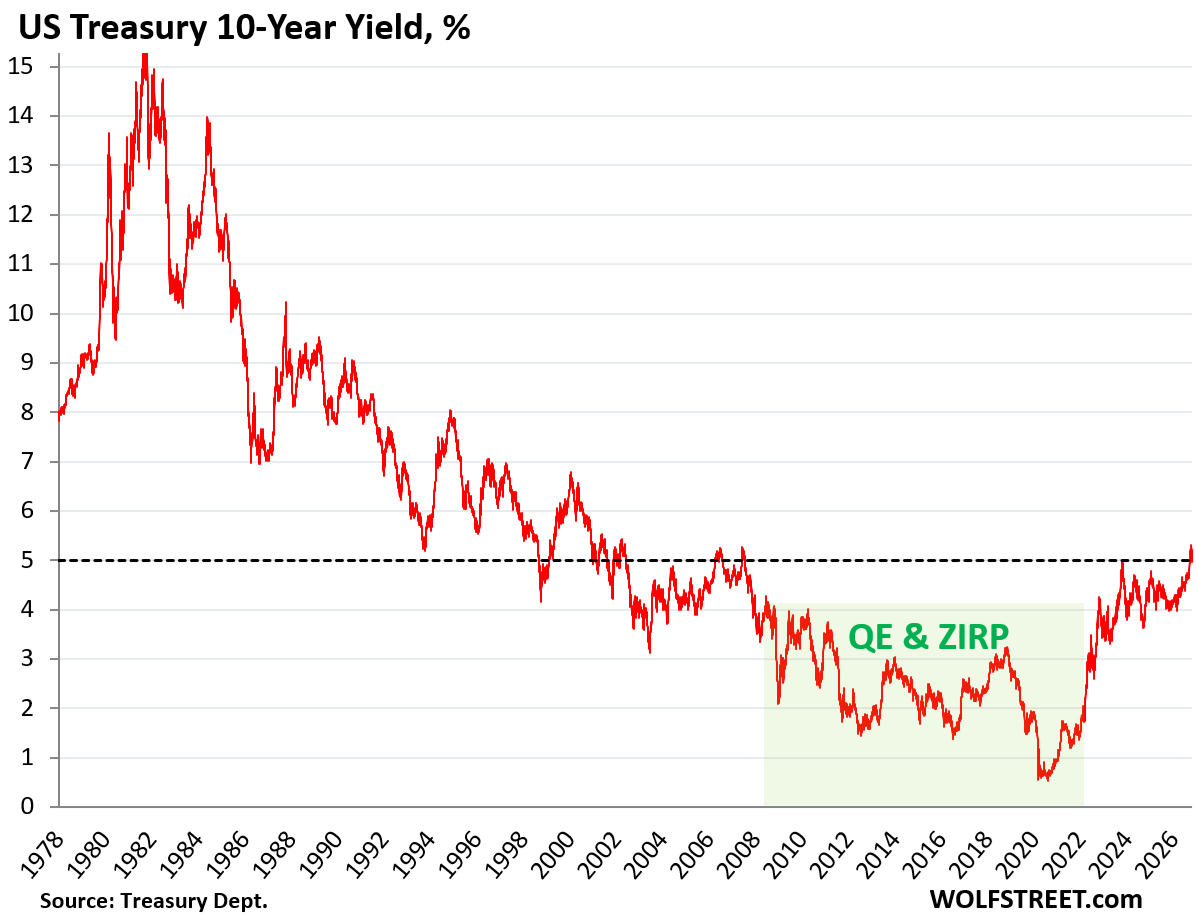
The 10-year Treasury yield ticked up to 5.00% on Friday, after plunging on Thursday and spending about a day below 5% for the first time since September 22. Since its closing high on October 5 of 5.31%, the 10-year yield has now backed off by 31 basis points.
On a long-term chart, these are minor ripples in an ocean of ripples and waves.
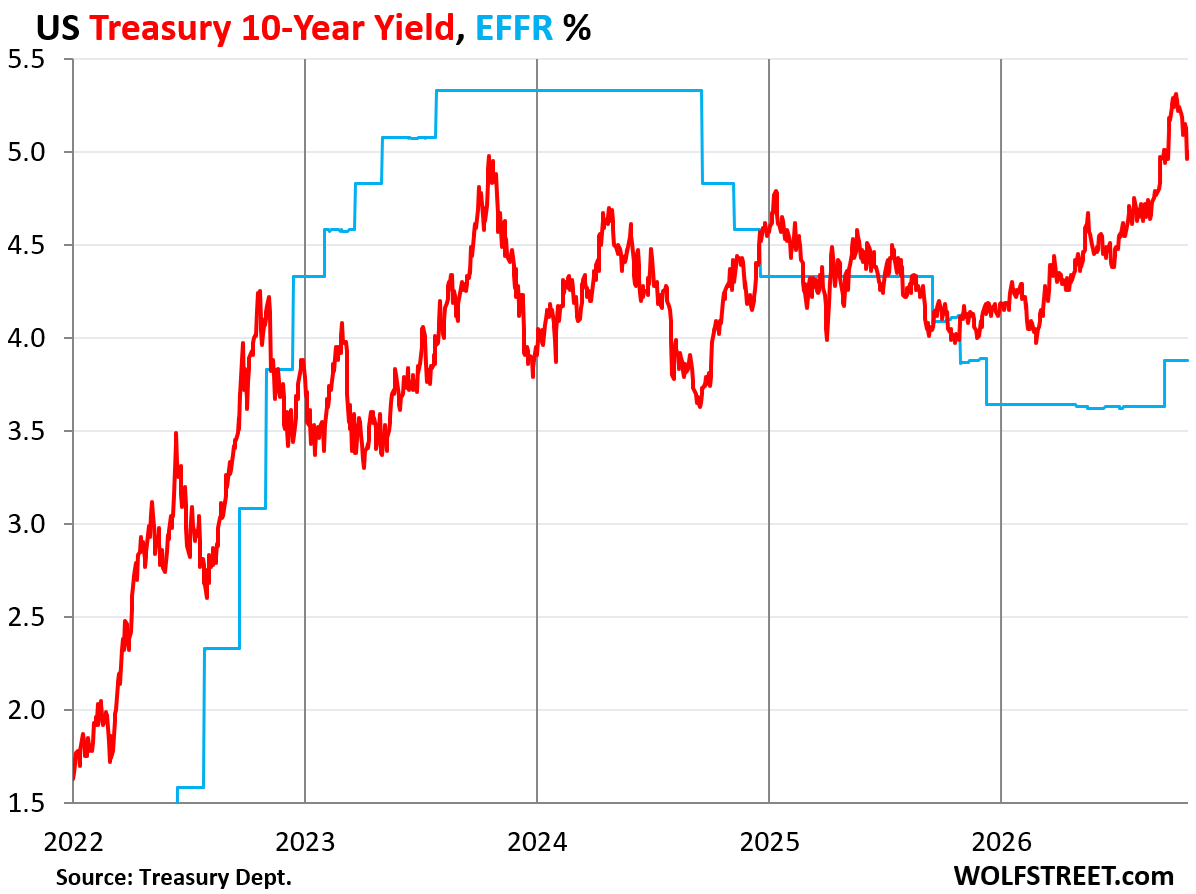
The 10-year Treasury yield has unwound in 13 trading days of rally the 31-basis-point yield rise produced by the 9-trading-day sell-off leading up to it. The yield went from 5.00% to 5.31% in 9 days and back to 5.00% in 13 days.
What was somewhat disconcerting and made a lot of people nervous was the sharp 9-day sell-off and surge of the yield to 5.31%. Wagging tongues were already predicting investors fleeing the Treasury market and buying gold, the collapse of the US Treasury debt, the US inability to pay the interest, “fiscal dominance” and QE to stave it off, or whatever.
What I don’t find disconcerting is unwinding that surge in 13 days, which caused yields to decline and bond prices to rise, and tempers to settle down. It was expected. I said on September 23 in the comments – when the 10-year yield hit 5.10% for the first time since 2007 – that “the market is going to take a breather here and back off a little. The buyers are starting to come out at those yields.” And I was promptly made fun of in the comments when the yield continued to rise.
The prediction was based on the somewhat tongue-in-cheek WOLF STREET dictum: Nothing Goes to Heck in a Straight Line. Not even the Treasury market.
But this breather didn’t set in just then; the 10-year yield would go over 5.3%, and 10-year Treasury notes would be sold at auction at 5.30% on October 7, before the breather finally kicked in.
There are many reasons for breathers, including investors seeing a buying opportunity (droplets of “blood in the streets”) and start buying massively, thereby pushing up prices and pushing down yields, thereby triggering a bout of short-covering among highly leveraged hedge funds.
In addition, there was the slowdown by AI bond offerings, which took pressure off the bond market. But that doesn’t mean a slowdown in AI spending: Companies front-loaded their cash raises and now sit on vast amounts of cash to fund capital expenditures without having to go back to the bond market for a while (see table above).
The 10-year yield has dropped by 31 basis points from the closing high on October 5 to October 23. Some examples of previous bond rallies expressed in yield declines:
- 39 basis point drop, Mar 27, 2025 to Apr 3, 2025 (5 trading days)
- 107 basis point drop, Apr 25, 2024 to Sep 16, 2024
- 121 basis point drop, Oct 23, 2023 to Dec 23, 2023
- 78 basis point drop, Mar 2, 2023 to Apr 4, 2023.
The five-year chart shows a more detail of the volatility of the 10-year Treasury yield. The current rally provides some welcome relief after the nine-month sell-off:
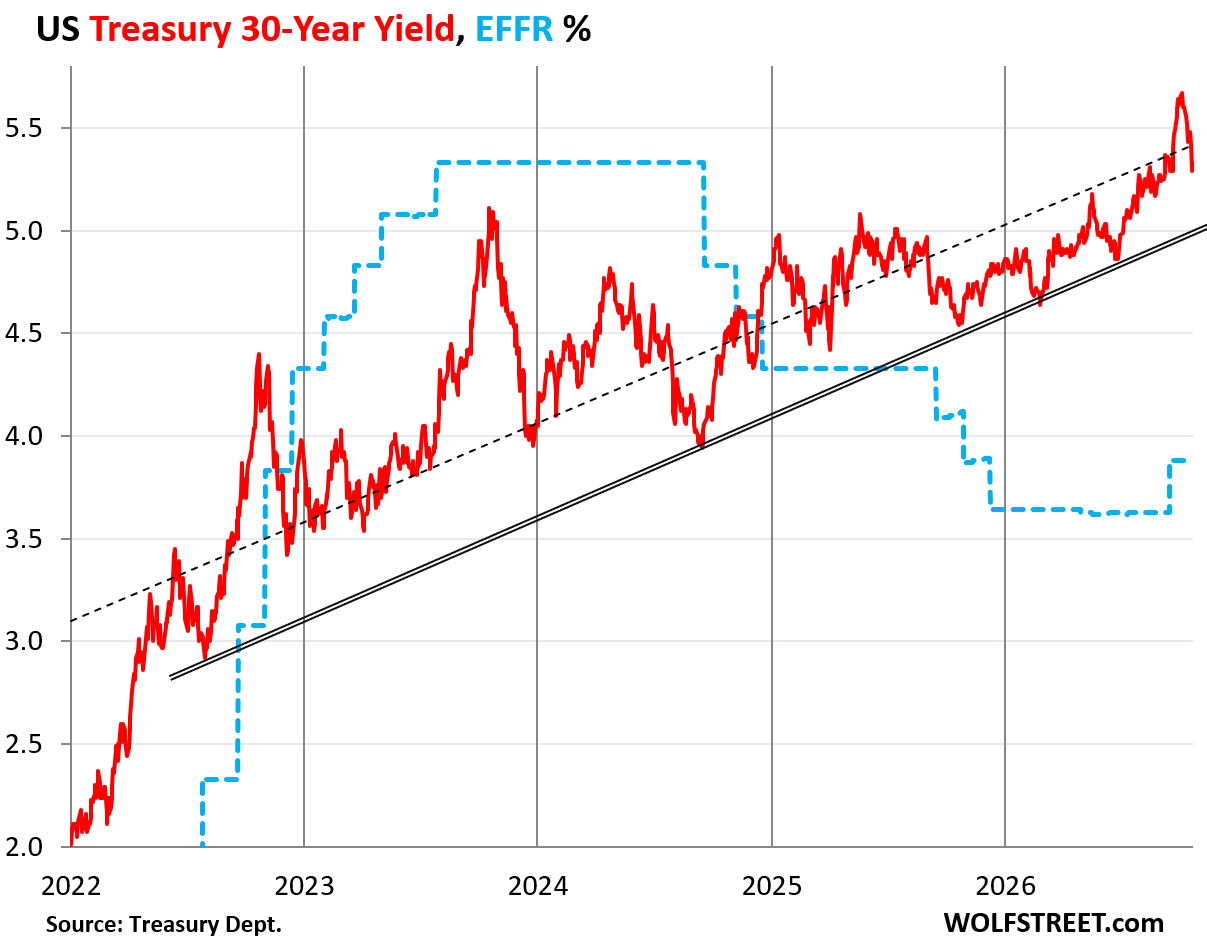
The 30-year Treasury yield ticked up to 5.33% on Friday, after having plunged on Thursday to 5.29%.
It has been zigzagging higher within a trading range for over four years. The black double-line connects the lows going back to July 2022. The black dotted line is the calculated trend line for the data within the time frame of the chart:
Enjoy reading WOLF STREET and want to support it? You can donate. I appreciate it immensely. Click on the mug to find out how:


And the U.S. Treasury, General Account 2026-10-21 $945,153b appears to be taking a “breather” as well.
The rally in the 10 year is easy to explain, hedge funds are borrowing from the repo market to buy the 10 year as protection from having the master trading algo dump their equity holdings by 50% or more. 3 days above 5,32% is the line of no return for risk selling momentum.
Hedge funds always borrow in the repo market and buy Treasuries with the proceeds, effectively using the Treasuries as collateral for their repos. Then they sell Treasury futures (effectively shorting Treasuries) against their leveraged Treasuries that they hold long. That is the huge and highly leveraged “basis trade.”
100% correct but the option contracts they sell don’t have the direct effect of lowering yield as rebuying actual T bonds and than wash rinse repeat with repo leverage to buy more. The treasury department loves the basis trade via repo market, it’s like they created it and approved it to sell more debt. Option markets effects cash markets I agree, but not to the degree of cash purchasing actual stocks or bonds. Thanks for participating with my comment, seriously. I seldom get a response from my target audience on your site. I know I sound egotistical and looking for ego validation but I follow what you follow for decades too with energy time and appetite, it’s a curse, or not. I appreciate your time in writing your articles obviously I am fan :) cheers
Which incidentally is not a directional play on the 10-yr rate and therefore should have negligible if any impact on Treasury prices/yields
i just went for long hike, found some clarity, the hedge funds are no longer buying a delta-neutral yield from a basis trade: holding 10 year bond asset long, and short an equal amount of perpetual futures, and collect the funding rate. They are engaging in a one side long trade without the short hedge, since 5,32% pivot waiting for the Calvary to come in for the rescue.
When the rubber band snaps liquidity shortfalls will happen from yield rising and stock equities crashing. double edge sword!
It’s impressive how well the hyperscalar finance teams have so far managed financing the buildout.
And how terrifically wrong the “It’s a bubble!” seers have been.
I’m starting to think we haven’t had a meaningful recession in almost 20 years because maybe, just maybe, the financial crisis cleared out some fools and left people in charge who kind of know what they’re doing.
Then I look at crypto and think, “Well, no, I’m the idiot, and starting to believe there’s nothing to hedge against is exactly how people start acting in ways that cause a recession.”
Haha, sure sure.
Summer child
AI is a bubble because everyone is heavily investing in it without a real busness plan. It’s just the same old same old, fear of missing out.
Hope and pray isn’t a business plan. China’s models are 90-99% cheaper, with results that are just about as good. That should tell us that in the long run 90% of the investment will be lost. They’re praying protectionism will save them, but in a global market that is unlikely to last long.
AI still gives a lot of wrong answers. Companies are trying to automate what they can. But if there is a high error rate, that increases hiring when the goal is to replace it. They won’t pay for that for very long.
It’s very simple. People would rather be wrong with everyone else than right on their own.
The math simply isn’t there for every AI company to be successful, so everyone bets that they’ll be the one, and if they’re not, ahh well, they were wrong in good company!
“…and left people in charge who kind of know what they’re doing.”
Best humor of the day! Thank you for that.
Don’t feel like your an idiot.
These financial markets are built to make everyone look like a fool.
By the way, if you didn’t see Wolf on Adam Taggerts “Thoughful money” podcast, go watch it.
Watching wolf on TV is even better than reading him.
Like the man who fell off a 100 story building said as he passed the 20th floor:
“So far, so good”
It’s a matter of time, all manias end badly
All technology gets reduced to commodity status at some point
Anyone who thinks there’s no limit to what NVidia can sell with 75% margins is delusional. The decreasing price earnings ratio on NVidia isn’t a buying opporunity, it’s a warning
And when you consider that so much of their revenue is coming from the other big tech companies who are, in my opinion, legally stealing money from Americans through their quasi-monopoly status, it’s even more tenuous.
“from the other big tech companies who are, in my opinion, legally stealing money from Americans through their quasi-monopoly status”
I really don’t know about that…let’s think about where the vast bulk of Google and Facebook’s *revenue* comes from…advertising. Not exactly without competitors, not exactly utterly indispensible/incapable of reduction, not exactly price inelastic.
So here’s my quote…
“It is worse than a crime…it is an error.”
Just how much more global advertising demand can be ginned up, from an already enormous base (perhaps the silent secret of Google/FB mega revenue growth…centering *global* advertising upon themselves…but there is only 1 Earth)?
Apple…at some point, hundreds of millions of buyers will stop upgrading every 2 to 3 years (rather pointlessly).
NVidia and every other AI dorkery – South Park Underpants Gnome Business Model from 2002. Telecomm circle jerk financing…also from 2002.
casOneTwoSeven
could you please revert to the original cas127? Thanks.
Many AI bubble stocks have already popped.
The only reason the broader market hasn’t crashed (yet?) is because of a rise in the rate-sensitive and defensive sectors.
Some of that was a side-effect of the end-stage Street trade: long AI, yes, but funded by short-bonds. Because no other room left on the balance sheet.
The trade overextended and blew up as everyone raced for the exits.
The economy is currently strong, but we’re about to find out how much of the massive surge in credit won’t translate into actual economic gains.
If you don’t know exactly what you’re holding, you’re probably holding the bag…
The focus here is on Treasuries but when it comes to lower rated corporate bonds, credit spreads are apparently widening. It would be interesting to get Wolf’s take on this. Is the corporate bond market getting nervous?
Yes CCC and below rated corporates have seen much wider spreads. But they’re still not wide. These are bonds with an uncomfortably high probability of default. “C” rated bonds are the lowest non-defaulted bonds on the verge of default. The next step down is “D” for Default.
Gross cash makes a good headline; net obligations tell you who is taking the real risk.
But nobody ever spends the Gobs of cash they have.
Apple had tons over in Ireland forever.
Cash is basically an admission that there is no place to put it.
And if people are putting cash with AI, then these companies are saying “we have no place to put this” or no smart place.
Corporate cash positions beyond normal operating requirements are a reflection of the position that there is “no better” option where the potential reward outweighs the underlying risk of loss including the return that cash is yielding. If businesses are choosing to allocate cash to AI buildout that is confirmation that they believe the potential reward is greater than the etablished loss.
They obviously believe significant revenue streams from these investments will occur soon and are already occuring to a small degree.
Wolf highlights the ad revenue drain from independent websites that AI is magnifying. So there is that revenue to be had.
To understand how prevasive the AI agent can become for retailers, its not hard to foresee a scenario where one tells their AI agent “order a top rated four slice toaster at a good price” and that is the extent of their purchase effort. A few hours later the toaster is on their door step. The various vendors have to compete to be that choice and to do that they will have to pay. And as a consumer one will pay to have the most effective AI agent “buyer” working for them. Just like companies do now with their purhase manager personel.
Wolf has also highlighted how he is able to produce content using AI for his readers that he would have needed to pay someone to do previously. I have the same experience and its reduced cost of advertising significantly.
We are enjoying a lot of these services at almost no cost currently as has been the case throughout the interent age but at some point we pay, directly through subscriptions or indirectly through third party paid influence.
Google and Meta, both incredibly dominant and profitable, know that the risk of not being at or near the top of this shift means they risk becoming the AOL and MySpace of days gone by. Hence the spending!
These are just a few aspects of AI impact on the retail and content provider industries. Extrapolate that across all the various industries and its many potential impacts and its no mystery how valuable AI will become.
This in now way is justification for some stock valuations which are entirely disconnected from AIs intrinsic value.
The big tech companies might not be investing in AI to get a high ROI. They may be investing to preserve current market share and profit streams.
It’s particularly applicable to Google, because AI advancements directly threaten search and advertising revenues.
NYT just did 5 things you can do with an agent
And the most spectacular thing was “they filled out a form to get me the lowest priced tires while I was walking the dog.”
But the agent cost him $100 a month…
Other even more mundane tasks
Schedule a restaurant
Get a workout plan
Apply for a job faster
Daily meal planning.
I mean cmon. This stuff is so elementary.
Last weeks was abuzz with media stories about an impending heating up of of the war against Iran. Oil went to 114 and delivered oil is over 130/barrel for oil leaving the Gulf to some destinations as tanker rates are near 1 million per day.
Iran says that if it is attacked it will target oil infrastructure throughout the gulf. Nobody can reliably calculate their ability to do that but neither can they calculate that Iran can’t do that.
Great insights on cash hordes held by the big spenders. I hadnt really appreciated that.
Maybe if the equity markets have another bad day monday, we will get a TACO Tuesday from Trump – reassuring everyone that there will be no more war until after the midterms.
If he loses the midterms, then he can blame the democrats for stopping him. If the midterms don’t turn out too badly he can claim a mandate for MORE WAR.
“we will get a TACO Tuesday from Trump – reassuring everyone that there will be no more war until after the midterms.”
So no need to worry, as the midterms will be a whole 7 days away on Tuesday
Party on Garth, Party on Wayne
Do the balance sheeps of the corporate piggies show how much interest they are earning from their mountain of cash?
Their income statements show that (not the balance sheet). For example, Alphabet earned $1.4 billion in interest income in Q2. Click on the link below, which opens Alphabet’s 10-Q quarterly report (income statement, balance sheet, cash flow statement, etc.), a long document that no one reads, and search via your browser’s search function (such as Ctr F) for “interest income.” Then make sure you look in the correct column for Q2 2026.
https://www.sec.gov/Archives/edgar/data/1652044/000165204426000071/goog-20260630.htm
It’s prob being consumed mostly by inflation, so perhaps .25%
They’re not “earning” anything (net) if they have bonds outstanding that are the source of the money
“…SpaceX is going to the loan market (insurance companies, pension funds, loan funds, private credit funds, etc., around the globe) and that’s taking pressure off the bond market that the government has to rely on…” Except that the money that it is borrowing from other sources is no longer available to buy bonds- the pool of bond buyers is a bit shallower. I would assume those entities that borrowed heavily and are now sitting on large quantities of cash are also having to pay interest on those large quantities of cash, and if the money has yet to be “deployed” then any sort of revenue to pay that interest is a longs ways off in the future. And right about then someone will develop a chip that puts the computing power of a 20 acres data center in a 14 inch laptop.
The SpaceX press release announcing the $25 billion of bonds on June 23 lists rates between 5.350% and 6.650% for maturities from 2031 to 2056. Just letting that $25 billion sit in T-bills while they figure out what to do with it would earn them 4.0% to 4.5%. It doesn’t look like they’d be sweating the bond interest payments for quite a while.
The spread between the interest they are earning and the interest they are paying may only be a percent or two but when applied to billions of dollars it adds up quick. Leverage working in reverse, or something like that.
I suspect it’s more that they’re borrowing for 30 years now while money is still relatively cheap.
Anyone willing to loan money to SpaceX at 6% for 25 years is a moron.
yeah but loans are different from bonds. Loans are backed by collateral (“secured”) and so come with lower risks and yields, while the SpaceX bonds were “unsecured.” So these loans appeal to different investors that are specialized in loans. You cannot buy those loans from your broker. But you can buy the SpaceX bonds from your broker. It’s not like investors say, oh heck, if I cannot get the SpaceX bonds, I’ll just buy the loans. Different investors, different objectives. So there is not that much overlap (if any).
“Real” treasury yields have fallen 20+ basis points this month on the long end of the yield curve. That might say something about the demand for capital from the private sector falling a bit, but I don’t know. Here is source and methodology:
https://home.treasury.gov/resource-center/data-chart-center/interest-rates/TextView?type=daily_treasury_real_yield_curve&field_tdr_date_value=202610
“Treasury Par Real Yield Curve Rates: These rates are commonly referred to as “Real Constant Maturity Treasury” rates, or R-CMTs. Par real yields on Treasury Inflation Protected Securities (TIPS) at “constant maturity” are interpolated by the U.S. Treasury from Treasury’s daily par real yield curve. These par real yields are calculated from indicative secondary market quotations obtained by the Federal Reserve Bank of New York. The par real yield values are read from the par real yield curve at fixed maturities, currently 5, 7, 10, 20, and 30 years. This method provides a par real yield for a 10-year maturity, for example, even if no outstanding security has exactly 10 years remaining to maturity.”
I’d always been taught that real interest rates were the better measure of supply and demand for credit, while nominal rates also reflect inflationary expectations.
Yield of the 30-year TIPS = 3.10% (aka “real yield” because investors get this yield plus CPI inflation protection added to the principal)
Yield of 30-year bond = 5.33%.
They have both fallen in a similar manner since the peak on Oct 6:
30-year TIPS: -30 basis points.
30-year bond: -33 basis points
They almost always move in near-lockstep in day-to-day trading, up and down, with the TIPS moving a little less. It doesn’t say anything about the “demand for capital from the private sector falling a bit.” It’s just two 30-year Treasury bonds whose yields are structured differently moving with the market.
Minus taxes*
Investments now bring enormous and accelerated tax credits.
Companies affiliated with AI have all kinds of ideas on spending money. KSL news Utah reports on “Project Beehive” to have four hundred fifty six (456) nuclear reactors generating 9.6 gigawatts on 9,000 acres of public land. There are 640 acres per square mile.
Forbidden Planet Movie (1956) with the immense “Krell” machine on a planet around the star Altair. This development looks like it was pulled directly out of the movie; with our far more primitive current technology. Question of how much of this AI is over the top hype.
Theological: If not AI hype, then the “Book of Revelations” with no one buying without “The Mark of the Beast,” perhaps the Tower of Babel, and since a large percentage of the Internet is “adult content” then Sodom and Gomorrah might be considered. Time to get a theology sign off on these projects before some interstellar asteroid or rogue planet heads our way.
I’m no expert in technical analysis and my take on the 10yr yield chart is that during this run up it’s done a few 28% drops after a big run. Staying inside a fairly clean channel. A 28% drops from its recent high takes it out of the channel. A run up to 6% before dropping 28% keeps it inside the channel.
And so concludes my November horoscope for men post, lol. But seriously a 6% 10yr does some significant changes in DCF or ERP calculations for the SPX and stocks not already sitting on wads of cash might have issues.
you made me LOL typing the word HECK. don’t think i ever saw that. hat tip to you. throw back to when i was 5. i like your blog. only thing i know for sure is the house dad built for 30k in the year of my birth in 1960 is now worth 100x. it’s a bedroom community of wall street, with fast commute for the grifters and hucksters. i’m a trader, too. like being a pig farm boy from arkansas. i’d have raised pigs.
The shift to the word “trader” here gave me a good laugh.
“it’s a bedroom community of wall street, with fast commute for the grifters and hucksters. i’m a trader, too.”
that was on purpose. for LOL. sitting on my ass making money trading electrons on a screen seems like a great grift. the local drug dealers / corner boys could only dream of the scam. i have had many convos with them over the decades. many get it. it’s not really splitting atoms. i worked at NASA in 1980s. that’s my big dick throw away line when i encounter douche bags online and in real life..
i have been a small time r/e investor. only a dozen or so multi family houses at a time. i’m mostly a stock trader. one thing all my r/e developer pals always said to me was that is there job. build build build. good and bad times. heads they win, tails the bankers lose. i agree with you the AI buildout is not stopping. who cares if the techies are now in the r/e development business. no big whoop. many old line companies changed over the centuries………john rock…. left his legacy in NYC stamped everywhere.
Capex for AI is not really consumer driven. It is the heavy mobilization of corporate capital to serve government industrial policy. The economics of the data center buildouts are not intended for retail software revenue models. They are building the bedrock infrastructure needed to reach their ultimate destination. Automated physical labor and embodied robotics at scale. There is no overbuilding from this perspective and the implicit government backstop already exists. It’s not hidden, this national industrial policy directly serves national security policy.
I think that a lot of those $ >700 billion cash those companies are sitting are reinvested in Treasuries or other bonds. Its not like “cash” on a ballance sheet is the same as cash as a houshold understands it.
So the bigger supply of bonds is mirrowed somewhat with a bigger demand. At least on the shorter end.
It looks like the EFFR has a long way to go to catch up to the bond market.
Rates are likely to head back up. Sept. money #s aren’t bad but the composition of the money stock presages an increase in the transaction’s velocity of money. That is evidenced by the steady increase in large CDs and the ratio of transaction’s-based deposits to savings/investment type deposits.
I think rates have been kept lower because the FED isn’t expected to hike this week.