
This is for October, advance notice, so to speak.
By Wolf Richter for WOLF STREET.
From the S&P Flash US PMI today:
“October’s flash PMI data indicate that the US economy continues to boom at the start of the fourth quarter. The output readings from the survey are consistent with GDP growing at a 5% annualized rate after a 4% expansion was signaled for the third quarter.
“Especially healthy corporate earnings and profits are also indicated, and hiring has surged as companies seek to boost capacity to fulfil stronger customer demand.
“If the reopening of the economy after COVID is excluded, recent months have seen the best growth spell for US businesses since early 2015.”
“Robust domestic demand was accompanied by renewed signs of export growth.”
Backlogs, an indicator of future business growth, rose at the sharpest rate since May 2022, spread across both manufacturing and services, which encouraged companies to increase their capacity and hiring, with employment rising at the second-fastest pace in over four years, according to the S&P PMI report.
But, but, but… hot inflation and struggling supply-chains.
“Cost pressures remain a key concern, notably as the renewed surge in oil prices reverberates through to impact a wide variety of goods and services.
“Supply chain bottlenecks have meanwhile intensified, and order book backlogs are growing, making it easier for companies to pass higher costs on to customers.
“The result is the sharpest increase in selling prices for over four years to a pace that indicates consumer price inflation is likely to rise further above the Fed’s target in the coming months.”
As companies tried to pass on a steep rise in costs, services inflation rose at the fastest rate since August 2022; and manufacturers’ selling prices rose at the fastest rate since July 2022.
Companies didn’t just cite oil-based input costs that soared, such as energy, fuel and freight rates. They also cited other raw materials, including steel, aluminum, and copper, “often due to tariffs or shortages.”
Service providers also cited higher wages and higher costs of utilities and insurance.
Material shortages, low inventories, overloaded suppliers, labor shortages, rising back orders, shipping delays, and import delays caused supplier delivery times to lengthen the most since 2022.

The flash Manufacturing PMI for manufacturers in the US rose to 56.0 in October, the fastest rate of growth since May 2022 – that was the growth spurt during the reopening of the economy after covid. Values above 50 indicate growth; values below 50 indicate contraction.
Job growth at manufacturers accelerated at the fastest pace since March 2012, when the economy was bouncing out of the Great Recession.
Suppliers’ delivery times to manufacturers lengthened “to the greatest degree since July 2022.”
Growth rates of production and new orders, though slightly lower than the growth rates in September, remained elevated.
The flash Services PMI Business Activity Index, at 57.9 for October, was the second-highest growth rate in nearly five years, behind only September.
Lots of economic growth and lots of inflation, that’s what the PMIs for October reflect – and that’s the definition of an economy that is “running hot.”
Letting the economy run hot has also been the official government policy of this administration as a way of making the deficit and the debt more manageable since neither Congress nor the administration — any recent Congress and administration — have shown any intention whatsoever of addressing the deficit via fiscal policy changes.
The Fed, by cutting interest rates last fall even as inflation was accelerating, has shown that it supports this policy of letting the economy run hot. With the rate hikes now underway, it’s indicating that it tries to prevent that process from spiraling out of control.
These high inflationary pressures in October that companies talked about here are a bad omen for the inflation indices in the coming months, including the Producer Price Index.
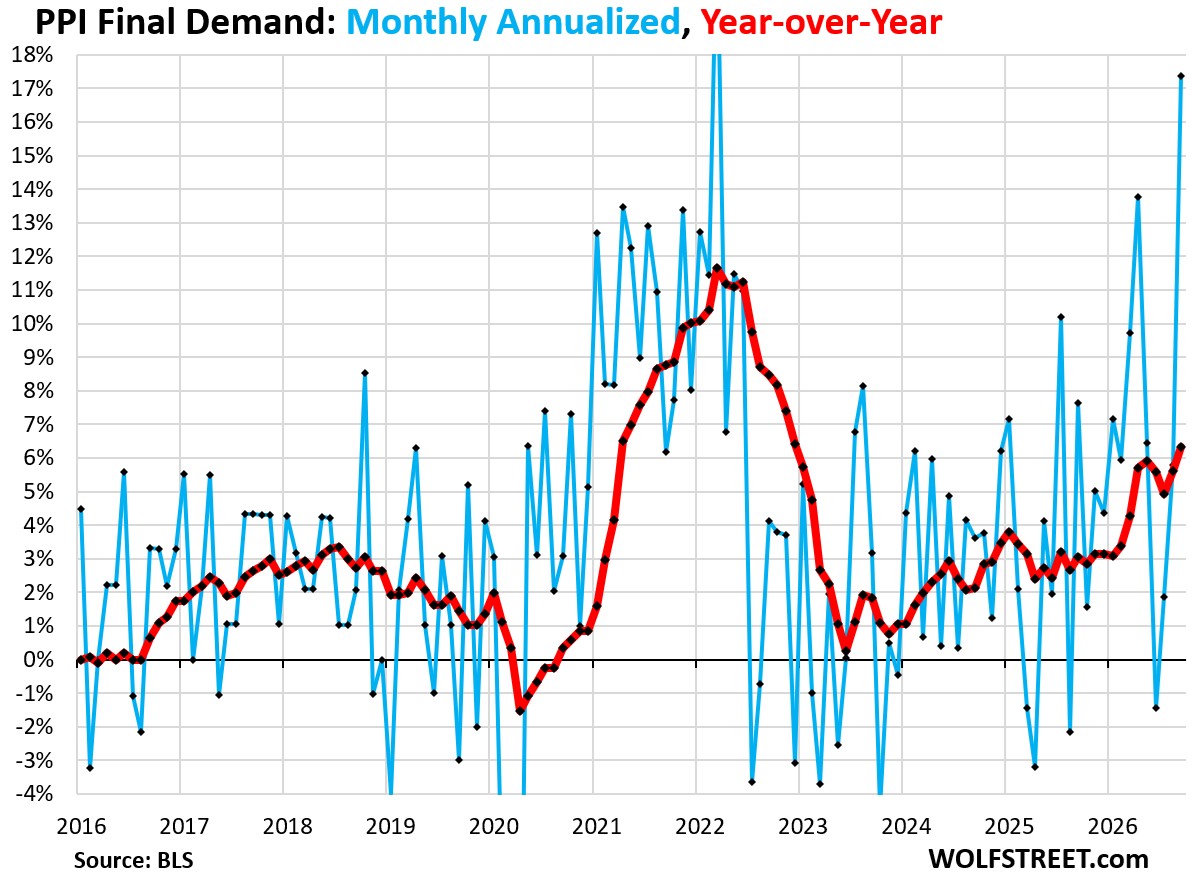
The PPI, which tracks inflation that businesses across the board face, already jumped by 6.3% year-over-year in September, the worst inflation that businesses have faced since December 2022. And the S&P flash PMI data today indicate that those inflation pressures still got worse in October.
Enjoy reading WOLF STREET and want to support it? You can donate. I appreciate it immensely. Click on the mug to find out how:


All right Wolf, fair enough – maybe NOT apocalypse now, but you know as well as the rest of us – the ‘running hot’ sectors are AI, data centers and warfare. Little to no benefit to most people, unless they work in those sectors.
Yes, that’s what’ll have to give first. But it’s not giving yet. And it might not give anytime soon. These companies are chockfull with cash that they’ve raised this year that they haven’t spent yet. they can stay away from the bond market for a while and let it settle down, before borrowing more, while they continue spending hand over fist the cash they already have, before they reload.
The hyperscalers are flush with cash, but many of the companies supplying and building out the data centers are taking on debt. The market is already repricing many of these companies already, debt or not. CAT for instance down about 30% from it’s high. There’s also the issue of not enough power for all these planned data centers, and that may be what triggers the hyperscalers to slow the build out.
I said: “These companies are chockfull with cash that they’ve raised this year that they haven’t spent yet.” The big ones have 10s of billions of unspent cash EACH. Even small-ish CoreWeave had $6 billion in cash at the end of Q2 and just now raised another $4 billion in cash. They’re sitting on gigantic amounts of cash that they can spend without having to borrow more.
I said: “Yes, that’s what’ll have to give first. But it’s not giving yet. And it might not give anytime soon. These companies are chockfull with cash that they’ve raised…
There are probably 1,000 stocks that are down 80% or more from their highs right now. I’ve been very bearish on stocks. But it will take a while before any AI bust hits the real economy. There is way too much cash at these companies, and they’re still raising more cash, and investors are still willing to fund it (see the $4 billion CoreWeave convertible note sale in late September), and they’re still spending it
So today the 10-year rose back to 5.0%. What actually is the bond market anticipating according to the bond the market, see the squiggles in the long-term chart?
Wolf, thanks as always for the clean data-based reporting. Do you think we are headed for a second round of 5%+ inflation? If so, what would it take to actually stop it?
My bet has been 3-5% consumer price inflation over the long term. This hasn’t changed. When consumer inflation gets closer to 5%, the Fed will crack down; when inflation gets closer to 3% or dips below 3%, the Fed will loosen. That’s what I see based on the past few years. Warsh could change that, but I doubt it. There is a lot of other inflation in the economy, such as facing companies (PPI), but that doesn’t always translate into consumer price inflation.
What about the 2% target?
The idea is to make everyone believe in it, so that inflation expectations remain anchored somewhere near that, maybe between 2-3%, and that has largely worked. “Inflation expectations” is pretty important concept for monetary policy makers.
It’s bullshit that the FED is doing this. They are stealing the fruits of everybody’s labor to give it to the pigmen.
We got 1 2 3 next week with interest rate decision, PCE and employment. Linear progression that will have huge outcomes with possible black Monday circuit breaker being triggered before Election Day Tuesday. The data is hot, the trend with overheating economy should continue. I am in the camp it takes 18 months for Fed interest rate moves to hit the economy, right now those cuts from last year are stoking the economy, stocks sure they anticipate Fed changes quickly, it takes time to move the economy with monetary policy in both directions. Have a good weekend!
Blown Debt covenants may stop companies from spending their cash on hand. We don’t know what the pool buyers agreed to, before buying public debt their could be debt covenants in separate contracts with debtor to unload the big dollar volume debt to big buyers of debt. Not sure what you would call it off balance sheet debt convents with your biggest creditors within the circular financial world. Or I may be delusional and this isn’t a thing. But my gut tells me Debt convents are being blown preventing entities from spending money at will. Hence Elon Musk rescue of Ellison with new capital. Larry has to or maybe loaded with DCs. Smart people want protection that they will get paid back!
bottom 1/2, 3/4 workers are NOT reaping wage increases
I’m getting ready to pull trigger on real estate addition(just 400SF)
got LABOR only bill of $56k-calc $150 hour, no materials, no mechanical stub outs
had discussion with wife and we both agreed that next year it would be even more for materials and labor so we’re pulling trigger
as it is I’m paying $1k week for general laborer doing routine maintenance
he said he’s paying $2k month for dumpy house(1200SF) in Tucson
lots of inflation both in labor and materials
This is purely an economical comment, Labor inflation will increase with every 70k workers per month or whatever the number is that we deport. Non-Accelerating Inflation Rate of Unemployment (NAIRU), “ The NAIRU is the lowest unemployment rate that can be sustained without causing wages growth and inflation to rise. It is a concept that helps us gauge how much ‘spare capacity’ there is in the economy.” ~ I’ve been commenting here for over year about the perfect storm will make it hard for the Fed to commit QE. UnEmployment rate will invert under the inflation rate due to NAIRU when that happens, if the Fed creates more inflations for the capital class, riots on the street like France would happen, We talked about golden handcuffs with low mortgages, the Fed will have Diamond handcuffs when the inversion of employment rate with inflation happens as a result from NAIRU. Post Covid Americans did t want to work, labor shortages were high inflation was spiking, I think Janet Yellen suggested to keep the southern border open to import workers (because Americans just didn’t want to return to work for basic jobs) to keep inflation down and rescue the capital class. The capital class will get haircut, no safe places to hide. Gold and silver are breaking down, gold at 2650 Oz I am buying because a participant here said Gold has no counterparty risk. Counterparty risk is in vogue again it’s just being discussed in private. When the talking kids on the media start talking about counterparty risk it’s too late!
That’s the businesses profiting like mad.
It’s happening everywhere in the trades.
The workers see none of the inflated amounts.
RE: ” consistent with GDP growing at a 5% annualized rate after a 4% expansion was signaled for the third quarter.”
But the St. Louis Fed Economic News Index: Real GDP Nowcast (STLENI)
Observations is now showing:
Q3 2026: ………………… 3.19220
Updated: Oct 23, 2026
Who’s Marlon Brando playing in your version? Michael Burry?
Good idea! I’ll ask him.
“The horror… The horror”
Is an alpocalopyse when the alps blow up? 😆
I was thinking, I can’t be the only one who read that as ALpocalypse and scratched their heads. Difference is I was thinking of Alpacas.. lol
Given the high inflationary conditions, why did the 10-year bond fall over 20 basis points over the last few days? Has the bond market started to see a steep stock market correction leading to some negative impact on the overall economy?
Lots of reasons. just look at a long-term chart. The move essentially disappears in a sea of bigger moves. It always moves. And it had surged a lot in a short time, and just looking at a chart, you could see that it would go the opposite way eventually for a while. There are lots of reasons for that phenomenon of volatility that have nothing to do with inflation.
No Wolf. As is widely discussed in the financial media, AI is the primary source of growth for the US economy. AI is in the short run, a cash burn machine with no proven model for profit growth. Token prices will collapse as China moves heavily into AI. Most AI growth models do not consider that the hyperscalers will have to constantly upgrade their chips.
The market is anticiapting a deflationary collapse in the US economy as the AI bubble bursts.
Or did you just invest way too much in AI stocks?
1. “AI is the primary source of growth for the US economy….” etc. etc.
Yes, agreed, been saying that for a long time.
2. “Or did you just invest way too much in AI stocks?”
No, as I discussed here, I’ve been buying at auction 10-year TIPS, 30-year TIPS, 10-year Treasury Notes, and this week the 20-year Treasury bond (5.47%). All of them gained value as yields dropped in recent days. But that’s not why I bought them.
I consider AI debt toxic, along with AI stocks. You buy them, if you want.
3. “The market is anticiapting a deflationary collapse in the US economy as the AI bubble bursts.”
🤣❤️ “deflationary collapse” 🤣
So today the 10-year rose back to 5.0%. What actually is the bond market anticipating according to the bond the market, see the squiggles in the long-term chart?
The last time rates fell so sharply was during the March 2023 failures of Silicon Valley Bank (SVB), Signature Bank, and later First Republic.
Nonsense. The 10-year yield has dropped by 31 basis points from closing high on Oct 5 to Oct 23.
It has dropped by:
39 basis points between Mar 27, 2025 and Apr 3, 2025 (in 5 trading days)
107 basis points between Apr 25, 2024 and Sep 16, 2024
121 basis points between Oct 23, 2023 and Dec 23, 2023
78 basis points between Mar 2, 2023 and Apr 4, 2023
Would you invest in US bonds if the IMF said the US government can not inflate it’s way out of its debt?
Perhaps we can grow our debt to GDP number like Japan did, 250 percent, before anything happen
s.
I expect inflation to be over 10 percent a year here before long. Plan accordingly.
Japan’s debt/GDP number is deceptive because their central bank owns assets worth almost 200% of their GDP. If you subtract their assets, this brings their “net” debt/GDP down to about 70% of GDP plus or minus. Additionally, the Japanese government acts like a sovereign wealth fund, borrowing from the Japanese people at low interest rates and using the funds to buy higher-yielding assets like US treasuries.
This is why Japan has not experienced high inflation or an interest rate spiral. They did not borrow money and distribute it into their economy; they borrowed money and invested it to earn a net margin. This is why Japan (like Switzerland) is deemed a lower credit risk than the US, UK, or other Western countries.
It also means the US will get into trouble long before we ever reach a debt/GDP of 250%, because there won’t be assets to back it.
Yes, but… the system finally ended up imploding the currency. All monetary sins ultimately lead to the currency.
So, under Powell the FED would review this hot data and call it transitory due to AI circle jerking, therefore not raise rates. Let’s all cross our fingers the new regime isn’t as naive.
It’s 2026, there is one inflationary shock after another. Just raise the damn rates.
New regime?
“Meet the old boss, same as the new boss.”
Plus, it’s a midterm election, so no matter how you look at it, new regime isn’t even a pretend possibility. Even worse, when politicians and ‘leaders’ aren’t even eligible for another term and their time is running out, they can completely let loose and go berserk, focusing only on serving, their own interests even more because they don’t have to attempt or pretend to cater to the wants and needs of their constituents and the general population.
Add to that, many of them being old to very old in age, they don’t seem to care about the consequences very much because they know they will not live long enough to suffer the most severe portion of the consequences of their poor ‘leadership’. Not all old people are like that, some actually care about other people besides themself or their small circle of clones. That is not the case for almost all the people in ‘leadership’ and politics in the United States. If they have children and grandchildren, many of them should be severely ashamed at the very least. Prison would be where many politicians would be for violating laws and other oaths, if the justice system served it’s purpose in a more equal sense, but many of the politicians and other people in power know that they are old enough that they can act like it’s unfair for them to go to prison and if they actually were to go to prison they would get released early or not be there very long before they die so it is worth it for the gains they made for their own life. Some older people do have genuine concern for those that will come after them.
Good luck with waiting for a less naive set of elected officials. They are not really naive, they are pawns and in it for themselves and their owners.
“You can wish in one hand and crap in the other and see which one fills up first.” (not a very profound quote, but still)
As for AI circle jerking, do you really think there is any potential politicians (including democrats) that will do a single thing different or make any change in regards to what is already going on, including stroking off the wanna-be techno-feudal lords who they used to kiss up to when they identified more with California liberal culture and money contributions to democrats?
Politics (both parties) is a wretched hive of scum and villainy. Just ask Obi-Wan Kenobi! :-)
Nice. Episode IV is the gift that keeps on giving. There are so many places where that line just works.
New regime?
“Meet the old boss, same as the new boss.”
You bet. Same as : “No matter who you vote for – you get John McCain.
Highest stock margin debt ever.
Prior to the Great Depression, key economic indicators included a booming stock market, rising consumer confidence, and increasing industrial production, but signs of instability emerged with unsustainable stock price increases and a tightening credit market. The stock market crash in October 1929 marked the beginning of the economic downturn.
Read below:
https://www.history.com/articles/1929-stock-market-crash-warning-signs
And what was not present in ’29 was the extreme political climate we now endure.
It’s not “Déjà Vu. Back then there were 12 central banks each one injecting or contracting credit without regard to what the other District Reserve banks were doing.
While there are some similarities to today, there are also important differences. That ‘s why I do not find analogues like these useful.
“With the rate hikes now underway, it’s indicating that it tries to prevent that process from spiraling out of control.”
FED sounds like a dude that stayed till last call, stumbled out to the parking lot, thought he couldn’t remember where he parked, then around 4am realizes his car is actually stolen.
Back in 1988 I went to a Bobby McGee’s restaurant/bar for a beer one Friday night. It was where all the 20 somethings went looking for love in all the wrong places. Well, when poor old lonesome me walked out to the parking lot to drive home, my truck was not there. I walked back in the restaurant and asked if they could call the police because my truck was stolen. They looked at me like I was drunk and said we’ll help you find your truck you probably just forgot where you parked it. So they drove me around the parking lot a few times and said okay let’s go call the police. The police show up and they said maybe you just forgot where you parked your truck. So, the police officer drove me around the parking lot a few times and then said okay I’ll file a report. So, the cop calls a taxi for me and leaves. The taxi shows up and I tell the driver my truck was stolen and I need a ride home. He says, you’re probably buzzed, lets take a drive around the parking lot :-). My truck was never recovered.
But what if you just forgot where you parked it, and it’s still out there?
Wolf, you struck a chord with the AI and Cyber In-security. It’s an invisible creature. Kinda like Martians, Communists, Socialists, Viruses but it’s really a new species of human kind that ultimately will dominate and allow homo sapiens to live like the apes we left in the jungle. What will our jungle look like?
Human brains simply don’t function. And it’s time to replace them with AI. Your comment is Exhibit A of that.
Your comment section is increasingly looking like MadLibs but with financial terms randomly filled in the blanks. Fed/IMF/Powell/repo/gold/Bretton Woods/inflation/deflation/stagflation/arglebargle.
Maybe they’re all just AI generated?
Not AI generated. But I think Apeman was being sarcastic, “aping” some of the stuff he saw in the comments.
I take such offense to your comment sir!
🎩 good day!
/s
Apparently (and this was in some publications recently including today) the interconnected nature of the AI financing is worrisome.
It’s a lot bigger than the dot com financing too and similar to the GFC the financing is coming from some dark places.
At first it was the large companies doing their own financing. Then companies they lent to then lended back to them. Now these secondary and tertiary companies are lending to others and vice versa.
There may also be large stockpiles of unused technology equipment filling warehouses. A byproduct of all the lending and everyone and their brother wanting to build a data center.
Think of the movie the big short but instead of AAA stamped credit default swaps, we’re playing jenga with data center loans.
The cascading damage could be huge.
The funny thing is they’ve raised the cash with this financing, but they haven’t spent it yet. They spent only a small portion of it. These companies are chockful with unspent cash.
And the “commitments” that are often tagged as “off-balance sheet debt”… do they have a 30-day cancellation clause? If yes, that’s not much of a commitment. What do we know about them? these are long complicated contracts.
So if that money doesn’t get spent, it’s not a debt issue, but a revenue issue for the receiving companies. That would blow up their stocks and the stock market, not the banks.
Financial Crisis = banking crisis. So where are the banks in this? They hold only small portions of this debt. Most of it is held by investors, such as bond holders, private credit, private equity, and other companies.
The Financial Crisis of 2006-2009 was about $10 trillion of mortgages held by banks.
When this pops, it’s going to crush equities primarily (and wipe out many companies as in the Dotcom Bust), AI-bond holders secondarily, with banks getting only scratched and dented.
The parallel is the Dotcom Bust (Nasdaq -78%), not the Financial Crisis.
Nice,
I was just watching a YouTuber I follow about investments. Now this guy is a strait laced Boglehead kind of guy. He was going over exactly what he’s invested in. And he’s a pro!
I couldn’t help but think how bad of a crushing his retirement is going to get, I mean I hope not for the guy’s sake. But whoa his portfolio is exposed to prob upwards of a 35%-55% haircut.
They always talk about that Boglehead steel stomach though. Can get thru anything. 🤷🏻♂️
Quick question? (And please excuse if the answer is obvious??
Anthropic and Open IA dont produce audited financial statements so how do we know there is all this cash unspent on their balance sheets? Also the likes of Google and Amazon have gone from huge amounts of free cash flow to selling bonds to raise cash
Thanks
1. I’m only talking about publicly traded companies, such as Alphabet, Meta, and SpaceX. Article coming shortly. I’m not including the cash that Anthropic, OpenAI, or any other startups have.
2. Even Anthropic and OpenAI produce audited financial statements, but they’re confidential and only for their investors. Investors demand them. They just don’t post them publicly.
So like any other bubble this will likely burst. I can’t think of a mania in recent history where we didn’t hit over supply. Dotcom, Shale Oil, Weed and now AI. All of these were things that were here to stay but they way overshot demand, which we will do again, because that’s capitalism. Compute is just another commodity the way weed, oil, and fiber were.
That being said it could be next year or it could be in another 5 years, it’s so hard to say.
The damage will be primarily to equities and AI companies at first, but will flow through to other industries like manufacturing, construction, investment banking. AI is driving a lot of economic growth. So that means recession, layoffs outside of just tech, housing price drops as the entire economy suffers. Then again, I hear recessions don’t happen anymore, the govt always steps in. So hard to say. Pretty sure any of the big AI companies would get bailed out in the interest of national security but shareholders may still get wiped out.
Compute is not a commodity. Tech CEO dorks have tried to publicly stroke themselves by turning a not so often used verb into a noun. Not to pick apart what you are saying because it makes enough sense, it’s more about the eccentric greedy salesmen disguised as nerds pushing their false reality onto the masses through language manipulation as one means of doing so.
Pointing out the fracking and weed busts is interesting, as ones to remember along with the other ones that get commonly mentioned and remembered. Does anyone have other busts to add to this to just keep in mind as a sort of bigger picture of relative events?
we are all 3d printing everything we need now man. except weed.
I think that I may have been a victim of brain siphoning.
It is though? You can get compute power anywhere agains prices in a transparant global market. If you have a IaC application or a website, you can host it in: AWS, GCP, Azure, Oracle, thousands of local parties, you can rent it, you can lease it, you can stall it in a co-location, you can buy it and put it in your attic. You can get a blockchain comprised of countless anonymous devices to do it. All of those compete in a price race to the bottom, provide the same core product, and you can change between providers at will. How is compute power not a commodity?
Ok, maybe the heaviest compute jobs, creating new neural language models by having it digest half of recorded history, is still a specialized good. But that’s really just because the sheer size of it, not because of a moat. Even that is being done enough to supply us with hundreds of available models competing for users. Not to mention the uncountable amounts of refined models people have been building for years now with their own training data improving a general models performance for their specific use case.
If 4% inflation is the plan, ST rates should be 1% above that, which they are. LT rates should be 2-3% above inflation to account for duration risk, so around 6-7%, but they are only at 5%.
Conclusion: Stay away from treasury bonds longer than 3 year maturity, unless you enjoy punishment.
Guess the market is under the impression that the Fed will keep inflation under control.
Regal Laugh 🤴 har harrr harrrr
Real interest rates have been going up.
https://fred.stlouisfed.org/series/REAINTRATREARAT10Y
I generally agree, but it has been six years since the last recession, so people looking ahead 5, 10, or 30 yeas seem to be looking ahead and thinking about the rate cuts that will happen someday.
I.e. if a recession is coming in the next 5 years, and rates will be cut 200bp during that recession, and stay there for the next 2 years, then the average short term rate could be lower than the <5% you could get in a 10 year treasury right now.
"Inflation is the plan" because policy makers and market makers are counting on a recession to erase the inflation. There is a risk that this plan turns out like the 1970s though.
“The parallel is the Dotcom Bust (Nasdaq -78%), not the Financial Crisis”.
Not even close Wolf. This isn’t Pet.com where there’s no money behind the website. These companies are absolutely loaded. There will undoubtedly be a crash (always is) but this is completely different animal than dotcom. Noone knows where the tentacles reach out what will ultimately be affected.
You don’t know nada about the dotcom bust. It took down HUGE telecom companies, including Lucent and WorldCom. It crushed huge stocks like CISCO (stock with the largest market at the time, today’s Nvidia), Intel, etc. Stocks of companies like Dell plunged. Amazon was reduced to nearly a penny stock. The Nasdaq plunged 78%, and it wasn’t pet.com that did that, you goofball. Why do you feel compelled to argue about stuff you’re so clueless about?
If only they had discovered Bernanke’s magic QE elixir a little sooner….
Wolf, I just read on Google that
“San Francisco has the most billionaires of any city in California, according to data from Forbes.”
Are you one of them? 😁😁
In inflation-adjusted 1913 dollars?
In Zimbabwe dollars.
(sips from Champaigne glass of water)
Wolf’s AI generated peasants are always trying to escape over the Wall!
Lol
As Milton Friedman said: “inflation is like alcoholism”. “In both cases…the good effects come first, the bad effects only come later.”
Unfortunately, there’s an important point left out of that: for who?
In the case of alcoholism it’s the same person experiencing the good effects and bad effects so there’s the possibility of a feedback effect to change behavior. In the case of inflation the assassins and the victims are not the same people. Unaligned incentives.
The Fed Chair must testify twice a year before Congress under the Humphrey–Hawkins Act of 1978. I’m sure their trying to perform their best.
Voters have been consistently choosing this path for 50 years, so if you mean to blame policymakers, I disagree. They are merely the proxies of the people’s wishes.
However, some of the voters who have been choosing this path for 50 years are exiting the world of the living, having suffered none of the ill consequences of their choices. Their kids and the next generation will pay the price, though.
Boomers and GenX will be cursed by the people who end up paying our bills. They should cut our Social Security and leave us eating dog food out of spite.
We’re in the daddy beats mommy phase.
Just before the dot com bust I remember a fellow employee tell me that they just bought some stock. I had not been following the stock market at all at the time, but I decided to look up the average NASDAQ PE ratio. It was insane! I went back and looked the fellow employee straight in the eye and said Sell! Like Yesterday! A month later it went south big time. PE ratios are somewhat high today, but not at all like back then. When any of the following become extreme, it s time to watch out: Inflation and rapidly increasing interest rates, rising stock and real estate valuations, commodity spikes, over leveraging, and plain old fear(the pandemic). Right now I do not see any of those things being extreme. Concerning maybe, but not extreme. Right now I think people are worried about the politics of the left vs Trump following the midterms. But Trump and the mayor of New York seem to be getting along, so maybe Trump and a democratic congress will get along too somehow after all. Trump sure likes to bad mouth people, but then ends up shaking their hand. Actually kind of funny, in a way.
We’re all socialists now. The main difference is whether one embraces the label or rails against it.
No pain for the rich only the sub-middle class.Oh wait what sub-middle class? It was here a minute ago or maybe 5 decades ago.It will take another 5 decades to rebuild ,if ever.
What is the sub middle class? Seems like a way to not use the term “low”
I got a notice from my health insurance yesterday with a price increase of 33% for 2027.
did you also have a big birthday recently (or soon), such as 50, 55, or 60? When you move into these higher age categories, heath insurance premiums explode. But age-related premium increases are not inflation; they’re part of the risk-based private health insurance system.
Nope, my wife and I have already been through the a few age related step ups and still have more to go before Medicare. Health insurance is my biggest expense. In fact insurance as a whole (health, home and auto), eat up the majority of my budget.
With homeowners’ insurance, I always found that if I switched plans every 3 years or so, I could save about 25%. I wonder if health insurance works the same way.
Yeah I had that last year and apparently they are going to do it again this year.
10k+ gone because so many people were dropped off the rolls.
Prob another 5k+ this year.
But if I was in a car wreck this is the only way not to go bankrupt. Any other health insurance would not cover that or when you travel around the U.S., would not cover that if also in a car wreck, plane wreck, heart attack, etc.
Some of these employee plans at your local hospital system just suck. They don’t follow you around the country or even your own state.
“Sir you better get sick here, in this city!”
I’m in New Mexico where the state picked up the tab on the expired subsidies, but there is a lot of over billing to pya for those without insurance. I saw this with a visit to the ER this summer. Also, my wife has insurance in Taiwan, and we didn’t cover her for a couple years in the US. Costs are 50% cheaper without insurance.
Inflation sucks…
Especially in vehicle parts and services.
My own personal records/receipts of spending show 50% increase in the last year or two. It is way more over the last 5 years.
Vehicle parts are soaring painfully high…. And I do the majority of my own repairs and services…
I am hit hard… the average person who takes everything to the shop… hit way harder.
Partially due to Tariff stuff maybe…most parts are made over seas and such, so there is that.
All part of “you will own nothing and be happy.” The billionaires don’t want the plebs to be able to afford to drive anymore, or travel period. They want all the nice places to themselves. The easiest way to accomplish this is to make things so expensive that people don’t have the means to travel. Enjoy your 15 minute cities, coming right up.
No, because if people cannot afford to buy those things and services and vacations anymore, the billionaires are going to lose their billions because everything will crash.
Dr. Lawrence H. White, a senior fellow at the Cato Institution wrote about duration risk in the borrow short to lend longer, savings-investment paradigm: “in 1979-1981 it rendered insolvent about two-thirds of US thrift institutions (FSLIC, NCUSIF, insured), who were financing 30-year fixed-rate mortgages with 1- and 2-year deposits”.
Today, financing is largely through bond-backed securities. There must be a lot of bond holders underwater with households now not moving around very much or asking for refinancing.
I would argue that aluminium is an energy dependend resource, too. It is refined with electricity, either from Bauxit or recycled.
Thus aluminium production is located where cheap and abundand electricity is available, historical in tandem with hydropower. Today China is faraway no.1 but for the european market Iceland and Norway are the main producers.
I don’t know how much aluminium is currently exported through Schrödingers Straight, as most news/ analysts focus on crude and product, but it is one of the ways the gulf countries export their “energy” with more value added. Just like fertilzer, Helium, and other very energy intensive production.