
But 5% was considered normal to low in the decades before the Fed’s financial repression kicked off in 2008.
By Wolf Richter for WOLF STREET.
The 10-year Treasury yield rose to 5.01% this morning, briefly, before backtracking a few basis points, the highest since October 23, 2023, when it had spiked to 5.02% for a few moments, before plunging. And beyond that, the highest yields since 2007.
Today, the 5% yield is made out to be a big deal because after 14 years of the Fed’s financial repression, during which it purchased trillions of dollars in Treasury securities and MBS with newly created money, it seems very high. But before financial repression kicked off in 2008, a 10-year yield of 5% was normal to low.
So now that the 10-year yield tested the 5% again, will it re-open the floodgates of demand, as 5% had done last time? Or will it have staying power and stick around 5%? Hourly chart via Investing.com:
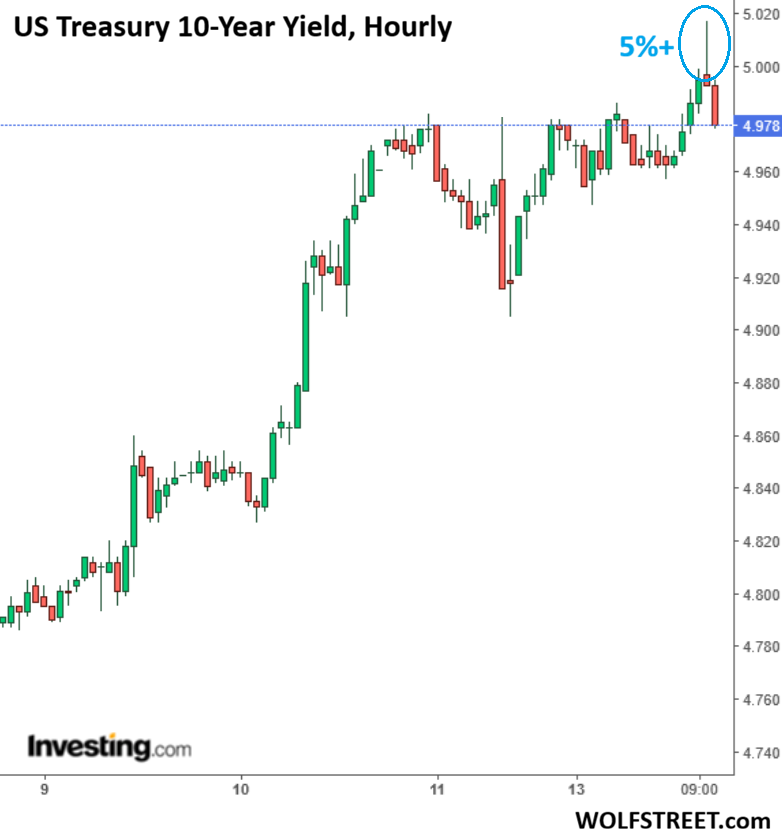
The last time it hit 5.02% for a few moments was on October 23, 2023, after a majestic six-month 170 basis-point surge that was too fast too soon, and the floodgates of demand opened at this yield, while sellers stopped selling, and near instantly the yield began to plunge, by 19 basis points intraday to 4.83%, and by over 120 basis points by yearend to 3.79%.
That’s how that first run at 5% since 2007 ended. Here is the hourly spectacle on October 23, 2023:
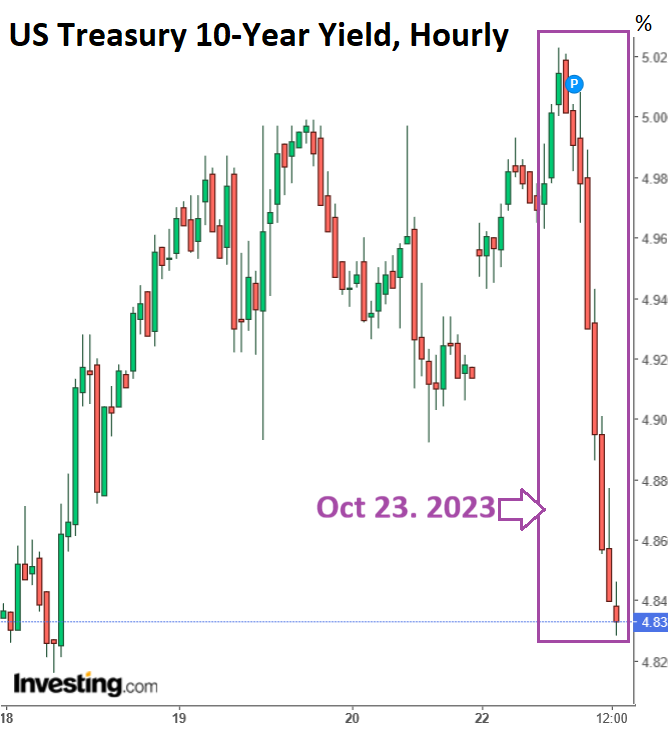
So we’re glued to our screens watching this breathless drama of the basis points. Will the floodgates of demand open again? Or will investors just nibble enough for a day or two to dent the yield by a few basis points, before the yield rises beyond 5.0% as new investors demand higher yields to be drawn in?
But that 5% is not high when compared to periods before the Fed’s financial repression wrecked the bond market.
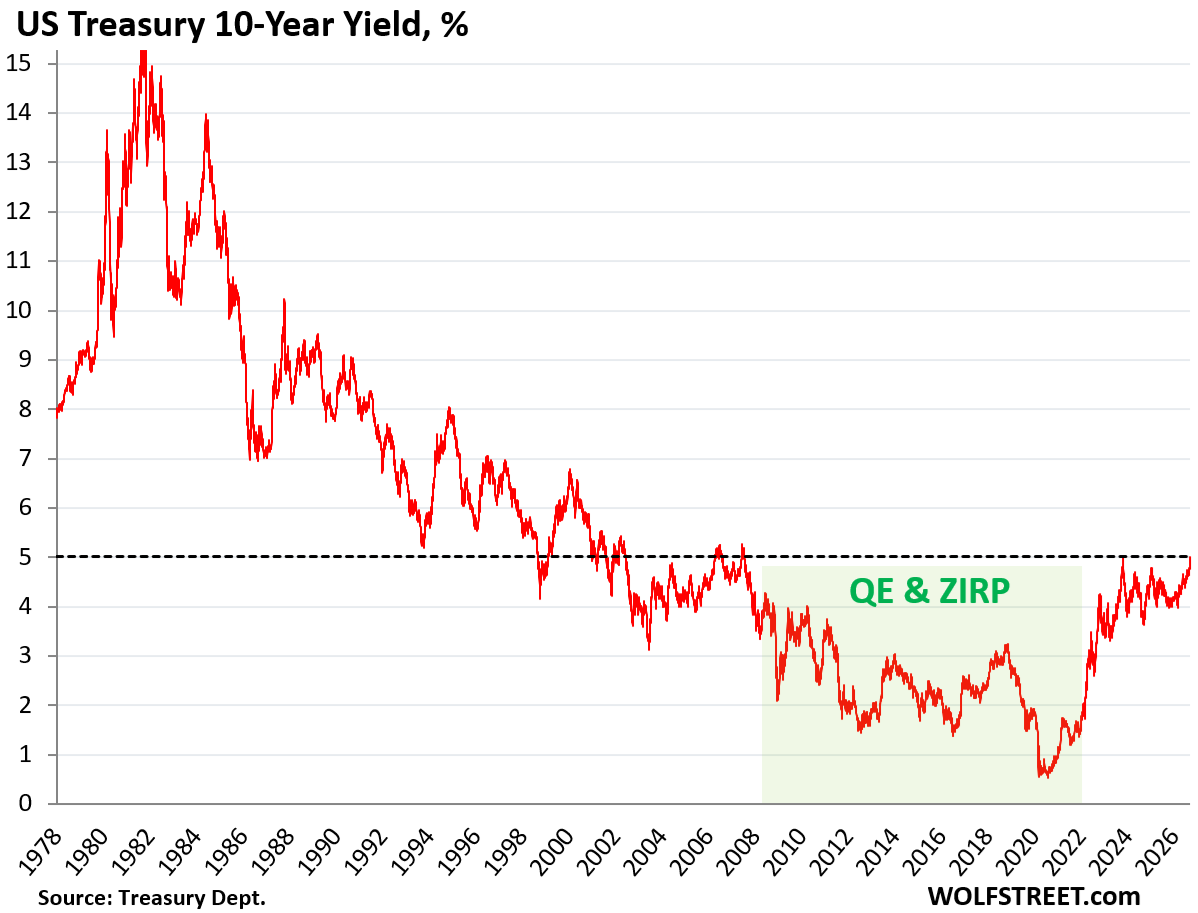
In case you missed it: The economy did fine with a 10-year yield of 5-8%, including in the 1990s, amid a tight labor market and lots of economic growth. Read: The 10-Year Treasury Yield over 5%? Some Thoughts
Enjoy reading WOLF STREET and want to support it? You can donate. I appreciate it immensely. Click on the mug to find out how:


Yep, only taken 14 years to correct Bernankes theories.
The bind market should get a Nobel Prize for common sense.
I wonder if the Nobel prize committee can
demand their prize back from Bernanke ?
They gave one to Krugman, too.
The value of that Nobel prize has been inflated away.
FUNNY!
Mr. Ben “The Fed will never monetize the debt” Bernanke needs to be tried for treason. The Fed has enabled the corporate owners and their political puppets to behave badly and rob the treasury and the average American’s purchasing power for far too long.
Is it really a “market” if The Fed or proxies of The Fed are doing all the buying? I don’t think so. The producers make the rules on this rock. That, and the golden rule, is all you ever need to know.
With inflation so close to 4%, the ten year yield should be at least 6%.
That last chart looks like it can go 7%, and even 8% in short order. The real inflation is probably 8%, until they phd it down to 3%.
First time seeing “phd” used as a verb. That’s gonna stick with me. 😂
Ahh yes the villainizing of smart people by dumb people. It always ends up doing wonderful things that lots of trials ultimately fix.
/s
sufferin,
Just bc you are on the Dunning-Kruger spectrum does not mean everyone is dumb all of a sudden.
Amen, but the yield must be made even lower if the government is to meet its budget commitments without printing even more money and causing more inflation. Thus, it is a spiral of debt.
If you think that the alternative of holding gold in guarantor-style gold ETFs is safe (other ETFs are laughingly more unsafe):
Discretionary “Sub-Custodians” and Alternative Vaults.
Even when gold is allocated, the agreements allow the main custodian banks to hold the gold outside of their own primary vaults at their sole discretion. How it works: The prospectuses permit the primary custodians to utilize sub-custodians (such as bullion clearing banks). When sub-custodians are used, the gold is kept in their respective vaults, not the primary vault. A major point of legal friction in the fine print is that the trustee’s ability to audit these sub-custodians is severely limited. The trust has no direct contractual relationship with sub-custodians, meaning gold can be legally held in an entirely different, undisclosed vault location under third-party management.
The “In-Transit” Gold Clause. When gold is being moved between sub-custodians, or being transferred to cover trust fees, it leaves the secure allocated vaulting system completely.How it works: Gold bars must occasionally be physically relocated, or fractional parts of bars must be liquidated to pay the sponsor’s management fees.The Fine Print: During the periods when gold is “in transit,” it does not sit inside the vault, and it is not covered by the custodian’s primary vault security terms. During these operational windows, the trust carries counterparty transit risk, holding a legal entitlement to a shipment rather than a secured asset in a vault.
In other words, what you hold, if any sub-custodian proves to be less than trustworthy or solvent, is their worthless IOU.
LMAO
Remember how Jerome had to put out a statement like he was being held h0stage? Perhaps this is now Kevin’s way of going around it to let the market show its hand first what the Fed then already have do have done automagically.
Yea the LT bond market is overdue for a yield correction / bond rally.
The thing to notice in Wolf’s zig zag charts is that the line never goes one direction for ever. DO NOT commit the extrapolation fallacy.
I’m looking hard at locking in a few perpetual preferred stocks, which have been beaten down by rising treasury yields and act a bit like long-duration corporate bonds. For example, OZKAP now yields 7.5%. Its price could pop upward very hard if the FOMC hikes rates tomorrow and shows it is serious about inflation. But if the Fed’s message is “we’re all talk” then there’s no limit to how high rates could go or how low preferred stock prices could go!
Don’t get too comfortable with prefs. They sit in an odd place in the capital stack. More often than not you’re better off with actual bonds instead, unless it’s PBR A of course.
Sure, bonds are “safer” in a bankruptcy. But perfs pull a higher rate, QDI tax benefits so you get to keep more, and the certainty that you’ll eventually get paid after a rough patch if you buy the cumulatives. Reward comes with some risk. Other than bankruptcy pecking order, are there other ways you’re better off with actual bonds?
Grab your popcorn. It would be interesting to see Bessent on phone calls today reminding the CEOs of banks he is the house and in charge today.
I think mainly he’s a Yeller.
You’ve got 2-3 types of bankers
1. Your strategist banker.
2. Your Yeller banker.
3. Your Fat banker.
😂
Hey Wolf,
Fairly new to the financial world, but I recall picking up a bunch of I-bonds during the covid years. Would we expect I bonds to be a good purchase given the increase in the treasury yield?
Thanks!
Kristi
I-Bonds are going to preserve wealth via the inflation rate. The fixed rate is really the only “gain.” At the start of covid the fixed rate was 0%. The fixed rate went up to 1.3% later, but I think has dipped a fraction now. It may go up slightly now.
I would roll anything that has a 0% fixed rate into a new version with a higher fixed rate, especially if they are 5 years old.
I hold a pile, but overall my view is they are pretty depressing product being tied into inflation.
The fixed rate is 0.9% right now, but it might go to 1.3% in November.
https://tipswatch.com/2026/08/09/the-i-bonds-fixed-rate-is-going-higher-but-how-much/
The fixed rate tends to track 65% of the 5-year TIPS real yield averaged over the 6 months prior to a rate reset.
The real problem with TIPS is that they have a fake index: When inflation is 5%, they pretend that inflation is 2%.
Honestly valued TIPS might be a good idea, but as long as they are faking the inflation adjustment numbers, TIPS are not a good option.
Wolf, what do you think about the theory that the Fed/Treasury are in alignment on a plan to essentially lower bank reserve ratios in order to spur more lending and purchasing of treasury debt?
Citrini Research writes about it here:
https://www.citriniresearch.com/p/macro-memo-regime-change
Of course, the plan comes with a higher risk of a GFC-style banking meltdown. Perceptions of that risk probably come down to one’s politics.
So the post you linked is a little late. Reserves are already down by $2.3 trillion. That’s the purpose of QT, to bring reserves down, and it did. But it didn’t spur bank lending.
And yes, in terms of the Fed and Treasury shifting to T-bills, but that’s not new, the Fed has already been buying T-bills to replace long-term MBS since December at a rate of $17 billion a month, and it has been discussing for two years replacing at least some of its $4 trillion of long-term Treasury bonds and notes with T-bills, but there aren’t enough T-bills out there now to do that. Warsh and Bessent have already discussed increasing the supply of T-bills so that the Fed can buy a couple of trillion over the next few years and shed a couple of trillion of notes and bonds and let the market absorb them.
1. What the Fed is doing is a reverse operation twist which pushes up long-term yields. Warsh has a taskforce that is working on the composition of the balance sheet, and it will make recommendations later this year, which the FOMC will discuss and vote on.
2. What Treasury would do by shifting issuance to T-bills is to counteract some of the Fed’s shedding of notes and bonds. But Treasury also has to finance $2.2 trillion of new deficits every year, so it has to increase the debt by $2.2 trillion a year. And some of that increase will come from notes and bonds, and some will come from T-bills, so the supply of both will increase, but the supply of T-bills will increase faster.
The article you linked summarized:
“The result is a smaller balance sheet, lower coupons, and greater private sector growth.”
I can see a “smaller balance sheet” (we’ve been talking about it here since Warsh showed up) and possibly “greater private sector growth,” though that’s not necessarily linked to bank lending and might not happen.
I can’t see “lower coupons” (interest rates at auctions of notes and bonds) for a couple of reasons:
— The Fed, the single biggest investor in the bond market, is shedding notes and bonds in addition to MBS, and the Fed getting out of the bond market like that is a big thing, and Treasury will have its hands full trying to counter it.
— Treasury will still have to increase the supply of notes and bonds because see #2 above.
Ultimately, it depends on where investors think they should put their money. They might like T-bills better than 10-year notes at these yields, and 10-year yields might have to be 200 basis points higher than T-bill yields over the longer term to be attractive.
What the Fed might be doing – reverting to T-bills and reducing the balance sheet – would be a good thing. And it would require the cooperation at Treasury to supply those T-bills.
Obviously, Treasury could destabilize the bond market by relying too much on T-bills, thereby turning much of the government’s fixed rate debt into variable rate debt, and that could come to haunt the government when inflation is high, and short-term interest rates spike, and it could hamper the government’s efforts to “inflate away” the debt.
Thanks, Wolf.
A lot of those outcomes are being sold as secondary effects of the primary thing they want to do, which is lowering bank reserve ratios. The article cites $500B to $1T of additional bank lending/treasury buying that would be possible if the reserve ratio was lowered, by counting assets that were previously not counted toward collateral at the Fed’s discount window.
In Econ 101, we learned that changing reserve ratios are the strongest medicine, followed by QE/QT, with interest rate tweaks being the fine tuning. Lowering the reserve ratio would be pro-inflationary and stimulative. But it would also come with additional risks – which is why RR’s were raised after the Global Financial Crisis in the first place.
What are your thoughts on the riskiness of doing this?
Banks have the capacity to lend a lot more today than their current loan book. But there isn’t enough demand for bank loans. My little company is getting hounded by my bank and by other banks to get a line of credit or a term loan. Every bank is aggressively marketing loans. Banks are far from tapped out on their lending power — that hasn’t been an issue in many many years.
In terms of business lending, banks lend only to lower-risk customers on good collateral. The riskier stuff gets shuffled off to investors, as we have seen with CMBS. And the bond market is lending unsecured without collateral. So there is a lot of competition from the bond market. In addition, there is a lot of competition from private credit for riskier loans.
But there just isn’t that much demand for bank loans. I mean, even consumers have $4.3 trillion in unused credit available on their credit cards and aren’t using it. There just isn’t that much demand for borrowing in the private sector.
Obviously, if T-bill yields are higher than the Fed’s interest rate on reserve balances, banks might shift some cash from reserves to T-bills. That would help the Fed because it wouldn’t have to pay interest on that amount and it would lower its interest on reserve balances. But that’s not stimulating private sector lending.
For private sector lending to pick up, there has to be more demand for bank loans – there’s already lots of supply. What’s missing is more demand. But part of that demand has gone to the bond market and to private credit.
Thanks Wolf, that’s very interesting. It coincides with what I’ve heard about bank lending from others. They want perfect credit and massive earnings to loan you lunch money at 10%, and they work hard selling that loan!
So perhaps the goal of loosening reserve requirements – if that is the policy – is simply to:
a) juice the economy,
b) create demand for US treasuries, or
c) increase funding for AI ventures, a cause championed by the president.
Regarding b), I suppose looser RR’s could cause banks to hold less uninvested cash but I can’t imagine it would be enough to be a policy priority. Maybe I’m wrong.
“For private sector lending to pick up, there has to be more demand for bank loans – there’s already lots of supply. What’s missing is more demand. But part of that demand has gone to the bond market and to private credit.”
This seems to be a key point. Does limited bank loan demand matter? I can see why it might, but also the risk is not longer with the TBTF banks, but does it matter that those risks are being taken by non-bank investors?
Any thoughts on a theory going around that they’ll use the GENIUS act in order to get much more demand in t bills?
IE – companies and the US gov make stable coins (backed by treasuries) and offer people yields on their money as a bonus. I know some companies have already come out with their stable coin- like the JPM coin.
If they make it easy to spend these coins – like through Apple wallet transactions – then even people from outside the US will use them.. driving demand for treasuries higher.
Then there’s the conspiracy theorists who believe you’ll wake up one day and your bank account is empty with news saying AI has hacked the banking system – they’ll repay your money but in the USD coin. This will force people to use them.
🤷♂️
I’d say it’s Crypto BS. Outside of the crypto ecosystem and money laundering, there is no use for stablecoins in the US. There are about $300 billion in total stablecoins out there globally, UNCHANGED from a year ago. No growth at all.
The crypto gamblers have switched to the prediction markets.
Don’t worry guys, Trump says we always have the option of using the military on the bond market. He probably has an airstrike inbound on the 10-year as we speak. That should knock it right back down.
Don’t forget the $5,000 we’re all going to get, too. We can all buy long dated Treasuries with that and do our own individual parts to keep interest rates low!
/s
Trump just declared a $5,000 dividend!
rates to da moon to pay for the scam!
should we counter-offer for $8,000 ?
These amounts are close to the amounts spent on advertising per swing voter in swing districts.
+25bps all but a certainty.
QT was a better option IMO.
“The economy did fine with a 10-year yield of 5-8%, including in the 1990s, amid a tight labor market and lots of economic growth.”
And up until Q2 2008, the debt to GDP ratio never exceeded 65% during the previous 15 years. We’re approaching 2X that nowadays. So the issue isn’t the interest rate. Rather, it’s the interest expense as yields march higher.
And it’s having a dysfunctional Congress make meaningful changes to the trajectory of our annual deficits & how AI job losses over the next 5 years are going to be handled, relative to tax revenue.
During the GR, tax receipts plunged 33% per FRED. Everyone I know expects the next recession to at least meet or exceed the GR, so a 50% plunge in receipts might not be out of the question.
No, I don’t think this economy can stand 5-8% 10YT yields. That’s wildly, wishful thinking, IMHO.
Social security COLA is expected to come in at 3.6% that is a full percentage above the mean of 2.6%(from memory don’t yell at me if I am mistaken by a tenth or two). I don’t use AI…Cola is the proof in the pudding that the Fed is behind on its job. If the Fed was doing its job, less risk in the $tnx, 10 year ust bond is still the best bond for liquidity in a bad neighborhood, people would have more faith that when capital is returned it’s not with a inflation haircut(it’s in the Fed court to raise rates) I am buyer 5.3, or in that neighborhood. Municipal bonds are at the 2011muni bond crisis level. If you have high income and tax rate that’s attractive! I believe the price of Diesel is now correlated to $tnx yield. Higher Diesel prices higher yield. Diesel prices is new the inflationary fuel!
And that’s with the BLS mucking with OER & healthcare CPI which Wolf has repeatedly pointed out are wildly inaccurate yet make up about 42% of CPI.
The 10-year yield hit 5% twice today. So it’s not going straight down like it did in October 2023.
Has anyone noticed that Walmart is rolling out little battery powered LCD screen price tags?
Press a button & prices rise within seconds all across the country with little to no labor involved.
My Sam’s cola just got a 16% price hike.
Legitimately not a conspiracy theory but that is AI surveillance pricing. It monitors your body language and shopping habits with facial/biometric recognition to change prices dynamically to maximize profits from customers.
IIRC some New England state was trying to make this illegal. AI supersurveillance nightmare here we come! Why do you think AI Datacenters are fueling the economic growth nearly single handedly these days?
Equating electronic shelf labels with surveilance pricing is quite the conspiracy though…
ESL have been around for +/- 30 years now and are commonplace in many countries. Its designed to reduce labour costs on price mgmt. and inventory mgmt. It does enable retailers to leverage dynamic pricing, which is neat in this day and age of tiktok hypes.
AI surveilance pricing exists, however it’s rather niche and it’ll quickly become illegal. Besides customers have great pricing insights online these days. It’s not relevant for Walmart at all, as customers would simply not accept paying a higher price than the next person in line with the same groceries. Might be relevant in high end shops with luxury products where you are the only customer in the store. Or online of course, neither of which has any connection with LCD prize tags.
Push the button to hike the price = sales collapse. People hate getting ripped off and search for deals. Walmart knows that.
I guess that’s possible.
But for damn sure, it’s going to make it a lot easier for them to raise prices.
As for my Sam’s Cola, this looks a like what happened four years ago with the GV Steak Sauce. $1 to $2.78 in about two years.
That’s 178% increase, all because it WAS priced so much lower than A1.
I’ve heard that theory about the digital tags.
So tell me, if I grab a shower curtain off the Walmart shelf and the tag says $7.58 when I buy it, then a few minutes later someone else with different body language sees $6.81, when we both get to the register does it remember us individually?
What stops me from saying “hey this was $5.12 on the shelf tag” when I pay up front?
In any case I need to learn which arm motions and facial expressions make me look the poorest so those AI tags will feel bad and cut me a break.
We already see dynamic pricing in many forms of purchases. From Amazon to plane tickets to literally in brick and mortar with this very technology. This isn’t some future prognostication. Additionally, I don’t know about anyone else but I’m not looking over the shoulder of the person in the checkout line comparing prices on a notepad to see if I’m being ripped off. With modern screens you can easily shield the view angle and watch peoples eyes to see if they are looking at the price tag and obfuscate it from someone nearby like how modern phones do. You can tag groups together so that associated individuals all see the same price. Asking random strangers what their price is versis yours is unlikely. To that end, what are you going to do anyways? Refuse to buy groceries? Just needs a critical mass of retailers opting in and “We can’t regulate AI!” And you’re golden if you’re big business.
We are in a hyper-capitalist world. It’s laughable to think Walmart wouldn’t implement this technology to maximize profits. I refuse to even shop at their shit holes because they have 4 self checkouts open with a 20 minute line for a 5 acre retail warehouse.
It is so irritating how many people have their head in the sand about what is coming. AI becoming sentient and killing all of humanity is a best realistic case scenario at this point. The real threat of AI is the surveillance state integrated with AI analysis monitoring everything and everyone. The handful of billionaires at the top will become trillionaires with weaponized drones to quell any dissention while granting all of us chatel freedom from freedom. The singularity is still a futurist sci-fi concept. A weaponized surveillance state is not.
I don’t fear the robots. I fear little men with god like power.
Dynamic pricing exists, is legal, and commonplace. Has been for a long time. It’s the price action in real time, 100% capitalism baby. Supply constraint on a specific type of car lubricant? Np, dynamic price increase to raise margins and keep that shelf from becoming all empty. Oversupply of baby diapers threatening to choke your diaper warehouse because Tiktok told people you can get Autism from them, no problem honey, dynamic price decrease and see the Autism fears melt away.
Then there’s online tracking, also real, not entirely legal in some cases. Your data is being scraped and sold to the highest bidder, the cookies (brilliant name, hard to get angry at cookies) on your own foldable $3000 IPhone betray you and the ticket you saw yesterday now has a different price on those price-comparison websites. Annoying as F, true, but solved easily by clearing your cache, using incognito or a VPN.
Then, and this is what you were suggesting, there is Surveilance Pricing. This is next level. This requires a store to hang camera’s at the entrance that feed into an identification system which in miliseconds, using AI to either perform facial recognition and match that to an online database that scrapes all your photo’s from social media and builds a profile, using your LinkedIn to check where you work and how much you or your spouse makes, or performs image analysis to match your clothes / posture etc to a customer profile which estimates how much you’re likely to spend. This then generates a report which is send to the salesperson in the store to inform him what kind of car or watch or whatever else mind of high-end product he should try and sell you. These are the kinds of places that probably didn’t have price tags to begin with.
If you think Walmart is making the price of your mayonaise higher because they scanned your eye movements… idk what to tell you other than take care and maybe take a break from the internet for a while.
You prob can check the walmart app before you go in,
Write down the prices or just commit to a memory. Double check your receipt.
I really doubt walmart is trying to scam anyone, it’s just they prob wanted to get rid of the person who manually changes prices, which leads to human error and price mismatches.
Some targets will have higher prices at diff stores, but if the website is less they will give you the difference back via chat on their site.
If the goal of gov is to ensure stocks go up forever and they have the means to do it, why would anyone buy treasuries if you’re guaranteed 10% per year? 5% is anemic in this new world.
Why? Because they don’t always do that.
I just posted this in my new article about money market funds, CDs, and T-bills:
https://wolfstreet.com/2026/09/14/money-market-funds-cds-americans-pile-on-low-risk-investments-despite-so-so-yields-higher-inflation/
Stock prices have pulled far ahead of inflation so far in this cycle, but the risks are big, and long sell-offs are not uncommon, and then those capital losses are made worse by the loss of purchasing power due to inflation.
The S&P 500 plunged by 50% and the Nasdaq Composite by 78% during the Dotcom Bust from their March 2000 highs. They plunged again by 50% during the Financial Crisis through March 2009.
It took the Nasdaq till 2015 to get back to its March 2000 high – after 15 years that included lots of money printing by the Fed.
But over those 15 years, there was 39% CPI inflation, so in “real” terms (adjusted for inflation), the Nasdaq was still down by 39% in 2015 from the March 2000 high.
In 2018, when the Nasdaq had just broken even in “real” terms with March 2000, there was another sell-off that pushed the Nasdaq back into the negative, adjusted for 47% inflation since March 2000.
Then came the covid crash that knocked the Nasdaq back into the negative in real terms, adjusted for 51% inflation since March 2000.
It wasn’t until April 2020, that the Nasdaq soared past its inflation-adjusted March 2000 high. It took 20 years in real terms!
But then over the past 6 years, the gains, adjusted for inflation, were huge. That is the interplay of “risk” and “inflation.”
energy inflation is not so transitory this time around. I think bills and bonds break out and up in yield this time.
Zen are you being serious?
Dude you’re going to sell when your stuff gets cut in half man.
The big Wall Street brokers are just waiting for you to sell to them when S… hits the fan.
You need to read Talib’s book and look up everything on Harry Markowitz Pronto!
Also The 10 year tips looks mighty tempting.
But I don’t buy bonds out that far.
Still, it’s a reissue of the last really good auction, that had low demand.
The floodgates of demand? Haha. How about 7-10% yield. That way, people MAY line up to buy like they would at a gourmet donut shop that opens its doors at 6 AM. 5% is barely treading water.
*Taleb’s*
Black Swan Events